PHYSICOCHEMICAL CHARACTERIZATION AND TECHNOLOGICAL VALORIZATION
OF PYTHON FAT (
1,2,3,*
Moussounga, J.E.,
1,2,3Dzondo Gadet, M.,
4Zassi-Boulou, A. G.,
1
Laboratoire de Bioprocédés Alimentaires et Médicaux, UMNG
2Centre de Recherche et d’Initiation des Projets de Technolo
et Technologique, Brazzaville Congo
3
Ecole Nationale Supérieur Polytechnique (ENSP), UMNG
4
Unité de Recherche sur les Ressources Herpétologiques IRSEN, Brazzaville Congo
5Laboratoire d’Ingénierie et Biomolécules, ENSAIA
ARTICLE INFO ABSTRACT
In order to enhance the
joint pain, etc., in the Congolese traditional medicine, we realized a physicochemical characterization of this fat. Studied fats come from three locations: Dolisie, Kindamba and Brazzavill
acid vary between 2,38 and 127,6%, the rate of oxidation of our samples is between 0,28 and 5,75 meq. O
shows a high level of creation of the order of
54.15% MUFA and 6,65% PUFA. The main components being (49.47%) oleic acid, Palmitic acid (28,51%), stearic acid (9.38%) and linoleic acid (5.85%). The viscosity of our samples varies between 65.88 and 94
ingredients was created, whose virtues have potential: antimicrobial, analgesic and anti
Copyright © 2018, Moussounga et al. This is an open access distribution, and reproduction in any medium, provided
INTRODUCTION
In recent years, food fats suffer trends in today's societies (cult of thinness, diets...) and thus their tarnished image. Indeed, the fat consumption is increasingly the object of an alarming situation; many are those who deplore his contribution because it often leads to obesity. However, the use of fat goes back several centuries. They do ensure that our meals are tasty, deliver energy, vitamins and essential fatty acids for the body. They may be of animal or plant origin; the most w
are those of plant origin for their food and industrial use. Outside this use, some fats are filled with many curative virtues. Natural oils are in general traditional remedies for many ailments.
*Corresponding author: 1,2,3*Moussounga,
1Laboratoire de Bioprocédés Alimentaires et Médicaux, UMNG
Brazzaville, Congo
2Centre de Recherche et d’Initiation des Projets de Technologie, Délégation
Générale à la Recherche Scientifique et Technologique, Brazzaville Congo
3Ecole Nationale Supérieur Polytechnique (ENSP), UMNG
Brazzaville, Congo
ISSN: 0975-833X
International
Vol.
Article History:
Received 16th November, 2017
Received in revised form
04th December, 2017
Accepted 01st January, 2018
Published online 28th February, 2018
Citation: Moussounga, J.E., Dzondo Gadet, M., Pambou Tobi
Fat (phythonsebae) of Congo Brazzaville”, International Journal of Current Research
Key words:
Characterization, Technological Valorization, Fat, PYTHON Sebae, Ointment.
RESEARCH ARTICLE
PHYSICOCHEMICAL CHARACTERIZATION AND TECHNOLOGICAL VALORIZATION
OF PYTHON FAT (
PHYTHONSEBAE
) OF CONGO BRAZZAVILLE
Dzondo Gadet, M.,
3Pambou Tobi, N. P. G.,
1,2,3Tamba Sompila, A. W. G.,
Boulou, A. G.,
1,2,3Diaboua, J. F. and
5Desobry, S.
Laboratoire de Bioprocédés Alimentaires et Médicaux, UMNG-ENSP BP. 69 Brazzaville, Congo
Centre de Recherche et d’Initiation des Projets de Technologie, Délégation Générale à la Recherche Scientifique
et Technologique, Brazzaville Congo
Ecole Nationale Supérieur Polytechnique (ENSP), UMNG-ENSP BP. 69 Brazzaville, Congo
Unité de Recherche sur les Ressources Herpétologiques IRSEN, Brazzaville Congo
aboratoire d’Ingénierie et Biomolécules, ENSAIA-INPL 2 avenue de la forêt de Haye, BP 172, 54505
Vandoeuvre, France
ABSTRACT
In order to enhance the Python sebae fat used as a traditional remedy to treat the boils, hemorrhoids, joint pain, etc., in the Congolese traditional medicine, we realized a physicochemical characterization of this fat. Studied fats come from three locations: Dolisie, Kindamba and Brazzavill
acid vary between 2,38 and 127,6%, the rate of oxidation of our samples is between 0,28 and 5,75 meq. O2/Kg; the detergent and foaming power varies between 157.99 and 178.73; the iodine value shows a high level of creation of the order of 127.12. The fatty acids profile reveals 39.19% SFA, 54.15% MUFA and 6,65% PUFA. The main components being (49.47%) oleic acid, Palmitic acid (28,51%), stearic acid (9.38%) and linoleic acid (5.85%). The viscosity of our samples varies between 65.88 and 949.7 mPa.s and a melting point between 38-40 0C. An ointment from the grease and a few ingredients was created, whose virtues have potential: antimicrobial, analgesic and anti
access article distributed under the Creative Commons Attribution the original work is properly cited.
In recent years, food fats suffer trends in today's societies (cult of thinness, diets...) and thus their tarnished image. Indeed, the fat consumption is increasingly the object of an alarming contribution because it often leads to obesity. However, the use of fat goes back several centuries. They do ensure that our meals are tasty, deliver energy, vitamins and essential fatty acids for the body. They may be of animal or plant origin; the most widely used are those of plant origin for their food and industrial use. Outside this use, some fats are filled with many curative virtues. Natural oils are in general traditional remedies for
Laboratoire de Bioprocédés Alimentaires et Médicaux, UMNG-ENSP BP. 69
Centre de Recherche et d’Initiation des Projets de Technologie, Délégation Générale à la Recherche Scientifique et Technologique, Brazzaville Congo
upérieur Polytechnique (ENSP), UMNG-ENSP BP. 69
Therefore, many authors have studied certain oils of plant and animal origin for their pharmacological application and revealed antimicrobial (Nissen
antiinflation (Caldefie-Chézet
2010; Cardoso et al., 2011), antioxidant
2014), and anticancer (Nikolakopoulou
These properties are often due to the fatty acids that make up these oils or fats, especially polyunsaturat
(Nikolakopoulou et al., 2013; Black
al., 2009; Mandal, et al., 2012; Guesnet
oils are also often used in traditional medicine such as cobra fat oil to treat skin necrosis (Khunsap
oil of snake Enhydrischinensis (Chinese water snake) which has anti-inflammatory effects and a therapeutic potential (Kunin, 1989); the oil extracted from boa constrictor fat has anti-inflammatory and antimicrob
2008). In Congo, python fat is traditionally used to treat rheumatism, boils, hemorrhoids.
to us to carry out a study on the physicochemical characterization of this fat to try to understand whi
International Journal of Current Research
10, Issue, 02, pp.65315-65322, February, 2018
Moussounga, J.E., Dzondo Gadet, M., Pambou Tobi et al. 2018. “Physicochemical Characterization and Technological Valorization of Python
International Journal of Current Research, 10, (02), 65315-65322.
PHYSICOCHEMICAL CHARACTERIZATION AND TECHNOLOGICAL VALORIZATION
) OF CONGO BRAZZAVILLE
Tamba Sompila, A. W. G.,
Desobry, S.
ENSP BP. 69 Brazzaville, Congo
gie, Délégation Générale à la Recherche Scientifique
ENSP BP. 69 Brazzaville, Congo
Unité de Recherche sur les Ressources Herpétologiques IRSEN, Brazzaville Congo
INPL 2 avenue de la forêt de Haye, BP 172, 54505
fat used as a traditional remedy to treat the boils, hemorrhoids, joint pain, etc., in the Congolese traditional medicine, we realized a physicochemical characterization of this fat. Studied fats come from three locations: Dolisie, Kindamba and Brazzaville. The indices of acid vary between 2,38 and 127,6%, the rate of oxidation of our samples is between 0,28 and 5,75 /Kg; the detergent and foaming power varies between 157.99 and 178.73; the iodine value 127.12. The fatty acids profile reveals 39.19% SFA, 54.15% MUFA and 6,65% PUFA. The main components being (49.47%) oleic acid, Palmitic acid (28,51%), stearic acid (9.38%) and linoleic acid (5.85%). The viscosity of our samples varies between C. An ointment from the grease and a few ingredients was created, whose virtues have potential: antimicrobial, analgesic and anti-inflammatory.
License, which permits unrestricted use,
Therefore, many authors have studied certain oils of plant and animal origin for their pharmacological application and
revealed antimicrobial (Nissen et al., 2010; Dias et al. 2013),
Chézet et al., 2006; Ferreira et al.,
., 2011), antioxidant (Sepahvand et al.,
(Nikolakopoulou et al., 2013) properties.
These properties are often due to the fatty acids that make up or fats, especially polyunsaturated fatty acids
., 2013; Black and Rhodes, 2006; Lim, et
., 2012; Guesnet et al., 2005). Snake
oils are also often used in traditional medicine such as cobra
necrosis (Khunsap et al., 2016), the famous
oil of snake Enhydrischinensis (Chinese water snake) which inflammatory effects and a therapeutic potential 1989); the oil extracted from boa constrictor fat has
icrobial properties (Falodun et al.,
2008). In Congo, python fat is traditionally used to treat rheumatism, boils, hemorrhoids. It therefore seemed important to us to carry out a study on the physicochemical characterization of this fat to try to understand which are its
INTERNATIONAL JOURNAL OF CURRENT RESEARCH
constituents which are responsible for these virtues and try to valorize it by a technological application: the production of a ointment made from this fat.
Ointments
Ointments are soft-consistency preparations obtained by mixing drug substances with a suitable excipient, and intended to be applied to the skin for the purpose of administering drugs dermally (Dembélé, 2011).. They do not contain water, liquefy on contact with a heat source and consist only of lipids, waxes, fats mixed with finely ground resin powders. Ointments have excipients derived most often from natural plant substances, solid or crushed, pasty or semi liquid and liquid (oils, balms, resin, gums, mixed with finely ground resinous powders ...) or animal (honey, wax, animal fat ...) (Wouessi, 2011). Originally, we mainly used fatty substances of animal or mineral origin (axonge, lanolin, petrolatum), currently we can use many other basic principles (Arditty, 2007).
The python
In the Congo, there are two species of pythons: the Royal
Python (Python regius) and the Python Seba (Python sebae)
[image:2.595.45.286.351.522.2]which is the subject of our study (Fig 1).
Fig. 1. Python sebae
This snake, which belongs to the family Pythonidae is both diurnal and nocturnal, it is not only the most ubiquitous (we meet everywhere) of the Congo, but also by far the heaviest and largest snake in Africa (Figure 2). He is easily differentiated from others by the shape of his head and the color of his body. Two other characters distinguish him at first glance. The very large number of dorsal scale ranks around the middle of the body (ranging from 71 to 95, while the other serpents all have less than 45), and the thermo-sensory dimples on the anterior supra-labial scales (Pauwels and VandeWeghe, 2008).
MATERIAL AND METHODS
MaterialAnimal material
The animal material used is a fat that is extracted from the
Python sebae from the following localities: Brazzaville (4 ° 16 '4 "S / 15 ° 16' 31" E), Dolisie (4 ° 11 '54 "S / 12 ° 39) '60' E)
and Kindamba (3 ° 44 '37 "S / 14 ° 31' 34" E). The fat samples that were the subject of our study were purchased in the markets of the aforementioned cities and stored at -20˚C.
Ingredient
For the manufacture of our ointment, we used the following ingredients or products:
The python fat that we have characterized.
The camphor of scientific name CinnamomumCamphorawhich is extracted from the camphor tree. Its chemical formula is
C10H16O. It is particularly famous for its medicinal properties.
Indeed, camphor is a stimulant of the adrenal cortex, releases attacks of asthma and emphysema, and it fights infectious diseases (microbial, viral). It is an antalgic and a powerful antiseptic that heals blows and bruises.
It is also a stimulant of the central nervous system and an anti-inflammatory par excellence;
Menthol of chemical formula: C10H20O is a covalent
organic compound obtained either by synthesis or by extraction from the essential oil of mint. It belongs to
the monoterpenolfamily. Menthol has
anti-inflammatory and antiviral properties. It is also used to relieve minor irritation of the throat. It is also a local anesthetic;
Vaseline is a petroleum jelly, known for decades for its
many uses. Its benefits to the skin are well known all over the world. It therefore has a moisturizing and insulating role at the same time.
METHODS
Lipid extraction
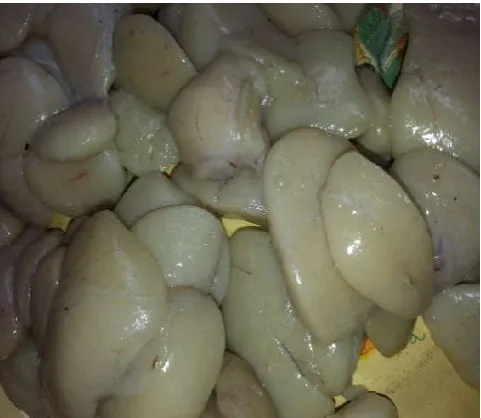
The lipids were extracted simply by heating the small pieces of fat from fat bags of fat extracted from the belly of python (Fig 2a and 2b) between 37 and 50 ˚C until complete dissolution of
these fats. Lipids were kept at -20˚C until use (Khunsap S. et
al. 2016)
[image:2.595.314.555.566.775.2]Fig. 2b. Fat of Python sebae
Methods of analysis
After lipid extraction, we proceeded to the characterization of these lipids, which generally refers to the determination of chemical indices, fatty acid profile, rheological properties and differential thermal analysis.
Physico-chemical analyzes
Determination of chemical indices
The different indices measured in this study were determined according to the following official AOAC standards: Acid Index (AOAC, 969.17, 1997); Iodine Number (AOAC, Standard 993.20, 1997); Peroxide Index (AOAC, Standard 965.33, 1997); Saponification index (AOAC, standard 920.160.1997) (AOCS, 1997; Kyari M.Z., 2008).
Viscosity
The viscosity is measured using the rheometer, Stress Techrorometer, REOLOGICA Instruments AB, Sweden calibrated according to the manufacturer's data. 7μl of sample are used by varying the stress (from 7 to 20 Pa) as a function of time. The kinematic viscosity η is expressed in mPa.S.
Determination of the fatty acid profile
KOH in solution in 2N methanol is used as a transmethylation reagent to prepare the fatty acid methyl esters of total lipids [Standard ID 182: 1999]. The methyl esters thus formed are analyzed by gas chromatography on a Per 2000 chromatograph (Périchrom, Saulx-le-Chartreux) equipped with a flame ionization detector. This device is equipped with a polyethylene glycol capillary column doped with terephthalic acid (Périchrom), 25 m long, 0.25 mm diameter and 0.5 m thick film. The temperature of the injector and detector is set at 260 ° C. The column is raised from 70 to 180 ° C (39.9 ° C / min), and is maintained at this temperature for 8 minutes. It then undergoes a second heating up to 220 ° C (3 ° C / min). The carrier gas is nitrogen (1.1 bar). The software Winilab (Périchrom, Saulx-le-Chartreux) allows the integration of chromatograms. The identification of the peaks is done by two standards of fatty acids provided by Supelco (Belle fonte, United States): PUFA1 (marine source) and PUFA2 (animal source).
Differential thermal analysis
Differential Thermal Analysis (DTA) consists in measuring a temperature difference between the sample studied and a reference sample, which does not show any thermal phenomena in the temperature range studied. The thermal profile thus obtained reflects the changes in the state of the analyzed product and the energy variations associated with these changes.
The thermal profile of the fats is determined according to Tan's method, and Che Man, (1999) (Sathivel S., 2005). Weigh 6 to 12 mg of Python sebae fat sample into hermetically sealed aluminum capsules, another empty and hermetically sealed aluminum capsule was used as a reference. The thermal program is as follows: in the chamber at 20 ° C., the cell block of the DSC was rapidly heated to 80 °C. at a rate of 40 °C/min and held for 5 minutes at this same temperature to destroy the crystal nuclei. The block is then rapidly cooled from 80 to -30 °C at a rate of 5 °C / min, and held for 5 minutes at this same temperature to allow for polymorphic changes. Finally, the block is new cooled from -30 to -85 °C at a rate of 1 °C / min to set the cooling profile.
Rheological properties
The viscosity is measured using the rheometer, (Stress ® rheometer, REOLOGICA Instruments AB, Sweden). We measured the viscosity by stress (from 1 to 78 Pa) as a function of time and at different temperatures (between 25 ° C and 40 ° C). Then, the viscosity of the liquid at the plateau of the curve was read.
Making an ointment
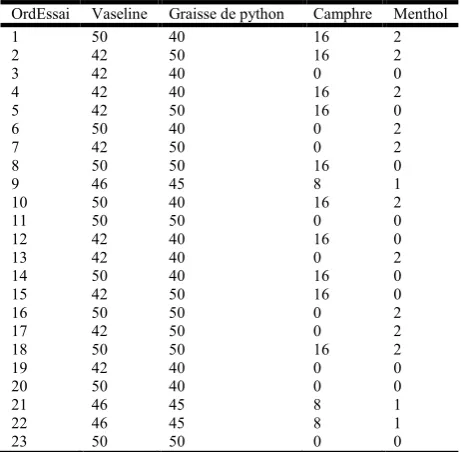
[image:3.595.318.549.569.795.2]For the manufacture of our ointment, we used the Plackett-Burman Experience Plan (Plckett and Plackett-Burman, 1946; Goupy, 2001). We selected four factors with the following maximum and minimum values: python fat (40.50); Vaseline (42.50); camphor (0.16); menthol (0,2). The results are recorded in the table 1.
Table 1. Experimental design generated according to the Plackett-Burman matrix
OrdEssai Vaseline Graisse de python Camphre Menthol
1 50 40 16 2
2 42 50 16 2
3 42 40 0 0
4 42 40 16 2
5 42 50 16 0
6 50 40 0 2
7 42 50 0 2
8 50 50 16 0
9 46 45 8 1
10 50 40 16 2
11 50 50 0 0
12 42 40 16 0
13 42 40 0 2
14 50 40 16 0
15 42 50 16 0
16 50 50 0 2
17 42 50 0 2
18 50 50 16 2
19 42 40 0 0
20 50 40 0 0
21 46 45 8 1
22 46 45 8 1
The compositions of the ointments were determined by the Plackett Burman mixing plane (Plackett R.L. and Burman J.P., 1946; Goupy J., 2001) based on a first-order model whose equation is as follows: Y = β0 + Σ βi Xi (1) Or Y is the answer (Composition of the ointment), β0 is the constant, βi is the linear coefficient and Xi is the level of the independent variable. We selected compositions whose total is equal to 100%.
Operating mode
Melt the fat of the python sebae in a bain-marie at a temperature of 50 ° C. Take the Vaseline, put it in a saucepan and melt it. Once the material has completely melted, add the oil obtained upstream based on the fat. Heat the mixture over low heat while stirring regularly with a spoon for a few minutes. Add camphor and menthol in this liquid mixture, continue to stir for one minute to homogenize it well. Verse all in a saucepan or pot and let cool by closing the lid. Keep the balm obtained in a cool place protect from light. We carried out the tests selected according to the results of the mixing plans.
Statistical Analysis
Results are expressed as mean ± standard deviation (SD). Statisticalanalysis was carried out by Excel Version 8.0 software. Significance was defined at P < 0.05.
RESULTS AND DISCUSSION
Physicochemical characterizations of the fats of Python sebae
The results of chemical analyzes of the Python sebae fat,
obtained after various manipulations are presented in the table 2. From the point of view of acidity, the acid values obtained in Table I vary in average from 2.38 to 127.59 mg KOH / g of Python Sebae fat. According to the Codex Alimentarius (CODEX STAN 19-1981), a good quality fat must have an acidity level of 4 mg KOH / g of fat. Only samples from Brazzaville conform to the standard. The high acidity of the Dolisie and Kindamba samples could be explained by the poor storage and storage conditions during the transport of these samples, since the conversion of triglycerides to fatty acids and
glycerol increases the acid number (Falodun, A. et al., 2008).
But it could also be that the environment and the geographical conditions have something to do with it because the Kindamba fat which has a higher acidity rate seemed cooler than that of Dolisie. Note also that we found much larger values in the literature for boa constrictor fat (310.73 mgKOH / g). From the point of view of oxidation, the peroxide index of the fats analyzed oscillate on average between 0.28 and 5.75 meq. O2 / kg. These values are in accordance with Codex Alimentarius standards (CODEX STAN 211-199) which sets the lower value up to 10 meq of active oxygen / kg of fat.
Which means that our fats are of good quality. There is a considerable difference between the peroxide values of these different samples. Although the level of oxidation of our fats is acceptable, that of the Dolisie and Kindamba samples shows that the latter are older than the fat from Brazzaville. We also note that the quality of the fat from Dolisie tends towards oxidation. It is noted that there is no considerable difference between the saponification indices of the 3 samples analyzed, it varies on average from 169.25 to 178.73 mg KOH / g of fat. These high values in the saponification index prove that our greases have long chains of carbon and can be applied in the field of soap. These results are close to those found by Okere
et al., 2014 on python regius fat (164.09 mgKOH / g). Our
Python sebae fats analyzed have an iodine index that varies between 87.5 and 127.12. The high values of iodine index
shows that our Python sebae fats from the three localities
(Dolisie, Kindamba and Brazzaville) are mostly composed of unsaturated fatty acids (UFA).
Fatty acid profile of Seba python fats
The chromatograms obtained on the analysis of the three
Python sebae fats have the same profile and we present an example of the chromatogram illustrated in Fig3. Fig 3 shows the chromatogram of fatty acid standards with well separated and well resolved peaks. This good separation of the various fatty acids also noted allows to easily consider the quantification.
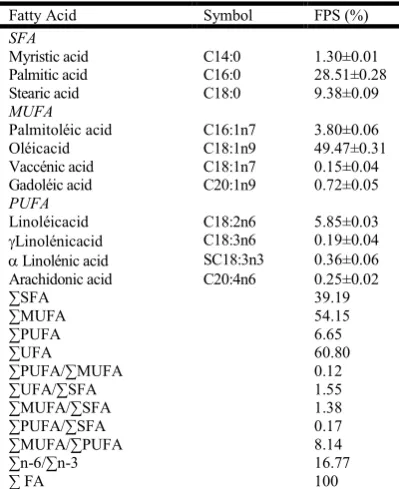
The chromatographic profile of the fatty acids shows the order of exit of the fatty acids. Table II shows the percentage probability of obtaining the majority fatty acids in the fats
which we analyzed as well as their standard deviations. Python
[image:4.595.313.547.501.686.2]sebae fats give a high probability of unsaturated fatty acids (60.80%), the most represented being oleic acid with 49.47%. Saturated fatty acids represent only 39.19% of total fatty acids with a significant proportion (28.51%) of palmitic acid. The ratio of unsaturated fatty acids to saturated fatty acids is 1.55.
Table 2. Results of chemical index
Samples IA values (% oleicacid) IP values (meq d’O2/kg) IS value (mg KOH/g) Value of II
FPsfromDolisie 39.18 ± 8.40 5.75 ± 0.53 169.25 ± 2.65 87.5 ± 3.53
FPsfromKindamba 127.60 ± 4.75 2.56 ± 0.05 175.68 ± 4.31 127.12 ± 7.47
FPsfrom Brazzaville 1 3.66 ± 0.42 0.28 ± 0.01 178.73 ± 7.64 103 ± 1.41
FPsfrom Brazzaville 2 2.38 ± 0.88 0.29 ± 0.07 157.99 ± 7.56 ND
*Python regiusfat 5.61±0.24 198.05±8.16 164.09±4.75 97.20±0.96
FPs : Fat of python sebae; IA: acidity in% oleic acid; IP: peroxide indice; IS: saponification indice; II: iodine indice; ND:
not determined; * (Okere and al., 2014)
Table 3. Fatty Acid Profile of Python Sebae Fat
Fatty Acid Symbol FPS (%)
SFA
Myristic acid C14:0 1.30±0.01
Palmitic acid C16:0 28.51±0.28
Stearic acid C18:0 9.38±0.09
MUFA
Palmitoléic acid C16:1n7 3.80±0.06
Oléicacid C18:1n9 49.47±0.31
Vaccénic acid C18:1n7 0.15±0.04
Gadoléic acid C20:1n9 0.72±0.05
PUFA
Linoléicacid C18:2n6 5.85±0.03
Linolénicacid C18:3n6 0.19±0.04
Linolénic acid SC18:3n3 0.36±0.06
Arachidonic acid C20:4n6 0.25±0.02
∑SFA 39.19
∑MUFA 54.15
∑PUFA 6.65
∑UFA 60.80
∑PUFA/∑MUFA 0.12
∑UFA/∑SFA 1.55
∑MUFA/∑SFA 1.38
∑PUFA/∑SFA 0.17
∑MUFA/∑PUFA 8.14
∑n-6/∑n-3 16.77
∑ FA 100
FPs : Fat of python sebae; FA: Fatty Acid; SFA: Satured fatty acid; MUFA:
monousatured fatty acid; PUFA: polyunsatured fatty acids; UFA: unsatured fatty acids. Les teneurs en ΣAGS, ΣAGMI, ΣAGI et ΣAGPI ont été calculées en considérant tous les acides gras détectés pour chaque classe d'acides gras en fonction du degré d'insaturation. Les données rapportées sont la moyenne ± l’équartype de trois measures.
The major unsaturated fatty acid present in Python sebae fat is
oleic acid. It reduces total cholesterol and low density lipoprotein (LDL) cholesterol without affecting high density lipoprotein (HDL). This leads to a reduction in the risk of cardiovascular disease, since HDL rids LDL-cholesterol blood,
known as "bad cholesterol," (Dommels et al., 2002; Mensink
RP and Katan MB; 1992; Guesnet P. et al., 2005). We note
essentially the presence of saturated fatty acids: myristic acid (C14: 0), palmitic (C16: 0), stearic (C18: 0).
This fat could be a nutritional oil because the ratio of unsaturated fatty acids to saturated fatty acids is greater than 1. These fatty acids are separated on the chromatogram at irregular intervals. In addition, the same number of fatty acids
is present in Python sebae fats from different localities. These
different elements allowed us to extrapolate to deduce some
fatty acids present in Python sebae fats.
On the other hand, as far as Python sebae fat is concerned, no
study to our knowledge has been done on its chemical composition, hence the lack of a standard for it. However, we can see that it is a fat that could be very nutritious given its levels of essential fatty acids (oleic acid and linoleic). We have made a table comparing the fatty acid profiles of certain reptilian fats (Table 4). All these fats have fatty acid profiles rich in unsaturated fatty acids (AGI), and they have any
ethnopharmacological activity (Khunsap et al., 2016; Dias et
al., 2013; Okere et al., 2014), the fatty acid profile of the
python fat sebae is closer to that of the fat of python regius.
We can therefore say that the fat of the Python sebae certainly
presents these ethnopharmacologicalactivities, whichare
recognized in traditional medicine.
Rheological properties
The rheological properties make it possible to study the flow and the deformation of the fats. At 30 ° C, the viscosity of these fats varies between 65.88 and 949.7 mPa.s characterizing
very viscous Python sebae fats. The high viscosity of Python
sebae fats indicates that these fats could be used in the
manufacture of lubricating greases and fuels (Adebanjo et al.,
2005).
Differential thermal analysis
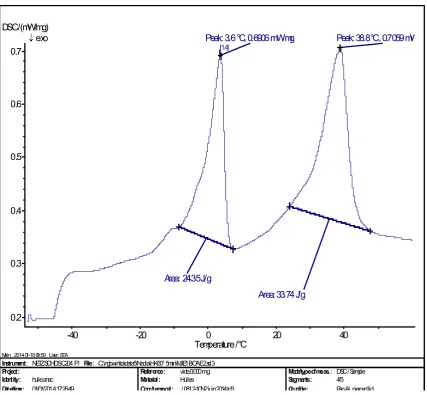
Fig 4 shows the polymorphic changes of the analyzed fats. These changes are observed following a change in temperature. The differential thermal analysis of the samples studied reveals the existence of two peaks. We present in Figure 4 a copy of the thermal profile of our greases. The first peak has amelting point of 0.8 ° C (ΔHf = 17.47 J / g) for the Dolisie sample and 3.08 ° C (ΔHf = 26.86 J / g) for the sample of Brazzaville. The last most important peak is at 40.1 ° C (ΔHf = 28.09 J / g) for the Dolisie sample and 38.8 ° C (ΔHf = 33.74 J / g) for the sample of Brazzaville. This peak represents those of high melting compounds. These peaks correspond to a fusion process because (ΔH> 0).
[image:5.595.39.554.537.701.2]This explains why this fat is solid at room temperature. The results obtained indicate the interval in which our fats can be heated without affecting their quality. Above 40 °C, there is a structural modification of our greases. Differential thermal analysis is one of the simple ways to study the characteristics of fats. Among other things, the influence of fat composition, aging and heat treatment on fat quality can be explained by the
Table 4. Comparison of fatty acid profiles of the fat of a few reptiles
Fattyacids Symbol Python sebae (%) Python regius25 (%) Naja kaouthia11 (%) Phrynops geoffroanus24(%)
Myristic ac. C14:0 1.30±0.01 - 0.71 -
Pentadecylicac. C15 :0 - - 0.18 3.68
Palmitic ac. C16:0 28.51±0.28 16.05±3.22 17.47 6.82
Stéaric ac. C18:0 9.38±0.09 10.10±2.87 4.81 -
Arachidicac. C20:0 - 2.25±0.65 0.25 -
Tétradécenoïcac. C14:1n-9 - 0.5±0.02 -
Palmitoléicac. C16:1n7 3.80±0.06 4.85±1.45 4.01 58.39
Oléicac. C18:1n9 49.47±0.31 41.27±5.22 3.84 15.70
Vaccénic ac. C18:1n7 0.5±0.04 0.15±0.04 22.98 -
Gadoléic ac. C20:1n9 0.72±0.05 11.87±3.67 - -
Linoléicac. C18:2n6 5.85±0.03 7.60±1.95 16.80 4.50
Linolénicac. C18:3n6 0.19±0.04 3.00±0.95 - 2.28
Linolénic ac. C18:3n3 0.36±0.06 0.36±0.06 - -
Arachidonic ac. C20:4n6 0.25±0.02 0.25±0.02 - -
Erucic ac. C22 :1n9 - 3.06±1.00 - 3.76
DSC (Tan et Che Man, 2002). DSC provides an approach to physical properties such as melting point, enthalpy, and
specific heat capacity of fats (Sathivel, 2005; Sathivel et al.,
2008).
Ointment manufacturing
[image:6.595.83.511.52.447.2]Among the 23 trials, we retained only those whose omposition is 100% and therefore the following three compositions or formulations:
Fig.4. Differents ointments manufactured
Ointment 1: 46 g of petrolatum, 45 g of python fat, 8 g of camphor and 1 g of menthol
Ointment 2: 42 g petrolatum, 40 g python fat, 16 g camphor and 2 g menthol
Ointment 3: 50 g of Vaseline, 50 g of python fat, 0 g of camphor and 0 g of menthol.
The ointments that we manufacturedare represented on figure 5
Conclusion
It is clear that the characterization of Python Sebae fat in this
work has been complete. The results we have just acquired, allow us to know, in the context of the valuation of our
products (ointments), the quality of the different Python
Sebaefats widely encountered in Congo. The first results found show how the environment and geographical conditions could
influence the chemical composition of Python Sebae’s fats. We
note also that Python Sebae grease from Kindamba has an
[image:6.595.63.265.594.785.2]acidity and a higher degree of unsaturation than those of Dolisie and Brazzaville, which indicates that this fat is very sensitive to oxygen and therefore very fragile. to rancidity. From the oxidation point of view, all fat samples analyzed are within acceptable limits, in accordance with Codex Alimentarius standards. The saponification index of our fats indicates a high detergency and foaming power. The fatty acid profile shows that our fats contain a lot of unsaturated fatty
Fig. 4. Thermal Profile of Python Sebae fat
Project : Identity : Date/time :
huile anac 01/01/2014 17:26:49
Reference : Material : Corr./temp.cal :
vide,0.000 mg Huiles
/ 0812-10N2 juin 2014.td3
Mode/type of meas. : Segments : Crucible :
DSC / Sample 4/5 Pan Al, pierced lid
Instrument : NETZSCH DSC 204 F1 File :C:\ngbwin\ta\data5\Nadia\HK 60° 5min\MJE1 BOA E2.sd3
-40 -20 0 20 40
Temperature /°C 0.2
0.3 0.4 0.5 0.6 0.7 DSC /(mW/mg)
Main 2014- 01-18 09:59 User: STA
Peak: 3.6 °C, 0.6906 mW/mg Peak: 38.8 °C, 0.7059 mW
Area: 24.35 J/g
Area: 33.74 J/g
[1.4]
exo
acids. Unsaturated fatty acids, in particular n-3, are precursors of prostaglandins and leukotrienes and have, among other things, a muscular, antimicrobial and anti-inflammatory
potential, which confers therapeutic advantages (Guesnet P. et
al., 2005; Khunsapet al., 2016) . But these unsaturated fatty
acids are also known for their hypocholesterolemic and antiatherogenic function.
In addition, the thermal and rheological analyzes indicate the range of melting temperature in which our greases can be heated without affecting the quality of the latter. Seen the ingredients added to our ointment, we can certify the therapeutic virtues (analgesics and analgesics) of the latter. It is important to note the importance of conducting in-depth studies of Python Sebae fats from various localities in our country, to see if the geographical conditions, environment and diet of these latters influence the composition of our fats. It would also be interesting to go deeper into a study on the therapeutic effects of these, in order to know the real and direct effect of the application of our ointments on human health. In view of the nutritional quality of our fat, studies may be conducted for culinary use of our fat.
REFERENCES
AdebanjoA.O., Dalai A.K., Bakhshi N.N. 2005. Production of Diesel-Like Fuel and Other Value-Added Chemicals from
Pyrolysis of Animal Fat. Energy Fuels.19(4),1735–1741
AOCS (American Oil Chem. Soc) 1997. In D. Firestone (Ed.), Official methods and recommended practices of the American Oil Chemists Society (4th ed.), Champaign, Illinois (USA): AOCS.
Arditty S. 2007. Fabrication, stabilité et propriétés rhéologiques des émulsions stabilisées par des particules
colloïdales. Analyse de données, Statistiques et
Probabilités. Université Sciences et Technologies.
Bordeaux I, p 78.
Black, H.S. and Rhodes, L.E. 2006. The potential of omega-3 fatty acids in the prevention of non-melanoma skin cancer.
Cancerdetection and prevention.30: 224-232.
Caldefie-Chézet, F., Fusillier, C., Jarde, T., Laroye, H., Damez, M. 2006. Potential anti-inflammatory effects of
Melaleuca alternifolia essential oil on human peripheral
blood leukocytes. Phytother Res.20: 364- 370.
Cardoso, C.R., Favoreto, Jr. S., Oliveira, L.L., Vancim, J.O., Barban, G.B. 2011. Oleic acid modulation of the immune response in wound healing: A new approach for skin repair.
Immunobiology.216: 409-415.
DEMBÉLÉ Daouda Lassine (2011) : Formulation de pommade antalgique et anti-inflammatoire à base de
Securidacalongepedunculata Fresen. http:// www.
keneya.net/fmpos/theses/2011/pharma/pdf/11P48.pdf, Consulté le 15/08/2017
Dias D.Q., Cabral M.E.S., Sales D.L., Oliveira O.P., Filho J.A.A., Teles D.A., Sousa J.G.G., Coutinho H.D.M.. , Costa J.G M., Kerntopf M.R., Alves R.R.N., Almeida W.O. (2013): Chemical Composition and Validation of the Ethnopharmacological Reported Antimicrobial Activity of
the Body Fat of PhrynopsgeoffroanusUsed in Traditional
Medicine, Hindawi Publishing
CorporationEvidence-Based Complementary and Alternative Medicine. Article ID 715040, 4 pages.
Dommels Y.E.M, Alink G.M, van Bladeren P.J, van Ommen
B 2002 Dietary n−6 and n−3 polyunsaturated fatty acids
and colorectal carcinogenesis: results from cultured colon
cells, animal models and human
studies.EnvironToxicolPharmacol 11: 297–308.
Falodun, A., Owolabi, O.J. and Osahon, O. 2008. Physicochemical, antimicrobial and antiinflammatory
evaluation of fixed oil from Boa constrictor.
ActaPoloniaePharmaceutica-Drug research.65 (4),
477-480.
Ferreira, F.S., Brito, S.V., Saraiva, R.A., Araruna, M.K.A., Menezes, I.R.A. 2010. Topical anti-inflammatory activity
of body fat from the lizard Tupinambismerianae. Journal
of Ethnopharmacology. 130: 514-520.
Goupy Jacques 2001. “Introduction aux Plans d’expériences”, Dunod. Paris. 303 pages.
Guesnet P., Alessandri J.M., Astorg P., Pifferi F., Lavialle M. 2005. Les rôles physiologiques majeurs exercés par les
acides gras polyinsaturés (AGPI). Oléagineux Corps Gras
Lipides. 12(5) : 333-43.
Khunsap, S., Vesaratchapong, T., Laongbao, P., Chanhome, L., Buranapraditkun, S., Pakmanee, N. and Boonchang, S.
2016. Antioxidant, Anticancer Cell Lines and
Physiochemical Evaluation of Cobra Oil, Int. J. Pure App.
Biosci. 4(3),21-27.
Kunin, A.R. 1989. Snake oil. West J.Med., 151: 208.
Kyari M.Z., 2008. Extraction and characterization of seed oils,
Int. Agrophysics.22: 139-142.
Lim, K., Han, C., Dai, Y., Shen, M. and Wu, T. 2009. Omega-3 polyunsaturated fatty acids inhibit hepatocellular carcinoma cell growth through blocking β-catenin and cox-2. 8: 3046-3055.
Mandal, C.C., Choudhury, T., Dey, N. 2012. Ghosh-Choudhury, G. and Ghosh- Ghosh-Choudhury, N., miR-21 is targeted by Omega-3 polyunsaturated fatty acid to regulate
breast tumor CSF-1 expression. Carcinogenesis.33:
1897-1908.
Mensink R.P, Katan M.B. 1992. Effect of dietary fatty acids on serum lipids and lipoproteins. A meta- analysis of 27 trials.
ArteriosclerThromb. 12:911-919.
Nikolakopoulou, Z., Shaikh, M.H., Dehlawi, H., Michael-Titus, A.T. and Parkison, E.K. 2013. The induction of apoptosis in pre-malignant keratinocytes by omega-3 polyunsaturated fatty acids docosahexaenoic acid (DHA) and eicosapentaenoic acid (EPA) is inhibited by albumin.
Toxicology Letters. 218: 150-158
Nissen, L., Zatta, A., Stefanini, I., Silvia, G., Sgorbati, B. 2010. Characterization and antimicrobial activity of
essential oils of industrial hemp varieties (Cannabis sativa
L.). Fitoterapia.81: 413-419.
Okere O.S., Okoli B.J., Moses Dele AdamsM.D.,
OmolabiAdeyemo S.O. 2014. Physicochemical, Trace
Metal Analysis and Fatty Acid Profile of Python regiusFat,
British Biotechnology Journal.4(10), 1064-1076.
Pauwels O.S.G., J.P.VandeWeghe, (2008), «Reptiles du Gabon ».Washington: Smithsonian Institution. p 272.
Plackett R.L. and Burman J.P. (1946): “The design of optimum multifactorial experiments”, Biometrika, n°33.
Sathivel S. 2005. Thermal and flow properties of oils from
salmon head. Journal of the American Oil Chemists’
Society.82: 147–151.
Sathivel S., Prinyawiwatkul W., Negulescu I., King J.M. 2008. Determination of melting points, specific heat capacity and enthalpy of catfish oil during different purification steps.
Journal of the American Oil Chemists’ Society. 85(3), 291-296
activity and antibacterial effect of essential oil of the aerial
parts of Salvia sclareoides. Asian PacJ Trop Med.7:
S491-S496.
Tan C.P., Che Man Y.B. 1999. Quantitative differential scanning calorimetric analysis for determining total polar
compounds in heated oils. Journal of the American Oil
Chemists’ Society. 76 (9), 1047-1057.
WouessiDjewe D. 2011. Formes galéniques administrées par voie cutanée, TICE de la Faculté de Médecine et de Pharmacie de Grenoble (Université Joseph Fourier – Grenoble 1) p 8.
65322 Moussounga et al. Physicochemical characterization and technological valorization of python fat (phythonsebae) of congo brazzaville