PREPARATION OF FAST DISSOLVING ORAL FILMS OF NEW GENERATION ANTI MIGRAINE
DRUGS BY SOLVENT CASTING METHOD
1,*
Pavan Kumar Kothapuvari
1
Pacific University, Debari, Udaipur, Rajasthan
2S. N. D. College of Pharmacy, Babhulgaon, Nashik
3
Mallareddy College of Pharmacy, Hyderabad
ARTICLE INFO ABSTRACT
This review article overview the advancement in the oral dosage forms, application, formulation consideration, method of preparation, evaluation of new generation Anti migraine drugs. Fast dissolving oral films (FDOFs) have been introduced in the market re
convenience and ease of use over other dosage forms such as orally disintegrating tablets. This technology evolved over the past few years from the confection and oral care markets in the form of breath strips and became a novel and
interest of large number of pharmaceutical industries. Fast dissolving oral films is the type of drug delivery system which when placed in the oral cavity, disintegrate or dissolve within few seco without the intake of water. FDOFs are very similar to postage stamp in their shape, size and thickness. These films have a potential to deliver the drug systemically through intragastric, sublingual or buccal route of administration and also
common, chronic disorder with episodic attacks9. It affects 10
productive periods of their working lives, women are affected up to four times more often than men. The present review
preparation of the new generation Anti migraine drugs like Almotriptan malate and Eletriptan HBR into FDOFs.
Copyright © 2016, Pavan Kumar Kothapuvari et al. This
unrestricted use, distribution, and reproduction in any medium, provided the original work is properly cited.
INTRODUCTION
Rapidly dissolving or quick dissolving dosage forms have acquired great importance in the pharmaceutical industry due to their unique properties and advantages
2003; Klancke, 2003). They undergo disintegration in the salivary fluids of the oral cavity within a minute, where they release the active pharmaceutical ingredient. The major amount of the active pharmaceutical ingredient is swallowed orally with the saliva where subsequent absorption takes place
in the gastrointestinal tract (Parakh and
Swapnil et al., 2012). Migraine is a common, chronic disorder
with episodic attacks (Himabindu et al., 2012
20% of the population during the most productive per their working lives, women are affected up to four times more
often than men (Kumar et al., 2005). Eletriptan HBr is a
selective 5-hydroxytryptamine 1B/1D (5-HT1B/1D) receptor agonist, used in the treatment of migraine attacks.
*Corresponding author: Pavan Kumar Kothapuvari,
Pacific University, Debari, Udaipur, Rajasthan-313024, India
ISSN: 0975-833X
Article History:
Received 17th February, 2016
Received in revised form
04th March, 2016
Accepted 26th April, 2016
Published online 10th May,2016
Key words:
FDOF, Migraine, Eletriptan HBr, Almotriptan malate.
Citation: Pavan Kumar Kothapuvari, Swati Rawat and Kis
anti migraine drugs by solvent casting method”, International Journal of Current Research
RESEARCH ARTICLE
PREPARATION OF FAST DISSOLVING ORAL FILMS OF NEW GENERATION ANTI MIGRAINE
DRUGS BY SOLVENT CASTING METHOD
Pavan Kumar Kothapuvari,
2Swati Rawat and
3Kishore Kumar Kadimpati
Pacific University, Debari, Udaipur, Rajasthan-313024, India
S. N. D. College of Pharmacy, Babhulgaon, Nashik - 423401, Maharashtra, India
Mallareddy College of Pharmacy, Hyderabad-501511, Telangana, India
ABSTRACT
This review article overview the advancement in the oral dosage forms, application, formulation consideration, method of preparation, evaluation of new generation Anti migraine drugs. Fast dissolving oral films (FDOFs) have been introduced in the market re
convenience and ease of use over other dosage forms such as orally disintegrating tablets. This technology evolved over the past few years from the confection and oral care markets in the form of breath strips and became a novel and widely accepted form by consumers, so FDOFs are gaining the interest of large number of pharmaceutical industries. Fast dissolving oral films is the type of drug delivery system which when placed in the oral cavity, disintegrate or dissolve within few seco without the intake of water. FDOFs are very similar to postage stamp in their shape, size and thickness. These films have a potential to deliver the drug systemically through intragastric, sublingual or buccal route of administration and also has been used for local action.
common, chronic disorder with episodic attacks9. It affects 10-20% of the population during the most productive periods of their working lives, women are affected up to four times more often than men. The present review provides an account of various formulation considerations, suitable method of preparation of the new generation Anti migraine drugs like Almotriptan malate and Eletriptan HBR into FDOFs.
This is an open access article distributed under the Creative Commons Att use, distribution, and reproduction in any medium, provided the original work is properly cited.
Rapidly dissolving or quick dissolving dosage forms have acquired great importance in the pharmaceutical industry due
(Borsadia et al.,
They undergo disintegration in the salivary fluids of the oral cavity within a minute, where they release the active pharmaceutical ingredient. The major amount of the active pharmaceutical ingredient is swallowed sorption takes place and Gothoskar, 2003; Migraine is a common, chronic disorder
2012).It affects
10-20% of the population during the most productive periods of their working lives, women are affected up to four times more . Eletriptan HBr is a HT1B/1D) receptor agonist, used in the treatment of migraine attacks.
Pavan Kumar Kothapuvari,
313024, India.
The terminal elimination half
approximately 4 hours, and is primarily metabolized by cytochrome P-450 enzyme CYP3A4 after
Although Eletriptan is well absorbed after oral administration, it undergoes first pass metabolism leading to a mean absolute oral bioavailability of approximately 50% (
2012).The available formulation of Eletriptan
is an immediate release tablet. Conventional Eletriptan HBr tablets are not suitable where quick onset of action is required. To provide the patients with the most convenient mode of administration, there is a need to develop rapidly dissolvi dosage form, particularly one that disintegrates and dissolves/ disperses in saliva and can be administered without need of water. Fast dissolving films are useful in patients such as paediatric, geriatric, bedridden, or developmentally disable who may face difficulty in swallowing conventional tablets. So the patients would be benefited from acute treatment by using proposed drug delivery system. Thus, a fast dissolving film is a unique solid oral dosage form and has valuable advantages. The present study is aim to formulate and characterize the fast dissolving oral films of Eletriptan HBr for rapid onset of action
Available online at http://www.journalcra.com
International Journal of Current Research
Vol. 8, Issue, 05, pp.30704-30710, May, 2016
INTERNATIONAL
Pavan Kumar Kothapuvari, Swati Rawat and Kishore Kumar Kadimpati, 2016. “Preparation of fast dissolving oral films of new generation
International Journal of Current Research, 8, (05), 30704-30710.
z
PREPARATION OF FAST DISSOLVING ORAL FILMS OF NEW GENERATION ANTI MIGRAINE
Kishore Kumar Kadimpati
313024, India
423401, Maharashtra, India
501511, Telangana, India
This review article overview the advancement in the oral dosage forms, application, formulation consideration, method of preparation, evaluation of new generation Anti migraine drugs. Fast dissolving oral films (FDOFs) have been introduced in the market recently as they provide convenience and ease of use over other dosage forms such as orally disintegrating tablets. This technology evolved over the past few years from the confection and oral care markets in the form of widely accepted form by consumers, so FDOFs are gaining the interest of large number of pharmaceutical industries. Fast dissolving oral films is the type of drug delivery system which when placed in the oral cavity, disintegrate or dissolve within few seconds without the intake of water. FDOFs are very similar to postage stamp in their shape, size and thickness. These films have a potential to deliver the drug systemically through intragastric, used for local action. Migraine is a 20% of the population during the most productive periods of their working lives, women are affected up to four times more often than men. provides an account of various formulation considerations, suitable method of preparation of the new generation Anti migraine drugs like Almotriptan malate and Eletriptan HBR
access article distributed under the Creative Commons Attribution License, which permits
The terminal elimination half-life of Eletriptan is
approximately 4 hours, and is primarily metabolized by 450 enzyme CYP3A4 after oral administration. Although Eletriptan is well absorbed after oral administration, it undergoes first pass metabolism leading to a mean absolute
ailability of approximately 50% (Mona Nagar et al.,
The available formulation of Eletriptan HBr in market is an immediate release tablet. Conventional Eletriptan HBr tablets are not suitable where quick onset of action is required. To provide the patients with the most convenient mode of administration, there is a need to develop rapidly dissolving dosage form, particularly one that disintegrates and dissolves/ disperses in saliva and can be administered without need of water. Fast dissolving films are useful in patients such as paediatric, geriatric, bedridden, or developmentally disable face difficulty in swallowing conventional tablets. So the patients would be benefited from acute treatment by using proposed drug delivery system. Thus, a fast dissolving film is a unique solid oral dosage form and has valuable advantages. dy is aim to formulate and characterize the fast dissolving oral films of Eletriptan HBr for rapid onset of action
INTERNATIONAL JOURNAL OF CURRENT RESEARCH
in the management of migraine attack and also to improve the bioavailability of the drug. Almotriptan malate is a second generation triptan used in acute treatment of migraine attacks in adults with a history of migraine with or without aura, which has been shown to have efficacy comparable to sumatriptan
with an improved tolerability profile (Mashru et al., 2005).
Conventional available Almotriptan malate tablets are not suitable where quick onset of action is required for the disease like migraine attack. There is a need to develop rapidly dissolving dosage form to provide the patients with the most convenient mode of administration, particularly one that disintegrates and dissolves/ disperses in saliva and can be administered without need of water. Fast dissolving oral films are useful in patients such as paediatric, geriatric, bedridden, or developmentally disable who may face difficulty in swallowing conventional tablets. So the patients would be benefited from acute treatment by using proposed drug delivery system. Thus, a fast dissolving film is a unique solid oral dosage form and has valuable advantages. The present study is aim to formulate and characterize the fast dissolving oral films of Almotriptan malate by solvent casting method for rapid onset of action in the management of migraine attack and also to improve the bioavailability of the drug.
Definition of FDOF
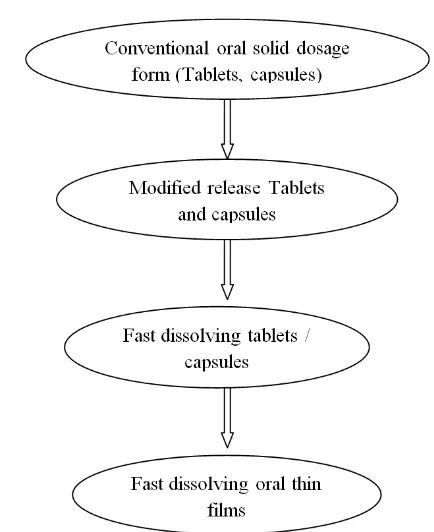
A fast dissolving oral film is defined as “an ultra-thin film containing active ingredient that dissolves or disintegrates in the saliva at a remarkably fast rate, within few seconds without the aid of water or chewing’’. The fast release action is due to larger surface area and less thickness as compared to a tablet. The saliva in the oral cavity wets the film as it consists of hydrophilic polymers and dissolves it rapidly. Thus the drug is released into the saliva and is absorbed via the highly vascularized oro mucosal tissues. Developing formulations for children has been a challenging task. Amongst other factors, palatability of formulations of pediatric oral medications is one of the most significant factors influencing compliance to therapeutic regimens. Although solid dosage forms are widely accepted by elders and adolescents, younger children tend to prefer liquid formulations that are easier to swallow. Keeping the ease of administration and swallowing in mind, pharmaceutical research has led to the development of fast dissolving oral films (FDOF’S). Research and development in the oral drug delivery segment has led to transition of dosage forms from simple conventional tablets/capsules to modified release tablets or capsules to oral disintegrating tablet (ODT) to wafer to the recent development of fast dissolving oral films. Basically the FDOF’S can be considered as an ultra-thin strip of postage stamp size with an active agent or active
pharmaceutical ingredient and other excipients. The
advantages of convenience of dosing and portability of FDOF’S have led to wider acceptability of this dosage form by pediatric as well as geriatric population equally. The introduction of FDOF’S in market was accompanied by educating the mass about the proper way to administer the product like giving instructions ‘’do not swallow’’ or ‘’do not chew’’.
The concept of oral dissolving film
This delivery system consists of a thin film.
After placing it on the top of the tongue, the film
dissolves within seconds, promoting first pass metabolism as compared to tablet and other immediate release oral dosage forms, and may increase the bioavailability of the drug.
[image:2.595.320.537.132.398.2] FDOF dissolves in the mouth like a cotton candy.
Fig. 1. Flow chart for the development of Oral solid dosage form
Classifications of fast dissolve technology
Fast-dissolve technologies can be divided in to three broad groups
Lyophilized systems
Compressed tablet- based systems
Oral thin films
Lyophilized systems
This technology involves taking a suspension or solution of drug with other structural excipients, by using mould or blister pack, which forms tablet-shaped units. The units or tablets are then frozen and lyophilized in the pack or mould. The resulting units are of very high porosity, which allows rapid water or saliva penetration and very rapid disintegration.
Compressed tablet based- systems
Oral Thin Films
It is also called as oral wafers. From the past few years the oral thin films are evolved in confection and oral care markets in the form of breath strips. These are novel and widely accepted form by consumers for delivering vitamins and personal care products. Today, FDOF’S are proven and accepted technology for the systemic delivery of APIs for over-the counter (OTC) medications and are in the early to mid development stages for prescription drugs.
This has been attributed to the success of the breath freshener products by consumers such as Listerine pockets packs in the US consumer market. Such systems use a variety of hydrophilic polymers to produce a 50-200 mm film. The film is manufactured as a large sheet and then cut into individual dosage units for packaging in a range of pharmaceutically acceptable formats.
Classification of oral films
There are three types of oral films. They are:
Flash release/ Fast dissolving films (Placed on the
tongue).
Mucoadhesive melts away films (Gingival or buccal
region).
Mucoadhesive sustained release films (adhere to the
buccal mucosa).
Salient features of fast dissolving oral films
Available as thin, elegant films that are easy to handle
and administer.
Ease of administration even to bedridden and
psychiatric patients.
Good stability and solubility in water and saliva.
The formulation of dissolvable films is customarily
facilitated through aqueous polymer matrices than span a wide molecular weight range, thereby providing flexibility to achieve certain physical properties.
Accurate dosage and pleasant in taste.
Advantages of FDOF’S
Fast dissolving oral films offer all advantages of solid dosage forms and liquid dosage forms along with special advantages, which include:
No requirement of specially trained person.
It dissolves instantly as soon it is placed on tongue.
Rapid onset of action and increased bioavailability.
Avoiding the risk of choking and therefore ease of self
administration.
Film consists of precise amount of drug.
Avoidance of water facilitating to use even travelling
and suitable for nausea patients.
Promoting mouth freshening property.
Films are flexible and not as fragile as most of the
ODTs. Hence, there is ease of transportation, consumer handling and storage.
As compared to drops or syrup formulations, precision
in the administered dose is ensured from each of the strips.
Helps to avoid hepatic metabolism to certain extent by
facilitating pregastric absorption of drugs from mouth, pharynx and oesophagus as saliva passes down.
Trans- mucosal drug delivery which bypass the first
pass metabolism.
The dosage form can be consumed at any place and any
time as per convenience of the individual.
No water required, No injections, No spoons and no
worries, but just a strip..!
Great advantage for Pediatrics, Geriatrics and a trend
for young.
Easy to transport, fits in your pocket or in valet, ease to
use and also act as breath freshener along with medication.
Disadvantages
Drugs that are required in high doses are difficult to
formulate into thin films. For instance, Rifampin (600 mg), Ethambutol (1000 mg).
[image:3.595.40.558.76.157.2]30706 International Journal of Current Research, Vol. 08, Issue, 05, pp.30704-30710, May, 2016
Table 1. Difference in three types of oral films
Sub Type / Property Flash release wafer Mucoadhesive melt-away films Mucoadhesive sustained release wafer
Area (cm2) 2-8 2-7 2-4
Thickness (µm) 20-70 50-500 50-250
Structure Film: Single layer Single or multilayer system Multi layer system
Excipients Soluble, highly hydrophilic polymers Soluble hydrophilic polymer Low/ non soluble polymers
Drug phase Solid solution Solid solution or suspended drug particles Suspension and/ or solid solution
Application Tongue (upper palate) Gingival or buccal region Gingival, other region in the oral cavity
Dissolution Maximum 60 seconds Disintegration in a few minutes, forming gel Maximum 10-20 hours
Table 2. Comparison between Fast Dissolving oral Films (FDOF) and Fast Dissolving Tablets (FDT)
Fast Dissolving oral Film Fast Dissolving Tablet
Large surface area gives greater dissolution Less surface area gives less dissolution than FDOF.
Fast dissolving films are flexible and durable. Fast dissolving tablet are brittle and less durable than FDOF.
Only low dose can be incorporated in formulation. High dose can also be incorporated in formulation.
[image:3.595.91.500.188.241.2] Proteinaceous drugs cannot be incorporated into films as they may be affected by the proteolytic salivary enzymes. If used, such drugs may be co-administered with enzyme inhibitors such as aprotinin, bestatin, puromicin and bile salts.
Limited number of available polymers.
Thermal process of drying may affect the drug and
polymer stability.
Require special packaging for products stability and
safety.
Anatomic and physiologic features of the oral cavity
The surface area of the oral mucosa is about 100 cm2. Three
different types of oral mucosa are recognized: the mucosa, the lining mucosa, and the specialized mucosa. The Masticatory mucosa, representing 25 % of the total oral mucosa, is 100-200 µm thick and covers the gingival and the hard palate. It is tightly attached to underlying structures and subjected to abrasion and shear stress during mastication. The lining mucosa (60 % of the total oral mucosa) is 500-800 µm thick and covers the lips, cheeks, soft palate, and lower surface of the tongue and the floor of the oral cavity. The specialized mucosa (15 % of the total oral mucosa) is present on the dorsum of the tongue and is involved in taste.
Buccal epithelium
The buccal epithelium is a non-keratinized stratified squamous epithelium, composed of multiple layers of cells that show different patterns of maturation between the deepest cells and the surface. The basal cells of the buccal epithelium are capable of division and maintain a constant epithelial population as cells move toward the surface. Tissue homeostasis requires differentiation followed by migration and desquamation of the superficial cells. The prickle cells (intermediate layer) accumulate lipids and cytokeratins of low molecular weight that do not aggregate to form filaments. An intracellular lipid portion is packaged in small organelles called membrane coating granules or lamellar granules. Such granules migrate towards the apical surface of the cell, where their membrane fuses with the cell membrane and their lipid content is extruded in the extra cellular space. The buccal epithelium lacks tight junctions, which are common to intestinal and nasal mucosa, but is endowed with gap junctions, glydesmosomes and hemidesmosomes, which are loose intercellular links. The epithelium rests on the basal epithelium, an irregular saliva continuous interface between the epithelium and the connective tissue. The basal membrane anchors the epithelium to the connective tissue and improves the barrier function of the epithelium, preventing large molecules from passing through the oral mucosa. Although buccal absorption is not the specific goal of oral fast dissolving tablets, this can occur when the drug is released in the oral cavity in contact with buccal mucosa. The drug transport mechanism through the buccal mucosa involves two major routes:
Transcellular (intracellular)
[image:4.595.315.542.51.224.2] Paracellular (intercellular)
Figure 2. Cross section of oral mucosa
The transcellular route involves passage through the cellular membranes with a polar and a lipid domain, while the paracellular route essentially consists of passive diffusion through the extracellular lipid domain. It is generally recognized that the lipid matrix of the extracellular space plays an important role in the barrier function of the paracellular pathway, especially with the compounds that are hydrophilic and have a high molecular weight, such as peptides.
Visualization of the Oral Mucosa
Arterial, venous and lymphatic capillaries penetrate the multi-layered epithelium, infiltrating the connective tissue. The oral mucosa is primarily supplied by the external carotid artery, which serves the large buccal blood vessels. The floor of the mouth, the root of the tongue and the cheek mucosa are the most highly vascularized areas. Vascular drainage from the oral mucosa is primarily via the lingual, facial and retromandibular veins, which flow together into the internal jugular vein. This is the mechanism responsible for by passing first pass hepatic metabolism.
Formulation consideration
The area of drug loaded FDOF should be between 1-20 cm2.
The drug can be loaded up to a single dose of 30 mg. Formulation considerations have been reported as important factors which affected mechanical properties of the films.
Migraine
[image:4.595.350.516.521.603.2]Migraine is a common and debilitating condition affecting 10-15 % of people. The causes are still not well understood. A migraine attack consists of an initial visual disturbance (the aura), in which a flickering pattern, followed by a blind spot (a
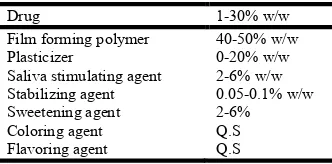
Table 3. Typical composition of FDOF’S
Drug 1-30% w/w
Film forming polymer 40-50% w/w
Plasticizer 0-20% w/w
Saliva stimulating agent 2-6% w/w
Stabilizing agent 0.05-0.1% w/w
Sweetening agent 2-6%
Coloring agent Q.S
scintillating scotoma), progresses gradually across an area of a visual field. This is followed by a severe throbbing headache starting unilaterally often accompanied by photophobia, nausea, vomiting and prostration which lasts for several hours. The visual aura occurs only in about 20 % of migraine sufferers. The attacks may be precipitated by particular foods or visual stimuli but most commonly without an obvious cause.
Anti migraine drugs
Two factors implicate 5-Hydroxy Tryptamine (5-HT) in the pathogenesis of migraine. The first one, a sharp increase in the urinary excretion of main 5-HT metabolite, 5- Hydroxy Indole Acetic Acid (5-HIAA) during the attack, thus decreasing the platelet 5-HT. The second one being that many drugs that are effective in treating migraine attacks are 5-HT receptor agonists or antagonists.
Various drugs effective during migraine attack are
Simple analgesics like aspirin, Paracetamol (with or
without metoclopramide) to hasten absorption.
Ergotamine and Triptan drugs (Sumatriptan,
Almotriptan, Eletriptan, Naratriptan, Frovatriptan, Rizatriptan, Zolmitriptan) for actue attacks.
Prophylactic drugs include β-Adrenoceptor
antagonists (E.g. Propranolol, metoprolol), Pitzotifen,
Cyproheptadine, Methysergide, Amitryptyline,
Clonidine, Verapamil.
The drugs used prophylactically are a mixed bag and their mechanism of action is poorly understood.
MATERIALS AND METHODS
Technologies used in the manufacture of mouth dissolving
films:
One or combination of the following process can be used to manufacture the mouth dissolving films.
Solvent casting
Semisolid casting
Hot melt extrusion
Solid dispersion extrusion
Rolling
Films can be prepared either by hot melt extrusion method or solvent casting technique. In the extrusion process the API and other ingredients are mixed in dry state, subjected to heating process and then extruded out in molten state. In this process, solvents are completely eliminated. The strips are further cooled and cut to the desired size. The high temperature used in this process may degrade thermolabile APIs.
Hence, generally the solvent cast method is employed for manufacture of FDOFS. Both Almotriptan malate and Eletriptan HBr are soluble in aqueous mediums and thermostable API’s.
Solvent Casting Method
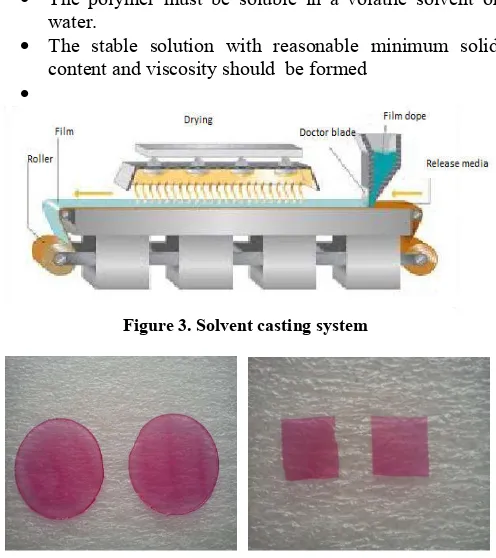
In this method, the water soluble polymers are dissolved in suitable solvent and the drug along with other excipients is dissolved in suitable solvent. Then both solutions are mixed and stirred and finally casted into the petri plate and dried.
Advantage
Greater uniformity of thickness and great clarity than
extrusion.
Films have fine gloss and freedom from defect such a
die lines.
Films have more flexibility and better physical
properties.
Disadvantages
The polymer must be soluble in a volatile solvent or
water.
The stable solution with reasonable minimum solid
content and viscosity should be formed
[image:5.595.310.558.353.632.2]
Figure 3. Solvent casting system
Figure 4. Eletriptan HBr Films
Preparation of Eletriptan HBr films
Fast dissolving oral films of Eletriptan HBr was prepared with
the dose of 20 mg per 4cm2 film. A total of 25 formulations
were prepared using three different Hypromellose E3LV, Hypromellose E6LV and Hypromellose E15LV and other polymers, the resulting films were shown in Figure 4.
Preparation of Almotriptan Malate oral films
Fast dissolving oral films of Almotriptan malate with the dose
of 6.25mg per 4 cm2 film. Total 25 formulations were prepared
[image:6.595.36.290.145.237.2]using three different polymers, HPMC E3LV, HPMC E6LV and HPMC E15LV and the resulting films were shown in Figure 5.
Fig. 5. Almotriptan Malate films
RESULTS
DISCUSSION
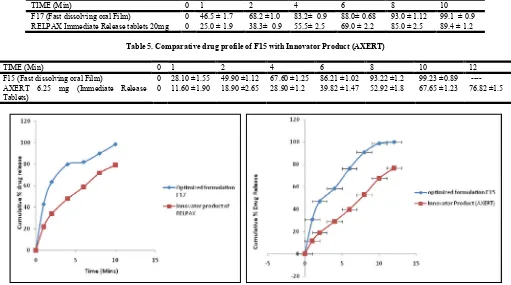
Both Almotriptan malate and Eletriptan HBr Films has been developed, optimized and compared with Innovator product which is available as Immediate release product in market. And found to be more bioavailable and quicker in action compared to innovator product.
Impact in industry: Both Eletriptan HBr and Almotriptan
malate Fast dissolving oral films were prepared by simple Solvent casting method. And found to stable, quickly
dissolving for dissolution. Fast dissolving products has grown rapidly in Industry from sales in 2007.
Conclusion
Fast dissolving oral films have gained popularity because of better patient compliance, rapid onset of action, the drug is directly absorbed in systemic circulation. Both Almotriptan malate and Eletriptan HBr are second generation triptans used to treat migraine headaches. Migraine headache need fast onset of action. In this concept both are suitable candidates to prepare Fast dissolving oral film technology.
Acknowledgements
The authors are grateful to M/s MSN Labs Pvt ltd, Hyderabad for the supply of the gift sample of Eletriptan Hydrobromide and Almotriptan malate.
Abbreviations
API : Active Pharmaceutical Ingredient CYP: Cytochrome P
DSC : Differential scanning calorimetry
FDT : Fast dissolving Tablet FDOF: Fast dissolving oral films
FTIR: Fourier transform infrared spectroscopy
HBr: Hydrobromide
HPLC : High Performance Liquid Chromatography
mOsm : milliosmole
Table 4. Dissolution profile comparison of F17 with innovator product of RELPAX-20 mg tablets
TIME (Min) 0 1 2 4 6 8 10
F17 (Fast dissolving oral Film) 0 46.5 ± 1.7 68.2 ±1.0 83.2± 0.9 88.0± 0.68 93.0 ± 1.12 99.1 ± 0.9
[image:6.595.46.557.308.593.2]RELPAX Immediate Release tablets 20mg 0 25.0 ± 1.9 38.3± 0.9 55.5± 2.5 69.0 ± 2.2 85.0 ± 2.5 89.4 ± 1.2
Table 5. Comparative drug profile of F15 with Innovator Product (AXERT)
TIME (Min) 0 1 2 4 6 8 10 12
F15 (Fast dissolving oral Film) 0 28.10 ±1.55 49.90 ±1.12 67.60 ±1.25 86.21 ±1.02 93.22 ±1.2 99.23 ±0.89 ----
AXERT 6.25 mg (Immediate Release Tablets)
0 11.60 ±1.90 18.90 ±2.65 28.90 ±1.2 39.82 ±1.47 52.92 ±1.8 67.65 ±1.23 76.82 ±1.5
ODT: oral disintegrating tablet OTC : over-the counter 5-HT : 5-Hydroxy Tryptamine
5-HIAA : 5- Hydroxy Indole Acetic Acid
REFERENCES
Bhowmik, D., Chiranjib, B., Krishnakanth, P., Chandra, R. M.
2009. Fast dissolving tablet: an overview. J Chem Pharm
Res., 1: 163–177.
Bhupinder, B., Sarita, J., Mandeep, K., Harmanpreet, S. 2011. Orally fast dissolving films: Innovations in formulations
and technology. Int J Pharm Sci Rev Res., 9(2):50-7.
Bhyan, B., Jangra, S., Kaur, M., Singh, H. 2011. Orally fast
dissolving innovation in formulation and technology, Int
J Pharm Sci Rev Res., 9 (2): 50–57.
Borsadia, S., Halloran, D., Osborne, J. L. 2003. Quick dissolving films- A novel approach to drug delivery.
Drug Deliv Technol., 3:63-6.
Choudhary, D. R., Patel, V., Patel, H., Kundawala, J. A. 2011. Exploration of film forming properties of film formers
used in the formulation of rapid dissolving films, Int J
Chemtech Res., 3 (2): 531–533.
Crama, A., Breitkreutzb, J., Desset‐Brèthesc, S., Nunnd, T.,
Tuleuf, C. 2009. Challenges of developing palatable oral
pediatric formulations. Int J Pharm., 365: 1‐3.
Florence, A. T. 2008. Neglected diseases, neglected
technologies, neglected patients. Int J Pharm., 350: 1‐2.
Himabindu, S., Sathish, D., Shaik Shayeda, 2012. Formulation and Ex Vivo Evaluation of Buccal Tablets of Eletriptan
HBr. Am. J. Pharm Tech Res., 2(3), 919-930.
Hiroyoshi, S., Kazumi, T., Misao, N., Katsuhiko, M., Tadao, T., Hirotaka, Y., Naoki, I., Kazuyuki, H., Mayumi, Y., Yasutomi, K., Yoshinori, I. 2009. Preparation of a fast dissolving oral thin film containing dexamethasone: A possible application to antiemesis during cancer
chemotherapy. Eur J Pharm Biopharm, 73(3): 361-5.
Klancke, J. 2003. Dissolution testing of orally disintegrating
tablets. Dissol Technol., 10:6–8.
Koland, M., Sandeep, V. P., Charyulu, N. R. 2010. Fast
Dissolving Sublingual Films of Ondansetron
Hydrochloride: Effect of Additives on in vitro Drug
Release and Mucosal Permeation. J Young Pharm., 2(3):
216–22.
Kumar, G. V., Krishna, R. V., William, G. J., Konde, A. 2005. Formulation and evaluation of buccal films of salbutamol
sulphate. Indian J Pharm Sci., 67:160–4.
Lipton, R. B., Bigal, M. E. 2005. The epidemiology of
migraine. Am J Med., 1 18: 3-10.
Mashru, R. C., Sutariya, V. B., Sankalia, M. G., Parikh, P. P. 2005. Development and evaluation of fast dissolving film
of Salbutamol sulphate. Drug Dev Ind Pharm., 31: 25–
34.
Mona Nagar, Mayank Nagar, Vikram Chopra, 2012. Formulation and evaluation of mouth dissolving film of
antipsychotic drug aripiprazole. Der Pharmacia Lettre, 4
(4):1221-1227.
Nafee, N. A., Boraie, M. A., Ismail, F. A., Mortada, L. M. 2003. Design and characterization of mucoadhesive
buccal patches containing cetylpyridinium chloride. Acta
Pharm., 53:199–212.
Parakh, S. R., Gothoskar, A. V. 2003. Review of mouth
dissolving tablet technologies. Pharm Tech., 27:92–100.
Prabhakara, P., Ravi, M., Marina, K., Vijaynarayana, K., Ullas Souza, D., Harish, N. M., Shastry, C. S. 2011. Formulation and evaluation of fast dissolving films of
levocetirizine dihydrochloride. Int J Pharm Inves., 1(2):
99–104.
Priya, Y. D., Chowdary, Y. A., Murthy, T.E.G.K., Seshagiri, B. 2011. Approaches for taste masking of bitter drugs: a
Review. J Adv Drug Res., 1 (2): 58–67.
Rajni, B., Pravin, P., Sushil, K., Sandeep, A. 2013. Orally dissolving strips: A new approach to oral drug delivery
system, Int J Pharm Invest., 3(2): 67–76.
Raju, S., Reddy, P.S. Kumar, V.A. Deepthi, 2011. A Reddy, KS Reddy. Flash release oral films of metoclopramide
hydrochloride for pediatric use: formulation and in
vitro evaluation. J Chem Pharm Res., 3 (4): 636–646.
Sheryl Haut, R., Marcelo Bigal, E., Richard Lipton, B. 2006. Chronic disorders with episodic manifestations: focus on
epilepsy and migraine. Lancet Neurol., 5: 148–57.
Swapnil, L. P., Paresh, R. M., Madhavi, A. S., Shradha, S. T., Ketan, V. P., Prashant, N. S. 2012. Fast dissolving oral
films: An innovative drug delivery system. Int J Res Rev
Pharm Appl Sci., 2(3): 482-96.