ISSN (e): 2250-3021, ISSN (p): 2278-8719 Vol. 05, Issue 03 (March. 2015), ||V3|| PP 08-15
Virtual Medical Support Application
Prof. S.A. Mahajan
1, Mayuri Mehta
2, Shweta Oza
3, Rupali Funde
4,
Ruchi Muldudwar
51(Information Technology, PVG’s COET, India) 2(Information Technology, PVG’s COET, India) 3(Information Technology, PVG’s COET, India) 4(Information Technology, PVG’s COET, India)
3(Information Technology, PVG’s COET, India)
Abstract: With the emerging need of hospitals to be more responsive, proactive and quick to fight against disease, the Virtual Medical Support App provides the transparency between doctors and patients and other users with secure access to information. The vision behind developing an online comprehensive virtual medical support application is to engage patients, doctors and hospitals. This smartphone app can be constantly accessible which involves and educates the patient, and provides a repository for patient and proper medication information. It Facilitate appropriate communication between all stakeholders - discussion chat or mail services.to use this application more securely login details are provided to registered user by administrator. This helps the doctor to maintain patients’ records as authorized user. Users may be Patients, Doctors, Relatives, Nurses or Volunteers. The patients can interact with doctors, their relatives and other patients connected through this app., by chats, video calling, and blogs and also by group video chats. The app provides emergency messages which can be sent by patients themselves or hospital volunteers. Patient’s all records, charts and progress reports can be maintained using this app. The Reports can be viewed by the Doctor, patient and their close relatives (who all are registered through this app).This system aims in bringing the patients, doctors, patient’s relative, volunteer and nurses together in a virtual environment so that the patient is never alone. A help is always a call away.
Keywords -Adherence, Applications, Cloud, Multilingual, Reminder, VMS.
I. INTRODUCTION
Now a day, Smartphones are multipurpose devices with easy available internet facilities that allow constant access for communication and information. They perform many tasks which use specialized applications. These applications can be easily downloaded and used by the customers. A smartphone app designed for the patients can hold collectively all the patient’s medication information that is structured to help the patient understand about his/her conditions [1].
This project aims at developing a Virtual Medical Support App., which is vital to facilitate Medical Services that are essential to human health. The VMS is a local Android Application. This app aims at solving problems or difficulties in communication, data storage, untimely medication, language barriers and several design issues. This system being a registered application for a specific hospital creates a patient centric culture. With this application we can maintain the chat application [9], the users can create their own Blog, and it will also help the patients to share their experiences or find other patients suffering with similar medical conditions, etc. VMS also provides the patients with facilities through which they can set medication reminders. Apps prove most beneficial for patients who deals with the complex medication regimens or for caregivers & family members and can be immediately accessed with the touch of a finger.
We decided to limit the number of challenges people face regarding the languages like Marathi and English. The main focus is on resolving issues related to communication, specifically the lack of face-to-face meetings, and avoids other issues. Also in Emergency cases such as Accidents or sudden causalities the onlooker can simply click a button and the location of the mishap will be sent to the registered hospital.
II. RELATEDWORK
To make patient more comfortable with their daily medication and physiotherapy many apps are designed like medication reminders, contact details, exercise instructors, etc. Some of these applications are discussed below:
2.1.1. MediSafe: MediSafe is an application that reminds you when to take your medication. User can even update their applications manually [10]. This application notifies the family members or caretakers if the user does not check in, so they can remind the users when needed. Provides high end graphics, list of what medication is "due today" and check them. The application also keeps track of the medication stock and notifies for a refill.
2.1.2. MyMedSchedule: It provides free medication reminders, schedules and NEW Health Tracker [11]. Many operations like read create and update can be performed on schedules created. The application also supports English or Spanish interfaces [12].
2.1.3. My Health Tracker: All the lab vital signs and lab results are stored in this application along with graphical representation to track the progress [13]. The application provides the facility to set users personal goals and they can be compared with the user’s actual results.The application also keeps track of the medication stock and notifies for a refill.
2.1.4. My MEDS: It lets you create, track, and share medication records for your entire family [15]. With other basic operations it easily locate your pharmacy from anywhere with the built-in map feature. Records your drug allergies, doctors, and pharmacies, keep track of your immunization records.
2.2. Health Dial Pune: This is a free application about the variety of medical facilities and emergency aids located in Pune [14]. It gives the users necessary information like contact details, location and website of different health related services located in pune. This application targets new comers as well as local population of the city. The services enlisted by the application includes Medical and Emergency services as Ambulances, Blood Banks, 24 Hours Medical Stores, Hospitals, Rehab Centers, 24 Hours OPD, Geriatric Care ,Oxygen Supply, MRI Centers [14].
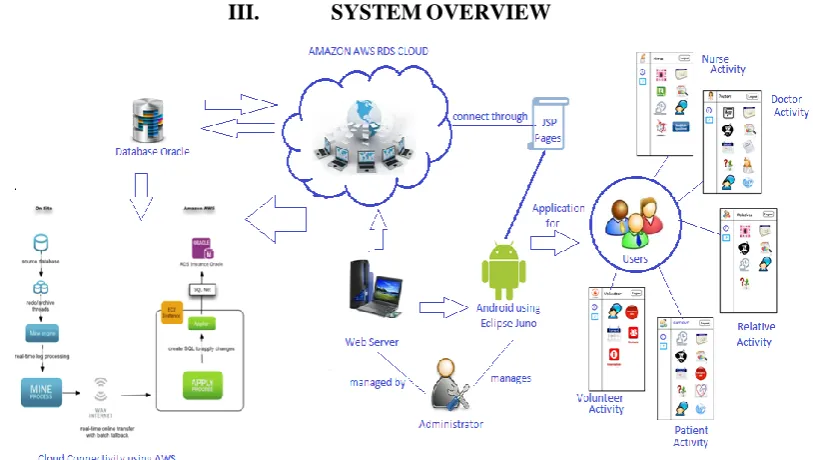
III. SYSTEMOVERVIEW
Fig. 1: Virtual Medical Support’s System Architecture
1.1.Multilingual Interface
For localizing the Application, making it more user-friendly, this Application supports multilingual interface[16]. From the perspective of the societies and language communities themselves, multilingualism is more a way of life by which a problem can be solved. As instructions in mother tongue language has proven more beneficial to language competencies. In addition to English interface a local language interface can be provided[17]. This feature can be attained by using the localization directories provided by the Android IDE [17].
For example: My Project/ Res/ Values/
strings.xml Values-hi/
strings.xml
Where the values/ directory contains appropriate resources for English language, the values-hi/ directory contains resources for devnagri. Then add the string values for each locale into the appropriate .xml file.
1.2.Locator
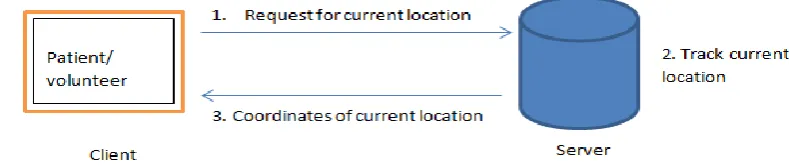
Smartphone users are increasingly using applications that can access their location[2]. Android applications solves people daily problem for getting locations in the similar manner this feature can be used to provide patients currents location to theirs doctors and relatives in case of any emergency situations with the location address and some details about that situation[16]. This feature will be included in our application by using the location APIs, making it easy for building location-aware applications, without giving much importance to locator technology used. This will intelligently manage the underlying location technology and gives the best location according to the needs[7]. This Application gives immediately availabilitywith immediate access to the best and most recent nearby location.
Server
When the clients accept the registration request, server gets activated for that particular hospital. It tracks out location of patient.
It fetches the coordinates and type of emergency from that particular client.
Fig. 2: Block Diagram for Locator
1.3.Emergency messages
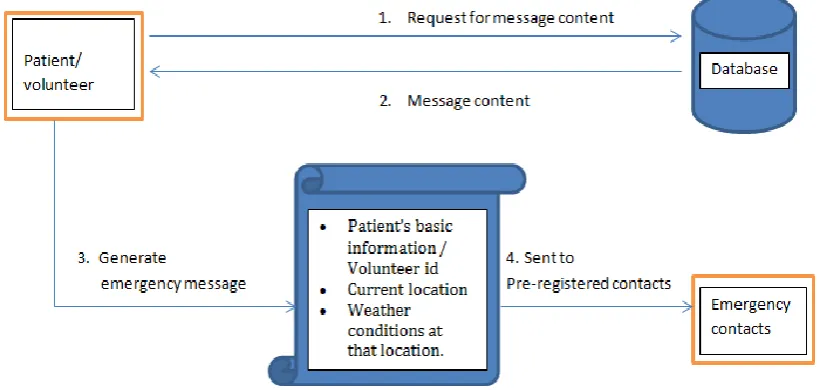
This facility can be provided to patient and volunteer of the hospital patients prone to high risk and can contact the hospital also their relative using emergency message in case of any emergency[4]. The message sent by the patients account will contain the following information:
Patient’s basic information including patient’s age, and their medical condition in short. Patients current location
Weather conditions at that location.
This feature sends notification that effectively alert and inform registered caretakers so, that immediate help can be provided. Android smartphones require subscribers to enable their GPS services so the application can deliver location-based multimedia alerts using push technology [4].
Using this feature the volunteers will be able to send message to the hospital if any mishap occurred in their vicinity, message will contain the volunteer’s ID provided to them during registration along with their location and some required information. The volunteer then do not have to wait for the further procedure that needs to be done.
Client Sends request to find the current location for emergency situation.
Generate emergency message of patient by pressing the emergency button of phone in case of emergency and send it to selected hospital for post-medical treatments.
Server
It fetches the coordinates and type of emergency from client.
Fig. 3: Block Diagram for Emergency message.
1.4.Cloud Management
While more and more companies are adopting cloud computing for its convenience, healthcare industry has been little slow in adopting this new trend. But gradually many hospitals and clinics are recognizing the benefits of cloud computing and embracing this technology to revolutionize their procedures. In the modern world of healthcare, it can be extremely challenging for the physicians to keep track of significant amount of information, from patient’s record to retrieve information from system. With the traditional system, it can be burdensome to transfer physical files from one facility to another, wasting time and spending money on transportation and employee expenses. Faced with growing amounts of electronic records and digital images, hospitals are now looking toward the cloud as a solution to their data storage needs. About 15% of U.S. health care systems are using cloud-based storage and it is predicted that more than half of the nation's health systems will use cloud computing for data storage in the next three years. Access to medical imaging over a secure network can help speed diagnoses, reduce the need for duplicate images, and protect patients from unnecessary problems. Cloud-based storage also helps doctors make quick and easy comparison between recent and historical images [6]. With a properly implemented cloud storage system, hospitals can establish a network that can process tasks quickly without a drop in performance. Doctors no longer need to be tied to their offices to look up patient’s information. They can pull up medical records remotely to review patient records and tests. Cloud computing will prove to be cost effective for patients and in healthcare providers, as the patients do not have to pay twice for the same test when they go to different doctors and medical offices do not have to pay for on-site hardware and storage services to maintain medical records. Information contained within a cloud can track (with the proper information of governance) so that data on treatments, costs, and performance and effectiveness studies can be analyzed and acted upon. Information can be harvested and repurposed for more appropriate referrals and medical research to support the promise of personalized health and care.At Care Cloud, data security is priority one.
Client
Client Requests for the information. Server
Fig 4: Block diagram for Cloud management
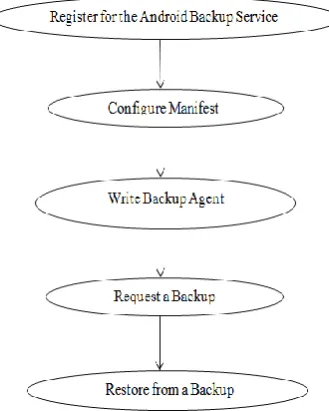
The following flowchart shows the working of cloud for android application
1.4.1. Register for the Android Backup Service <meta-data
android name="com.google.android.backup.api_key"
android value="ABcDe1FGHij2KlmN3oPQRs4TUvW5xYZ" />
1.4.2. Configure Manifest
<application android: label="MyApp" android: backupAgent="TheBackupAgent"> ...
<meta-data android: name="com.google.android.backup.api_key" android: value="ABcDe1FGHij2KlmN3oPQRs4TUvW5xYZ" /> ...
</application>
import android.app.backup.BackupAgentHelper; import android.app.backup.FileBackupHelper;
1.4.4. Request Backup
Import android.app.backup.BackupManager; ...
public void requestBackup() {
BackupManager bm = new BackupManager(this); bm.dataChanged();
}
1.5.Report Generation
As there are many tools available for storing and retrieving the data with all details generating the report, report generation and time to time updation makes the application more efficient [8]. There are many other sources where we can store the information but they make some difficulties to get it resolved. So cloud has been one of the best options for storing large amount of data in system[20].
Difficulties to store these tools:
Whendifferent manufactures sell various ECG products to a hospital purchases, clinicians encounter, and information technicians (ITs), but also have great difficulty in managing ECG information systems due to the heterogeneous ECG data formats and incompatible ECG information database provided by 12-lead ECG manufactures and huge difficulty in retrieving ECG records [20]. By unifying heterogeneous ECG data formats, researchers have converted hospital-used SCP-ECG and XML-ECG to DICOM-ECG that can be integrated in the Picture Archiving and Communication Systems (PACS) with medical images using cloud storage to provide hospitals with easier ECG management [5].
The VMS application will contain the History and current status of the patients reports like: 1. Blood pressure.
2. Blood sugar. 3. Heart Rate. 4. ECG reports.
5. Other related reports as per the patient.
For maintaining the overall blood pressure report we need to have input and output that is been read; both the cardiac output and total peripheral resistance (TPR) to the blood flow is used to maintain brachial artery [19]. The formula to calculate mean arterial pressure (MAP) is:
MAP =2DBP − SBP
3
Where, DBP-diastolic blood pressure and SBP is systolic blood pressure.The overall blood flow is calculated by using Mean arterial Pressure which indicates accurate perfusion pressure (ΔP).
Poiseuille’s law defines the Blood Flow as:
Q = ∆P × πr
8NL
Where,
Q- Blood flow, ΔP - Pressure gradient, r - Radius of the vessel N - Blood viscosity L - Length of the vessel.
CO =MAP × 8
TPR
Here CO is the cardiac output in liters/minute and is the clinical equivalent of blood flow (Q). MAP (in mm Hg) is used to approximate the pressure gradient (ΔP). The resistance to flow that is the TPR is measured in dynes · sec · cm−5 and represented clinically by using 8 NL/πr4. The 80 in the formula is the conversion that simply allowsthe use of conventional units.
Example 1: BP of 120/80 and normal cardiac output of 5 L/min:
MAP =2 × 80 + 120
3 = 93.33 mm Hg
TPR =93.33 × 80
5.0 = 1490
The example exibites, normal cartiac output and as a result of increase in TPR elevated bloob preasure is observed. The maintainance of TPR is done by resistance vessel.The rate of diastolic runoff in the arterial tree is regulated by small precapillary muscular arterioles. The changes in the vascular tone regulate the blood flow in the resistance vessels that further adjust the radius (r) of the vessels. As the radius has the fourth power as shown in formula(i.e., TPR = 8NL/πr4), small change in the values causes significant changes in TPR.
Example 2: BP of 80/60, TPR of 600:
MAP = 2 × 60 + 80
3 = 66.7 mm Hg
CO = 66.7 × 80
600 = 8.9 L/min
IV. FUTUREWORK
The main focus of the application is covering all necessary features for patients but this application can be made realize. For further work the feature like self-talk can be added so that the patient can converse with the system. Also the regular based question and answer session can be added. The hospital database can be connected with the medical stores located in their campus so that the user can check for the availability of medicines .The further versions of this application can be developed based on user review. Research is needed to determine whether and how effectively applications can improve adherence and therapeutic outcomes in acute and chronic conditions.
V. CONCLUSION
Virtual medical support application can prove most beneficial for patients with complex medication regimes or for the care givers and family members. It can be immediately accessed with the touch of finger. The main focus of this application is to provide security to the patients with 24 hours connectivity. It eliminates the basic problem while using android application like complex user interface and language barrier.
VI. ACKNOWLEDGEMENTS
We would like to express our gratitude and appreciation to all those who gave us the possibility to complete this project. A special thanks to our project guide, Prof. S.A.Mahajan whose help, stimulating suggestions and encouragement and his dedicated efforts in guiding the team to achieve its goal as well as his encouragement to maintain our progress in track. We would also like to acknowledge with much appreciation the crucial role of the staff of Information Technology laboratory,who gave the permission to use all required machinery and the necessary material to complete the Differential Simulation Rig. Last but not least, we would like to appreciate the guidance and the valuable time given by other supervisor as well as the panels that has improved our presentation skills by their comment and tips.
REFERENCES
[1] Lindsey Dayer, Seth Heldenbrand, Paul Anderson ,Paul O. Gubbins and Bradley C. Martin. Smartphone medication adherence apps: Potential benefits to patients and providers. J Am Pharm Assoc (2003). 2013 ; 53(2): 172–181. doi:10.1331/JAPhA.2013.12202.
[2] Radhika Kinage, Jyotshna Kumari, Purva Zalke, Meenal Kulkarni.Mobile Tracking Application.International Journal of Innovative Research in Science, Engineering and TechnologyVol. 2, Issue 3, March 2013.
[3] Amit Kushwaha, Vineet Kushwaha.Location Based Services using Android Mobile Operating System.International Journal of Advances in Engineering & Technology, © IJAET ISSN: 2231-1963.
[4] Prof. Seema Vanjire, Unmesh Kanchan, Ganesh Shitole, Pradnyesh Patil.Location Based Services on Smart Phone through the Android Application. International Journal of Advanced Research in Computer and Communication Engineering Vol. 3, Issue 1, January 2014.
[5] Jui –Chien Hsieh ,Ai-Hien Li,Chung-Chi Yang. Mobile, Cloud, Big Data Computing: Contributions, Challenges and New Directions in Telecardiology. International Journal of Environmental Research and Public Health DOI:10.3390/ijerph10116131 sep 07,2014
[6] Saeid Abolfazli, Member, IEEE, Zohreh Sanaei, Member, IEEE, Ejaz Ahmed, Member, IEEE, Abdullah ,Gani, Senior Member, IEEE, and Rajkumar Buyya, Senior Member, IEEE.Cloud-Based Augmentation for Mobile Devices: Motivation, Taxonomies, and Open Challenges.IEEE COMMUNICATIONS SURVEYS & TUTORIALS, VOL. 16, NO. 1, FIRST QUARTER 2014 337.
[7] Schwinger, W., Grin, C., Prll1, B., and Retschitzegger, W. A lightweight framework for location-based services. In Lecture Notes in Computer Science (Berlin, 2005), Springer, pp. 206_210
[9] Jade Tutorial Jade Programming for Android. Authors: Giovanni Caire (Telecom Italia S.P.A.Giovanni Iavarone (Telecom Italia S.P.A.), Michele Izzo (Telecom Italia S.P.A.), Kevin Heffner (PEGASUS SIMULATION).
[10] https://play.google.com/store/apps/details?id=com.medisafe.android.client&hl=en [11] http://www.mymedschedule.com/
[12] https://secure.medactionplan.com/transplantexperience/
[13] https://play.google.com/store/apps/details?id=com.benoved.phr_lite&hl=en [14] https://play.google.com/store/apps/details?id=com.myapp.healthdial [15] http://mymedapp.ie/
[16] www.icanlocalize.com/site/tutorials/android-application-localization-tutorial [17] http://developer.android.com/guide/topics/resources/localization.html