University of Twente
EEMCS / Electrical Engineering
Control Engineering
Redesign of the CSP execution engine
Bart Veldhuijzen
MSc report
Supervisors: prof.dr.ir. J. van Amerongen
dr.ir. J.F. Broenink ir. M.A. Groothuis
February 2009
iii
Summary
Nowadays the world is getting “computerized”. Embedded systems are getting more numerous and also become more complex. The formal language Communicating Sequential Processes (CSP) was designed to aid developers of embedded systems.
At the Control Engineering (CE) group CSP is used in the graphical modeling tool called gCSP. This tool allows to generate code from a gCSP model, which can be compiled against the Com-municating Threads (CT) library into an executable. The CT library is an execution engine for CSP constructs. This library has two major problems; execution of a blocking system call will block the entire application, and the library does not provide the accurate timing required for real-time applications. This assignment redesigns this library to solve these problems and make the library future proof.
The blocking problem originates from the use of user level threads and scheduling in the li-brary, which are invisible to the Operating System (OS). The inaccurate timing is caused by the non-preemptive scheduler. Replacing the user level threads and scheduler by kernel level threads and a priority-based preemptive OS scheduler solves these problems. To be able to support real-time applications, the OS has to be real-time as well.
The CSP language is used to create formally correct software. To classify as dependable soft-ware, the application has also to be safe and reliable. The OS must meet these requirements to be able to create dependable systems. The currently used RTAI does not meet these require-ments.
The analysis of different kernel architectures shows that the microkernel based platform is safe and extensible. It has the benefit of using message passing as inter process communication, which is very much like the CSP rendezvous method. QNX Neutrino is a microkernel-based real-time operating system which uses channels for message passing, as does CSP. QNX is open source, provides a great integrated development environment, an instrumented kernel, Adap-tive Partitioning Scheduling (APS) and transparent distributed networking.
The new library is structured in such a way that the OS provides the implementation of the API calls where possible. The CSP rendezvous communication is implemented using QNX channels and processes run in parallel using POSIX threading. Kernel tracing using the in-strumented kernel provides the tracing and monitoring functionality, while retaining the real-timeliness of the application. APS is used to guarantee a group of processes a minimum amount of CPU time, and make remote debugging possible even when the system is fully loaded.
Testing the library for functionality and timing accuracy shows that the new library and QNX perform according to the specifications. The production cell setup is used to show the usability of the library for real-time control of a mechatronic setup.
Samenvatting
Computers maken steeds meer deel uit van ons dagelijks leven. Het aantal ’embedded’ syste-men wordt groter en de systesyste-men steeds complexer. Om ontwikkelaars hierbij the helpen is de formele taal Communicating Sequential Processes (CSP) ontwikkeld.
De Control Engineering (CE) vakgroep gebruikt CSP in de grafische modellerings tool gCSP. Deze tool maakt het mogelijk om van een gCSP model broncode te generen. Deze code kan gecompileerd worden met de ’Communicating Threads’ (CT) bibliotheek tot een uitvoerbare applicatie. De CT bibliotheek voert de CSP bouwblokken uit. De huidige biblotheek heeft twee grote problemen; het uitvoeren van een blokkerende ’system call’ zorgt ervoor dat de hele ap-plicatie blokkeert en de bibliotheek beschikt niet over de vereiste nauwkeurige timing voor real-time applicaties. Deze opdracht omvat het herontwerpen van de biblotheek om deze proble-men te verhelpen en de bibliotheek voor te bereiden op de toekomst.
Het gebruik van user level threading and scheduling in de huidige bibliotheek zorgt voor het blokerende probleem. De user level threads en de scheduler zijn onzichtbaar voor het bes-turingssysteem. De onnauwkeurige timing wordt veroorzaakt door het gebruik van een ’non-preemptive’ scheduler. Het vervangen van de user level threading en de scheduler door kernel level threads en een op prioriteit gebaseerde preemptive scheduler in het besturingssysteem, verhelpt deze problemen. Om real-time toepassingen mogelijk te maken zal het besturingssys-teem ook real-time moeten zijn.
CSP wordt gebruikt om formeel correcte software te ontwerpen. Software kan pas als betrouw-baar bestempeld worden als het ook veilig is. Het besturingssysteem moet ook aan deze eisen voldoen om betrouwbare systemen te kunnen realiseren. Het huidige RTAI voldoet niet aan de eisen.
De analyse van verschillende kernel architecturen laat zien dat de microkernel betrouwbare en uitbreidbare systemen mogelijk maakt. Microkernels maken gebruik van rendezvous com-municatie als interprocess comcom-municatie. Dit is vrijwel gelijk aan de manier van rendezvous communicatie in CSP. QNX Neutrino is een real-time besturingssyteem gebaseerd op een mi-crokernel. Het gebruikt kanalen voor communicatie, net als CSP. QNX heeft beschikbare bron-code, een zeer goede geïntegreerde ontwikkelomgeving, een geïnstrumenteerde kernel, Adap-tive Partitioning Scheduling (APS) en transparant gedistribueerde netwerk ondersteuning.
De nieuwe bibliotheek is zo opgezet dat de functionaliteit van het besturingssysteem gebruikt wordt waar mogelijk. De rendezvous communicatie van CSP wordt verzorgd door QNX kanalen en het parallel uitvoeren van processen wordt gedaan met behulp van POSIX threading. Kernel tracing wordt gebruikt met behulp van de geïnstrumenteerde kernel voor tracing en monitor-ing zonder het real-time gedrag van de applicatie aan te tasten. APS wordt gebruikt om een groep van processen een gegarandeerde CPU tijd te geven. Hierdoor is debugging altijd mo-gelijk, ook als het systeem volledig belast wordt.
The functionele en timing testen laten zien dat de nieuwe bibliotheek in combinatie met QNX aan de eisen voldoen. The productie cell is gebruikt om de bruikbaarheid van de bibliotheek aan te tonen voor het real-time regelen van een mechatronisch systeem.
v
Contents
1 Introduction 1
1.1 Context . . . 1
1.2 Goals of the assignment . . . 1
1.3 Report outline . . . 2
2 Background 3 2.1 Design methodology . . . 3
2.2 Hardware architectures . . . 4
2.3 Software architectures . . . 5
3 Analysis 10 3.1 Requirements . . . 10
3.2 Current architecture and problems . . . 11
3.3 New architecture and approach . . . 12
3.4 Conclusions . . . 14
4 Design and implementation 16 4.1 Introduction . . . 16
4.2 Processes . . . 17
4.3 Constructs . . . 17
4.4 Channels . . . 18
4.5 Tracing and profiling . . . 20
4.6 Qnet . . . 21
4.7 Adaptive Partitioning Scheduler . . . 23
4.8 Conclusions . . . 23
5 Testing and Evaluation 25 5.1 Introduction . . . 25
5.2 Functional tests . . . 25
5.3 Timing test . . . 28
5.4 Production cell . . . 30
5.5 Conclusions . . . 32
6 Conclusion and recommendations 33 6.1 Conclusions . . . 33
6.2 Recommendations . . . 33
A.1 Functional test models . . . 35
A.2 Timing tests models . . . 38
A.3 Production cell model . . . 38
B Compiling the ct-library 41 B.1 Introduction . . . 41
B.2 Checking out the source . . . 41
B.3 Compiling the library . . . 41
B.4 Using the library . . . 41
C Kernel event tracing 42 C.1 Configuring the instrumented kernel . . . 42
C.2 Using the IDE for kernel tracing . . . 43
D Adaptive Partitioning Scheduler 46 D.1 Remote debugging . . . 46
D.2 Using APS from source code . . . 49
E Qnet 51 E.1 Configuring . . . 51
E.2 Using Qnet . . . 51
1
1 Introduction
1.1 Context
The world is getting “computerized”. In the industry this is going on for some time but nowa-days most household appliances, kitchen utensils and even toys contain a small computer. These devices evolve into so called embedded systems. An embedded system is a complete device which not only contains hardware and mechanical parts, but also a special-purpose computer, designed to perform one or a few dedicated functions to control the hardware. The design of these systems becomes more and more complex since the requirements are growing.
At the University of Twente, the embedded control systems project of the Control Engineering group deals with the realization of control schemes on digital computers. The process algebra CSP (Communicating Sequential Processes) developed by Hoare (1985) and Roscoe et al. (1997) forms the theoretical basis. It is used to describe systems with several computational processes running at the same time, called concurrent systems. Embedded systems typically are such systems.
To aid the modeling of these systems with CSP, a graphical tool called gCSP has been developed (Jovanovic et al., 2004). This tool is able to generate code from a model which can be executed on a hardware device. The generated code has to be compiled against the Communicating Threads (CT) library (Hilderink et al., 1997), which is an execution engine for CSP constructs. The application can be monitored in gCSP through an animation facility (van der Steen et al., 2008). An overview is shown in figure 1.1.
gCSP model
Code generation
CT library
Executable +
Animation gCSP Tool
Figure 1.1: Overview of gCSP & the CT library
The current CT-library is a product of many years of research and development. In the early stages of development the decision was made to be platform independent where possible. That decision was very reasonable at the time, but results in undesired behavior nowadays:
• The CT-library is designed to do everything involving scheduling and threading by itself to be able to run on MS-DOS and DSP processors without an Operating System (OS). This means that if an OS is present, it runs in one OS thread. If some process in the CT-program executes a blocking system call the entire application is blocked. Furthermore the CT-library does not make use of multiple processors or cores if they are available.
• The Operating System has no knowledge of the scheduler and threads running in the CT-library. The CT-library has to deliver external events like timer interrupts to the appropri-ate process in the CT-program. The current scheduler cannot guarantee when this event is handled. This results in inconsistent and inadequate timing behavior (Maljaars, 2006; Deen, 2007).
1.2 Goals of the assignment
engine an analysis will be done to chart the needs for control software. From this set of require-ments several software architectures will be investigated and a choice for a kernel architecture will be made. From a comparison of several operating systems built on the chosen kernel ar-chitecture an Operating System will be chosen. The new library is implemented on the chosen OS and should be compatible where possible with the current code generation in gCSP.
1.3 Report outline
In Chapter 2 the used terms and environment are explained in more detail. Chapter 3 describes the analysis and choices made resulting in the design of the new library as explained in Chapter 4. The new library is tested in Chapter 5 on the production cell setup.
Finally Chapter 6 summarizes the conclusions and presents the recommendations for further development and research.
3
2 Background
This chapter discusses background information. The design methodology at the Control Engi-neering (CE) group and the currently used software are discussed first (Section 2.1). In Section 2.2 an overview is given of the hardware which is used at the CE group.Finally, different software architectures are explained in Section 2.3.
2.1 Design methodology
At the Control Engineering (CE) group embedded software is developed using the design tra-jectory as defined by Broenink and Hilderink (2001); Broenink et al. (2007), see Figure 2.1. This project falls in theEmbedded Control System Implementationphase and theRealizationphase. The entire trajectory consists of the four phases shown in figure 2.1. In thePhysical System Modeling stage, models are made which describe the dynamic behavior of the system. The controllers for the system are made in theControl Law Designstage. These first two stages are performed in 20-sim (Broenink, 1999; Controllab Products, 2008). In the thirdEmbedded Con-trol System Implementationstage the control laws are implemented in software. This is done with 20-sim and gCSP (Jovanovic et al., 2004). At last the software is implemented on the target using the CT-library.
2.1.1 20-sim
20-sim is a graphical modeling and simulation program. It is possible to model a dynamic system using graphical representations and to simulate and analyze the behavior of the en-tire system. Using the Control Toolbox the controllers for the system can be designed. These controllers can be used in gCSP by generating code using the 20-sim Code Generation Toolbox.
2.1.2 (g)CSP
The theory of Communicating Sequential Processes (CSP), introduced by Hoare (1985), is a mathematical formalism for reasoning about patterns of communication in distributed sys-tems. The system is represented byprocesseswhich engage in a sequence ofevents, which may include communication with another process via achannel. The set of all events that a pro-cess may engage in is called itsalphabet. These can correspond to real-world occurences such as sensor-input, output, and so so on. Processes can define themselves in terms of other pro-cesses, including several processes running in parallel. The formalism provides for interprocess synchronization each time an event occurs that is in their common alphabet. This implies that processes synchronize around channel communication.
Figure 2.2: gCSP example model
Because performing manual analysis and verification of the system in CSP can be both tedious and error prone, automated tools are developed to formally check a design. For example the Failures-Divergence Refinement (FDR) tool developed by Formal Systems (Europe) Limited (2008).
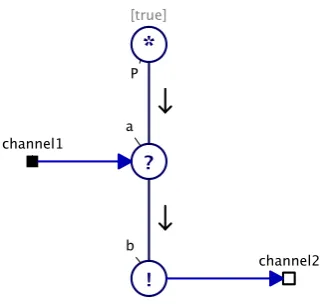
The following is a short example of a process which first reads from a channel, afterwards it writes to another channel and then repeats itself.
P=channel1?a→channel2!b→P
At the CE group, CSP was first used on transputers using the Occam language (INMOS, 1988). When the production of the transputer ceased, a few universities developed an Occam API in libraries for mainstream programming languages. The Communicating Threads (CT) library was developed at the CE group (Hilderink et al., 2000; Orlic and Broenink, 2003; Hilderink, 2005). Similar libraries are developed at the University of Kent (JCSP and C++CSP) (Moores, 1999; Welch, 2002; Brown and Welch, 2003; Brown, 2007).
Hilderink (2005) introduced a graphical way to represent the CSP language. In the CASE tool gCSP (Jovanovic et al., 2004), systems can be modeled, visualized and animated (van der Steen et al., 2008). In figure 2.2 the graphical model of the earlier mentioned CSP example is given. From the model machine readable CPSm code can be generated for formal checking with FDR, or C++ code can be generated for compilation against the CT-library.
2.1.3 CT-library
The Communicating Threads library was developed to bring the Occam constructs, and in-herently the CSP constructs, to platforms other then transputers. It was first developed in Java (Hilderink et al., 1997), after which versions in C and C++ were created. Later the Java and C ver-sions were abandoned in favor of the C++ version. The library has been restructured a couple of times (Orlic and Broenink, 2004).
2.2 Hardware architectures
Background 5
for controlling setups.
2.3 Software architectures
2.3.1 Real-Time
A system is said to be real-time if the total correctness of an operation depends not only on its logical correctness, but also upon the time in which it is performed. In a hard real-time system, the completion of an operation after its deadline is considered useless - ultimately, this may lead to a critical failure of the complete system. A soft real-time system on the other hand will tolerate such lateness, and may respond with decreased service quality (e.g., dropping frames while displaying a video). This places some demands on the Operating System (OS) running on the system. The basic requirements according to Silberschatz et al. (2004) and Cooling (2000) of a Real-Time Operating System (RTOS) are:
- Preemptive, priority-based scheduling - Preemptive kernel
- Fixed upper bound on latency - Task structuring of programs
- Parallelism (concurrency) of operations
2.3.2 Kernel architectures
The kernel is the central component of most operating systems. Its primary purpose is to man-age the resources available in the computer and allow other programs to run and use these resources. Typically, the resources consist of one or more CPU’s, the memory and Input/Out-put devices, such as keyboard, disk drives, display. The kernel has full access to the system memory and must allow other processes to access safely this physical memory as they require it. Each process is given a separate virtual memory space, which is mapped to available phys-ical memory. This virtual addressing also allows the creation of virtual partitions of memory. Typically, two partitions are available, one being reserved for the kernel (kernel space) and one for applications (user space). The separation is strict and enforced by the hardware which com-pareseveryaddress generated in user space to the allowed boundaries. An attempt to access an address in kernel space from user space results in a trap to the operating system (Silberschatz et al., 2004).
Nanokernel
Nanokernels are relatively small kernels which provide hardware abstraction, but offer no other system services. The term nanokernel has become analogous to microkernel with modern mi-crokernels. En example of a kernel which calls itself still a nanokernel is Adeos (Adeos Project, 2004), used by RTAI (DIAPM, 2008) and Xenomai (Xenomai, 2008).
Microkernel
A microkernel is closely related to nanokernels. The first well-known microkernel was Mach (Rashid et al., 1989). It was intended to be a replacement for UNIX, but its performance was extremely low compared to UNIX. Microkernels were considered useless because of the low performance. Liedtke (1993) showed that the performance problems originated in bad design and implementation in the Mach kernel and proved with the L3 kernel that microkernels could perform very well. He formulated the minimality principle on which modern microkernels are build:
VFS
IPC, File System
Scheduler, Virtual Memory
Device Drivers, Dispatcher, ... Basic IPC, Virtual Memory, Scheduling UNIX
Server DeviceDriver File Server Application
IPC System Call
Application
Hardware Hardware
user mode
kernel mode Monolithic Kernel
based Operating System
[image:12.595.81.487.107.299.2]Microkernel based Operating System
Figure 2.3: Kernel architecture overview
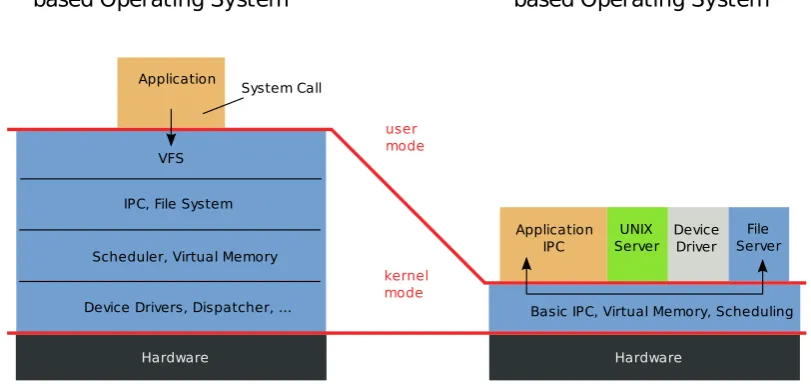
This comes very close to the definition of a nanokernel and is why the distinction between nanokernels and microkernels has faded. The minimality principle dictates that almost every-thing has to run in userspace, except the services which provide the mechanisms needed for the support of multiple processes:
- Managing memory protection
- Managing CPU allocation (threads or scheduling) - InterProcess Communication (IPC)
All other OS services such as device drivers and filesystem drivers, run as normal tasks in user space, as can be seen in the right half of figure 2.3. This architecture relies heavy on an efficient means of communicating between different processes. The performance of the IPC implemen-tation contributes for a great part to the performance of the entire OS. Existing microkernels and operating systems using microkernels are Mach, L4, QNX Neutrino, Minix, OpenRTOS, Drops, Symbian.
Monolithic kernel
The monolithic kernel design has all OS services running within the privileged mode (kernel space) of the processor. This is schematically shown at the left in figure 2.3. This makes com-munication between OS services efficient and fast because there are no switches between priv-ileged mode and usermode. The drawback is that an error in a program in kernel space will likely corrupt and crash the kernel, and thus the entire system. Examples of operating systems using a monolithic kernel are Linux, FreeBSD, DOS, Windows 9x series.
2.3.3 Processes and threads
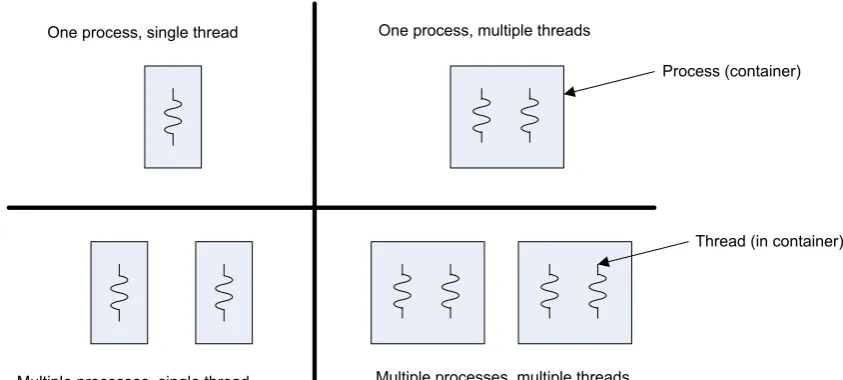
In Operating Systems terms, a process is a thread container. The process has its own address space which boundaries are guarded by the memory management unit in the cpu. A process groups the threads running in this address space. The threads themselves are the entities that are scheduled on the cpu by the scheduling algorithm. In Figure 2.4 this is schematically shown.
Background 7
One process, single thread One process, multiple threads
Multiple processes, single thread Multiple processes, multiple threads
Process (container)
[image:13.595.100.522.83.273.2]Thread (in container)
Figure 2.4: Thread and process types
address space
Kernel kernel
User space
Kernel space
User space
Kernel space Thread
library
kernel thread kernel threads
Figure 2.5: Diagram showing user level threads on the left and kernel level threads on the right
remains the same. When switching between processes the kernel has to change the address space on top of performing a context switch.
Thread types
Apart from the OS threads, also called kernel level threads, there are also user level threads. In Figure 2.5 the two types are shown. User level threads are unknown to the OS, and are all mapped to one OS thread. Kernel level threads are independent entities to the OS.
2.3.4 POSIX
[image:13.595.145.475.326.524.2]indepen-dent certification authority and compliance means it provides partial POSIX support, which is indicated in its documentation.
Code which uses POSIX-calls can be compiled and run on any Operating Systems which is POSIX conformant, resulting in the same behavior.
POSIX scheduling
The POSIX standard defines four different modes in which threads can be scheduled by the OS: FIFO, Round-robin, Sporadic and Other. FIFO and round-robin only apply to threads at the same priority level. When FIFO scheduling is used, threads run until completion, or until preempted by a higher priority thread. Round-robin scheduling is identical to FIFO, but adds timeslicing. A thread is allowed to run until its timeslice is consumed, after which it is put at the back of the READY-queue. Sporadic scheduling can be used in combination with Rate Monotonic Analysis. The other scheduling mode is unspecified in the standard and is left to the OS.
2.3.5 Application profiling
Application profiling is used to investigate the behavior of a program using information gath-ered while the application executes. For application profiling several techniques are available, each with its strengths and weaknesses.
Sampling
Sampling uses the instruction pointer to record where the application is spending its time. It gives a rough estimate by using a target agent which periodically samples the instruction pointer. A separate tool, for example an IDE, can gather all the samples, aggregate them and present the results in the form of a table or annotated code. The strengths and weaknesses can be summarized as follows:
+ No recompilation of the application necessary + Low overhead
- Granularity depends on the periodic sampling - Reliable results only over long period of time
- Possible incorrect results for timer based applications - No call graph
Call count instrumentation
The call count technique requires instrumentation support in the compiler, linker, and libraries, and a recompilation of the application. It provides a precise call count of all functions and all function pairs. A separate tool can visualize the call graph and call counts. The strengths and weaknesses can be summarized as follows:
+ Precise call count information
+ Call pair information, aggregated as call graph + Relatively low overhead
+ Can extend sampling profiling - Requires instrumentation
- No information for non-instrumented libraries
Function instrumentation
Background 9
+ Complete runtime call graph, including call counts and stack-frames + Precise function execution time
- Requires instrumentation - Higher overhead
Kernel event tracing
Kernel event tracing allows to observe the system as a whole. It uses hooks in each kernel call to record each call. Together with the function instrumentation is provides a system-wide perspective of the target behavior. The strengths and weaknesses can be summarized as: + System-wide perspective
+ Precise information on context switches
- Due to the amount of available data, only relatively small timeframes possible - Higher overhead when capturing the trace
3 Analysis
In the first section an analysis is done of the requirements for the CT-library to support real-time systems and still fit in the tooling used at the CE-group. The current architecture of the library and its problems are discussed in Section 3.2 and proposed solutions are given. In Sec-tion 3.3 a closer look is given to various Operating Systems and the best fit to the requirements is chosen. The last section draws the conclusions from the earlier analysis.
3.1 Requirements
3.1.1 Real-time
The most important job of a real-time system is to run its real-time tasks. In control engineering the control loop is the most important task. The constraints are determined in the Control Law Design phase (figure 2.1) and are dictated by the controlled system. Typically, the control loop is designed to run on each sample moment of the hardware sensors. This is a hard deadline. If it does not finish before the next sample moment the controller could become unstable with potentially catastrophic results.
Apart from the real-time tasks, the system may have to perform other tasks. For example log-ging, handling a user interface and remote connections. These tasks could be classified as soft real-time, or even not real-time at all. For example writing logdata to a physical medium takes a long time, compared to sample times. This task should not influence the hard real-time tasks.
To be able to determine whether a system is real-time feasible, it is required to know the exe-cution times of the tasks that are run. With this knowledge an analysis, e.g. Rate Monotonic (RM) or Earliest Deadline First (EDF), can be performed which indicates real-time feasibility (Marwedel, 2006). To determine the execution times the system has to be deterministic. This way the system behaves in a predictable manner and RM or EDF analysis can be used.
3.1.2 Operating System
The use of an Operating System greatly helps in the process of software development. The OS can take care of the most tedious tasks like booting the system, operating the hardware, man-aging resources and so on. The drawback is that it creates an extra layer between an application and the hardware, possibly affecting predictability and performance. An OS should therefore be real-time, or support real-time software. To classify as a real-time OS it should fulfill the requirements mentioned in Section 2.3.1.
3.1.3 CE-group
The new library should be backwards compatible with the old library where possible, to still be able to use the existing tools used at the CE-group. This means it should be usable in combi-nation with the code generation in gCSP. It should also be available for the most used hardware platforms: x86, ARM and PowerPC.
3.1.4 Dependable software
Analysis 11
3.2 Current architecture and problems
In the introduction (Chapter 1) the main problems with the CT-library were mentioned in short. In this section a more detailed analysis of the origin of the problems is given and where it fails to meet the requirements set in the previous section. Based on this analysis a solution is proposed.
3.2.1 CT-library Threading
The current CT-library employs its own scheduler and threading system using user level threads (Hendriks, 1998; Hilderink, 2005). In Figure 2.5 the difference between kernel level threads and user level threads is shown schematically. The advantages of user level threads are:
• Operating System independent • Usable on OS-less targets
• No kernel privileges needed for switching threads • Fast thread switching possible
Whereas the negative aspects of user level threads compared to kernel level threads can be summarized as:
• All user level threads block when one thread does a blocking OS call • Communication with non user level threads is hard to implement • User level threads can not be distributed over multiple cores
The first two negative points make real-time dependable software nearly impossible to imple-ment and outweigh the advantages the user level threads have to offer.
Scheduler
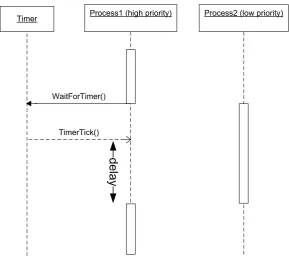
The internal user level scheduler in the CT-library is a prioritized FIFO scheduler without pre-emption and follows the OCCAM way of scheduling. For CSP behavior this is sufficient, but the lack of forced preemption causes non-deterministic behavior, which is unwanted for real-time applications. When a high priority process waits for example, on an external timer event, it is blocked and the scheduler will allow other processes to run (Figure 3.1). When the timer event arrives, the waiting process will be set in the READY state, but has to wait for the currently running process to finish before it can be scheduled to run. The CT-library has no means of preempting the running process, or even to limit the execution time of a process. As a result the latency to handling external events is unpredictable.
3.2.2 (Timed)CSP
CSP has no notion of timing. The current CT-library is based on CSP and has time support added by writing to external linkdrivers which use an OS timer. No mechanism is available for checking if the timing constraints are met.
There is substantial literature on Timed CSP (Hoare, 1985; Roscoe et al., 1997; Schneider, 1999), which adds a continuous time dimension to CSP. The main disadvantage of continues time is that it is infinite, which makes state verification impossible. Roscoe et al. (1997) therefore intro-duced the explicit time eventtock, which implicitly introduces discrete time. In Istin (2007) and SystemCSP by Orlic (2007) thetockevent is used to extend the CSP based models with timing. The improvements suggested by Istin (2007) are partly implemented in gCSP. SystemCSP is not yet implemented.
Process1 (high priority) Process2 (low priority) Timer
WaitForTimer()
TimerTick()
[image:18.595.141.431.76.333.2]delay
Figure 3.1: Unpredictable latency without preemption
3.2.3 RTAI
The Real Time Application Interface (RTAI) is strictly speaking not a real-time operating system but aims to add real-time capabilities to the standard Linux OS. It adds a hardware abstraction layer (Adeos) which implements an interrupt pipeline (ipipe). The RTAI kernel modules over-take Linux and are at the front of the interrupt pipeline. If RTAI does not handle the interrupts, they are passed on to Linux. Linux is a background task for RTAI and runs at a low priority. RTAI runs entirely in kernel space and real-time tasks run along RTAI, at a higher priority than Linux. In kernel space there is no memory protection between tasks (Section 2.3.2) and as a re-sult tasks can have a direct impact on each other. Applications based on the current CT-library use LXRT to be able to use RTAI’s hard real-time system calls while running in user space. This causes extra latency and the use of Linux system calls will cause undeterministic behavior. The big advantage of Linux, the great software and driverbase, is not available for real-time tasks.
3.2.4 Proposed solution
The usage of a priority based OS scheduler allows the removal of the internal CT-library sched-uler and the usage of kernel level threads. This solves the problem of blocking system calls while still preserving the correct way of scheduling. The addition of a preemptive scheduler al-lows to react to external events with a predictable latency. This will also allow the improvement of the current implementation of thetockevent.
The operating system for the CT-library should be reconsidered. RTAI fails to match the de-pendable software criteria of Section 3.1 and there may be better alternatives at the moment.
3.3 New architecture and approach
Analysis 13
3.3.1 Software architecture
There are three main software architectures used in real-time operating systems. The real-time executive, the monolithic kernel and the microkernel. A real-time executive is compiled as one big monolithic binary containing all required functionality normally found in an OS and the application. The significant downside to this approach is that all of the code, applications and kernel reside in one large address-space without protection.
The services and drivers provided by a monolithic kernel design (Section 2.3.2) reside all in kernel-space, without memory protection. This allows a high average throughput, and is easy to implement, but is very fault sensitive. A programming error in one part could crash or cor-rupt the entire system. The size of the kernel grows with the capabilities, in terms of binary size, as well as code size, making it hard to maintain and test. Debugging programs in kernel space requires special kernel debugging tools.
Microkernels (Section 2.3.2) have most services and drivers outside the kernel, running in user space, along normal applications. As a result they are guarded by the hardware memory man-agement unit, can be relatively easy developed like normal applications, and debugged with regular debugging tools. The work of Molanus (2008) showed that the message passing paradigm used in microkernels is similar to the synchronization method in CSP compositional constructs.
3.3.2 Available operating systems
There are quite a few available operating systems which claim to be time, or support real-time applications. The ones mentioned in Table 3.1 are considered more closely because they are already used at the CE-group, are freely available, or stand out with respect to the others.
Property RTAI Xenomai Open/FreeRTOS DROPS/TUD:OS QNX Neutrino
Hardware ++ ++ - -+ ++
Drivers ++ ++ - -+ -+
Real-time + + ++ + ++
Scheduler + + + + ++
Safe - - - + ++
Documentation - -+ ++ - - ++
Support + + + -+ ++
Open Source ++ ++ ++ ++ +
POSIX + + - + ++
Development tools - - + - ++
Debugging - - - -+ + ++
Table 3.1: Requirements of different Operating Systems
RTAI (DIAPM, 2008) and Xenomai (Xenomai, 2008) originate from the same code-base, but have taken different paths. They support real-time applications in the monolithic kernel, but provide non real-time support through a separate Linux instance. Real-time applications have to run in kernel-space, and therefore they are not classified as safe and are hard to debug. Doc-umentation for Xenomai is more up to date, but is not very extensive. They are both POSIX compliant. A great amount of hardware drivers is available.
OpenRTOS (High Integrity Systems, 2008) and its open source counter part FreeRTOS are real-time executives, but are mainly available for various microcontrollers. They provide a develop-ment environdevelop-ment including special debugging tools and very extensive docudevelop-mentation.
avail-able. It supports the x86 architecture, support for ARM is still unstavail-able.
QNX Neutrino (QNX Software Systems, 2008) is a microkernel based OS, available for a variety of hardware architectures. Specific hardware drivers may not be available, but driver develop-ment is relatively easy. There is no differentiation between real-time and non real-time tasks. Next to the normal priority based preemptive scheduler there is an additional and optional Adaptive Partitioning Scheduler. Very extensive documentation is available on the website. The source code is for a major part available, but is not licensed under a GPL-like license. It has a hybrid license, which allows the developer the choice of sharing their code. QNX is POSIX certified conformant. It offers an eclipse based development environment called Momentics with various debugging, tracing, profiling and monitoring tools.
Proposed architecture and OS
The match between CSP and the microkernel architecture make it the best choice. From Table 3.1 it can be concluded that QNX Neutrino, QNX for short, is the best match. QNX is the most extensive and mature microkernel based real-time operating system available. The drawback of a commercial license is taken away by the availability of (free) academic licenses. The ex-tensive documentation, IDE and detailed tracing, debugging and profiling functionality make it absolutely superior to its competitors.
3.3.3 Library structure
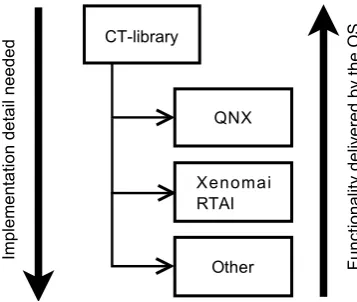
The library provides the Application Programming Interface (API) to access the CSP execution engine. The operating systems provides the implementation details for this API. By using an OS which matches the CSP constructs, the implementation detail can be less. As seen in the previous section and Chapter 2, QNX requires less work to implement than RTAI or Xenomai, see Figure 3.2.
CT-library QNX Xenomai RTAI Im pl em en ta tio n de ta il ne ed ed
Other Fun
[image:20.595.193.372.435.586.2]ct io na lit y de liv er ed b y th e O S
Figure 3.2: Relative amount of work needed to implement the CT-library
3.4 Conclusions
The current problems in the CT-library can be resolved by removing the internal scheduler and user level threading, and use the functionality offered by the operating system. This could result in a lower performance, which can be a drawback. A priority-based preemptive scheduler in combination with kernel level threads provides the same behavior as the current CT-scheduler with user level threads, but does not suffer from the blocking system call problem. Preemption is needed for deterministic interrupt latency.
mi-Analysis 15
crokernel provides a safe computing platform because almost all services and applications run in userspace, guarded by the hardware mmu.
The microkernel based real-time OS QNX Neutrino fulfills the requirements for real-time sys-tems and operating syssys-tems much better than the currently used RTAI. The available IDE and tools support the developer in creating dependable software.
4 Design and implementation
4.1 Introduction
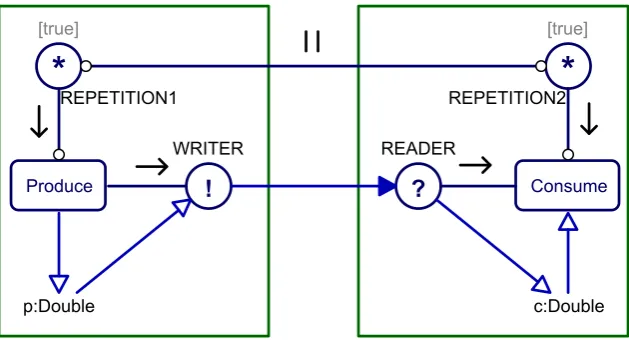
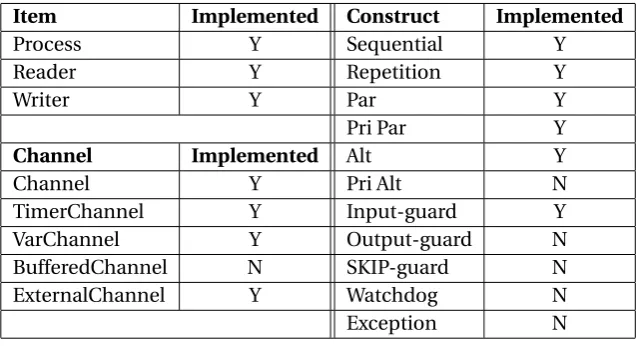
A typical model of an application used in Control Engineering is shown in Figure 4.1. Several processes run in parallel and communicate with each other and interface with external hard-ware. Each process contains more subprocesses and constructs. Figure 4.2 shows the most used objects in gCSP and in control applications. The current CT-library and gCSP support and implement all the items, channels and constructs shown in Table 4.1. The new CT-library implements at this moment only the most used parts due to time constraints. In Table 4.1 is indicated which items, channels and constructs are implemented and which are not yet imple-mented.
20 Analysing gCSP models using runtime and model analysis algorithms
Figure 3.28, Plotter model
[image:22.595.118.447.273.410.2]READER17->WRITER4->READER16->WRITER3->READER13->WRITER2->READER8->WRITER1->READER12 ->READER11->READER10->READER9->WriteToTimer->Safety_X->READER14->READER15->Safety_Y ->Safety_Z->READER1->READER2->READER3->WRITERX->PWMY_Safe_WRITER->READER19 ->PWMZ_Safe_WRITER->READER20->PWMX_Safe_WRITER->READER18->READER4->WRITERY ->DoubletoShortConversion->WRITER11->WRITER12->WRITER13->READER5 ->LongtoDoubleConversion->Controller->WRITERZ->(READER21) READER21->DoubletoBooleanConversion->WRITER14 ->VCCZ_Safe_WRITER->(READER17, HPGLParser) WRITER1->READER8->WRITER2->READER13->WRITER3->READER16->WRITER4->READER17 ->WriteToTimer->READER12->READER11->READER10->READER9->READER1->READER2->Safety_X ->READER14->READER15->Safety_Y->Safety_Z->READER3->WRITERX->READER4 ->WRITERY->PWMY_Safe_WRITER->READER19->PWMZ_Safe_WRITER->READER20->PWMX_Safe_WRITER ->READER18->READER5->LongtoDoubleConversion->Controller->WRITERZ ->DoubletoShortConversion->WRITER11->WRITER12->WRITER13->(HPGLParser) HPGLParser->(WRITER1, READER21) [start]->HPGLParser->WriteToTimer->READER1->READER2->READER3->WRITERX->READER4 ->WRITERY->READER5->LongtoDoubleConversion->Controller->WRITERZ->(HPGLParser)
Figure 3.29, Result of the analyser for the plotter controller
3.30. The last ‘HPGLParser’ references back to the first one and the loop is complete. This
complex order also is a result of the channel optimisations.
[start]->HPGLParser->WRITER1->HPGLParser->Reader21->READER17->READER21->(HPGLParser*)
Figure 3.30, Execution order of the chains
3.5 Conclusions
First of all the runtime analyser seems to work as expected. It is able to analyse most (pre-compiled) models, only rare situations are known for which the analyser will stop prematurely. The sets of rules are defined by using relevant tests containing most common situations. The defined rules are sufficient for deterministic models and for simple non-deterministic models as well. However, the rules are not proved to be complete. When new (non-deterministic) situations are analysed it might be possible that new rules are required.
Currently, the results of the analysis are based on a single thread scheduler. When multiple-cores are used and the scheduler is able to schedule for multiple threads the analysis results are undefined. Processes will be running really parallel and received state changes are originating from unknown threads. To solve this problem the received state changes should be accompanied by thread information. The analysis algorithms can construct the chains for each thread separately using this extra information.
Another usage possibility of the the current runtime analyser tool would be post-executing anal-ysis. The executable is executed on a target system first and the trace is stored in a log. A small tool could be created to replay the logged trace by using the animation protocol to connect to the
Figure 4.1: Typical gCSP model for control applications (Damstra, 2008)
In the next section, the design and implementation of Processes is presented, followed by the various Constructs in Section 4.3. The different types of Channels are discussed in Section 4.4. To show the additional functionality available in QNX, tracing and profiling is discussed in Section 4.5, while the possibility to use distributed systems with rendezvous channels is imple-mented in Section 4.6. A first attempt in using the advanced partitioning scheduler of QNX is explained in Section 4.7.
Model analyser 31
The buttons below the restart button in panel 2 can be used to skip steps of the algorithm. When a setting is changed only a part of the algorithm needs to be rerun depending on the changed setting. This may save rearranging the dependency graph when that step is skipped. On slower computers or when using a big model, skipping algorithm steps might save valuable time.
The User Interface also supports rearranging the dependency graph by selecting and dragging (groups of) processes. It is able to store and reload the rearranged processes in the dependency graph. It is also able to export the created views in PNG and EPS format and to change settings of the available cores and processes in order to influence the algorithms.
6.2 Algorithms
Thealgorithm created by van Rijn (1990) will beused. It isthemost suitableand clearly explained algorithm found. The important parts are based on a set of rules that can be extended, in order to create an even more sophisticated algorithm. The original algorithm was created to be used for model equations run on transputers. The extended algorithm is usable for scheduling CSP processes on available processor cores or distributed system nodes.
The algorithm blocks, shown in Figure 6.1, are independent blocks chained together. So it is fairly easy to extend the blocks or to add a new one in between without the need to rewrite following blocks. Assuming that the data send to the existing blocks stays compatible. This data is also used by the user interface to update its views after each step. This section will describe each separate step or block of the algorithm.
Unlessstated otherwise, themodel of Figure6.3 isused to createtheshown resultsin thefollowing sections.
Figure 6.3, Exploded view of the ProducerConsumer model
6.2.1 Creation of the structure tree
The structure tree, shown in panel 1 of Figure 6.2, is only for informational use. The algorithm does not use it. This algorithm step is simple:
• It loads the selected model
• Builds the tree by recursively walking trough all sub-models to add the available parts • And sends the loaded model to the dependency graph step
6.2.2 Dependency Graph creation
The dependency graph is extensively used by the algorithm blocks to find and make use of the dependencies of the processes. Thus creating a good and complete dependency graph is very important.
Control Engineering
Figure 4.2: Most used gCSP constructs in exploded view
[image:22.595.129.444.578.748.2]Design and implementation 17
Item Implemented Construct Implemented
Process Y Sequential Y
Reader Y Repetition Y
Writer Y Par Y
Pri Par Y
Channel Implemented Alt Y
Channel Y Pri Alt N
TimerChannel Y Input-guard Y
VarChannel Y Output-guard N
BufferedChannel N SKIP-guard N
ExternalChannel Y Watchdog N
[image:23.595.148.467.78.251.2]Exception N
Table 4.1: Available gCSP constructs in the new CT-library
4.2 Processes
A process in CSP terms is an object which can be executed and has references to the channels connected to it. The activity of the process is encapsulated in itsrun()method. Processes may interact with their environments only through their communication interfaces. A process itself can be composed of other processes and constructs. This implementation is equal to the one found in the old CT-library.
4.2.1 Readers and Writers
The READER and WRITER objects in Figure 4.2 are process instances whose only functionality is to communicate over a channel. Therun()method is already filled. The WRITER puts a variable on the channel, the READER puts the received value in a variable.
4.3 Constructs
Constructs are implemented as processes without channel interfaces. Their children, pro-cesses composed in the constructs, are immediately connected to the channels. Each construct can be given an execution time-limit. If the processes in the construct are not finished within the time-limit, a notification is send to the construct.
4.3.1 Sequential
The sequential construct executes its child processes in sequence according to the order of processes in the declaration list of the construct. It terminates after the last child process has terminated.
4.3.2 Repetition
The repetition construct is a special form of a sequential construct. Instead of terminating after the last child process, it evaluates a predefined condition whether it has to repeat the sequence of processes or not.
4.3.3 Parallel
A threadpool is created at the construction of the parallel construct which holds one thread for each child process. All child processes are dispatched to their own thread, leaving the main thread available for monitoring timeouts on the execution time. When a child process termi-nates, the freed thread is returned to the pool. The threadpool is only destroyed on destruction of the parallel construct. For consecutive executions of the same parallel construct (calling the
run()method), the threads in the threadpool are reused, eliminating the overhead of
creat-ing and destroycreat-ing OS threads repetitively. This behavior differs from the old CT-library, where creating and destroying user level threads is a much cheaper operation.
4.3.4 PriParallel
Instead of dispatching each child process to a thread with the same OS priority, the threads are given a higher priority according to the order of processes in the declaration. This differs slightly from the original implementation where priorities were relative to each other, whereas in the new construct they are absolute OS priorities. To prevent overlapping priorities in nested PriParallel constructs, the step size between priorities can be adjusted. There is a limit of 256 priority levels in QNX, 0 being the idle thread, 255 the highest priority. In most applications this limit will not pose a problem.
4.3.5 Alt
The alternative construct offers the environment a choice between its child processes, based on which process can accomplish a channel communication. Each child process has a guard lis-tening on the associated channel. At the moment only ChannelInput guards are implemented. Because ChannelOutput guards are difficult to implement without additional helper processes, and output guards are rarely used, they are not yet implemented. When a writer on the other end of a channel becomes ready to communicate, the alternative construct executes the child process connected to the channel.
On construction a threadpool is created with one thread for each guard. The guards are dis-patched to their own thread and try to establish channel communication on a specific chan-nel. On success the alternative construct is notified, the connected child process is started and given the established channel communication. The child process completes the rendezvous communication with the sender. The other guards are canceled and the channels they were listening on are released. The threads are returned to the threadpool. The pool is destroyed only when the alternative construct is destroyed by its parent.
4.4 Channels
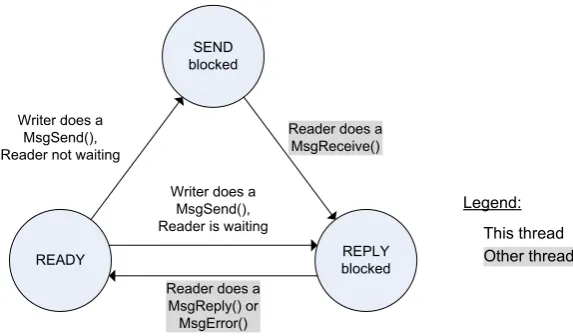
In CSP, processes can become blocked on communication events, which is indicated by its state. A process can be RUNNING, READY, SEND blocked, or RECEIVE blocked. The thread states used by QNX in channel communication are nearly identical, but the rendezvous behav-ior differs from the CSP kind on one point. In QNX, the receiving end has to explicitly reply to the sender it has received the message. When a process writes a message to a channel and no reader is waiting, it is put in the SEND-blocked state as shown in Figure 4.3. When a reader be-comes available the message is sent and the writer is put in the REPLY-blocked state, meaning it is waiting for an answer from the receiving end of the channel. A process could wait until it has finished its work before it sends the reply message. The CSP rendezvous does not support this behavior, so in the library a reply is send back to sender as soon as the message is received.
Design and implementation 19
SEND blocked
READY blockedREPLY
Writer does a MsgSend(), Reader not waiting
Reader does a MsgReceive()
Writer does a MsgSend(), Reader is waiting
Reader does a MsgReply() or MsgError()
Legend: This thread Other thread
Figure 4.3: State changes in channel communication on the writer side (this thread)
READY RECEIVE
blocked Reader does a
MsgReceive(), Writer not waiting
Writer does a MsgSend()
Legend: This thread Other thread Reader does a
MsgReply() or MsgError()
[image:25.595.163.450.78.246.2]Reader does a MsgReceive(), Writer is waiting
Figure 4.4: State changes in channel communication on the reader side (this thread)
and one writer can be active on a channel at all times.
A CSP channel supports multiple readers and writers concurrently. When they try to use the channel at the same time, they are ordered by their priority on a first come, first served basis. A QNX channel has the same properties as the required One2OneChannel, Any2OneChannel, One2AnyChannel and Any2AnyChannel, which means only one implementation suffices.
The priority inversion problem is prevented by using the priority inheritance protocol. The QNX kernel has this protocol standard implemented in the channels. This means that the pri-ority of the process at the receiving end is temporarily boosted to the pripri-ority of the sender. After the reply message is sent, the receiver has to take care itself of returning to the original priority. In the new CT-library the priority is checked after each completed communication event and the priority is adjusted when necessary.
A major benefit of using QNX native channels, is the support for timeouts. Each potentially blocking operation can be guarded by a timeout, completely implemented in the QNX kernel. In the new CT-library, the read and write actions on a channel are extended with an additional timeout parameter. On a timeout, the kernel unblocks the thread and the read or write action returns an error. The return value of a read or write action has therefore to be checked.
4.4.1 TimerChannel
A TimerChannel is implemented as a special type of channel which will block until a timeout has elapsed. It can be used to synchronize periodically on atockevent, or to wait for a specific amount of time to elapse.
To wait a specific amount of time, the process writes the desired amount to the TimerChannel, which programs the timer in one-shot mode. When the timer fires it delivers a message over the channel to the waiting process.
For periodic synchronization the timer is programmed in periodic mode. This gives a more ac-curate timing because it prevents the overhead of programming the timer multiple times. The timer sends a message over the TimerChannel on every timer tick. These messages accumulate on the channel, if they are not received by the process. It is not yet possible to check if there are multiple messages waiting on a channel.
4.4.2 External channels
The communication with the outside world is usually performed using a hardware device. The software driver provides the interface for applications to access the hardware device. QNX drivers are normal user-space programs. They run in user-space and request from the OS low-level access to the hardware they need. Because of the message passing used in QNX, the inter-face from the driver to other programs has to go through messages. Therefore a driver registers itself with a pathname (e.g. /dev/motordriver) by creating a channel. A program willing to communicate with the driver simply connects to the channel and sends messages over it. The driver replies with the appropriate response and activates the hardware.
This mechanism is very much like the normal channels described above, with the exception that the channel does not need to be created, only connected to. The ExternalChannel behaves after connecting exactly like a normal channel. The linkdrivers used in the old library are no longer necessary because the driver already provides the message passing interface. It is not yet possible to draw and use ExternalChannels directly in gCSP. The existing LinkDriver objects still have to be used, but are nothing more than a link between a READER or WRITER and the ExternalChannel.
4.5 Tracing and profiling
Tracing, monitoring (Posthumus, 2007) and animation (van der Steen et al., 2008) are used to monitor and visualize the execution of a system or application. Two levels at which informa-tion about the system is desired are the CSP level, and the code level. The CSP level uses the processes, constructs and the synchronized communication to evaluate the correct behavior of the system, according to its CSP specification. At code level it gives insight in the actual behavior of the program, the functionality enclosed in therun()method of a process.
The functionality to trace and profile the behavior of the program should not influence the real-time part. The facilities in the old library are not decoupled from the real-real-time parts, which results in unpredictability and are therefore not suitable for real-time systems. The current tracing functionality is putting messages on standard output, typically the screen. This is a blocking system call, which does not influence the custom scheduler in the old library, but will influence the QNX scheduler. A process which unblocks again will be put at the end of the ready queue for its priority level. Writing to standard output is a very time consuming operation, so it should be avoided in real-time applications.
Design and implementation 21
6>QNX Neutrino Realtime Operating System
Instrumented kernel
The instrumented microkernel can monitor, record, and time-stamp every system event, including kernel calls, interrupts, messages, thread states, and scheduling activities. It is, in effect, a software logic analyzer for your entire system. If something goes wrong, the kernel will help you pinpoint when the event occurred, which software modules were involved, what those modules were doing, and, more importantly, how to interpret the event.
A drop-in replacement for the standard QNX Neutrino microkernel, the instrumented microkernel is nonintrusive, so you don’t have to modify your code. Better yet, you can use it in live production systems, since it’s only marginally slower than the regular microkernel. Performance is affected only when events are being traced, but even then, you can perform event logging dynamically and filter information at various levels to ensure the least possible impact on your system.
With the instrumented kernel, you can:
3 capture system-level activity— The kernel can record and time-stamp every system event, including kernel calls, interrupts, messages, thread states, and scheduling.
3 create custom filters— If the stock event filters provided by the instrumented microkernel don’t suit the behavior you want to capture, no problem: the kernel supports dynamic, user-defined filters for complex, application-specific conditions. Your applications can also inject custom events into the trace system to proactively influence the event-collection process.
3 visualize system events— The instrumented microkernel also gives you precise control over which events are recorded and when, so you can focus on areas of interest. The kernel works hand-in-hand with the QNX Momentics®
system profiler, which lets you graphically “zoom in” on areas of interest and view complex interactions.
Instrumented Kernel
Using the instrumented kernel in the QNX Neutrino RTOS, you can quickly pinpoint timing
conflicts, deadlocks, logic flaws, software faults, and a variety of other system-level issues,
in both uniprocessor and multiprocessor systems.
Instrumented kernel
Using the instrumented kernel with the QNX Momentics system profiler, you can quickly pinpoint deadlocks, logic flaws, and a variety of other performance-degrading hotspots. Capture utility Circular event buffers Events State changes On/off Filters Static event filters
User defined filters Network QNX Momentics system profiler
(Graphic visualization tool)
[image:27.595.101.578.84.212.2]Log file System calls Interrupts Process/thread creation
Microkernel
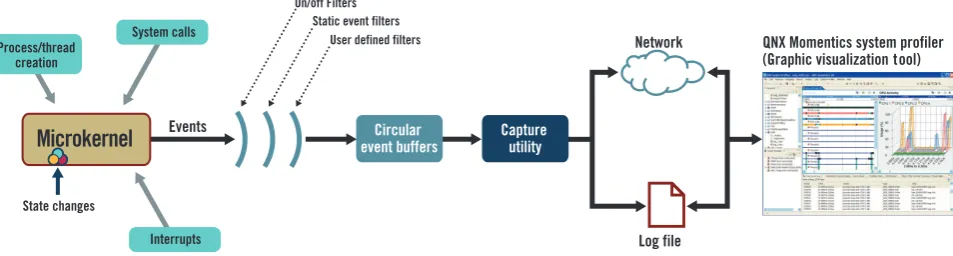
Figure 4.5: QNX instrumented kernel overview (QNX Software Systems (2008))
can be found in instrumentation of the code.
4.5.1 Instrumentation
When a recompilation of the application is possible, call count instrumentation or function instrumentation (Section 2.3.5) can provide a better way of tracing. The QNX Momentics IDE can visualize the data collected from these methods. Examples are shown in the next Chapter and in Figure C.2.
For a detailed view of the entire system, kernel event tracing has to be used. QNX has a special instrumented kernel (Figure 4.5) which allows to record information about what the kernel is doing, generating very precise time-stamped events that are stored in a circular linked list of buffers. Not only system calls like thread creation, but also interrupts and read/write actions on channels are recorded. In combination with the call count instrumentation or function instrumentation, this gives a really detailed view of the system and the application. The in-strumented kernel runs at 98% of the speed of the regular microkernel QNX Software Systems (2008). The events can be captured by a tracelogger and visualized in the IDE. For an overview of the possibilities of the instrumented QNX kernel see Molanus (2008) and QNX Software Sys-tems (2008). This functionality allows to trace and visualize the behaviour of the program and see the influence of other system parts on the application, without modifying the sourcecode of the application.
The instrumented kernel allows to insert user-generated events into the stream of kernel events. They are very small, integer-based events, which can replace the old tracing macros. To con-vert the numbered events to more meaningful messages, the IDE can decode the events using an XML-file which describes the events. There are no special functions to accomplish this im-plemented in the library yet. Adding a user-event has to be done by hand by calling the QNX
TraceEvent()function. For more information about setting up the instrumented kernel and
using the IDE for tracing, see Appendix C. The QNX Foundation Classes (QFC) (Allen, 2008) have preliminary support for using the instrumented kernel during runtime, but this is still a proof of concept and therefore it is not used in the library. Further research is needed to asses if the QFC is usable, or if the techniques used in the QFC can be reused in the CT-library.
4.6 Qnet
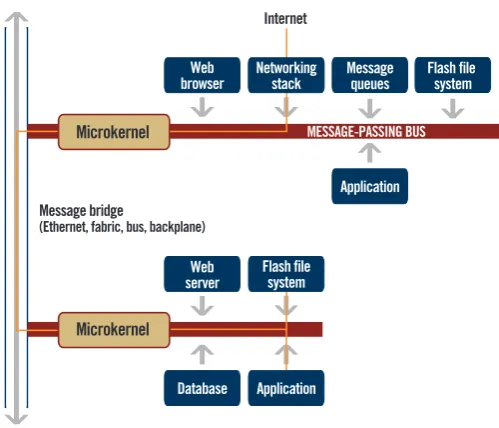
Distributed processing involves multiple nodes which have to communicate over some type of network link. QNX has its own protocol for distributed networking called Qnet. It extends the message passing architecture over a link, e.g. ethernet, resulting in transparent access to any resource on any node (Figure 4.6).
22 Redesign of the CSP execution engine
Message queues
Message bridge
(Ethernet, fabric, bus, backplane)
Internet Web browser Microkernel Microkernel Flash file system Flash file system Application Application Database MESSAGE-PASSING BUS Networking stack Web server
Transparent distributed processing provides a framework for the dynamic interconnection of hardware and software resources located on remote nodes, using standard messages. Processes running on a single CPU will continue to com-municate with each other even if they are subsequently distributed among multiple CPUs, enabling you to extend resources and simplify the design of multi-node systems.
With this unique capability, you can create highly robust and fault-tolerant systems that offer on-demand access to resources on multiple CPUs.
Using transparent distributed processing, you can:
3 reduce hardware costs— Nodes can share resources instead of duplicating them, eliminating redundant hardware. For example, if one node has a large flash file system, other nodes don’t need to; they can simply use that node’s flash memory instead.
3 deliver built-in redundancy and load balancing— Since QNX Neutrino inherently supports multiple links between CPUs, data will automatically be re-routed over the remaining links without loss of service. Network traffic can be load-balanced over all available links, resulting in significantly higher throughput.
3 gain location independence— Global name service provides a central directory of global naming and location services, enabling the flexible deployment and portioning of the application at runtime.
3 implement centralized debugging— Query and collect remote data via a single connection to multiple cards.
3 work with any transport— Since transparent distributed processing operates above the transport layer, it works well across LANs, backplanes, proprietary switch fabrics, and vehicle buses such as MOST.
Transparent Distributed Processing
The QNX Neutrino RTOS’s transparent distributed processing replaces the traditional
custom messaging infrastructure required to enable inter-processor communications —
saving time and costs associated with custom development and incremental hardware.
5>QNX Software Systems
Transparent distributed processing
[image:28.595.159.409.147.361.2]Transparent distributed processing allows an application to access resources on any node in the network. Applications and services can become instantly network distributed without special coding.Figure 4.6: Transparent distributed processing overview (QNX Software Systems (2008))
Design and implementation 23
#Create the reading end of a remote channel
Channel< i n t >* chan = new Channel< i n t >(REMOTEREAD, " / csp / channel " ) ; #Normal read from the channel
i f ( ( r e t = chan−>read(&value , timeoutvalue ) ) ! = EOK) {
std : : cout << "Read f a i l e d : " << s t r e r r o r ( r e t ) << s t d : : endl ; }
Listing 4.1: Creating RemoteChannels, reading end
#Create the w r i t i n g end of a remote channel Channel< i n t >* chan = new Channel< i n t >
(REMOTEWRITE, " / net /node1/ csp / channel " ) ; i f ( ( r e t = chan−>write (&value , timeoutvalue ) ) ! = EOK)
{
std : : cout << " Write f a i l e d : " << s t r e r r o r ( r e t ) << s t d : : endl ; }
Listing 4.2: Creating RemoteChannels, writing end
manager to attach itself to a pathname (e.g. /csp/channel1) (Listing 4.1). The writing end of the channel is able to open the pathname like a normal file (e.g. open /net/node1/csp/channel1) and write to it (Listing 4.2), just like a regular ExternalChannel. The established channel works like a normal local channel and can be used for rendezvous communication. The deterministic behavior of the channel is determined by the network link between the nodes. The procedure to setup Qnet is explained in Appendix E.
4.7 Adaptive Partitioning Scheduler
The QNX Adaptive Partitioning Scheduler is an optional thread scheduler that guarantees a minimum percentage of CPU time to groups of threads, processes, or applications. This means that even under full load, low priority processes in a different partition will still get their min-imum percentage CPU time. In Figure 4.8 this is schematically shown. Each partition has its own guaranteed CPU time. If the system is not fully utilized, a partition is allowed to utilize more than its budget of CPU time, taken from other partitions.
In the new CT-library an application is started at default in a partition with a budget of 80% CPU time, which can easily be changed. The system has furthermore a debugging partition of 10%, which enables the posibility of remote or local debugging, even when an application is requesting 100% CPU time. The remaining percentage is automatically given to the system, and to all other programs which are eventually running. In Appendix D more information is given about setting up APS, and how to properly configure the debugging partition.
4.8 Conclusions
The use of functionality already present in the Operating System has slimmed down the CT-library compared to the old version. QNX provides the rendezvous channels, the threading mechanism and the scheduler for the library. The most often used constructs are implemented in the library.
24 Redesign of the CSP execution engine
12>QNX Neutrino Realtime Operating System
Using adaptive partitioning you can:
Build secure systems— Rogue software can prevent your critical system functions from running by starving them of CPU time or memory. To address this, QNX adaptive partitioning allows you to construct compartments around groups of applications and dedicate a portion of CPU time and memory to each compartment.
Maximize CPU use— Unlike static partitioning approaches with cyclical scheduling, adaptive partitioning recognizes that CPU utilization is sporadic and systems can often have idle time available. With adaptive partitioning, this idle time is not wasted. Since unused CPU cycles from one partition can be dynamically reallocated to other partitions,
overall CPU utilization is maximized. Standard priority-based scheduling is in force when the system isn’t under full load or attack. Adaptive partitioning provides a simple, reliable solution for systems that are heavily processor intensive and where task starvation is a design concern.
Get started quickly— Adaptive partitioning uses the standard POSIX programming model so you can use the same, familiar design, programming and debugging techniques as in any embedded system. You can introduce adaptive partitioning by simply defining the partition budgets and deciding which applications and/or threads reside in each partition. With QNX adaptive partitioning, applica-tions and system services can simply be launched into the appropriate partition.
Adaptive Partitioning
The QNX Neutrino RTOS is the only embedded operating system to provide secure,
guaranteed real time without compromising performance and flexibility. Using our
patent-pending adaptive partitioning technology, you can guarantee real time for your applications,
contain threats and protect your system.
Build secure compartments for your software using adaptive partitioning
Patent-pending adaptive partitioning by QNX Software Systems enforces CPU time partition budgets when the system is loaded and dynamically allocates free CPU cycles during periods of low processor utilization.
Partition 1
20% Budget 10 MB RAM
Partition 2
40% Budget 30 MB RAM
Partition 3
Untrusted apps 40% Budget
24 MB RAM
CPU guarantees for partitions at full system load
CPU utilization
25% 50% 75% 100%
Dynamic allocation of CPU during low utilization Microkernel Application Application Drivers File system Application Application 40%
60% 5% idle
15%
20% 40%
Partition 1 Partition 2 Partition 3
Figure 4.8: Adaptive partitioning (QNX Software Systems (2008))
disturbing the real-timeliness of the system.
Distributed processing is made available through RemoteChannels, which use Qnet and re-source managers to extend the normal rendezvous channels over a network link.