Services Discovery Frameworks for Dynamic
Environments: An Overview and Limitations
Furkh Zeshan
1Member IAENG
, Radziah Mohamad
1, Mohammad Nazir Ahmad
2Abstract— Distributed Embedded Real-Time Systems (DERTS), one of the most dynamic systems are setting trend of moving away from centralized, high cost products towards low cost and high volume products. The non-functional constraints and the device heterogeneity lead to system complexity. In this regard, Service Oriented Architecture (SOA) is the best methodology for developing loosely coupled, dynamic, flexible, distributed and cost effective application. SOA relies heavily on services and the semantic web handles the application complexity and heterogeneity with the help of ontology. With an ever-increasing number of functional similar web services in central repository, only functional descriptions of web services is not sufficient in the discovery process. It is also difficult to rank the similar services based on their functionality. Therefore, the Quality of Service (QoS) description of web services plays an important role in ranking services within many similar functional services. Context-awareness has been widely studied in embedded and real-time systems can also play an important role in services ranking as an additional set of criteria. In order to address the issues of complexity and ranking similar services based on the QoS and context-awareness, we have compared the existing work based on some of the important requirements of dynamic environments. The basic aim was to identify the best work and the limitations of the existing work. We also have provided some suggestions for the improvements of the existing.
Keywords—Quality of Service aware service discovery frameworks; Web services discovery frameworks; Context-aware service discovery frameworks; Web services selection framework
I.INTRODUCTION
According to the Internet of Things (IoT) vision [19], the majority of the devices will soon have communication and computation capabilities, which they will use to connect, interact and cooperate with their surrounding environment. In such dynamic environment, the service-based systems will provide a good groundwork for a new type of real-world aware applications. In such an environment, the efficiency will depend on the heterogeneous networked embedded devices and the challenge is how to discover the best real-world services for their integration into applications.
Heterogeneity in terms of programming language, operating platform and data management standards restricts the ability of the devices to interact with each other: if two devices speak different languages, have different operating platforms or data management standards, then the data
1 Department of Software Engineering,
Teknologi Malaysia (UTM), 81310 Skudai, Johor, Malaysia
[email protected], [email protected] (Corresponding Address)
2 Department of Information Systems,
Teknologi Malaysia (UTM), 81310 Skudai, Johor, Malaysia [email protected]
provided by one device cannot be interpreted correctly by the other. So in the dynamic environment of devices, heterogeneity restricts the understanding of the capabilities of the devices and how to discover and use these devices properly.
In this regards, Service Oriented Architecture (SOA) with the help of semantic web technology provides the base to address these restrictions properly and enables different devices to work together by exposing their functionalities to others as services. Semantic web and ontology (ontologies that present the concepts in a formal way by eliminating the terminological heterogeneity and enable the use of reasoning tools for knowledge discovery) allows the binding of data semantics along with the data for the ease of sharing and correct interpretation.
In order to develop dynamic, flexible, distributed and cost-effective applications, service-oriented computing can be used. Web services handle the complexity and heterogeneity with the help of ontology. Services are the entities which enable users to access the capabilities through pre-defined interfaces in accordance to the policies and constraints which are the part of the description of that service [20]. Services are platform-independent and can be accessed through the internet. The most significant aspect of the web, due to which the overheads of companies have reduced and business is flourishing, is the role of the facilitator in service outsourcing [21, 22]. The service deployment model can be applied to any application component in order to make it a service. Services are well-defined, self-described and reusable software components that can be used over the web using the most silent and stable technologies such as the SOAP communication framework, Web Services Description Language (WSDL) and Universal Description Discovery Integration (UDDI) (which provides a mechanism to clients to find services [23]) [24]. A service is a set of related functions that can be accessed through programming over the web [22]. The key feature of the web services is that they are loosely coupled, allowing ad-hoc and dynamic binding and reusable software components and the key challenge is to find (discover) the best service for solving the particular problem.
of QoS are not adequate, since the service providers and requesters may use different concepts, scales and measurements. Hence, the semantics of QoS is necessary in web service discovery for satisfying users’ needs and to determine whether the service is best suitable for the requesters’ needs.
For the last two decades, researchers have considered context-awareness for enhancing human-computer interaction by providing applications with context information [25, 26, 27] while in recent years, ontologies have been playing an important role in embedded and real-time computing. So, context-awareness can also play an important role in service ranking as an additional set of criteria which enables the selection of the most suitable service among the functional similar services. The work of [28, 29] have emerged as an important tool for context modeling and to integrate, share and reuse context knowledge from distributed and heterogeneous sources of information.
In this paper, we have compared the work of different researchers [1-14]; the objective was to identify the best work and the strengths and the limitations of the existing work. For comparison we have categorized the existing work into two groups, the QoS based frameworks and the context-awareness based frameworks. We have identified twelve different kinds of requirements and have categorized into two groups; the design based requirements (clarity, owl-s, automatic, extensibility, modularity and quality of service) and the process based requirements (dynamicity, prioritization, correctness, context-awareness, approximate matching and advance categorization). According to our knowledge this is a minimum set of requirements that have a large impact on the web service discovery, ranking and selection.
The rest of the paper is organized as follows. Section 2 presents the overview of service discovery frameworks. Section 3 provides the detailed discussion on comparative evaluation criteria. Section 4 discusses the comparative evaluation results and Section 5 provides the limitations and the future research directions. Finally, we conclude the overall paper in Section 6.
II.SERVICE DISCOVERY FRAMEWORKS
Due to the continuous increase of functional similar services in the central repository, the demand of efficient retrieval of services based on a set of required quality of services is increased. In this regards many researchers have tried to present the service discovery frameworks to address the limitations discussed in section I. In this section we have provided a brief overview of the existing work that we have divided into two categories; i: QoS based frameworks and ii: context-aware frameworks. Detail of the work from each group is given below.
A.QoS Based Service Discovery Frameworks
Baocai [1] has proposed a QoS ontology based framework for automatic discovery, composition and execution of web services using the semantic description. The proposed ontology is general purpose ontology for describing the quality of service attributes of the web service using the semantic description of the web services. The
framework can resolve the issues of interoperability of QoS description and can improve the efficiency for users in finding the best services. The proposed QoS ontology uses the OWL-S for describing its specifications.
MA [2] proposes a semantic QoS-aware framework for SWS discovery. The proposed framework is based on three layers. In the first layer semantic matchmaking is performed through DL (Description Logic) reasoning for examining the compatibility of the concepts involved from both sides (demand and offer). In the second layer QoS conditions are translated as a declarative constraints and user CP (constraints programming) to find the satisfying values. In the third layer, optimizing the global utility function is used for the getting the optimized result.
Chua [3] have presented a visualization framework where the service discovery and selection is performed based on the Quality of Service (QoS) attributes in a visual context. Visualization enables users to interact positively with the information and this technique has not been widely used in the process of web services discovery and selection. The proposed framework considers the Graphical User Interface (GUI) design criteria and design patterns in the service discovery process as a visual context. The framework also considers the priorities of users in discovery process.
The proposed semantic web service discovery framework in [4] uses functional and non-functional requirement of the user for selecting the most appropriate services. Author has used a canonical web service model (in which other semantic framework can be linked through semantic mappings) for flexible matching of services. The proposed model is based on deductive techniques which relax the query constraints (based on semantic descriptions and domain knowledge) for the enhancement of the search space of candidate services. A ranking process in the framework is performed based on the priority weights assigned by the users to a set of non-functional attributes.
Zhao [5] has presented a multi-source QoS collection based framework. This framework can collect, aggregate and store QoS data of different web service. This framework can construct a QoS model for the support of computation of QoS. Author has performed an experiment in-order to show the flexibility of the framework. They have implemented their service requesters QoS data collection approach using WSDL and java mapping data structure while service providers QoS data collection approach using handler method.
Li has proposed WSMO-QoS [6] framework. This framework consists on ontology based QoS meta-model and the Web Service Modeling Ontology (WSMO). The framework is based on the Web service execution environment WSMX and has two parts, the core part and the expansion part. In the core part service matching is performed at three levels (Basic information matching, IOPE matching and QoS matching) while in the expansion part services are rated based on the QoS score and the feedback by third-party organization and return the score to the service requester.
B.Context-Aware Service Discovery Frameworks
performed on service capability (Input/ Output, Preconditions/ Effects) and the non-capability (QoS) description. Against the user request the algorithm matches the request with all service by means of service category, Input/output and needed QoS and finally get the desired service. The whole matchmaking is based on the semantic filter while the QoS matching is performed type of parameters. The algorithm finally returns the ordered list based on the user defined preferences for web services.
The COnTag [8], a framework for a personalized ontology-based context-aware data search is based on the general concepts of PeCMan [15] and GloServ [16] the global service discovery system. The framework uses additional information on data coming from the users and the resources other than the tagged keyword for query optimization. Author has used the extended Newman tag ontology [17] for mapping the knowledge obtained from the user, tag and the resource onto a hybrid hierarchical peer-to-peer network. This extended ontology combines the flat tag registration and querying with ontology-based tag registration and queries.
The framework in [9] consists on goal based service ontology (to define domain specifications), a set of domain ontologies and a service matching algorithm. After defining the goal client submit his goal to the platform, then matching algorithm searches for services that can fulfill the client’s goal. Platform also uses the client’s contextual information as inputs in searching of services resulting in reduced interaction of the client. Author has used the task descriptions and concrete realization of activities for the support of dynamic service discovery. This framework work based on the assumption that the existing domain and task ontologies are defined by the domain experts. Author has tested the framework with a limited amount of services and concepts of the ontologies.
III.COMPARATIVE EVALUATION CRITERIA
In this section the above discussed work is compared based on the defined criteria. The basic aim of this comparison is to evaluate the usefulness of existing methods and to estimate the degree of effectiveness in discovery, ranking and selection of services. Detail of criteria is given below.
A.Context-awareness
Context-awareness is the information related to the data produced by the service. For example, generally, the information related to the temperature measurement service (device) is when and where the data was produced by the service and without this description the produced data is meaningless. In service discovery the user contexts and service contexts are compared with each other so as to fetch services of relevance with the aid of context awareness.
B.Quality of Service
With an ever-increasing number of similar web services in UDDI, a functional description of web services is not sufficient in the discovery process. It is also difficult to rank the similar services based on their functionality. Therefore, the quality of service (QoS) description of web services plays an important role in ranking services within many similar functional services.
C.Prioritization
In case of similar values of metrics of a candidate service, a user must be allowed to assign values to the metrics to get the best result according to his or her requirements.
D.Extensibility
Extensibility is a concept of software engineering applied to the software systems that deals with how to avoid errors by adding functionality in the system in the future. In case of application server for the semantic web, extensibility deals with the XML parsers or validators that support the XML schema data types, RDF stores, tools that map relational databases to RDFS ontologies, ontology stores and OWL reasoners [18].
E.Correctness
In a real-time system, the concreteness of the system behavior not only depends on the logical results of the computations, but also on the physical instant at which these results are produced. Normally, the determination of correctness of specific input is performed in the business logic layer against the business rules.
F.Dynamicity
In the real world, services in terms of devices are highly dynamic and they continually degrade, disappear and re-appear. This implies the need for automated and immediate (dynamic) discovery of services as well as their effective management.
G.Clarity
Clarity means the ontology is understandable by domain experts and is intended for shared conceptualization.
H.Modularity
This requirement allows for adapting Context / QoS ontology for different domains and applications.
I. Automatic
Automation enables the web services to be selected dynamically at run-time with the minimal user intervention and accelerate the process. Automation reduces the time spent in-order to create a weighted list of services and eliminates human errors and reduces the overall cost of the process.
J. Approximate matching
For the effective service discovery, it is necessary for any approach to return the service that meet the user requirements but if no service found exactly according to the user defined criteria, the approach should return the approximate results to the user.
K.Advance categorization
Service matching approach should categorize the found results based on the similarity score. It may be beneficial for the requester.
IV.COMPARATIVE EVALUATION
group); i: QoS based frameworks and ii: Context-aware frameworks. Similarly, we have divided the evaluation criteria into two groups (each group consists of six requirements); i: Design based criteria and the ii: Process related criteria. Table I is based on the observed data of these studies.
After analyzing Figure 1 (consists on the data of Table I) carefully, we came to know that the framework proposed in [1] is the most mature framework because it fulfills the eight requirements out of 12; hence its contribution in meeting the defined requirements is 66%. It also meets the highest designed based requirements out of all participating frameworks and its contribution in fulfilling the designed based criteria is 100%. Similarly, the framework proposed by the Liang [13] meets the highest process related requirements which are 83%. Whereas the framework proposed in [5] does not meet any process related requirements.
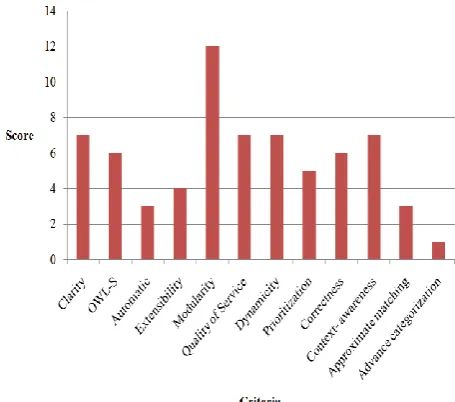
[image:4.595.310.547.145.343.2]From Figure 2, it is observed that the modularity requirement from the group of design criteria is the most fulfilled requirement whereas advance categorization requirement from process related criteria is the least fulfilled requirement by the studied frameworks. It is also observed that five requirements (Advance categorization, approximate matching, automatic, extensibility, prioritization and
TABLE I. COMPARISON OF SERVICE DISCOVERY FRAMEWORKS
Properties
Frameworks
Design Based Criteria
Process Based Criteria
C
la
rity
OW
L
-S
A
uto
m
a
tic
E
x
tens
ib
ili
ty
Mo
d
ula
rity
Qua
lity o
f
Ser
vice
Dyna
m
icity
P
rio
ritiz
a
tio
n
C
o
rr
ec
tnes
s
C
o
ntex
a
w
a
renes
s
A
p
p
ro
x
im
a
te
m
a
tchin
g
A
d
va
nce
ca
teg
o
riz
a
tio
n
Baocai [1] √ √ √ √ √ √ √ √
MA [2] √ √ √ √ √ √
Chua [3] √ √ √ √ √
Ayadi [4] √ √ √ √ √
Zhao [5] √ √ √
Li [6] √ √ √ √
Zhu [7] √ √ √ √
Arabshian [8] √ √ √ √
Santos [9] √ √ √ √
Suraci [10] √ √ √
Qi [11] √ √ √ √ √ √
Gu [12] √ √ √
Liang [13] √ √ √ √ √ √ √
Daniele [14] √ √ √ √ √ √
correctness) which are mostly related to the process related criteria are least considered requirements in the frameworks. The total percentage of the fulfillment of these requirements is 33%.
[image:4.595.47.296.377.775.2]From the analysis it is also observed that almost equal efforts have been done by the researchers in the field of QoS and context-aware frameworks.
Fig. 1. Framework evaluation based on evaluation criteria
QoS frameworks are slightly matured as compared to the context-aware frameworks because the score of requirements fulfillment of QoS frameworks is 51% while the score of context-aware frameworks is 49%.
Fig. 2. Comparison of framework evaluation criteria
Based on the above analysis it is recommended that the research on context-aware frameworks towards the most neglected requirements (Advance categorization, approximate matching, automatic, extensibility, prioritization and correctness) may be highly beneficial for the industry.
V.LIMITATIONS AND RESEARCH DIRECTIONS
[image:4.595.311.539.431.632.2]Detail is given below.
To make frameworks more generic, the evolution of an ontology based on the new concepts should be considered.
To determine the impact of the use of the framework on the activity of testing in real world application should be considered. The current work provides no discussion on the subject of testing in real world applications.
The lack of integration of accessibility tools within the discovery process of services tends to leave accessibility assessment procedures to quality assurance tasks.
There are still many difficult issues to solve in order to meet the objective of automated discovery. In this regards user-friendly tools adapted for the reuse of existing services in an ontology-based approach would be highly required.
VI.CONCLUSION
The trend to use smaller, more intelligent and cost-effective embedded real-time systems continues, resulting in much greater functionality and complexity. In order to operate and maintain such complex systems, SOA can be the best methodology which relies heavily on web services. Semantic web handles the system complexity with the help of ontologies. Web services discovery, ranking and selection based on context and QoS information have remained hot topics for research since the start of the semantic web. Context-awareness and QoS can be used in the service selection process as a set of criteria to enable the service requester to select the most suitable service among similar functional services. In order to address the issues of complexity and ranking similar services based on the QoS and context-awareness, we have compared the existing work based on some of the important requirements of dynamic environments. For comparison we categorized the service discovery frameworks and the evaluation criteria into two groups each. Based on the analysis it is recommended that the research on context-aware frameworks towards the most neglected requirements (Advance categorization, approximate matching, automatic, extensibility, prioritization and correctness) may be highly beneficial for the industry. We also have given some future research directions for the researcher’s in-order to make a successful service discovery framework for the dynamic environments.
ACKNOWLEDGMENT
We would like to thank Software Engineering Research Group (SERG) of Universiti Teknologi Malaysia for providing the facilities and support for this research.
REFERENCES
[1] Baocai, Y., Huirong, Y., Pengbin, F., Liheng, G. and Mingli, L. (2010). “A Framework and QoS Based Web Services Discovery.” 2010 IEEE.
[2] MA Q., Hao WANG, Ying LI, Guotong XIE, Feng LIU, “A Semantic QoS-Aware Discovery Framework for Web Services.” International Conference on Web Services 2008.
[3] Chua F.F., Hao Yuan, and Soo Dong Kim, “A Visualization Framework for Web Service Discovery and Selection Based on Quality of Service.” Asia-Pacific Services Computing Conference 2007.
[4] Ayadi N. Y., Mohamed Ben Ahmed, “An Enhanced Framework for Semantic Web Service Discovery.” Springer: Lecture Notes in Business Information Processing Volume 82, 2011, pp 53-67 [5] Zhao J., Lingshuang Shao, Zhiwen Cheng, Bing Xie, “A Flexible
Multi-Source Web Service’s QoS Acquisition Framework and Implementation.” Symposia and Workshops on Ubiquitous, Autonomic and Trusted Computing 2010
[6] Li S., Juan Zhou, “The WSMO-QoS Semantic Web Service Discovery Framework.” International Conference on Computational Intelligence and Software Engineering, CiSE 2009.
[7] Zhu Y., Xiao-hua Meng, “A Framework for Service Discovery in Pervasive Computing.” 2nd International Conference on Information Engineering and Computer Science (ICIECS), Dec. 2010.
[8] Arabshian K., Troy Cauble, “COnTag: A Framework for Personalized Context-aware Search of Ontology-based Tagged Data.” 19th International Conference on Web Services 2012.
[9] Santos L. O. B. S., Eduardo Gonc¸ alves Silva, Lu´ıs Ferreira Pires, and Marten van Sinderen, “Towards a Goal-Based Service Framework for Dynamic Service Discovery and Composition.” Sixth International Conference on Information Technology: New Generations2009.
[10] Suraci, V.; Mignanti, S.; Aiuto, A. “Context-aware Semantic Service Discovery.” 16th IST, Mobile and Wireless Communications Summit, Page(s): 1 – 5, 2007.
[11] Qi Y., Guo-Xing S., “Context-Aware Service Discovery in Pervasive Computing Environments.” Third International Conference on Semantics, Knowledge and Grid, 2007.
[12] Gu X., Shi H., Ye J., “A Hierarchical Service Discovery Framework for Ubiquitous Computing.” Third International Conference on Pervasive Computing and Applications, ICPCA 2008.
[13] Liang Y., Zhou X., Yu Z., Wang H., Guo B., “A context-aware multimedia service scheduling framework in smart homes.” EURASIP Journal on Wireless Communications and Networking 2012.
[14] Daniele L. M., Silva E., Pires L. F., Sinderen M., “A SOA-Based Platform-Specific Framework for Context-Aware Mobile Applications.” Lecture Notes in Business Information Processing Volume 38, 2009, pp 25-37.
[15] K. Daenen et al. “The personal internet.” In Bell Labs Technical Journal, 2010.
[16] Arabshian K., C. Dickmann, and H. Schulzrinne, “Service composition in an ontology-based global service discovery system.” Technical report, Columbia University, New York, NY, September 2007.
[17] Ayers D. Newman R. and Russell S. “Tag ontology.” 2005. http://www.holygoat.co.uk/owl/redwood/0.1/tags/.
[18] Oberle, D., Volz, R., Motik, B., Staab, S.: “An extensible ontology software environment.” In: Staab, S., Studer, R. (eds.) Handbook on Ontologies. International Handbooks on Information Systems, ch. III, pp. 311–333. Springer, Heidelberg (2004).
[19] E. Fleisch, F. Mattern, “Das Internet der Dinge. Ubiquitous Computing und RFID in der Praxis:Visionen,” Technologien, Anwendungen, Handlungsanleitungen. Springer-Verlag, 2005. [20] J. A. Estefan, K. Laskey, F. G. McCabe, D. Thornton, “Reference
Architecture for Service Oriented Architecture Version 1.0.” Online PDF, 2008.
[21] B. Medjahed, A. Bouguettaya, A.K. Elmagarmid, “Composing Web services on the Semantic Web.” The VLDB Journal 12:333-351 (2003).
[22] S. Tsur, S. Abiteboul, R. Agrawal, U. Dayal, J. Klein, G. Weikum, “Are Web Services the Next Revolution in e-Commerce?” (Panel). In: Proceedings of the 27th International Conference on Very Large Data Bases: Morgan Kaufmann Publishers Inc. p 614-617, 2001.
[23] T. Bellwood, L. Clément, D. Ehnebuske, A. Hately, M. Hondo, Y. L. Husband, K. Januszewski, S. Lee, B. McKee, J. Munter, C. V. Riegen, http://uddi.org/pubs/uddi-v3.00-published-20020719.htm, 2002.
[24] F. Curbera, M. Duftler, R. Khalaf, W. Nagy, N. Mukhi, S. Weerawarana, “Unraveling the Web services web: an introduction to SOAP, WSDL, and UDDI.” Internet Computing, IEEE 6:86-93 (2002).
Who, Where, When and how of Context Awareness, ACM Press, New York (2001).
[26] B. N. Schilit, N. W. R. Adams, W. Roy, Context-Aware Computing Applications, In Proceedings of the 1994 First Workshop on Mobile Computing Systems and Applications, pp 85-90, IEEE Computer Society Washington, DC, USA, 1994.
[27] R. Want, A. Hpper, V. Falcao, J. Gibbons, “The Active Badge Location System.” ACM Transactions on Information Systems, pp. 91 – 102, 1992.
[28] C. Bettini, O. Brdiczka, K. Henricksen,J. Indulska,D. Nicklas, A. Ranganathan, D. Riboni, “A Survey of Context Modelling and reasoning Techniques.” Pervasive and Mobile Computing 2009.
[29] T. Strang, C. Linnhoff-Popien, “A Context-Modelling survey.” First International Workshop on Advanced Context Modelling, Reasoning and Management. UbiComp 2004.
[30] S. P. Ran, “A model for Web services discovery with QoS.” ACM SIGecom Exchanges, 2003, 4(1):1-10.
[31] V.X. Tran, H. Tsuji, R. Masuda, “A new QoS ontology and its QoS-based ranking algorithm for Web services.” Simulation Modelling Practice and Theory ,17,2009:1378-1398.