FOLLOWER EFFECTIVENESS: THE LINK
BETWEEN WORK VALUES AND BEHAVIOR.
Melisa Mangan
University of Twente P.O. Box 217, 7500AE EnschedeThe Netherlands [email protected]
How do effective followers behave, and how is their behavior influenced by their
work values? In this study, the relation between follower work values and follower
behavior is examined. Surveys were held among followers and leaders to
comprehend the work values of followers. In addition, the actual behavior of 172
followers was coded through video observation during regular staff meetings. As
hypothesized, results show that highly effective followers differentiate themselves
through ‘intellectually stimulating’ each other during staff meetings. In addition,
the behavior ‘directing’ during regular staff meetings was found to be significantly
related to the work value type ‘self-transcendence’. The other behaviors, in the
analyzed behavior repertoire, did not significantly relate to the work values. These
findings have important implications for a research agenda that examines the
behavioral repertoire of followers, as it deepens the understanding about follower
behaviors, follower work values and follower effectiveness.
Supervisors University of Twente:
Prof. Dr. C.P.M Wilderom
Drs. A.M.G.M Hoogeboom
Keywords
Followers effectiveness, work values, follower behavior, video-observation method
Permission to make digital or hard copies of all or part of this work for personal or classroom use is granted without fee provided that copies are not made or distributed for profit or commercial advantage and that copies bear this notice and the full citation on the first page. To copy otherwise, or republish, to post on servers or to redistribute to lists, requires prior specific permission and/or a fee. 1stIBA Bachelor Thesis Conference, July 3th, 2014, Enschede, The Netherlands.
1.
INTRODUCTION
Traditionally, when organizations perform well, leaders are treated as ‘the heroes’ of this success. Today, it is generally accepted that followers are essential to leadership, because leadership cannot exist without followership (Uhl-Bien et al., 2013). Despite the acceptance of the importance of followership, until now leadership has been studied extensively but followership is often left out of leadership studies. However, in recent years, an increasing numbers of researchers have become interested in understanding the role of followers and the interaction between them and their leaders (e.g. Grayson & Speckhart, 2006; Dvir et al., 2002; Lord & Maher 1991). Much of these previous writings are typically leader-focused, highlighting leader personality, behaviors, attitudes and effectiveness. Therefore, leadership research can be criticized for overly focusing on leader behaviors and effectiveness, and for paying less attention to the role of followers. This criticism had led to carry out the present follower-focused study, which is exploratory in nature.
Compared to leader-focused research, relatively few studies are follower-focused. Some researchers described different types of follower behavior (Organ, 1988; Chaleff, 2009; Carsten et al., 2010). Other researchers made an attempt to link these types of follower behavior to follower effectiveness (Podsakoff et al., 2000; Boerner, 2007; Carsten et al., 2010). However, these studies do not take into account an important aspect that influences behavior: work values. Bardi and Schwarz (2003) argue that the linkage between values and behavior has not always been clearly demonstrated in empirical studies. The present study attempts to partially bridge this gap by focusing on followers’ work values that are assumed to partly determine follower behavior that in turn explains follower effectiveness. Therefore, the underlying question for this exploratory research: ‘‘How do follower work values influence follower behavior and how does this explain follower effectiveness?’’
Many studies in the leadership research have sought to identify types of behavior that improve individual and collective effectiveness. The most common research method to examine leader behavior is a survey questionnaire (Yukl et al., 2002). This method assesses behavior, using followers’ perceptions of their leaders’ behavior. Follower behavior can also be measured with a similar questionnaire, where followers assess their own behavior. Various researchers have however criticized that perceptions of one’s own behavior do not correspondent to actual behavior (e.g. Bono & Judge, 2004; Brown & Keeping, 2005). This perceptual bias in behavior can occur when followers view their own behavior more in line with their expectations than warranted on the basis of their actual performance. In addition, human beings are generally prone to biases when perceiving themselves. Many followers have the tendency to overestimate their performance and capabilities and see themselves in a more positive light than others see them (self-enhancement bias), while other followers may have the tendency to underestimate their performance and capabilities (self-effacement bias) (John & Robins, 1994). In response to this criticism, this study will use a more objective, valid, precise and reliable approach to examine behavior compared to the similar questionnaire based operationalizations of behavior. Using cameras and microphones, video observations will be made to observe followers’ behaviors in regular staff meetings, i.e. in their naturalistic work environments. Independent observers will examine follower behaviors through fine-grained video coding. This method ensures that perceptual bias in behavior will be reduced.
This study aims to contribute to the extant, limited followership literature. Specifically, by focusing on followers instead of leaders, we hope to fill a part of the gap in the literature. In addition, this study will introduce a more valid approach to examining (follower) behavior by using video-based observations. Besides, examining links among follower work values and behaviors may add to a better understanding and explain follower effectiveness.
2.
THEORY AND HYPOTHESES
2.1
Follower Behavior
Kelley (1992) shows that not only leaders, but also followers are an important force behind organizational productivity: followers contribute 80 percent to the work of an organization, where leaders only contribute 20 percent. Kelley (1992) defines followers as: ‘‘people who act with intelligence, independence, courage and a strong sense of ethics’’ (Kelley, 1992). Chaleff (1995) adds that a follower ‘’shares a common purpose with the leader, believes in what the organization is trying to accomplish, and wants both the leader and the organization to succeed’’. In addition, Dixon (2003) and Chaleff (1995) agreed that ‘a follower’ is not synonymous with ‘a subordinate’. Subordinates are expected to obey commands from the person in the position of leader. Followers are however not forced to follow the leader but follow because they want to (Ivey Business Journal, 2013). Looking at these definitions of ‘followers’, one can conclude that there is no consensus about the definition of a follower. However, these researchers give a general idea of what followers are and what their role in the organization is.
The second reason concerns the characteristics of the followers being observed. Observers may have different expectations for different followers, based on their motivation, skills and abilities; this results in specific behavior being labeled as in-role behavior for one follower and extra-role behavior for another. Third, the same behavior may also be labeled as in-role or extra-role depending on the time frame (Van Dyne et al., 1995). Hence, observing one follower at two different times could lead to originally labeling behavior extra-role, and later labeling the same behavior as in-role, and the reverse. In sum, OCB has been criticized in recent literature because of its unstable nature and being defined differently by different researchers, which led to difficulties in following and measuring OCB empirically (Van Dyne, Grahm & Dienesh, 1994). In addition, it is difficult to observe these behaviors in the work environment because they are not specific enough and do not contain the full behavioral repertoire.
Chaleff (2009), on the other hand, used two behaviors to distinguish effective followers from ineffective followers. The first behavior is ‘the courage to support’ and the second behavior is ‘the courage to challenge the leader’s behavior or policies’. Effective followers possess both behaviors. Carsten et al. (2010) have also identified three types of followers varying on a passive to proactive scale. First, passive followers just take orders from their leaders and do things in the way that leaders want. Second, active followers are loyal to the leaders, but state their own opinion. Third, proactive followers take initiative and opportunities to express their concerns and find solutions to problems before being asked to do so by their leaders. Effective followers are those who are passive and would involve behaviors such as being flexible and being obedient. For others however, effective followership requires proactivity where followers express opinions and take initiative. Looking at Organ’s construct of OCB and the social construction of followership from Carsten (2010), one can state that they do not include actual observable behaviors. However, identifying actual observable behavior could play a crucial role in creating knowledge about the differences between effective and ineffective follower behaviors. Therefore, it is important to examine actual behaviors of followers to get an indication of how effective followers behave.
As seen above, a variety of constructs and typologies of behavior exist in the followership literature, whilst in the leadership literature, behaviors are often broadly defined into two major types of behavior that are best described as ‘task-oriented behavior’ and ‘relation-‘task-oriented behavior’ (Yukl, 2013). One set of behaviors involves a primary concern for task objectives. This behavioral category includes assigning tasks to followers, asking followers to follow standard procedures and coordinating the activities of different subordinates. The other set of behaviors involves a concern for relationships. This behavioral category includes doing personal favors for followers, being willing to accept suggestions from followers, and treating followers as equals (Yukl, 2013). Yukl (2002) uses the Hierarchical Taxonomy to describe leaders. This includes behaviors that are directly observable on the work floor, whilst Organ’s construct of OCB and Carsten’s social construction of followership uses definitions in terms of attribution or outcomes that are not directly observable. In addition, Yukl’s observable behaviors are relevant and grounded in prior theory of leadership (Yukl et al., 2002). Therefore, this study chooses to take Yukl’s typology as basis of the behaviors that will be observed.
As noted earlier, task-oriented behaviors focus on ensuring that people and other resources are used in an efficient way in order to accomplish a task. Specific component behaviors include clarifying, task monitoring, informing and visioning. Relation-oriented behavior, on the other hand, is focused on showing consideration for team members’ feelings, enhancing team members’ skills, and being concerned for their welfare. Specific component behaviors include intellectual stimulation and individualized consideration. In the next section, each of these specific behaviors will be linked with follower effectiveness.
2.2
Task-oriented Behavior and Follower
Effectiveness
2.2.1
Clarifying
Leaders clarify in order to guide and coordinate work activities. Clarifying includes, among others, assigning tasks among followers without enforcing them, setting task objectives and planning short-term activities (Yukl, 2002). According to the findings of surveys in the leadership literature, there is an abundance of evidence to prove clarifying can enhance managerial effectiveness (e.g. Kim & Yukl, 1995; Shipper, 1991; Yukl & Kanuk, 1979). However, the effect of clarifying through followers is barely explored in the followership literature. Looking at the social construction of followership (Carsten et al., 2010) there is a behavior referred as ’taking ownership’. Taking ownership is defined as ‘’emphasis on taking full responsibility for, and having power and influence over, any part of an individual’s job’’ (Carsten et al., 2010). Looking at the characteristics of taking ownership (having power and influence over an individual’s tasks) it is comparable with clarifying behavior. Both active and proactive followers perceived that taking ownership made them effective in their follower role. This could give an indication that clarifying is also positively related to follower effectiveness.
Clarifying is a core component of directive behavior in the path-goal theory of leadership (House & Mitchell, 1974). Hence, in this study clarifying behavior will be considered as ‘directing’. Based on the foregoing, we can hypothesize: Hypothesis 1. The follower behavior ‘directing’ towards the leader or team-members is positively related to follower effectiveness.
2.2.2
Task-monitoring
Task monitoring behavior in this study is when a follower verifies or monitors the tasks of other team-members or their leader. A more appropriate task monitoring behavior for followers is Bales’ definition of task monitoring behavior: Bales (1950) defines task-monitoring behavior as ‘’asking for clarification and confirmation’’, we can call this ‘verifying’ behavior. This behavior could be analyzed as followers referring to previously made agreements and checking other team members’ progress in carrying out their tasks. Followers who frequently verify during staff meetings could give the signal that they are not aware of what is going on within their team. It is also possible that other team members do not explain current task progress, which results in verifying team members. In both situations, when a follower is verifying, he or she is obtaining information about agreements made and task progress achieved. This can give the follower the necessary information to carry out his or her own tasks effectively.
All in all, we propose that task monitoring is positively related to follower effectiveness. Since this study is about follower behavior, the study assumes that task-monitoring behaviors is a way of verifying the situation of other team members or of their leader. Thus the study hypothesizes:
Hypothesis 2. The follower behavior ‘verifying’ towards the leader or team-members is positively related to follower effectiveness.
2.2.3
Informing
‘Informing’, or ‘sharing information’, during staff meetings could be personal (i.e. about personal circumstances) or factual (i.e. about the task). In this study, the focus will be on factual informing. Arnold et al. (2000) state that ‘’informing refers to the leader's dissemination of company wide information such as mission and philosophy as well as other important information. This category included behaviors such as explaining company decisions to the team and informing the team about new developments in organizational policy.’’ These researchers developed an Empowering Leadership Questionnaire with eight categories of leader behavior, which included leader informing. Looking at the most recent version of Yukl’s popular Managerial Practice Survey (MPS), which represents several leadership questionnaires that measure a variety of behaviors, the behavior ‘informing’ is not included (Yukl, 1999). However, Mesmer-Magnus & DeChurch (2009) showed the importance of informing related to team performance. In addition, the observational study of Gupta et al. (2013) showed that informing is one of the important behaviors for effective leaders. Drawing upon this leadership research, it is also important for followers to inform his/her leader or team members. When followers are able to share information with his or her team members or leader, it probably means that he or she knows what is going on within the organization and has the information to perform the assigned task properly.
Hence, in this study we include the follower behavior ‘informing’ and we assume that it is positively related to follower effectiveness.
Hypothesis 3. The follower behavior ‘informing’ towards the leader or team-members is positively related to follower effectiveness.
2.3
Relation-oriented behaviors and
follower effectiveness
2.3.1
Visioning
‘Visioning’ is often related to effective leaders, inspiring their followers to perform well (Bass, 1985). However, followers could also have a vision. Visioning is not only providing a vision of what someone wants to be in the future, it could also be expressing opinions. Carsten et al. (2010) define ‘expressing opinions’ as: ‘’individual makes known his or her opinions and feelings to the leader and the group, constructively challenges leader’s ideas, decisions, initiative etc.’’ In this study followers were interviewed to obtain their opinion about effective followers. The majority of these followers agreed that ‘expressing opinions’ is an important behavior in order to be an effective follower. This could be an indication that expressing an opinion is positively related to follower effectiveness. Hypothesis 4. The follower behavior ‘visioning, giving an opinion’ towards the leader or team-members is positively related to follower effectiveness.
2.3.2
Intellectual Stimulation
According to Yukl (2013), ‘’intellectual stimulation is behavior that influences followers to view problems from a new perspective and look for more creative solutions.’’ Various researchers examined the relationship between intellectual stimulation and effectiveness with different results. Komives (1991), for example, found in his study a correlation of r= .74 between intellectual stimulation and effectiveness in a sample of resident assistants rating directors. Spangler and Braiotto (1990), however found a correlation of r = .25 between the leadership style of board audit committee chairmen and effectiveness. Looking at the study of Carsten et al. (2010), ‘Initiative/proactive behavior’ has similarities with intellectual stimulation. Initiative/proactive behavior is defined as ‘’willingness to identify, confront, and solve problems or issue; recognize and act on initiatives without deferring to the leader’’ (Carsten et al., 2010). These followers are willing to take opportunities to voice their concerns and offer solutions before being asked to do so by the leader, which makes this behavior comparable to intellectual stimulation. According to Carsten et al., the active and proactive followers in their study state that effective followers are initiative/proactive. This indicates that intellectual stimulation through followers may positive relate to follower effectiveness.
To the best of my knowledge, intellectual stimulation has not been measured amongst followers. Assuming that the relationship between intellectual stimulation through leaders and their effectiveness is equivalent to intellectual stimulation through followers and their effectiveness, we can expect: Hypothesis 5. The follower behavior ‘intellectual stimulation’ towards the leader or team-members is positively related to follower effectiveness.
2.3.3
Individualized Consideration
Leader effectiveness and individualized consideration are positively related to each other (Wang et al., 2005). However, to the best of my knowledge, individualized consideration of followers has never been linked to follower effectiveness in scientific research. Looking at the characteristics of individualized consideration (helping, supporting, voluntary behavior), it is comparable to OCB as described earlier (Organ, 1988). The relationship between OCB and follower performance has been studied. Boerner et al. (2007) showed in their study that OCB and follower performance are positively related. Based on the foregoing, I expect:
Hypothesis 6. The follower behavior ‘individualized consideration’ towards the leader or team-members is positively related to follower effectiveness.
2.4
Follower Work Values
It is assumed that individual behavior is affected by individual’s values. According to Bardi & Schwarz (2003) these linkages have not always been clearly demonstrated in empirical studies. Literature presents a large number of definitions of ‘values’ are giving in the literature. Rokeach’s definition is much cited. He defines a value as ‘’an enduring belief that a specific mode of conduct or end-state of existence is personally or socially preferable to an opposite or converse mode of conduct or end-state of existence.’’ (Rokeach, 1973). Comparing this definition to other definitions by other researchers, there are certain qualities they have in common (Roe & Ester, 1999): all definitions treat values as latent constructs involved in evaluating activities or outcomes, as having a general nature, and as applying at multiple levels. ‘Work values’ has been labeled as a specification of basic, personal values (Ros et al., 1999).
When linking values to behavior, a commonly used model is Schwartz’s research. Schwartz (1996) organized the total structure of value systems on two higher order dimensions, resulting in four value types. The first dimension opposes ‘openness to change’ (combining self-direction, stimulation and hedonism) to ‘conservation’ (combining security, conformity, and tradition). This dimension captures a conflict between the emphasis on own individual and independent action, thought and feeling versus self-restriction, resistance to change and protection of stability. Hedonism shares elements of both openness to change and self-enhancement. The second dimension opposes ‘self-transcendences’ (combining benevolence and universalism) to ‘self-enhancement’ (combining power and achievement). This dimension reflects a conflict between acceptance of and concern for other’s welfare versus pursuit of one’s self-interest and dominance over others (Schwartz, 1996).
Values in the categories ‘openness to change’ and ‘self-transcendence’ primarily regulate how one relates socially to others and affects their interests (Schwartz, 2012). Egri & Herman (2000) studied leadership values and styles in the environmental sector. In this study, environmental leadership is defined as ‘’the ability to influence individuals and mobilize organizations to realize a vision of long-term ecological sustainability’’ (Egri & Herman, 2000). They state that the description of environmental leaders is comparable to the descriptions of transformational leaders. Therefore, their study hypothesized that environmental leaders are more likely to exhibit a transformational style than a transactional style. Their assumption was consistent with their result; environmental leaders did display a wide variety of transformational leadership behaviors.
In addition, Egri & Herman (2000) assumed that environmental leaders, compared to managers in general, attribute higher importance to openness to change values and self-transcendence values. Their results provided support for their assumption regarding the work values.
To the best of my knowledge, work values of followers have never before been linked to follower behavior in the followership literature. Based on the findings of Egri & Herman (2000), one can conclude that leaders displaying a transformational style pay more importance to openness to change values and self-transcendence values. In addition, the findings of Fu et al. (2010) are in line with Egri & Herman’s study: the ‘self-transcendence’ motive is shown as the primary explanatory factor in a leader’s transformational style. Building on these studies, we can expect that followers who possess openness to change values and self-transcendence values exhibit a more transformational style.
The three relation-oriented behaviors (intellectual stimulation, individualized consideration and visioning) are components of transformational leadership (Avolio et al., 1999). The essence of transformational leadership is to be inspiring, developing and empowering others (Yukl, 2013). Therefore, transformational style consists of relation-oriented behavior. Assuming that transformational style consist of relation-oriented behaviors, we can hypothesize:
Hypothesis 7. Followers who score high on (a) ‘openness to change’ values or (b) ‘self-transcendence’ values are more relation-oriented than followers who score low on these values.
Whilst the values ‘openness to change’ and ‘self-transcendence’ have a more social focus, the values in the categories of ‘self-enhancement’ and ‘conservation’ primarily regulate how one expresses personal interests and characteristics (Schwartz, 2012). Kark & Van Dijk (2007) state that the values of self-enhancement and conservation can be linked to monitoring and transactional behavior. In transactional style, leaders clarify rewards and expectations and monitor the tasks of followers (Bass, 1995). Transactional style does not exclusively consist of all task-related behaviors discussed above. Yet, task-oriented behavior task monitoring is a very important aspect of transactional style (Lowe et al., 1996). Thus, this study intends to label transactional style as task-oriented. Based on the foregoing, we can expect that followers who possess self-enhancement and conservation more often display a transactional style.
Hypothesis 8. Followers who score high on (a) ‘self-enhancement’ or (b) ‘conservation’ values are more task-oriented than followers who score low on these values.
3.
METHODS
3.1
Design of Study
3.2
Sampling
The follower sample consisted of 172 employees employed in a large Dutch public sector organization. The sample compromised of 112 male (65.1%), 50 female (29.1%) followers and from 10 (5.8%) the sex is unknown. These followers were on average of 49.4 of age, ranging from 22 to 64 years old (SD=10.3). The followers had an average job tenure of 24.7 years, ranging from 6 months to 44 years (SD=13.4). The followers were asked, directly after the video recorded staff meeting, to fill out a survey in which they were asked about among others their work values. In total, 172 followers filled in the survey, which results in a response rate of 100% for the followers.
Follower effectiveness. Follower effectiveness, as perceived by the leaders, was measured using a questionnaire. In order to capture the overall sense of the effectiveness of the follower, a four-item scale was used. This four-item was originally developed by Gibson, Cooper and Conger (2009) to measure team performance. After rescaling these items, it was possible to measure follower effectiveness with the same four items. The four items are: (1) ‘’This employee is consistently a high performing employee’’, (2) ‘’This employee is effective’’, (3) ‘’This employee makes a few mistakes’’, and (4) ‘’This employee does high quality work.’’ Every leader rated his or her followers on a scale of 1 to 10 for each of the four items. This leader was the same person who chaired the staff meeting.
Follower behavior. In the current study, behaviors are divided into three categories: ‘self-defending’, ‘steering’ and ‘supporting’. The category self-defending consists of more negative behaviors, such as giving negative feedback. These types of behavior have not been studied much in the literature. Therefore, only the task and relation oriented behaviors in the two categories steering and supporting are relevant for this study. Task oriented behaviors consist of the behaviors directing, verifying and informing. An example of the behavior informing is: ‘‘we score significantly lower on accountability’’. The relation-oriented, on the other hand, consist of intellectual stimulation, individualized consideration and visioning. An example of intellectual stimulation behavior is: ‘’Do you have any plans regarding this?’’ and an example of individualized consideration is: ‘’I am sorry to hear that, how are things at home now?’’ Table 1, in the appendix, of this paper contains illustrative examples for each of the behaviors in the study.
Follower work values. Immediately after filming the staff meeting, a survey was administrated. This survey included Brown and Treviño’s (2009) work-value questionnaire to measure each work value type (openness to change, self-transcendence, self-enhancement and conservation). In order to capture the work values of followers, the followers were asked: ‘’To what degree do you use each of these values and what are important guiding principle for your work?’’ The answering scale was recommended by Schwartz (1996) and consists of -1 (opposed to my values) to 7 (of supreme importance). A sample item of an openness to change type value is: ‘Creativity’ (innovating, thinking outside the box), of a self-transcendence type value is: ‘Helpfulness’ (working for the welfare of others), of a self-enhancement type value is: ’Success’ (achieving, accomplishing) and of a conservation type value is: ’Conformity’ (following the rules, fitting in). All these work value types consist of five items, except the self-transcendence value. This work value type is comprised of merely three items, therefore we added three other work-relevant self-enhancement values from Schwarz’ Values Survey (Schwartz, 1992, 1994). Specifically, the values ‘’Directive’’ (authority: the right to lead or command), ‘Admirable’ (social recognition: approval by
others) and ’Diligent’ (ambitious: hardworking, aspiring) were added. These additional values are in line with how Brown and Treviño conceptualize self-enhancement at work.
3.3
Video Observation Method
The 172 followers and their leaders were videotaped during randomly selected staff meetings in the ordinary course of their daily business were videotaped. A total of 1800 minutes were recorded while each meeting took 138.47 minutes on average. The videos were precisely coded and analyzed through the behavioral software program The Observer XT which has been developed for the analysis, management and presentation of observational data (Noldus et al., 2000).
The observers were six third-year students of International Business Administration and three master students of the University of Twente who all received training on the software. Additionally, they learnt how to apply the 15-page behavioral coding scheme within the software (Van der Weide, 2007). Their training, and clear instructions, helped to enhance the accuracy of the coding of different behaviors.
Based on the behavioral coding scheme, the pre-defined sets of behaviors were coded very precisely for each leader and each follower to ensure valid and reliable results. In order to avoid subjectivity bias, two observers coded each video independently and subsequently the results were compared through the so-called confusion error matrix by The Observer XT to determine inter-reliability. This inter-reliability was defined as the percentage of agreement of a specific code within a time range of two seconds; if significant differences or disagreements occurred, the observers re-viewed, discussed and re-coded the affected fragment. In this study, the obtained average inter-reliability rate was 95%.
Each staff meeting was recorded by three video cameras installed beforehand in the meeting rooms so that actual leader and follower behaviors could be ensured. According to Erickson (1992) and Kent and Foster (1997), shortly after entering the meeting room, the presence of the camera is forgotten and leaders and followers behave naturally whereas observers who attend meetings often cause more obtrusive and abnormal behaviors of leaders and followers. This is why video cameras are used instead of outside people sitting in the same room, observing the meeting and taking notes. Hence, observer bias is prevented and the meeting takes place without any interferences.
3.4
Behavioral Coding Scheme
Feyerherm (1994) extended the work of Bales and Borgatta; he used an experimental approach towards measuring leadership behaviors and added some task-oriented and social-oriented behaviors to their work. The three coding schemes, (Bales, 1950; Borgatta, 1964; Feyerherm, 1994), have two important commonalities. First, all of three schemes assess the directly observable behavior. Second, the three studies use behavioral schemes to code leader behavior in a group context (e.g., Avolio, Howell, & Sosik, 1999; Bass & Avolio, 1995; Pearce et al., 2003; Yukl et al., 2002). We have also used the behavioral taxonomy of Yukl et al. (2002) in the development of the behavioral coding scheme. It is more accurate for describing the behaviors of followers in more detail, i.e. the observable behavior than in one or two meta-constructs such as transactional or transformational leadership. Examples of behavior coded as directing behavior are; “I want you to have the work done next week”, “You handle this one”, and “Do you want to figure this out for me?”
3.5
Data Analysis
The objective of this study was to examine how follower work values could influence follower behavior. In addition, this study attempts to explain follower effectiveness relating it to follower behaviors. Because the majority of the variables in this study did not follow a normal distribution, the non-parametric Mann-Whitney U test was conducted to identify statistical significant differences. Besides, correlation analysis was used to examine the relationship between mutually exclusive follower behaviors and follower effectiveness.
[image:7.612.324.556.124.325.2]4.
RESULTS
Table 2 presents an overview of the frequency and duration of the coded follower behaviors. It is remarkable that followers displayed a high amount of ‘informing’ during staff meetings, with a total duration of 34.4%, and 32.7% of the time in terms of their frequency. ‘Visioning/giving own opinion’ behavior accounted for the second most frequently displayed behavior (with a duration of 24.0%, and 15.0% of the time in terms of their frequency). Next to these two behaviors, ‘providing negative feedback’ was shown the most, with a duration of 10.3%. In general, task-oriented behaviors (i.e., directing, verifying and informing) were more frequently displayed than relation-oriented behaviors (i.e. intellectual stimulation, individualized consideration, visioning/giving opinion).
Table 2. Frequency and duration of displayed follower behaviors
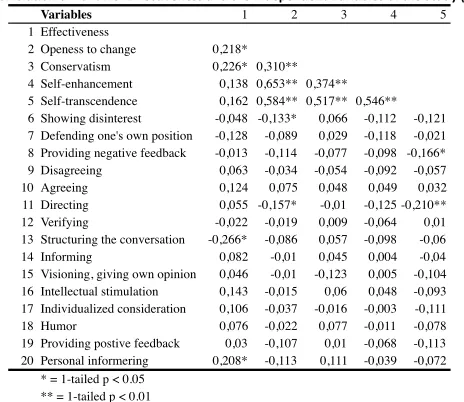
Table 3 presents the correlations between the frequencies of the specific behaviors and follower effectiveness. In addition, in table 4 we look at the correlation between the duration of the individual behavior and follower effectiveness.
Table 3. Correlation of Follower Effectiveness and the Independent Variables of the Study (Frequency)
Table 4. Correlation of Follower Effectiveness and the Independent Variables of the Study (Duration)
In hypothesis 1, a positive relation between ‘directing’ and follower effectiveness is proposed. Results shown that there is no significant correlation between the frequency of ‘directing’ and follower effectiveness (r = .055 p = .294). Also there was no correlation found between duration of ‘directing’ and follower effectiveness (r = .021, p = .416). A positive relation between the frequency of the behavior ‘verifying’ and follower effectiveness, as stated in hypothesis 2, was not found (r = -.022, p = .413). Looking at the relation between the duration of ‘verifying’ behavior and follower effectiveness, there is also no significant relationship found (r = -.087, p = .195).
Frequency and duration of follower behaviors Frequency Duration
n = 172 n = 172
Showing disinterest 0,4% 0,1%
Defending one's own position 5,6% 4,1%
Providing negative feedback 10,3% 6,2%
Disagreeing 1,7% 3,4%
Agreeing 3,4% 9,5%
Directing 2,9% 11,4%
Verifying 5,7% 9,1%
Structuring the conversation 1,2% 2,0%
Informing 34,4% 23,7%
Visioning, giving own opinion 24,0% 15,0%
Intellectual stimulation 2,6% 2,1%
Individualized consideration 2,1% 6,6%
Humor 2,4% 4,3%
Providing postive feedback 1,1% 0,9%
Personal informing 2,1% 1,7%
100% 100%
Correlation*of*Follower*Effectiveness*and*the*Independent*Variables*of*the*Study*(Frequency)
Variables 1 2 3 4 5
1 Effectiveness
2 Openess to change 0,218*
3 Conservatism 0,226* 0,310**
4 Self-enhancement 0,138 0,653** 0,374** 5 Self-transcendence 0,162 0,584** 0,517** 0,546** 6 Showing disinterest -0,048 -0,133* 0,066 -0,112 -0,121 7 Defending one's own position -0,128 -0,089 0,029 -0,118 -0,021 8 Providing negative feedback -0,013 -0,114 -0,077 -0,098 -0,166*
9 Disagreeing 0,063 -0,034 -0,054 -0,092 -0,057
10 Agreeing 0,124 0,075 0,048 0,049 0,032
11 Directing 0,055 -0,157* -0,01 -0,125 -0,210**
12 Verifying -0,022 -0,019 0,009 -0,064 0,01
13 Structuring the conversation -0,266* -0,086 0,057 -0,098 -0,06
14 Informing 0,082 -0,01 0,045 0,004 -0,04
15 Visioning, giving own opinion 0,046 -0,01 -0,123 0,005 -0,104 16 Intellectual stimulation 0,143 -0,015 0,06 0,048 -0,093 17 Individualized consideration 0,106 -0,037 -0,016 -0,003 -0,111
18 Humor 0,076 -0,022 0,077 -0,011 -0,078
19 Providing postive feedback 0,03 -0,107 0,01 -0,068 -0,113 20 Personal informering 0,208* -0,113 0,111 -0,039 -0,072
* = 1-tailed p < 0.05 ** = 1-tailed p < 0.01
Correlation*of*Follower*Effectiveness*and*the*Independent*Variables*of*the*Study*(Duration)
Variables 1 2 3 4 5 1 Effectiveness
2 Openess to change 0,218*
3 Conservatism 0,226* 0,31**
4 Self-enhancement 0,138 0,653** 0,374** 5 Self-transcendence 0,162 0,584** 0,517** 0,546** 6 Showing disinterest -0,048 -0,131 -0,005 -0,133* -0,106 7 Defending one's own position -0,1 -0,073 0,019 -0,097 -0,023 8 Providing negative feedback -0,015 -0,116 -0,083 -0,081 -0,194**
9 Disagreeing 0,065 -0,042 -0,044 -0,111 -0,06
10 Agreeing 0,097 0,064 0,023 0,054 0,032
11 Directing 0,021 -0,206** -0,033 -0,159* -0,258**
12 Verifying -0,087 -0,054 -0,002 -0,071 -0,024
13 Structuring the conversation -0,235** -0,089 0,046 -0,116 -0,071
14 Informing 0,047 -0,014 -0,032 0,03 -0,087
15 Visioning, giving own opinion 0,018 -0,025 -0,156* 0,026 -0,148* 16 Intellectual stimulation 0,166* -0,033 0,061 0,028 -0,122 17 Individualized consideration 0,131 -0,036 -0,01 -0,038 -0,111
18 Humor 0,06 -0,041 0,073 -0,007 -0,087
19 Providing postive feedback 0,003 -0,149* 0,017 -0,063 -0,099 20 Personal informering 0,235** -0,119 0,112 -0,058 -0,082
[image:7.612.327.545.372.568.2] [image:7.612.64.292.549.711.2]For the purpose of examining hypothesis 3, the relation between ‘informing’ and follower effectiveness was tested. There seem to be no significant correlations between the frequency of ‘informing’ and follower effectiveness (r = .082, p = .208) and the duration of ‘informing’ and follower effectiveness (r = .047 p = .322).
Hypothesis 4, which proposed a positive relation between ‘visioning/giving own opinion’ and follower effectiveness is also rejected; the relation of the frequency of the behavior ‘visioning/giving opinion’ and follower effectiveness was not significant (r = .046, p = .325). Also no significant relation was found between the duration of \visioning/giving opinion’ and follower effectiveness (r = .018, p = .413). For hypothesis 5, no significant relation was found between the frequency of ‘intellectual stimulation’ and follower effectiveness (r = .143, p = .078). However, a positive significant correlation was found between the duration of ‘intellectual stimulation’ and follower effectiveness (r = .166, p = .049). A positive relation between the behavior ‘individualized consideration’ and follower effectiveness was not found, rejecting hypothesis 6. Results neither show significant correlation for frequency (r = .106, p = .147) nor for duration (r = .131, p = .097).
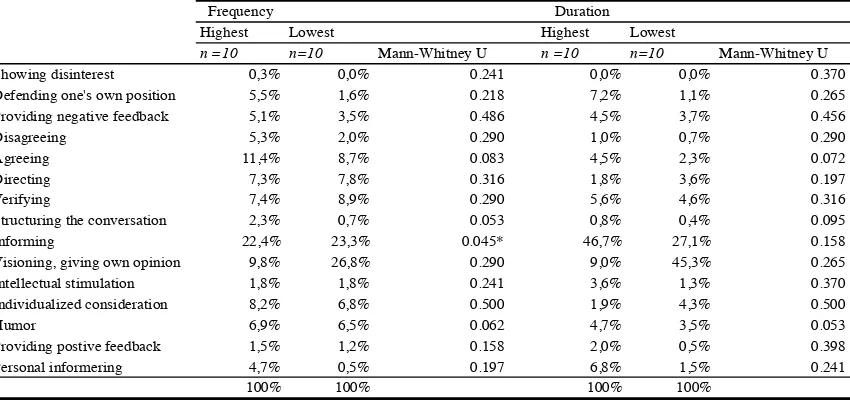
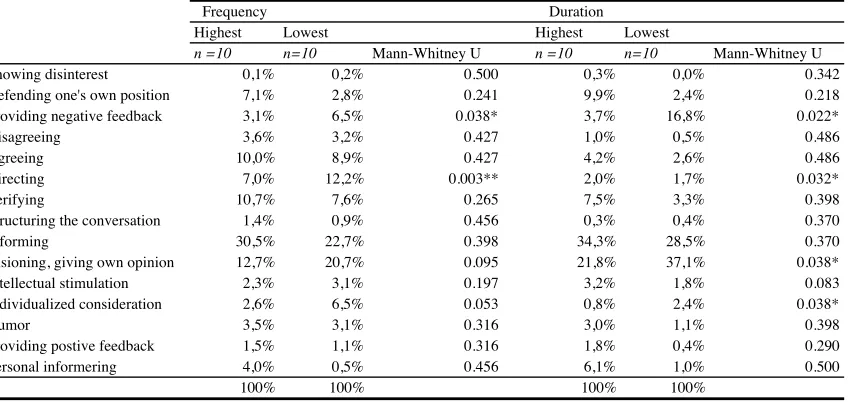
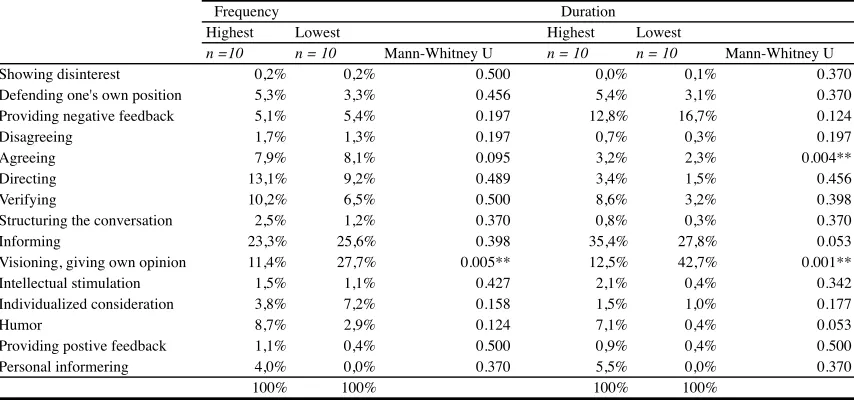
Tables 5, 6, 7 and 8, in the appendix, present the Mann-Whitney U test results, which provides an initial view on the hypotheses 7 and 8, linking follower behavior to work values. In hypothesis 7 it is expected that followers who score high on (a) ‘openness to change’ values or (b) ‘self-transcendence’ values behave in a more relation-oriented type of way (i.e., intellectual stimulation, individualized consideration, visioning/giving own opinion) than followers who score low on ‘openness to change’ values or ‘self-transcendence’ values. Results, in table 5, show no significant difference between the frequencies of behaving in a more task or relation oriented way by followers scoring high on ‘openness to change’ and followers scoring low on ‘openness to change’. Looking at the differences between the frequencies of the behaviors of the followers who scored the highest and the lowest on the value type ‘openness to change’, a significant difference is found in the task-oriented behavior ‘informing’ (p = .045). However, this difference is not significantly correlated (r = - .014, p = .432). Thus, these results show no support for hypothesis 7a. When inspecting the results for hypothesis 7b, however, a significant difference was found between the frequencies of the behaviors ‘providing negative feedback’ (p = .038) and ‘directing’ (p = .026) in table 6. ‘Providing negative feedback’ was not hypothesized, but a negative correlation was found between ‘providing negative feedback’ and ‘self– transcendence’ values (r = - .166, p = .019). Also, a negative correlation occurred between the frequency of ‘directing’ behavior and ‘self-transcendence’ values (r = - .210, p = .004). In addition, results show significant differences between the durations of the behaviors ‘providing negative feedback’ (p = .022), directing (p = .032), ‘visioning/giving own opinion’ (p = .038) and ‘individualized consideration’ (p = .038). For these behaviors, a negative correlation was found between the value ‘self-transcendence’ and the behavior ‘providing negative feedback’ (r = -. 194, p = .0008) and ‘directing’ (r = -. 258, p = .0005). Hypothesis 8 predicted that followers scoring high on (a) ‘self-enhancement’ values or (b) ‘conservation’ values show more task-oriented behaviors (i.e. directing, verifying and informing) than followers scoring low on these values. Looking at table 7, a significant difference was found between both the frequency (p = .015) and the duration (p = .006) of the behavior ’agreeing’ by followers who scored the highest and lowest on the value type ‘self-enhancement’.
However, no correlation was found between ‘agreeing’ behavior and the ‘self-enhancement values’. These results show no support for hypothesis 8a. The results in table 8 of the value conservation show a significant difference between the frequency of the behavior ‘visioning/giving own opinion’ (p = .005) and scoring high or low on ‘conservation’ values. Looking at the duration of the behaviors, a significant difference was found for ‘agreeing’ (p = .045) and ‘visioning/giving own opinion’ (p = .0005). However, no correlation was found between the value type ‘conservation’ and any one of the single specific behaviors. Hence, also no support was found for hypothesis 8b.
Results show some other significant relations, which were not hypothesized in advance. First, the direct relationship between follower work values and follower effectiveness was not hypothesized. However, results show a significant relationship between the value type ‘openness to change’ and follower effectiveness (r = .218, p = .016) and the value type ‘conservation’ and follower effectiveness (r = .226, p = .013). Furthermore, a significant correlation was found between follower effectiveness and two specific behaviors (i.e. ‘personal informing’ and ‘structuring the conversation’), which were not hypothesized. Results show a positive correlation between the frequency of ‘personal informing’ and follower effectiveness (r = .208, p = .019). Looking at the relationship between the duration of ‘personal informing’ and follower effectiveness, a significant positive correlation was also found (r = .235, p = .009). Second, results show a negative correlation between the frequency of ‘structuring the conversation’ and follower effectiveness (r = - .266, p = .004). Looking at the relationship between the duration of ‘structuring the conversation’ and follower effectiveness, we establish a negative significant correlation (r = - .235, p = .010).
5.
DISCUSSION
In order to explore or examine the relationship between follower work values and follower behaviors, on one hand, and explaining follower effectiveness using exclusively mutual behaviors on the other hand, this study used three different types of methods to collect data. One of these methods has previously not been used in followership studies: the coding of video-based observations with the purpose to capture actual follower behaviors during regularly held staff meetings. Correlation analysis was used to examine significant relationships between the mutually exclusive behaviors and follower effectiveness. Besides, by using the Wilcoxon-Mann-Whitney test, it was possible to investigate statistically significant differences between follower behaviors of followers scoring high and low on the four types of work values (i.e. self-enhancement, openness to change, self-transcendence and conservation). Thereafter, using correlation analysis, significant relationships between these work values and follower behaviors were examined. The results of the study support hypothesis 5, stating that the longer followers are intellectually stimulating during staff meetings, the more effective they are. This is line with what we expected on basis of Carsten’s (2010) comparable conduct ‘initiative/proactive’ behavior.
However, merely one of the twelve passive followers perceived this behavior as important for making them effective in their follower role. Another notable discussion point is the expected relationship between ‘visioning/giving own opinion’ as stated in hypothesis 4. Results show that the relationship is not significant, so follower effectiveness is not determined by the frequency or duration by which followers are ‘visioning/giving their opinion’ during staff meetings.
As previously mentioned, the direct relationship between visioning/giving own opinion and follower effectiveness has not been examined previously in the literature. This is why the hypothesis is substantiated on the basis of Carsten's (2010) similar conduct ‘expressing opinions’. The results of this study are also not consistent with Carsten’s results where proactive followers argue that expressing opinions is important for followers to be effective. However, passive followers in this research stated that expressing opinions is not important for the effectiveness of followers.
A reason why hypotheses 1 and 4 are not supported is the hierarchy in the organization. Followers who vision/give their own opinion or are directive during staff meetings may not be seen as effective by their leaders. This is confirmed by the results about the direct link between work values and follower effectiveness, which was not hypothesized. There is a significant relationship between the type of value ‘conservation’ and follower effectiveness. Conservation values (combining security, conformity, and tradition) emphasize self-restriction, resistance to change and protection of stability. Results show that followers who possess the category value conservation were considered as effective by their leaders. Followers with conservation values do what they are told and are less likely to express their own opinion/vision and/or be directive. Therefore, it could be possible that there is no significant relation found between the behaviors ‘vision/giving own opinion’ and ‘directing’, on the one hand, and follower effectiveness on the other.
Neither the expectations of hypotheses 7 or 8, about the link between work values and relation or task-oriented behavior by followers, are completely supported by the results. Direct relationships between the work values and the specific follower behaviors have not been examined previously in the literature. Therefore, these two hypotheses are substantiated on the basis of transformational and transactional style. The relation-oriented behaviors and task-relation-oriented behaviors are labeled as respectively transformational and transactional style. The rejection of both hypotheses may be due to the fact that the behaviors that we have observed do not exactly correspond to transactional and transformational leadership. However, results show a negative relationship between the value type ‘self-transcendence’ (combining benevolence and universalism) and the task-oriented behavior ‘directing’. Followers who oppose self-transcendence values promote equality and want to help others. Directing behavior, on the other hand, is dominant, and followers who direct are taking the lead and see themselves as more powerful compared to their team members. This may cause the observed negative relation between the behavior directing and the work value type self-transcendence.
The positive relationship that was found between ‘personal informing’ and follower effectiveness is also noteworthy. The theoretical framework only contained a hypothesis about ‘(factual) informing’ (which was not supported by the results).
Factual informing has been studied much (e.g., Borgatta, 1962; Arnold et al., 2000); contrary to ‘personal informing’ which is hard to find in the literature. Although, followers are engaged in ‘(factual) informing’ during 34.4%, and in ‘personal informing’ only during 2.1% of the time, it follows from the results that there is a significant relationship between personal informing and follower effectiveness. This could be explained by followers who personally informing most of the time during staff meetings having a better relationship with their leader. According to the Leader-Member Exchange theory (LMX theory), some followers have a formal relationship with the leader, whilst other followers have a special higher quality exchange relationship with their leader (Graen & Uhl-Bien, 1995). Several studies report higher effectiveness from followers in higher-quality exchanges (e.g. Deluga & Perry, 1994; Dockery & Steiner, 1990). Thus, this higher quality exchange may explain the positive relationship between ‘personal informing’ and follower effectiveness.
In addition, it is interesting to note that there were significant relationships found that were not noted hypotheses. The first significant relationship found was the negative link between ‘structuring the conversation’ and follower effectiveness. This behavior was, in the first place, not divided into task or relation oriented behaviors, because little research has been done about that topic in the leadership literature. However, this behavior is characterized by coordinating and structuring behavior, for example by moving to the next agenda item. The chairman or leaders of a staff meeting generally execute such coordinating and structuring behaviors (Allen & Rogelberg, 2013). The negative relationship between ‘structuring the conversation’ and follower effectiveness can be explained by the strong hierarchical organization where this study was held. Followers who exhibit this structuring and coordinating can be seen as attempting to take the lead in staff meetings. Leaders may consider such behavior as undesirable and not effective in a strongly hierarchical organization. Looking at Carsten’s social construct of followership (2010), other leading, dominant behaviors (e.g. ‘taking ownership’) are also not perceived as effective by passive followers. This indicates that leaders in this study may perceive passive followers as effective, which is also confirmed by the significant positive relation between the value type conservation and follower effectiveness. In conclusion, this may lead to the leading behavior ‘structuring the conversation’ being negatively related to follower effectiveness as perceived by the leader.
5.1
Practical Implications
Naturally, leaders would need to know this, given that they would need to facilitate such cognitive follower activity during those meetings, and even perhaps beyond their confines; future research must show to what extent these ideas hold true. In addition, even though we did not hypothesize direct relations between work values and follower effectiveness we found a positive relationship between the work values ‘openness to change’ and ‘conservation’, on the one hand, and follower effectiveness on the other hand. Thus, results in this study show that direct relationships between follower work value and follower effectiveness do exist. Of course, the work values explaining follower effectiveness can differ within different organizations, depending on e.g. public versus private organizations or small versus large organizations. The direct relationship between work values and effectiveness could help recognize effective followers using a survey about work values. These days some assessment centers and other employment organizations use personality testing to detect applicants who are potentially job good candidates, e.g. by using the Big Five personality test, based on the Big Five model of Goldberg (1990). Based on such assessments, an applicant with the ‘best’ personal profile will be the one receiving the job offer. Such tests are already used and accepted in society. To what extent work values are already part-and-parcel of such assessments may vary from assessment center to assessment center. Based on the results of this and previous recent studies that are based on the research by Schwarz and colleagues, it may be possible to develop a complementary test, using culturally stable work values. Creating and combining such a new work-value types of test is likely to offer a better preview of the likely effectiveness of the job applicant as an employee. However, one should take into consideration that many job applicants do not have a strong incentive to be honest, but to answer the questions in the way they think the company is expecting. Besides, one must also take into consideration to which extent it is ethical to use such tests in order to determine the effectiveness of job applicants as employees.
5.2
Strength, Limitations, and Future
Research Directions
The first strength of the present study is its use of the objective video-observation method to examine follower behaviors. To gain a deeper understanding of how work values influence follower behavior, and how this explains follower effectiveness, it is necessary to study how followers actually behave in organizations. To the best of my knowledge, this objective video-observation method has never been used in earlier studies with the purpose of extending the current followership literature. The second strength of the present study is the use of three types of measures: questionnaire, video-coded data and expert ratings, which together reduced common method bias considerably.
However, despite these strengths, the present study also has a few limitations. First of all, this study has used an entirely Dutch sample, consisting of Dutch followers and leaders within one Dutch organization. Earlier research revealed that values and behaviors are related and rooted in a country’s culture, norms and beliefs (Schwartz, 1996). Using a sample with a Western culture that is characterized as highly individualistic (Hofstede & Bond, 1984), compared to an Eastern culture, may limit the generalizability of the results to other countries. In addition, the data used in this study were obtained from a public organization where hierarchy is very important. Past leadership research stated that relation-oriented behaviors, displayed in transformational leadership style, are thought to be less effective in public organizations (Shamir & Howell, 1999).
Obtaining data from a public organization may also limit the generalizability of the results to private organizations.
This present study is a first attempt in order to create this deeper understanding with help of different data sources, especially the academic-based coding scheme. However, this observational study collected observational data at staff meetings at one specific point in time. Hence, future research could be a longitudinal study on follower behavior, not only in the context of staff meetings, but also in the other situation in which people carry out their work. It could be possible that followers behave more in a task-oriented way during staff meetings (e.g. informing behavior), whilst during the rest of their working day they behave more in a relation-oriented way (e.g. individual consideration behavior). Therefore, observing followers throughout the whole working day can gain new insights into the behavior and effectiveness of followers within organizations. Gaining a deeper understanding about follower behaviors and their relative effectiveness may provide insight into how leaders can influence followers in terms of their effectiveness on productivity and wellbeing. This may advance the emerging followership literature.
In addition, follower work values need to be studied more often to improve knowledge of the relation between these values and follower effectiveness. An interesting future research topic within the work values field is value congruence. Schein (1985) proposed that shared work values between leaders and followers enhance behaviors and facilitate internal communication between organizational members. Examining the impact of a common set of work values between followers and leaders on follower effectiveness could enrich the followership literature.
6.
CONCLUSION
Results of this research have not found general patterns on the link between follower work values and follower behaviors. However, we found a specific significant relationship between the behavior ‘directing’ and the value type ‘self-transcendence’. Further, the specific behaviors ‘intellectual stimulation’, ‘structuring the conversation’ and ‘personal informing’, were found to be significantly related to follower effectiveness. More extensive research is required to draw general conclusions about followers’ intrinsic work values, actual daily work behavior and follower effectiveness.
7.
APPENDIX
Table 1. Examples of the Video-recorded Follower Behaviors Coded on this Study
Behavior
category Behavior Definition Examples
Self-defending 1 Showing disinterest Not showing any interest, not taking problems seriously, wanting to get rid problems and conflicts
Not actively listening, talking to others while somebody has the speaking term, looking away
2 Defending one’s own position
Protecting the own opinion or ideas, emphasizing the own importance
“We are going to do it in my way.” Blaming other people
3 Providing negative feedback
Criticizing “I do not like that…”
“But we came to the agreement that…”
Steering 4 Disagreeing Contradicting ideas, opposing team members “That is not correct” “I do not agree with you” 5 Agreeing Saying that someone is right, liking an idea “That is a good idea”
“You are right” 6 Directing Telling others what (not) to do, dividing tasks “I want that”
“Kees, I want you to” Interrupting 7 Verifying Getting back to previously made agreements/
visions/ norms
“We came to the agreement that…”
8 Structuring the
conversation Giving structure by telling the agenda, start/end time etc. “The meeting will end at…” “We are going to have a break now” 9 Informing Giving factual information “The final result is …”
10 Visioning Giving the own opinion
Giving long-term visions “I think that…” “Within the next years, we want to…”
Supporting 11 Intellectual
stimulation Asking for ideas, inviting people to think along or come up with own ideas, brainstorming
“What do you think is the best way to…?”
“What is your opinion about…?” 12 Individualized
consideration
Rewarding, complimenting, encouraging, being friendly, showing empathy
“Good idea, thank you” “You did a great job” “Welcome” “How are you?” 13 Humor Making people laugh, saying something with
a funny meaning
Laughing, making jokes
14 Positive feedback Rewarding, complimenting “Well done” 15 Personally
informing
Giving non-factual, but private information “Last weekend, my wife…”
Followers who scored the highest and lowest on the value type ''openess to change'' compared with displayed behaviors
Frequency Duration
Highest Lowest Highest Lowest
n =10 n=10 Mann-Whitney U n =10 n=10 Mann-Whitney U
Showing disinterest 0,3% 0,0% 0.241 0,0% 0,0% 0.370
Defending one's own position 5,5% 1,6% 0.218 7,2% 1,1% 0.265
Providing negative feedback 5,1% 3,5% 0.486 4,5% 3,7% 0.456
Disagreeing 5,3% 2,0% 0.290 1,0% 0,7% 0.290
Agreeing 11,4% 8,7% 0.083 4,5% 2,3% 0.072
Directing 7,3% 7,8% 0.316 1,8% 3,6% 0.197
Verifying 7,4% 8,9% 0.290 5,6% 4,6% 0.316
Structuring the conversation 2,3% 0,7% 0.053 0,8% 0,4% 0.095
Informing 22,4% 23,3% 0.045* 46,7% 27,1% 0.158
Visioning, giving own opinion 9,8% 26,8% 0.290 9,0% 45,3% 0.265
Intellectual stimulation 1,8% 1,8% 0.241 3,6% 1,3% 0.370
Individualized consideration 8,2% 6,8% 0.500 1,9% 4,3% 0.500
Humor 6,9% 6,5% 0.062 4,7% 3,5% 0.053
Providing postive feedback 1,5% 1,2% 0.158 2,0% 0,5% 0.398
Personal informering 4,7% 0,5% 0.197 6,8% 1,5% 0.241
100% 100% 100% 100%
Table 5. Mann-Whitney Test of the ten followers who scored the highest and the lowest on the value type ’openness to change’ compared with displayed behaviors
Table 6. Mann-Whitney Test of the ten followers who scored the highest and the lowest on the value type ‘self-transcendence’ compared with displayed behaviors
Table 7. Mann-Whitney Test of the ten followers who scored the highest and the lowest on the value type ‘self-enhancement’ compared with displayed behaviors
Followers who scored the highest and lowest on the value type ''self-transcendence'' compared with displayed behaviors
Frequency Duration
Highest Lowest Highest Lowest
n =10 n=10 Mann-Whitney U n =10 n=10 Mann-Whitney U
Showing disinterest 0,1% 0,2% 0.500 0,3% 0,0% 0.342
Defending one's own position 7,1% 2,8% 0.241 9,9% 2,4% 0.218
Providing negative feedback 3,1% 6,5% 0.038* 3,7% 16,8% 0.022*
Disagreeing 3,6% 3,2% 0.427 1,0% 0,5% 0.486
Agreeing 10,0% 8,9% 0.427 4,2% 2,6% 0.486
Directing 7,0% 12,2% 0.003** 2,0% 1,7% 0.032*
Verifying 10,7% 7,6% 0.265 7,5% 3,3% 0.398
Structuring the conversation 1,4% 0,9% 0.456 0,3% 0,4% 0.370
Informing 30,5% 22,7% 0.398 34,3% 28,5% 0.370
Visioning, giving own opinion 12,7% 20,7% 0.095 21,8% 37,1% 0.038*
Intellectual stimulation 2,3% 3,1% 0.197 3,2% 1,8% 0.083
Individualized consideration 2,6% 6,5% 0.053 0,8% 2,4% 0.038*
Humor 3,5% 3,1% 0.316 3,0% 1,1% 0.398
Providing postive feedback 1,5% 1,1% 0.316 1,8% 0,4% 0.290
Personal informering 4,0% 0,5% 0.456 6,1% 1,0% 0.500
100% 100% 100% 100%
* = 1-tailed p < 0.05 ** = 1-tailed p < 0.01
Followers who scored the highest and lowest on the value type ''self-enhancement'' compared with displayed behaviors
Frequency Duration
Highest Lowest Highest Lowest
n =10 n=10 Mann-Whitney U n =10 n=10 Mann-Whitney U
Showing disinterest 0,1% 0,0% 0.370 0,3% 0,0% 0.370 Defending one's own position 7,1% 3,9% 0.218 11,0% 4,3% 0.140 Providing negative feedback 1,5% 8,2% 0.241 1,6% 10,5% 0.241
Disagreeing 2,0% 2,0% 0.342 0,4% 0,9% 0.398
Agreeing 10,6% 5,8% .015* 4,5% 2,3% 0.006**
Directing 8,0% 13,9% 0.500 2,1% 8,2% 0.342
Verifying 9,9% 9,0% 0.095 7,1% 5,4% 0.158
Structuring the conversation 1,5% 1,5% 0.342 0,3% 0,8% 0.370
Informing 23,9% 29,0% 0.124 30,8% 40,1% 0.1775
Visioning, giving own opinion 12,0% 17,4% 0.316 15,1% 20,5% 0.265 Intellectual stimulation 5,1% 0,0% 0.072 11,8% 0,0% 0.140 Individualized consideration 7,0% 1,5% 0.158 2,3% 0,3% 0.109
Humor 4,9% 7,2% 0.124 3,7% 6,3% 0.124
Providing postive feedback 1,8% 0,5% 0.124 2,1% 0,5% 0.197 Personal informering 4,7% 0,0% 0.241 6,8% 0,0% 0.241
100% 100% 100% 100%