The effect of the resource based view on decisions
in supply management
Author: Tobias Bohnenkamp
University of Twente P.O. Box 217, 7500AE Enschede
The Netherlands
[email protected]
The paper focuses on the link between the resource based view and supply management,
in particular on the contribution of the theory to four key decision points related to the
purchasing year cycle, namely: make or buy, sourcing strategies, supplier portfolio and
relationship strategies as well as the awarding of contracts. In this sense, the analysis of
literature showed that the resource based view impacts all four decision points, with the
highest significance on the make or buy decision and lowest on contract awarding, and
therefore allows to be considered in the whole decision making process.
Keywords
Resource based view, supply management, purchasing year cycle, sourcing.
Permission to make digital or hard copies of all or part of this work for personal or classroom use is granted without fee provided that copies are not made or distributed for profit or commercial advantage and that copies bear this notice and the full citation on the first page. To copy otherwise, or republish, to post on servers or to redistribute to lists, requires prior specific permission and/or a fee.
1stIBA Bachelor Thesis Conference, June 27th, 2013, Enschede, The Netherlands.
1.
THE PURCHASING YEAR CYCLE
LEADS TO FOUR DECISION POINTS
The fields of purchasing and supply management are enjoying growing popularity and importance to organizations in a variety of different industries. Mainly the higher status is due to increased competition, improved time-to-market and cost reductions which cause firms to adjust their supply structures in order to cope with the strategic pressures (Cousins, Lamming, Lawson, & Squire, 2008, p. 24). Therefore, since the development of supply management in the 1990s, firms increasingly realize that their ability to compete is closely linked to the adoption of ‘best practice` manufacturing techniques, including internal production mechanisms as well as the alignment with suppliers for delivering customer value (Cousins & Menguc, 2006, p. 605). In this sense, the term of supply management is defined as a process which includes the sourcing of goods and services from suppliers aimed at achieving a sustainable competitive advantage (Handfield, Petersen, Cousins, & Lawson, 2009, p. 101; Kaufmann, 2002, p. 12).
The growing importance of supply management also impacts the purchasing function by increasing responsibilities. The span of control (i.e. the main responsibilities) of the purchasing function can be summarized as follows: evaluate and select suppliers, review materials bought, act as the primary contact with suppliers and decide how to make a purchase However, besides these main activities, the purchasing function has a broader range of objectives, such as the support of organizational goals and objectives, the development of an integrated purchasing strategy in line with corporate objectives, the support of operational requirements, the efficient and effective use of resources, supply base management as well as the development of intra-firm relationships (Monczka, Handfield, Giunipero, & Patterson, 2010, pp. 28-29). The strategic direction of a corporation is outside the range of control of the purchasing function and happens at an earlier stage as the purchasing process itself. Further, the main activities are depended on supportive processes in order to be efficient and effective. For instance, a sourcing strategy needs a supporting cost- and/or risk-based analysis.
Based on these considerations, a 3-phase model is established, which structures the annual activities of the purchasing department:
(1) Anteceding processes: These processes occur outside the range of responsibilities of the purchasing department prior to the purchasing process
(2) Primary processes: These are the main tasks of the purchasing department
(3) Supportive processes: These processes support primary processes
Anteceding processes
The anteceding processes consist of two different inputs, which are mainly outside the range of responsibilities of the purchasing function.
(1) Purchasing targets: The purchasing targets are not made in isolation, but are linked to the corporate strategy (Cousins et al., 2008, pp. 13-15).
(2) Demand planning: The second input is the demand planning process, which determines which material has to be bought at a specified quantity and time
(Monczka et al., 2010, pp. 33-35). The demand planning process leads to the first decision point: the make-or-buy decision.
Primary processes
The primary processes are the direct responsibility of a purchasing function and can be divided into 5 different processes.
(1) Category strategy: Category strategies put similar products/services into one group in order to determine a purchasing strategy (H. Schiele, 2006, p. 2). As mentioned in (Weele, 2005, p. 161), sourcing strategies result in decisions such as global vs. local sourcing, single vs. multiple sourcing or partnership vs. competitive bidding This process determines the second decision point: selecting specific sourcing strategies for each commodity. (2) Supplier strategy: This step establishes the planned
purchasing volume on suppliers and defines the relationships. This leads to decision point number 3: selecting supplier strategies and making supplier portfolio decisions.
(3) Quotation, supplier selection and negotiation: This process leads to the final supplier selection, by employing either competitive bidding or negotiation (Monczka et al., 2010, pp. 36-49). This step is associated with decision point number 4: Awarding contracts after negotiating with suppliers and taking the supplier strategies into account.
(4) Operative procurement: This step ensures that the outcomes of the negotiation and contracts are being implemented.
(5) Supplier evaluation: This step measures the actual performance of the supplier in terms of for instance delivery, quality, costs and service (Monczka et al., 2010, p. 220).
Supporting processes
These activities are not in the span of control of the purchasing function and serve as a means to enhance the performance of the primary functions.
(1) Controlling: The supply controlling process measures whether the executional plan was fulfilled according to the plan. It also contributes to demand planning.
(2) Contract Management: This step administrates the contracts and monitors their execution.
(3) Organization and personnel: This step is employed to adapt the structures, processes and workforce, which will enable the execution phase.
(4) Analyses: Analyses serve as input for the category as well as supply strategy. The subjects of these analyses are far-reaching, e.g. cost, market, supply or risk-based.
This paper will focus on the resource based view and determine the linkage between the theory and the underlined decision points, leading to the research question:
How does the resourced based view influence and contribute to decisions to be made in the field of supply management?
2.
RESOURCE BASED VIEW
2.1
The importance of the resource
based view and its contribution to
supply management
The resource based view per se was mainly developed in the late 1980s and 90s, while later being adjusted with extensions. With paying attention to the achievement of a competitive advantage through internal resources, the resource based view became one of the grand theories of economics. According to Barney (1991, p. 100) “the resource based view examines the link between a firm’s internal characteristics and performance’’. As the basis for a competitive advantage, the resource based view considers the application of a bundle of tangible and intangible resources (Penrose, 1959, p. 24; Wernerfelt, 1984, p. 172). In order to make to competitive advantage sustainable, resources are required to be heterogeneous and immobile (Barney, 1991, p. 105; Peteraf, 1993, p. 180). Moreover, to create a competitive advantage, resource need to fulfil the criteria of being valuable, rare, in-imitable and non-substitutable (Barney, 1991, p. 99; Dierickx & Cool, 1989, p. 1504; Peteraf, 1993, p. 183).
Building on this, the resource based view enable firms to determine their core competences which are also critical for the creation of the latter (Espino‐Rodríguez & Padrón‐Robaina, 2006, p. 53). An even greater benefit of the resource based view is attained through the extension with dynamic capabilities.
The concept of dynamic capabilities was firstly referred to by Teece, Pisano, and Shuen (1997, p. 516), who define this as the “firm’s ability to integrate, build and reconfigure internal and external competences to address rapidly changing environments”. With this in mind they discuss factors of production, resources, organizational competencies as well as core competencies which enable the usage of firm specific assets in clusters including groups and individuals. This means that competencies are not only valid internally, but may also be of value outside the firm. In addition to this, Eisenhardt and Martin (2000, p. 1107) view dynamic capabilities as processes within firms, using resources and creating a market change, and argue that through these, new resource configuration can be achieved. These new or enhanced resource configurations can then lead to a sustained competitive advantage (Eisenhardt & Martin, 2000, p. 1106). According to Helfat et al. (2009, p. 1), dynamic capabilities are developed by a firm under conditions of change and enable firms to stay profitable. They define dynamic capabilities as the “capacity of an organization to purposefully create, extend, or modify its resource base” (Helfat et al., 2009, p. 4). With this definition, attention is also paid to the process of search and selection of dynamic capabilities. As capabilities are considered to be resources, they can be created through external acquisition, which involves the search and selection for appropriate candidates (Helfat et al., 2009, pp. 4-6). The external focus proposed here through the concept of dynamic capabilities was also regarded by other scholars under different topics. With an emphasis on a relational view of competitive advantage, Dyer and Singh (1998, p. 661) took into account network routines in order to gain an advantage over competitors. To achieve this, assets are argued to be interconnected across organizational boundaries. Hence, while the original resource based view pays attention to the creation of returns based on resources and capabilities in-house, the
relational perspective enhances this view by capturing that rents can be generated jointly through knowledge sharing with partners and alliances (Dyer & Singh, 1998, p. 675). Such alliances can either provide a competitive advantage by collaboration with complementary resources or through an effective development of an alliance portfolio, leveraging resources (Ireland, Hitt, & Vaidyanath, 2002, p. 439). Partnering and maintaining this relationship is desirable as long as it actively provides network resources by partners, which enhances the firm’s market performance if the firm can prevent being dependent on its partner (Lavie, 2007, pp. 1206-1207).
Not only the extension of the resource based view mentioned before might be of great benefit for economics, also its relationship to another theory, to which it constitutes a counterpart, is of importance. With the assumption that a firm derives a competitive advantage internally, the resource based view stays in strong contradiction to another powerful theory. In this sense the resource based view was firstly developed as a “reaction against the ‘competitive forces’ analysis of firm strategy” (Mowery, Oxley, & Silverman, 1998, p. 508), mentioned in Porter (1979). Similar to the resource based view, Porter (1979), in general, focuses on how firms achieve and eventually sustain a competitive advantage. According to him, competition is not restricted to mainly other players and more related to competitive forces in an industry, which go beyond rival entities. Hence, the framework of competitive forces clearly emphasizes an external oriented focus as competitive forces in the industry and with opportunities and threats need to be analyzed and the firm positioned according to it (Porter, 1979, p. 137). Consequently, it also appears contrasting that while the competitive framework mainly focuses on the industry and products as the determinant of profitability and a competitive advantage, the resource based view follows the logic that the firm exerts the power and hence becomes the success factor. Even though both the resource based view and Porter’s framework of competitive forces have differences they can be rather seen as complementary. Since neither a firm without external focus is possible nor and industry without paying attention to firms and their internal exists, both, the internal and external focus might be more useful in combination.
In order to cope with the aim of this paper, the resource based view can also be applied to supply management and the purchasing function. As shown in the results, the resource based view is able to contribute to and support every decision point of the purchasing year cycle. With assuming that activities leading a competitive advantage should be maintained in-house, clearly less important items are sourced externally. Moreover, through collaboration with suppliers and through the accomplishment of a preferred customer status the achievement of a competitive advantage is facilitated, awarding preferably fixed and long-term contacts. Hence, even though high significance for the contribution to the decisions is not available in literature for every single decision point, a logical mind-set allows for assumptions.
2.2
History of the resource based view
2.2.1
The firm is a bundle of valuable, rare,
in-imitable and non-substitutable resources
Originally, the resource based view was firstly considered in the late 1950s. By arguing that firms consist of a bundle of collective resources, Penrose (1959, p. 24) laid the foundation on which further scholars based their assumptions and reasoning. Only if certain resources are employed in a way that gives a firm access to their potential value, these resources may contribute to and impact the firm’s competitive position. To turn it differently: A firm which is in possession of valuable resources, but does not have the ability to use them and exploit their maximum potential, is not better off than a firm which doesn’t have access to them in the first place. Resources which are heterogeneous or in other words exclusive compared to others, have the prospective to give each firm a unique character (Penrose, 1959, p. 75). Several years later, as similar to the view of Penrose (1959), Rubin (1973) states that a firm is a collection of particular resources. To the firm, resources are worth more than their market value due to specialized experience, and may either be used for output production or for the establishment of new resources (Rubin, 1973, p. 936). Hence, even if two firms can access the same resources, the firm which is more experienced in exploiting them is argued to create the greater benefit. Resources are defined as input which enables the performance of a particular tasks, and which includes people and the assets they use (Rubin, 1973, p. 937). Those assets can be of tangible or intangible nature and are tied to the firm (Caves, 1980, p. 64). In order to make these resources useful to the firm, they need to be processed (Rubin, 1973, p. 938). Standing alone, resources therefore cannot be of any value. Trying to clarify how resources may lead to a competitive advantage, Wernerfelt (1984, p. 171) proposes that resources and products are closely related, being “two sides of the same coin”. This means that the performance of a certain firm, which is directly driven by its products, is exceedingly and indirectly affected by its resources as they steer the production of the latter (Wernerfelt, 1984, p. 171). Therefore resources, at an ultimate level, determine the firm’s success and failure. By identifying and eventually acquiring those resources, which are critical and important for the development and creation of the products demanded, firms may have the chance to earn returns above the average level. Consequently, firms desire a condition where its own resource position complicates others to catch up (Wernerfelt, 1984, p. 173). According to the author, this situation may present a competitive advantage of the firm with the resource position taking the function of an entry barrier.
The view of Wernerfelt (1984) that firm performance is driven by products and ultimately by resources is taken up by Barney (1986b, p. 1231), who claims that firms need to be analysed from resource side as well as from the product side. Moreover the concept of the strategic factor market, a market for the acquisition of strategy critical resources, is introduced and stated that the acquisition of these resources can lead a firm to above normal economic performance. However, this performance is only achievable in case the firm has superior information or, simply, has luck (Barney, 1986b, p. 1231). Hence, while unique insights and abilities may lead a firm to superior performance, unanticipated synergies between acquired resources and the firm may also play a role. The proposition of the existence of factor
markets however is criticized as it is argued to be incomplete, neglecting certain factors which are simply not traded (Dierickx & Cool, 1989, p. 1506). Apart from that, a firm’s competitive position is seen due to the exploitation of bundled assets and resources, depending less on product market combinations. To achieve and maintain this position, the protection of resources is of high significance (Dierickx & Cool, 1989, p. 1504). In this sense, the degree to which resources can be strategic depends on the extent to which they are non-tradable, non-imitable and non-substitutable (Dierickx & Cool, 1989, p. 1510). Again, at this point it is important to underline that those characteristics of resources are key to achieve a competitive advantage. Only if these prevail, a firm can obtain superiority over competitors, which specifies and extends the view of Wernerfelt (1984) by clarifying how the resource position may create barriers to access.
One year later, the so far emphasised internal focus and the relation between resources, performance and a competitive position, was further promoted. Prahalad and Hamel (1990, p. 78) contend that competitiveness derives from core competencies of the corporation, which enable the creation of new and unanticipated products. These core competencies are corporate resources which are used, exploited and reallocated by the management (Prahalad & Hamel, 1990, p. 86). Similar to what was stated in Penrose (1959) and Rubin (1973), core competencies do not only include tangible assets and resources, but also skills and knowledge possessed by people (Prahalad & Hamel, 1990, p. 78). They provide access to a variety of markets, contribute to perceived customer benefit and should be difficult to imitate Prahalad and Hamel (1990, p. 81). If core competencies are build prior to competitors, the firm is able to outpace rivals as it has established a competitive advantage Prahalad and Hamel (1990, p. 84), which also goes in line with Wernerfelt (1984).
2.2.2
Competences
and
capabilities
contribute to the value exploitation of
resources
In 1992, Mahoney and Pandian (1992, p. 365) claim that a firm does not have a good performance because of better resources, but rather due to the firm’s competence to make better use them , which represents a deeper focus on the basics of the resource based view as proposed in Penrose (1959). To put it in another way, a firm that knows best how to make use of its resources will implement them in a way to maximize productivity. This argumentation is supported by Peteraf (1993, p. 188) who states that as resources can be an important ground of a competitive advantage, they should be leveraged further. By analysing the resource position, the firm might gain a clearer insight whether conditions for this advantage are met or not. As the achievement of a competitive advantage should have priority for a firm, it should pursue strategies which are supported by its resources (Peteraf, 1993, p. 189). A related view is taken by Henderson and Cockburn (1994) in their attempt to explain competences. Referring to this, it is argued that a competence may include knowledge and skills, and can be a source of a sustained competitive advantage (Henderson & Cockburn, 1994, p. 65). It further enables the firm to choose and develop value enhancing strategies (Lado & Wilson, 1994, p. 702). Moreover, not only a competence itself, but also how this is managed inside the firm has significant implications for its productivity (Henderson & Cockburn, 1994, p. 79). All in all, no matter if resources are used (Mahoney & Pandian, 1992), leveraged (Peteraf, 1993) or managed (Henderson & Cockburn, 1994), is becomes clear that there needs to be some action involved in order to extract their value and achieve a competitive advantage.
Similar to Henderson and Cockburn (1994), other independent scholars focus on different capabilities and competencies. With regard to this, a capability refers to a kind of resource aiming at improving the productivity of other resources Makadok (2001). Leonard‐Barton (1992, p. 113) concentrated on core capabilities, being characterized as a set of knowledge that makes the difference and provides a competitive advantage. They distinguish a firm strategically and subject resources to exploit their hidden value (Leonard‐Barton, 1992, p. 111/113). Fiol (1991, p. 192), however, paid attention to organizational competencies, which are cognitive processes that analyse resources and translate them into action. Moreover they are considered as critical competitive resources as they link skills and action outcomes to obtain a superior competitive position Fiol (1991, p. 208).
If firms’ resources and skills are tacit, complex and specific they can generate ambiguity and raise barriers to imitation. Therefore Reed and DeFillippi (1990, p. 88) maintain that ambiguous competencies are necessary for the protection of a competitive advantage. Whether this advantage will be sustainable or not depends on the degree of ambiguity and with it on the preservation of the barriers Reed and DeFillippi (1990, p. 100). Kogut and Zander (1992, p. 385) regard combinative capabilities which associate internal as well as external learning with organizational knowledge for the creation of opportunities. Learning is argued to be the result of combinative capabilities using existing knowledge in order to create something new. In this way combinative
capabilities exploit organizational knowledge to achieve an advantage Kogut and Zander (1992, p. 391). Similar to scholars such as Penrose (1959) or Mahoney and Pandian (1992), Amit and Schoemaker (1993, p. 33) propose the challenge of identifying, protecting and exploiting resources and capabilities to provide the firm with a sustainable competitive advantage. Capabilities are created by a firm to provide increased productivity of its resources, and in contrast to them, they aim at generating and trading information using human capital (Amit & Schoemaker, 1993, p. 35). Additionally, Russo and Fouts (1997, p. 573) also see the need of using resources in order to make them productive. Therefore they consider organizational capabilities, the firm’s “abilities to assemble, integrate, and manage these bundles of resources”. Moreover according to them, resources and capabilities have to be combined in three different settings, physical assets and skills to use them, human resources and organizational capabilities including culture, and reputational resources and political expertise. At the same time of the argumentation, the concept of dynamic capabilities was added to this discussion, being defined as the “firm’s ability to integrate, build and reconfigure internal and external competences to address rapidly changing environments” (Teece et al., 1997, p. 516). This concept promotes a duality between internal and external resources and aims at reconfiguring the firm’s resource base to achieve a competitive advantage (Eisenhardt & Martin, 2000, p. 1106). In other words, dynamic capabilities enable the firm to access resources externally.
Concluding, the history of the resource based view assumed an in particular internal focus of the firm to create a competitive advantage. Through the processing and exploiting of firm-specific resources, possessing attributes making it difficult for rivals to catch up and therefore constituting barriers to entry, companies therefore were argued to have the opportunity to gain the lead of competitors. Moreover, capabilities and competences were proposed to either be one aspect of resources or facilitate the deployment of such. Further, the addition of dynamic capabilities allows for inter-firm cooperation in order to acquire resources (Dyer & Singh, 1998, p. 661; Ireland et al., 2002, p. 414). The next section will focus on basic assumptions made by the resource based view.
2.3
Assumptions of the resource based
view
Generally spoken, the value of the resource based view of the firm lies in the utility of valuable tangible and intangible resources as the basis for a competitive advantage (Fahy & Smithee, 1999, p. 1; Penrose, 1959, p. 24; Wernerfelt, 1984, p. 172). A competitive advantage is defined as a firm “implementing a value creating strategy not simultaneously being implemented by any current or potential competitor” (Barney, 1991, p. 102). Even though this has not been realized yet at a certain point of time, a firm can enter the market with resources having the potential to attack the current advantage of a competitor, reducing its rents obtained and hence opening up opportunities of establishing the latter in the future (Barney, 1986a, p. 658).
that according to the resource based view, only in case resources are able to stand out of the ones possessed by competitors, and if they can be considered as not interchangeable by other random assets, they have the power to create a position superior to the firm’s rivals. These resources, as assumed by the resource based view, can be categorized into three groups, including physical capital resources, human capital resources as well as organizational capital resources. While physical capital resources refer to technology, firm equipment, location and access to raw materials, human capital resources comprise amongst others training, experience and insight of individual managers and workers of the firm, whereas organizational capital resources consider the formal reporting structure of the firm as well as informal relations among groups within it (Barney, 1991, p. 101). This categorization reveals the broadness of the resource based view as the amount of resources and related sub-groups makes it hard to quantify and emphasise which resources are more important and which are eventually able to contribute to the achievement of a competitive advantage. The answer to the question whether this is possible to achieve with the given resources or not is assumed to be dependent on the criteria whether the firm’s resources can be regarded as valuable, rare, inimitable and non-substitutable (Barney, 1991, pp. 105-106; Dierickx & Cool, 1989, p. 1510). A resource is considered valuable if it is able to utilize environmental circumstances in order to produce benefits for the firm. In the same way a valuable resource is required to counteract threats deriving from the firm’s environment, including competitive actions (Barney, 1991, p. 106). However, even if resources are as valuable as possible, they do not lead to a competitive advantage if they can be accessed by every competitive firm. If every entity is able to acquire valuable resources, the real benefit of holding them diminishes. In other words, if resources possess a certain rarity and hence cannot be utilized by other companies, the achievement of a competitive advantageous position lies within the realm of possibility (Barney, 1991, pp. 106-107). Nevertheless, this possibility is only given if a third condition, the condition of imperfectly imitable resources is fulfilled, which in particular means that a resource cannot be obtained by competitive firms and hence is only controlled by one specific firm (Barney, 1991, p. 107). Since imitation increases the competition and with it reduces the individual performance of a certain firm, the possession of inimitable resources can therefore be a source of sustained performance and simultaneously a sustained advantage (Barney, 1986a, p. 658; Peteraf, 1993, p. 183). Resources can be imperfectly imitable in case they are dependent upon unique historical conditions, the imitability is caused by causal ambiguity, or if they are socially complex (Barney, 1991, p. 107; Dierickx & Cool, 1989, p. 1508). A firm which has access to resources due to activities performed in its history will be able to deploy their value in a way that cannot be replicated by firms with this historic path (Barney, 1991, p. 108). In other words, historic success will lead a firm to a better position in its current state (Dierickx & Cool, 1989, p. 1507). Causal ambiguity is present if the relationship between the possessed resources and a prevailing sustained competitive advantage is unknown (Barney, 1991, p. 109; Peteraf, 1993, p. 182). Hence, if no one has knowledge about why a superior position is caused, no one can imitate it. Causal ambiguity between firms itself is also argued of contributing to a competitive advantage (King, 2007, p. 156).Finally, the third condition and
2.4
Key Constructs
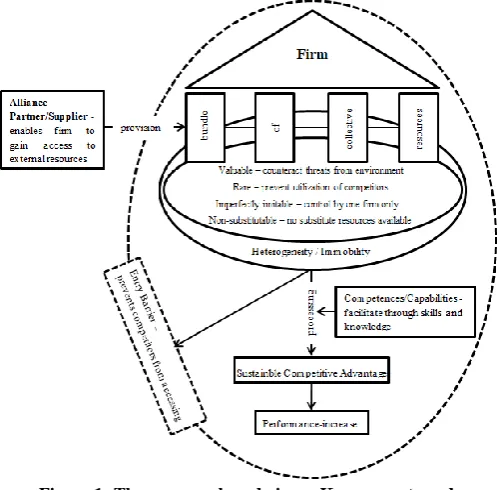
Figure 1 is drawn based on the identified assumptions regarding the resource based view, developed by scholars mainly during the last thirty years. Moreover, it briefly displays, in a visual way, key aspects of the theory. As already mentioned, the firm was originally seen as a bundle of collective resources (Penrose, 1959, p. 24). In order to achieve a competitive advantage that is not of limited duration but of sustainable nature, resources need to be heterogeneous and perfectly immobile (Barney, 1991, pp. 105-106; Peteraf, 1993, p. 180), which means that they have to protrude the ones owned by competitors. This follows a rather basic logic, and might mean for firms to benchmark rivals in order to differentiate and create benefits.
Resources have the potential to eventually create a superior competitive position in case they can be considered valuable, rare, imperfectly imitable and non-substitutable Barney (1991, p. 107). This implies that resources possessed need to be quantifiable, with the possibility to distinguish between these four categories. However, resources standing alone do not lead to any benefit, as they need to be processed to exploit their full value, which is facilitated through firm competences and capabilities (Henderson & Cockburn, 1994, p. 79; Mahoney & Pandian, 1992, p. 365; Peteraf, 1993, p. 188). This means that firms need to encourage the process my applying internal knowledge and skills (Henderson & Cockburn, 1994, p. 65; Leonard‐Barton, 1992, p. 111/113). As skills are possessed by people, the human resources, firms should pay attention to training and education.
[image:7.595.296.545.22.267.2]The full deployment of resources without competitors being able to access and copy the latter then leads to a competitive advantage and an increase in performance. This can also be understood as an entry barrier such as imitation or substitution difficulties, making it more complicated for competitors to reach the firm’s performance level (Wernerfelt, 1984, p. 173). Moreover with regards to an extended resource based view, cooperation and dynamic capabilities enable the firm to access external resources to improve its resource position and stay ahead of rivals. The formation of alliances as well as the development of buyer-supplier relationships might then lead to a competitive advantage of the firm (Das & Teng, 2000, p. 31; Mol, 2003, p. 46). This is due to the creation of value by pooling together the resources of both partners (Das & Teng, 2000, p. 36; Eisenhardt & Schoonhoven, 1996, p. 137). Thus, buyer-supplier relationships enable the acquisition of valuable and rare resources, which might also include knowledge that supports the management of incoming and outgoing materials (Rungtusanatham, Salvador, Forza, & Choi, 2003, p. 1090). Moreover, these supply chain linkages between buyer and suppliers itself can be regarded as a resource since they “exclude competitors from forming the same connections” and hence provide a competitive benefit to the firm in form of enhanced operational performance (Rungtusanatham et al., 2003, p. 1089). The next section will give an overview about the empirics of the theory, whether the assumptions, made by the resource based view, were tested or not, how this was done, and what the result was.
Figure 1: The resource based view – Key concepts and variables.
2.5
Empirics: Problems with specifying
hypotheses and measuring variables
make empirical testing of the resource
based view difficult.
Empirics derive from the word “empiricism” which pays attention to the role of experience and active learning (Carlile & Jordan, 2005, p. 13). Per se it refers to making theoretical contributions by testing and building theory (Colquitt & Zapata-Phelan, 2007, p. 1282). In this sense, empirical testing is indispensable to provide a theory with practical validity, with a proof that studied aspects do not only hold in theory but can also be applied in real life context. Empirics or its related adjective “empirical” can broadly be defined as a meaning that is “guided by practical experience and not theory” (Tickner, 2006, p. 20). It therefore is the “way of knowing through senses, through direct, physical experience” (Rife, 2010, p. 45). Hence, this section will briefly cover the empirics of the resource based view, whether practical applications and tests of key aspects have been conducted and what they imply for the theory.
An overview about empirical evidence of the resource based view is provided by Lockett et al. (2009, p. 18) who state that the relationship between the firm performance and the possession of imitable resources and capabilities, as well as whether the possession of the latter has an impact of the firm development, have been scholarly examined. Testing the relationship between performance and resources is argued to come along with difficulties in specifying hypotheses and measuring variables. This is especially true for the measure of resources where a wide range of variables is available. In other words, since the term “resources” is broadly defined as tangible or non-tangible input to perform a task, that includes people and the assets they use, empirical testing becomes challenging and nearly impossible (Caves, 1980, p. 64; Rubin, 1973, p. 937). Due to this fact, scholars are claimed to have mainly focused on easily measureable resources, which therefore opens the likelihood of methodological problems and research biases (Lockett et al., 2009, p. 19). A scholar focusing on the empirics of the resource based view is Newbert (2007, p. 124), conducting empirical research by examining the literary support of this theory. According to him, only slightly above half of the assessed papers (53%) support the resource based view empirically (Newbert, 2007, p. 136). Moreover, evidence suggests that merely in combination resources account for performance differences while taken solely do not have an effect (Newbert, 2007, p. 139). Additionally empirical evidence was found that attributes such as value and rareness determine a competitive advantage, rather than a specific resource itself (Newbert, 2008, p. 761). This view however is contradicted by Crook et al. (2008, p. 1153) arguing that the resource based view is generally supported by scholars, and that the possession of strategic resources is in fact leading to enhanced performance. Lockett et al. (2009, p. 19) proceed with the relationship of resources and the development of the firm, and focus on diversification where the resource based view is argued to have empirical application. Since the decisions to expand relate to firm specific assets and attributes difficult to replicate, the resource based view becomes relevant (Lockett et al., 2009, p. 20). Concluding it can be captured that even though, as stated by Newbert (2007), a slight majority of papers promote the empirical evidence of the resource based view, it must not be neglected that also many scholars are of different opinion. The resource based view therefore might have a certain kind of practical sense, even if only in a narrow range, however further research still needs to thoroughly analyse this, which was only possible to a limited extent in the past and might even continue to be a problem in the future, due to difficulties in defining the feasible measures and variables. The next section will link the resource based view to the decision points in supply management.
3.
CONTRIBUTION
OF
THE
RESOURCE
BASED
VIEW
TO
PURCHASING
The following pages will focus on the connection between the resource based view and supply management. As argued in Barney (2012, p. 4) “purchasing, and supply chain management, can, at least in some settings, be sources of sustained competitive advantage for a firm” and hence is linked to the resource based view. How this linkage holds for individual supply management decisions is shown below.
3.1.1
Decision point 1: The resource based
view contributes to the make or buy decision
by arguing that resources and activities
critical to a competitive advantage are
maintained
internally
while
non-critical
resources and activities are outsourced
valuable, rare, in-imitable and non-substitutable activities should be performed internally, activities being part of a distinctive capability position are likely to be performed in-house while activities belonging to a non-distinctive capability position can be outsourced (Barney, 1991, p. 105; Dierickx & Cool, 1989, p. 1510; McIvor, 2009, p. 54). In other words, as the relative capability position is assessed by organizational performance relative to competitors, areas where the organizational performance is high are expected to be handled internally while low performance areas are contracted to external providers (Espino-Rodríguez & Padrón-Robaina, 2005, p. 708; Espino‐Rodríguez & Padrón‐Robaina, 2006, p. 64; Gilley, Greer, & Rasheed, 2004, p. 233). It however is only true to the extent to which high performance activities lead to a competitive advantage. If the contribution is low, even activities of high performance can become subject to outsourcing (McIvor, 2009, p. 54). Additionally, from the resource based view, the decision whether to make or buy, whether to outsource or not, is not only related to critical activities as there might be firms which cannot not even perform these. In this sense, also the size of the firm plays an important role. Here, the resource based view is argued to be of special relevance for small firms, since their lack of capabilities forces them to acquire them externally (Hadjimanolis, 2000, pp. 263-264). To say it differently, for small firms outsourcing provides a mean of eventually receiving a piece of the cake, which would not have been possible by purely internal operations (Espino-Rodríguez & Padrón-Robaina, 2005, p. 708). In contrast to this, as large firms are more likely to possess a greater amount of resources and capabilities needed to perform activities internally, outsourcing is less certain to be on the agenda (Gilley et al., 2004, p. 235). However, there are also risks going in line with outsourcing. Subcontracting third parties to perform a certain activity on behalf of the firm removes the attributes of in-imitability and non-substitutability from the resources, thus making it easy for competitors to imitate them and hence eliminating a potential competitive advantage (Espino-Rodríguez & Padrón-Robaina, 2005, p. 709). In this way outsourcing further takes away barriers to market entry, which simultaneously implies that firms should only contract out highly contested resources that already have low barriers to entry (Cox, 1999, p. 170). To sum up, the resource based view is effective in explaining the make or buy decision as it helps to understand the link between outsourcing and firm performance at the operations level (McIvor, 2009, p. 61). Even though the theory assumes that high firm performance derives from internal activities, it becomes clear that strategic sourcing can be of value also from the resource based perspective. It allows for spreading the risk in certain operations areas among suppliers and supports the firm in accessing their innovative capabilities in order to encourage its performance to a level that would not have been possible to reach without outsourcing (McIvor et al., 1997, p. 177).
3.1.2
Decision Point 2: The resource based
view contributes to the selection of sourcing
strategies by arguing that mainly non-critical
or bottleneck strategies are preferred, while
strategic and leverage strategies may be
chosen under certain circumstances.
The second decision point in question refers to the selection of a specific sourcing strategy. A starting point
for this can be derived from the first decision point, the decision of whether to make in-house or buy externally. As argued in Barney (1991, p. 105), resources that intend to facilitate a competitive advantage have to be valuable, rare, in-imitable and non-substitutable. This implies that resources or activities which do not possess these attributes do not lead to higher organizational performance and are hence candidates for outsourcing (Espino‐Rodríguez & Padrón‐Robaina, 2006, pp. 62-64). In other words, a firm should consider outsourcing if activities are not worth to be conducted internally, since they do not lead to a competitive advantage. Following this logic contains a simple but serious implication for the selection of a sourcing strategy. As important activities with high value for the firm are internalized, only less important activities require a sourcing strategy. With accordance to the matrix developed in Kraljic (1983, pp. 111-112) this would mean that a resource based focus of a sourcing strategy should lie on non-critical as well as on bottleneck items, requiring simply routine supply and efficient processes. Sourcing strategies for strategic and leverage items can therefore basically assumed to be rather unlikely, due to the internal emphasis of the resource based view of the firm. McIvor (2009, p. 57) contributes to this discussion by developing his own framework of sourcing strategies, tailored for the resource based view. As already mentioned in decision point 1, the distinction was made between critical/non-critical to a competitive advantage and distinctive/non-distinctive capability position activities. In this framework, McIvor (2009, pp. 58-59) basically agreed with the stated assumption that non-critical and bottleneck items are outsourced according to the resource based view, however he leaves room for sourcing of strategic and leverage items.
The first category mainly displays the basic assumption of the resource based view. Capabilities are developed internally as this helps the organization to build and sustain a competitive advantage. Still, outsourcing might be an option: Even though firms wish to be high performing in every activity they are only able to possess superior performance positions to a rather limited number. Further, as certain superior performance positions are not sustainable, outsourcing them enables the firm to concentrate on activities which promise sustainability (McIvor, 2009, p. 58). In this sense, out-contracting even high performance areas is also in accord with the resource based view.
strategies of strategic and leverage items mentioned in Kraljic (1983), the third and fourth category are on line with non-critical and bottleneck item strategies.
A last point that must not be neglected when selecting the most suitable sourcing strategy refers to the size of the firm, which was already part of the first decision point. There, it was argued that small firms are more likely to outsource due to a limited amount of resources and capabilities available, while large firms tend to perform most of the activities internally (Espino-Rodríguez & Padrón-Robaina, 2005, p. 708; Gilley et al., 2004, p. 235). For small firms, this basically implies that due to their resource scarcity, all sourcing strategies mentioned in Kraljic (1983) are feasible. This means that if a firm does not possess strategic resources, they naturally cannot be developed and exploited internally. Therefore the resource based view allows for external acquisition, to improve the organizational performance, respectively to make organizational performance possible.
To conclude, in general the resource based view assumes that if resources or activities do not contribute to a competitive advantage they should be outsourced, which thus facilitates the usage of non-critical and bottleneck sourcing strategies. However, the resource based view also allows for exceptions: If an activity is critical to a superior competitive position, but the firm does not have the capabilities to perform it on a high level, the possibility of outsourcing exists. Similarly if the firm is relatively small and does not possess strategic resources, outsourcing becomes a vital option. Thus, even though the resource based view prefers non-critical or bottleneck sourcing strategies, it leaves room for the opportunity to conduct strategic and leverage sourcing strategies under certain conditions.
3.1.3
Decision Point 3: The resource based
view contributes to the selection of the supplier
portfolio
by
considering
the
preferred
customer status as a mean to achieve a
competitive advantage.
The third decision point deals with selecting supplier strategies and deciding about the supplier portfolio, which intends to mitigate the supply risk in order to maximize the returns of the firm (Wagner & Johnson, 2004, p. 179). Moreover, the relationship the buyer wants to have with its supplier plays an important role: While some argue that a close between both might result in problems as dependency on one supplier, others argue that close relationships can result in mutually beneficial partnerships, as the introduction of a preferred customer status (Cousins et al., 2008, p. 32; Holger Schiele, Veldman, & Hüttinger, 2011, pp. 16-17). The concept of the preferred customer refers to a small group of buying firms getting access to the most valuable resources provided by the supplier, while at the same time reducing the level of dependency on the latter by becoming more attractive, which fortunately results in a decrease of risk related to the abuse of the supplier position (Holger Schiele et al., 2011, p. 7). In other words, the buying firm has achieved a preferred customer status, if the supplier treats is preferential by offering a favoured allocation of resources (Steinle & Schiele, 2008, p. 11). According to Steinle and Schiele (2008, p. 6), suppliers can be regarded as resources in case they are “sufficiently bound to a firm”. With these assumptions they clearly follow the extended resource based view, e.g. the relational view as mentioned in Dyer and Singh (1998, p. 672), implying
resources can also be obtained through inter-firm connection from the external environment. They proceed by setting suppliers in context with the four resource attributes, mentioned in Barney (1991), required to achieve a competitive advantage. Following his logic, suppliers can be argued to contribute to a competitive advantage in case they offer valuable products, are rare in the sense of being not comparable to others, their products are not easy to substitute, and the relationship between buyer and supplier is difficult to imitate (Steinle & Schiele, 2008, p. 6). The last dimension referring to the buyer-supplier relationship is strongly related to the preferred customer status. As it is argued, that within an industry only few suppliers exist which offer valuable resources, being a preferred customer of them can have a contribution to a competitive advantage of the firm, which supports the focus of the resource based view (Steinle & Schiele, 2008, p. 12).
Therefore, the resource based contributes to the decision about the supplier portfolio by considering the relationship between buyer and supplier as the mean to achieve a competitive advantage. Suppliers are seen as valuable resources themselves or as the source to access them, and by becoming their preferred customer, firms do not only gain preferential treatment but also the ability to distance competitors which do not have the same status, that eventually can lead to a superior competitive position.
3.1.4
Decision Point 4: The resource based
view contributes to the awarding of contracts
by favoring long term and fixed price
contracts.
The fourth decision point pays attention to the awarding of contracts and negotiating with suppliers. Generally, it is distinguished whether the contract price is fixed or not, and whether their duration is short or long-term (Monczka et al., 2010, p. 336). While fixed-price contracts are appropriate in stable markets, they bear risks in unstable environments. Moreover, trust between buyer and supplier is important to establish mutually benefiting agreements. The goal of the section therefore is to point out if and how the resource based view can contribute to contract management.
preferred customer of the supplier is in accord with the resource based view, eventually leading to a competitive advantage. This argumentation is therefore also relevant for the awarding of contracts where a relationship built on trust plays an important role. Summing up, it can be assumed that the resource based view contributes to contract management as it might be reasonable to believe that according to the theory long-term, fixed price contracts are preferential. Moreover, when considering contracting a supplier, not only cost benefits per se should be regarded as main criteria, but also the possibility of establishing a trust and commitment based relationship between the firm and the supplier, which could turn out to be of even greater value, leading to a superior position relative to competitors.
Table 1: Contribution of the resource based view
4.
CONCLUSION: THE RESOURCE
BASED VIEW AS A FEASIBLE
THEORY
IN
SUPPLY
MANAGEMENT
The resource based view belongs to the grand theories of economics and is discussed in science extensively. It has made a great impact to economics and to the behavior of firms by pointing out how firms can achieve a sustainable competitive advantage by linking internal resources to organizational performance.
Yet, there have been several critics questioning the contribution of the resource based view as the theory of the firm and with it its usefulness. Ten years after the publication of Barney’s (1991) article, Priem and Butler (2001, p. 29) argue that the real value of resources possessed by a firm is determined by the market environment, posing opportunities and threats. Therefore, the value of a resource, and with it a possible competitive advantage, has an external origin and is hence contradicting with the internal focus of the resource based view (Priem & Butler, 2001, p. 30). Moreover it is criticised that even though the resource based view points out that resources and capabilities can lead to a superior competitive position, it is not clarified how does this is done respectively which processes are needed (Priem & Butler, 2001, p. 33). In the same year, Barney (2001, p. 53) responds to this critique, by admitting that if a firm achieves to obtain resources which are valuable, rare, costly to imitate and non-substitutable, the action and process of how to exploit them becomes self-evident. A firm which already managed to become aware of these resources simultaneously knows how to process them. A well selected summary of these critics is provided by Kraaijenbrink et al. (2009), dividing the critical voices risen in literature, such as in Priem and Butler (2001) into eight categories. Among the eight categories of critics highlighted, the first five do not threaten the position of the resource based view, while the remaining three challenge it in its basics (Kraaijenbrink et al., 2009, p. 6). The critics imply the following (Kraaijenbrink et al., 2009, pp. 5-6):
(1) The resource based view has no managerial implications; (2) the resource based view implies infinite
regress; (3) the resource based view’s applicability is too limited; (4) a sustainable competitive advantage is not achievable; (5) the resource based view is not a theory of the firm; (6) valuable, rare, in-imitable and non-substitutable attributes are insufficient or not necessary for a sustainable competitive advantage; (7) the value of a resource is too indeterminate to provide for useful theory; (8) the definition of resource is unworkable.
The resource based view therefore, even though it is able to repel the majority of critics, it has weaknesses when it comes to resources and value. Moreover, trying to explain every action and mechanism with the resource based view might be difficult and even wrong; therefore the focus should more lie on consulting other theories as complements to make the whole picture more realistic.
Turning back to the linkage to purchasing, and given the more recent shift from a purely internal focus to a more externally open consideration by allowing for the acquisition of resources through cooperation and networking, the resource based view acknowledges suppliers and external organizations as potential sources of valuable resources and widens the possibility for a contribution to the supply management. Focusing on the latter, this paper discussed how the resource based view might impact the four critical decisions in the field of purchasing and procurement, being identified as make or buy, the selection of sourcing strategies, the choice of the supplier portfolio and contract awarding.
The first decision point, the make or buy decision, is the one most extensively discussed in literature. Here, the resource based view basically contributes to the decision by distinguishing between activities critical and non-critical to a competitive advantage, assuming that non-critical activities are maintained in-house, while non-critical activities get outsourced. Deriving from the first decision point, the paper tried to consider the second one. The basic assumption here is that due to the fact that only non-critical activities, activities with less value for the firm, are outsourced to suppliers, which would only require routine processing and therefore bottleneck or non-critical strategies are chosen. Yet, there are exceptions in case an activity is seen critical to a competitive advantage, the firm however doesn’t have the capabilities to perform them, which also allows for strategic or leverage strategies. For the third decision point about portfolio decisions, the focus lied in particular on the preferred customer status a buyer should strive for at its supplier. From the perspective of the resource based view, the supplier is therefore seen as a potential source of valuable resources, and the preferred customer status as a mean to achieve a competitive advantage. Finally, the last decision point is the one with least literature available, yet it is assumed that the resource based view contributes to this decision. Due to its preference for stable markets, fixed and long term contracts are preferred which is in line with the outsourcing decisions focusing on routine processes.
Concluding, the resource based view can therefore be considered as contributive to the decisions in supply management. Nevertheless there are certain limitations as not for every decision point, especially for the 4th,
literature was available and therefore the argumentation is partly built on an assumption. Hence, future research should focus especially on the contribution of the resource based view to the awarding of contracts, in order to verify the assumption and enhance it.
Make-or-Buy
Selecting specific sourcing strategies for each commodity
Selecting supplier strategies and making supplier portfolio decisions
Awarding contracts after negotiating with suppliers and taking the supplier strategies into
account
Resource Based View X X X X
Theory
5.
REFERENCES
Amit, R., & Schoemaker, P. J. (1993). Strategic assets and organizational rent. Strategic Management Journal, 14(1), 33-46.
Barney, J. B. (1986a). Organizational culture: can it be a source of sustained competitive advantage?
Academy of management review, 656-665.
Barney, J. B. (1986b). Strategic factor markets: expectations, luck, and business strategy.
Management science, 32(10), 1231-1241.
Barney, J. B. (1991). Firm resources and sustained competitive advantage. Journal of management, 17(1), 99-120.
Barney, J. B. (2001). Is the resource-based " view" a useful perspective for strategic management research? Yes. Academy of management review, 26(1), 41-56.
Barney, J. B. (2012). Purchasing, Supply Chain Management and Sustained Competitive Advantage: The Relevance of Resource‐based Theory. Journal of Supply Chain Management, 48(2), 3-6.
Carlile, O., & Jordan, A. (2005). It works in practice but will it work in theory? The theoretical underpinnings of pedagogy. Emerging Issues in the Practice of University Learning and Teaching. Dublin: AISHE, 11-26.
Caves, R. E. (1980). Industrial organization, corporate strategy and structure. Journal of economic literature, 18(1), 64-92.
Colquitt, J. A., & Zapata-Phelan, C. P. (2007). Trends in theory building and theory testing: A five-decade study of the Academy of Management Journal. Academy of management Journal, 50(6), 1281-1303.
Cousins, P., Lamming, R., Lawson, B., & Squire, B. (2008). Strategic supply management: principles, theories and practice: Financial Times/Prentice Hall.
Cousins, P., & Menguc, B. (2006). The implications of socialization and integration in supply chain management. Journal of operations management, 24(5), 604-620.
Cox, A. (1999). Power, value and supply chain management. Supply Chain Management: An International Journal, 4(4), 167-175.
Crook, T. R., Ketchen, D. J., Combs, J. G., & Todd, S. Y. (2008). Strategic resources and performance: a meta‐analysis. Strategic Management Journal, 29(11), 1141-1154.
Das, T. K., & Teng, B.-S. (2000). A resource-based theory of strategic alliances. Journal of management, 26(1), 31-61.
Dierickx, I., & Cool, K. (1989). Asset stock accumulation and sustainability of competitive advantage.
Management science, 35(12), 1504-1511.
Dyer, J. H., & Singh, H. (1998). The relational view: Cooperative strategy and sources of interorganizational competitive advantage.
Academy of management review, 23(4), 660-679.
Eisenhardt, K. M., & Martin, J. A. (2000). Dynamic capabilities: what are they? Strategic Management Journal, 21(10-11), 1105-1121.
Eisenhardt, K. M., & Schoonhoven, C. B. (1996). Resource-based view of strategic alliance formation: Strategic and social effects in entrepreneurial firms. Organization science, 7(2), 136-150.
Espino-Rodríguez, T. F., & Padrón-Robaina, V. (2005). A resource-based view of outsourcing and its implications for organizational performance in the hotel sector. Tourism Management, 26(5), 707-721.
Espino‐Rodríguez, T. F., & Gil‐Padilla, A. M. (2005). Determinants of information systems outsourcing in hotels from the resource‐based view: An empirical study. International Journal of Tourism Research, 7(1), 35-47.
Espino‐Rodríguez, T. F., & Padrón‐Robaina, V. (2006). A review of outsourcing from the resource‐based view of the firm. International Journal of Management Reviews, 8(1), 49-70.
Fahy, J., & Smithee, A. (1999). Strategic marketing and the resource based view of the firm. Academy of Marketing Science Review, 10(1), 1-21.
Fiol, C. M. (1991). Managing culture as a competitive resource: An identity-based view of sustainable competitive advantage. Journal of management, 17(1), 191-211.
Gilley, K. M., Greer, C. R., & Rasheed, A. A. (2004). Human resource outsourcing and organizational performance in manufacturing firms. Journal of Business Research, 57(3), 232-240.
Hadjimanolis, A. (2000). A resource-based view of innovativeness in small firms. Technology Analysis & Strategic Management, 12(2), 263-281.
Handfield, R., Petersen, K., Cousins, P., & Lawson, B. (2009). An organizational entrepreneurship model of supply management integration and performance outcomes. International Journal of Operations & Production Management, 29(2), 100-126.
Helfat, C. E., Finkelstein, S., Mitchell, W., Peteraf, M., Singh, H., Teece, D., & Winter, S. G. (2009).
Dynamic capabilities: Understanding strategic change in organizations: Wiley-Blackwell.
Henderson, R., & Cockburn, I. (1994). Measuring competence? Exploring firm effects in pharmaceutical research. Strategic Management Journal, 15(S1), 63-84.
Ireland, R. D., Hitt, M. A., & Vaidyanath, D. (2002). Alliance management as a source of competitive advantage. Journal of management, 28(3), 413-446.
Kaufmann, L. (2002). Purchasing and supply management-a conceptual framework.
Handbuch industrielles
beschaffungsmanagement, 2, 3-33.