A P P O R T I O N I N G
D E V E L O P M E N T
E F F O R T
I N A P R O B A B I L I S T I C
L R P A R S I N G S Y S T E M
T H R O U G H
E V A L U A T I O N
J o h n C a r r o l l
T e d B r i s c o e
C o g n i t i v e a n d C o m p u t i n g S c i e n c e s C o m p u t e r L a b o r a t o r yU n i v e r s i t y o f S u s s e x U n i v e r s i t y o f C a m b r i d g e
B r i g h t o n B N 1 9 Q H , U K P e m b r o k e S t r e e t , C a m b r i d g e C B 2 3 Q G , U K j o h n . [email protected], ac. uk ejb @cl. cam. ac. uk
A b s t r a c t
We describe an implemented system for robust domain-independent syntactic parsing of English, using a unification-based g r a m m a r of part-of- speech and punctuation labels coupled with a probabilistic LR parser. We present evaluations of the system's performance along several differ- ent dimensions; these enable us to assess the con- tribution t h a t each individual part is making to the success of the system as a whole, and thus prioritise the effort to be devoted to its further enhancement. Currently, the system is able to parse around 80% of sentences in a substantial corpus of general text containing a number of distinct genres. On a random sample of 250 such sentences the system has a mean crossing bracket rate of 0.71 and recall and precision of 83% and 84~0 respectively when evaluated against manually-disambiguated analyses I .
1. I N T R O D U C T I O N
This work is part of an effort to develop a ro- bust, domain-independent syntactic parser capa- ble of yielding the unique correct analysis for un- restricted naturally-occurring input. Our goal is to develop a system with performance compara- ble to extant part-of-speech taggers, returning a syntactic analysis from which predicate-argument structure can be recovered, and which can sup- port semantic interpretation. The requirement for a domain-independent analyser favours statistical 1Some of this work was carried out while the second author was visiting Rank Xerox, Grenoble. The work was also supported by UK DTI/SALT project 41/5808 'Integrated Language Database', and by SERC/EPSRC Advanced Fellowships to both au- thors. Geoff Nunberg provided encouragement and much advice on the analysis of punctuation, and Greg Grefenstette undertook the original corpus tokenisa- tion and segmentation for the punctuation experi- ments. Bernie .]ones and Kiku Ribas made helpful comments on an earlier draft. We are responsible for any mistakes.
techniques to resolve ambiguities, whilst the lat- ter goal favours a more sophisticated grammatical formalism than is typical in statistical approaches to robust analysis of corpus material.
Briscoe ~ Carroll (1993) describe a proba- blistic parser using a wide-coverage unification- based grammar of English written in the Alvey Natural Language Tools (ANLT) m e t a g r a m m a t - ical formalism (Briscoe et al., 1987), generating around 800 rules in a syntactic variant of the Def- inite Clause G r a m m a r formalism (DCG, Pereira Warren, 1980) extended with iterative (Kleene) operators. The ANLT g r a m m a r is linked to a lex- icon containing about 64K entries for 40K lex- emes, including detailed subcategorisation infor- mation appropriate for the grammar, built semi- automatically from a learners' dictionary (Car- roll L= Grover, 1989). The resulting parser is efficient, constructing a parse forest in roughly quadratic time (empirically), and efficiently re- turning the ranked n-most likely analyses (Car- roll, 1993, 1994). The probabilistic model is a refinement of probabilistic context-free g r a m m a r ( P C F G ) conditioning CF 'backbone' rule applica- tion on LR state and lookahead item. Unification of the 'residue' of features not incorporated into the backbone is performed at parse time in con- junction with reduce operations. Unification fail- ure results in the associated derivation being as- signed a probability of zero. Probabilities are as- signed to transitions in the LALR(1) action table via a process of supervised training based on com- puting the frequency with which transitions are traversed in a corpus of parse histories. The result is a probabilistic parser which, unlike a P C F G , is capable of probabilistically discriminating deriva- tions which differ only in terms of order of appli- cation of the same set of CF backbone rules, due to the parse context defined by the LR table.
m a r / p a r s e r in which (minimally) probabilities are associated with alternative subcategorisation pos- sibilities of individual lexical items. Currently, the relative frequency of subcategorisation possibili- ties for individual lexical items is not recorded in wide-coverage lexicons, such as ANLT or COM- LEX (Grishman e¢
al.,
1994). Secondly, removal of punctuation from the input (after segmen- tation into text sentences) worsens performance as punctuation both reduces syntactic ambigu- ity (Jones, 1994) and signals non-syntactic (dis- course) relations between text units (Nunberg, 1990). Thirdly, the largest source of error on un- seen input is the omission of appropriate subcate- gorisation values for lexical items (mostly verbs), preventing the system from finding the correct analysis. The current coverage--the proportion of sentences for which at least one analysis was f o u n d S - - o f this system on a general corpus (e.g. Brown or LOB) is estimated to be around 20% by Briscoe (1994). Therefore, we have developed a variant probabilistic LR parser which does not rely on subcategorisation and uses punctuation to reduce ambiguity, The analyses produced by this parser can be utilised for phrase-finding applica- tions, recovery of subcategorisation frames, and other 'intermediate' level parsing problems.2. P A R T : O F - S P E E C H T A G S E Q U E N C E G R A M M A R
We utilised the ANLT metagrammatical formal- ism to develop a feature-based, declarative de- scription of part-of-speech (PoS) label sequences (see e.g. Church, 1988) for English. This gram- mar compiles into a DCG-like grammar of ap- proximately 400 rules. It has been designed to enumerate possible valencies for predicates (verbs, adjectives and nouns) by including sep- arate rules for each pattern of possible comple- mentation in English. The distinction between ar- guments and adjuncts is expressed, following X- bar theory (e.g. Jackendoff, 1977), by Chomsky- adjunction of adjuncts to maximal projections (XP ~ XP Adjunct) as opposed to government of arguments (i.e. arguments are sisters within X1 projections; X1 --~ X0 A r g l . . . ArgN). Although the g r a m m a r enumerates complementation pos- sibilities and checks for global sentential well- formedness, it is best described as 'intermediate' as it does not a t t e m p t to associate 'displaced' con- stituents with their canonical position / grammat- ical role.
The other difference between this grammar 2Briscoe & Carroll (1995) note that "coverage" is a weak measure since discovery of one or more global analyses does not entail that the correct analysis is recovered.
and a more conventional one is that it incorporates some rules specifically designed to overcome lim- itations or idiosyncrasies of the tagging process. For example, past participles functioning adjec- tivally, as in (la), are fl'equently tagged as past participles (VVN) as in (lb), so the grammar in- corporates a rule (violating X-bar theory) which parses past participles as adjectival premodifiers in this context.
(1) a The disembodied head
b The_AT disembodied_VVN head_NN1 Similar idiosyncratic rules are incorporated for dealing with gerunds, adjective-noun conversions, idiom sequences, and so forth. Further details of the PoS grammar are given in Briscoe & Carroll (1994, 1995).
The grammar currently covers around 80% of the Susanne corpus (Sampson, 1995), a 138K word treebanked and balanced subset of the Brown cor- pus. Many of the 'failures' are due to the root S(entence) requirement enforced by the parser when dealing with fragments from dialogue and so forth. We have not relaxed this requirement since it increases ambiguity, our primary interest at this point being the extraction of subcategorisa- tion information from full clauses in corpus data.
3. T E X T G R A M M A R A N D P U N C T U A T I O N
Nunberg (1990) develops a partial 'text' g r a m m a r for English which incorporates mnany constraints that (ultimately) restrict syntactic and seman- tic interpretation. For example, textual adjunct clauses introduced by colons scope over following punctuation, as (2a) illustrates; whilst textual ad- juncts introduced by dashes cannot intervene be- tween a bracketed adjunct and the textual unit to which it attaches, as in (2b).
(2)
a *He told them his reason: he would not renegotiate his contract, but he did not explain to the team owners. (vs. but would stay)principle, be found; for example, in (3), the ab- sence of dashes would mislead a parser into seek- ing a syntactic relationship between three and the following names, whilst in fact there is only a dis- course relation of elaboration between this text adjunct and pronominal three.
(3) T h e three - Miles J. C o o p e r m a n , Sheldon Teller, and Richard Austin - and eight other defendants were charged in six in- dictments with conspiracy to violate fed- eral narcotic law.
Further details of the text g r a m m a r are given in Briscoe ~ Carroll (1994, 1995). T h e text g r a m m a r has been tested on the Susanne corpus and covers 99.8% of sentences. (The failures are mostly text segmentation problems). The number of analyses varies f r o m one (71%) to the thousands (0.1%). Just over 50% of Susanne sentences con- tain some punctuation, so around 20% of the sin- gleton parses are punctuated. T h e m a j o r source of ambiguity in the analysis of punctuation concerns the function of c o m m a s and their relative scope as a result of a decision to distinguish delimiters and separators (Nunberg 1990:36). Therefore, a text sentence containing eight c o m m a s (and no other punctuation) will have 3170 analyses. T h e mul- tiple uses of c o m m a s cannot be resolved without access to (at least) the syntactic context of occur- rence.
4. T H E I N T E G R A T E D G R A M M A R
Despite Nunberg's observation t h a t text g r a m m a r is distinct from syntax, text g r a m m a t i c a l ambigu- ity favours interleaved application of text gram- matical and syntactic constraints. Integrating the text and the PoS sequence g r a m m a r s is straight- forward and the result remains modular, in t h a t the text g r a m m a r is 'folded into' the PoS sequence g r a m m a r , by treating text and syntactic categories as overlapping and dealing with the properties of each using disjoint sets of features, principles of feature propagation, and so forth. In addition to the core t e x t - g r a m m a t i c a l rules which carry over unchanged f r o m the stand-alone text g r a m m a r , 44 syntactic rules (of pre- and post- posing, and co- ordination) now include (often optional) c o m m a markers corresponding to the purely 'syntactic' uses of punctuation.
T h e approach to text g r a m m a r taken here is in m a n y ways similar to t h a t of Jones (1994). How- ever, he opts to treat p u n c t u a t i o n m a r k s as clitics on words which introduce additional featural in- f o r m a t i o n into s t a n d a r d syntactic rules. Thus, his g r a m m a r is thoroughly integrated and it would be harder to extract an independent text g r a m m a r
or build a m o d u l a r semantics. Our less-tightly in- tegrated g r a m m a r is described in more detail in Briscoe & Carroll (1994).
5. P A R S I N G T H E S U S A N N E A N D S E C C O R P O R A
We have used the integrated g r a m m a r to parse the Susanne corpus and the quite distinct Spoken English Corpus (SEC; Taylor ~ Knowles, 1988), a 50K word treebanked corpus of transcribed British radio p r o g r a m m e s p u n c t u a t e d by the corpus com- pilers. Both corpora were retagged using the Ac- quilex HMM tagger (Elworthy, 1993, 1994) trained on text tagged with a slightly modified version of CLAWS-II labels (Garside et al., 1987). In con- trast to previous systems taking as input fully- determinate sequences of PoS labels, such as Fid- ditch (Hindle, 1989) and M I T F P (de Marcken, 1990), for each word the tagger returns multiple label hypotheses, and each is thresholded before being passed on to the parser: a given label is re- tained if it is the highest-ranked, or, if the highest- ranked label is assigned a likelihood of less t h a n 0.9, if its likelihood is within a factor of 50 of this. We thus a t t e m p t to minimise the effect of incor- rect tagging on the parsing c o m p o n e n t by allow- ing label ambiguities, but control the increase in indeterminacy and concomitant decrease in subse- quent processing efficiency by applying the thresh- olding technique. On Susanne, retagging allowing only a single label per word results in a 97.90% label/word assignment accuracy, whereas multi- label tagging with this thresholding scheme results in 99.51% accuracy.
In an earlier paper (Briscoe & Carroll, 1995) we gave results for a previous version of the g r a m - m a r and parsing system. We have m a d e a num- ber of significant i m p r o v e m e n t s to the s y s t e m since then, the m o s t f u n d a m e n t a l being the use of multi- ple labels for each word. System accuracy evalua- tion results are also improved since we now o u t p u t trees t h a t conform more closely to the a n n o t a t i o n conventions employed in the test treebank.
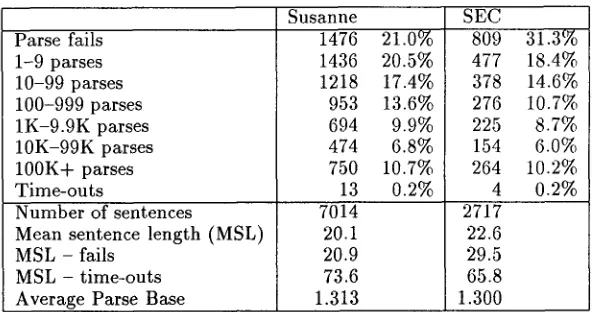
C O V E R A G E A N D A M B I G U I T Y
Parse fails 1-9 parses 10-99 parses 100-999 parses 1K-9.9K parses 10K-99K parses 100K+ parses T i m e - o u t s
N u m b e r of sentences
Mean sentence length (MSL) MSL - fails
MSL - time-outs Average Parse Base
Susanne
1476 21.0% 1436 20.5% 1218 17.4% 953 13.6% 694 9.9% 474 6.8% 750 10.7% 13 0.2% 7014
20.1 20.9 73.6
1.313
SEC
809 31.3% 477 18.4% 378 14.6% 276 10.7% 225 8.7% 154 6.0% 264 10.2% 4 0.2% 2717
22.6 29.5 65.8 1.300
Table 1: G r a m m a r coverage on Susanne and SEC
analysed successfully received under 100 parses, although there is a long tail in the distribu- tion. Monitoring this distribution is helpful during g r a m m a r development to ensure t h a t coverage is increasing but the ambiguity rate is not. A more succinct though less intuitive measure of ambigu- ity rate for a given corpus is Briscoe & Carroll's (1995) average parse base (APB), defined as the geometric m e a n over all sentences in the corpus of ¢/~, where n is the n u m b e r of words in a sen- tence, and p, the n u m b e r of parses for t h a t sen- tence. Thus, given a sentence n words long, the A P B raised to the n t h power gives the number of analyses t h a t the g r a m m a r can be expected to as- sign to a sentence of t h a t length in the corpus. Ta- ble 1 gives these measures for all of the sentences in Susanne and in SEC.
As the g r a m m a r was developed solely with ref- erence to Susanne, coverage of SEC is quite robust. T h e two corpora differ considerably since the for- m e r is drawn from American written text whilst the latter represents British transcribed spoken material. T h e corpora overall contain material drawn from widely disparate genres / registers, and are more complex t h a n those used in DARPA ATIS tests, and more diverse t h a n those used in MUCs and p r o b a b l y also the Penn Treebank. Black et al. (1993) report a coverage of around 95% on c o m p u t e r manuals, as opposed to our cov- erage rate of 70-80% on much more heterogeneous d a t a and longer sentences. T h e APBs for Susanne and SEC of 1.313 and 1.300 respectively indicate t h a t sentences of average length in each corpus could be expected to be assigned of the order of 238 and 376 analyses (i.e. 1.3132°n and 1.300226).
The parser t h r o u g h p u t on these tests, for sen- tences successfully analysed, is around 25 words per C P U second on an HP PA-RISC 715/100. Sentences of up to 30 tokens (words plus sentence- internal punctuation) are parsed in an average of
under 1 second each, whilst those a r o u n d 60 tokens take on average around 7 seconds. Nevertheless, the relationship between sentence length and pro- cessing time is fitted well by a quadratic function, supporting the findings of Carroll (1994) t h a t in practice NL g r a m m a r s do not evince worst-case parsing complexity.
G r a m m a r D e v e l o p m e n t & R e f i n e m e n t
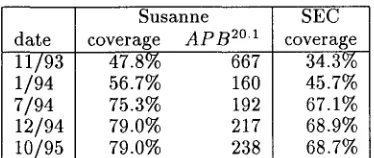
The results we report above relate to the latest version of the tag sequence g r a m m a r . To date, we have spent about one person-year on g r a m m a r de- velopment, with the effort spread fairly evenly over a two-and-a-half-year period. The various phases in the development and refinement of the g r a m m a r can be observed in an analysis of the coverage and A P B for Susanne and SEC over this p e r i o d - - s e e table 2. The phases, with dates, were:
6 / 9 2 - 1 1 / 9 3 Initial development of the g r a m m a r . 1 1 / 9 3 - 7 / 9 4 Substantial increase in coverage on the development corpus (Susanne), correspond- ing to a drive to increase the general coverage of the g r a m m a r by analysing parse failures on actual corpus material. From a lower initial fig- ure, coverage of SEC (unseen corpus), increased by a larger factor.
7 / 9 4 - 1 2 / 9 4 Incremental i m p r o v e m e n t s in cover- age, but at the cost of increasing the ambiguity of the g r a m m a r .
1 2 / 9 4 - 1 0 / 9 5 Improving the accuracy of the sys- t e m by trying to ensure t h a t the correct analysis was in the set returned.
[image:4.612.148.444.79.235.2]Susanne date coverage A P B 2°1
11/93 47.8% 667
1/94 56.7% 160
7/94 75.3% 192
12/94 79.0% 217
10/95 79.0% 238
SEC coverage
34.3% 45.7% 67.1% 68.9% 68.7%
Table 2: G r a m m a r coverage and ambiguity during development
text of Susanne compares well with the state-of- the-art in g r a m m a r - b a s e d approaches to NL anal- ysis (e.g. see Taylor el al., 1989; Alshawi el al.,
1992), it is clear t h a t the subsequent g r a m m a r re- finement phases have led to m a j o r i m p r o v e m e n t s in coverage and reductions in spurious ambiguity. We have experimented with increasing the richness of the lexical feature set by incorporating subcategorisation information for verbs into the g r a m m a r and lexicon. We constructed r a n d o m l y f r o m Susanne a test corpus of 250 in-coverage sen- tences, and in this, for each word tagged as pos- sibly being an open-class verb (i.e. not a modal or auxiliary) we extracted from the A N L T lexi- con (Carroll & Grover, 1989) all verbal entries for t h a t word. We then m a p p e d these entries into our PoS g r a m m a r experimental subcategorisation scheme, in which we distinguished each possible p a t t e r n of c o m p l e m e n t a t i o n allowed by the gram- m a r (but not control relationships, specification of prepositional heads of P P complements etc. as in the full A N L T representation scheme). We then a t t e m p t e d to parse the test sentences, us- ing the derived verbal entries instead of the orig- inal generic entries which generalised over all the subcategorisation possibilities. 31 sentences now failed to receive a parse, a decrease in coverage of 12%. This is due to the fact t h a t the A N L T lexi- con, although large and comprehensive by current standards (Briscoe & Carroll, 1996), nevertheless contains m a n y errors of omission.
P A R S E S E L E C T I O N
A probabilistic LR parser was trained with the in- tegrated g r a m m a r by exploiting the Susanne tree- b a n k bracketing. An LR parser (Briscoe & Car- roll, 1993) was applied to unlabelled bracketed sentences f r o m the Susanne treebank, and a new treebank of 1758 correct and complete analyses with respect to the integrated g r a m m a r was con- structed s e m i - a u t o m a t i c a l l y by m a n u a l l y resolving the remaining ambiguities. 250 sentences from the new treebank, selected randomly, were kept back
for testing 3. T h e remainder, together with a fur- ther set of analyses from 2285 treebank sentences t h a t were not checked manually, were used to train a probabilistic version of the LR parser, us- ing Good-Turing smoothing to estimate the prob- ability of unseen transitions in the LALR(1) ta- ble (Briscoe & Carroll, 1993; Carroll, 1993). T h e probabilistic parser can then return a ranking of all possible analyses for a sentence, or efficiently return just the n-most probable (Carroll, 1993).
The probabilistic parser was tested on the 250 sentences held out from the manually- disambiguated treebank (of lengths 3-56 tokens, mean 18.2). The parser was set up to return only the highest-ranked analysis for each sentence. Table 3 shows the results of this t e s t - - w i t h re- spect to the original Susanne b r a c k e t i n g s - - u s i n g the G r a m m a r Evaluation Interest Group scheme ( G E I G , see e.g. Harrison et al., 1991) 4. This com- pares unlabelled bracketings derived from corpus treebanks with those derived f r o m parses for the same sentences by computing recall, the ratio of matched brackets over all brackets in the treebank;
precision, the ratio of m a t c h e d brackets over all
brackets found by the parser; m e a n crossings, the number of times a bracketed sequence o u t p u t by the parser overlaps with one from the treebank but neither is properly contained in the other, av- eraged over all sentences; and zero crossings, the percentage of sentences for which the analysis re- turned has zero crossings.
T h e table also gives an indication of the best and worst possible performance of the disambigua- tion component of the system, showing the results obtained when parse selection is replaced by a sim- ple r a n d o m choice, and the results of evaluating the analyses in the m a n u a l l y - d i s a m b i g u a t e d tree- bank against the corresponding original Susanne bracketings. In this latter figure, the m e a n n u m b e r of crossings (0.41) is greater t h a n zero m a i n l y be- cause of incompatibilities between the structural representations chosen by the g r a m m a r i a n and the corresponding ones in the treebank. Precision is less t h a n 100% due to crossings, minor m i s m a t c h e s and inconsistencies (due to the m a n u a l nature of the m a r k u p process) in tree annotations, and the fact t h a t Susanne often favours a "flat" t r e a t m e n t of VP constituents, whereas our g r a m m a r always makes an explicit choice between a r g u m e n t - and adjunct-hood. Thus, perhaps a more informa- tive test of the accuracy of our probabilistic sys- t e m would be evaluation against the m a n u a l l y - disambiguated corpus of analyses assigned by the g r a m m a r . In this, the m e a n crossing figure drops 3The appendix contains a random sample of sen- tences from the test corpus.
[image:5.612.94.281.85.164.2]Zero Mean Recall Precision crossings crossings
Probabilistic parser analyses
Top-ranked analysis 59.6% 1.03 74.0% 73.0%
R a n d o m analysis 40.4% 1.84 58.6% 60.0%
Manually-disambiguated analyses
' I d e a l ' analysis 80.1% 0.41 85.4% 82.9%
Table 3: G E I G evaluation metrics for test set of 250 held-back sentences against Susanne bracketings
to 0.71 and the recall and precision rise to 83-84%, as shown in table 4.
Black el al. (1993:7) use the crossing brackets measure to define a notion of structural consis- tency, where the structural consistency rate for the g r a m m a r is defined as the proportion of sentences for which at least one a n a l y s i s - - f r o m the m a n y typically returned by the g r a m m a r - - c o n t a i n s no crossing brackets, and report a rate of around 95% for the IBM g r a m m a r tested on the com- puter m a n u a l corpus. However, a problem with the G E I G scheme and with structural consistency is t h a t b o t h are still weak measures (designed to avoid problems of p a r s e r / t r e e b a n k represen- tational compatibility) which lead to unintuitive numbers whose significance still depends heavily on details of the relationship between the repre- sentations c o m p a r e d (e.g. between structure as- signed by a g r a m m a r and t h a t in a treebank). One particular problem with the crossing bracket mea- sure is t h a t a single a t t a c h m e n t mistake embedded n levels deep (and perhaps completely innocuous, such as an "aside" delimited by dashes) can lead to n crossings being assigned, whereas incorrect identification of arguments and adjuncts can go unpunished in some cases.
Schabes et al. (1993) and M a g e r m a n (1995) report results using the G E I G evaluation scheme which are numerically similar in terms of parse se- lection to those reported here, but achieve 100% coverage. However, their experiments are not strictly comparable because they both utilise more homogeneous and p r o b a b l y simpler corpora. (The appendix gives an indication of the diversity of the sentences in our corpus). In addition, Sch- abes et al. do not recover tree labelling, whilst M a g e r m a n has developed a parser designed to pro- duce identical analyses to those used in the Penn Treebank, removing the problem of spurious er- rors due to g r a m m a t i c a l incompatibility. Both these approaches achieve better coverage by con- structing the g r a m m a r fully automatically, but as an inevitable side-effect the range of text phenom- ena that can be parsed becomes limited to those present in the training material, and being able to deal with new ones would entail further substan-
tial treebanking efforts.
To date, no robust parser has been shown to be practical and useful for some N L P task. However, it seems likely that, say, rule-to-rule se- mantic interpretation will be easier with hand- constructed g r a m m a r s with an explicit, determi- nate rule-set. A more meaningful parser compar- ison would require application of different parsers to an identical and extended test suite and utilisa- tion of a more stringent standard evaluation pro- cedure sensitive to node labellings.
Training D a t a Size and A c c u r a c y
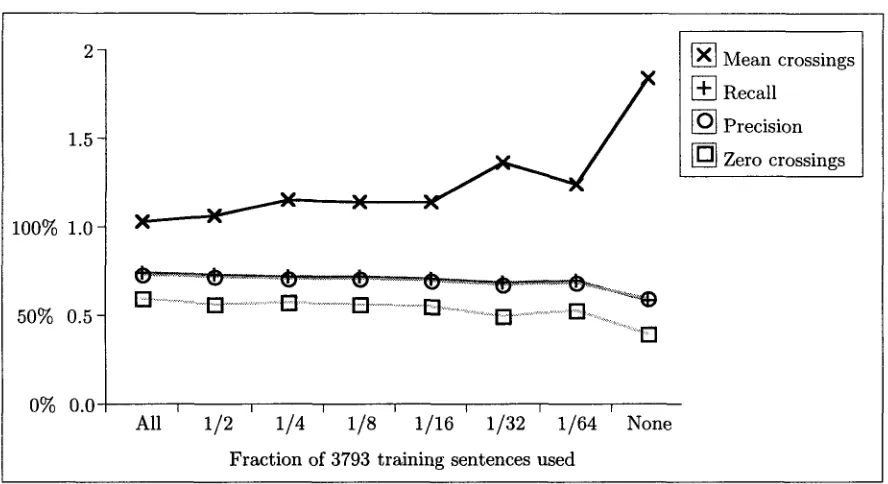
Statistical HMM-based part-of-speech taggers re- quire of the order of 100K words and upwards of training d a t a (Weischedel et al., 1993:363); tag- gers inducing non-probabilistic rules (e.g. Brill, 1994) require similar a m o u n t s (Gaizauskas, pc). Our probabilistic disambiguation system currently makes no use of lexical frequency information, training only on structural configurations. Nev- ertheless, the n u m b e r of p a r a m e t e r s in the prob- abilistic model is large: it is the total n u m b e r of possible transitions in an LALR(1) table contain- ing over 150000 actions. It is therefore interesting to investigate whether the system requires more or less training d a t a t h a n a tagger.
[image:6.612.125.473.78.171.2]Zero Mean Recall Precision crossings crossings
Probabilistic parser analyses
Top-ranked analysis 67.2% 0.71 82.9% 83.9%
Table 4: G E I G evaluation metrics for test set of 250 held-back sentences against the manually-disambigated analyses
2-
1.5-
100% 1.0-
50% 0.5-
0% o.o
[
[ ] Mean crossings [~] Recall[~] Precision [ ~ Zero crossings
[] ... [] ... El ... [] ... [] ... [] ... [] ...
...~
I I I i I I f
All 1/2 1/4 1/8 1/16 1/32 1/64 None
Fraction of 3793 training sentences used
Figure 1: GEIG metrics for held-back sentences, training on varying amounts of data
be, we ran the system on a set of 250 sentences ran- domly extracted from the training corpus. On this set, the system achieves a zero crossings rate of 60.0%, mean crossings 0.88, and recall and preci- sion of 77.0% and 75.2% respectively, with respect to the original Susanne bracketings. Although this is a different set of sentences, it is likely that the upper asymptote for accuracy for the test corpus lies in this region. Given that accuracy is increas- ing only slowly and is relatively close to the asymp- tote it is therefore unlikely that it would be worth investing effort in increasing the size of the train- ing corpus at this stage in the development of the system.
6 . C O N C L U S I O N S
In this paper we have outlined an approach to ro- bust domain-independent parsing, in which sub- categorisation constraints play no part, resulting in coverage that greatly improves upon more con- ventional grammar-based approaches to NL text analysis. We described an implemented system, and evaluated its performance along several dif- ferent dimensions. We assessed its coverage and
that of previous versions on a development cor- pus and an unseen corpus, and demonstrated that the g r a m m a r refinement we have carried out has led to substantial improvements in coverage and reductions in spurious ambiguity. We also evalu- ated the accuracy of parse selection with respect to treebank analyses, and, by varying the amount of training material, we showed that it requires comparatively little data to achieve a good level of accuracy.
[image:7.612.149.476.82.128.2] [image:7.612.91.535.164.406.2]level of accuracy with little treebank data, and that 67-75% coverage was achieved for English quite early in the grammar refinement effort, port- ing the current system to other languages should be possible with small-to-medium-sized treebanks (around 20K words) and feasible manual effort (of the order of 12 person-months for grammar- writing and treebanking). This may yield a sys- tem accurate enough for some types of application, given that the system is not restricted to return- ing the single highest ranked analysis but can re- turn the n-highest ranked for further application- specific selection.
Although we report promising results, parse selection that is sufficiently accurate for many practical applications will require a more lexi- calised system. Magerman's (1995) parser is an extension of the history-based parsing approach developed at IBM (Black et al., 1993) in which rules are conditioned on lexical and other (es- sentially arbitrary) information available in the parse history. In future work, we intend to ex- plore a more restricted and semantically-driven version of this approach in which, firstly, probabili- ties are associated with different subcategorisation possibilities, and secondly, alternative predicate- argument structures derived from the grammar are ranked probabilistically. However, the mas- sively increased coverage obtained here by relaxing subcategorisation constraints underlines the need to acquire accurate and complete subcategorisa- tion frames in a corpus-driven fashion, before such constraints can be exploited robustly and effec- tively with free text.
R E F E R E N C E S
Alshawi, H., Carter, D., Crouch, R., Pulman, S., Rayner, M., ~ Smith, A. 1992. CLARE: a contex- tual reasoning and cooperative response framework for the Core Language Engine. SRI International, Cambridge, UK.
Billot, S. & Lang, B. 1989. The structure of shared forests in ambiguous parsing. In Proceedings of the 27lh Meeting of Association for Computational Linguistics, Vancouver, Canada. 143-151.
Black, E., Garside, R. & Leech, G. (eds.) 1993. Statistically-driven computer grammars of En- glish: the IBM~ Lancaster approach. Amsterdam, The Netherlands: Rodopi.
Brill, E. 1994. Some advances in transformation- based part of speech tagging. In Proceedings of the 12th National Conference on Artificial Intelligence (AAAI-94), Seattle, WA.
Briscoe, E. 1994. Prospects for practical parsing of unrestricted text: robust statistical parsing tech- niques. In Oostdijk, N L: de Haan, P. eds. Corpus-
based Research into Language. Rodopi, Amster- dam: 97-120.
Briscoe, E. & Carroll, J. 1993. Generalised prob- abilistic LR parsing for unification-based gram- mars. Computational Linguistics 19.1: 25-60. Briscoe, E. ,~ Carroll, J. 1994. Parsing ('with) punctuation etc. Rank Xerox Research Centre, Grenoble, MLTT-TR-007.
Briscoe, E. ,~ Carroll, J. 1995. Developing and evaluating a probabilistic LR parser of part-of- speech and punctuation labels. In Proceedings of the 4th ACL/SIGPARSE International Workshop on Parsing Technologies, Prague, Czech Republic. 48-58.
Briscoe, E. • Carroll, J. 1996. Automatic extrac- tion of subcalegorization from corpora. Under re- view.
Briscoe, E., Grovel', C., Boguraev, B. & Carroll, J. 1987. A formalism and environment for the devel- opment of a large grammar of English. In Proceed- ings of the lOth International Joint Conference on Artificial Intelligence, Milan, Italy. 703-708. Carroll, J. 1993. Practical unification-based pars- ing of natural language. Cambridge University, Computer Laboratory, TR-314.
Carroll, J. 1994. Relating complexity to prac- tical performance in parsing with wide-coverage unification grammars. In Proceedings of the 32nd Meeting of Association for Computational Lin- guistics, Las Cruces, NM. 287-294.
Carroll, J. ~: Grover, C. 1989. The derivation of a large computational lexicon for English from LDOCE. In Boguraev, B. &: Briscoe, E. eds. Com- putational Lexicography for Natural Language Pro- cessing. Longman, London: 117-134.
Church, K. 1988. A stochastic parts program and noun phrase parser for unrestricted text. In Pro- ceedings of the 2nd Conference on Applied Natural Language Processing, Austin, Texas. 136-143. Elworthy, D. 1993. Part-of-speech lagging and phrasal tagging. Acquilex-II Working Paper 10, Cambridge University Computer Laboratory (can be obtained from [email protected]).
Elworthy, D. 1994. Does Baum:Welch re- estimation help taggers?. In Proceedings of the 4th Conference on Applied NLP, Stuttgart, Germany. Garside, R., Leech, G. & Sampson, G. 1987. Com- putational analysis of English. Harlow, UK: Long- m a i l .
Grishman, R., Macleod, C. & Meyers, A. 1994. Comlex syntax: building a computational lexicon. In Proceedings of the International Conference on
Harrison, P., Abney, S., Black, E., Flickenger, D., Gdaniec, C., Grishman, R., Hindle, D., In- gria, B., Marcus, M., Santorini, B. & Strza- lkowski, T. 1991. Evaluating syntax performance
of parser/grammars of English. In Proceedings
of the Workshop on Evaluating Natural Language
Processing Systems, ACL.
Hindle, D. 1989. Acquiring disambiguation rules
from text. In Proceedings of the 27th Annual Meet-
ing of the Association for Computational Linguis-
tics, Vancouver, Canada. 118-25.
Jackendoff, R. 1977. X-bar syntax. Cambridge,
MA: MIT Press.
Jones, B. 1994. Can punctuation help parsing?.
In Proceedings of the International Conference on
Computational Linguistics, COLING-94, Kyoto,
Japan.
Magerman, D. 1995. Statistical decision-tree mod-
els for parsing. In Proceedings of the 33rd Annual
Meeting of the Association for Computational Lin-
guistics, Boston, MA.
de Marcken, C. 1990. Parsing the LOB corpus.
In Proceedings of the 28th Annual Meeting of the
Association for Computational Linguistics, New
York. 243-251.
Nunberg, G. 1990. The linguistics of punctuation.
CSLI Lecture Notes 18, Stanford, CA.
Pereira, F. & Warren, D. 1980. Definite clause grammars for language analysis - a survey of the formalism and a comparison with augmented tran-
sition networks. Artificial Intelligence 13.3: 231-
278.
Sampson, G. 1995. English for the computer. Ox-
ford, UK: Oxford University Press.
Schabes, Y., Roth, M. & Osborne, R. 1993. Pars- ing of the Wall Street Journal with the inside-
outside algorithm. In Proceedings of the Meeting
of European Association for Computational Lin-
guistics, Utrecht, The Netherlands.
Taylor, L., Grover, C. & Briscoe, E. 1989. The syntactic regularity of English noun phrases. In
Proceedings of the 4th European Meeting of the As-
sociation for Computational Linguistics, Manch-
ester, UK. 256-263.
Taylor, L. &: Knowles, G. 1988. Manual of in-
formation to accompany the S E C corpus: the
machine-readable corpus of spoken English. Uni-
versity of Lancaster, UK, Ms.
Weischedel, R., Meteer, M., Schwartz, R.,
Ramshaw, L. & Palmucci J. 1993. Coping with ambiguity and unknown words through probabilis-
tic models. Computational Linguistics 19(2): 359-
382.
A P P E N D I X
Below is a random sample of the 250-sentence test set. The test set comprises the Brown genre cat- egories: "press reportage"; "belles lettres, biog- raphy, memoirs"; and "learned (mainly scientific and technical) writing".
"Yes, your honour", replied Bellows.
This is another of the modifications of policy on Laos that the Kennedy administration has felt compelled to make.
On Monday, the Hughes concern was formally declared bankrupt after its directors indicated they could not draw up a plan for reorganiza- tion.
Ierulli will replace Desmond D. Connall who has been called to active military service but is expected back on the job by March 31. Place kicking is largely a matter of timing, Moritz declared.
Ritchie walked up to him at the magazine stand.
Hector Lopez, subbing for Berra, smashed a 3-run homer off Bill Henry during another 5- run explosion in the fourth.
That's how he first won the Masters in 1958. Cooperman and Teller are accused of selling $4,700 worth of heroin to a convicted nar- cotics peddler, Otis Sears, 45, of 6934 Indi- ana av.
However, the system is designed, ingeniously and hopefully, so that no one man could ini- tiate a thermonuclear war.
He bent down, a black cranelike figure, and put his mouth to the ground.
Those who actually get there find that it isn't spooky at all but as brilliant as a tile in sun- light.
Others look to more objective devices of or- der.
What additional roles has the scientific un- derstanding of the 19th and 20th centuries played?
I f we look at recent art we find it preoccupied with form.
Hence the beatniks sustain themselves on marijuana, jazz, free swinging poetry, ex- hausting themselves in orgies of sex; some of them are driven over the borderline of sanity and lose contact with reality.
Heidenstam could never be satisfied by sur- face.