49
Normalization of Transliterated Words in Code-Mixed Data Using
Seq2Seq Model & Levenshtein Distance
Soumil Mandal, Karthick Nanmaran
Department of Computer Science & Engineering SRM Institute of Science & Technology, Chennai, India
{soumil.mandal, karthicknanmaran}@gmail.com
Abstract
Building tools for code-mixed data is rapidly gaining popularity in the NLP research com-munity as such data is exponentially rising on social media. Working with code-mixed data contains several challenges, especially due to grammatical inconsistencies and spelling vari-ations in addition to all the previous known challenges for social media scenarios. In this article, we present a novel architecture focus-ing on normalizfocus-ing phonetic typfocus-ing variations, which is commonly seen in code-mixed data. One of the main features of our architecture is that in addition to normalizing, it can also be utilized for back-transliteration and word iden-tification in some cases. Our model achieved an accuracy of 90.27% on the test data.
1 Introduction
With rising popularity of social media, the amount of data is rising exponentially. If mined, this data can proof to be useful for various purposes. In countries where the number of bilinguals are high, we see that users tend to switch back and forth be-tween multiple languages, a phenomenon known as code-mixing or code-switching. An interest-ing case is switchinterest-ing between languages which share different native scripts. On such occasions, one of the two languages is typed in it’s phoneti-cally transliterated form in order to use a common script. Though there are some standard transliter-ation rules, for example ITRANS 1, ISO2, but it is extremely difficult and un-realistic for people to follow them while typing. This indeed is the case as we see that identical words are being transliter-ated differently by different people based on their own phonetic judgment influenced by dialects, lo-cation, or sometimes even based on the informal-ity or casualness of the situation. Thus, for
cre-1
https://en.wikipedia.org/wiki/ITRANS 2https://en.wikipedia.org/wiki/ISO 15919
ating systems for code-mixed data, post language tagging, normalization of transliterated text is ex-tremely important in order to identify the word and understand it’s semantics. This would help a lot in systems like opinion mining, and is actu-ally necessary for tasks like summarization, trans-lation, etc. A normalizing module will also be of immense help while making word embeddings for code-mixed data.
In this paper, we present an architecture for automatic normalization of phonetically translit-erated words to their standard forms. The lan-guage pair we have worked on is Bengali-English (Bn-En), where both are typed in Roman script, thus the Bengali words are in their transliterated form. The canonical or normalized form we have considered is the Indian Languages Translitera-tion (ITRANS) form of the respective Bengali word. Bengali is an Indo-Aryan language of In-dia where 8.10%3of the total population are 1st
language speakers and is also the official language of Bangladesh. The native script of Bengali is the Eastern Nagari Script4. Our architecture utilizes fully char based sequence to sequence learning in addition to Levenshtein distance to give the final normalized form or as close to it as possible. Some additional advantages of our system is that at an intermediate stage, the back-transliterated form of the word can be fetched (i.e. word identifica-tion), which will be very useful in several cases as original tools (i.e. tools using native script) can be utilized, for example emotion lexicons. Some other important contributions of our research are the new lexicons that have been prepared (dis-cussed in Sec3) which can be used for building various other tools for studying Bengali-English code-mixed data.
3
2 Related Work
Normalization of text has been studied quite a lot (Sproat et al., 1999), especially as it acts as a pre-processing step for several text process-ing systems. Usprocess-ing Conditional Random Fields (CRF), Zhu et al. (2007) performed text normal-ization on informal emails. Dutta et al. (2015) created a system based on noisy channel model for text normalization which handles wordplay, contracted words and phonetic variations in code-mixed background. An unsupervised framework was presented by Sridhar (2015) for normaliz-ing domain-specific and informal noisy texts usnormaliz-ing distributed representation of words. The soundex algorithm was used in (Sitaram et al., 2015) and (Sitaram and Black, 2016) for spelling correc-tion of transliterated words and normalizacorrec-tion in a speech to text scenario of code-mixed data re-spectively. Sharma et al. (2016) build a normal-ization system using noisy channel framework and SILPA spell checker in order to build a shallow parser. Sproat and Jaitly (2016) build a system combining two models, where one essentially is a seq2seq model which checks the possible normal-izations and the other is a language model which considers context information. Jaitly and Sproat (2017) used a seq2seq model with attention trained at sentence level followed by error pruning us-ing finite-state filters to build a normalization sys-tem, mainly targeted for text to speech purposes. A similar flow was adopted byZare and Rohatgi (2017) as well where seq2seq was used for nor-malization and a window of size 20 was consid-ered for context. Singh et al.(2018) exploited the fact that words and their variations share similar context in large noisy text corpora to build their normalizing model, using skip gram and cluster-ing techniques. To the best of our knowledge, the system architecture proposed by us hasn’t been tried before, especially for code-mixed data.
3 Data Sets
On a whole, three data sets or lexicons were cre-ated. The first data set was a parallel lexicon (PL) where the 1st column had phonetically transliter-ated Bn words in Roman taken from code-mixed data prepared inMandal et al. (2018b). The 2nd column consisted of the standard Roman translit-erations (ITRANS) of the respective words. To get this, we first manually back-transliterated PLcol 1
to the original word in Eastern Nagari script, and
then converted it into standardized ITRANS for-mat. The final size of the PL was 6000. The second lexicon we created was a transliteration dictionary (BN TRANS) where the first column had Bengali words in Eastern Nagari script taken from samsad5, while the second column had the standard transliterations (ITRANS). The number of entries in the dictionary was 21850. For test-ing, we took the data used in Mandal and Das (2018), language tagged it using the system de-scribed in Mandal et al. (2018a), and then col-lected Bn tagged tokens. Post manual checking and discarding of misclassified tokens, the size of the list was 905. Finally, each of the words were tagged with their ITRANS using the same approach used for making PL. For PLcol 1and test
data, some initial rule based normalization tech-niques were used. If the input string contains a digit, it was replaced by the respective phone (e.g.
ekfor 1,duifor 2, etc), and if there aren consecu-tive identical characters wheren>2 (elongation), it was trimmed down to 2 consecutive characters (e.g. baaaad will become baad), as no word in it’s standard form has more than two consecutive identical characters.
4 Proposed Method
Our method is a two step modular approach com-prising of two degrees of normalization. The first normalization module does an initial normaliza-tion and tries to convert the input string closest to the standard transliteration. The second normal-ization module takes the output from the first mod-ule and tries to match with the standard translitera-tions present in the dictionary (BN TRANS). The candidate with the closest match is returned as the final normalized string.
5 First Normalization Module
The purpose of this module is to phonetically nor-malize the word as close to the standard transliter-ation as possible, to make the work of the match-ing module easier. To achieve this, our idea was to train a sequence to sequence model where the input sequences are user transliterated words and the target sequences are the respective ITRANS transliterations. We had specifically chosen this architecture as it has performed amazingly well in complex sequence mapping tasks like neural ma-chine translation and summarization.
5.1 Seq2Seq Model
The sequence to sequence model (Sutskever et al., 2014) is a relatively new idea for sequence learn-ing uslearn-ing neural networks. It has been especially popular since it achieved state of the art results in machine translation task. Essentially, the model takes as input a sequence X = {x1, x2, ..., xn}
and tries to generate another sequence Y = {y1,
y2, ..., ym}, where xi and yi are the input and
target symbols respectively. The architecture of seq2seq model comprises of two parts, the en-coder and deen-coder. As the input and target vec-tors were quite small (words), attention (Vaswani et al.,2017) mechanism was not incorporated.
5.1.1 Encoder
Encoder essentially takes a variable length se-quence as input and encodes it into a fixed length vector, which is supposed to summarize it’s mean-ing takmean-ing into context as well. A recurrent neural network (RNN) cell is used to achieve this. The directional encoder reads the sequence from one end to the other (left to right in our case).
~ht =f~enc(Ex(xt), ~ht-1)
Here,Exis the input embedding lookup table (dic-tionary),f~enc are the transfer function for the
re-current unit e.g. Vanilla, LSTM or GRU. A con-tiguous sequence of encodingsC={h1, h2, ..., hn}
is constructed which is then passed on to the de-coder.
5.1.2 Decoder
Decoder takes input context vectorCfrom the en-coder, and computes the hidden state at time t as,
st =fdec(Ey(yt-1), st-1, ct)
Subsequently, a parametric function outk returns
the conditional probability using the next target symbol being k. Here, the concept of teacher forc-ing is utilized, the strategy of feedforc-ing output of the model from a prior time-step as input.
p(yt =k|y < t, X) = 1
Zexp(outk(Ey(yt−1), st, ct))
Z is the normalizing constant
X
jexp(outj(Ey(yt−1), st, ct))
5.2 Training
The model is trained by minimizing the negative log-likelihood. For training, we used the fully character based seq2seq model (Lee et al.,2016) with stacked LSTM cells. The input units were user typed phonetic transliterations (PLcol 1) while
the target units were respective standard transliter-ations (PLcol 2). Thus, the model learns to map
user transliterations to standard transliterations, effectively learning to normalize phonetic varia-tions. The lookup tableEx we used for character
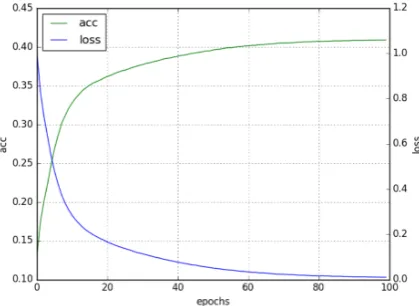
[image:3.595.311.521.437.590.2]encoding was a dictionary where the keys were the 26 English alphabets and the values were the re-spective index. Encodings at character level were then padded to the length of the maximum existing word in the dataset, which was 14, and was con-verted to one-hot encodings prior to feeding the to the seq2seq model. We created our seq2seq model using the Keras (Chollet et al.,2015) library. The batch size was set to 64, and number of epochs was set to 100. The size of the latent dimension was kept at 128. Optimizer we chose was rm-sprop, learning rate set at 0.001, loss was categor-ical crossentropy and transfer function used was softmax. Accuracy and loss graphs during train-ing with respect to epochs are shown in Fig1.
Figure 1: Training accuracy and loss.
6 Second Normalization Module
This module basically comprises of the string matching algorithm. For this, we have used Levenshtein distance (LD) (Levenshtein, 1966), which is a string metric for measuring difference between two sequences. It does so by calculating the minimum number of insertions, deletions and substitutions required for converting one sequence to the other. Here, the output from the previous module is compared with all the standard ITRANS entries present in BN TRANS and the string with the least Levenshtein distance is given as out-put, which is the final normalized form. If there are ties, the instance which has higher matches traversing from left to right is given more prior-ity. Also, observing the errors from first normal-izer, we noticed that in a lot of cases, the char-acter pairs{a,o}and{b,v}are used interchange-ably quite often (language specific phonological features), both in phonetic transliterations alone, as well as when compared with ITRANS. Thus, along with the standard approach, we tried a mod-ified version as well where the cost of the above mentioned character pairs are same, i.e. they are treated as identical characters. This was simply done by assigning special symbols to those pairs, and replacing them in the input parameters. For example, post replacement, distance(chalo,chala) will become distance(ch$l$,ch$l$).
7 Evaluation
Our system was evaluated in two ways, one at word level and another at task level.
7.1 Word Level
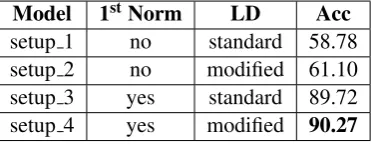
Here, the basic idea was compare the normalized words with the respective standard transliterations. For this, the testing data discussed in Sec 3 was used. For comparison purposes, three other se-tups other than our proposed model (setup 4) were tested, all of which are described in Table1.
Model 1stNorm LD Acc
setup 1 no standard 58.78
setup 2 no modified 61.10
setup 3 yes standard 89.72
setup 4 yes modified 90.27
Table 1: Comparison of different setups.
From Table1, we can see that the jump in
accu-racy from setup 1 to setup 3 is quite significant (by 30.94%). This proves that instead of sim-ple distance comparison with lexicon entries, a prior seq2seq normalization can have great impact on the performance. Additionally, we can also see that when modified input is given to the Lev-enshtein distance (LD), the accuracies achieved are slightly better. On analyzing the errors, we found out that majority (92%) of them is due to the fact that the standard from was not present in BN TRANS, i.e. was out of vocabulary. These words were mostly slangs, expressions, or two words joined into a single one. The other 8% was due to the first module casuing substantial deviation from normal form. For deeper analy-sis, we collected the ITRANS of errors due out of vocab, and on comparison with the first normal-izations, the mean LD was calculated to be 1.89, which is suggesting that if they were present in BN TRANS, the normalizer would have given the correct output.
7.2 Task Level
For task level evaluation, we decided to go with sentiment analysis using the exact setup and data described in Mandal et al. (2018b), on Bengali-English code-mixed data. All the training and test-ing data were normalized ustest-ing our system along with the lexicons that are mentioned. Finally, the same steps were followed and the different metrics were calculated. The comparison of the systems prior (noisy) and post normalization (normalized) is shown in Table2.
Model Acc Prec Rec F1
noisy 80.97 81.03 80.97 81.20
[image:4.595.89.275.643.715.2]normalized 82.47 82.52 82.47 82.61
Table 2: Prior and post normalization results.
We can see an improvement in the accuracy (by 1.5%). On further investigation, we saw that the unigram, bigram and trigram matches with the bag of n-grams and testing data increased by 1.6%, 0.4% and 0.1% respectively. The accuracy can be improved further more if back-transliteration is done and Bengali sentiment lexicons are used but that is beyond the scope of this paper.
8 Discussion
re-quirement for the parallel corpus (PL) for training a seq2seq model, as manual checking and back-transliteration is quite tedious. Speed of process-ing in terms of words/second is not very high due to the fact that both seq2seq and Levenshthein dis-tance calculation is computationally heavy, plus the O(n) search time. For string matching, sim-pler and faster methods can be tested and search area reduction algorithms (e.g. specifying search domains depending on starting character) can be tried to improve the processing speed. A lexical checker can be added as well prior to seq2seq to see if the word is already in it’s transliterated form.
9 Conclusion & Future Work
In this article, we have presented a novel archi-tecture for normalization of transliterated words in code-mixed scenario. We have employed the seq2seq model with LSTM cells for initial normal-ization followed by evaluating Levenshthein dis-tance to retrieve the standard transliteration from a lexicon. Our approach got an accuracy of90.27%
on testing data, and improved the accuracy of a pre-existing sentiment analysis system by 1.5%. In future, we would like to collect more translit-erated words and increase the data size in order to improve both PL and BN TRANS. Also, combin-ing this module with a context capturcombin-ing system and expanding to other Indic languages will be one of the goals as well.
References
Franc¸ois Chollet et al. 2015. Keras. https:// keras.io.
Sukanya Dutta, Tista Saha, Somnath Banerjee, and Sudip Kumar Naskar. 2015. Text normalization in code-mixed social media text. InRecent Trends in Information Systems (ReTIS), 2015 IEEE 2nd Inter-national Conference on, pages 378–382. IEEE.
Navdeep Jaitly and Richard Sproat. 2017. An rnn model of text normalization.
Jason Lee, Kyunghyun Cho, and Thomas Hofmann. 2016. Fully character-level neural machine trans-lation without explicit segmentation. arXiv preprint arXiv:1610.03017.
Vladimir I Levenshtein. 1966. Binary codes capable of correcting deletions, insertions, and reversals. In Soviet physics doklady, volume 10, pages 707–710.
Soumil Mandal and Dipankar Das. 2018. Ana-lyzing roles of classifiers and code-mixed
fac-tors for sentiment identification. arXiv preprint arXiv:1801.02581.
Soumil Mandal, Sourya Dipta Das, and Dipankar Das. 2018a. Language identification of bengali-english code-mixed data using character & phonetic based lstm models. arXiv preprint arXiv:1803.03859.
Soumil Mandal, Sainik Kumar Mahata, and Dipankar Das. 2018b. Preparing bengali-english code-mixed corpus for sentiment analysis of indian languages. arXiv preprint arXiv:1803.04000.
Arnav Sharma, Sakshi Gupta, Raveesh Motlani, Piyush Bansal, Manish Srivastava, Radhika Mamidi, and Dipti M Sharma. 2016. Shallow parsing pipeline for hindi-english code-mixed social media text. arXiv preprint arXiv:1604.03136.
Rajat Singh, Nurendra Choudhary, and Manish Shri-vastava. 2018. Automatic normalization of word variations in code-mixed social media text. arXiv preprint arXiv:1804.00804.
Sunayana Sitaram and Alan W Black. 2016. Speech synthesis of code-mixed text. InLREC.
Sunayana Sitaram, Sai Krishna Rallabandi, and SRAW Black. 2015. Experiments with cross-lingual sys-tems for synthesis of code-mixed text. In9th ISCA Speech Synthesis Workshop, pages 76–81.
Richard Sproat, Alan W Black, Stanley Chen, Shankar Kumar, Mari Ostendorf, and Christopher Richards. 1999. Normalization of non-standard words. In WS’99 Final Report. Citeseer.
Richard Sproat and Navdeep Jaitly. 2016. Rnn ap-proaches to text normalization: A challenge. arXiv preprint arXiv:1611.00068.
Vivek Kumar Rangarajan Sridhar. 2015. Unsupervised text normalization using distributed representations of words and phrases. In Proceedings of the 1st Workshop on Vector Space Modeling for Natural Language Processing, pages 8–16.
Ilya Sutskever, Oriol Vinyals, and Quoc V Le. 2014. Sequence to sequence learning with neural net-works. InAdvances in neural information process-ing systems, pages 3104–3112.
Ashish Vaswani, Noam Shazeer, Niki Parmar, Jakob Uszkoreit, Llion Jones, Aidan N Gomez, Łukasz Kaiser, and Illia Polosukhin. 2017. Attention is all you need. InAdvances in Neural Information Pro-cessing Systems, pages 6000–6010.
Maryam Zare and Shaurya Rohatgi. 2017. Deepnorm-a deep leDeepnorm-arning Deepnorm-approDeepnorm-ach to text normDeepnorm-alizDeepnorm-ation. arXiv preprint arXiv:1712.06994.