Memory-enhanced Decoder for Neural Machine Translation
Mingxuan Wang1 Zhengdong Lu2 Hang Li2 Qun Liu3,1 1Key Laboratory of Intelligent Information Processing,
Institute of Computing Technology, Chinese Academy of Sciences
{wangmingxuan,liuqun}@ict.ac.cn
2Noah’s Ark Lab, Huawei Technologies
{Lu.Zhengdong,HangLi.HL}@huawei.com
3ADAPT Centre, School of Computing, Dublin City University
Abstract
We propose to enhance the RNN decoder in a neural machine translator (NMT) with external memory, as a natural but power-ful extension to the state in the decoding RNN. This memory-enhanced RNN de-coder is called MEMDEC. At each time during decoding, MEMDECwill read from this memory and write to this memory once, both with content-based addressing. Unlike the unbounded memory in previ-ous work(Bahdanau et al., 2014) to store the representation of source sentence, the memory in MEMDECis a matrix with pre-determined size designed to better cap-ture the information important for the de-coding process at each time step. Our empirical study on Chinese-English trans-lation shows that it can improve by 4.8 BLEU upon Groundhog and 5.3 BLEU upon on Moses, yielding the best perfor-mance achieved with the same training set.
1 Introduction
The introduction of external memory has greatly expanded the representational capability of neu-ral network-based model on modeling se-quences(Graves et al., 2014), by providing flex-ible ways of storing and accessing information. More specifically, in neural machine translation, one great improvement came from using an array of vectors to represent the source in a sentence-level memory and dynamically accessing relevant segments of them (alignment) (Bahdanau et al.,
2014) through content-based addressing (Graves et al., 2014). The success of RNNsearch demon-strated the advantage of saving the entire sen-tence of arbitrary length in an unbounded mem-ory for operations of next stage (e.g., decoding).
In this paper, we show that an external memory can be used to facilitate the decoding/generation process thorough a memory-enhanced RNN de-coder, called MEMDEC. The memory in
MEMDEC is a direct extension to the state in
the decoding, therefore functionally closer to the memory cell in LSTM(Hochreiter and Schmid-huber, 1997). It takes the form of a matrix with pre-determined size, each column (“a memory cell”) can be accessed by the decoding RNN with content-based addressing for both reading and writing during the decoding process. This mem-ory is designed to provide a more flexible way to select, represent and synthesize the informa-tion of source sentence and previously generated words of target relevant to the decoding. This is in contrast to the set of hidden states of the entire source sentence (which can viewed as an-other form of memory) in (Bahdanau et al., 2014) for attentive read, but can be combined with it to greatly improve the performance of neural ma-chine translator. We apply our model on English-Chinese translation tasks, achieving performance superior to any published results, SMT or NMT, on the same training data (Xie et al., 2011; Meng et al., 2015; Tu et al., 2016; Hu et al., 2015)
Our contributions are mainly two-folds
• we propose a memory-enhanced decoder for
neural machine translator which naturally extends the RNN with vector state.
• our empirical study on Chinese-English
translation tasks show the efficacy of the proposed model.
Roadmap In the remainder of this paper, we will first give a brief introduction to attention-based neural machine translation in Section 2, presented from the view of encoder-decoder, which treats the hidden states of source as an unbounded memory and the attention model as a content-based reading. In Section 3, we will elaborate on the memory-enhanced decoder MEMDEC. In Section 4, we will apply NMT with
MEMDEC to a Chinese-English task. Then in
Section 5 and 6, we will give related work and conclude the paper.
2 Neural machine translation with attention
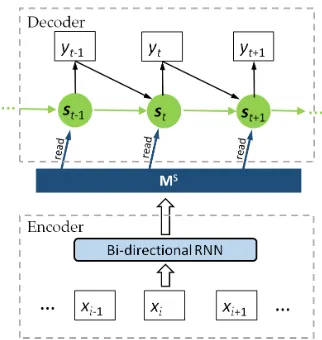
Our work is built on attention-based NMT(Bahdanau et al., 2014), which repre-sents the source sentence as a sequence of vectors after being processed by RNN or bi-directional RNNs, and then conducts dynamic alignment and generation of the target sentence with another RNN simultaneously.
[image:2.612.339.500.53.223.2]Attention-based NMT, with RNNsearch as its most popular representative, generalizes the con-ventional notion of encoder-decoder in using a unbounded memory for the intermediate repre-sentation of source sentence and content-based addressing read in decoding, as illustrated in Figure 1. More specifically, at time step t, RNNsearch first get context vectorctafter
read-ing from the source representationMS, which is then used to update the state, and generate the word yt (along with the current hidden statest,
and the previously generated wordyi−1).
Formally, given an input sequence x = [x1, x2, . . . , xTx] and the previously generated
sequencey<t = [y1, y2, . . . , yt−1], the
probabil-ity of next wordytis
p(yt|y<t;x) =f(ct, yt−1,st), (1)
Figure 1:RNNsearch in the encoder-decoder view.
wherestis state of decoder RNN at time step t
calculated as
st=g(st−1, yt−1,ct). (2)
whereg(·)can be an be any activation function,
here we adopt a more sophisticated dynamic op-erator as in Gated Recurrent Unit (GRU, (Cho et al., 2014)). In the remainder of the paper, we will also useGRUto stand for the operator. The read-ingctis calculated as
ct= jX=Tx
j=1
αt,jhj, (3)
where hj is thejth cell in memory MS. More
formally, hj = [←h−j>,−h→j>]> is the annotations
ofxj and contains information about the whole
input sequence with a strong focus on the parts surroundingxj, which is computed by a
bidirec-tional RNN. The weightαt,jis computed by
αt,j =
exp(et,j)
Pk=Tx
k=1 exp(et,k)
.
whereei,j = vTa tanh(Wast−1 +Uahj) scores
how well st−1 and the memory cell hj match.
Figure 2:Diagram of the proposed decoder MEMDECwith details.
2.1 Improved Attention Model
The alignment model αt,j scores how well the
output at positiontmatches the inputs around po-sition j based on st−1 and hj. It is intuitively
beneficial to exploit the information ofyt−1when
reading fromMS, which is missing from the
im-plementation of attention-based NMT in (Bah-danau et al., 2014). In this work, we build a more effective alignment path by feeding both previous hidden statest−1 and the context word
yt−1 to the attention model, inspired by the
re-cent implementation of attention-based NMT1.
Formally, the calculation ofet,j becomes
et,j =vTa tanh(Was˜t−1+Uahj),
where
• ˜st−1 = H(st−1,eyt−1) is an intermediate
state tailored for reading fromMS with the information ofyt−1(its word embedding
be-ingeyt−1) added;
• H is a nonlinear function, which can be
as simple as tanh or as complex as GRU. In our preliminary experiments, we found GRUworks slightly better than tanh func-tion, but we chose the latter for simplicity.
1github.com/nyu-dl/dl4mt-tutorial/
tree/master/session2
3 Decoder with External Memory
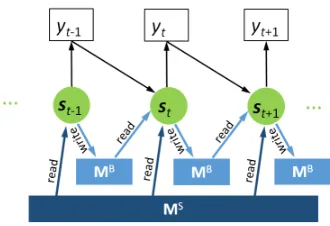
In this section we will elaborate on the proposed memory-enhanced decoder MEMDEC. In
ad-dition to the source memory MS, MEMDEC is
equipped with a buffer memory MB as an
ex-tension to the conventional state vector. Fig-ure 3 contrasts MEMDEC with the decoder in
[image:3.612.339.504.413.526.2]RNNsearch (Figure 1) on a high level.
Figure 3:High level digram of MEMDEC.
In the remainder of the paper, we will refer to the conventional state as vector-state (denotedst)
and its memory extension as memory-state (de-noted as MB
t). Both states are updated at each
time step in a interweaving fashion, while the out-put symbolytis predicted based solely on
vector-statest(along withctandyt−1). The diagram of
Vector-State Update At timet, the vector-state stis first used to readMB
rt−1 = readB(st−1,Mt−B 1) (4)
which then meets the previous predictionyt−1to
form an “intermediate” state-vector
est=tanh(Wrrt−1+Wyeyt−1). (5)
where eyt−1 is the word-embedding associated
with the previous predictionyt−1. This pre-state
estis used to read the source memoryMS
ct = readS(est,MS). (6)
Both readings in Eq. (4) & (6) follow content-based addressing(Graves et al., 2014) (details later in Section 3.1). After that,rt−1is combined
with output symbolyt−1andctto update the new
vector-state
st=GRU(rt−1,yt−1,ct) (7)
[image:4.612.348.480.60.134.2]The update of vector-state is illustrated in Fig-ure 4.
Figure 4:Vector-state update at timet.
Memory-State Update As illustrated in Fig-ure 5, the update for memory-state is simple after the update of vector-state: with the vector-state st+1the updated memory-state will be
MBt =write(st,MBt−1) (8)
[image:4.612.326.513.308.458.2]The writing to the memory-state is also content-based, with same forgetting mechanism sug-gested in (Graves et al., 2014), which we will elaborate with more details later in this section.
Figure 5:Memory-state update at timet.
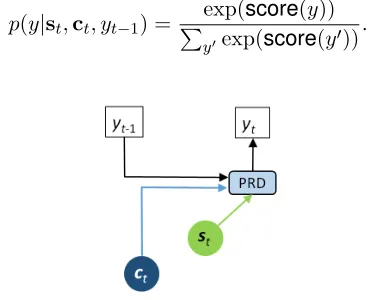
Prediction As illustrated in Figure 6, the pre-diction model is same as in (Bahdanau et al., 2014), where the score for wordyis given by
score(y) =DNN([st,ct,eyt−1])>ωy (9)
where ωy is the parameters associated with the
wordy. The probability of generating wordy at timetis then given by a softmax over the scores
p(y|st,ct, yt−1) =
exp(score(y))
P
y0exp(score(y0))
[image:4.612.96.290.418.500.2].
Figure 6:Prediction at timet.
3.1 Reading Memory-State
Formally MBt0 ∈ Rn×m is the memory-state at timet0after the memory-state update, wherenis the number of memory cells andmis the dimen-sion of vector in each cell. Before the vector-state update at timet, the output of readingrtis given
by
rt= j=n
X
j=1
wtR(j)MBt−1(j)
wherewRt ∈Rnspecifies thenormalizedweights assigned to the cells in MB
t. Similar with the
More specifically, wR
t is also updated from the
one from previous timewtR−1 as
wRt =gtRwtR−1+ (1−gtR)wetR, (10)
where
• gtR =σ(wRgst)is the gate function, with
pa-rameterswR g ∈Rm;
• wetgives the contribution based on the
cur-rent vector-statest
e
wtR = softmax(aRt) (11)
aRt(i) = v>(WaRMtB−1(i) +URast−1), (12)
with parametersWRa,UaR ∈Rm×mandv∈ Rm.
3.2 Writing to Memory-State
There are two types of operation on writing to memory-state:ERASEandADD. Erasion is
simi-lar to the forget gate in LSTM or GRU, which de-termines the content to be remove from memory cells. More specifically, the vectorµtERS ∈ Rm
specifies the values to be removed on each dimen-sion in memory cells, which is than assigned to each cell through normalized weightswtW. For-mally, the memory-state afterERASEis given by
f
MBt(i) =MtB−1(i)(1−wWt(i)·µtERS) (13)
i= 1,· · ·, n where
• µERSt = σ(WERSst) is parametrized with
WERS ∈Rm×m;
• wW
t (i)specifies the weight associated with
the ith cell in the same parametric form as
in Eq. (10)-(12) with generally different pa-rameters.
ADDoperation is similar with the update gate in
LSTM or GRU, deciding how much current in-formation should be written to the memory.
MBt(i) = MftB(i) +wWt (i)µADDt µtADD = σ(WADDst)
whereµtADD∈RmandWADD ∈Rm×m.
In our experiments, we have a peculiar but in-teresting observation: it is often beneficial to use the same weights for both reading (i.e., wRt in Section 3.1) and writing (i.e.,wW
t in Section 3.2
) for the same vector-statest. We conjecture that
this acts like a regularization mechanism to en-courage the content of reading and writing to be similar to each other.
3.3 Some Analysis
The writing operation in Eq. (13) at time t can be viewed as an nonlinear way to combine the previous memory-stateMBt−1 and the newly updated vector-state st, where the nonlinearity
comes from both the content-based addressing and the gating. This is in a way similar to the update of states in regular RNN, while we con-jecture that the addressing strategy in MEMDEC
makes it easier to selectively change some tent updated (e.g., the relatively short-term con-tent) while keeping other content less modified (e.g., the relatively long-term content).
The reading operation in Eq. (10) can “extract” the content from MB
t relevant to the alignment
(reading fromMS) and prediction task at timet. This is in contrast with the regular RNN decoder including its gated variants, which takes the en-tire state vector to for this purpose. As one ad-vantage, although only part of the information in MB
t is used att, the entire memory-state, which
may store other information useful for later, will be carry over to timet+ 1for memory-state
up-date (writing).
4 Experiments on Chinese-English Translation
We test the memory-enhanced decoder to task of Chinese-to-English translation, where MEMDEC
is put on the top of encoder same as in (Bahdanau et al., 2014).
4.1 Datasets and Evaluation metrics
Our training data for the translation task con-sists of1.25M sentence pairs extracted from LDC corpora2, with27.9M Chinese words and34.5M
English words respectively. We choose NIST 2002 (MT02) dataset as our development set, and the NIST 2003 (MT03), 2004 (MT04) 2005 (MT05) and 2006 (MT06) datasets as our test sets. We use the case-insensitive 4-gram NIST BLEU score as our evaluation metric as our eval-uation metric (Papineni et al., 2002).
4.2 Experiment settings
Hyper parameters In training of the neural networks, we limit the source and target vocab-ularies to the most frequent30K words in both
Chinese and English, covering approximately
97.7%and99.3%of the two corpora respectively.
The dimensions of word embedding is512 and
the size of the hidden layer is1024. The
dimem-sion of each cell in MB is set to 1024 and the
number of cellsnis set to8.
Training details We initialize the recurrent weight matrices as random orthogonal matrices. All the bias vectors were initialize to zero. For other parameters, we initialize them by sampling each element from the Gaussian distribution of mean0and variance0.012. Parameter
optimiza-tion is performed using stochastic gradient de-scent. Adadelta (Zeiler, 2012) is used to auto-matically adapt the learning rate of each param-eter ( = 10−6 and ρ = 0.95). To avoid
gra-dients explosion, the gragra-dients of the cost func-tion which had`2 norm larger than a predefined
threshold 1.0 was normalized to the threshold
(Pascanu et al., 2013). Each SGD is of a mini-batch of 80 sentences. We train our NMT model with the sentences of length up to 50 words in training data, while for moses system we use the full training data.
Memory Initialization Each memory cell is initialized with the source sentence hidden state computed as
MB(i) = m+νi (14)
m = σ(WINI iX=Tx
i=0
hi)/Tx (15)
LDC2004T08 and LDC2005T06.
whereWINI ∈ Rm×2·m;σ istanhfunction. m
makes a nonlinear transformation of the source sentence information.νiis a random vector
sam-pled fromN(0,0.1).
Dropout we also use dropout for our NMT baseline model and MEMDEC to avoid
over-fitting (Hinton et al., 2012). The key idea is to randomly drop units (along with their connec-tions) from the neural network during training. This prevents units from co-adapting too much. In the simplest case, each unit is omitted with a fixed probability p, namely dropout rate. In our experiments, dropout was applied only on the output layer and the dropout rate is set to0.5. We
also try other strategy such as dropout at word embeddings or RNN hidden states but fail to get further improvements.
Pre-training For MEMDEC, the objective
function is a highly non-convex function of the parameters with more complicated land-scape than that for decoder without exter-nal memory, rendering direct optimization over all the parameters rather difficult. Inspired by the effort on easing the training of very deep architectures (Hinton and Salakhutdi-nov, 2006), we propose a simple pre-training strategyFirst we train a regular attention-based NMT model without external memory. Then we use the trained NMT model to initialize the parameters of encoder and parameters of MEMDEC, except those related to memory-state
(i.e., {WaR,URa,v,wgR,WERS,WADD}). After that, we fine-tune all the parameters of NMT with MEMDEC decoder, including the
parame-ters initialized with pre-training and those associ-ated with accessing memory-state.
4.3 Comparison systems
We compare our method with three state-of-the-art systems:
• Moses: an open source phrase-based
trans-lation system3: with default configuration
and a 4-gram language model trained on the target portion of training data.
SYSTEM MT03 MT04 MT05 MT06 AVE. Groundhog 31.92 34.09 31.56 31.12 32.17
RNNsearch? 33.11 37.11 33.04 32.99 34.06
RNNsearch?+ coverage 34.49 38.34 34.91 34.25 35.49
MEMDEC 36.16 39.81 35.91 35.98 36.95
[image:7.612.151.464.55.145.2]Moses 31.61 33.48 30.75 30.85 31.67
Table 1: Case-insensitive BLEU scores on Chinese-English translation. Moses is the state-of-the-art phrase-based statistical machine translation system. For RNNsearch, we use the open source system Groundhog as our baseline. The strong baseline, denoted RNNsearch?, also adoptsfeedback attentionanddropout. Thecoveragemodel on top of RNNsearch?has significantly improved upon its published version (Tu et al., 2016), which achieves the best published result on this training set. For MEMDECthe number of cells is set to8.
pre-training n MT03 MT04 MT05 MT06 Ave.
N 4 35.29 37.36 34.58 33.32 35.11
Y 4 35.39 39.16 35.33 35.02 36.22
Y 6 35.63 39.29 35.61 34.92 36.58
Y 8 36.16 39.81 35.91 35.98 36.95
Y 10 36.46 38.86 34.46 35.00 36.19
Y 12 35.92 39.09 35.31 35.12 36.37
Table 2: MEMDECperformances of different memory size.
• RNNSearch: an attention-based NMT model with default settings. We use the open source system GroundHog as our NMT baseline4.
• Coverage model: a state-of-the-art variant of attention-based NMT model (Tu et al., 2016) which improves the attention mecha-nism through modelling a soft coverage on the source representation.
4.4 Results
The main results of different models are given in Table 1. Clearly MEMDEC leads to
remark-able improvement over Moses (+5.28BLEU) and
Groundhog (+4.78 BLEU). The feedback
atten-tiongains+1.06BLEU score on top of
Ground-hog on average, while together withdropoutadds another+0.83BLEU score, which constitute the 1.89 BLEU gain of RNNsearch? over
Ground-hog. Compared to RNNsearch? MEMDEC is
+2.89 BLEU score higher, showing the
model-ing power gained from the external memory.
Fi-4https://github.com/lisa-groundhog/
GroundHog
nally, we also compare MEMDECwith the
state-of-the-art attention-based NMT withCOVERAGE
mechanism(Tu et al., 2016), which is about 2
BLEU over than the published result after adding fast attention and dropout. In this comparison MEMDEC wins with big margin (+1.46 BLEU
score).
4.5 Model selection
Pre-training plays an important role in optimiz-ing the memory model. As can be seen in Tab.2, pre-training improves upon our baseline +1.11
BLEU score on average, but even without pre-training our model still gains+1.04BLEU score
on average. Our model is rather robust to the memory size: with merely four cells, our model will be over 2 BLEU higher than RNNsearch?.
This further verifies our conjecture the the exter-nal memory is mostly used to store part of the source and history of target sentence.
4.6 Case study
src 以前把战士的驻扎地点安顿完毕恩达依兹耶说:“签署(2003年11月停火。” )协定的各方,最迟必须在元月五日
ref “Allthe cantoning of their fighters by January 5, 2004, at the latest,” Ndayizeyepartiesthat signed the(November 2003 ceasefire)accord should finish said.
MEMDEC UNK said, “ the parties involved in the ceasefire agreement on November 2003will have to be completed by January 5, 2004. ”
base “The signing of the2003 ceasefiremust be completed by January 5, 2004.agreement (UNK-fire) agreement in the November
src 代表团成员告日至十日展开的北韩之行。诉今日美国报说,布希政府已批准美国代表团预定元月六
ref Members of the delegation toldapproved the US delegation’ s visitUS Todayto North Korea from January 6 to 10.that the Bush administration had
MEMDEC The delegation told theUS todaythat the Bush administration hasapproved the US delegation’s visitto north Korea from 6 to 10 january .
[image:8.612.118.497.55.266.2]base The delegation told theto begin his visitto north Korea from 6 to 10 January.USthat the Bush administration hasapproved the US
Table 3: Sample translations-for each example, we show the source(src), the human translation (ref),the translation from our memory model MEMDECand the translation from RNNsearch(equipped with fast attention and dropout).We italicise somecorrecttranslation segments and highlight a fewwrongones in bold.
and the RNNsearch model for its pre-training. It is appealing to observe that MEMDECcan
pro-duce more fluent translation results and better grasp the semantic information of the sentence.
5 Related Work
There is a long thread of work aiming to im-prove the ability of RNN in remembering long se-quences, with the long short-term memory RNN (LSTM) (Hochreiter and Schmidhuber, 1997) be-ing the most salient examples and GRU (Cho et al., 2014) being the most recent one. Those works focus on designing the dynamics of the RNN through new dynamic operators and appropri-ate gating, while still keeping vector form RNN states. MEMDEC, on top of the gated RNN,
ex-plicitly adds matrix-form memory equipped with content-based addressing to the system, hence greatly improving the power of the decoder RNN in representing the information important for the translation task.
MEMDECis obviously related to the recent
ef-fort on attaching an external memory to neural networks, with two most salient examples be-ing Neural Turbe-ing Machine (NTM) (Graves et al., 2014) and Memory Network (Weston et al., 2014). In fact MEMDEC can be viewed as a
special case of NTM, with specifically designed reading (from two different types of memory) and writing mechanism for the translation task. Quite remarkably MEMDEC is among the rare
instances of NTM which significantly improves upon state-of-the-arts on a real-world NLP task with large training corpus.
Our work is also related to the recent work on machine reading (Cheng et al., 2016), in which the machine reader is equipped with a memory tape, enabling the model to directly read all the previous hidden state with an attention mecha-nism. Different from their work, we use an ex-ternal bounded memory and make an abstraction of previous information. In (Meng et al., 2015), Meng et. al. also proposed a deep architecture for sequence-to-sequence learning with stacked lay-ers of memory to store the intermediate represen-tations, while our external memory was applied within a sequence.
6 Conclusion
References
[Bahdanau et al.2014] Dzmitry Bahdanau, Kyunghyun Cho, and Yoshua Bengio. 2014. Neu-ral machine translation by jointly learning to align and translate.arXiv preprint arXiv:1409.0473. [Cheng et al.2016] Jianpeng Cheng, Li Dong, and
Mirella Lapata. 2016. Long short-term memory-networks for machine reading. arXiv preprint arXiv:1601.06733.
[Cho et al.2014] Kyunghyun Cho, Bart Van Merri¨enboer, Caglar Gulcehre, Dzmitry Bahdanau, Fethi Bougares, Holger Schwenk, and Yoshua Bengio. 2014. Learning phrase representations using rnn encoder-decoder for statistical machine translation. arXiv preprint arXiv:1406.1078.
[Graves et al.2014] Alex Graves, Greg Wayne, and Ivo Danihelka. 2014. Neural turing machines. arXiv preprint arXiv:1410.5401.
[Hinton and Salakhutdinov2006] Geoffrey E Hinton and Ruslan R Salakhutdinov. 2006. Reducing the dimensionality of data with neural networks. Sci-ence, 313(5786):504–507.
[Hinton et al.2012] Geoffrey E Hinton, Nitish Srivas-tava, Alex Krizhevsky, Ilya Sutskever, and Ruslan Salakhutdinov. 2012. Improving neural networks by preventing co-adaptation of feature detectors. [Hochreiter and Schmidhuber1997] Sepp Hochreiter
and J¨urgen Schmidhuber. 1997. Long short-term memory.Neural computation, 9(8):1735–1780. [Hu et al.2015] Baotian Hu, Zhaopeng Tu, Zhengdong
Lu, and Hang Li. 2015. Context-dependent trans-lation selection using convolutional neural net-work.
[Luong et al.2015] Minh-Thang Luong, Hieu Pham, and Christopher D Manning. 2015. Effective ap-proaches to attention-based neural machine trans-lation.arXiv preprint arXiv:1508.04025.
[Meng et al.2015] Fandong Meng, Zhengdong Lu, Zhaopeng Tu, Hang Li, and Qun Liu. 2015. A deep memory-based architecture for sequence-to-sequence learning. arXiv preprint arXiv:1506.06442.
[Papineni et al.2002] Kishore Papineni, Salim Roukos, Todd Ward, and Wei-Jing Zhu. 2002. Bleu: a method for automatic evaluation of machine translation. In Proceedings of the 40th annual meeting on association for computa-tional linguistics, pages 311–318. Association for Computational Linguistics.
[Pascanu et al.2013] Razvan Pascanu, Caglar Gul-cehre, Kyunghyun Cho, and Yoshua Bengio. 2013.
How to construct deep recurrent neural networks. arXiv preprint arXiv:1312.6026.
[Tu et al.2016] Zhaopeng Tu, Zhengdong Lu, Yang Liu, Xiaohua Liu, and Hang Li. 2016. Model-ing coverage for neural machine translation. ArXiv eprints, January.
[Weston et al.2014] Jason Weston, Sumit Chopra, and Antoine Bordes. 2014. Memory networks. arXiv preprint arXiv:1410.3916.
[Xie et al.2011] Jun Xie, Haitao Mi, and Qun Liu. 2011. A novel dependency-to-string model for sta-tistical machine translation.