Recommendation Method with Rough Sets in
Restaurant Point of Sales System
Tomoko Kashima
∗, Shimpei Matsumoto, and Hiroaki Ishii
Abstract—In recent years, a point of sales (POS) systems with a restaurant order function are devel-oped. Since expensive apparatus and system for ex-clusive use are required for a point of sales system, the introduction is restricted to the large-scale chain store etc. In this research, we consider the point-of-sale management which cooperated with the auto-matic order function by using a personal digital de-vice aiming at the safety of the menu in a restaurant, pursuit of service, and operational efficiency improve-ments further, such as foods management, accounting treatment, and ordering work. In the traditional POS system, information recommendation technology was not taken into consideration. We realize recommen-dation of the menu according to the user’s prefer-ence using rough sets, and menu planning based on stock status by applying information recommendation technology. Therefore, it is thought that offer in con-sideration of freshness of foods, allergy, people with diabetes, etc. can use this system in comfort. Fur-thermore, it becomes possible even if it is reduction of the personnel expenses by an operational efficiency improvement, and a small-scale store.
Keywords: Point of sales system, Rough sets, Recom-mendation
1
Introduction
Many kind of POS system having a restaurant-oriented automatic order function is developed by many compa-nies until now. The system is introduced in the conveyor-belt sushi restaurant and broiled meat restaurant of a ma-jor company, Japanese-style bar, etc in Japan. The func-tions of the system are showing menu, detail of menu, PR of dish, calorie of dish, and allergy. However, we think it important to recommend a user knowledge acquired by analyzing the information which a user searches for inevitably or potentially. Recommendation of the menu according to the user’s preference leads to the improve-ment in a degree of satisfaction of a user in a restaurant. Thus, we think it important to grasp a user’s decision rule and trend and to carry out a user’s decision support. The user’s decision rule are using rough sets theory [1].
∗Department of Information and Physical Science, Graduate School of Information Science and Technology, Osaka University. Address:1-5 Yamadaoka, Suita, Osaka 565-0871, Japan, Email: [email protected]
䞉Order menu
Checking of stock
Wi-Fi
䞉Recommendation
䞉Order history Checking of stock
and billing Data base
䞉Data of dish
䞉Personal data Order Checkstand
Figure 1: Image of POS system with menu planning sys-tem
The actual implementation in a restaurant can be consid-ered by modifying the menu system with a point of sales (POS) system functionality. Restaurant POS systems assist businesses to track transactions in real time and a system adopting the recommendation function could take a user’s food preference into consideration. A pos-sible scenario could be as follows. A user can browse through the available menus at a restaurant on a touch-sensitive tablet PC with wireless connection to the store’s database. He can then receive a custom-made menu rec-ommendation according to his preferences and directly place his order online. Furthermore, the system could be linked with inventory control at the restaurant to not only perform order automation, but also assure freshness of the food in stock or consider seasonal availabilities of menu components. Additionally, it is possible to also integrate the system into the whole supply chain man-agement, not only into the POS function (Fig. 1).
1.1
Restaurant POS
cashiering and order taking. POS systems are often de-signed for a variety of clients, and can be programmed by the end users to suit their needs. Some large clients write their own specifications for vendors to implement. In some cases, POS systems are sold and supported by third party distributors, while in other cases they are sold and supported directly by the vendor.
The staff of restaurant can make reduction, and also since the opportunity loss of the order by the time of rush hours is lost, the rise of sales is expectable. Moreover, since an order mistake is also lost, a claim also decreases, and it has effect also to improvement in service. Actually, the sushi boats and Japanese-style bar of the major company were able to increase the sales volume by having intro-duced this system. In this way, the merit of POS system has been known. Although there are few stores which have introduced this system. Because of possible cause of payment of hefty utility fee of devices and system for registration are required by system company. Therefore, the present condition is that the restaurant and the small-scale store which are carrying out 24-hour to sale are in the state where it cannot decide on introduction, and in-troduction of system is restricted to the major company chain store. But it becomes realizable to use our POS sys-tem by using handheld devices. Reality becomes possible even if it considers the most important cost. This system is also taking into consideration user’s preference which was not taken into consideration about the function until now.
1.2
Example of cost
When introducing a POS system at a retail store, the case where lease is used is common. Although cost changes with a leasing company or systems, the basic monthly charge for the system is about 29,800 yen. And initial cost of construction of the introduction of the new system is 500,000 yen. The software of the POS system which takes over a POS system main part (personal computer), a scanner (bar code reading portion), cash desk, a receipt printer, a fee indicator machine, merchandise manage-ment, etc. unify consolidate the managemanage-ment, and these servise as the general contents of a set. On the other hand, in our system, it becomes possible to realize low prices. Because, our system is used automatic order sys-tem using a personal digital device like ipod touch. And the order system is not need waiter at all. So Self order POS system by iPodtouch’s cost are 296,800yen in one year.
1. Ten waiter of employeeHourly wage of 1,000yen, 8hours / one day, 20days / one month. The wages paid to ten employees are 19,200,000yen in one year.
(a) One day1,000yen×8hours = 8,000yen
(b) One month8,000yen ×20days = 160,000yen
Login
Menu
Order User
Management
Display of dish Administrator
Information of dish
Stock
!"#
pay desk
account information
[image:2.595.331.522.73.219.2]Database
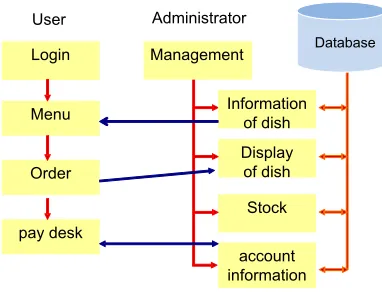
Figure 2: System structure of self order POS system by iPodtouch
(c) One year 160,000yen × 12months = 1,920,000yen
2. Three waiter of employee, and handheld POS device for waiterMonthly wage of 29,000yen, Ini-tial cost is 500,000 yen. The wages paid to three waiter of employee, and handheld POS device for waiter are Total costs are 6,608,000yen in one year.
(a) One month29,000yen
(b) One year29,000yen×12months = 348,000yen
(c) Initial cost500,000yen
(d) Total cost of POS system848,000yen
3. Self order POS system by iPodtouch for cus-tomerTotal cost are 296,800yen in one year.
(a) Initial cost (iPodtouch) 19,800yen × 10 = 198,00yen
(b) Initial cost (Macbook)98,800yen
(c) Total cost of POS system by iPodtouch 296,800yen
1.3
System structure
The self order POS system consists of two part (Fig. 2). User can look at menu of dish, can order menu, and can check payment. Administrator can do management of dishes in database, can get user’s order data and the dish’s stuff of stock information, and can account of user’s pay information.
2
Decision Rule using Rough Sets
The-ory
2.1
Background on Rough Set Theory
a new data analysis approach, rough set theory can effec-tively deal with all kinds of inaccurate, inconsistent, and incomplete data. It is well suited to extract useful infor-mation and rules in inforinfor-mation systems. Compared with other classic data classification approaches, rough sets have several advantages by easily handling fuzzy data. In the recent past, rough sets have been flourishing in mathematical theory, algorithms, and applications.
The current state on rough sets is that most of the re-search is focusing on the mathematical theory and al-gorithms. Theoretical research includes studies on the structure of the rough arithmetic operators, the relation-ship between rough sets and topological spaces, the mea-sures of rough set theory, the extension of the rough set theory and so on. The research on the algorithmic side includes algorithms for the reduction in the rough set rules, algorithms for extracting the decision rules, algo-rithms for rule-matching, etc.
Rough set theory, as proposed by Pawlak, has recently also been used to analyze data sets for the purpose of classification. This theory is an extension of the classical set theory for studying insufficient or incomplete informa-tion and has been demonstrated to be useful in fields of applications such as pattern recognition, machine learn-ing, or automated knowledge acquisition.
2.2
Rough Sets Definition and Rules
The database regarding the experts’knowledge is gen-erally given in the form of an information system. The definition of a traditional information system given by Pawlak is as follows.
Definition 1 (Information SystemIS). Aninformation system (IS) is an ordered quadruple IS = (U, Q, V, ρ) where U is the universe (a non-empty finite set of ob-jectsx),Qis a finite set of attributesq,V =∪q∈QVq is the domain of attribute q, and ρ is a mapping function such that ρ(x, q)∈Vq,∀q∈Qandx∈U.
The set Q is composed of two parts: a set of condition attributes C anddecision attributes D, i.e.,Q=C∪D. Functionρalso is calleddecision function. If we introduce the function ρx : Q → V such that ρx(q) = ρ(x, q) for everyq∈Q andx∈U,ρx is called decision rule in IS, andxis called alabel of the decision rule ρx.
Let IS = (U, Q, V, ρ) be an information system and let
q∈Q, andx, y∈U. Ifρx(q) =ρy(q), then we sayxand
y areindistinguishable(in symbolsxRqy) whereRq is an equivalence relation. Also, objects x, y∈U are indistin-guishable with respect toP ⊂QinIS (in symbolsxRPy), ifxRpy for everyp∈P. In particular, ifP =Q,xandy are indistinguishable in IS, i.e., we have xRy instead of
xRQy. Therefore, each information system IS uniquely defines an approximation spaceA= (U, R), whereRis an equivalence relation generated by the information system
IS. The equivalence relationRpartitionsU into a family of disjoint subsets, which are called Q-elementary sets. Likewise, RC leads toC-elementary sets, and RD leads to D-elementary sets. Given an arbitrary setX ⊆U, it may not be in general possible to describeX precisely in
A. Thus, one may characterizeX by a pair of lower and upper approximations.
Definition 2 (Rough set). Let R be an equivalence re-lation on a universe U. For any set X ⊆ U, the lower approximation apr(X) and the upper approxima-tionapr(X)are defined by as follows:
apr(X) ={x∈U |[x]R⊆X} (1)
apr(X) ={x∈U |[x]R∩X =∅} (2)
wherexR={y|xRy} is an equivalence class containing
x.
The lower approximation apr(X) is the union of ele-mentary sets which are subsets of X, and the upper approximation apr(X) is the union of elementary sets which have a non-empty intersection with X. The set
bnd(X) = apr(X)−apr(X) is called boundary of X in
A. If bnd(X) is empty, then subsetX is exactly defin-able. Note that a rough set is a pair of both, lower and upper approximation. An accuracy measure of set X in the approximation spaceA= (U, R) is defined as
α(X) = |apr(X)|
|apr(X)|
where | · | denotes the cardinality of a set. Clearly, it is true that 0 ≤ α(x) ≤ 1. Besides, X is called definable in A if α(X) = 1, and X is called undefinable in A if
α(X)<1.
Now, let us consider the issue of rule extraction from an information system. A natural way to extract rules or to represent an expert’s knowledge is to construct a set of conditional productions, each of them having the form
if {set of conditions}then{set of decisions}
Such a form can be easily induced by taking the ad-vantage of rough sets. In an approximation space A = (U, R), regarding a subset X of U, the whole universe
U is partitioned into three regions which corresponds to certain decision rules. The positive region posS(X) =
apr(X) corresponds to positive (certain) decision rules, whereas the negative region negS(X) = U −apr(X) corresponds to the negative decision rules. Finally, the boundary regionbnd(X) =apr(X)−apr(X) represents the possible decision rules.
3
Decisions Based on User Preferences
Suppose that there is an information system IS =
Table 1: Example of menu data
U
Q
C D
c1 c2 c3 c4 d
x1 2 0 0 0 1
x2 1 1 0 1 1
x3 1 0 1 1 0
x4 0 1 1 0 1
x5 2 0 0 0 0
x6 0 1 1 1 0
x7 1 1 0 0 0
x8 1 1 1 1 1
shown in Table 1. In this information system, U =
{x1, x2, ..., x8} in which each object (element) expresses
a dish; Q = C∪D = {c1, c2, c3, c4, d} in which ci de-notes the attribute of dish iand dis the user’s decision value. For instance, if c1 represents the type of cuisine,
its domain set isVc1 ={0,1,2,3} in which the numbers
represent “Japanese”, “Chinese”, “German”, or “other” food, respectively. The other attributesc2, c3, c4could be
binary values representing other dish characteristics with
Vci = Vd = {0,1}, for i = 2,3,4 in which 0 expresses “no” and 1 “yes”. Furthermore, the mapping function ρ
for Table 1 is given asρ(x1, c1) = 2,ρ(x2, c1) = 1.
Clearly, IS yields the following elementary sets with re-spect to the condition attributes C={c1, c2, c3, c4}:
E1 ={x:c1= 2, c2= 0, c3= 0, c4= 0}={x1, x5}
E2 ={x:c1= 1, c2= 1, c3= 0, c4= 1}={x2}
E3 ={x:c1= 1, c2= 0, c3= 1, c4= 1}={x3}
E4 ={x:c1= 0, c2= 1, c3= 1, c4= 0}={x4}
E5 ={x:c1= 0, c2= 1, c3= 1, c4= 1}={x6}
E6 ={x:c1= 1, c2= 1, c3= 0, c4= 0}={x7}
E7 ={x:c1= 1, c1= 1, c3= 1, c4= 1}={x8}
(3)
Thus, theC-elementary sets are{E1, E2, ..., E7}.
Now, let us consider to approximate a subset X =
{x1, x2, x4, x8}, which is a set of dish which a user likes.
Based on the concepts defined above, we now have the sets:
apr(X) ={x2, x4, x8} apr(X) ={x1, x5, x2, x4, x8}
posS(X) ={x2, x4, x8} negS(X) ={x3, x6, x7}
bnd(X) ={x1, x5}
Therefore, thecertainrules follow fromposS(X) as given below:
[image:4.595.106.231.89.224.2]1. if c1= 1∧c2= 1∧c3= 0∧c4= 1thend= 1
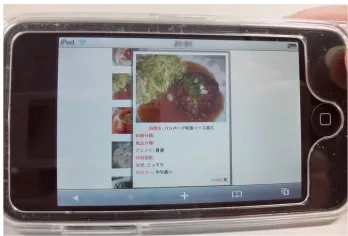
Figure 3: Screenshot of web-based menu planning system on handheld device
2. if c1= 0∧c2= 1∧c3= 1∧c4= 0thend= 1
3. if c1= 1∧c2= 1∧c3= 1∧c4= 1thend= 1
Furthermore, thepossible rules follow frombnd(X) as:
4. if c1= 2∧c2= 0∧c3= 0∧c4= 0thend= 1
5. if c1= 2∧c2= 0∧c3= 0∧c4= 0thend= 0
where we can see that in rules (4) and (5), although they have the same condition in theif part, their decisions are different in the thenpart. It means in such a case that the user may probably like a dish. Thenegative decision rules are obtained by describingnegS(X) as follows:
6. if c1= 1∧c2= 0∧c3= 1∧c4= 1thend= 0
7. if c1= 0∧c2= 1∧c3= 1∧c4= 1thend= 0
8. if c1= 1∧c2= 1∧c3= 0∧c4= 0thend= 0.
The total approximation accuracy isα(X) = 3 5 = 0.6.
3.1
Design of Menu Planning System
In developing an implementation of the menu planning system, we use a Web server running Apache, MySQL, PHP, and a database management system as Web appli-cation. The reason for using this environment is because they are all multi-platform software, freely available un-der the Open Source License. For example, the system abbreviated as “WAMP (Windows, Apache, MySQL, PHP)” is a very popular combination. Since a large amount of documentation and programming interfaces are provided, the system is easily portable for access from handheld devices, see Fig. 3. The database that we use in this study stores the data of approximately 300 dishes consisting of several ingredients. The data for these dishes is taken from the book “Foods Supporter” [2].
Figure 4: Result of test installation
1. The system presents a menu of 10 arbitrary dishes. Then, the user replies to a questionnaire and evalu-ates the menu. Evaluation is done by entering “like” or “dislike”.
2. The result in response to the questionnaire is then stored in a database.
3. A preference rule is extracted from this information.
4. The user is then presented the information of a menu suitable for his preference. The menu also provides nutrition information, which can be used to optimize the menu selection in terms of calorie intake and nu-trition balance [3].
3.2
Implementation and Evaluation
The operation of the system developed in this research was evaluated in [4]. First, ten users tested the system and its performance was investigated. It was verified how much the recommended menu conforms to a user’s prefer-ences as compared with the subject’s taste. Each user es-timated the performance of the system in five steps. The total result of this evaluation is shown in Fig. 4. Here, the vertical axis expresses the number of users and the horizontal axis expresses their evaluation of the system on a scale of 1–5. Three users gave evaluation 5, four users gave evaluation 4, and two users gave evaluation 3. However, one user was not satisfied with the result. Although the number of test candidates were only ten people, this figure shows that the majority of users are satisfied with the menus suggested by our system.
[image:5.595.72.266.72.184.2]We got the user to evaluate to all the dishes, and an-alyzed the menu chosen by the menu recommendation system. You can see this Fig. 5 result shows that many high evaluation dishes of a user are recommended.
[image:5.595.327.525.227.351.2]Figure 6 shows the average of the experimental results in [4]. First, the users evaluated all of the dishes in the database. Each dish is given points ranging from 0 to 100. The blue bars in Fig. 6 represent the average ratio of entries in the database according to the liking or dis-liking from the user. As a result of analyzing the dish selected by the system, the white bars show that the dish
Figure 5: The relation between satisfaction and items
Figure 6: The change ration sof dish’s evaluation
which has 80 points increases over the ratio of all entries. On the other hand, the ratio decreases for the menus with high evaluation score of 90 or 100 points because the eval-uation of junk food, which has a bad nutritional balance, is high for some users. Such a result is expected when there are constraints that are inversely proportional to a user’s degree of satisfaction. Therefore, many dishes of 80 points which can both fulfill nutritional balance and user’s preference are recommended.
Recommendation of a menu shows several kinds of menus at the same time. By analyzing the recommended dish showed that there were two features. One of the features is to have characteristics in common (Fig. 7). For ex-ample, the recommendation of a menu has some decision rules “Staple food”, “Side dish”, and “Easy to arrange cooking”. The menu shows some dishes cooked by veg-etables, the dishes are non-fatty in common. Other of the features is to have Chain structure (Fig. 8).
Decision rule Decision
rule
Attribute in common Attribute in
common
Vegetable Non-fatty
Vegetable Non-fatty
Figure 7: Structure feature having characteristics in com-mon
Non-fatty
Non-fatty Japanese
food Japanese
food
Decision rule Decision
rule
Attribute in common Attribute in
common
Figure 8: Chain structure feature having characteristics in common
the users’ taste and the recommended menus is obtained.
4
Conclusions and Future Work
In this paper, we considered about make an arrangement of automatic order, and POS system using handheld de-vice. The result is that the system could use as the effec-tive management support technique for raising the service and the customer satisfaction to the restaurant of a pri-vate management scale. We think that useless reduction of foods and healthy support of the customer by a nu-trition labeling are the effective functions for attaining a competitor and differentiation.
A part of the menu planning system was designed in this work since it is very intuitive in explaining and inter-preting the essential properties of rough sets. However, decision making is an important field in a vast area of applications. One future challenge is applying the con-cept of rough sets with fuzzy weights to research areas such as information networking, especially in the context-aware scenarios of future ambient information environ-ments. For example, the menu planning system could respond to the activities that take place in the kitchen of restaurant. An “Ambient Kitchen” [5] can sense which
fresh stale
patient freshness
allergy
preference
satisfaction Private menu except
his allergy foods
Recommendation of user’s preference
Figure 9: Menu recommendation in consideration of the best-before date of stock
ingredients the user has available, presents the nutrition value of the recipe they can choose, as well as step-by-step preparation instructions. Such a system will make our life more comfortable and healthy.
5
Acknowledgment
Part of this work has been supported by
FY2009“Research for Promotiong Technological Seeds (discovery type 16-001)” of Japan Science and Technol-ogy Agency.
References
[1] Z. Pawlak, “Rough sets,” International Journal of Computer and Information Sciences, vol. 11, no. 5, pp. 341–356, 1982.
[2] “Foods supporter - nutrient calculation software.” Hi-totsu bashi-shuppan (In Japanese), 2007.
[3] T. Kashima, S. Matsumoto, and H. Ishii, “Develop-ment of web-based menu planning support system and its solution using genetic algorithm,” in IAENG Transactions on Engineering Technologies (S. long Ao, A. H.-S. Chan, H. Katagiri, and L. Xu, eds.), vol. 3, pp. 56–68, America Institute of Physics, 2009.
[4] T. Kashima, S. Matsumoto, and H. Ishii, “A web-based menu recommendation system with interac-tive interface using rough sets,” inProceedings of In-ternational Symposium on Management Engineering (ISME 2009), (Dalian, China), August 2009.