72
CogCompTime: A Tool for Understanding Time in Natural Language
Qiang Ning,1Ben Zhou,1 Zhili Feng,2 Haoruo Peng,1Dan Roth1,3 Department of Computer Science
1University of Illinois at Urbana-Champaign, Urbana, IL 61801, USA 2University of Wisconsin-Madison, Madison, WI 53706, USA
3University of Pennsylvania, Philadelphia, PA 19104, USA
{qning2,xzhou45,hpeng7}@illinois.edu, [email protected], [email protected]
Abstract
Automatic extraction of temporal information is important for natural language understand-ing. It involves two basic tasks: (1) Un-derstanding time expressions that are men-tioned explicitly in text (e.g., February 27, 1998 or tomorrow), and (2) Understanding temporal information that is conveyed im-plicitly via relations. This paper introduces CogCompTime, a system that has these two important functionalities. It incorporates the most recent progress, achieves state-of-the-art performance, and is publicly available.1 We believe that this demo will provide valuable in-sight for temporal understanding and be useful for multiple time-aware applications.
1 Introduction
Time is an important dimension when we describe the world because many facts are time-sensitive, e.g., one’s place of residence, one’s employment, or the progress of a conflict between countries. Consequently, many applications can benefit from temporal understanding in natural language, e.g., timeline construction (Do et al., 2012; Minard et al., 2015), clinical events analysis (Jindal and Roth, 2013; Bethard et al., 2015), question an-swering (Llorens et al.,2015), and causality infer-ence (Ning et al.,2018a).
Temporal understanding from natural language requires two basic components (Verhagen et al.,
2007,2010;UzZaman et al.,2013). The first, also known as the Timex component, requires extract-ing explicit time expressions in text (i.e., “Timex”) and normalize them to a standard format. In Ex-ample1, the Timex is February 27, 1998and its normalizedform is ‘1998-02-27”. Note that nor-malization may also require a reference time for Timexes like “tomorrow”, for which we need to
1http://cogcomp.org/page/publication_
view/844
know the document creation time (DCT). In ad-dition to DATE, there are also other Timex types including TIME (e.g., 8 am), DURATION (e.g., 3 years), and SET(e.g.,every Monday).
Timexes carry temporal information explicitly, but temporal information can also be conveyed im-plicitly via temporal relations (i.e., “TempRel”). In Example2, there are two events: e1:exploded
ande2:died. The text does not tell us when they happened, but we do know that there is a TempRel between them, i.e., e1:exploded happenedbefore
e2:died. The second basic component of tem-poral understanding is thus the TempRel compo-nent, which extracts TempRels automatically from text. While the Timex component provides abso-lute time anchors, the TempRel component pro-vides the relative order of events. These two to-gether provide a complete picture of the tempo-ral dimension of a story, so they are natutempo-rally the most important building blocks towards temporal understanding.
Example 1:Presidents Leonid Kuchma of Ukraine and Boris Yeltsin of Russia signed an economic cooperation plan on (t1:February 27, 1998).
Example 2: A car (e1:exploded) in the middle of a group of men playing volleyball. More than 10 people have (e2:died), police said.
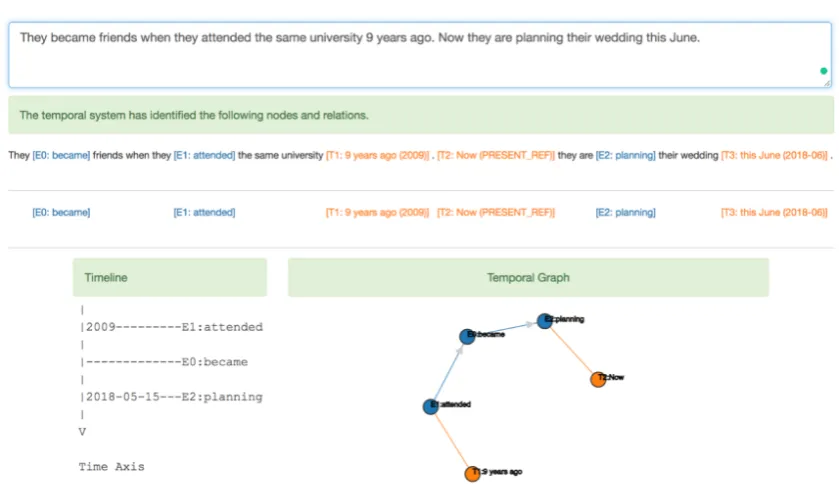
Figure 1: A snapshot of the interface of CogCompTime. From top to bottom: Input box, event and Timex highlight, and two visualizations (timeline and graph). The document creation time was chosen to be 2018-05-15.
TempRel component by a large margin, from the literature’s F1 ≈ 50 (UzZaman et al., 2013) to F1 ≈ 70 (see details in Sec. 3). Given these
two contributions, we believe that CogCompTime is a good demonstration of the state-of-the-art in temporal understanding. In addition, since CogCompTime is publicly available, it will pro-vide easy access to users working on time-aware applications, as well as valuable insight to re-searchers seeking further improvements.
We briefly review the literature and explain in detail the processing pipeline of CogCompTime in Sec. 2: the Timex component, the Event Ex-traction component, and the TempRel compo-nent. Following that, we provide a benchmark evaluation in Sec. 3 on the TempEval3 and the MATRES datasets (UzZaman et al., 2013; Ning et al.,2018c). Finally, we point out directions for future work and conclude this paper.
2 System
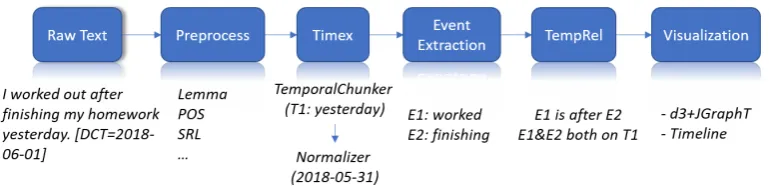
The system pipeline of CogCompTime is shown in Fig. 2: It takes raw text as input and uses CogCompNLP (Khashabi et al., 2018) to extract features such as lemmas, part-of-speech (POS) tags, and semantic role labelings (SRL). Then CogCompTime sequentially applies the Timex component, the event extraction component, and the TempRel component. Finally, both a graph visualization and a timeline visualization are pro-vided for the users. In the following, we will
ex-plain these main modules in detail.
2.1 Timex Component
Existing work on Timex extraction and normal-ization falls into two categories: rule-based and learning-based. Rule-based systems use regular expressions to extract Timex in text and then deter-ministic rules to normalize them (e.g., HeidelTime (Str¨otgen and Gertz, 2010) and SUTime (Chang and Manning, 2012)). Learning-based systems use classification models to chunk out Timexes in text and normalize them based on grammar pars-ing (e.g., UWTime (Lee et al., 2014) and Pars-ingTime (Angeli et al., 2012)). CogCompTime adopts a mixed strategy: we use machine learning in the Timex extraction step and rule parsing in the normalization step. This mixed strategy, while maintaining a state-of-the-art performance, signif-icantly improves the computational efficiency of the Timex component, as we show in Sec.3.
com-Figure 2: System pipeline of CogCompTime: It preprocesses raw text input using CogCompNLP and then applies Timex, Event Extraction, and TempRel components sequentially, with two user-friendly visualizations (i.e., graph-type visualization and timeline-type visualization) provided at the end.
pared to regular expression matching, which has to check every substring of text against regular ex-pressions and is often slow. However, we do ad-mit that learning-based extraction handles corner cases not as well as rule-based systems because of the limited training examples.
After Timexes are extracted, we apply rules to normalize them. We think rule-based methods are generally more natural for normalization: On one hand, the desired formats of various types of Timexes are already defined as rules by corre-sponding annotation guidelines; on the other hand, the intermediate steps of how one Timex is nor-malized are not annotated in any existing datasets (it is inherently hard to do so), so learning-based methods usually have to introduce latent vari-ables and need more training instances as a result. Therefore, we have adopted a rule-based normal-ization method. However, we admit that an obvi-ous drawback is that the rule set needs to be re-designed for every single language.
2.2 Event Extraction Component
Event extraction is closely related to how events are defined. Generally speaking, an event is con-sidered to be an action associated with the corre-sponding participants. In the context of tempo-ral understanding, events are usually represented by their head verb token, so unlike the generic chunking problem in Timex extraction, event ex-traction can be formulated as a classification prob-lem for each token. Specifically, CogCompTime only considers those main-axis events, so event extraction is simply a binary classification prob-lem (i.e., whether or not a token is a main-axis event or not). As defined by the MATRES annota-tion scheme (Ning et al.,2018c), main-axis events are those events that form the primary timeline of a story and approximately 60%-70% of the verbs are on the main-axis in MATRES. We extract lem-mas and POS tags within a fixed window, SRL,
and prepositional phrase head, and train a sparse averaged perceptron for event extraction.
2.3 TempRel Component
Temporal relations can be generally modeled by a graph (called temporal graph), where the nodes represent events and Timexes, and the edges represent TempRels. With all the nodes ex-tracted (by previous steps), the TempRel com-ponent is to make predictions on the labels of those edges. In this paper, the label set for Event-Event TempRels isbefore,after,equal, and vague and for Event-Timex TempRels is equal andnot-equal.2 State-of-the-art methods include, e.g., ClearTK (Bethard, 2013), CAEVO ( Cham-bers et al., 2014), and Ning et al. (2017). The TempRel task is known to be very difficult. Ning et al. (2018c) attributes the difficulty partly to the low inter-annotator agreement (IAA) of exist-ing TempRel datasets and proposes a new Multi-Axis Temporal RElations dataset of Start-points (MATRES) with significantly improved IAA, so for the TempRel task, we have chosen MATRES as the benchmark in this paper.3
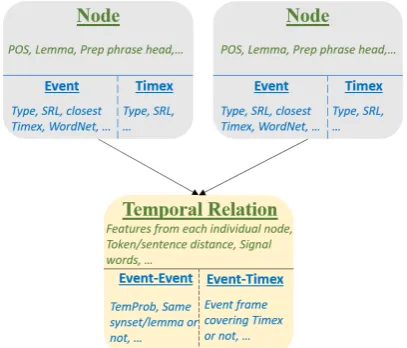
We also incorporate the recent progress ofNing et al. (2017, 2018a,b). The feature set used for TempRel is shown in Fig. 3, which contains fea-tures derived individually from each node and jointly from a node pair. Since a node can be ther an event or a Timex, an edge can also be ei-ther an Event-Event edge or an Event-Timex edge and the features have to vary a bit, as detailed by Fig. 3. Note that for Event-Event edges, we incorporate features from TemProb,4 which
en-codes prior knowledge of typical temporal orders
2
The simplification of Event-Timex label set is due to our observation that other labels have very low accuracies. As a demo paper, we have chosen not to use them. However, we think it is interesting and worth further investigation.
3
Specifically, we only need to replace the TempRel anno-tations in TempEval3 by the new annoanno-tations in MATRES.
4http://cogcomp.org/page/resource_
[image:3.595.110.495.62.155.2]of events (Ning et al., 2018b). With these fea-tures, we also adopt the constraint-driven learn-ing algorithm for TempRel classification proposed in Ning et al. (2017) with sparse averaged per-ceptron. Then our TempRel component assigns local prediction scores (i.e., soft-max scores) to each edge and solves an integer linear program-ming (ILP) problem via Gurobi (Gurobi Optimiza-tion,2015) to achieve globally consistent temporal graphs (please refer toNing et al.(2018a) for de-tails). CogCompTime is a unique package so far that incorporates all the recent progress.
Figure 3:The primary features used in the TempRel com-ponent(also standard features used in the literature). Since there are two types of nodes (i.e., event and Timex), and two types of TempRels (i.e., Event-Event and Event-Timex), we put the common features above and split specific feature sets below. Conjunctive features are not listed exhaustively here.
2.4 Visualization
As shown in Fig. 1, we highlight the extracted Timexes and events in the text. Specifically for Timexes, we also annotate their normalized val-ues along with their chunks. We provide two forms of visualization for the extracted TempRels. Since TempRels can be naturally modeled by a graph, a graph visualization is an obvious choice and we use d3 (https://d3js.org/) in CogCompTime. Additionally, we provide a more compact visualization to those graphs via timeline construction. Since a graph is only par-tially ordered (as opposed to a timeline which is fully ordered), we resort to the appearance order of events in timeline construction when the tem-poral order isvagueaccording to its graph.
3 Benchmark Experiment
We used the dataset provided by the TempE-val3 workshop, with the original train/test split in
our experiment: TimeBank and AQUAINT were for training (256 articles), and Platinum was for testing (20 articles). Note that we replaced the TempRel annotations in the original TempEval3 datasets by MATRES due to its higher IAA. In the Timex component, TemporalChunker by default takes 10% of the train set as the development set, and in other components, 5-fold cross-validation was used for parameter tuning.
Table 1 evaluates the Timex component of CogCompTime, comparing with state-of-the-art systems. The “normalization” and “end-to-end” columns were evaluated based on gold Timex extraction and system Timex extraction, respec-tively. The fact that CogCompTime had the best extractionF1 and normalization accuracy but
not the best end-to-end performance is due to our mixed strategy: Timexes extracted by our learning-based TemporalChunker sometimes can-not be normalized correctly by our rule-based nor-malizer. This phenomenon is relatively more se-vere in CogCompTime comparing to systems that are consistently rule-based or learning-based in both extraction and normalization. However, the computational efficiency is improved significantly by reducing the runtime of the second fastest, HeidelTime, by more than 50%.
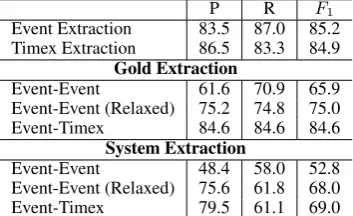
Table 2 shows the performance of the Event Extraction and TempRel components. We also copied the Timex extraction performance from Ta-ble 1. Note that CogCompTime only extracts those main-axis events as defined by MATRES. Since Ning et al. (2018c) did not propose an event extraction method, Table 2 is in fact the first reported performance of event extraction on MATRES and as we see, both the precision and recall are better than those numbers reported in TempEval3. Note that since CogCompTime works on different annotations, this does not indicate that our event extraction algorithm is better than those participants in TempEval3; instead, this indicates that the event extraction problem in MATRES is a better-defined machine learning task.
The performance of TempRel extraction is fur-ther evaluated in Table2, both when the gold event and Timex extraction is used and when system ex-traction is used. As for Event-Event TempRels, we also introduce a new relaxed metric5, where pre-dictions ofbefore/afterare not penalized when the gold label isvague. This is based on the definition
5
[image:4.595.79.283.234.408.2]Timex Systems Extraction Normalization End-to-end Runtime P R F1 Accuracy F1 Seconds
HeidelTime (Str¨otgen and Gertz,2010) 84.0 79.7 81.8 78.1† 78.1 18 SUTime (Chang and Manning,2012) 80.0 81.1 80.6 69.8† 69.8 16 UWTime (Lee et al.,2014) 86.7 80.4 83.5 84.4 82.7 400
[image:5.595.102.496.61.125.2]CogCompTime 86.5 83.3 84.9 84.7 76.8 7
Table 1:Performance of our Timex componentcompared with state-of-the-art systems on a benchmark dataset, the Platinum dataset from the TempEval3 workshop (UzZaman et al.,2013). The “extraction” and “normalization” columns are the two intermediate steps. “Normalization” was evaluated given gold extraction, while “end-to-end” means system extraction was used. Runtimes were evaluated under the same setup.
†
HeidelTime and SUTime have no clear-cut between extraction and normalization, so even if gold Timex chunks are fed in, their extraction step cannot be easily skipped.
ofvaguein MATRES, i.e., to assignvaguelabels when eitherbeforeorafteris reasonable. We think this relaxed metric is more suitable when creating timelines from temporal graphs, where an order must be picked anyhow when two events have a vaguerelation. When system extraction was used, the TempRel performance saw a large drop. How-ever, the performance here, although it is perhaps still not sufficiently good for some applications, is already a significant step forward in temporal understanding. As a reference point, the best sys-tem in TempEval3, ClearTK (Bethard,2013), had P=34.08, R=28.40, F1=30.98 (using system
ex-traction) and P=37.32, R=35.25,F1=36.26 (using
gold extraction). Again, given the dataset differ-ence, these numbers are not directly comparable, but it indicates that the MATRES dataset used here probably has the TempRel task better defined and we hope this demo paper will be a good showcase of the new state-of-the-art.
P R F1
Event Extraction 83.5 87.0 85.2 Timex Extraction 86.5 83.3 84.9
Gold Extraction
Event-Event 61.6 70.9 65.9 Event-Event (Relaxed) 75.2 74.8 75.0 Event-Timex 84.6 84.6 84.6
System Extraction
Event-Event 48.4 58.0 52.8 Event-Event (Relaxed) 75.6 61.8 68.0 Event-Timex 79.5 61.1 69.0
Table 2:Performance of the Event/Timex Extraction and TempRel componentswhen gold/system extraction is used. The relaxed metric does not penalize the system if a be-fore/afterprediction is made on avaguerelation. Please also refer to the text about this metric.
4 Future Work
We plan to further improve CogCompTime in the following directions. First, the MATRES dataset (Ning et al., 2018c) only considers verb events, but nominal events are also very common and important, so we plan to incorporate nominal
event extraction and corresponding TempRel ex-traction. Second, CogCompTime currently does not incorporate an event coreference component. Since coreference is important for bridging long-distance event pairs, it is a desirable feature. We can adopt existing event coreferencing techniques such asPeng et al.(2016) in the next step. Third, CogCompTime currently only works on the main-axis events as defined in MATRES. How to incor-porate other axes, e.g., intention axis, opinion axis, and hypothesis axis, requires further investigation.
5 Conclusion
This paper presents CogCompTime, a new pack-age that, given raw text, (1) extracts time expres-sions (Timex) and normalizes them to a standard format, and (2) extracts events on the main time axis of a story and the temporal relations between events and Timexes. CogCompTime takes advan-tage of many recent advances and achieves state-of-the-art performance in both tasks. We think this demo will be interesting for a broad audience be-cause it is useful not only for identifying the short-comings of existing methods, but also for applica-tions that depend on the temporal understanding of natural language text.
Acknowledgements
[image:5.595.93.270.486.594.2]U.S. Government. The U.S. Government is autho-rized to reproduce and distribute reprints for Gov-ernment purposes notwithstanding any copyright notation here on.
References
Gabor Angeli, Christopher D. Manning, and Daniel Ju-rafsky. 2012. Parsing time: Learning to interpret time expressions. InProc. of the Annual Meeting of the North American Association of Computational Linguistics (NAACL).
Steven Bethard. 2013. ClearTK-TimeML: A minimal-ist approach to TempEval 2013. In Second Joint Conference on Lexical and Computational Seman-tics (* SEM), volume 2, pages 10–14.
Steven Bethard, Leon Derczynski, Guergana Savova, James Pustejovsky, and Marc Verhagen. 2015. SemEval-2015 Task 6: Clinical TempEval. InProc. of the 9th International Workshop on SemEval.
Nathanael Chambers, Taylor Cassidy, Bill McDowell, and Steven Bethard. 2014. Dense event ordering with a multi-pass architecture. TACL, 2:273–284.
Angel X. Chang and Christopher D. Manning. 2012. SUTIME: A library for recognizing and normalizing time expressions. InLREC.
Quang Do, Wei Lu, and Dan Roth. 2012. Joint infer-ence for event timeline construction. InProc. of the Conference on Empirical Methods in Natural Lan-guage Processing (EMNLP).
Inc. Gurobi Optimization. 2015. Gurobi optimizer ref-erence manual.
Prateek Jindal and Dan Roth. 2013. Extraction of events and temporal expressions from clinical nar-ratives. Journal of Biomedical Informatics (JBI).
Daniel Khashabi, Mark Sammons, Ben Zhou, Tom Redman, Christos Christodoulopoulos, and Vivek Srikumar et al. 2018. CogCompNLP: Your swiss army knife for NLP. InLREC.
Kenton Lee, Yoav Artzi, Jesse Dodge, and Luke Zettle-moyer. 2014. Context-dependent semantic parsing for time expressions. InProc. of the Annual Meet-ing of the Association for Computational LMeet-inguistics (ACL), pages 1437–1447.
Hector Llorens, Nathanael Chambers, Naushad UzZa-man, Nasrin Mostafazadeh, James Allen, and James Pustejovsky. 2015. SemEval-2015 Task 5: QA Tem-pEval - evaluating temporal information understand-ing with question answerunderstand-ing. InProc. of the 9th In-ternational Workshop on SemEval.
Anne-Lyse Minard, Manuela Speranza, Eneko Agirre, Itziar Aldabe, Marieke van Erp, Bernardo Magnini, German Rigau, Ruben Urizar, and Fon-dazione Bruno Kessler. 2015. SemEval-2015 Task
4: TimeLine: Cross-document event ordering. In Proc. of the 9th International Workshop on SemEval.
Qiang Ning, Zhili Feng, and Dan Roth. 2017. A struc-tured learning approach to temporal relation extrac-tion. InProc. of the Conference on Empirical Meth-ods in Natural Language Processing (EMNLP), pages 1038–1048, Copenhagen, Denmark.
Qiang Ning, Zhili Feng, Hao Wu, and Dan Roth. 2018a. Joint reasoning for temporal and causal re-lations. InProc. of the Annual Meeting of the Asso-ciation for Computational Linguistics (ACL), pages 2278–2288, Melbourne, Australia.
Qiang Ning, Hao Wu, Haoruo Peng, and Dan Roth. 2018b. Improving temporal relation extraction with a globally acquired statistical resource. InProc. of the Annual Meeting of the North American Associ-ation of ComputAssoci-ational Linguistics (NAACL), pages 841–851, New Orleans, Louisiana.
Qiang Ning, Hao Wu, and Dan Roth. 2018c. A multi-axis annotation scheme for event temporal relations. In Proc. of the Annual Meeting of the Association for Computational Linguistics (ACL), pages 1318– 1328, Melbourne, Australia.
Haoruo Peng, Yangqiu Song, and Dan Roth. 2016. Event detection and co-reference with minimal su-pervision. In Proc. of the Conference on Em-pirical Methods in Natural Language Processing (EMNLP).
Vasin Punyakanok and Dan Roth. 2001. The use of classifiers in sequential inference. In Proc. of the Conference on Neural Information Processing Sys-tems (NIPS), pages 995–1001. MIT Press.
Jannik Str¨otgen and Michael Gertz. 2010. HeidelTime: High quality rule-based extraction and normaliza-tion of temporal expressions. In Proc. of the 5th International Workshop on SemEval.
Naushad UzZaman, Hector Llorens, James Allen, Leon Derczynski, Marc Verhagen, and James Pustejovsky. 2013. Sem2013 Task 1: TEMPEVAL-3: Eval-uating time expressions, events, and temporal rela-tions.*SEM, 2:1–9.
Marc Verhagen, Robert Gaizauskas, Frank Schilder, Mark Hepple, Graham Katz, and James Pustejovsky. 2007. SemEval-2007 Task 15: TempEval temporal relation identification. InProc. of the 4th Interna-tional Workshop on SemEval, pages 75–80.
Marc Verhagen, Roser Sauri, Tommaso Caselli, and James Pustejovsky. 2010. SemEval-2010 Task 13: TempEval-2. InProc. of the 5th international work-shop on SemEval, pages 57–62.