Iterative Document Representation Learning Towards Summarization
with Polishing
Xiuying Chen1, Shen Gao1, Chongyang Tao1, Yan Song2, Dongyan Zhao1 and Rui Yan1∗
1Institute of Computer Science and Technology, Peking University, Beijing, China
2Tencent AI Lab
{xy-chen,shengao,chongyangtao,zhaody,ruiyan}@pku.edu.cn [email protected]
Abstract
In this paper, we introduce Iterative Text Sum-marization (ITS), an iteration-based model for supervised extractive text summarization, in-spired by the observation that it is often nec-essary for a human to read an article multiple times in order to fully understand and summa-rize its contents. Current summarization ap-proaches read through a document only once to generate a document representation, result-ing in a sub-optimal representation. To ad-dress this issue we introduce a model which iteratively polishes the document representa-tion on many passes through the document. As part of our model, we also introduce a selec-tive reading mechanism that decides more ac-curately the extent to which each sentence in the model should be updated. Experimental results on the CNN/DailyMail and DUC2002 datasets demonstrate that our model signifi-cantly outperforms state-of-the-art extractive systems when evaluated by machines and by humans.
1 Introduction
A summary is a shortened version of a text doc-ument which maintains the most important ideas from the original article. Automatic text summa-rization is a process by which a machine gleans the most important concepts from an article, removing secondary or redundant concepts. Nowadays as there is a growing need for storing and digesting large amounts of textual data, automatic summa-rization systems have significant usage potential in society.
Extractive summarization is a technique for generating summaries by directly choosing a sub-set of salient sentences from the original docu-ment to constitute the summary. Most efforts made towards extractive summarization either rely
∗
Corresponding author: Rui Yan ([email protected])
on human-engineered features such as sentence length, word position, and frequency (Cohen,
2002;Radev et al., 2004;Woodsend and Lapata,
2010; Yan et al., 2011a,b, 2012) or use neural networks to automatically learn features for sen-tence selection (Cheng and Lapata,2016; Nallap-ati et al.,2016a).
Although existing extractive summarization methods have achieved great success, one limita-tion they share is that they generate the summary after only one pass through the document. How-ever, in real-world human cognitive processes, people read a document multiple times in order to capture the main ideas. Browsing through the document only once often means the model cannot fully get at the document’s main ideas, leading to a subpar summarization. We share two examples of this. (1) Consider the situation where we almost finish reading a long article and forget some main points in the beginning. We are likely to go back and review the part that we forget. (2) To write a good summary, we usually first browse through the document to obtain a general understanding of the article, then perform a more intensive reading to select salient points to include in the summary. In terms of model design, we believe that letting a model read through a document multiple times, polishing and updating its internal representation of the document can lead to better understanding and better summarization.
modi-fied version of a Gated Recurrent Unit (GRU) net-work, which can decide how much of the hidden state of each sentence should be retained or up-dated based on its relationship with the document.
Overall, our contribution includes:
1. We propose Iterative Text Summarization (ITS), an iteration based summary generator which uses a sequence classifier to extract salient sentences from documents.
2. We introduce a novel iterative neural net-work model which repeatedly polishes the distributed representation of document in-stead of generating that once for all. Besides, we propose a selective reading mechanism, which decides how much information should be updated of each sentence based on its re-lationship with the polished document rep-resentation. Our entire architecture can be trained in an end-to-end fashion.
3. We evaluate our summarization model on representative CNN/DailyMail corpora and benchmark DUC2002 dataset. Experimen-tal results demonstrate that our model out-performs state-of-the-art extractive systems when evaluated automatically and by human.
2 Related Work
Our research builds on previous works in two fields: summarization and iterative modeling.
Text summarization can be classified into ex-tractive summarization and absex-tractive summa-rization. Extractive summarization aims to gener-ate a summary by integrating the most salient sen-tences in the document. Abstractive summariza-tion aims to generate new content that concisely paraphrases the document from scratch.
With the emergence of powerful neural net-work models for text processing, a vast majority of the literature on document summarization is ded-icated to abstractive summarization. These mod-els typically take the form of convolutional neu-ral networks (CNN) or recurrent neuneu-ral networks (RNN). For example, Rush et al. (2015) propose an encoder-decoder model which uses a local at-tention mechanism to generate summaries. Nal-lapati et al.(2016b) further develop this work by addressing problems that had not been adequately solved by the basic architecture, such as keyword modeling and capturing the hierarchy of sentence-to-word structures. In a follow-up work,Nallapati
et al.(2017) propose a new summarization model which generates summaries by sampling a topic one sentence at a time, then producing words us-ing an RNN decoder conditioned on the sentence topic. Another related work is bySee et al.(2017), where the authors use “pointing” and “coverage” techniques to generate more accurate summaries.
Despite the focus on abstractive summarization, extractive summarization remains an attractive method as it is capable of generating more gram-matically and semantically correct summaries. This is the method we follow in this work. In ex-tractive summarization,Cheng and Lapata(2016) propose a general framework for single-document text summarization using a hierarchical article en-coder composed with an attention-based extractor. Following this, Nallapati et al. (2016a) propose a simple RNN-based sequence classifier which outperforms or matches the state-of-art models at the time. In another approach, Narayan et al.
(2018) use a reinforcement learning method to op-timize the Rouge evaluation metric for text sum-marization. The most recent work on this topic is (Wu and Hu, 2018), where the authors train a reinforced neural extractive summarization model called RNES that captures cross-sentence coher-ence patterns. Due to the fact that they use a dif-ferent dataset and have not released their code, we are unable to compare our models with theirs.
3 Methodology
3.1 Problem Formulation
In this work, we propose Iterative Text Sum-marization (ITS), an iteration-based supervised model for extractive text summarization. We treat the extractive summarization task as a sequence labeling problem, in which each sentence is vis-ited sequentially and a binary label that determines whether or not it will be included in the final sum-mary is generated.
ITS takes as input a list of sentences s = {s1, . . . , sns}, where ns is the number of
sen-tences in the document. Each sentence si is a list of words: si = {w1i, . . . , wniw}, wherenw is
the word length of the sentence. The goal of ITS is to generate a score vector y = {y1, . . . , yns}
for each sentence, where each score yi ∈ [0,1] denotes the sentence’sextracting probability, that is, the probability that the corresponding sentence
si will be extracted to be included in the sum-mary. We train our model in a supervised man-ner, using a corresponding gold summary written by human experts for each document in training set. We use an unsupervised method to convert the human-written summaries to gold label vec-tory0 ={y10, ..., y0ns}, wherey0i ∈ {0,1}denotes whether thei-th sentence is selected (1) or not (0). Next, during training process, the cross entropy loss is calculated betweenyandy0, which is min-imized to optimizey. Finally, we select three sen-tences with the highest score according toyto be the extracted summary. We detail our model be-low.
3.2 Model Architecture
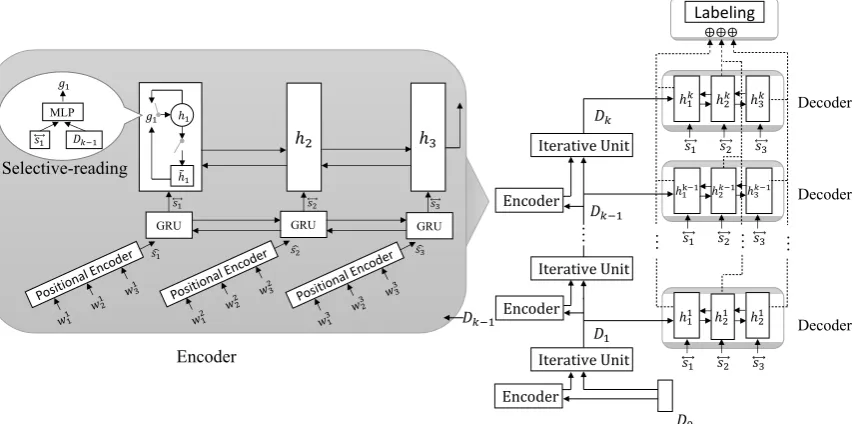
ITS is depicted in Fig.1. It consists of multiple it-erations with one encoder, one decoder, and one iteration unit in each iteration. We combine the outputs of decoders in all iterations to generate the extracting probabilities in the final labeling mod-ule.
Our encoder is illustrated in the shaded region in the left half of Fig.1. It takes as input all sentences as well as the document representation from the previous unitDk−1, processes them through sev-eral neural networks, and outputs the final state to the iterative unit module which updates the docu-ment representation.
Our decoder takes the form of a bidirectional RNN. It takes the representation of sentence gen-erated by the encoder as input, and its initial state
is the polished document representationDk. Our
last module, the sentence labeling module, con-catenates the hidden states of all decoders together to generate an integrated score for each sentence.
As we apply supervised training, the objective is to maximize the likelihood of all sentence labels
y0={y10, ..., yn0s}given the input documentsand model parametersθ:
logp(y0|s;θ) = ns
X
i=1
logp(yi0|s;θ) (1)
4 Our Model
4.1 Encoder
In this subsection, we describe the encoding pro-cess of our model. For brevity, we drop the super-script k when focusing on a particular layer. All theW’s andb’s in this section with different su-perscripts or subscripts are the parameters to be learned.
Sentence Encoder: Given a discrete set of sen-tencess= {s1, . . . , sns}, we use a word
embed-ding matrixM ∈ RV×D to embed each wordwi in sentencesi into continuous spacewˆi, whereV is the vocabulary size,Dis the dimension of word embedding.
The sentence encoder can be based on a variety of encoding schemes. Simply taking the average of embeddings of words in a sentence will cause too much information loss, while using GRUs or Long Short-Term Memory (LSTM) requires more computational resources and is prone to overfit-ting. Considering above, we selectpositional en-coding described in (Sukhbaatar et al., 2015) as our sentence encoding method. Each sentence rep-resentationsˆiis calculated bysˆi=Pnj=1w lj◦wˆij,
where◦is element-wise multiplication,ljis a
col-umn vector computed aslj,d= (1−njw)−(Dd)(1− 2j
nw),lj,ddenotes thed-th dimension oflj.
…
!"
!#
!$%#
ℎ#$ ℎ'$ ℎ($
ℎ#)%# ℎ'$%# ℎ($%#
Iterative Unit
ℎ## ℎ'# ℎ'#
!$
4(
4'
4#
4(
4'
4#
4(
4'
4#
Labeling
ℎ5#
ℎ#
ℎ' 6#
ℎ(
GRU GRU GRU
Encoder
Encoder
Encoder
⨁⨁⨁
Decoder
Decoder Decoder
Selective-reading
… …
Iterative Unit Iterative Unit
…
Encoder 4# !$%#
MLP 6#
4# 4' 4(
4<# 4<' 4<(
[image:4.595.80.507.66.278.2]!$%#
Figure 1: Model Structure: There is one encoder, one decoder and one iterative unit (which is used to polish document representation) in each iteration. The final labeling part is used to generating the extracting probabilities for all sentences combining hidden states of decoders in all iterations. We take a document consists of three sentences for example here.
ui, a reset gate vector ri, and an output vector
hi. For each time step iwith input xi and
pre-vious hidden statehi−1, the updated hidden state
hi=GRU(xi,hi−1)is computed by:
ui=σ(W(u)xi+U(u)hi−1+b(u)) (2)
ri=σ(W(r)xi+U(r)hi−1+b(r)) (3) ˜
hi=tanh(W(h)xi+ri◦U hi−1+b(h)) (4)
hi=ui◦h˜i+ (1−ui)◦hi−1 (5)
where σ is the sigmoid activation
function, W(u),W(r),W(h) ∈ RnH×nI,U(u),U(r),U ∈ RnH×nH, n
H is the hidden size,nIis the size of inputxi.
To further study the interactions and informa-tion exchanges between sentences, we establish a Bi-directional GRU (Bi-GRU) network taking the sentence representation as input:
−
→s
i =GRUfwd(sˆi,−−→si−1) (6)
←s−
i =GRUbwd(sˆi,←−−si−1) (7)
←→s
i =−→si +←s−i (8)
where ˆsi is the sentence representation input at
time stepi, −→si is the hidden state of the forward
GRU at time stepi, and←s−i is the hidden state of
the backward GRU. This architecture allows in-formation to flow back and forth to generate new sentence representation←→si.
Document Encoder: We must initialize a doc-ument representation before polishing it. Gener-ating the document representation from sentence representations is a process similar to generat-ing the sentence representation from word embed-dings. This time we need to compress the whole document, not just a sentence, into a vector. Be-cause the information a vector can contain is lim-ited, rather than to use another neural network, we simply use a non-linear transformation of the av-erage pooling of the concatenated hidden states of the above Bi-GRU to generate the document rep-resentation, as written below:
D0 =tanh(W 1
ns ns
X
i=1
[−→si;←s−i] +b) (9)
where ‘[·;·]’ is the concatenation operation. Selective Reading module: Now we can for-mally introduce the selective reading module in Fig.1. This module is a bidirectional RNN con-sisting of modified GRU cells whose input is the sentence representation←→s = {←s→1, ...,←s→ns}. In the original version of GRU, the update gate ui
in Equation2is used to decide how much of hid-den state should be retained and how much should be updated. However, due to the wayuiis
calcu-lated, it is sensitive to the position and ordering of sentences, but loses information captured by the polished document representation.
[image:4.595.78.291.419.558.2]replace the ui with the newly computed update
gategi. The new cell takes in two inputs, the
sen-tence representation and the document representa-tion from the last iterarepresenta-tion, rather than merely the sentence representation. For each sentence, the se-lective network generates an update gate vectorgi
in the following way:
fi= [←→si ◦Dk−1;←→si;Dk−1] (10)
Fi=W(2)tanh(W(1)fi+b(1)) +b(2) (11)
gi=
exp(Fi) Pns
j=1exp(Fj)
(12)
where ←→si is the i-th sentence representation,
Dk−1is the document representation from last it-eration. Equation5now becomes:
hi =gi◦h˜i+ (1−gi)◦hi−1 (13)
We use this “selective reading module” to auto-matically decide to which extent the information of each sentence should be updated based on its relationship with the polished document. In this way, the modified GRU network can grasp more accurate information from the document.
4.2 Iterative Unit
After each sentence passes through the selective reading module, we wish to update the document representationDk−1 with the newly constructed sentence representations. The iterative unit (also depicted above in Fig.1) is designed for this pur-pose. We use a GRUiter cell to generate the
pol-ished document representation, whose input is the final state of the selective reading network from the previous iteration,hns and whose initial state is set to the document representation of the previ-ous iteration,Dk−1. The updated document rep-resentation is computed by:
Dk=GRUiter(hns,Dk−1) (14)
4.3 Decoder
Next, we describe our decoders, which are de-picted shaded in the right part of Fig.1. Follow-ing most sequence labelFollow-ing task (Xue and Palmer,
2004; Carreras and M`arquez, 2005) where they learn a feature vector for each sentence, we use a bidirectional GRUdecnetwork in each iteration to
output features so as to calculate extracting proba-bilities. Fork-th iteration, given the sentence rep-resentation←→s as input and the document repre-sentation Dk as the initial state, our decoder
en-codes the features of all sentences in the hidden
statehk={hk0, ...,hkns}:
hki =GRUdec(←→s ,hki−1) (15)
hk0 =Dk (16)
4.4 Sentence Labeling Module
Next, we use the feature of each sentence to gener-ate corresponding extracting probability. Since we have one decoder in each iteration, if we directly transform the hidden states in each iteration to ex-tracting probabilities, we will end up with several scores for each sentence. Either taking the aver-age or summing them together by specific weights is inappropriate and inelegant. Hence, we concate-nate hidden states of all decoders together and ap-ply a multi-layer perceptron to them to generate the extracting probabilities:
y=W(4)tanh(W(3)[h1;...;hk] +b(3)) +b(4)
(17) wherey={y1, ..., yns},yi is the extracting
prob-ability for each setence. In this way, we let the model learn by itself how to utilize the outputs of all iterations and assign to each hidden state a re-liable weight. In section6, we will show that this labeling method outperforms other methods.
5 Experiment Setup
In this section, we present our experimental setup for training and estimating our summarization model. We first introduce the datasets used for training and evaluation, and then introduce our ex-perimental details and evaluation protocol.
5.1 Datasets
5.2 Implementation Details
We implemented our model in Tensorflow (Abadi et al., 2016). The code for our models is avail-able online1. We mostly followed the settings in (Nallapati et al.,2016a) and trained the model us-ing the Adam optimizer (Kingma and Ba, 2014) with initial learning rate 0.001 and anneals of 0.5 every 6 epochs until reaching 30 epochs. We se-lected three sentences with highest scores as sum-mary. After preliminary exploration, we found that arranging them according to their scores con-sistently achieved the best performance. Ex-periments were performed with a batch size of 64 documents. We used 100-dimension GloVe (Pennington et al., 2014) embeddings trained on Wikipedia 2014 as our embedding initialization with a vocabulary size limited to 100k for speed purposes. We initialized out-of-vocabulary word embeddings over a uniform distribution within [-0.2,0,2]. We also padded or cut sentences to con-tain exactly 70 words. Each GRU module had 1 layer with 200-dimensional hidden states and with either an initial state set up as described above or a random initial state. To prevent overfitting, we used dropout after each GRU network and embed-ding layer, and also applied L2 loss to all unbi-ased variables. The iteration number was set to 5 if not specified. A detailed discussion about itera-tion number can be found in secitera-tion7.
5.3 Baselines
On all datasets we used the Lead-3 method as a baseline, which simply chooses the first three sen-tences in a document as the gold summary. On DailyMail datasets, we report the performance of SummaRuNNer in (Nallapati et al., 2016a) and the model in (Cheng and Lapata, 2016), as well as a logistic regression classifier (LReg) that they used as a baseline. We reimplemented the Hy-brid MemNet model in (Singh et al.,2017) as one of our baselines since they only reported the per-formance of 500 samples in their paper. Also,
Narayan et al.(2018) released their code2for the REFRESH model, we used their code to produce Rouge recall scores on the DailyMail dataset as they only reported results on CNN/DailyMail joint dataset. Baselines on CNN dataset are similar.
1https://github.com/yingtaomj/Iterati
ve-Document-Representation-Learning-Tow ards-Summarization-with-Polishing
2https://github.com/EdinburghNLP/Refr
esh
On DUC2002 corpus, we compare our model with several baselines such as Integer Linear Program-ming (ILR) and LReg. We also report the perfor-mance of the newest neural networks model in-cluding (Nallapati et al., 2016a;Cheng and Lap-ata,2016;Singh et al.,2017).
5.4 Evaluation
In the evaluation procedure, we used the Rouge scores, i.e. Rouge-1, Rouge-2, and Rouge-L, cor-responding to the matches of unigram, bigrams, and Longest Common Subsequence (LCS) respec-tively, to estimate our model. We obtained our Rouge scores using the standard pyrouge pack-age3. To compare with other related works, we used full-length F1 score on the CNN corpus, lim-ited length of 75 bytes and 275 bytes recall score on DailyMail corpus. As for the DUC2002 corpus, following the official guidelines, we examined the Rouge recall score at the length of 75 words. All results in our experiment are statistically signifi-cant using 95% confidence interval as estimated by Rouge script.
Schluter(2017) noted that only using the Rouge metric to evaluate summarization quality can be misleading. Therefore, we also evaluated our model using human evaluation. Five highly ed-ucated participants were asked to rank 40 sum-maries produced by four models: the Lead-3 base-line, Hybrid MemNet, ITS, and human-authored highlights. We chose Hybrid MemNet as one of the human evaluation baselines since its perfor-mance is relatively high compared to other base-lines. Judging criteria included informativeness and coherence. Test cases were randomly sampled from DailyMail test set.
6 Experiment analysis
Table 1 shows the performance comparison of our model with other baselines on the DailyMail dataset with respect to Rouge score at 75 bytes and 275 bytes of summary length. Our model performs consistently and significantly better than other models on 75 bytes, while on 275 bytes, the improvement margin is smaller. One possible in-terpretation is that our model has high precision on top rank outputs, but the accuracy is lower for lower rank sentences. In addition, (Cheng and Lapata,2016) used additional supervised training
3https://pypi.python.org/pypi/pyrouge
DailyMail b75 b275
Rouge-1 Rouge-2 Rouge-L Rouge-1 Rouge-2 Rouge-L
Lead-3 21.9 7.2 11.6 40.5 14.9 32.6
LReg(500) 18.5 6.9 10.2 - -
-Chenget.al’16 22.7 8.5 12.5 42.2 17.3 34.8
SummaRuNNer 26.2 10.8 14.4 42 16.9 34.1
REFRESH 24.1 11.5 12.5 40.3 15.1 32.9
Hybrid MemNet 26.3 11.2 15.5 41.4 16.7 33.2
[image:7.595.108.491.61.185.2]ITS 27.4 11.9 16.1 42.4 17.4 34.1
Table 1: Comparison with other baselines onDailyMailtest dataset using Rouge recall score with respect to the abstractive ground truth at 75 bytes and at 275 bytes.
CNN Rouge-1 Rouge-2 Rouge-L
Lead-3 29.1 11.1 25.9
Chenget.al’16 28.4 10.0 25.0
Hybrid MemNet 29.9 11.3 26.4
REFRESH 30.4 11.7 26.9
[image:7.595.74.289.232.316.2]ITS 30.8 12.6 27.6
Table 2: Comparison with other baselines onCNNtest dataset using full-length F1 variants of Rouge.
to create sentence-level extractive labels to train their model, while our model uses an unsupervised greedy approximation instead.
We also examined the performance of our model on CNN dataset as listed in Table 2. To compare with other models, we used full-length Rouge F1 metric as reported by Narayan et al.
(2018). Results demonstrate that our model has a consistently best performance on different datasets.
In Table3, we present the performance of ITS on the out of domain DUC dataset. Our model out-performs or matches other basic models including LReg and ILR as well as neural network baselines such as SummaRuNNer with respect to the ground truth at 75 bytes, which shows that our model can be adapted to different copora maintaining high accuracy.
In order to explore the impact of internal struc-ture of ITS, we also conducted an ablation study in Table4. The first variation is the same model without the selective reading module. The sec-ond one sets the iteration number to one, that is, a model without iteration process. The last variation is to apply MLP on the output from the last itera-tion instead of concatenating the hidden states of all decoders. All other settings and parameters are the same. Performances of these models are worse than that of ITS in all metrics, which demonstrates
DUC2002 Rouge-1 Rouge-2 Rouge-L
Lead-3 43.6 21.0 40.2
LReg 43.8 20.7 40.3
ILP 45.4 21.3 42.8
Chenget.al’16 47.4 23.0 43.5
SummaRuNNer 46.6 23.1 43.0
Hybrid MemNet 46.9 23.0 43.1
ITS 47.6 23.4 43.5
Table 3: Comparison with other baselines on DUC2002 dataset using Rouge recall score with re-spect to the abstractive ground truth at 75 bytes.
Variations Rouge-1Rouge-2Rouge-L
ITS 27.4 11.9 16.1
w/o selective reading 27.1 11.6 15.4
w/o iteration 26.9 11.6 15.8
w/o concatenation 27.2 11.7 15.9
Table 4: Ablation study on DailyMail test dataset with respect to the abstractive ground truth at 75 bytes.
the preeminence of ITS. More importantly, by this controlled experiment, we can verify the contribu-tion of different module in ITS.
7 Further discussion
[image:7.595.310.525.234.350.2] [image:7.595.313.522.392.463.2]27.0
27.2 rouge-1rouge-L
rouge-2
15.8 16.0 16.2
Rouge Score
1 2 3 4 5 6 7
Iteration Number
[image:8.595.309.522.61.132.2]11.6 11.8
Figure 2: Relationship between number of iteration and Rouge score on DailyMail test dataset with respect to the ground truth at 75 bytes.
(a)
(b)
Figure 3: The predicted extracting probabilities for each sentence calculated by the output of each iteration.
the result of training the model for only one epoch outperforms the state-of-the-art in (Singh et al.,
2017), which demonstrates that our selective read-ing module is effective. The fact that continu-ing this process increase the performance confirms that the iteration idea behind our model is useful in practice. Based on above observation, we set the default iteration number to be 5.
Analysis of polishing process: Next, to fully investigate how the iterative process influences the extracting results, we draw heatmaps of the ex-tracting probabilities for each decoder at each it-eration. We pick two representative cases in Fig.3, where thex-axis represents the sentence index and
y-axis is the iteration number, x-axis labels are omitted. The darker the color is, the higher the extracting probability is. In Fig.3(a), it can be seen that when the iteration begins, most sentences have similar probabilities. As we increase the number of iteration, some probabilities begin to fall and others saturate. This means that the model already has preferred sentences to select. Another interesting feature we found is that there is a
tran-Models 1st 2nd 3rd 4th
Lead-3 0.12 0.11 0.25 0.52
Hybrid MemNet 0.24 0.25 0.28 0.23
ITS 0.31 0.34 0.23 0.12
[image:8.595.79.283.65.212.2]Gold 0.33 0.30 0.24 0.13
Table 5: System ranking comparison with other base-lines on DailyMail corpus. Rank 1 is the best and Rank 4 is the worst. Each score represents the percentage of the summary under this rank.
sitivity between iterations as shown in Fig.3(b). To be specific, the sentences which are not preferred by iteration 3 remain low probabilities in the next two iterations, while sentences with relatively high scores are still preferred by iteration 4 and 5.
Human Evaluation: We gave human evalua-tors three system-generated summaries, generated by Lead-3, Hybrid MemNet, ITS, as well as the human-written gold standard summary, and asked them to rank these summaries based on summary informativeness and coherence. Table5shows the percentages of summaries of different models un-der each rank scored by human experts. It is not surprising that gold standard has the most sum-maries of the highest quality. Our model has the most summaries under 2nd rank, thus can be con-sidered 2nd best, following are Hybrid MemNet and Lead-3, as they are ranked mostly 3rd and 4th. By case study, we found that a number of sum-maries generated by Hybrid MemNet have two sentences the same as ITS out of three, however, the third distinct sentence from our model always leads to a better evaluation result considering over-all informativeness and coherence. Readers can refer to the appendix to see our case study.
8 Conclusion
In this work, we introduce ITS, an iteration based extractive summarization model, inspired by the observation that it is often necessary for a hu-man to read the article multiple times to fully un-derstand and summarize it. Experimental results on CNN/DailyMail and DUC corpora demonstrate the effectiveness of our model.
Acknowledgments
[image:8.595.74.296.280.399.2]Re-search and Development Program of China (No. 2017YFC0804001), the National Science Foun-dation of China (NSFC No. 61876196, No. 61672058). Rui Yan was sponsored by CCF-Tencent Open Research Fund and Microsoft Re-search Asia (MSRA) Collaborative ReRe-search Pro-gram.
References
Mart´ın Abadi, Paul Barham, Jianmin Chen, Zhifeng Chen, Andy Davis, Jeffrey Dean, Matthieu Devin, Sanjay Ghemawat, Geoffrey Irving, Michael Isard, et al. 2016. Tensorflow: A system for large-scale machine learning. InOSDI, volume 16, pages 265– 283.
Xavier Carreras and Llu´ıs M`arquez. 2005. Intro-duction to the conll-2005 shared task: Semantic role labeling. InProceedings of the Ninth Confer-ence on Computational Natural Language Learn-ing, CONLL ’05, pages 152–164, Stroudsburg, PA, USA. Association for Computational Linguistics.
Jianpeng Cheng and Mirella Lapata. 2016. Neural summarization by extracting sentences and words.
Kyunghyun Cho, Bart Van Merrienboer, Caglar Gul-cehre, Dzmitry Bahdanau, Fethi Bougares, Holger Schwenk, and Yoshua Bengio. 2014. Learning phrase representations using rnn encoder-decoder for statistical machine translation. Computer Sci-ence.
Kevin Bretonnel Cohen. 2002. Natural language pro-cessing for online applications: Text retrieval, ex-traction and categorization (review). Language, 80(3):510–511.
Karl Moritz Hermann, Edward Grefenstette, Lasse Es-peholt, Will Kay, Mustafa Suleyman, and Phil Blun-som. 2015. Teaching machines to read and compre-hend. pages 1693–1701.
Sepp Hochreiter and J¨urgen Schmidhuber. 1997. Long short-term memory. Neural computation, 9(8):1735–1780.
Diederik Kingma and Jimmy Ba. 2014. Adam: A method for stochastic optimization. Computer Sci-ence.
Ramesh Nallapati, Igor Melnyk, Abhishek Kumar, and Bowen Zhou. 2017. Sengen: Sentence generating neural variational topic model.
Ramesh Nallapati, Feifei Zhai, and Bowen Zhou. 2016a. Summarunner: A recurrent neural network based sequence model for extractive summarization of documents.
Ramesh Nallapati, Bowen Zhou, Cicero Nogueira Dos Santos, Caglar Gulcehre, and Bing Xiang. 2016b.
Abstractive text summarization using sequence-to-sequence rnns and beyond.
Shashi Narayan, Shay B. Cohen, and Mirella Lapata. 2018. Ranking sentences for extractive summariza-tion with reinforcement learning.
Jeffrey Pennington, Richard Socher, and Christopher Manning. 2014. Glove: Global vectors for word representation. In Conference on Empirical Meth-ods in Natural Language Processing, pages 1532– 1543.
Dragomir R Radev, Timothy Allison, Sasha Blair-Goldensohn, John Blitzer, Arda Celebi, Stanko Dimitrov, Elliott Drabek, Ali Hakim, Wai Lam, Danyu Liu, et al. 2004. Mead-a platform for mul-tidocument multilingual text summarization. In
LREC.
Alexander M. Rush, Sumit Chopra, and Jason Weston. 2015. A neural attention model for abstractive sen-tence summarization.Computer Science.
Natalie Schluter. 2017. The limits of automatic sum-marisation according to rouge. In Proceedings of the 15th Conference of the European Chapter of the Association for Computational Linguistics: Volume 2, Short Papers, volume 2, pages 41–45.
Abigail See, Peter J. Liu, and Christopher D. Manning. 2017.Get to the point: Summarization with pointer-generator networks.CoRR, abs/1704.04368.
Abhishek Kumar Singh, Manish Gupta, and Vasudeva Varma. 2017. Hybrid memnet for extractive sum-marization. pages 2303–2306.
Sainbayar Sukhbaatar, Arthur Szlam, Jason Weston, and Rob Fergus. 2015. End-to-end memory net-works. Computer Science.
Kristian Woodsend and Mirella Lapata. 2010. Auto-matic generation of story highlights. In Meeting of the Association for Computational Linguistics, pages 565–574.
Yuxiang Wu and Baotian Hu. 2018. Learning to extract coherent summary via deep reinforcement learning.
arXiv preprint arXiv:1804.07036.
Caiming Xiong, Stephen Merity, and Richard Socher. 2016. Dynamic memory networks for visual and textual question answering.
Nianwen Xue and Martha Palmer. 2004. Calibrating features for semantic role labeling. InProceedings of the 2004 Conference on Empirical Methods in Natural Language Processing.
Rui Yan. 2016. i, poet: Automatic poetry composition through recurrent neural networks with iterative pol-ishing schema. InIJCAI, pages 2238–2244.
Rui Yan, Jian Yun Nie, and Xiaoming Li. 2011a. Sum-marize what you are interested in: An optimization framework for interactive personalized summariza-tion. InConference on Empirical Methods in Natu-ral Language Processing, EMNLP 2011, 27-31 July 2011, John Mcintyre Conference Centre, Edinburgh, Uk, A Meeting of Sigdat, A Special Interest Group of the ACL, pages 1342–1351.
Rui Yan, Xiaojun Wan, Mirella Lapata, Wayne Xin Zhao, Pu-Jen Cheng, and Xiaoming Li. 2012. Vi-sualizing timelines: Evolutionary summarization via iterative reinforcement between text and image streams. In Proceedings of the 21st ACM inter-national conference on Information and knowledge management, pages 275–284. ACM.