An empirical study on the effectiveness of images in Multimodal Neural
Machine Translation
Jean-Benoit Delbrouck and St´ephane Dupont TCTS Lab, University of Mons, Belgium
{jean-benoit.delbrouck, stephane.dupont}@umons.ac.be
Abstract
In state-of-the-art Neural Machine Trans-lation (NMT), an attention mechanism is used during decoding to enhance the trans-lation. At every step, the decoder uses this mechanism to focus on different parts of the source sentence to gather the most use-ful information before outputting its tar-get word. Recently, the effectiveness of the attention mechanism has also been ex-plored for multimodal tasks, where it be-comes possible to focus both on sentence parts and image regions that they describe. In this paper, we compare several atten-tion mechanism on the multimodal trans-lation task (English, image → German) and evaluate the ability of the model to make use of images to improve translation. We surpass state-of-the-art scores on the Multi30k data set, we nevertheless iden-tify and report different misbehavior of the machine while translating.
1 Introduction
In machine translation, neural networks have at-tracted a lot of research attention. Recently, the attention-based encoder-decoder framework (Sutskever et al.,2014;Bahdanau et al.,2014) has been largely adopted. In this approach, Recurrent Neural Networks (RNNs) map source sequences of words to target sequences. The attention mech-anism is learned to focus on different parts of the input sentence while decoding. Attention mecha-nisms have shown to work with other modalities too, like images, where their are able to learn to attend the salient parts of an image, for instance when generating text captions (Xu et al., 2015). For such applications, Convolutional Neural Net-works (CNNs) such as Deep Residual (He et al.,
2016) have shown to work best to represent im-ages.
Multimodal models of texts and images em-power new applications such as visual question an-swering or multimodal caption translation. Also, the grounding of multiple modalities against each other may enable the model to have a better under-standing of each modality individually, such as in natural language understanding applications.
In the field of Machine Translation (MT), the ef-ficient integration of multimodal information still remains a challenging task. It requires combining diverse modality vector representations with each other. These vector representations, also called context vectors, are computed in order the capture the most relevant information in a modality to out-put the best translation of a sentence.
To investigate the effectiveness of informa-tion obtained from images, a multimodal machine translation shared task (Specia et al., 2016) has been addressed to the MT community1. The best
results of NMT model were those ofHuang et al.
(2016) who used LSTM fed with global visual features or multiple regional visual features fol-lowed by rescoring. Recently,Calixto et al.(2017) proposed a doubly-attentive decoder that outper-formed this baseline with less data and without rescoring.
Our paper is structured as follows. In section2, we briefly describe our NMT model as well as the conditional GRU activation used in the decoder. We also explain how multi-modalities can be im-plemented within this framework. In the following sections (3and4), we detail three attention mech-anisms and explain how we tweak them to work as well as possible with images. Finally, we report and analyze our results in section5then conclude in section6.
1http://www.statmt.org/wmt16/multimodal-task.html
2 Neural Machine Translation
In this section, we detail the neural machine trans-lation architecture byBahdanau et al. (2014), im-plemented as an attention-based encoder-decoder framework with recurrent neural networks (§2.1). We follow by explaining the conditional GRU layer (§2.2) - the gating mechanism we chose for our RNN - and how the model can be ported to a multimodal version (§2.3).
2.1 Text-based NMT
Given a source sentenceX = (x1, x2, . . . , xM),
the neural network directly models the condi-tional probabilityp(Y|X) of its translation Y = (y1, y2, . . . , yN). The network consists of one
en-coder and one deen-coder with one attention mecha-nism. The encoder computes a representation C
for each source sentence and a decoder generates one target word at a time and by decomposing the following conditional probability :
logp(Y|X) =Xn
t=1
logp(yt|y < t, C) (1)
Each source wordxiand target wordyi are a
col-umn index of the embedding matrixEX andEY.
The encoder is a bi-directional RNN with Gated Recurrent Unit (GRU) layers (Chung et al.,2014;
Cho et al., 2014), where a forward RNN −→Ψenc reads the input sequence as it is ordered (from
x1 toxM) and calculates a sequence of forward
hidden states (−→h1,−→h2, . . . ,−→hM). A backward
RNN ←Ψ−enc reads the sequence in the reverse order (fromxM tox1), resulting in a sequence of backward hidden states (←h−M,←h−M−1, . . . ,←h−1). We obtain an annotation for each wordxi by
con-catenating the forward and backward hidden state ht = [−→ht;←h−t]. Each annotationht contains the
summaries of both the preceding words and the following words. The representation C for each source sentence is the sequence of annotations
C= (h1,h2, . . . ,hM).
The decoder is an RNN that uses a condi-tional GRU (cGRU, more details in §2.2) with an attention mechanism to generate a wordyt at
each time-step t. The cGRU uses it’s previous hidden state st−1, the whole sequence of source annotationsCand the previously decoded symbol
yt−1 in order to update it’s hidden statest: st=cGRU(st−1, yt−1, C) (2)
In the process, the cGRU also computes a time-dependent context vector ct. Both st and ct are
further used to decode the next symbol. We use a deep output layer (Pascanu et al.,2014) to com-pute a vocabulary-sized vector :
ot=Lotanh(Lsst+Lcct+LwEY[yt−1]) (3)
whereLo,Ls,Lc,Lw are model parameters. We
can parameterize the probability of decoding each wordytas:
p(yt|yt−1,st,ct) =Softmax(ot) (4)
The initial state of the decoders0at time-stept=
0is initialized by the following equation :
s0 =finit(hM) (5)
wherefinitis a feedforward network with one hid-den layer.
2.2 Conditional GRU
The conditional GRU 2 consists of two stacked
GRU activations called REC1 and REC2 and an attention mechanism fatt in between (called ATT in the footnote paper). At each time-stept, REC1 firstly computes a hidden state proposals0
t based
on the previous hidden state st−1 and the previ-ously emitted wordyt−1:
zt0 =σ Wz0EY[yt−1] +Uz0st−1 rt0 =σ Wr0EY[yt−1] +Ur0st−1 s0
t=tanh W0EY[yt−1] +rt0(U0st−1) s0
t=(1−zt0)st0 +zt0st−1 (6)
Then, the attention mechanism computes ct over
the source sentence using the annotations se-quence C and the intermediate hidden state pro-posals0
t:
ct=fatt C,s0t (7)
Finally, the second recurrent cell REC2, com-putes the hidden statestof the cGRU by looking
at the intermediate representation s0
t and context
vectorct:
zt=σ Wzct+Uzs0t
rt=σ Wrct+Urs0t
st=tanh W ct+rt(Us0t)
st=(1−zt)st+zts0t (8)
2https://github.com/nyu-dl/
2.3 Multimodal NMT
Recently, Calixto et al. (2017) proposed a dou-bly attentive decoder (referred as the ”MNMT” model in the author’s paper) which can be seen as an expansion of the attention-based NMT model proposed in the previous section. Given a se-quence of second a modality annotations I = (a1,a2, . . . ,aL), we also compute a new context
vector based on the same intermediate hidden state proposals0
t:
it=fatt0 I,s0t (9)
This new time-dependent context vector is an ad-ditional input to a modified version of REC2 which now computes the final hidden statest
us-ing the intermediate hidden state proposal s0
t and
both time-dependent context vectorsctandit:
zt=σ Wzct+Wzit+Uzs0t
rt=σ Wrct+Writ+Urs0t
st=tanh W ct+W it+rt(Us0t)
st=(1−zt)st+zts0t (10)
The probabilities for the next target word (from equation3) also takes into account the new context vectorit:
Lotanh(Lsst+Lcct+Liit+LwEY[yt−1]) (11) whereLi is a new trainable parameter.
In the field of multimodal NMT, the second modality is usually an image computed into fea-ture maps with the help of a CNN. The annotations
a1, a2, . . . , aLare spatial features (i.e. each
anno-tation represents features for a specific region in the image) . We follow the same protocol for our experiments and describe it in section5.
3 Attention-based Models
We evaluate three models of the image attention mechanismf0
att of equation7. They have in com-mon the fact that at each time step t of the de-coding phase, all approaches first take as input the annotation sequenceI to derive a time-dependent context vector that contain relevant information in the image to help predict the current target wordyt. Even though these models differ in how
the time-dependent context vector is derived, they share the same subsequent steps. For each mech-anism, we propose two hand-picked illustrations showing where the attention is placed in an image.
3.1 Soft attention
Soft attention has firstly been used for syntactic constituency parsing byVinyals et al. (2015) but has been widely used for translation tasks ever since. One should note that it slightly differs fromBahdanau et al. (2014) where their attention takes as input the previous decoder hidden state instead of the current (intermediate) one as shown in equation 7. This mechanism has also been successfully investigated for the task of image description generation (Xu et al., 2015) where a model generates an image’s description in natural language. It has been used in multimodal translation as well (Calixto et al.,2017), for which it constitutes a state-of-the-art.
The idea of the soft attentional model is to consider all the annotations when deriving the context vector it. It consists of a single
feed-forward network used to compute an expected alignmentetbetween modality annotational and
the target word to be emitted at the current time step t. The inputs are the modality annotations and the intermediate representation of REC1s0
t:
et,l =vTtanh(Uas0t+Waal) (12)
The vectorethas lengthL and itsl-th item
con-tains a score of how much attention should be put on thel-th annotation in order to output the best word at timet. We compute normalized scores to create an attention maskαtover annotations:
αt,i=PLexp(et,i)
j=1exp(et,j) (13)
it= L
X
i=1
αt,iai (14)
Finally, the modality time-dependent context vec-toritis computed as a weighted sum over the
an-notation vectors (equation 14). In the above ex-pressions,vT,U
aandWaare trained parameters.
[image:3.595.311.517.643.709.2]Figure 2: Ein Junge sitzt auf und blickt aus einem Mikroskop .
3.2 Hard Stochastic attention
This model is a stochastic and sampling-based process where, at every timestept, we are making a hard choice to attend only one annotation. This corresponds to one spatial location in the image. Hard attention has previously been used in the context of object recognition (Mnih et al., 2014;
Ba et al., 2015) and later extended to image description generation (Xu et al., 2015). In the context of multimodal NMT, we can follow Xu et al. (2015) because both our models involve the same process on images.
The mechanism f0
att is now a function that returns a sampled intermediate latent variables γt,i based upon a multinouilli distribution
parameterized byα:
γt∼Multinoulli({α1,...,L}) (15)
whereγt,i an indicator one-hot variable which is
set to 1 if thei-th annotation (out ofL) is the one used to compute the context vectorit:
p(γt,i = 1|γ< t, I) =αt,i (16)
it= L
X
i=1
γt,iai (17)
Context vectoritis now seen as the random
vari-able of this distribution. We define the variational lower bound L(γ) on the marginal log evidence
logp(y|I)of observing the target sentenceygiven modality annotationsI.
L(γ) =X
γ
p(γ|I) logp(y|γ, I)
≤logX
γ
p(γ|I)p(y|γ, I)
= logp(y|I) (18) The learning rules can be derived by taking derivatives of the above variational free energy
L(γ)with respect to the model parameterW :
∂L ∂W =
X
γ
p(γ|I)
"
∂logp(y|γ, I)
∂W +
logp(y|γ, I)∂log∂Wp(γ|I)
#
(19) In order to propagate a gradient through this process, the summation in equation19can then be approximated using Monte Carlo based sampling defined by equation16:
∂L ∂W ≈
1
N N
X
n=1 "
∂logp(y|˜γn, I)
∂W +
logp(y|˜γn, I)∂logp(˜γn|I) ∂W
#
(20) To reduce variance of the estimator in equation
20, we use a moving average baseline estimated as an accumulated sum of the previous log likeli-hoods with exponential decay upon seeing thek-th mini-batch:
bk = 0.9×bk−1+ 0.1×logp(y|γ˜k, I) (21)
Figure 3: Ein Mann sitzt neben einem
Computerbildschirm .
Figure 4: Ein Mann in einem orangefarbenen Hemd und mit Helm .
3.3 Local Attention
[image:4.595.313.527.82.177.2]subset of the image annotations. Local Attention has been used for text-based translation (Luong et al., 2015) and is inspired by the selective attention model ofGregor et al. (2015) for image generation. Their approach allows the model to select an image patch of varying location and zoom. Local attention uses instead the same ”zoom” for all target positions and still achieved good performance. This model can be seen as a trade-off between the soft and hard attentional models. The model picks one patch in the annotation sequence (one spatial location) and selectively focuses on a small window of context around it. Even though an image can’t be seen as a temporal sequence, we still hope that the model finds points of interest and selects the useful information around it. This approach has an advantage of being differentiable whereas the stochastic attention requires more complicated techniques such as variance reduction and rein-forcement learning to train as shown in section
3.2. The soft attention has the drawback to attend the whole image which can be difficult to learn, especially because the number of annotations L
is usually large (presumably to keep a significant spatial granularity).
More formally, at every decoding step t, the model first generates an aligned position pt.
Context vector it is derived as a weighted
sum over the annotations within the window
[pt − N;pt + N] where N is a fixed model
parameter chosen empirically3. These selected
annotations correspond to a squared region in the attention maps around pt. The attention mask
αt is of size2N + 1. The model predictspt as
an aligned position in the annotation sequence (referred as Predictive alignment (local-m) in the author’s paper) according to the following equation:
pt=S·sigmoid(vT tanh(Uas0t)) (22)
where vT and Ua are both trainable model
pa-rameters andS is the annotation sequence length
|I|. Because of the sigmoid,pt ∈ [0, S]. We use
equation12and13respectively to compute the ex-pected alignment vectoretand the attention mask
αt. In addition, a Gaussian distribution centered
aroundptis placed on the alphas in order to favor
3We pickN=|a
i|/4 = 49
annotations nearpt:
αt,i =αt,iexp
−(i−2σp2t)2
(23)
[image:5.595.313.519.161.225.2]where standard deviationσ = D2. We obtain con-text vectoritby following equation14.
Figure 5: Ein M¨adchen mit einer Schwimmweste schwimmt im Wasser .
Figure 6: Ein kleiner schwarzer Hund springt ¨uber Hindernisse .
4 Image attention optimization
Three optimizations can be added to the attention mechanism regarding the image modality. All lead to a better use of the image by the model and improved the translation scores overall.
At every decoding step t, we compute a gat-ing scalar βt ∈ [0,1] according to the previous
decoder statest−1:
βt=σ(Wβst−1+bβ) (24)
It is then used to compute the time-dependent im-age context vector :
it=βt L
X
l=1
αt,lal (25)
Xu et al. (2015) empirically found it to put more emphasis on the objects in the image descriptions generated with their model.
We also double the output size of trainable parametersUa, WaandvT in equation12 when
[image:5.595.314.518.285.348.2]formally, given the image annotation sequence
I = (a1,a2, . . . ,aL),ai ∈ RD, the three
ma-trices are of size D×2D,D×2Dand2D×1
respectively. We noticed a better coverage of the objects in the image by the alpha weights.
Lastly, we use a grounding attention inspired by Delbrouck and Dupont (2017). The mech-anism merge each spatial location ai in the
annotation sequence I with the initial decoder states0 obtained in equation5with non-linearity :
I0 =(f(a1+s0), f(a2+s0), . . . , f(aL+s0)) (26) where f is tanh function. The new annota-tions go through a L2 normalization layer fol-lowed by two1×1convolutional layers (of size
D→ 512,512→ 1respectively) to obtainL×1
weights, one for each spatial location. We nor-malize the weights with a softmax to obtain a soft attention map α. Each annotation ai is then
weighted according to its correspondingαi: I =(α1a1,α2a2, . . . ,αLaL) (27)
This method can be seen as the removal of unnec-essary information in the image annotations ac-cording to the source sentence. This attention is used on top of the others - before decoding - and is referred as ”grounded image” in Table1.
5 Experiments
For this experiments on Multimodal Machine Translation, we used the Multi30K dataset (Elliott et al., 2016) which is an extended version of the Flickr30K Entities. For each image, one of the English descriptions was selected and manually translated into German by a professional transla-tor. As training and development data, 29,000 and 1,014 triples are used respectively. A test set of size 1000 is used for metrics evaluation.
5.1 Training and model details
All our models are build on top of the nematus framework (Sennrich et al., 2017). The encoder is a bidirectional RNN with GRU, one 1024D single-layer forward and one 1024D single-layer backward RNN. Word embeddings for source and target language are of 620D and trained jointly with the model. Word embeddings and other non-recurrent matrices are initialized by sampling
from a GaussianN(0,0.012), recurrent matrices are random orthogonal and bias vectors are all initialized to zero.
To create the image annotations used by our decoder, we used a ResNet-50 pre-trained on ImageNet and extracted the features of size
14 × 14 × 1024 at its res4f layer (He et al.,
2016). In our experiments, our decoder operates on the flattened 196 × 1024 (i.e L × D). We also apply dropout with a probability of 0.5 on the embeddings, on the hidden states in the bidirectional RNN in the encoder as well as in the decoder. In the decoder, we also apply dropout on the text annotations hi, the image features
ai, on both modality context vector and on all
components of the deep output layer before the readout operation. We apply dropout using one same mask in all time steps (Gal and Ghahramani,
2016).
We also normalize and tokenize English and German descriptions using the Moses tokenizer scripts (Koehn et al.,2007). We use the byte pair encoding algorithm on the train set to convert space-separated tokens into subwords (Sennrich et al., 2016), reducing our vocabulary size to 9226 and 14957 words for English and German respectively.
All variants of our attention model were trained with ADADELTA (Zeiler, 2012), with mini-batches of size 80 for our monomodal (text-only) NMT model and 40 for our multimodal NMT. We apply early stopping for model selection based on BLEU4 : training is halted if no improvement on the development set is observed for more than 20 epochs. We use the metrics BLEU4 (Papineni et al., 2002), METEOR (Denkowski and Lavie,
2014) and TER (Snover et al., 2006) to evaluate the quality of our models’ translations.
5.2 Quantitative results
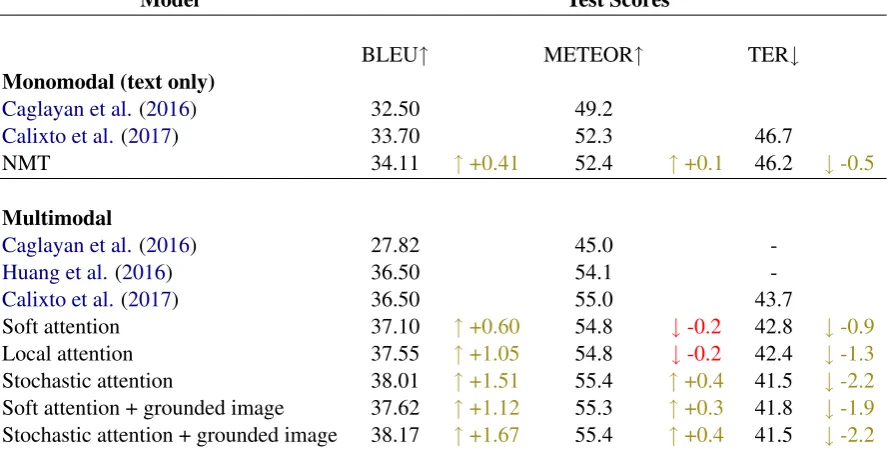
Model Test Scores
BLEU↑ METEOR↑ TER↓
Monomodal (text only)
Caglayan et al.(2016) 32.50 49.2
Calixto et al. (2017) 33.70 52.3 46.7
NMT 34.11 ↑+0.41 52.4 ↑+0.1 46.2 ↓-0.5
Multimodal
Caglayan et al.(2016) 27.82 45.0
-Huang et al.(2016) 36.50 54.1
-Calixto et al. (2017) 36.50 55.0 43.7
Soft attention 37.10 ↑+0.60 54.8 ↓-0.2 42.8 ↓-0.9
Local attention 37.55 ↑+1.05 54.8 ↓-0.2 42.4 ↓-1.3
Stochastic attention 38.01 ↑+1.51 55.4 ↑+0.4 41.5 ↓-2.2
Soft attention + grounded image 37.62 ↑+1.12 55.3 ↑+0.3 41.8 ↓-1.9
[image:7.595.78.522.69.294.2]Stochastic attention + grounded image 38.17 ↑+1.67 55.4 ↑+0.4 41.5 ↓-2.2
Table 1: Results on the 1000 test triples of the Multi30K dataset. We pickCalixto et al. (2017) scores as baseline and report our results accordingly (green for improvement and red for deterioration). In each of our experiments, Soft attention is used for text. The comparison is hence with respect to the attention mechanism used for the image modality.
are roughly the same across our models which is expected because all attention mechanisms share the same subsequent step at every time-step t, i.e. taking into account the attention weights of previous time-step t−1in order to compute the new intermediate hidden state proposal and there-fore the new context vectorit. Again, the largest
improvement is given by the hard stochastic attention mechanism (+0.4 METEOR): because it is modeled as a decision process according to the previous choices, this may reinforce the idea of recall. We also remark interesting improvements when using the grounded mechanism, especially for the soft attention. The soft attention may benefit more of the grounded image because of the wide range of spatial locations it looks at, especially compared to the stochastic attention. This motivates us to dig into more complex grounding techniques in order to give the machine a deeper understanding of the modalities.
Note that even though our baseline NMT model is basically the same as Calixto et al.
(2017), our experiments results are slightly better. This is probably due to the different use of dropout and subwords. We also compared our results to
Caglayan et al. (2016) because our multimodal models are nearly identical with the major
ex-ception of the gating scalar (cfr. section4). This motivated some of our qualitative analysis and hesitation towards the current architecture in the next section.
5.3 Qualitative results
For space-saving and ergonomic reasons, we only discuss about the hard stochastic and soft attention, the latter being a generalization of the local attention.
Figure 7: Representative figures of the soft-attention behavior discussed in§5.3
gating scalar happens to be really low in the stochastic attention mechanism: a significant amount of sentences don’t have a summed gating scalar ≥ 0.10. The model totally discards the image in the translation process.
It is also worth to mention that we use a ResNet trained on 1.28 million images for a classification tasks. The features used by the attention mechanism are strongly object-oriented and the machine could miss important information for a multimodal translation task. We believe that the robust architecture of both encoders
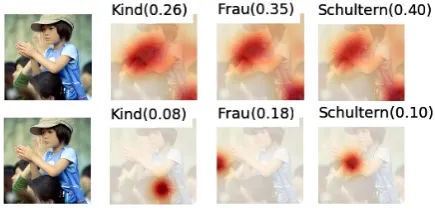
{←Ψ−enc,−→Ψenc} combined with a GRU layer and word-embeddings took care of the right trans-lation for retrans-lationships between objects and time-dependencies. Yet, we noticed a common misbehavior for all our multimodal models: if the attention loose track of the objects in the picture and ”gets lost”, the model still takes it into account and somehow overrides the information brought by the text-based annotations. The translation is then totally mislead. We illustrate with an example:
Source: A child claps while riding on a woman ’s shoulders .
GT: Ein Kind sitzt auf den Schultern einer Frau und klatscht .
Mono: Ein Kind sitzt auf den Schultern einer Frau und schl¨aft .
Soft: Ein Kind , das sich auf der Schultern eines Frau reitet , f¨ahrt auf den Schultern .
Hard: Ein Kind in der Haltung , w¨ahrend er auf den Schultern einer Frau f¨ahrt .
The monomodal translation has a sentence-level BLEU of 82.16 whilst the soft attention and hard stochastic attention scores are of 16.82 and 34.45 respectively. Figure 8 shows the attention maps for both mechanism. Nevertheless, one has to concede that the use of images indubitably helps the translation as shown in the score tabular.
Figure 8: Wrong detection for both Soft attention (top) and Hard stochastic attention (bottom)
6 Conclusion and future work
[image:8.595.307.525.379.487.2]7 Acknowledgements
This work was partly supported by the Chist-Era project IGLU with contribution from the Belgian Fonds de la Recherche Scientique (FNRS), con-tract no. R.50.11.15.F, and by the FSO project VCYCLE with contribution from the Belgian Waloon Region, contract no. 1510501.
References
Jimmy Ba, Volodymyr Mnih, and Koray Kavukcuoglu. 2015. Multiple object recognition with visual atten-tion. InProceedings of the International Conference on Learning Representations (ICLR).
Dzmitry Bahdanau, Kyunghyun Cho, and Yoshua Bengio. 2014. Neural machine translation by jointly learning to align and translate. CoRR
abs/1409.0473.
Ozan Caglayan, Walid Aransa, Yaxing Wang, Marc Masana, Mercedes Garc´ıa-Mart´ınez, Fethi Bougares, Lo¨ıc Barrault, and Joost van de Wei-jer. 2016. Does multimodality help human and machine for translation and image captioning?
In Proceedings of the First Conference on
Ma-chine Translation. Association for Computational
Linguistics, Berlin, Germany, pages 627–633.
http://www.aclweb.org/anthology/W/W16/W16-2358.
Iacer Calixto, Qun Liu, and Nick Campbell. 2017.
Doubly-attentive decoder for multi-modal neu-ral machine translation. CoRR abs/1702.01287.
http://arxiv.org/abs/1702.01287.
Kyunghyun Cho, Bart van Merri¨enboer, C¸alar G¨ulc¸ehre, Dzmitry Bahdanau, Fethi Bougares, Hol-ger Schwenk, and Yoshua Bengio. 2014. Learning phrase representations using rnn encoder–decoder for statistical machine translation. InProceedings of the 2014 Conference on Empirical Methods in
Nat-ural Language Processing (EMNLP). Association
for Computational Linguistics, Doha, Qatar, pages 1724–1734. http://www.aclweb.org/anthology/D14-1179.
Junyoung Chung, Caglar Gulcehre, Kyunghyun Cho, and Yoshua Bengio. 2014. Empirical evaluation of gated recurrent neural networks on sequence mod-eling.
Jean-Benoit Delbrouck and Stephane Dupont. 2017. Multimodal compact bilinear pool-ing for multimodal neural machine trans-lation. arXiv preprint arXiv:1703.08084
https://arxiv.org/pdf/1703.08084.pdf.
Michael Denkowski and Alon Lavie. 2014. Meteor universal: Language specific translation evaluation for any target language. InProceedings of the EACL
2014 Workshop on Statistical Machine Translation.
D. Elliott, S. Frank, K. Sima’an, and L. Specia. 2016. Multi30k: Multilingual english-german image de-scriptions pages 70–74.
Yarin Gal and Zoubin Ghahramani. 2016. A theoret-ically grounded application of dropout in recurrent neural networks. InAdvances in Neural Information Processing Systems 29 (NIPS).
Karol Gregor, Ivo Danihelka, Alex Graves, Danilo Rezende, and Daan Wierstra. 2015. Draw: A recur-rent neural network for image generation. In Fran-cis Bach and David Blei, editors,Proceedings of the 32nd International Conference on Machine Learn-ing. PMLR, Lille, France, volume 37 ofProceedings
of Machine Learning Research, pages 1462–1471.
http://proceedings.mlr.press/v37/gregor15.html.
Kaiming He, Xiangyu Zhang, Shaoqing Ren, and Jian Sun. 2016. Deep residual learning for image recog-nition. InThe IEEE Conference on Computer Vision
and Pattern Recognition (CVPR).
Po-Yao Huang, Frederick Liu, Sz-Rung Shiang, Jean Oh, and Chris Dyer. 2016. Attention-based mul-timodal neural machine translation. In Proceed-ings of the First Conference on Machine Translation, Berlin, Germany.
Philipp Koehn, Hieu Hoang, Alexandra Birch, Chris Callison-Burch, Marcello Federico, Nicola Bertoldi, Brooke Cowan, Wade Shen, Christine Moran, Richard Zens, Chris Dyer, Ondˇrej Bojar, Alexandra Constantin, and Evan Herbst. 2007. Moses: Open source toolkit for statistical machine translation.
In Proceedings of the 45th Annual Meeting of the
ACL on Interactive Poster and Demonstration
Ses-sions. Association for Computational Linguistics,
Stroudsburg, PA, USA, ACL ’07, pages 177–180.
http://dl.acm.org/citation.cfm?id=1557769.1557821.
Minh-Thang Luong, Hieu Pham, and Christopher D. Manning. 2015. Effective approaches to attention-based neural machine translation. InProceedings of the 2015 Conference on Empirical Methods in Nat-ural Language Processing.
Volodymyr Mnih, Nicolas Heess, Alex Graves, and koray kavukcuoglu. 2014. Recurrent models of visual attention. In Z. Ghahramani, M. Welling, C. Cortes, N.D. Lawrence, and K.Q. Weinberger, editors,Advances in Neural Information Processing
Systems 27, Curran Associates, Inc., pages 2204–
2212. http://papers.nips.cc/paper/5542-recurrent-models-of-visual-attention.pdf.
Kishore Papineni, Salim Roukos, Todd Ward, and Wei-Jing Zhu. 2002. Bleu: A method for au-tomatic evaluation of machine translation. In
Proceedings of the 40th Annual Meeting on
As-sociation for Computational Linguistics.
Asso-ciation for Computational Linguistics, Strouds-burg, PA, USA, ACL ’02, pages 311–318.
Razvan Pascanu, Caglar Gulcehre, Kyunghyun Cho, and Yoshua Bengio. 2014. How to construct deep recurrent neural networks.
Rico Sennrich, Orhan Firat, Kyunghyun Cho, Alexan-dra Birch, Barry Haddow, Julian Hitschler, Marcin Junczys-Dowmunt, Samuel L”aubli, Antonio Vale-rio Miceli Barone, Jozef Mokry, and Maria Nade-jde. 2017. Nematus: a Toolkit for Neural Machine Translation. InProceedings of the Demonstrations at the 15th Conference of the European Chapter of the Association for Computational Linguistics. Rico Sennrich, Barry Haddow, and Alexandra Birch.
2016. Neural Machine Translation of Rare Words with Subword Units. In In Proceedings of the 54th Annual Meeting of the Association for
Com-putational Linguistics (Volume 1: Long Papers).
http://www.aclweb.org/anthology/P16-1162. Matthew Snover, Bonnie Dorr, Richard Schwartz,
Lin-nea Micciulla, and John Makhoul. 2006. A study of translation edit rate with targeted human annota-tion. InIn Proceedings of Association for Machine Translation in the Americas. pages 223–231. Lucia Specia, Stella Frank, Khalil Sima’an, and
Desmond Elliott. 2016. A shared task on multi-modal machine translation and crosslingual image description. InProceedings of the First Conference
on Machine Translation. Association for
Computa-tional Linguistics, Berlin, Germany, pages 543–553.
http://www.aclweb.org/anthology/W/W16/W16-2346.
Ilya Sutskever, Oriol Vinyals, and Quoc V Le. 2014. Sequence to sequence learning with neural net-works. InAdvances in neural information process-ing systems. pages 3104–3112.
Oriol Vinyals, Ł ukasz Kaiser, Terry Koo, Slav Petrov, Ilya Sutskever, and Geoffrey Hinton. 2015. Gram-mar as a foreign language. In C. Cortes, N. D. Lawrence, D. D. Lee, M. Sugiyama, and R. Garnett, editors,Advances in Neural Information Processing
Systems 28, Curran Associates, Inc., pages 2773–
2781. http://papers.nips.cc/paper/5635-grammar-as-a-foreign-language.pdf.
Kelvin Xu, Jimmy Ba, Ryan Kiros, Kyunghyun Cho, Aaron Courville, Ruslan Salakhudinov, Rich Zemel, and Yoshua Bengio. 2015. Show, attend and tell: Neural image caption generation with visual atten-tion. In David Blei and Francis Bach, editors,
Proceedings of the 32nd International Conference
on Machine Learning (ICML-15). JMLR Workshop
and Conference Proceedings, pages 2048–2057.
http://jmlr.org/proceedings/papers/v37/xuc15.pdf. Matthew D. Zeiler. 2012. ADADELTA: an
adap-tive learning rate method. CoRR abs/1212.5701.