Exploiting Multiple Sources for Open-domain Hypernym Discovery
Ruiji Fu, Bing Qin, Ting Liu∗
Research Center for Social Computing and Information Retrieval School of Computer Science and Technology
Harbin Institute of Technology, China {rjfu, bqin, tliu}@ir.hit.edu.cn
Abstract
Hypernym discovery aims to extract such noun pairs that one noun is a hypernym of the other. Most previous methods are based on lexical patterns but perform badly on open-domain data. Other work extracts hypernym relations from encyclopedias but has limited coverage. This paper proposes a simple yet ef-fective distant supervision framework for Chi-nese open-domain hypernym discovery. Giv-en an Giv-entity name, we try to discover its hy-pernyms by leveraging knowledge from mul-tiple sources, i.e., search engine results, ency-clopedias, and morphology of the entity name. First, we extract candidate hypernyms from the above sources. Then, we apply a statistical ranking model to select correct hypernyms. A set of novel features is proposed for the rank-ing model. We also present a heuristic strate-gy to build a large-scale noisy training data for the model without human annotation. Exper-imental results demonstrate that our approach outperforms the state-of-the-art methods on a manually labeled test dataset.
1 Introduction
Hypernym discovery is a task to extract such noun pairs that one noun is a hypernym of the other (S-now et al., 2005). A noun His a hypernym of an-other nounEifEis an instance or subclass ofH. In other word,His a semantic class ofE. For instance, “actor” is a hypernym of “Mel Gibson”; “dog” is a hypernym of “Caucasian sheepdog”; “medicine” is a hypernym of “Aspirin”. Hypernym discovery is an important subtask of semantic relation extraction
∗
Email correspondence.
and has many applications in ontology construction (Suchanek et al., 2008), machine reading (Etzion-i et al., 2006), quest(Etzion-ion answer(Etzion-ing (McNamee et al., 2008), and so on.
Some manually constructed thesauri such as WordNet can also provide some semantic relations such as hypernyms. However, these thesauri are lim-ited in its scope and domain, and manual construc-tion is knowledge-intensive and time-consuming. Therefore, many researchers try to automatically ex-tract semantic relations or to construct taxonomies.
Most previous methods on automatic hypernym discovery are based on lexical patterns and suffer from the problem that such patterns can only cov-er a small part of complex linguistic circumstances (Hearst, 1992; Turney et al., 2003; Zhang et al., 2011). Other work tries to extract hypernym rela-tions from large-scale encyclopedias like Wikipedia and achieves high precision (Suchanek et al., 2008; Hoffart et al., 2012). However, the coverage is limit-ed since there exist many infrequent and new entities that are missing in encyclopedias (Lin et al., 2012). We made similar observation that more than a half of entities in our data set have no entries in the en-cyclopedias.
This paper proposes a simple yet effective distan-t supervision framework for Chinese open-domain hypernym discovery. Given an entity name, our goal is to discover its hypernyms by leveraging knowl-edge from multiple sources. Considering the case where a person wants to know the meaning of an un-known entity, he/she may search it in a search engine and then finds out the answer after going through the search results. Furthermore, if he/she finds an en-try about the entity in an authentic web site, such as Wikipedia, the information will help him/her
stand the entity. Also, the morphology of the enti-ty name can provide supplementary information. In this paper, we imitate the process. The evidences from the above sources are integrated in our hyper-nym discovery model.
Our approach is composed of two major steps: hypernym candidate extraction and ranking. In the first step, we collect hypernym candidates from mul-tiple sources. Given an entity name, we search it in a search engine and extract high-frequency nouns as its main candidate hypernyms from the search re-sults. We also collect the category tags for the entity from two Chinese encyclopedias and the head word of the entity as the candidates.
In the second step, we identify correct hypernyms from the candidates. We view this task as a rank-ing problem and propose a set of effective features to build a statistical ranking model. For the param-eter learning of the model, we also present a heuris-tic strategy to build a large-scale noisy training data without human annotation.
Our contributions are as follows:
• We are the first to discover hypernym for Chi-nese open-domain entities by exploiting mul-tiple sources. The evidences from different sources can authenticate and complement each other to improve both precision and recall.
• We manually annotate a dataset containing 1,879 Chinese entities and their hypernyms, which will be made publicly available. To the best of our knowledge, this is the first dataset for Chinese hypernyms.
• We propose a set of novel and effective fea-tures for hypernym ranking. Experimental re-sults show that our method achieves the best performance.
Furthermore, our approach can be easily ported from Chinese to English and other languages, except that a few language dependent features need to be changed.
The remainder of the paper is organized as fol-lows: Section 2 discusses the related work. Section 3 introduces our method in detail. Section 4 de-scribes the experimental setup. Section 5 shows the experimental results. Conclusion and future work are presented in Section 6.
2 Related Work
Previous methods for hypernym discovery can be summarized into two major categories, i.e., pattern-based methods and encyclopedia-pattern-based methods.
Pattern-based methods make use of manually
or automatically constructed patterns to mine hyper-nym relations from text corpora. The pioneer work by Hearst (1992) finds that linking two noun phras-es (NPs) via certain lexical constructions often im-plies hypernym relations. For example, NP1is a
hy-pernym of NP2 in the lexical pattern “such NP1 as
NP2”. Similarly, succeeding researchers follow her
work and use handcrafted patterns to extract hyper-nym pairs from corpora (Caraballo, 1999; Scott and Dominic, 2003; Ciaramita and Johnson, 2003; Tur-ney et al., 2003; Pasca, 2004; Etzioni et al., 2005; Ritter et al., 2009; Zhang et al., 2011).
Evans (2004) considers the web data as a large corpus and uses search engines to identify hyper-nyms based on lexical patterns. Given an arbitrary document, he takes each capitalized word sequence as an entity and aims to find its potential hypernyms through pattern-based web searching. SupposeXis a capitalized word sequence. Some pattern queries like “such as X” are threw into the search engine. Then, in the retrieved documents, the nouns that im-mediately precede the pattern are recognized as the hypernyms ofX. This work is most related to ours. However, the patterns used in his work are too strict to cover many low-frequency entities, and our ex-periments show the weakness of the method.
Encyclopedia-based methods extract hyper-nym relations from encyclopedias like Wikipedia (Suchanek et al., 2008; Hoffart et al., 2012). The user-labeled information in encyclopedias, such as category tags in Wikipedia, is often used to derive hypernym relations.
In the construction of the famous ontology YA-GO, Suchanek et al. (2008) consider the title of each Wikipedia page as an entity and the corresponding category tags as its potential hypernyms. They ap-ply a shallow semantic parser and some rules to dis-tinguish the correct hypernyms. Heuristically, they find that if the head of the category tag is a plural word, the tag is most likely to be a correct hyper-nym. However, this method cannot be used in Chi-nese because of the lack of plurality information.
The method of Suchanek et al. (2008) cannot han-dle the case when the entity is absent in Wikipedia. To solve this problem, Lin et al. (2012) connect the absent entities with the entities present in Wikipedia sharing common contexts. They utilize the Freebase semantic types to label the present entities and then propagate the types to the absent entities. The Free-base contains most of entities in Wikipedia and as-signs them semantic types defined in advance. But there are no such resources in Chinese.
Compared with previous work, our approach tries to identify hypernyms from multiple sources. The evidences from different sources can authenticate and complement each other to improve both preci-sion and recall. Our experimental results show the effectiveness of our method.
3 Method
Our method is composed of two steps. First, we col-lect candidate hypernyms from multiple sources for a given entity. Then, a statistical model is built for hypernym ranking based on a set of effective fea-tures. Besides, we also present a heuristic strategy to build a large-scale training data.
3.1 Candidate Hypernym Collection from
Multiple Sources
In this work, we collect potential hypernyms from four sources, i.e., search engine results, two ency-clopedias, and morphology of the entity name.
We count the co-occurrence frequency between
the target entities and other words in the returned snippets and titles, and select topN nouns (or noun phrases) as the main candidates. As the experiments show, this method can find at least one hypernym for 86.91% entities whenN equals10 (see Section 5.1). This roughly explains why people often can in-fer semantic meaning of unknown entities after go-ing through several search results.
Furthermore, the user-generated encyclopedia category tags are important clues if the entity exist-s in a encyclopedia. Thuexist-s we add theexist-se tagexist-s into the candidates. In this work, we consider two Chi-nese encyclopedias, Baidubaike and Hudongbaike1, as hypernym sources.
In addition, the head words of entities are also their hypernyms sometimes. For example, the head word of “•2è (Emperor Penguin)” indicates that it’s a kind of “è (penguins)”. Thus we put head words into the hypernym candidates. In Chi-nese, head words are often laid after their modifiers. Therefore, we try to segment a given entity. If it can be segmented and the last word is a noun, we take the last word as the head word. In our data set, the head words of 41.35% entities are real hypernyms (see Section 5.1).
We combine all of these hypernym candidates to-gether as the input of the second stage. The final coverage rate reaches 93.24%.
3.2 Hypernym Ranking
After getting the candidate hypernyms, we then adopt a ranking model to determine the correct hy-pernym. In this section, we propose several effective features for the model. The model needs training da-ta for learning how to rank the dada-ta in addition to parameter setting. Considering that manually anno-tating a large-scale hypernym dataset is costly and time-consuming, we present a heuristic strategy to collect training data. We compare three hypernym ranking models on this data set, including Support Vector Machine (SVM) with a linear kernel, SVM with a radial basis function (RBF) kernel and Logis-tic Regression (LR).
1
Feature Comment Value Range
Prior the prior probability of a candidate being a potential hypernym [0, 1]
Is Tag whether a candidate is a category tag in the encyclopedia
page of the entity if it exists 0 or 1
Is Head whether a candidate is the head word of the entity 0 or 1
In Titles some binary features based on the frequency of occurrence of
a candidate in the document titles in the search results 0 or 1
Synonyms the ratio of the synonyms of the candidate in the candidate
list of the entity [0, 1]
Radicals the ratio of the radicals of characters in a candidate matched
with the last character of the entity [0, 1]
Source Num the number of sources where the candidate is extracted 1, 2, 3, or 4
[image:4.612.91.521.56.243.2]Lexicon the hypernym candidate itself and its head word 0 or 1
Table 1: The features for ranking
3.2.1 Features for Ranking
[image:4.612.330.522.279.336.2]The features for hypernym ranking are shown in Table 1. We illustrate them in detail in the following.
Hypernym Prior: Intuitively, different words
have different probabilities as hypernyms of some other words. Some are more probable as hypernyms, such asanimal,plant andfruit. Some other words such as sun, nature andalias, are not usually used as hypernyms. Thus we use a prior probability to express this phenomenon. The assumption is that if the more frequent that a noun appears as category tags, the more likely it is a hypernym. We extract category tags from 2.4 million pages in Baidubaike, and compute the prior probabilities prior(w)for a wordwbeing a potential hypernym using Equation 1. countCT(w)denotes the times a word appeared as a category tag in the encyclopedia pages.
prior(w) = PcountCT(w)
w0countCT(w0)
(1)
In Titles: When we enter a query into a search
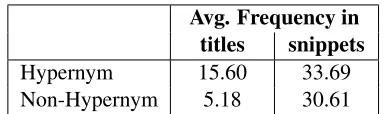
engine, the engine returns a search result list, which contains document titles and their snippet text. The distributions of hypernyms and non-hypernyms in ti-tles are compared with that in snippets respectively in our training data. We discover that the average frequency of occurrence of hypernyms in titles is 15.60 while this number of non-hypernyms is only 5.18, while the difference in snippets is very small (Table 2). Thus the frequency of candidates in titles can be used as features. In this work the frequency
Avg. Frequency in
titles snippets
Hypernym 15.60 33.69
Non-Hypernym 5.18 30.61
Table 2: Distributions of candidate hypernyms in titles and snippets
is divided into three cases: greater than 15.60, less than 5.18, and between 5.18 and 15.60. Three binary features are used to represent these cases.
Synonyms: If there exist synonyms of a
candi-date hypernym in the candicandi-date list, the candicandi-date is probably correct answer. For example, when “†¬ (medicine)” and “†Ô (medicine)” both appear in the candidate list of an entity, the entity is probably a kind of medicine. We get synonyms of a candidate from a Chinese semantic thesaurus – Tongyi Cilin (Extended) (CilinE for short)2 and compute the s-core as a feature using Equation 2.
ratiosyn(h, le) =
countsyn(h, le) len(le)
(2)
Given a hypernym candidatehof an entityeand the list of all candidatesle, we compute the ratio of the synonyms ofhinle.countsyn(h, le)denotes the count of the synonyms ofhinle.len(le)is the total count of candidates.
2
Radicals: Chinese characters are a form of ideogram. By far, the bulk of Chinese characters were created by linking together a character with a related meaning and another character to indicate its pronunciation. The character with a related meaning is called radical. Sometimes, it is a important clue to indicate the semantic class of the whole character. For example, the radical “Á” means insects, so it hints “|n(dragonfly)” is a kind of insects. Simi-larly “û” hints “ nJ (lymphoma)” is a kind of diseases. Thus we use radicals as a feature the value of which is computed by using Equation 3.
radical(e, h) = countRM(e, h)
len(h) (3)
Hereradical(e, h)denotes the ratio of characters radical-matched with the last character of the entity
e in the hypernym h. countRM(e, h) denotes the count of the radical-matched characters inh.len(h)
denotes the total count of the characters inh.
3.2.2 Training Data Collection
Now training data is imperative to learn the weights of the features in Section 3.2.1. Hence, we propose a heuristic strategy to collect training data from encyclopedias.
Firstly, we extract a number of open-domain enti-ties from encyclopedias randomly. Then their hyper-nym candidates are collected by using the method proposed in Section 3.1. We select positive training instances following two principles:
• Principle 1: Among the four sources used for candidate collection, the more sources from which the hypernym candidate is extracted, the more likely it is a correct one.
• Principle 2: The higher the prior of the candi-date being a hypernym is, the more likely it is a correct one.
We select the best candidates following Principle 1 and then select the best one in them as a positive instance following Principle 2. And we select a can-didate as a negative training instance when it is from only one source and its prior is the lowest. If there are synonyms of training instances in the candidates list, the synonyms are also extended into the training set.
Domain # of entities
Dev. Test
Biology 72 351
Health Care 61 291
Food 75 303
Movie 51 204
Industry 56 224
Others 35 136
[image:5.612.359.495.58.187.2]Total 350 1529
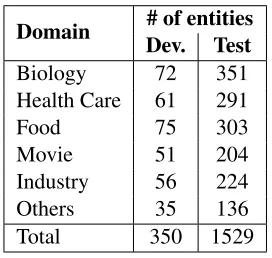
Table 3: The evaluation data
In this way, we collect training data automatically, which are used to learn the feature weights of the ranking models.
4 Experimental Setup
In this work, we use Baidu3search engine, the most popular search engine for Chinese, and get the top 100 search results for each entity. The Chinese seg-mentation, POS tagging and dependency parsing is provided by an open-source Chinese language pro-cessing platform LTP4(Che et al., 2010).
4.1 Experimental Data
In our experiments, we prepare open-domain enti-ties from dictionaries in wide domains, which are published by a Chinese input method editor soft-ware Sogou Pinyin5. The domains include biology, health care, food, movie, industry, and so on. We sample 1,879 entities from these domain dictionaries and randomly split them into 1/5 for developmen-t and 4/5 for developmen-tesdevelopmen-t (Table 3). We find developmen-thadevelopmen-t only 865 (46.04%) entities exist in Baidubaike or Hudong-baike. Then we extract candidate hypernyms for the entities and ask two annotators to judge each hyper-nym relation pair true or false manually. A pair(E, H)is annotated as true if the annotators judge “Eis a (or a kind of)H” is true. Finally, we get 12.53 candi-date hypernyms for each entity on average in which about 2.09 hypernyms are correct. 4,330 hypernym relation pairs are judged by both the annotators. We measure the agreement of the judges using the Kap-pa coefficient (Siegel and Castellan Jr, 1988). The
3http://www.baidu.com
4
http://ir.hit.edu.cn/demo/ltp/
5
0 5 10 15 20
0.2
0.4
0.6
0.8
1.0
Top N
Co
v
er
age Rate
SRN
[image:6.612.331.524.58.186.2]SRN+ET+HW
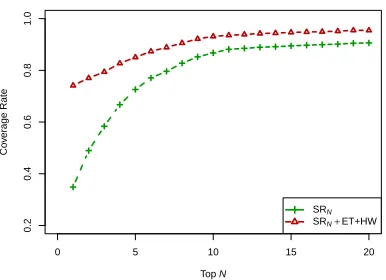
Figure 1: Effect of candidate hypernym coverage rate while varyingN
Kappa value is 0.79.
Our training data, containing 11,481 positive in-stances and 18,378 negative ones, is extracted from Baidubaike and Hudongbaike using the heuristic s-trategy proposed in Section 3.2.2.
4.2 Experimental Metrics
The evaluation metrics for our task include:
Coverage Rate: We evaluate coverage rate of the
candidate hypernyms. Coverage rate is the number of entities for which at least one correct hypernym is found divided by the total number of all entities.
Precision@1: Our method returns a ranked list
of hypernyms for each entity. We evaluate precision of top-1 hypernyms (the most probable ones) in the ranked lists, which is the number of correct top-1 hypernyms divided by the number of all entities.
R-precision: It is equivalent to Precision@R
where R is the total number of candidates labeled as true hypernyms of an entity.
Precision, Recall, and F-score: Besides, we can
convert our ranking models to classification models by setting thresholds. Varying the thresholds, we can get different precisions, recalls, and F-scores.
5 Results and Analysis
5.1 The Coverage of Candidate Hypernyms
In this section, we evaluate the coverage rate of the candidate hypernyms. We check the candidate hy-pernyms of the whole 1,879 entities in the develop-ment and test sets and see how many entities we can collect at least one correct hypernym for.
Source Coverage
Rate Avg. #
SR10 0.8691 9.44∗
ET 0.3938 3.07
HW 0.4135 0.87†
SR10+ ET 0.8909 12.02
SR10+ HW 0.9117 9.75
ET + HW 0.7073 3.92
[image:6.612.74.267.64.204.2]SR10+ ET + HW 0.9324 12.53
Table 4: Coverage evaluation of the candidate hypernym extraction
There are four different sources to collect candates as described in Section 3.1, which can be di-vided into three kinds: search results (SR for short), encyclopedia tags (ET) and head words (HW). For SR, we select topN frequent nouns (SRN) in the search results of an entity as its hypernym candi-dates. The effect of coverage rate while varyingN
is shown in Figure 1. As we can see from the fig-ure, the coverage rate is improved significantly by increasing N until N reaches 10. After that, the improvement becomes slight. When the candidates from all sources are merged, the coverage rate is fur-ther improved.
Thus we set N as 10 in the remaining experi-ments. The detail evaluation is shown in Table 4. We can see that top 10 frequent nouns in the search results contain at least one correct hypernym for 86.91% entities in our data set. This coincides with the intuition that people usually can infer the seman-tic classes of unknown entities by searching them in web search engines.
The coverage rate of ET merely reaches 39.38%. We find the reason is that more than half of the enti-ties have no encyclopedia pages. The average num-ber of candidate hypernyms from ET is 3.07. Note that the number is calculated among all the enti-ties. We also calculate the average number only for the present entities in encyclopedias. The number reaches 6.68. The reason is that for many present en-tities, the category tags include not only hypernyms
∗
For some of entities are rare, there may be less than 10 nouns in the search results. So the average count of candidates is less than 10.
†
Method Present Entities Absent Entities All Entities
P@1 R-Prec P@1 R-Prec P@1 R-Prec
MP attern 0.5542 0.4937 0.4306 0.3638 0.5229 0.4608
MSnow 0.3199 0.2592 0.2827 0.2610 0.3092 0.2597
MP rior 0.7339 0.5483 0.3940 0.3531 0.5494 0.4423 MSV M−linear 0.8569 0.6899 0.6157 0.5837 0.7260 0.6322 MSV M−rbf 0.8484 0.6940 0.6241 0.5901 0.7266 0.6376
[image:7.612.88.524.59.173.2]MLR 0.8612 0.7052 0.6807 0.6258 0.7632 0.6621
Table 5: Precision@1 and R-Precision results on the test set. Here the present entities mean the entities existing in the encyclopedias. The absent entities mean the ones not existing in the encyclopedias.
but also related words. For example, “Ù. |¥
%(Bradley Center)” in Baidubaike have 5 tags, i.e., “NBA”, “N˜(sports)”, “N˜$Ä (sports)”, “;
¥(basketball)”, and “|,(arena)”. Among them, only “|,(arena)” is a proper hypernym whereas the others are some related words indicating mere-ly thematic vicinity. Comparing the results of SR10
and SR10+ ET, we can see that collecting candidates
from ET can improve coverage, although many in-correct candidates are added in at the same time.
The HW source provides 0.87 candidates on av-erage with 41.35% covav-erage rate. That is to say, for these entities, people can infer the semantic classes when they see the surface lexicon.
At last, we combine the candidates from all of the three sources as the input of the ranking methods. The coverage rate reaches 93.24%.
We also compare with the manually construct-ed semantic thesaurus CilinE mentionconstruct-ed in Section 3.2.1. Only 29 entities exist in CilinE (coverage rate is only 1.54%). That is why we try to automatically extract hypernym relations.
5.2 Evaluation of the Ranking
5.2.1 Overall Performance Comparison
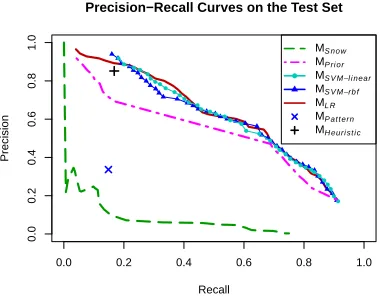
In this section, we compare our proposed methods with other methods. Table 5 lists the performance measured by precision at rank 1 and R-precision of some key methods. The precision-recall curves of all the methods are shown in Figure 2. Table 7 lists the maximum F-scores.
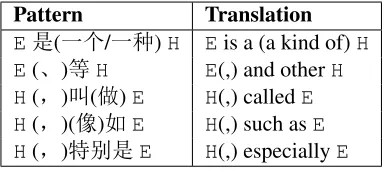
MP attern refers to the pattern-based method of Hearst (1992). We craft Chinese Hearst-style patterns (Table 6), in which Erepresents an entity andH represents one of its hypernyms. Following
Pattern Translation
E´(˜‡/˜«)H Eis a (a kind of)H
E(!) H E(,) and otherH
H(§) (‰)E H(,) calledE H(§)(”)XE H(,) such asE H(§)AO´E H(,) especiallyE
Table 6: Chinese Hearst-style lexical patterns
Evans (2004), we combine each pattern and each en-tity and submit them into the Baidu search engine. For example, for an entity E, we search “E ´˜
‡ (Eis a)”, “E (Eand other)”, and so on. We select top 100 search results of each query and get 1,285,209 results in all for the entities in the test set. Then we use the patterns to extract hypernyms from the search results. The result shows that 508 cor-rect hypernyms are extracted for 568 entities (1,529 entities in total). Only a small part of the entities can be extracted hypernyms for. This is mainly be-cause only a few hypernym relations are expressed in these fixed patterns in the web, and many ones are expressed in more flexible manners. The hypernyms are ranked based on the count of evidences where the hypernyms are extracted.
[image:7.612.331.524.224.309.2]0.0 0.2 0.4 0.6 0.8 1.0
0.0
0.2
0.4
0.6
0.8
1.0
Precision−Recall Curves on the Test Set
Recall
Precision
● ●
● ● ●
● ●●
● ●●
●●● ● ●
● ● ●●
● ● ●
● ●
● ●●
●● ●●
● ●
● ● ●
● ●
MS now
MP ri or
MS V M−l i near
MS V M−rb f
ML R
MP at t ern
[image:8.612.353.502.60.172.2]MH euri st i c
Figure 2: Precision-Recall curves on the test set
our corpus, there are 652,181 candidates for 1,529 entities (426.54 for each entity on average), most of which are not hypernyms. One possible reason is that this method relies on an accurate syntactic pars-er and it is difficult to guarantee the quality of the automatically extracted patterns. Even worse, the low quality of the language in the search results may make this problem more serious.
MP riorrefers to the ranking method based on on-ly the prior of a candidate being a hypernym. As Table 5 shows, it outperforms MSnow and achieves comparable results with MP attern on Precision@1 and R-Precision.
Based on the features proposed in Section 3.2.1, we train several statistical models based on SVM and LR on the training data. MSV M−linear and MSV M−rbfrefer to the SVM models based on linear kernels and RBF kernels respectively. MLR refers to the LR model. The probabilities6 output by the models are used to rank the candidate hypernyms. All of the parameters which need to be set in the models are selected on the development set. Table 5 shows the best models based on each algorithm. These supervised models outperform the previous methods. MLRachieves the best performance.
The precision-recall plot of the methods on the test set is presented in Figure 2. MHeuristic refers to the heuristic approach, proposed in Section 3.2.2, to collect training data. Because this method cannot
6
The output of an SVM is the distance from the decision hyper-plane. Sigmoid functions can be used to convert this un-calibrated distance into a un-calibrated posterior probability (Platt, 1999).
Method Max. F-score
MP attern 0.2061
MSnow 0.1514
MHeuristic 0.2803 MP rior 0.5591 MSV M−linear 0.5868 MSV M−rbf 0.6014
[image:8.612.74.264.63.211.2]MLR 0.5998
Table 7: Summary of maximum F-score on the test set
Feature P@1 R-Prec Max.
F-score
All 0.7632 0.6621 0.5998
−Prior 0.7534 0.6546 0.5837
−Is Tag 0.6965 0.6039 0.5605
−Is Head 0.7018 0.6036 0.5694
−In Titles 0.7436 0.6513 0.5868
−Synonyms 0.7495 0.6493 0.5831
−Radicals 0.7593 0.6584 0.5890
−Source Num 0.7364 0.6556 0.5984
−Lexicon 0.7377 0.6422 0.5851
−Source Info 0.6128 0.5221 0.5459
Table 8: Performance of LR models with different fea-tures on the test set
provide ranking information, it is not listed in Ta-ble 5. For fair comparison of R-precision and recall, we add the extra correct hypernyms from MP attern and MSnow to the test data set. The models based on SVM and LR still perform better than the other methods. MP attern and MSnow suffer from low re-call and precision. MHeuristic get a high precision but a low recall, because it can only deal with a part of entities appearing in encyclopedias. The preci-sion of MHeuristicreflects the quality of our training data. We summarize the maximum F-score of dif-ferent methods in Table 7.
5.2.2 Feature Effect
Entity Top-1
Hypernym Entity
Top-1 Hypernym
Þ”bÑ?(cefoperazone sodium) †¬(drug) ûy(bullet tuna) ~a(fish)
ÃÃò(finger citron rolls) ¯(snack) =œ(zirconite) ¶œ(ore)
EËöé†(The Avengers) >K(movie) ¤|Žd÷(Felixstowe) l•(port)
@U=(mastigium) ÄO(datum) Ä!Ï(coxal cavity) ‡Ô(plant)
¯UX Œ=£s
(Ethanolamine phosphotransferase)
)Ô (organism)
Þu
(coma)
[image:9.612.95.520.60.171.2]•£ (knowledge)
Table 10: Examples of entity-hypernym pairs extracted by MLR
Domain P@1 R-Prec Max.
F-score
Biology 0.8165 0.7203 0.6424
Health Care 0.7354 0.5962 0.6061
Food 0.7450 0.6634 0.6938
Movie 0.9310 0.8069 0.7031
Industry 0.6286 0.5841 0.4624
Others 0.6324 0.4936 0.4318
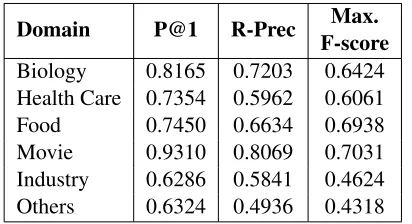
Table 9: Performance of MLRin various domains
Source Num. The performance is degraded sharply. This indicates the importance of the source informa-tion for hypernym ranking.
5.2.3 The Performance in Each Domain
In this section, we evaluate the performance of MLRmethod in various domains. We can see from Table 9 that the performance in movie domain is best while the performance in industry domain is worst. That is because the information about movies is abundant on the web. Furthermore, most of movies have encyclopedia pages. It is easy to get the hy-pernyms. In contrast, the entities in industry domain are more uncommon. On the whole, our method is robust for different domains. In Table 10, some in-stances in various domains are presented.
5.3 Error Analysis
The uncovered entities7 and the false positives8are
analyzed after the experiments. Some error exam-ples are shown in Table 10 (in red font).
7Uncovered entities are entities which we do not collect any
correct hypernyms for in the first step.
8False positives are hypernyms ranked at the first places, but
actually are not correct hypernyms.
Uncovered entities:About 34% of the errors are
caused by uncovered entities. It is found that many of the uncovered entities are rare entities. Nearly 36% of them are very rare and have only less than 100 search results in all. When we can’t get enough information of an unknown entity from the search engine, it’s difficult to know its semantic meaning, such as “@U=(mastigium)”, “Ä!Ï(coxal cav-ity)”, “Þu(coma)”. The identification of their hy-pernyms requires more human-crafted knowledge. The ranking models we used are unable to select them, as the true synonyms are often below rank 10.
False positives: The remained 66% errors are
false positives. They are mainly owing to the fact that some other related words in the candi-date lists are more likely hypernyms. For exam-ple, “)Ô (organism)” is wrongly recognized as the most probable hypernym of “¯UX Œ=
£s(Ethanolamine phosphotransferase)”, because the entity often co-occurs with word “)Ô (organ-ism)” and the latter is often used as a hypernym of some other entities. The correct hypernyms actu-ally are “s(enzyme)”, “zÆÔŸ(chemical sub-stance)”, and so on.
6 Conclusion
[image:9.612.84.290.214.326.2]preci-sion of 76.32% on a manually labeled test dataset. All of the features which we propose are effective, especially the features of source information. Morover, our method works well in various domains, e-specially in the movie and biology domains. We al-so conduct detailed analysis to give more insights on the error distribution. Except some language de-pendent features, our approach can be easily trans-fered from Chinese to other languages. For future work, we would like to explore knowledge from more sources to enhance our model, such as seman-tic thesauri and infoboxes in encyclopedias.
Acknowledgments
This work was supported by National Natu-ral Science Foundation of China (NSFC) via grant 61133012, 61073126 and the National 863 Leading Technology Research Project via grant 2012AA011102. Special thanks to Zhenghua Li, Wanxiang Che, Wei Song, Yanyan Zhao, Yuhang Guo and the anonymous reviewers for insightful comments and suggestions. Thanks are also due to our annotators Ni Han and Zhenghua Li.
References
Sharon A. Caraballo. 1999. Automatic construction of a hypernym-labeled noun hierarchy from text. In Pro-ceedings of the 37th Annual Meeting of the Associ-ation for ComputAssoci-ational Linguistics, pages 120–126, College Park, Maryland, USA, June.
Wanxiang Che, Zhenghua Li, and Ting Liu. 2010. Ltp: A chinese language technology platform. In Coling 2010: Demonstrations, pages 13–16, Beijing, China, August.
Massimiliano Ciaramita and Mark Johnson. 2003. Su-persense tagging of unknown nouns in wordnet. In
Proceedings of the 2003 conference on Empirical methods in natural language processing, pages 168– 175.
Oren Etzioni, Michael Cafarella, Doug Downey, Ana-Maria Popescu, Tal Shaked, Stephen Soderland, Daniel S Weld, and Alexander Yates. 2005. Unsuper-vised named-entity extraction from the web: An exper-imental study.Artificial Intelligence, 165(1):91–134. Oren Etzioni, Michele Banko, and Michael J Cafarella.
2006. Machine reading. In AAAI, volume 6, pages 1517–1519.
Richard Evans. 2004. A framework for named enti-ty recognition in the open domain. Recent Advances
in Natural Language Processing III: Selected Papers from RANLP 2003, 260:267–274.
Marti A Hearst. 1992. Automatic acquisition of hy-ponyms from large text corpora. InProceedings of the 14th conference on Computational linguistics-Volume 2, pages 539–545.
Johannes Hoffart, Fabian M Suchanek, Klaus Berberich, and Gerhard Weikum. 2012. Yago2: a spatially and temporally enhanced knowledge base from wikipedia.
Artificial Intelligence, pages 1–63.
Thomas Lin, Mausam, and Oren Etzioni. 2012. No noun phrase left behind: Detecting and typing unlinkable entities. InProceedings of the 2012 Joint Conference on Empirical Methods in Natural Language Process-ing and Computational Natural Language LearnProcess-ing, pages 893–903, Jeju Island, Korea, July.
Paul McNamee, Rion Snow, Patrick Schone, and James Mayfield. 2008. Learning named entity hyponyms for question answering. In Proceedings of the Third International Joint Conference on Natural Language Processing, pages 799–804.
Marius Pasca. 2004. Acquisition of categorized named entities for web search. In Proceedings of the thir-teenth ACM international conference on Information and knowledge management, pages 137–145.
John Platt. 1999. Probabilistic outputs for support vec-tor machines and comparisons to regularized likeli-hood methods. Advances in large margin classifiers, 10(3):61–74.
Alan Ritter, Stephen Soderland, and Oren Etzioni. 2009. What is this, anyway: Automatic hypernym discovery. In Proceedings of the 2009 AAAI Spring Symposium on Learning by Reading and Learning to Read, pages 88–93.
Cederberg Scott and Widdows Dominic. 2003. Using lsa and noun coordination information to improve the pre-cision and recall of automatic hyponymy extraction. In
Proceedings of the seventh conference on Natural lan-guage learning at HLT-NAACL 2003-Volume 4, pages 111–118.
Sidney Siegel and N John Castellan Jr. 1988. Nonpara-metric statistics for the behavioral sciences. McGraw-Hill, New York.
Rion Snow, Daniel Jurafsky, and Andrew Y. Ng. 2005. Learning syntactic patterns for automatic hypernym discovery. In Lawrence K. Saul, Yair Weiss, and L´eon Bottou, editors,Advances in Neural Information Pro-cessing Systems 17, pages 1297–1304.
Peter Turney, Michael L Littman, Jeffrey Bigham, and Victor Shnayder. 2003. Combining independent mod-ules to solve multiple-choice synonym and analogy problems. In Proceedings of the International Con-ference RANLP-2003, pages 482–489.