Corrective Controllers with Switching Capability
for Modeling Matching of Input
/
State
Asynchronous Machines
Jung–Min Yang
Abstract—A control methodology for asynchronous sequen-tial machines is addressed in this paper. The considered machine consists of a number of input/state asynchronous machines, termed submachines, between which asynchronous switching is conducted by the switching signal. The control objective is to design a corrective controller so that the stable-state behavior of the closed-loop system can mimic a reference model. In response to the external input and state feedback, the corrective controller generates a sequence of appropriate switching signals that change the mode of the asynchronous machine to show the desirable input/state specifications. An illustrative example is provided for demonstrating the proposed corrective control scheme.
I. Introduction
Owing to the lack of a synchronizing clock, asynchronous sequential machines are regarded more difficult to design than synchronous machines. Once implemented, on the other hand, asynchronous sequential machines exhibit significant advantages over synchronous machines such as fast transition speed, low power consumption, etc. For this reason, asyn-chronous sequential machines are widely used in high speed computing and parallel computing mainly having the form of digital systems, in modeling molecular biology, and in many other engineering applications [1]–[3].
In this paper, we present a control theoretic approach to asynchronous sequential machines—corrective control the-oryas it is often called [4]–[6]. If the behavior of an existent asynchronous machine is undesirable or the machine is sub-ject to negative effects of adversarial entities or disturbances, we usually re-design the inner logic of the faulty machine. In corrective control, however, the considered machine is always intact; instead, we design a corrective controller and place it in front of the controlled machine. Receiving the external input and state or output feedback from the machine, the corrective controller provides a sequence of control inputs so that the closed-loop system can show the agreeable behavior. Corrective control is unique in that all the interactions between the controller and the machine are executed in an asynchronous mechanism. Thus the operation of the closed-loop system is interpreted in terms of the stable-state behavior. This scheme allows the asynchronous
This work was supported in part by Basic Science Research Program through the National Research Foundation of Korea (NRF) funded by the Ministry of Education (No. NRF-2010-0007271), and in part by the National Research Foundation of Korea (NRF) grant funded by the Korea government (MSIP) (No. NRF-2012R1A2A2A01003419).
J.–M. Yang is with the School of Electronics Engineering, Kyung-pook National University, Daegu, 702-701, Republic of Korea. E-mail: [email protected].
machine to show the transition features that are not inherently specified in the machine.
The main consideration of this paper is to present the model matching problem of the switched asynchronous se-quential machines. The switched asynchronous sese-quential machine consists of multiple asynchronous machines, termed submachines or modes. The present mode of the machine is changed in response to the switching signal. The switched machine is equivalent to one of its submachines at a specific time and by change of the switching signal, it transfers to another submachine. Since each submachine is supposed to have the same input and state set in this study, the mode switching between any pair of submachines is made possible. Recently, switched systems are gaining a prominent po-sition in control theory, as many engineering systems can operate with different models according to the environment changes or by virtue of hardware redundancy. Researches on switched systems for the past decades mainly focused on continuous/discrete time systems [7], [8]. In contrast, the topic of switched event-driven systems, which the present study may belong to, has been attracting little interest. Among few results, switched Boolean control networks (BCN), a specific type of switched event-driven systems, haven been studied by several research groups to describe the model of gene regulatory networks in cells [9], [10].
The corrective controller studied in this paper generates the switching signal as its output value. This control structure differs from the prior works since the previous corrective controllers generate a sequence of input characters as its output. Our control goal is to derive the existence condition and design procedure for a corrective controller so that the closed-loop system follows the behavior of a reference model. This problem, called model matching, has been extensively studied in both continuous time domain and event driven systems [11]–[13]. A novel scheme of interweaving the switching and state feedback operations is addressed in this paper, and a simple example is provided to demonstrate the applicability of the proposed scheme.
with model uncertainties, and corrective control with descrip-tion of semi-tensor product (STP) [30].
II. Preliminaries
A. Switched Asynchronous Sequential Machines
A switched asynchronous sequential machine withm sub-machines is represented as
Σσ:“ pA,X,x0,fσq. (1)
σ P M is the switching signal generated by the controller where M :“ t1, . . . ,mu. Σi, i P M, is the ith submachine
modeled as an input/state asynchronous machine in which the current state is given as the output. A and X are the input and state set, respectively, x0 P X is the initial state,
and
fi:XˆAÑX
is the state transition function partially defined on X ˆA. Note that all msubmachines have the same input and state set; only their state transition characteristics are different with each other.
Σi complies with the feature of asynchronous machines.
A valid state and input pair px,vq P XˆA is said to be a stable combination and x a stable state if fipx,vq “ x.
Since no global clock exists that synchronizes the change of all the variables, Σi lingers at px,vq infinitely as long as
the external input remains fixed. Else if fipx,vq,x,px,vqis
called a transient combination and xa transient state.Σifalls
into a transition combination from a stable combination by a change of the input, for example, fromv1tovwherepx,v1qis a stable combination. Due to the absence of a synchronizing clock, a transient combination causes Σi to pass through a
chain of transient combinations, e.g.,
fipx,vq “x1,
fipx1,vq “x2,
...
Note that the input value v remains unchanged throughout the transitions. This chain of transitions may or may not terminate. It it does not terminate, px,vq,px1,vq, . . . are part
of an infinite cycle. In this study, we restrict our attention to asynchronous machines that have no infinite cycles. Thus
Σireaches another stable combinationpx1,vqas the result of
the transitions. x1 is termed the next stable state ofpx,vq. A significant feature of asynchronous sequential machines is that the speed of transient transitions is very fast. This means the duration thatΣi stays at transient states is almost
zero time and imperceptible by outer users. Thus it is convenient to depict the transitions of Σi only in terms
of stable states. For this purpose, we introduce the stable
recursion function si:XˆAÑX [15] as
sipx,vq:“x1
wherex1 is the next stable state ofpx,vq. Ifpx,vqis a stable combination, spx,vq “x. The domain of si can be extended
from input characters to strings recursively. For x PX and
v1v2¨ ¨ ¨vkPA`, whereA`is the set of all non-empty strings
of characters of An, we define
sipx,v1v2¨ ¨ ¨vkq:“spspx,v1q,v2¨ ¨ ¨vkq.
Definition 1. Let Σi be a submachine of the switched
asynchronous machine (1). A chain of transient transitions from one stable state to another is termed a stable transition
in Σi, e.g., from x to x1 in response to v characterized by
sipx,vq “x1. If there exists an input string tPA` such that
x1 “s
ipx,tq, x1 is said to be stably reachable from x in Σi
[15].
B. Closed-Loop System
C
D
1
Σ
m
Σ
P
v
x
ı
x
i
Σ′
v
x
c
[image:2.595.309.543.172.377.2]Σ
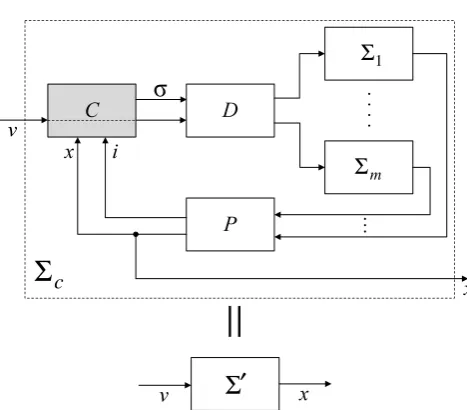
Fig. 1. Corrective control systemΣcfor model matching withΣ1.
Fig. 1 shows the proposed architecture of the corrective control system for the switched asynchronous machine (1).C
is the corrective controller having the form of an input/output asynchronous machine, that is, its output is different from the current state. v P A is the external input, and σ P M
is the switching signal generated byC. D and P represent
the demultiplexer and multiplexer, respectively. D receives
the external input vand provides it to the input channel of submachine Σσ that is determined by the switching signal σ. Among m state feedbacks from Σ1, . . . ,Σm, P selects x,
namely the state feedback of the active submachine. x is delivered to C along with i P M, the index of the active submachine.
Referring to Fig. 1,Cis described as the following finite-state machine.
C:“ pMˆXˆA,M,Ξ, ξ0, ϕ, ηq (2)
where Ξ is the state set, ξ0 P Ξ is the initial state, and ϕ
andη are the state transition function and output function, respectively, having the mapping
ϕ:ΞˆMˆXˆAÑΞ η:ΞÑM.
The control objective is to present the existence condi-tion and design algorithm for C for which the stable-state behavior of the closed-loop system Σc can match that of a
reference model Σ1 defined as
Σ1:“ pA,X,x
0,s1q.
Model matching betweenΣcandΣ1is regarded accomplished
if their stable-state behaviors are equivalent with other other, that is, for a valid state and input pair, they reach the same next stable state. Hence only the stable recursion function s1 of Σ1 is given without loss of generality.
To prevent asynchronous sequential machines from doing unpredictable behaviors, one must design the machines so as to preserve the principle of the fundamental mode oper-ation [31], namely to prohibit changes to the input while a machine is in transition. Assume on the contrary that the external input changes its value while the asynchronous machine undergoes transient transitions. Due to the lack of a synchronizing clock, it is indeterminate which transient state the machine has at the moment of the input change. Thus the next transition would be uncertain, impeding the deterministic operation. Based on the former studies on the system configuration [18], [29], we derive the following conditions for the closed-loop systemΣcof Fig. 1 to preserve
the principle of the fundamental mode operation.
Condition 1. The closed-loop system Σc of Fig. 1 operates
in fundamental mode when all the following conditions are valid:
(i) Among C and Σ1, . . . ,Σm, whenever one machine goes
on transient transitions, the other machines are at stable combinations.
(ii) The inputsσand v to the demultiplexer D must change
their values only one at a time.
(iii) The outputs i and x of the multiplexer P must change their values only one at a time.
These conditions must be implemented during the design of the closed-loop system Σc. The reason for ensuring part
(ii) is obvious. If the inputsσandvchange simultaneously, the next operation ofDwould be ambiguous, i.e., whetherD
must change the mode of the switched asynchronous machine toΣσ or it must change the current input value tov. Part (ii) can be satisfied by setting the operation sequence of C in the following way: Whenever the switching signal σ must be activated in response to the change of v, C provides σ before transmitting the changed v. This is possible because
valways passes throughCas shown in Fig. 1. Furthermore, to guarantee part (iii), every switching operation must be conducted in such a way that the present mode and state are not changed simultaneously.
III. ModelMatching
A. Controller Existence
Let us first review the prior results (e.g., [15], [28]) on the model matching problem of a single asynchronous machine
Σ1 “ pA,X,x0,f1q, or m“1 in terms of (1). Let s1 be the
stable recursion function of Σ1. Assume that for a valid pair
px,vq P XˆA of the modelΣ1 “ pA,X,x
0,s1q, s1px,vq “x1
whereas s1px,vq,x1. Since the stable-state behaviors ofΣ1
andΣ1mismatch each other atpx,vq, the correction procedure
must be activated whenΣ1has the pairpx,vq. The necessary
and sufficient condition for the existence of a corrective controller is that the goal state x1 is stably reachable from
x, namely there exists an input string t P A` such that
s1px,tq “x1(refer to Definition 1).tis used by the corrective
controller as the control input sequence. Upon receiving the external inputvwhileΣ1staying atx, the controller provides
asynchronously the sequence of input characters of t while suppressingv. As a result,Σ1 will undergo a chain of stable
transitions from x to x1. Since the transient transitions of
Σ1 and the generation of control inputs by the corrective
controller are conducted in an asynchronous manner, the closed-loop system will seem to transfer from x directly to x1 in response to v, thus accomplishing the matching performance.
As mentioned before, the proposed corrective controller
C in Fig. 1 is endowed with only switching capability. Hence the foregoing control scheme applied to a single asynchronous machine cannot be used in our study. Instead,
Cmust provide the switching signal that changes the present mode to a submachine having the same reachability as
Σ1. To describe this in formal terms, we first define sets
A1pxq,A
ipxq ĎAfor xPX as
A1pxq:“ tvPA|s1px,vqis definedu,
Aipxq:“ tvPA|sipx,vqis definedu.
A1pxqand A
ipxqare the set of input characters that make a
valid pair with the statexin the modelΣ1and submachineΣ
i,
respectively. Further, we define subsets of A1pxq and A
ipxq
as follows.
U1pxq:“ tvPA1pxq|s1px,vq “xu,
Uipxq:“ tvPAipxq|sipx,vq “xu,
T1pxq:“ tvPA1pxq|s1px,vq,xu, (3)
Tipxq:“ tvPAipxq|sipx,vq,xu.
U1pxq and U
ipxq denote the set of input characters that
make a stable combination withxinΣ1 andΣ
i, respectively.
Similarly,T1pxqandT
ipxqdenote the set of input characters
that make a transient combination with x in Σ1 and Σ
i.
Clearly, for allxPX and alliPM,
U1pxq XT1pxq “ H,
Uipxq XTipxq “ H,
U1pxq YT1pxq “A1pxq,
Uipxq YTipxq “Aipxq.
Since all the asynchronous sequential machines are sup-posed to have no infinite cycles in any case, we have the following.
Condition 2. For every state xP X of Σi, Uipxq,H, i“
1, . . . ,m. For every state xPX ofΣ1, U1pxq,H.
To materialize model matching with Σ1, at least one submachine must have the same transition characteristics as
Σ1 for each transient combination px,vq P X ˆT1pxq. The latter condition is written as
@xPX and@vPT1pxq,
While (4) is the necessary condition for materializing model matching between (1) and Σ1, it is not sufficient. For example, suppose v1 P T1pxq and sipx,v1q “ s1px,v1q
for some i P M. Assume that model matching has been well implemented thus so far and that the present mode of the switched asynchronous machine (1) is Σk while Σk
stays at a stable combination px,aq P XˆUkpxq. Assume
further that the external input changes to v1. If skpx,v1q “
s1px,v
1q, model matching is automatically satisfied, so no
subsequent control action is required. On the other hand, if
skpx,v1q , s1px,v1q, the next state transition would violate
the input/state specification of the model Σ1 unless any control action is enforced before the stable transition. Since
sipx,v1q “ s1px,v1q by assumption, it seems that model
matching can be maintained if the controller C generates the switching signal σ“iat the moment the external input
v1 is transmitted toC.
However, an attention has to be paid to the switching operation between two submachines, since the property that an asynchronous machine cannot stay at a transient state imposes a restraint on the switching operation. Suppose that in response to the switching signal σ “ i, the switched asynchronous machine changes its mode to Σi. Since the
demultiplexer D in Fig. 1 preserves the principle of the fundamental mode operation, its inputs σ and v cannot change simultaneously. Hence, whenσswitches toi,vdoes not change its value yet, which means that the value of the input channel provided by D is still a at the moment the present mode becomes submachine Σi. If a P Uipxq,
the switched machine maintains the present state at xafter completion of switching to Σi. If a < Uipxq, on the other
hand, Σi cannot stay at x with the external input a but
initiate the chain of transient transitions from px,aq. Even though the external input v1 may be transmitted to Σi right
after the switching operation, the intended stable transition
sipx,v1q “ s1px,v1qcould not be manifested since Σi is not
at the state xany more.
We ensure that to elude this problem, a must belong to
Uipxq, namely a must make a stable combination with xin
submachine Σi. In fact, a can be any input character that
makes a stable combination with xin the modelΣ1, that is,
aPU1pxq, because model matching is supposed to have been well accomplished until now. Thus we must guarantee that not only abut all the characters in U1pxqmust be elements ofUipxqfor certifying a consistent switching operation at the
state xwith respect to the input characterv1. The foregoing
condition is described as
U1pxq ĎUipxq. (5)
The above condition is still insufficient to solve model matching at x, since it only elucidates the requirement for dealing with the input character v1. When the switched
asynchronous machine stays at the stable state x, the next input character can be any element of T1pxq. For such a character, condition (5) must be always valid. Considering (4) and (5) together, we have the following conclusion.
‚ For everyviPT1pxq, there must exist a submachineΣi
for which (4) is valid, i.e., sipx,viq “s1px,viq.
‚ For every submachineΣi that is selected for the stable
transition frompx,viq, (5) must be satisfied.
More than one submachine may emulate a stable transition of the modelΣ1. In that case, (5) serves as the criterion for choosing a pertinent submachine. For instance, assume that
sipx,v1q “ sjpx,v1q “ s1px,v1q for some i,j P M. Assume
further that U1pxq Ď U
ipxq but U1pxq * Ujpxq. Definitely,
submachineΣi must be selected in the correction procedure
forpx,v1q.
Our discussion thus so far is summarized in the following theorem.
Theorem 1. Given the switched asynchronous sequential
machine (1), letΣ1“ pA,X,x0,s1qbe the reference model and
let T1pxq, U1pxq, and Uipxq, i“1, . . . ,m, be the subsets of A
as defined in (3). In view of Fig. 1, there exists a corrective
controller C that solves model matching betweenΣc and Σ1
if and only if for each xPX,
@vPT1pxq, DiPM s.t.
s1px,vq “sipx,vq and U1pxq ĎUipxq. (6)
B. Controller Design
Reminding that the form of the corrective controller is as described in (2), we designCpzq “ pMˆXˆA,M,Ξ, ξ0, ϕ, ηq,
namely a corrective controller module that solves the model matching problem for the statezPX. OnceCpzqis designed for every valid pair pz,vq of Σ1, the overall controller C is obtained by assembling allCpzq’s:
C:“ _zPXCpzq
where ‘_’ is thejoinoperation that combines two corrective controller modules [18], [28].
Suppose that the switched asynchronous machine (1) sat-isfies all the conditions (6) described in Theorem 1 are valid with respect to the modelΣ1. Assume that model matching between Σc and Σ1 has been well accomplished, and that
Cpzqstays at the initial stateξ0. Assume further thatΣc and
Σ1 reach a stable combination with the state z. Cpzq then transfers to ξz P Ξ, namely the transition state that deals
with all the transitions starting from z. To this end, we set the recursion functionϕ as
ϕpξ0,i,z,vq “ξz, vPUipzq,
ϕpξz,i,z,vq “ξz, vPUipzq (7)
whereiPMdenotes the present mode of the switched asyn-chronous machine (1). Since no actual control is executed in either ξ0 or ξz, Cpzq maintains the present mode of the
switched machine, so the output functionη is defined as
ηpξ0q “i,
ηpξzq “i. (8)
Assume now that the external input changes to another value v1 P T1pzq when Cpzq is at ξ
z. Two cases arise with
respect to the changed input character.
(i) First, ifs1pz,v1q “s
ipz,v1q wheresi is the stable
recur-sion function of the present submachineΣi, no control
activity is necessary becauseΣi has the same transition
to the initial stateξ0. The latter behavior is implemented
by the following.
ϕpξz,i,z,v1q “ξz,
ϕpξz,i,z1,v1q “ξ0. (9)
(ii) Secondly, assume s1pz,v1q, sipz,v1q. Model mismatch
would occur unless corrective control is enforced. By assumption, a submachineΣjexists that satisfies
condi-tion (6) for the state/input pairpz,v1q, that is,s1pz,v1q “
sjpz,v1q and U1pzq Ď Ujpzq. Hence, upon receiving
the changed input character v1, Cpzq transfers to the auxiliary state ξpz,v1q P Ξ and provides the switching
signal σ “ j as the control input. In response to σ“ j, the switched asynchronous machine (1) changes its mode to Σj and receives the inputv1, which moves
Σj to the desirable state z1 :“ s1pz,v1q “ sjpz,v1q. The
foregoing correction procedure is implemented by the following assignment ofϕ andη.
ϕpξz,i,z,v1q “ξpz,v1q,
ϕpξpz,v1q,i,z,v1q “ξpz,v1q,
ηpξpz,v1qq “ j, (10)
ϕpξpz,v1q,j,z1,v1q “ξ0.
(7)–(10) serve as the design algorithm of the corrective controllerCpzqthat solves the model matching problem for valid pairstzu ˆA1pzqofΣ1.
‚ At first glimpse, (9) and (10) seem contradictory with each other. However, Cpzq will utilize only of them, depending on the feature of submachine Σi. As
men-tioned already, if s1pz,v1q “ s
ipz,v1q,Cpzqemploys the
procedure (9); else if s1pz,v1q,s
ipz,v1q, it must launch
the switching operation according to (10).
‚ Cpzqrequires the statesξ0, ξz, ξpz,v1qto realize the above
procedure. Generalizing this procedure to all the input characters ofT1pzqthat invoke transient transitions with
z, we have the state set ofCpzq:
Ξ“ tξ0, ξzu Y tξpz,v1q|v1PT1pzqu.
IV. Example
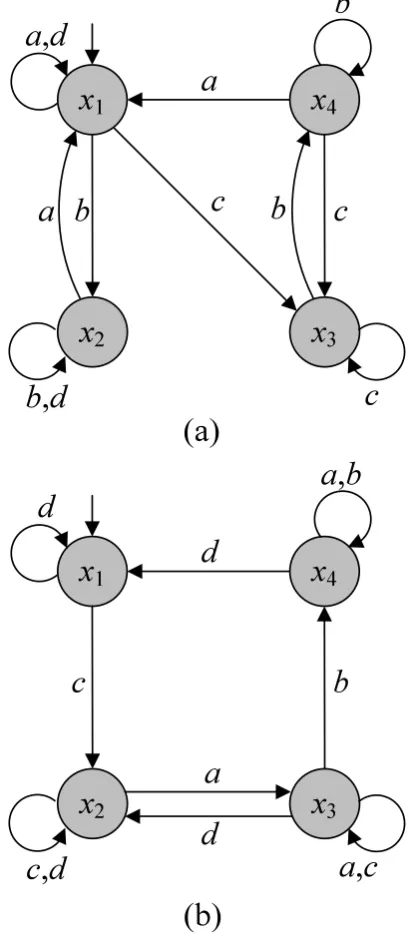
Consider a switched asynchronous machine with two submachines Σ1 and Σ2 shown in Fig. 2, i.e., m “ 2 and
M“ t1,2u. The input and state set of the machine are
X“ tx1,x2,x3,x4u,
x0:“x1,
A“ ta,b,c,du.
For the sake of simplicity, we set
fipx,vq “sipx,vq, @px,uq PXˆA, i“1,2.
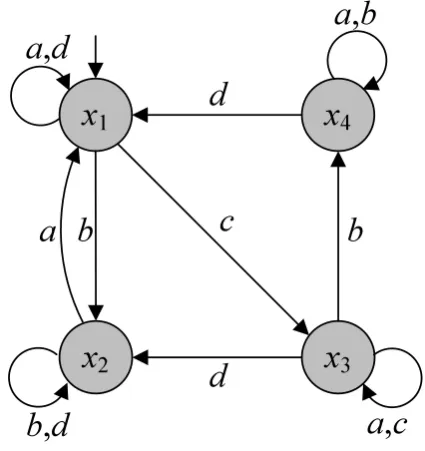
The objective is to determine whether a corrective con-trollerCexists such that the closed-loop systemΣccan match
the behavior of the reference modelΣ1 “ pA,X,x
0,s1qwhose
state flow diagram is illustrated in Fig. 3. Applying Theorem 1, let us check whether condition (6) is satisfied for each state of X.U1pxq’s andT1pxq’s are derived from Fig. 3:
U1px1q “ ta,du, T1px1q “ tb,cu,
U1px
2q “ tb,du, T1px2q “ tau,
U1px
3q “ ta,cu, T1px3q “ tb,du,
U1px
4q “ ta,bu, T1px4q “ tdu.
x
2
x
3
x
1
a
,
d
c
b
,
d
x
4
b
a
b
c
a
c
x
2
x
3
x
1
d
a
,
c
d
c
,
d
x
4
a
,
b
d
c
b
a
(a)
[image:5.595.323.528.59.528.2](b)
b
Fig. 2. Switched asynchronous machine withm“2: (a)Σ1 and (b)Σ2.
Consider x1 in the first. A comparison between Fig. 2
and Fig. 3 shows that x1 of submachine Σ1 has the same
characteristics of transient transitions asx1of the modelΣ1.
Formally, we have
s1px1,bq “s1px1,bq “x2,
s1px1,cq “s1px1,cq “x3.
Also, we have
U1px1q “ ta,du “U1px1q.
Hence x1 of Σ1 satisfies condition (6) for all the input
characters of T1px
1q. In a similar manner to the case of
x1, we can prove that x2 of Σ1, x3 and x4 of Σ2 emulate
the corresponding states of the model Σ1. By Theorem 1, the corrective controllerCexists that makes the closed-loop systemΣcstably equivalent to the modelΣ1. The construction
x
2
x
3
x
1
a
,
d
a
,
c
d
b
,
d
x
4
a
,
b
d
b
b
[image:6.595.61.274.54.280.2]a
c
Fig. 3. Reference modelΣ1.
V. Conclusion
A corrective control scheme has been presented to solve the model matching problem for switched asynchronous sequential machines. The proposed controller generates the switching signal that changes the mode of the considered switched machine. According to the incoming input value and the present state, the controller determines the next submachine so that the input/state behavior of the switched asynchronous machine can match that of a reference model. The necessary and sufficient condition for the existence of an appropriate controller has been addressed and the design algorithm for the controller has been outlined. Although the present study focuses on the corrective controller having only switching capability, it can be extended to the controllers that can provide not only the switching signal but also the control input character. The latter topic will be studied as a future research.
References
[1] J. Hammer, “On the modeling and control of biological signal chains,” Proc. 34th IEEE Int. Conf. Decision and Control, New Orleans, USA, pp. 3747–3752, 1995.
[2] J. Sparsø and S. Furber,Principles of Asynchronous Circuit Design — A Systems Perspective, Kluwer Academic Publishers, 2001.
[3] A. J. Martin and M. Nystr¨om, Asynchronous techniques for system-on-chip design,Proc. IEEE, vol. 94, no. 6, pp. 1089–1120, 2006. [4] J. Hammer, “On the corrective control of sequential machines,”Int. J.
Control, vol. 65, no. 2, pp. 249–276, 1996.
[5] J.–M. Yang, “Corrective control of asynchronous sequential machines in the presence of adversarial input,”IET Control Theory Appl., vol. 2, no. 8, pp. 706–716, 2008.
[6] J.–M. Yang, “Corrective control of input/output asynchronous sequential machines with adversarial inputs,”IEEE Trans. Autom. Control, vol. 55, no. 3, pp. 755–761, 2010.
[7] Z. Sun and S. S. Ge, “Analysis and synthesis of switched linear control systems,”Automatica, vol. 41, no. 2, pp. 181–195, 2005.
[8] H. Lin and P. J. Antsaklis, “Stability and stabilizability of switched linear systems: a survey of recent results,”IEEE Trans. Autom. Control, vol. 54, no. 2, pp. 308–322, 2009.
[9] L. Zhang J. Feng, and J. Yao, “Controllability and observability of switched Boolean control networks,”IET Control Theory Appl., vol. 6, no. 16, pp. 2477–2484, 2012.
[10] H. Li, Y. Wang, and Z. Liu, “Stability analysis for switched boolean networks under arbitrary switching signals,”IEEE Trans. Autom. Con-trol, vol. 59, no. 7, pp. 1978–1982, 2014.
[11] W. A. Wolovich, P. Antsaklis, and H. Elliott, “On the stability of solutions to minimal and nonminimal design problems,”IEEE Trans. Autom. Control, vol. 22, no. 1, pp. 88–94, 1977.
[12] M. D. Di Benedetto and J. Grizzle, “Asymptotic model matching for nonlinear systems,” IEEE Trans. Autom. Control, vol. 39, no. 8, pp. 1539–1550, 1994.
[13] M. D. Di Benedetto, A. Sangiovanni-Vincentelli, and T. Villa, “Model matching for finite-state machines,” IEEE Trans. Autom. Control, vol. 46, no. 11, pp. 1726–1743, 2001.
[14] T. E. Murphy, X. Geng, and J. Hammer, “Controlling races in asyn-chronous sequential machines,” inProc. 15th IFAC World Congress, Barcelona, Spain, 2002.
[15] T. E. Murphy, X. Geng, and J. Hammer, “On the control of asyn-chronous machines with races,”IEEE Trans. Autom. Control, vol. 48, no. 6, pp. 1073–1081, 2003.
[16] J. Peng and J. Hammer, “Input/output control of asynchronous sequen-tial machines with races,”Int. J. Control, vol. 83, no. 1, pp. 125–144, 2010.
[17] J. Peng and J. Hammer, “Bursts and output feedback control of non-deterministic asynchronous sequential machines,”Euro. J. Control, vol. 18, no. 3, pp. 286–300, 2012.
[18] J.–M. Yang and J. Hammer, “State feedback control of asynchronous sequential machines with adversarial inputs,”Int. J. Control, vol. 81, no. 12, pp. 1910–1929, 2008.
[19] J.–M. Yang and J. Hammer, “Asynchronous sequential machines with adversarial intervention: the use of bursts,”Int. J. Control, vol. 83, no. 5, pp. 956–969, 2010.
[20] J.–M. Yang and S. W. Kwak, “Realizing fault-tolerant asynchronous sequential machines using corrective control,”IEEE Trans. Control Syst. Technol., vol. 18, no. 6, pp. 1457–1463, 2010.
[21] J.–M. Yang and S. W. Kwak, “Model matching for asynchronous sequential machines with adversarial inputs using state bursts,”Int. J. Control, Autom., Syst., vol. 8, no. 5, pp. 985–993, 2010.
[22] J.–M. Yang, “Fault tolerance in asynchronous sequential machines using output feedback control,”IEEE Trans. Autom. Control, vol. 57, no. 6, pp. 1604–1609, 2012.
[23] J.–M. Yang and S. W. Kwak, “Fault diagnosis and fault-tolerant control of input/output asynchronous sequential machines,”IET Control Theory Appl., vol. 6, no. 11, pp. 1682–1689, 2012.
[24] J.–M. Yang and S. W. Kwak, “Output feedback control of asyn-chronous sequential machines with disturbance inputs,” Inf. Sci., vol. 259, pp. 87–99, 2014.
[25] J.–M. Yang, “Fault-tolerant control of a class of asynchronous se-quential machines with permanent faults,”Automatica, vol. 50, no. 3, pp. 989–993, 2014.
[26] J.–M. Yang and S. W. Kwak, “Tolerating intermittent faults in in-put/state asynchronous sequential machines with a bounded delay,”2014 European Control Conference (ECC’14), Strasbourg, France, pp. 1789– 1794, 2014.
[27] X. Geng and J. Hammer, “Input/output control of asynchronous sequential machines,” IEEE Trans. Autom. Control, vol. 50, no. 12, pp. 1956–1970, 2005.
[28] N. Venkatraman and J. Hammer, “On the control of asynchronous sequential machines with infinite cycles,”Int. J. Control, vol. 79, no. 7, pp. 764–785, 2006.
[29] J.–M. Yang, T. Xing, and J. Hammer, “Adaptive control of asyn-chronous sequential machines with state feedback,”Euro. J. Control, vol. 18, no. 6, pp. 503–527, 2012.
[30] X. Xu and Y. Hong, “Matrix approach to model matching of asyn-chronous sequential machines,”IEEE Trans. Autom. Control, vol. 58, no. 11, pp. 2974–2979, 2013.