Composing Instrument Control Dynamics
Dylan Menzies
Zenprobe Technologies
dylan zenprobe com
www.zenprobe.com/os
The expression gestural mapping is well imbedded in the language of instrument designers,
describing the function from interface control parameters to synthesis control parameters. This
function is in most cases implicitly assumed to be instantaneous, so that at any time its output
depends only on its input at that time. Here more general functions are considered, in which the
output depends on the history of input, especially functions that behave like physical dynamic
systems, such as a damped resonator. Acoustic instruments are rich in dynamical behaviour.
Introducing dynamics at the control stage of an electronic instrument can help compensate for lack
of dynamics in later non-physical synthesis stages. A broadening of the function space offers new
aesthetic possibilities for composing instruments. Examples are presented to illustrate the new
design/composition mode as well as practical techniques. In this context, it is suggested that the
word mapping be updated with the more descriptive expression dynamic control processing.
1 Introduction
Two technology classes have dominated electronic musical instrument design, interface and
synthesis. Increasingly attention has been focused on the bridge between these. Gestural Mapping
synthesis parameters. The main focus of research has been on identifying suitable matches between
interface control parameters and synthesis parameters. Beyond this, cross coupling or mixing of
interface parameters has been explored as a way to complicate and enrich the control process by
several authors (Garnett and Goudeseune, 1999; Hunt, Wanderley and Kirk, 2000; Menzies 1995a;
Menzies 1999). See Fig 1.
Figure 1
It seems that the adoption of the word mapping has perpetuated a vague and overly
simplistic view of instrument design. The main deficiency is that mapping strongly suggests an
instantaneous function. The output depends on the input at that time. A process in which the output
depends on the history of the input parameters can instead be termed a dynamical process
1. The
generalized mapping can now be referred to more precisely as dynamic control processing.
Note that we shall not use the usual musical meaning of dynamic, meaning volume or
energy, although there is a connection in that the volume of an acoustic instrument is often very
clearly a dynamical variable. The original mathematical use of term dynamics was to describe the
motion of a physical system acting under Newton's Laws. To distinguish dynamics 'similar' to this
from dynamics in general we shall call it physical dynamics.
A secondary problem is that mapping excludes random variables, which by definition are
not interface parameters. A process taking on random variables can be called a stochastic process.
So the most general bridge-process is a stochastic dynamical process. Chadabe (Chadabe, 2002)
also notes his dissatisfaction with 'mapping' principally because it does not allow for
1 A process depending on future input, is not meaningful in a real-time instrument! For post-processing it could be useful, for example in time-reversed echoes.
interface many to synthesis interface synthesis
function
many few to function
deterministic, ie stochastic, processing. However, even very simple dynamical systems can exhibit
complex, even chaotic behaviour, that is perceived as random by the human observer. The classic
but familiar example is the dripping tap. For an introduction see, for example (Hilborn, 2000). One
of our goals is to show that deterministic behaviour in the bridge-process need not prevent
perceptual complexity, if dynamics are used. Chadabe's virtual performers constitute a stochastic
dynamical system, since the output depends on previous events and random variables. The virtual
players are loosely-coupled to the real player's actions. In contrast, the kind of dynamics that shall
be explored here shall be close-coupled and physical, as they are in an acoustic instrument. This
provides an alternative approach.
This paper first attempts to justify the use of quasi-physical dynamic control processing by
examining dynamic human interaction and control, in everyday situations and then in the context of
performing an acoustic instrument. The concept of perceptual dynamics in instruments is identified
and then broken into components. Practical considerations of dynamical synthesis are made, and
some dynamical elements are then collected together. Finally some examples are provided of
simple instruments designed using the dynamic control processing approach. The overall goal is to
extract some of the inherent dynamical feel of acoustic instruments whilst freeing up creative
possibilities for composing new instruments.
The concepts and methods in this paper were introduced in (Menzies 1995a; Menzies 1999).
as part of a general exploration of instrument properties. The recent growth of interest in interactive
instrument design, as evidenced for instance, by NIME and the present focus by Organised Sound,
has created an excellent platform for their discussion.
Our lives are rich with physical dynamic experience. When we move a limb or manipulate an
object, we are bound by physical laws. Our brains are well adapted to achieving control objectives
in spite of inertia, friction and gravity. The most primitive variable that we control is force. Via
motor neurons and muscle-chemistry the brain controls the force that a muscle exerts. When we
move our hand the muscle forces are controlled expertly using visual and internal-pressure
feedback, so that we are hardly even aware of the process (Thompson and Floyd, 2000). At each
time the position of the hand depends on the history of force control. Moving an external object we
must adapt the control process to include the mass of the new object, and we become more
conscious of the dynamical interaction, and the dynamical properties of the object.
Dealing with dynamics is not only a daily necessity, but also a recreation. Physical sports all
demand a high degree of dynamic control. The athlete pushes the dynamical control of their own
bodies. The soccer player is an expert in the dynamics of the football as well as their body. A
Snooker player’s performance is determined mostly by how well they can control the dynamics of
several balls at once. The race car driver's objective is simple, but to win he must understand fully
the dynamics of his car and the track. Closely related to music is dancing, which can be viewed as
the art of body control dynamics.
genetic or learned is a separate matter, but for the purpose of instrument design it is important to
realize that we have it.
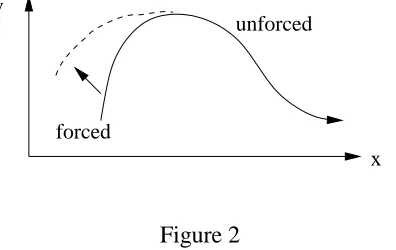
[image:5.595.206.404.362.487.2]Paradoxically, dynamics can help in achieving some specific control tasks, as well as
hindering others. If the desired system trajectory happens to be one requiring little control input,
then we just have to ensure the initial conditions are good, and make small adjustments during the
trajectory. We are 'riding the system' rather than fighting it. If the initial conditions are bad, then
some initial substantial effort may be required, but after that it is back to small adjustments. Fig 2
illustrates this effect in a general parameter space, {x,y} that might represent position for example.
Figure 2
A simple example is making an object accelerate downwards. We just have to let the object fall
under gravity. Another example is walking. Our legs swing like pendulums, with adjustments so
that we don't trip.
Dynamics can also help by reducing control 'noise'. Since it is the integration of force over
time that is important for causing changes is velocity, short inadvertent spikes of force have a
minimal effect on the trajectory. See Fig 3.
forced
unforced y
x
force
time time
force
3 Perceptual Dynamics in Acoustic Instruments
Acoustic instruments have there own rich dynamics, which are again the result of the Newton's
Laws acting in complicated ways with electric and gravitational forces. Instrument dynamics cover
a broad frequency range. At the top of the range are the audio frequencies. A pure note is a
perceptually static object despite the rapid pressure oscillations, so it is important to differentiate
between the physical dynamics that may yield high frequencies and the perceptual dynamics of
quantities that can be perceived to vary. Such quantities are usually subdivided into pitch, volume
and timbre. The latter is, of course, a catch-all for anything that is not pitch or volume. Depending
on the details of the quantity perceived, the frequency range available for perceived dynamics
extends up to around 50Hz. At higher frequencies we can no longer capture the contour of the
varying quantity and a transition to a new static perception occurs. A common expression used to
describe acoustic instruments is 'liveliness'. This is an almost subconscious reference to perceptual
dynamics. Just as dynamics enriches the recreational activities of the previous section, so it does to
acoustic instruments.
The overall dynamic behaviour of an instrument can be broken down into two main stages;
the dynamics of the interface and the acoustic dynamics of pressure and tension waves, shown in
Fig 4.
Figure 4
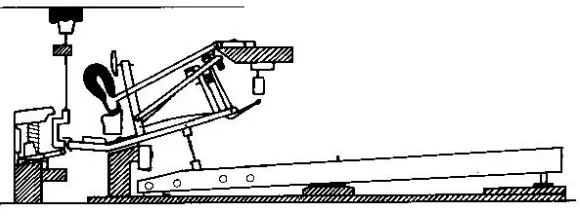
The piano action provides a good example of interface dynamics. The inertia of the hammer and
the escape mechanism combine to create the 'feel' of the keyboard, see Fig 5.
interface dynamics
Figure 5
[image:7.595.158.448.179.287.2]This dynamics has several subtle consequences. It allows the player to create a wide variety of
strike velocities from small finger movements, since the final velocity is proportional to the impulse
applied by the finger. This is the area under the finger force / time graph shown in Fig 6.
Figure 6
Timing is improved by virtue of the denoising effecting discussed in the previous section. Fast
repeats are possible because the hammer does not return immediately, and can restart a hit from a
short distance away from the string. Because the dynamics of the interface are relatively slow, they
are perceptually relevant.
Acoustic dynamics yields frequencies well above the perceptual range, but also within the
perceptual range. The following list attempts to seperate out different aspects of acoustic dynamics,
but it is by no means exhaustive, and the boundaries are often unclear.
Decay dynamics
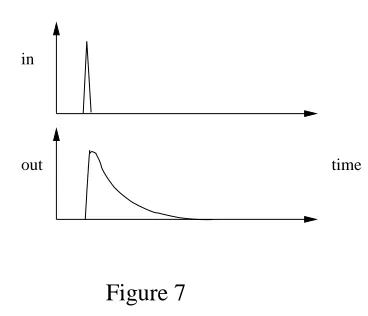
[image:8.595.233.417.314.472.2]Perhaps the simplest examples of dynamics are the volume decays of struck instruments, see Fig 7.
Figure 7
As the different frequency components decay at different rates so the spectral contour and timbre
change during the decay also. Decay dynamics also apply in continuously controlled instruments,
immediately following a period of control, for example when a bow leaves a string.
Beating and related dynamics
Even signals that contain only frequencies above the perceptual upper limit, in the pure spectral
domain, can evoke perceived frequencies. A simple example is the beating of two similar
frequencies. In the sound of a piano note a host of complex timbral dynamics can be heard,
resulting from beating and sympathetic interactions between strings.
Onset dynamics
in
Instruments with which the player interacts continuously for the duration of the note expose richer
dynamics than event based instruments such as percussion. In the continuous case the onset of a
note is a critical period, as the instrument progresses through a turbulent dynamical transition to a
'steady state' oscillation. During the transition the player must respond quickly to the available
indicators of instrument state, the sound and vibration history, in order to guide the instrument to
the desired state. The brevity of the period makes the task all the more challenging.
Locking
The instrument can enter different states that will have a lasting effect on the subsequent note,
independent of the way the input develops. This is a general property of nonlinear dynamical
systems called Mode-locking. An example is register shifting, whereby the output frequency of an
instrument flips by an interval and remains locked into that shift. For instance, overblowing on a
windinstrument can cause an octave rise, which holds as the pressure is reduced. For the most part
locking effects are more subtle than a register change, amounting to a change of timbre.
Evolution Dynamics
During the course of a note played with continuous control, the perceptual features vary smoothly,
but control is still dynamically filtered in subtle ways. For instance, the energy within the
instrument takes time to rise and fall and establish equilibrium as the blowing or bowing strength
changes.
Microunpredictability
in the dynamics of the instrument, as confirmed by the simplified physical models that recreate
these effects.
Macrounpredictability
Many continuously controlled instruments can be driven to state of gross chaotic behaviour
characterized noisy, rapidly fluctuating tones. An example is the vocalized saxophone style in
which vocal sounds interact directly with vibrations in the saxophone. There is a fine line here
between timbre and dynamics.
This section has exposed a variety of physical dynamical effects and challenges that face players of
acoustic instruments. Players learn to achieve these difficult control tasks using the same innate
mechanisms required to deal with everyday dynamics. This is why incorporating physical dynamics
into instruments is a good idea, but one easily overlooked because dynamic control is so much
second nature.
4 Existing Physical Dynamics In Electronic Instruments
Close-coupled physical dynamics has already entered into electronic instrument design in several
ways, as a consequence of emulating acoustic instruments.
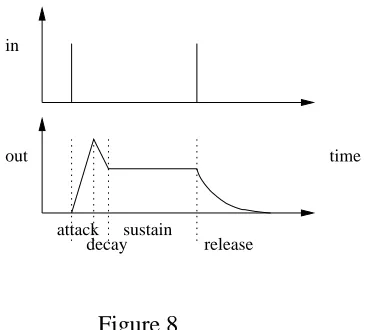
4.1 Dynamic Envelopes
Figure 8
A single event, a key depression, sets the trajectory of a note on course. A key release event makes
the envelope jump towards the release section (To simulate piano dynamics, the sustain section is
removed). This is a simple case because the output only depends on discrete events rather than a
continuum. The envelope is a simple model of keyboard dynamics.
4.2 Effects Processing
Effects processing is a common way of adding dynamical behaviour. It is added at the end of the
signal chain rather than the beginning. A note played into an echo processor for example, produces
a stream of decaying notes. The output at any time depends on previous input events, see Fig 9.
in
time out
decay release
attack sustain
in
The popularity of a range of abstract effects processors is possibly as much due to their dynamical
effect as the immediate timbral effect. While effects offer possibilities for creative design of
dynamics, this is limited by the fact that the effects act at the end of the instrument signal chain
where there are only a few available connections, and not within it, see Fig 10. Also effects
necessarily operate at audio rate, so the computational cost is significant.
Figure 10
4.3 Physical modeling
The advent of physical modeling introduced all the dynamic qualities of acoustic instruments into
the electronic arena. By default, the interface controls connect directly to the synthesizer. The
design process hasn't forced us to acknowledge the importance of dynamics, they have just
appeared as a natural consequence of the modeling process. The 'liveliness' present in acoustic
instruments is inherited.
Physical modeling comes in various forms. Accurate waveguide models seek to simulate
the propagation of sound waves in an object, including critical regions of nonlinear interaction
(Smith, 1992). Matching a waveguide structure to an existing instrument is a demanding task. A
given structure is only capable of a certain range of behaviour. Identifying a structure that will
realize some arbitrary imagined dynamics is intractable in most cases.
Physically inspired modeling models bulk motion in instruments such as shakers, by
making physically reasonable assumptions about the overall sonically relevant behaviour without
worrying about detailed behaviour (Cook, 97). If the bulk dynamics are modeled accurately this
allows the details of interaction sounds to be explored, and is particularly effective when
accompanied by a graphical rendering of the bulk system (Menzies, 99). Fig 11 shows a screenshot
of a system of rigid bodies.
Figure 11
The outer ball can rotate but its centre is fixed, the midsized ball is controlled via an invisible
spring by the mouse. All balls have different resonant properties. It is also possible to model the
acoustic dynamics itself in a semi-physical way, for example using noise for diffuse resonance
(Menzies, 2002)
4.4 Data driven modelling
real instrument. In performance, the output of the clusters mixes short basis samples to generate the
output. Using this approach Schoner has succeeded in producing recognizable, if not hi-fidelity,
string synthesis (Schoner, Cooper, Douglas and Gershenfeld, 1999). This is a promising area for
development, especially if the captured dynamics can be analyzed into perceptually meaningful
'subdynamics', so that they can be creatively transformed.
5 Composing Dynamics
The case for dynamics in instruments has been made. Existing dynamics in electronic instruments
has been reviewed. Now we turn to new practical design processes for adding control processing
dynamics to an interface-synthesis system in which the synthesis component has little or no
inherent perceptual dynamical properties. The following discussion will not assume much technical
knowledge, but hopefully it will also be of interest to the experienced reader by being cast in the
context of instrument control dynamics. Additional background material can be found in
introductory books on filters, for instance (Oppenheim, Schafer and Buck, 1999).
5.1 Linear Filters
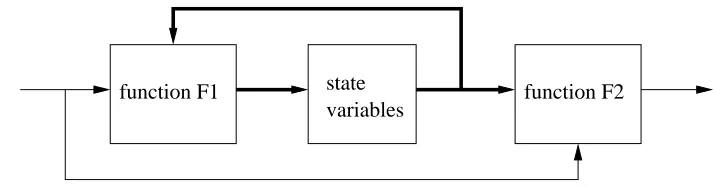
the output, and the state variables, are a function of the current input and the state variables, see Fig
12.
Figure 12
Linear dynamical systems, are a subclass with additional properties. They are useful for
modeling a variety of real processes, including physical dynamics, and can be analyzed in depth. In
the language of audio signal processing such systems are more commonly known as linear filters,
and are frequently used as building blocks. In the current context, however, we are interested in
processing control signals rather than audio signals, so the characteristic timescale is larger, and the
bandwidth smaller. A general linear filter can be realized by choosing the state variables to be
recent input and output samples, lagging behind the current sample by fixed amounts. The
functions in Fig 12 are constrained to be linear. If only inputs are chosen then the system is
described as finite impulse response otherwise infinite impulse response. The familiarity of linear
filters will be an aid to their deployment in control processing.
We have already observed that the acoustic dynamics of instruments is often characterized
by non-linearities imbedded within a linear system, so we should question whether non-linearities
should be introduced into the control processing. In this introductory study we shall only consider
linear processing. Interesting results can be hoped from this because the timescale of the processing
is, by design, the same as the human player interacting with it, so the player takes on the role of an
important non-linear interacting element, from the global player-instrument system viewpoint.
state variables
Linear filters can be classified by their order, or how far backwards in time the state
variables extend in their simplified input, output form. Here we consider just first and second order
filters. To aid comprehension, and avoid the technical language of z-transforms, the filters will not
necessarily be constructed in their purest and most efficient form. This doesn't matter because the
computational demands of signal processing at low bandwidth are small compared the demands of
audio rate signal processing in the synthesis section. We shall be more concerned with the details of
the time domain behaviour than would be the case for audio signal processing. Hence filters with
similar frequency responses may have quite different effects as control processors.
5.2 Implementation
There are many ways to implement control filters. Max-related systems have become very popular
for real-time music applications, primarily because of the user-friendly graphical interface. On the
other hand programming languages such as C and C++ offer the greatest flexibility and efficiency.
We shall take the comparatively unpopular middle route of using Csound, which offers several
advantages. Csound is free and available on many platforms, requires modest resources and has a
common multichannel audio interface. The script language is flexible enough to build filter
structures compactly, and enables rapid development. It also means that specific code can be
quoted within this document. One minor draw back is that the real-time capability has been grafted
on to a batch style architecture, so workarounds are sometimes required.
In theory it would be convenient to use the built-in audio filters for control processing.
Unfortunately it is usually found that the filters don't function correctly, if at all, at the low
Depending on what we wish to do, it may be worth upsampling the processed control signal
to improve the final audio output quality. For instance, if a control has a large effect on output
amplitude then up-sampling will reduce zipper noise. Frequency stepping is less noticeable, but
may be worth improving by upsampling.
5.3 A Control Dynamics Kit
The aim here is to present a collection of practical techniques for dynamic control processing. It is
in no way designed to be exhaustive, but rather illustrative of the methods involved. In the
following code snippets, global variables are used so that values can be passed between
instruments, and so that values are retained between performance passes.
gkdtis the control time
step, and should be set to
1/kr, the inverse of the control sampling rate. The code should reside in a
Csound instr that is active for the duration of the performance, which normally means switching on
from within the score. Time responses to various signals are used to illustrate the dynamics.
1
storder Differentiator
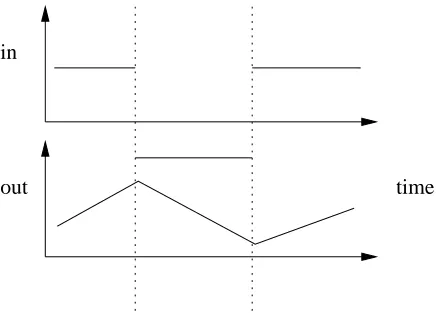
This is the simplest useful linear filter for control processing. It outputs the rate of change of the
input, see Fig 13.
in
It has the special property of being point-local. Local means that the output only depends on a
finite stretch of input history. This is true in general for finite impulse response filters. Point-local
additionally means that the history dependence is confined to a small fixed number of samples.
2The Csound implementation looks like:
gkout = (gkin - gkinold) * kr
gkinold = gkin
The differentiator is useful for calculating the velocity of an interface object such as a bow or
hammer. From this we can infer the energy associated with interactions of the control object.
Because it is point-local its dynamic behaviour is simple. The acceleration can be found by
chaining two differentiators together.
1
storder Integrator
[image:18.595.197.417.478.644.2]The integrator is the inverse to the differentiator, see Fig 14.
Figure 14
2 For the more mathematically inclined: The entire history of an infinitely differentiable function is defined by the derivatives at a point. In the discrete domain, however, calculating the analog of derivatives amounts to knowing the history, so point-local is useful for describing filters with history dependence that shrinks with time step size.
in
Combining them leaves the input unchanged. The integrator is not local, since it is an infinite
impulse response filter. The output depends on the entire history of input. In the following
implementation our state variable
gkout1is a delayed output (
gkout1could be dropped and
replaced with
gkoutproviding it is not modifed later on in the code).
gkout = (gkin * gkdt) + gkout1gkout1 = gkout
Leaky integrator
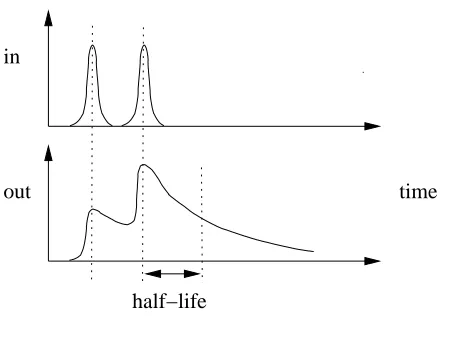
[image:19.595.194.419.406.575.2]In practice the pure integrator is limited in usefulness because the output always grows for positive
input. The leaky integrator is an integrator with an exponential 'drain' added so that the output
decays if no input is present, see Fig 15.
Figure 15
This can model the energy in a resonant object like a string. Energy can be accumulated by
repeated bowing, but ultimately it dissipates.
gkout = (gkin * gkdt) + gkoutold
gkoutold = gkout * gkdecay
Where
gkdecay = 2^(-gkdt/gkhl),and
gkhlis the half life of the decay. Note
gkdecayis not
in
time out
specified as a variable, so that it can be controlled in run time.
1
storder Lowpass
We now consider some common filters in their original forms as audio filters. The low pass filter
reduces high frequency content while the lowest frequency content is unchanged, and in fact is the
same as a leaky integrator, but with gain normalized for low frequencies, and a different control
viewpoint (The pure integrator is the low frequency limit of lowpass, with infinite gain at 0Hz). Its
audio implementation in Csound is tone.
gkout = gka * gkin + gkb * gkout1
gkout1 = gkout
For normalization
gka = 1 - gkb.
gkbcan be controlled directly, or via its relation to the
formal cutoff frequency
kf :kb = 2 - cos(kf*6.282*gkdt)
gkb = kb - sqrt(kb*kb-1.0)
This definition for
gkbis of limited use because the cutoff is not very sharp, but it does at least
provide a way to scale
gkbfor differing
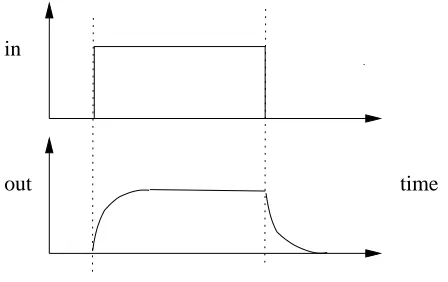
kr. [image:20.595.192.416.576.717.2]Lowpass intuitively resists change in the input signal, so it provides a simple model for a
physical damping action, see Fig 16.
Figure 16
in
A more accurate model of damping must introduce the notion of acceleration and requires a second
order filter. This is expressed in the resonators below. Lowpass filters can be chained to create
sharper cutoffs, but more ideal filters can be created using other higher-order designs.
Lowpass can also be viewed as a time averaging of the input, so it extracts the large
timescale motion of the input. For sufficiently small
gkathe output converges to the signal offset,
if that exists.
1
storder Highpass
[image:21.595.191.410.383.555.2]The high pass filter attenuates low frequencies. It transmits rapid change well, see Fig 17.
Figure 17
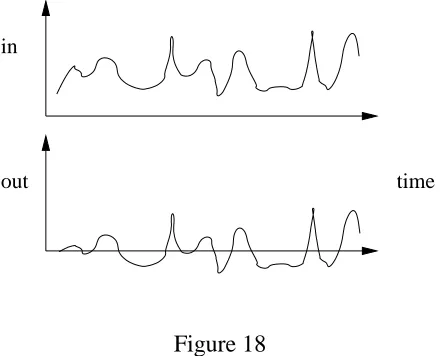
It can be constructed by subtracting the lowpass output from the input. Add :
gkout = gkin - gkout
(a more efficient construction is possible, but efficiency is not very important at control rates). The
highpass is useful for generating signals from sudden changes in the input.
For very low cutoff frequency the highpass is better known as a DC block, which passes all
frequencies unattenuated except the 0Hz or DC offset signal. This is useful for shifting the input so
in
that its time average value is zero, more of a practical than a perceptual-dynamical operation, see
Fig 18.
Figure 18
Resonator
Moving up to second order filters introduces the possibility of oscillation. We consider recursive or
IIR filters whose output depends on the entire history of input, as for the recursive first order filters.
Following the direct form implementation of reson in Csound, we define a control version:
gkout = gkin + ka * gkout1 - kb * gkout2
gkout1 = gkout
gkout2 = gkout1
kca
and
kcbare obtained from the centre frequency
kcf, and bandwidth
kbwas follows:
kb = exp(-kbw * 6.282 * gkdt)ka = 4 * kb * cos(kcf * 6.282 * gkdt) / (kb + 1)
Note that numerical errors may cause problems in setting
ka,
kbif
kcfis too small compared to kr.
Generally
krshould be kept to a maximum of 5000, and can be much lower. As the bandwidth is
reduced the filter becomes more resonant and oscillations decay more slowly. Control input which
oscillates near the centre frequency will cause a build up of output oscillations towards a saturation
level, see Fig 19.
in
Figure 19
Resonant-Follower
Resonance can also be approached from a physical viewpoint, and this aids the intuitive
construction of variations on the basic resonator. As an example consider the physical system
shown in Fig 20.
Figure 20
The input control is the position of one end a spring relative to a fixed point. The other end of the
spring is attached to a mass and one end of a damper. The other end of the damper is fixed. The
filter output is the displacement of the mass from its resting position when the input is zero. The
force on the mass depends on the extension/compression of the spring and the velocity of the
damper extension. Without loss of generality take the mass to be 1. In Csound we can integrate the
system to a first approximation with:
in
time out
spring mass damper
[image:23.595.164.447.462.583.2]gkvel = gkvel + ( (gkin-gkout1)*gkk - gkvel*gkd ) * gkdt
gkout = gkout + gkvel * gkdt
gkout1 = gkout
gkvel
is the velocity,
gkkis the spring constant and
gkdis the damping constant. The step
[image:24.595.194.416.272.419.2]response is shown in Fig 21.
Figure 21
This is a resonator with DC pass. We call it a resonant-follower to emphasize that the output
follows the input, with added resonance caused by sudden change. It is typical of mechanical
suspension systems that transmit the input but impose resonance and damping as well.
Modified Resonator
The DC component of the resonant-follower can be removed by subtracting the output from the
input. Add:
gkout = gkin - gkout
The step response is shown in Fig 22.
in
Figure 22
This is similar to the resonator step response but with an initial discontinuity. The modified
resonator is equivalent to a resonator and differentiator attached in series, with gain adjustment.
The frequency response does not roll off at high frequencies, so impulses are responded to rapidly
irrespective of the resonant frequency. This feature is exploited in the first example.
Only filters up to 2
ndorder have been considered. This may seem somewhat restrictive, but in
practice a wide range of perceptual dynamics can be approximated well using the filters described.
They have the advantage that the behaviour of each can be clearly understood. Higher order filters
can be built from networks of simpler filters, in a structured way.
6 Example I - Bird
The purpose of the examples is to present complete instruments that use dynamic control
processing, without becoming submerged in synthesis details. To this end we return to the simplest
of instruments, the Theremin, as the starting point. The synthesis section will consist only of a sine
oscillator. The design or compositional elements contributing to the first example are:
a f breath
reed key freq
freq / damping
•
The amplitude and frequency should by effected by output from dynamic control processing.
This should create possibilities for output that the player could not achieve by direct control.
•
The interface is a standard wind controller, such as a Yamaha WX7 / WX11. Use should be
made of the reed pressure sensor.
•
It would be useful if the instrument could be driven to a 'normalized state' where playing keys
produced corresponding scale tones, with no superimposed frequency changes.
•
It would similarly be useful if the instrument could be driven to an 'anti-normalized' state in
which we control the frequency directly and continuously, like the Theremin.
•
The overall aesthetic inspiration is from bird song, the rapid, complex and varied modulation of
simple tones. The effect should be one of intimate rather than loose control, as if the player
were singing directly.
The design process proceeds roughly as follows: To generate frequency modulations, we use a
resonator. But what should drive the resonator? The breath control should be mainly used to control
amplitude, in agreement with the normalization requirement. The staccato nature of bird song
suggests that changes of breath should excite resonant modulation. Using the derived resonator
from the last section we can additionally drive the instrument into an anti-normalized state at low
frequencies, so that breath changes directly control frequency. The remaining piece of the jigsaw is
to use the reed pressure to control the resonant frequency and damping.
Fig 23 shows the overall scheme. The method for controlling the resonant frequency and the
damping is to multiply the time step
gkdtby a factor depending on the reed pressure. A tighter
Figure 23
With a tight reed, oscillations die away fast and scales can be played. With a looser reed the
oscillations become slower, and the player interacts dynamically with the oscillations. It is here that
interesting and perceptually unpredictable behaviour can occur. The player has control of the
overall shape of a phrase, but the details of modulation are ever fluid. With a loose reed, breath
drives the frequency directly. By moving rapidly through these regimes the player can achieve a
variety of interesting bird-like performances, that would be impossible without dynamic
processing.
Interesting variations on bird have been made by combining several sine oscillators, each
controlled by slightly different dynamics. The oscillators tend to join and spread according to the
playing conditions, creating chorus like effects and adding more dynamic interest.
7 Example II - Spiro
For the second example we stay with sine modulation, but use a keyboard as the interface. Instead
of using linear filters for dynamic processing we return to the ADSR envelope and wavetable
oscillator, to demonstrate how ‘off the shelf parts’ can be given a new lease of dynamics life. The
ADSR was designed for modeling the volume and filter dynamics of event-based notes. However,
a
f breath
reed
key freq
freq / damping
it also provides a compact dynamical unit for building more general dynamic processing. The
specific criteria this time are:
•
The inspiration is taken from the sustained animal song common in jungles and elsewhere, for
instance by birds and frogs. Cyclic patterns of sound that repeat approximately but never
perfectly.
•
Each key 'contributes' to the output in a different way, and the contribution has dynamical
behaviour.
•
The modulation and pitch wheels can additionally be used to modify the behaviour in some
global way.
[image:28.595.73.526.444.712.2]These goals are achieved by associating two enveloped oscillators, operating at frequencies in the
perceptual-dynamic range, with each key that has been pressed, one for amplitude and one for
frequency, see Fig 24.
Figure 24
a
f ADSR
The output of the currently active enveloped oscillators is summed to provide the final pitch and
amplitude modulation parameters. Various parameters for the enveloped oscillators, wavetable,
frequency, mode (cycle/oneshot), attack time, decay time, sensitivity to key velocity, are all
selected from tables indexed by the key number. The mod wheel is used to shift the global
oscillator frequencies, while the pitch wheel shifts the final modulation pitch. A simple variation
employs separate amplitude oscillators for right and left channels, so that panning movement
patterns additionally occur.
Csound provides a very efficient structure for implementing this design. A single instrument
definition is accessed by each key that is played, and global variables are used to accumulate the
final modulation parameters (Menzies, 1996). The envelopes are implemented with linenr, which
forces the instrument to remain active after the key is released. This permits a smooth fade of the
effect associated with the key, under the players control.
A variety of tables were generated for experimentation. The most rewarding frequency
range to operate the instrument is just at the point where the patterns of pitches cannot each be
followed exactly but are none the less recognizable from one another. One then perceives a mixture
of dynamics in the sound, possibly resulting from correlations between repeating features. The
effect is analagous to spirograph pattern generators used on some bank notes. As the envelopes
vary the oscillator outputs, so they interact dynamically to create transitional pattern changes in the
output, similar to those heard in nature. A piece, lifeforms, was written combining performances on
bird and spiro, (Menzies, 1996), and has been diffused by the group nerve8 on several occasions.
Conclusion
The motivation for this work has been the belief in the value of dynamical behaviour in
dynamics is important generally, and specifically in the performance of acoustic instruments.
Physical modeling has opened the doors to dynamics, but within certain boundaries. By explicitly
designing perceptually relevant dynamics, a broader more abstract design space is accessible, yet
one still benefiting from dynamics. From a practical viewpoint, the computational costs of
perceptual dynamics are small compared to audio signal processing because of the lower
bandwidth.
Some examples have been given of simple control dynamics processing that yield
compelling results given their simplicity. More generally any dynamical process, whatever its form
or origin, can be considered and transferred to the perceptual band, thus creating a rich field for
experimentation. Of course, the sine generators can be replaced with arbitrarily complex synthesis
units with parameters effecting timbre in many ways. Even physical synthesis units may benefit
from dynamic control preprocessing, by enhancing and modifying aspects of the existing dynamics
that might otherwise be difficult.
Instrument design is foremost an artistic compositional process, but one that is likely to
benefit increasingly from technical proficiency in the abstract manipulation of dynamical systems.
References
Bhushan, N. and Shadmehr, R. 1998. Evidence for learning of a forward dynamic model in human
adaptive control. Journal of Cognitive Neuroscience 5(1), 56--78.
Chadabe, J. 2002. The Limitations of Mapping as a Structural Descriptive in Electronic
Cook, P.R. 1997. Physically Inspired Sonic Modeling (PhISM): Synthesis of Percussive Sounds.
Computer Music Journal, 21(3).
Garnett, G. and Goudeseune, C. 1999. Performance Factors in Control of High-Dimensional
Spaces. Proceedings of the International Computer Music Conference, San Francisco.
Gershenfeld, N. Schoner, B. and Metois, E. 1999. Cluster-Weighted-Modeling for Time Series
Analysis. NATURE, Vol. 397, P. 329-332.
Hilborn, R.C. 2000. Chaos and Nonlinear Dynamics: An Introduction for Scientists and Engineers.
Oxford University Press.
Hunt, A. and Wanderley, M. M. and Kirk, R. 2000. Towards a Model for Instrumental Mapping in
Expert Musical Interaction. Proceedings of the 2000 International Computer Music Conference.
Lennie, P. 1981. The physiological basis of variations in visual latency. Vision Research 21.
Menzies, D. 1995. An Investigation into the Design of Musical Performance Instruments. MSc
report. www.zenprobe.com/dylan/pubs.
Menzies, D. 1995. Bird Csound Instrument code and examples. www.zenprobe.com/os
Menzies, D. 1996. Spiro Csound Instrument code and examples. www.zenprobe.com/os
Menzies, D. 1999. New Performance Instruments for Electroacoustic Music. DPhil thesis.
www.zenprobe.com/dylan/pubs.
Menzies, D. 1999. Physical audio library demos. www.zenprobe.com/dylan/work.
Menzies, D. 2002. Perceptual Resonators For Interactive Worlds. AES 22
ndInternational
Conference on Virtual, Synthetic and Entertainment Audio, Helsinki.
Oppenheim, R. W. Schafer, A.V. Buck, J.R. 1999. Discrete-Time Signal Processing (2nd Edition).
Prentice Hall.
Schoner, B. Cooper, C. Douglas, C. and Gershenfeld, N. 1999. Data-driven Modeling of Acoustical
Instruments. Journal for New Music Research, Vol 28(2), 1999.
Smith, J. 1992. Physical modelling using digital waveguides. Computer Music Journal, 16(4):74–
87.