1
Methods and Tools for Identifying Communities of Practice
Harith Alani, Kieron O’Hara and Nigel Shadbolt Intelligence, Agents, Multimedia Group
Dept. of Electronics and Computer Science University of Southampton
Abstract: The paper describes ONTOCOPI, a tool for identifying communities of practice (COPs) by analysing ontologies of the relevant working domain. COP identification is currently a resource-heavy process largely based on interviews. ONTOCOPI attempts to uncover informal COP relations by spotting patterns in the formal relations represented in ontologies, traversing the ontology from instance to instance via selected relations. Experiments to determine particular COPs from an academic ontology are described, showing how the alteration of threshold and temporal settings, and the weights applied to the ontology’s relations affect the composition of the identified COP.
Key words: ontologies, communities of practice, network analysis, distributed knowledge management, corporate memory
1.
INTRODUCTION
Communities of practice (COPs) are informal self-organising groups of individuals interested in a particular practice. Membership is not often conscious; members will typically swap war stories, insights or advice on particular problems or tasks connected with the practice (Wenger 1998). An example of a COP might be the set of people in an organisation who do the same (or overlapping) jobs. They understand each other’s problems, both with the job itself and with liaison with the outside world. A de facto community gradually emerges from their discussions and interests.
(d) act as foci for innovation. For individuals, the COP promotes the smooth integration of the practice with daily working life. For an example where COPs have been exploited in knowledge management, see the experience of Schlumberger (Smith and Farquhar 2000).
However, COPs are difficult to identify within organisations – an essential first step to understanding the knowledge resources of an organisation (Wenger 1999, McDermott 1999). In this paper we describe ONTOCOPI, the ONTOlogy-based Community Of Practice Identifier, a tool which uses ontology-based network analysis to support the task of COP identification. As a first cut proxy for a COP, we look for the set of most similar instances to a selected instance in the knowledge-base (i.e the instances that have most in common). ONTOCOPI was built as part of the Advanced Knowledge Technologies (AKT 2001) project.
Considerations of space in this paper preclude a deep discussion of the theory underlying ONTOCOPI. For such a discussion see (O’Hara et al 2002).
The structure of the paper is as follows. Section 2 will briefly examine the issues relating to the use of ontologies of working domains to identify COPs, while section 3 will then set out the principles underlying ONTOCOPI. Sections 4 and 5 will then discuss the current and future refinements of ONTOCOPI’s performance.
2.
EXPLOITING ONTOLOGIES FOR
COMMUNITIES OF PRACTICE
ONTOCOPI is a tool for ontology-based network analysis (ONA). By an ontology we refer to the classification structure and the knowledge-base of instantiations. If an ontology represents the objects and relations in a domain of work, then it can be analysed to extract the connections between entities in that domain. A COP is defined by certain relations between entities relating to that practice, and so the aim of ONTOCOPI is to extract patterns of such relations.
The advantage of using an ontology to analyse such networks is that relations have semantics or types. Hence certain relations – the ones relevant to the COP – can be favoured in the process of analysis. During the analysis the weight of the contribution made by the important relations is high, while that of the less important ones can be made relatively low, or zero.
The essence of a COP is that it is an informal set of relations; ontologies will be wholly or largely made up of formal relations. By ‘formal’ here we mean relations that are determinate, fixed and cheap to establish/monitor, such as the relation of being a member of a group, being the author of a paper, having a particular telephone number. By ‘informal’ we mean relations that are often indeterminate and expensive to establish, such as a tendency to have a drink together after work. The ONTOCOPI hypothesis is that such informal relations can be inferred from the presence of formal relations. For instance, if A and B have no formal relation, but they have both authored papers (formal relation) with C, then that indicates that they might share interests (informal relation).
3.
ONTOCOPI
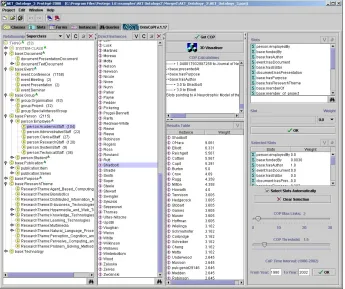
The AKT ontology is implemented in Protégé 2000 (Eriksson et al 1999). ONTOCOPI plugs into Protégé and uses the ontology as its raw material. For more on the AKT ontology, see (O’Hara et al 2002). The user interface is shown in Figure 1. The left hand panel shows the ontology, to allow the user to select a class; second on the left displays the class instances, allowing an instance to be selected. Top right shows the available relations. The user selects the relations that he feels will be important in COP identification, and gives these weights depending on their relative importance (this can be done automatically – see below); selected relations and weights are displayed in the middle right panel. Controls at the bottom right allow the user to determine threshold and temporal settings.
Figure 1. ONTOCOPI's User Interface
3.1
Relation and Weight Selection
Selecting the relations and weights can be manual or automatic. The system allows the user to select the relationships of interest, and weight them as needed. For example if the user is interested in peoples’ collaboration on projects and co-authorships, then the relations memberOfProject, hasAuthor, and publishedIn can be selected. The user can then set weights for these relations to increase or decrease their impact on the COP to be identified. The less weight a relation is given, the less its impact will be.
The system can also select relations and calculate their weights automatically based on the frequency of use of these relations in the ontology, which is taken as an indication of the level of importance of those relations to that ontology, and whether the ontology is good or weak in providing information related to certain relationships. Ontologies are normally unevenly populated. Our experience shows that when an ontology is populated with instances, certain relations will normally be used more than others; some relations might not be used at all (i.e. the slot has been created but not filled in for any instance). This is normally due to the unavailability of certain information, or that different information has different levels of importance reflected in the amount of effort given to collecting and adding it to the ontology. This approach of selecting relations bypasses problems about user uncertainty, but equal frequency of use may only be a partial measure of its relevance to a user’s interests.
3.2
The Algorithm
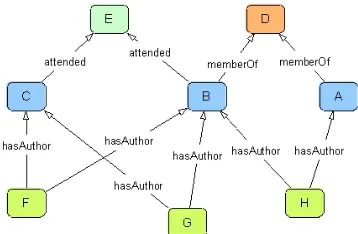
The expansion algorithm generates the COP of the selected instance (this is a person in our experiments, but could be any type of object) by identifying the set of close instances and ranking them according to the weights of their relations. It applies a breadth first, spreading activation search, traversing the semantic relations between instances (ignoring directionality) until the link threshold is reached. Starting with a weight of 1 for all instances, it transfers weights to all other instances following a set of weighted relations. The pseudocode is given in Figure 2; where n is the number of links traversed to reach the instance starting from the primary instance.
Consider the example in Figure 3. Assume we need to identify the COP of the query instance A, using the relationships hasAuthor, memberOf and
attended, with the weights 1.0, 0.6, and 0.3 respectively. All instances will
query instance. Instances therefore accumulate weight based on the number of relevant relations they have with the initial instance.
Initialise all instances weights to 1
Create a relationship-array of selected relationships and weights Set query instance as the current instance
Mark current instance as unlocked and add it to an instance-array Loop to the maximum number of links to traverse
Search for the first unlocked instance in instance-array If found:
Mark instance as locked
Set instance as the current instance
Get all instances connected to current instance with a relationship in the relationship-array
Loop to number of connected instances
If instance not in instance-array (new instance)
Weight of instance = initial weight + current instance weight * weight of connecting relationship
Mark instance as unlocked and add it to instance-array If instance already in instance array
Weight of instance = instance weight + current instance weight * weight of connecting relationship
End loop
If not found then exit End loop
Normalise all weights to the power 1/n
[image:6.595.143.322.366.483.2]Rank instance-array according to instance final weights
Figure 2. The ONTOCOPI Algorithm in Pseudocode
Figure 3. Example Ontology Network
The number of indirectly-linked instances will also increase if hubs appear in the connected network. Hubs are highly-connected instances, and are very influential. They often score high ranks in the identified COPs as they receive high weights accumulated from their many connections. The drawback of this is that a high percentage of a hub’s weight can be propagated to some of its connected instances which in turn will earn an ‘unjustified’ high rank in the COP. One possible approach to take is to compensate the weight to be passed from an instance based on the number of connections the instance has. The more connections an instance has, the more general it is considered to be, and hence the less weight it can transfer.
In terms of its intellectual roots, the ONTOCOPI algorithm takes ideas derived from the literature on similarity measures and applies them to the context of ONA. It builds on an approach introduced by Paice (1991) where relevance values of instances increase with the number of semantic paths leading to these instances. The algorithm however is different to Paice’s in that relationship direction is ignored, since ontological relationships can be represented bi-directionally (e.g. has-author vs authored-by).
Furthermore, ONTOCOPI’s algorithm allows an instance to transfer some weight back to its “source” instance, to ease a problem that arises when applying Paice’s method to a dense ontology, were some instances have large number of connections. If activation is spread over more than few links, reaching heavily connected instances, then such instances will receive disproportionately high weights accumulated from their large number of connections. Hence a one-step backwards weight transfer is introduced in our algorithm to give extra weight back to source instances. We are experimenting with other alternatives, such as applying a weight-transfer cost for each instance based on its number of connections.
4.
REFINING THE PICTURE
Getting the COP right will depend on the ontology, on the purposes of the user, and on the domain. Even if there are rules of thumb that emerge from study, experiments would still need to be carried out in any new domain to establish the network properties of the ontology. In this section, we discuss some of the experiments tried on the AKT ontology.
when expanding to a high number of links, or if the initial instance has low connectivity (i.e. not much information is available about the selected instance). The weight threshold also allows the user to control the display of results to, for example, only highly ranked entities if the interest is to identify strongly related entities only. We can describe the results of a set of experiments with ONTOCOPI using different settings to identify the COP of
Shadbolt based on the AKT ontology. Note that only the first 20 results of
each experiment are displayed.
4.1
Using Automatic Settings
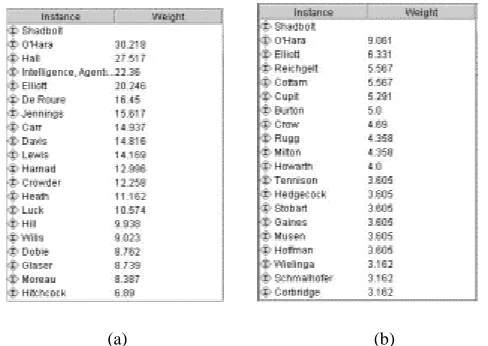
The extent of the identified COP is dependent on the number of links to expand from the COP query instance. Here we first use a 2 link-threshold to identify the immediate COP of Shadbolt; the automatic relations selector was used, which sets the highest weight of 1 to the relationship hasAuthor, which is the reason why the highly ranked people in Shadbolt’s COP are in general the ones with the highest number of joint publications with him. It can be seen from Figure 4(a) that the closest person to Shadbolt was found to be O’Hara, Shadbolt’s trusty lieutenant, who works in the same department, and has co-authored more than 30 papers with him.
[image:8.595.98.342.345.518.2](a) (b)
Figure 4. Shadbolt's COP, Automatic Selection (a) 2 links (b) 4 links
supervisors of someone’s co-authors. Hence we see new people with less direct connections coming into the picture because of their connections with others; in this way we can see that the COP identified with a higher link threshold can make suggestions for COP membership that the unaided subject would be less likely to come up with.
4.2
Using Manual Settings
To identify more specific types of COP, the user can select the relations of interest and weigh them manually. For example to identify the COP of
Shadbolt based on his co-authors, project collaborators, and co-workers, then
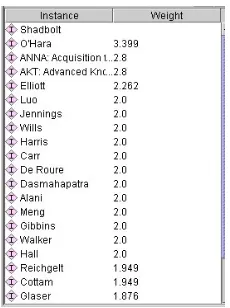
[image:9.595.170.285.259.413.2]the relationships hasAuthor, memberOfProject, and memberOf can be selected. Using the relationship weights of 0.2, 0.9 and 0.3 respectively, the resulting COP will be as in Figure 5.
Figure 5. Shadbolt's COP, manual selection
This COP differs from the one identified in the previous section as some of the instances in this COP (all the ones with a weight of 2) have no joint papers with Shadbolt, but are all members of the same project, group, and department. The results will obviously be slightly different if the weights of the selected relationships change. For example people with more joint publications with Shadbolt will get higher values if the weight of hasAuthor is increased.
4.3
Temporally-based COP Identification
Previous examples identified COPs using default temporal boundaries (from 1980 till 2002). Temporal limits can be applied to restrict COPs to certain intervals. Figure 6 shows the COPs of Shadbolt in three different periods, focusing on co-authorship relations. Hedgecock, Underwood, and
Stobart were highly ranked in (a) but were excluded from the COP in (b).
Others such as Reichgelt, Burton, Rugg were some of the most relevant to Shadbolt’s COP in (a) but faded gradually when their ranks dropped in (b) and disappeared completely in (c). There are always new people in the COP replacing the fading ones, for example O’Hara, Cottam, and Elliott appeared in (b) and maintained very high ranks throughout (b) and (c).
(a) (b) (c)
Figure 6. Shadbolt's COPs, (a) 1985-90, (b) 1991-7, (c) 1998-2002
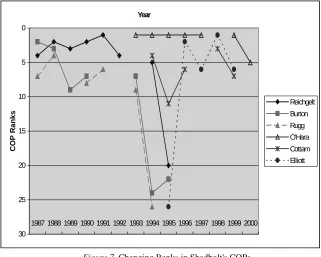
The Proustian Figure 7 shows the time-related ranks of certain people in
Shadbolt’s co-authorship-based COP, displaying how people fade out of the
COP while others move in. The rate of change in a COP depends of course on the movements of these individuals. For example Reichgelt climbed from 4th in 1987 to top in 1991, then dropped until he disappeared for good in 1995. A new person, Elliott, joined this COP in 1995 and started to climb and secure higher positions but also began to fade after 1998.
As COPs are highly variable through time, it would be useful to be able to filter out relations that did not obtain in particular relevant periods; however, such information must be present in the ontology in the first place.
Figure 7. Changing Ranks in Shadbolt's COPs
5.
DISCUSSION
By using ontologies, ONTOCOPI makes itself sensitive to the semantics of the relations out of which networks are built. As a support tool for COP identification, it has the scope to cut down search spaces radically.
This contrasts with similar work investigating networks of semi-formal relations between people or within systems. For instance, the analysis of networks of pages and hyperlinks to identify hubs and authoritative sites on the web in order to improve search engine results (e.g. Page et al 1999) is based on the number and direction of links between web pages, but the significance of such links is lost after a page is authored. Work related to ONTOCOPI is discussed in more depth in (O’Hara et al 2002).
We have discussed ONTOCOPI’s ontology-based analysis techniques; we should also express the following caveats (cf. O’Hara et al 2002).
1. ONTOCOPI makes an explicit assumption that (some) informal COP relations can be inferred from the formal ones in an ontology.
0
5
10
15
20
25
30
1987 1988 1989 1990 1991 1992 1993 1994 1995 1996 1997 1998 1999 2000
Year
C
O
P
R
an
ks
2. In any new domain, a range of trials would have to be carried out to determine the interesting link thresholds and relation weights.
3. Note the problem of brokers or boundary objects (people or objects who exist in two COPs). In cases such as these the COPs identified may be the
union of two or more COPs. It could be that this is a widespread problem,
though Wenger (1998) does not think so. Much will depend on what possible filtering information is represented in the ontology.
Future research will focus on ways of filtering out noise and making search more flexible. Further scenarios will also be employed to ascertain which other knowledge management tasks can exploit ONA (e.g. coreference identification).
ACKNOWLEDGEMENTS
This work is supported under the Advanced Knowledge Technologies (AKT) Interdisciplinary Research Collaboration (IRC), which is sponsored by the UK Engineering and Physical Sciences Research Council under grant number GR/N15764/01. The AKT IRC comprises the Universities of Aberdeen, Edinburgh, Sheffield, Southampton and the Open University.
REFERENCES
AKT, The AKT Manifesto, 2001,http://www.aktors.org/publications/Manifesto.doc
Eriksson H, Fergerson R, Shahr Y, Musen M. Automatic generation of ontology editors. Proceedings of the Twelfth Workshop on Knowledge Acquisition, Modelling and Management (KAW'99); 1999; Banff. Canada.
McDermott R., Why information technology inspired but cannot deliver knowledge management, California Management Review, 1999; 41
O’Hara K, Alani H, Shadbolt N. Identifying communities of practice: analysing ontologies as networks to support community recognition. Proceedings of the World Computer Congress; 2002; Montreal. Canada.
Page L, Brin S, Motwani R, Winograd T. The PageRank Citation Ranking: Bringing Order to the Web. Stanford University working paper SIDL-WP-1999-0120; 1999.
Paice C.D. A thesaural model of information retrieval. Information Processing and Management 1991, 27(5):433-447
Smith R.G., Farquhar A. The road ahead for knowledge management: an AI perspective. AI Magazine, Winter 2000, 17-40
Wenger E, Communities of Practice: Learning, Meaning and Identity. Cambridge University Press, Cambridge, 1998.