Conflicts of Interest, Information Provision
and Competition in Banking
∗
Patrick Bolton
†Xavier Freixas
‡Joel Shapiro
§June 11, 2004
Abstract
In some markets, such as the market for drugs or for financial services, sellers have better information than buyers regarding the matching between the buyer’s needs and the good’s actual character-istics. Depending on the market structure, this may lead to conflicts of interest and/or the underprovision of information by the seller. This paper studies this issue in the market for financial services. The anal-ysis presents a new model of competition between banks, as banks’ price competition influences the ensuing incentives for truthful infor-mation revelation. We compare two different firm structures, special-ized banking, where financial institutions provide a unique financial product, and one-stop banking, where a financial institution is able to provide several financial products which are horizontally differen-tiated. We show first that, although conflicts of interest may prevent information disclosure under monopoly, competition forces full infor-mation provision for sufficiently high reputation costs. Second, in the ∗Financial support from the Fondation Banque de France and Barcelona Economics (CREA) is gratefully acknowledged. Shapiro also acknowledges the financial support from DGES under BEC 2000-1026 and BEC2003-00412.We thank Ricardo Fuentes and Judit Montoriol for their research assistance. We also thank Fabrizio Germano, Joseph Har-rington, Edi Karni, Sjaak Hurkens, Giancarlo Spagnolo and audiences at the Banque de France, Columbia, Johns Hopkins, UAB, the Econometric Society NASM 2003 and NAWM 2004, and European Finance Association 2003 Meetings for helpful discussions.
†Princeton University
‡Universitat Pompeu Fabra and CEPR §Universitat Pompeu Fabra
presence of market power, one-stop banks will use information strate-gically to increase product differentiation and therefore will always provide reliable information and charge higher prices than specialized banks, thus providing a new justification for the creation of one-stop banks. Finally, we show that, if independent financial advisers are able to provide reliable information, this increases product differentiation and therefore market power, so that it is in the interest of financial intermediaries to promote external independent financial advice.
JEL Classifications: D43, D82, G20, L15
Keywords: Conflicts of interest, information provision, one-stop banks, financial advice
1
Introduction
This paper is concerned with the provision of information by sellers of fi-nancial services to customers when the fifi-nancial products are horizontally differentiated. The issue of information provision is timely, as the banking industry is evolving from the traditional business of financial intermediation towards a fee-based industry where information is crucial in providing more added value to customers. In a departure from the standard finance litera-ture, we make the assumption that some investors are partially uninformed in the sense that they don’t know the financial product that best suits their needs. This innovative assumption allows for a rich environment where differ-ent types of phenomena such as misselling of financial products might occur. Although information is valuable to customers, the sellers face a fundamental conflict of interest problem: should a financial intermediary tell a client that another firm offers a product that better suits the client’s needs? Our results directly challenge the conventional wisdom that information is only credible if it is produced from an independent institution that has no conflict of in-terests. We find that in different environments, competition or consolidation (into one-stop banks) can solve the apparent conflicts of interest.
In addition to horizontal differentiation and customers’ imperfect infor-mation, our setting is characterized by two additional assumptions that we deem natural in the financial industry: non-verifiable information and repu-tation costs for misselling. In a heavily regulated environment, the disclosure of verifiable information can be made compulsory and any attempt to falsify it can be heavily penalized. This then leaves open the issue of inducing rev-elation of non-verifiable information. Since financial institutions often care
about establishing a relationship with their clients, however, some discipline can be imposed in the revelation of non-verifiable information through the reputation costs institutions bear for giving misleading advice.
Although our research is originally motivated by the issues relevant to the financial industry, our findings apply to any market where buyers are uncertain about which product is best for them and where sellers face a reputation cost if they provide misleading information. Examples of such markets outside the financial industry could be the market for medicine, where information is provided by physicians, the market for real estate, and the market for sophisticated technical equipment. Moreover, the issue of how informative information provision is and how it affects competition is important to discussions of markets where advertising is used1.
Our main findings can be summarized as follows. Competition among specialized financial intermediaries leads to full credible information disclo-sure, even for small but strictly positive reputation costs that are bounded away from zero. The basic intuition for this result is that competition may eliminate the potential conflict of interest by reducing the gains from lying and by inducing banks to differentiate their product by providing credible information. Banks can thus restore their margins on a smaller base of cus-tomers that have a special need for their product. However, the size of reputation costs limit profit margins because of the need to remain credible in giving advice to clients. As a consequence, sellers could gain from the presence of a third party (for instance some independent financial advisor) that could provide information, allowing them to raise prices further.
One-stop banks (defined here as banks that sell multiple products) can also overcome this conflict of interest in certain circumstances. While the usual explanation for the creation of one-stop banks is based on an economies of scope argument that it is more efficient to sell multiple financial products from the same outlet, we find that the ability to credibly provide information may be another major motive for consolidation. One-stop banks are able to provide reliable information and charge higher prices than specialized banks when they have market power. Otherwise, competition with one-stop banks results in a similar outcome as competition with specialized banks.
The main theoretical novelty of the paper is that firms’ actions (the prices they set) define an ensuing signaling game (the advice banks give to cus-tomers). These actions commit the firms to credible or non-credible
tion revelation by providing incentives to tell the truth or not. Most other signaling models have payoffs determined by current or future actions, not past actions as in our model. Moreover, these models have each firm signaling its private information, such as in Mailath (1989). Here, the private infor-mation is the inforinfor-mation acquired by a bank about its customer’s financial profile, which it can reveal as it wishes.
Our model incorporates several elements from the industrial organization literature. As all customers are uncertain of which product they prefer, there are flavors of both horizontal differentiation (Hotelling, 1929) and vertical differentiation (Shaked and Sutton, 1983). In order to provide information to customers, we assume that banks make unverifiable statements about which product is best for the customer. This is a form of information revelation game in which talk is not cheap. In contrast, most other models that have been considered in the literature involve agents providing information that is either cheap talk or verifiable. As is well known, when private information is verifiable, voluntary disclosure often leads to full information revelation (see Grossman and Hart, 1980, Milgrom and Roberts, 1986, and Okuno-Fujiwara, Postlewaite, and Suzumura, 1990). In our setup, we allow for lying, but make it costly by introducing a reputation cost.
The issue of the market provision of information prior to a sale has been discussed in different settings. For example, Benabou and Laroque (1992) and Morgan and Stocken (2003) discuss a conflict of interest similar to the one we look at in the context of stock recommendations. However, our analysis focuses on direct price competition between information providers, while they consider information providers that benefit from subsequent movements in the secondary market price of a recommended stock.
The environment we discuss resembles in some ways the literature on
credence goods, first discussed in Darby and Karni (1973). For such goods
or services the consumer is never able to completely ascertain the quality of the good and must rely on the advice of experts (an example of a credence service is automobile repairs - all one knows is whether the car functions properly, not whether the repair was necessary or well executed). Several papers that discuss credence goods are interested in credible revelation of information (Pitchik and Schotter (1987), Emons (1997, 2001)) and in com-petition among credence good providers (Wolinsky, 1993 and Pesendorfer and Wolinsky, 2003). In our model, however, the financial instruments are also partially experience goods, since we allow for a reputation cost for misleading customers. Another difference with the literature on information revelation
and credence goods is that prices are not signals in our model, but instead provide incentives for information revelation.
The problem we analyze is also related to the literature onreferrals. In a recent contribution Garicano and Santos (2004) discuss efficiency in match-ing clients with the correct agents when referrals are possible. Since agents may have private information about a client’s value, there is an adverse selec-tion problem. In addiselec-tion, they allow for moral hazard in effort provision in helping the client. We allow for costless referrals and focus on the potential for price competition to provide incentives for revealing information (whereas they abstract away from competition for customers to focus on the alloca-tion problem). They find that partnerships may provide incentives to allocate clients efficiently, much as we find one-stop banks have greater incentives to match customers correctly to products, although for different reasons - part-nerships create a moral hazard problem for the referrer, weakening incentives to lie about the project.
Finally, Demski and Sappington’s (1987) and Shavell’s (1994) contribu-tions also deal with the issue of information acquisition and disclosure but in a different setting from ours. In Demski and Sappington (1987) the service provided by the agent is a form of credence good and the agent can only be given incentives to acquire information with an output-based compensation scheme. In contrast, in Shavell (1994) information is verifiable but whether the agent has acquired the information is not observable. To be able to limit information disclosure ex-post the agent then has an incentive not to always acquire the information. But the largest difference with our analysis is that we permit Bertrand competition between sellers, while both Shavell (1984) and Demski and Sappington (1987) focus on bilateral buyer-seller contracting relations.
The paper is organized as follows: Section 2 is devoted to a description of the model. Section 3 studies the benchmark case of monopoly banks. Section 4 considers information production and competition among specialized banks and in Section 5 we study how incentives change when one-stop banks are present. In Section 6 we analyze market structure, while in Section 7 we study the case where the bank investment in the production of information is not observable. Finally, Section 8 concludes.
2
The model
We consider a model where two financial intermediaries (FIs) compete by offering one or possibly two different types of financial products, which we label simply as A and B. A working example which we will refer to in this article is life insurance and pension funds, two substitute savings vehicles with different appeal for different households depending on their tax situation, savings horizon and idiosyncratic income shocks.
2.1
Customers
For simplicity, we take bank customers to be risk neutral households who buy at most one unit of a financial product from an FI.2
We assume that customers could be of two different types, A and B, reflecting their different tax status, say. Type A investors matched with product Aderive a gross payoffR, while when they get productB they only get a payoff r (r < R). Similarly, for type B investors, when matched with product B they get a payoff R and when mismatched they getr. We denote by ∆the difference R−r.
Customers do not know which of the two products is best suited for their needs. For example, they may be unaware of important tax advantages of one of the products or they may not be aware of specific contractual clauses such as foreclosure penalties. We model this lack of knowledge as incomplete information about their true type.3 Thus, all they know is the prior proba-bility of being of typeA, which is denoted byq. In addition, we assume that this prior probability is equal to the true proportion of type A customers, and that q > 12 (without loss of generality). Given this information and the prices of the financial products posted by the FIs, customers choose which FI to approach. This choice will depend not only on the product’s price but also on whether the FI is expected to provide reliable information on the cus-tomers’ types. Should a customer approaching FIA, say, obtain information that FIB offers the best deal (better matched product at competitive terms) then she will switch to FIB. In our basic model, we assume that a firm’s in-vestment in information provision technology is observable. We abandon this
2An alternative interpretation may also be that customers are firms choosing between
alternative financial structures.
3Equivalently, we could interpret this lack of knowledge as incomplete information
assumption in Section 7. We also assume that the switching cost technology is such that a customer may switch between banks only once45.
2.2
Financial Intermediaries
We consider two types of FIs, specialized FIs and one-stop banks. A special-ized FI is one that offers only one financial product. A one-stop bank offers both types of financial product6.
The cost of production for the two products is the same and is normalized to zero. This means that the prices of the two products, pA and pB are to be interpreted as spreads.
Although customers do not know their type, FIs may know which prod-uct best fits the needs of each customer. FIs can offer an advisory service and guide customers to the relevant product but they may face a conflict of interest problem in their dual role as financial advisors and sellers of financial products. This conflict of interest puts them in a position where they may not be able to credibly communicate their information about a good match to customers since they have an incentive to peddle their own product. Cus-tomers understand this and will only follow an FI’s recommendation if it is in the FI’s interest to truthfully reveal its information.
An FI’s incentive is driven in part by a concern to maintain areputation
for honest advice and by competitive pressure, which limits the FI’s ability to benefit from its provision of information. To model this reputational concern we assume that an FI suffers a reputation loss of ρ when a lie told to a customer leads to a purchase by that customer. We interpret this as a loss of future business from that customer or from word-of-mouth due to the
4Pesendorfer and Wolinsky (2003) consider situations where uninformed customers may
seek second opinions. In their model, however, sellers can only communicate noisy infor-mation to their customers.
5In the U.S., the average number of banks with which small businesses have
relation-ships is 1.5 (60% of businesses only have relationrelation-ships with 1 bank, 26% with two banks) which indicates that businesses tend to minimize their number of relationships. If we ex-tend this by adding all financial institutions, the average number is 2 (42% of businesses only have relationships with one bank or institution, 28% with two). This data is taken from the National Survey of Small Business Finances (NSSBF) 1998.
6The terms universal bank or financial conglomerate are also commonly used to
de-scribe a one-stop bank. We prefer the term one-stop bank since the first term carries a connotation of economies of scope and the second a connotation of regulatory arbitrage, which are both absent from our framework.
bank’s deliberately misleading or confusing advice. In the appendix (section 10.6) we examine the robustness of the model with a more general definition of reputation7. We also find similar results to those of the text when the reputation cost is endogenized8.
Obviously, if this reputational loss is very large then the FIs’ incentive to peddle their products disappears. This is why we assume that:
Assumption A1: Min(∆, r)> ρ.
This assumption allows us to focus on the more relevant case where a conflict of interest arises. If ρ is too large, then there is no choice but to reveal full information since the firm will be strictly punished for not doing so. Although we have placed an upper bound on ρ, we allowρ to be as low as zero, in which case we are analyzing a pure cheap talk game.
We restrict the customers’ strategies with the following assumption: Assumption A2: There is a tiny amount of uncertainty on the part of firms about the actual values of ρ and R, i.e. ρ ∈ [˜ρ−ε1,˜ρ+ε1] and R ∈[ ˜R−ε2,R˜+ε2]such that ε1, ε2 →0.
For any small amount of uncertainty, however small, firms are unable to set prices exactly at levels to make consumers indifferent between choices (or to balance the reputation effect). Thus, this small uncertainty limits customers to pure strategies and eliminates multiple equilibria.
2.3
Timing
1. FIs decide whether to invest in information provision technology. 2. FIs set prices. To simplify the strategic analysis we will give one of the
FIs a price leadership role (that is, one of the FIs moves first in setting
7In this more general definition, we allow for two reputation costs. One reputation
cost is incurred when the FI lies and misleads the customer into purchasing the wrong product. The other reputation cost is incurred when the FI lies but doesn’t mislead the customer. This analysis is less tractable (partially revealing equilibria are not trivial) but yields essentially the same equilibrium as the model we analyze.
8Specifically, if the reputation cost takes the form¯ρ+θπ, whereρ¯is an exogenous fixed
cost and θπis an endogenous cost that varies with current sales (with θ <1), the model maintains exactly the same structure and results (instead of a cutoff ofρfor information regimes, the cutoff is 1−θ¯ρ ). It is important that some part of the reputation cost be exogenous. One possible interpretation of this exogenous part is that it represents a loss in profits on other unrelated financial products (such as deposits) or businesses run by the bank. Another possibility is that it represents a part of future demand growth.
prices).
3. Investors approach an FI, which then recommends a financial product. 4. Investors make a decision on which product to purchase at which FI,
based on observed prices and the FI’s recommendation. We begin with a brief analysis of monopoly banking.
3
Monopoly Banking
3.1
A specialized monopoly
Under no information provision, a specialized monopoly FI sets the monopoly spread at either r+q∆for an A bank, orr+ (1−q)∆ for aB bank. Under full information a specialized bank either serves all customers at a maximum spread of r or it only serves well matched customers at a monopoly spread of R. The latter policy is optimal for FI A if and only ifr ≤qR.
It is obvious then, that either FI monopoly strictly prefers consumers to be uninformed, as it can then sell to both types at a sufficiently large spread. Assuming that the specialized bank has the ability to convey information about customer types, the above results indicate that the incentive to reveal information is quite low. Indeed, analyzing the pricing decision and the signaling game (where customers must purchase product i=A, B or receive their reservation utility of zero, and the FI can say whether product i is a good or bad match) in the appendix we prove:
Proposition 1 Under assumptions A1and A2, a monopoly FI A reveals no information (always recommends product A) and sets price pA = r +q∆. A monopoly FI B reveals no information (always recommends product B) if ρ < 1−q
q ∆ and sets price pB =r+ (1−q)∆. If ρ > 1−qq∆, FI B sets pB =r and fully reveals its information.
At an intuitive level, the rationale is the following. For any price above r, the monopoly can’t reveal any information and get stuck with only the customers of its type, because it would then prefer to deviate and grab all of the customers. Given an investment in information provision, the rents from selling to all of the market always outweigh the reputation cost of lying to
a fraction of the customers for FI A (under assumption A1) and sometimes for FI B.
This logic, which is present as well in comparing the no information case to the full information case, disappears when competition is introduced, as we will see in the following sections. The advantage of having a captive audience that has high valuations for the product drives this reversal.
3.2
Monopoly Pricing of a one-stop bank
The key difference between a specialized and a one-stop FI is that the latter will find it much easier to overcome the conflict of interest problem in the provision of information. This can be explained by the fact that provision of information need no longer result in any loss of clientele. This is an important potential benefit of one-stop banks emphasized by bankers who deal with the marketing of financial products.
We now assume that one FI, which we will call FI1, offers both financial products A and B without competition at prices p1A and p1B, and refer to this FI as a one-stop bank. Market power gives the FI leverage in pricing, but it cannot fully extract consumer rents if consumers are uncertain about their types and it is unable to provide information. In this case, the best that the FI can do would be to set p1A equal to r+q∆, and setp1B so that no one will purchase product B (i.e. p1B > r+ (1−q)∆). The one-stop bank then does not even sell both products, it sells the one for which customers have a higher ex-ante valuation. Its actions emulate those of a specialized bank.
In the case where the one-stop bank can provide information, product B is sold to type B customers. The one-stop bank is able to segment the market and extract full rents by providing full information.
Proposition 2 A monopoly one-stop bank fully reveals information, cus-tomers purchase the product which matches their type, and prices are p1A= p1B =R.
The proof is in the appendix. Note that whenρ > 0, the one-stop bank can credibly reveal the information it has about customer types. The reason is simply that by making the prices of the two products close to each other, it eliminates the incentive to misdirect the customer, and saves the reputation cost ρwhen it tells the truth. By setting the prices equal to R, the bank can
tell the truth and simultaneously extract all rents. When ρ= 0 the bank is indifferent and one equilibrium is for the bank to tell the truth.
This section highlights a simple but important economic principle, which is that monopoly one-stop banks are better able to overcome the conflict of interest problem in advising their clients on what product is best for them. We shall now see, however, that when there is competition among banks this general principle is no longer valid. Put simply, competition induces information revelation whether it is between specialized banks or with a one-stop bank.9
4
Competition among Specialized FIs
This section determines under what conditions, if any, a specialized FI has incentives to provide information to its customers in equilibrium. As we have already pointed out, specialized FIs have a conflict of interest in advising their prospective customers to bank at the competitor FI. At the same time, truthful revelation increases the customers’ valuations for their own products. These diverging incentives determine the equilibrium amount of revelation. Before analyzing the FIs’ incentives for truthful revelation it is helpful to first consider the extreme situations of no information revelation and full information disclosure.
4.1
Competition with no information
In the absence of any additional information, a customer buys product A provided by the FI specialized in A services if and only if:
qR+ (1−q)r−pA≥qr+ (1−q)R−pB (1) That is, if and only if
(2q−1)∆≥pA−pB
9We take the reputation cost per customer incurred when lying as exogenously fixed
at ρ. It might be argued, however, that the reputation cost varies with market structure. To the extent that monopolists extract larger mark-ups they may be more wary of losing future customers. On the other hand, monopolists face a captive demand, which makes them less concerned about losing business to competitors. How these countervailing effects play out requires a more detailed analysis, which is beyond the scope of this paper.
Thus, FIA will set a pricepA= (2q−1)∆, forcing FIB to zero profits10. For this price level the customer’s participation constraint is satisfied:
qR+ (1−q)r−(2q−1)∆ =R−q∆≥0
As is intuitive, the larger the product differentiation ∆ and the larger the probability that customers are of type A, the larger the price difference and As profits. The closer∆is to zero and/or the closerqis to 1
2 the more intense
the competition between FIs and the larger is the customer’s surplus, as the two products become close substitutes from the perspective of uninformed customers. Absent any information, FI B makes zero profits due to the ex-ante preference of customers for product A.
4.2
Competition under full information
Suppose that a customer knows her true type. All A-customers are then likely to bank at FI A, and allB-customers to bank at FIB. In other words, each FI is then likely to have a captive clientele. This will have the effect of dampening price competition as each FI will be reluctant to cut prices low enough to attract mismatched customers. It is not surprising then that the following proposition should hold:
Proposition 3 Under full information, if FI Ais the price leader, the equi-librium prices are
i) If qR < 2∆, pA = min[(1−q)R+ ∆, R], pB = R, and profits are πA=qpA and πB = (1−q)R
ii) ifqR >2∆, pA= 2−qq∆,pB = 2q∆, and profits are πA= (2−q)∆and πB = 2(1q−q)∆.
This is proven in the appendix. Note that if FI B becomes the price leader, the results are symmetric (switch A forB andq for 1−q).
The comparison with the absence of information case points out the mit-igating effect of quality uncertainty (Bester (1998)). Information production increases efficiency (total surplus here isR, compared toqR+ (1−q)r in the
10That is, assuming that FIA is the price leader. If FIB is the price leader, there is
a continuum of equilibria each with a different pB that is ‘undercut’ by FIAwith a best responsepA= min[(2q−1)∆ +pB, qR+ (1−q)r](since FIB always makes zero profits it does not care which pB it sets). Note that the equilibrium when FIAis the price leader is included in this set.
no information case), but it also decreases competition through higher prices as every firm now has market power over its own type. We will now show however that this monopoly power is impaired by the FIs’ conflict of interest problem in advising its customers.
4.3
Competition under credible information
produc-tion
When FIs must be induced to give honest advice they are in a weaker position to exploit their local monopoly power. The reason is simply that if they charge high prices and also recommend their expensive product to prospective customers, this recommendation is not credible.
Once FIs have set their prices and customers have made their decision on which FI to approach, an FI that has invested in information provision can ascertain the true types of customers. We analyze the incentives of this FI to provide information in the signaling game where the FI’s type is its information about the customer.
4.3.1 The information revelation game for a specialized FI
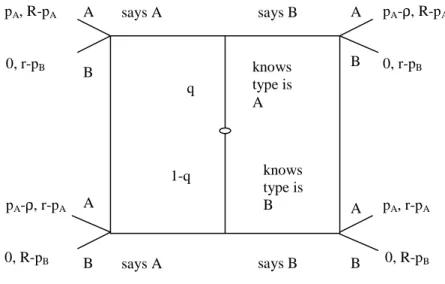
An FI’s strategy can be summarized by two variables: the probability α that a type A customer is correctly advised to choose product A and the probability β that a type B customer is wrongly advised to take product A. Having received a recommendation A to purchase product A, or B to purchase product B, a customer’s strategy can be described, symmetrically, by the probability a of following the advice to take product A, and the probability b of following the advice to take product B. Figure 1 shows the basic information revelation game structure.
We begin by characterizing Perfect Bayesian Equilibria in the informa-tion revelainforma-tion game of FI A, taking as given the prices quoted by the FIs and the customers’ decisions as to which FI to approach. In a second step we shall move back in the game tree and solve for the equilibrium prices and customer decisions on where to bank in the full game. In a Perfect Bayesian Equilibrium, each agent optimally chooses its strategy given equi-librium (and out-of-equiequi-librium) beliefs and the other agents’ strategies. For out-of-equilibrium beliefs we rely on the Cho-Kreps (1987) intuitive criterion to pin down beliefs.
pA, R-pA pA-ρ, R-pA 0, r-pB 0, r-pB pA-ρ, r-pA pA, r-pA 0, R-pB 0, R-pB q knows type is A 1-q knows type is B says A says A says B says B A A A A B B B B
Figure 1: The Information Revelation Game
FIs maximize their profits net of the reputation cost of lying. So, when FI A observes a type Acustomer the necessary condition for FI A to truthfully reveal A’s type is:
apA ≥(1−b)(pA−ρ),
or equivalently, using the notation≡ to mean “defined by”:
∆πA(A)≡(a+b−1)pA+ (1−b)ρ≥0 (2)
Symmetrically, when FI A observes a type B customer, the necessary condition for FI A to truthfully reveal B’s type is:
∆πA(B)≡ −(a+b−1)pA+aρ≥0 (3)
In general, FIs may play mixed strategies.
Customers use equilibrium updated beliefs, when they receive a recom-mendation, to compute their optimal strategies. Under assumptionA2, how-ever, customers only use pure strategies. Denote by X the announcement a customer receives and by p(i|X) the updated belief that a customer receiv-ing the announcement X is of type i (where i= A, B and X = A, B). The
necessary condition for a customer at FI A, receiving a recommendation A, to buy product A is then:
p(A|A)R+ (1−p(A|A))r−pA≥p(A|A)r+ (1−p(A|A))R−pB
This can be simplified to
(2p(A|A)−1)∆≥pA−pB
or equivalently,
∆UA(A)≡(2p(A |A)−1)∆−pA+pB ≥0 (4)
Correspondingly, the necessary condition for a customer at FIA, receiving a recommendation B, to buy productB is:
∆UA(B) = (2p(B |B)−1)∆−pB+pA≥0 (5)
A Perfect Bayesian Equilibrium is then defined by a set of posterior beliefs p(i|X), which are consistent with the optimal behavior of FIs and customers as inferred from the signs of ∆πA(A), ∆πA(B), ∆UA(A) and ∆UA(B). The following lemma provides a characterization of the FIs’ information revelation in equilibrium. It is the central result of our analysis.
Lemma 4 Under assumptions A1 and A2, equilibria in the information rev-elation game of FI A are as follows:
1. If pA < pB−∆, then FI A truthfully reveals the customer’s type and all customers purchase A.
2. If pB −∆ < pA < ρ, then FI A truthfully reveals the customer’s type and the customers purchase the good that matches their type.
3. If max[ρ, pB−∆] < pA< pB+ (2q−1)∆, then FI A always announces
ˆ
A and customers purchase A.
4. If pA> pB+ (2q−1)∆, then either
(a) the FI A mixes its messages for both types of customers (α, β ∈
(0,1)× (0,1)), or mixes its messages for one type of customer (α= 1, β∈(0,1)) or (β = 1, α∈(0,1)) within a range defined by
pA> pB+∆ max[2αq+βαq(1−q)−1,1−2(1−α(1)q−+ (1β)(1−−β)(1q) −q)]
(b) systematically announces Aprovided the out-of-equilibrium beliefs P(B |B) satisfy pA> pB+ ∆ max 2q−1,1−2P(B |B) or
(c) systematically announcesB provided the out-of-equilibrium beliefs
P(A |A) satisfy
pA> pB+ ∆ max
2q−1,2P(A|A)−1
and all customers purchase B.
5. If pA > pB + ∆, then all customers purchase B and any revelation strategy (including full revelation) is an equilibrium
The proof of the lemma is in the appendix. We can now use it to determine for a given set of parametersρ,q,∆, and pricespAandpB what information revelation regime a firm is in. In one interval, pB + (2q−1)∆ < pA < ρ, there exist multiple equilibria: a fully revealing one where customers follow FI A’s advice and many partially revealing equilibria in which all customers purchase product B. However, given that pA < ρ, any partially revealing strategy by a sender type of FIA(where sender types are “Knows customer is typeA” and “Knows customer is typeB”) is weakly dominated by a strategy of full revelation. Hence the partially revealing strategy will not survive any tiny trembles in the customer’s decision, and we ignore it11. Since FI A and FI B are symmetric except for consumer’s ex-ante preferences, we can replicate Lemma 2 for FI B by substituting in (1−q) forq.
In Figure 2 we fix pB and display FI A’s information revelation regime for any possible pA that it may set. We find that when FI A has very low prices, it has the incentives to reveal information truthfully and can capture the whole market. In contrast, when FIA has high prices, it will not get any
11More formally, type “Knows customer is type A” gets a payoff of either 0or p A by
announcingAˆand gets a payoff of either0orpA−ρby announcingBˆ. In the interval of parameters,pA< ρ, so weak dominance is clear. Similarly type “Knows customer is type
B” gets a payoff of either0orpAby announcingBˆ and gets a payoff of either0orpA−ρ by announcingAˆ. Therefore, any partially revealing equilibrium in this interval does not survive the test of trembling hand perfection.
∆ − < ≤ρ pB 0 ∆ − + < ≤ ∆ − p ( q2 1) pB ρ B ρ ≤ ∆ − +( q2 1) pB Fully Revealing, all buy A ∆ − B p p Not Revealing in A, all buy A pB+( q2 −1)∆ Partially Revealing, all buy B pA pA Fully Revealing, all buy A Fully Revealing, customers follow advice Not Revealing in A, all buy A Partially Revealing, all buy B pA Fully Revealing, all buy A Fully Revealing, customers follow advice Partially Revealing, all buy B ∆ − +( q2 1) pB ∆ − B p pB - ∆ ρ ρ
Figure 2: The Information Revelation Regimes of FI A (holdingpB fixed) customers, and will be willing to say anything. For a middle range of prices, FI A may credibly reveal information but only capture the customers who are good matches, or it may reveal nothing and take advantage of its ex-ante advantage in terms of consumers’ preferences.
At this point we have solved the subgame of information revelation given fixed prices. We can now determine how each firm sets its prices and then determine which firm invests in information provision in equilibrium.
4.3.2 The price competition game between specialized FIs
The previous lemma characterizes a number of scenarios where there is either partial or no credible information disclosure, given pA and pB. This limited information disclosure outcome is what one would expect to see in light of our observation that monopoly specialized FIs are never able to credibly convey information. We now show, however, that price competition among specialized FIs is likely to bring about equilibrium outcomes where each FI can credibly convey information. To see this, suppose for the sake of argument that specialized FIs are never able to credibly convey information.
Then, as we showed earlier, Bertrand competition under no information will result in an equilibrium outcome where πB = 0 and πA = (2q−1)∆. But note that bank B will then have a strict incentive to truthfully reveal the customer’s type, as long asρ >0. This is due to the fact that bankB would be able to raise its price pB up toρ, credibly convey information to its well matched customers and make higher profits.
In our formal analysis of the price competition stage game we begin by assuming that firm A is the price leader and firm B is the price follower. This means that FI A essentially defines the choice set of possible informa-tion revelainforma-tion regimes (with their accompanying profits) and FI B decides where to locate in the choice set. Clearly this gives FI B an advantage it never had when customers did not have access to information - it can force some information to be revealed credibly and increase its sales. Our simple observations above lead us to conclude:
Proposition 5 1) WhenA invests in information andB does not, there are
two possible equilibria. If ρ >(2q−1)∆, equilibrium is pA=ρ, pB =ρ+ ∆, all customers approach FI A and are revealed their true types. Customers then purchase at the bank that matches their type, so profits are πA = qρ,
πB = (1−q)(ρ+ ∆). If ρ < (2q−1)∆, equilibrium is pA = (2q−1)∆, pB
undetermined, all customers approach FI A, are all told they are typeA, and purchase at FI A. Profits are πA= (2q−1)∆,πB = 0.
2) When B invests in information and A does not, the equilibrium is
pA= min[(1−q)ρ+ ∆, ρ+ (2q−1)∆], pB =ρ, all customers approach FI B
and are revealed their true types. Customers follow the advice of FI B and profits are πA=qpA,πB = (1−q)ρ.
3) When both A and B invest in information, the equilibrium is pA =
min[(1−q)ρ+∆, ρ+(2q−1)∆], pB =ρ, just as in the case of onlyB investing
in information. All customers approach FI B or are indifferent between approaching FIAor FIB and are revealed their true types. Customers follow the advice of the bank they approach and profits areπA=qpA,πB = (1−q)ρ. The proof is in the appendix. Thus, for almost all of the cases the types of customers are completely revealed, and prices are such that they purchase the product which matches their type. This results from the following intuition: FI B can almost always set its price low enough so that FI A will have zero profits. Therefore FI A must set its price such that FI B will find it more attractive not to undercut. This must be a regime where both FI A
and FI B make positive profits. The only area where both firms may profit is where they can commit to fully revealing types and customers find the price differential small enough to purchase the product which matches their type. The only case in which information is not revealed occurs when ex-ante valuations are so biased towards product A ((2q−1)∆ > ρ) that FI A can extract higher rents by not revealing information. The role of reputation is quite critical here - in order to commit to full revelation, the payoff from deviating must be non-positive, but the size ofρ strictly limits the payoff for the firm that is providing information.
4.3.3 The information provision game between specialized FIs
We are now in a position to roll back to the first stage of the game, where FIs make their investment in information-provision decisions. We have so far taken the information structure as given (which bank provides information). Now we let banks choose whether they want to invest in an information pro-vision technology (hire analysts, build IT systems, etc.) at some fixed12 cost
f >0. To the extent that information provision is a public good and is costly to produce it is efficient for at most one bank to provide this information. We now show that in equilibrium no more than one bank will provide infor-mation, and that it is the disadvantaged bank (i.e. FI B) that is likely to provide that information. This follows from the fact that the disadvantaged bank is the one with the strongest incentives towards truthful revelation of information. Consequently, we are able to obtain the remarkable result that, as long as investment in information provision is profitable in equilibrium, there always will be full information disclosure under competition between specialized FIs.
The basic logic leading us to this conclusion runs as follows. Under no information provision, the unique equilibrium in profits is such that πB = 0 andπA= (2q−1)∆. If bankAwere to provide information and communicate it credibly to its customers it would have to set its marginpAno higher than
ρ. Thus, bank A’s profits under full credible information revelation would be no more than qρ −f. Therefore bank A would not want to provide information whenever (2q−1)∆ ≥ qρ −f. Proposition 5 also states that 12If instead we assumed that there was a constant marginal cost per customer, the
results would be qualitatively the same. Examining a game where the FIs only inform a fraction of their customers (i.e. if they randomize or have a convex cost function) is outside the scope of the paper.
when (2q−1)∆≥ρ and only bankAis in a position to provide information then there will be no credible information disclosure in equilibrium. This appears to set a limit to the amount of credible information disclosure we should expect to see in an equilibrium with competition among specialized FIs.
However, since bankB has, if anything, even more to gain from providing information there will be full credible information disclosure in equilibrium for a much larger set of parameter values.
Proposition 6 There is full credible information disclosure in pure strategy
equilibria when ρ≥ 1−fq.
i) Forρ small (1−fq < ρ < (2q−1)∆+q f) there is a unique equilibrium where FI B provides information and FI A does not.
ii) Forρ large (ρ > (2q−1)∆+q f) three equilibria coexist, one where only FI
A provides information, one where only FI B provides information and a mixed strategy equilibrium.
Otherwise, forρ < 1−fqno information will be disclosed.
The decision to invest is derived from a two-by-two game summarized by the following matrix13:
qpA-f, (1-q)ρ-f (2q-1)∆- (1-q)ρ-f, 0 Info if ρ<(2q-1) ∆ qpA-f, (1-q)ρ-f qρ-f, (1-q)(ρ+ ∆) Info if ρ>(2q-1)∆ qpA, (1-q)ρ-f (2q-1)∆, 0 No Info FI A Info No Info FI B qpA-f, (1-q)ρ-f (2q-1)∆- (1-q)ρ-f, 0 Info if ρ<(2q-1) ∆ qpA-f, (1-q)ρ-f qρ-f, (1-q)(ρ+ ∆) Info if ρ>(2q-1)∆ qpA, (1-q)ρ-f (2q-1)∆, 0 No Info FI A Info No Info FI B
Matrix for Competition among Specialized Banks (A is the price leader) FIB has a strong incentive to provide information since the information gives it the market power it was lacking when all customers ex-ante preferred
13For presentation purposes, we place a strict upper bound such thatf <(1−q)(2q−1)∆. This incorporates the case where the fixed cost is close to zero.
productA. FIAcan free ride on this information provision as its own invest-ment in information would not change its returns. In fact, for intermediate values ofρ, FI Ahas a dominant strategy not to provide information since if FIB doesn’t provide information FIAcan still enjoy its inherent advantage. Once ρ gets larger, FI A can possibly credibly provide information, because it receives a high enough rent to justify its provision. Lastly, notice that asρ approaches zero, all of FI B’s rents disappear in every scenario. The lack of a reputation cost eliminates the ability to credibly reveal information, which FI B used to achieve positive profits.
Total welfare is maximized in the equilibria where full information is provided, since each customer is able to realize more utility due to the match. When information is not provided, as is the case when ρ is tiny, matching efficiency is not realized and welfare decreases.
When FI B is the price leader, the qualitative results do not change substantially. The payoffs are given by the following matrix (the proof is in the appendix): q(ρ+ ∆)-f, (1-q)ρ-f (2q-1)∆- (1-q)ρ+pBI,NI-f, 0 Info if ρ<(2q-1) ∆ q(ρ+ ∆)-f, (1-q)ρ-f qρ-f, (1-q)(ρ-(2q-1)∆) Info if ρ>(2q-1)∆ q(ρ+ ∆), (1-q)ρ-f (2q-1)∆+pBNI,NI, 0 No Info FI A Info No Info FI B q(ρ+ ∆)-f, (1-q)ρ-f (2q-1)∆- (1-q)ρ+pBI,NI-f, 0 Info if ρ<(2q-1) ∆ q(ρ+ ∆)-f, (1-q)ρ-f qρ-f, (1-q)(ρ-(2q-1)∆) Info if ρ>(2q-1)∆ q(ρ+ ∆), (1-q)ρ-f (2q-1)∆+pBNI,NI, 0 No Info FI A Info No Info FI B
Matrix for Competition among Specialized Banks (B is the price leader) A few comments are in order regarding the case where FIB is the price leader. First, the (No Information, No Information) and the (Information if
ρ <(2q−1)∆, No Information) cases are now partially undetermined, since for anypB announced by FIB, FIA will be able to grab all of the customers and leave FIB with zero profits. For the purposes of comparison, we assume
pB is the same in both cases (pNI,NIB = pNI,IB ). Second, the (Information, Information) case is more complex here, since FI A’s advantage in ex-ante
preferences (q > 12) allows it to free ride on FI B in the sense that FI A may keep its prices high and force FI B to inform customers of their types. Indeed, the equilibrium has FIA partially revealing, FIB fully revealing, all customers approaching FI B first and then following FI B’s advice.
Third, it is clear from the (Information, Information) case, and the (No Information, Information) case that FI Ais able to exploit its role as a price follower to its advantage in achieving higher payoffs.
Finally, we find again that for reputation cost that is tiny or equal to zero (ρ < 1−fq), the unique equilibrium is that neither firm provides information. For larger reputation costs, the unique equilibrium is that only FIB provides information. All customers go to FI B, are revealed their true type, and purchase the product which matches their type. Thus, contrasting with the case where A is price leader, there is no multiplicity of equilibria here for large values of ρ.
5
Competition between a one-stop bank and
a specialized FI
In this section we consider competition between a one-stop bank, FI 1, and another FI that remains specialized and offers, say, product B. Since both banks now offer product B, competition is tougher in a certain sense. We begin with the case where FI 1 is the price leader.
5.1
Price leadership by FI
1
When neither FI provides any information zero profits are made on productB in equilibrium. Equilibrium profits are then the same as under competition between specialized FIs. Similarly, the equilibrium under full information (i.e. where customers know their type) is also identical to that of competi-tion between specialized FIs. The reason for this is that since B plays last, it will undercut FI 1. Hence, the power of FI 1to set a lower price for prod-uct B brings no additional advantage - the one-stop bank does not profit strategically or directly from having product B.
When FIB can provide information to customers, however, FI 1can set the pricep1Bstrategically to force FIB into an information revelation regime that is favorable to FI 1. This is the main difference between competition among specialized FIsAandB, and competition between a one-stop bank FI
1 and a specialized FI B when information provision is possible. Therefore, FI 1’ s profit here is at least as high, if not higher, than the profits of FI A in the case of competition among specialized banks14. Recall that in section 4.3.3, we found that pA= min[(1−q)ρ+ ∆, ρ+ (2q−1)∆]in the equilibrium where FI B provides information. In this equilibrium FIA has to setpAlow enough to make sure that FI B would not lower its price in an attempt to grab the whole market. Now, the one-stop bank can discipline FIBby setting its price for product B appropriately and is free to set p1A = (1−q)ρ+ ∆. Hence, FI 1 is able to generate higher profits π1 = q((1−q)ρ+ ∆) in this case. In the cases where FI B does not provide information, though, FI B can undercut FI A on product B, making the solutions exactly the same as when specialized FIs compete.
5.2
Price leadership by FI B
In contrast, when FI B is the price leader, results change in the information revelation game from when there were just two specialized banks competing. Let’s assume that FI B chooses some pricepB.
In the environment where no information is provided, the equilibrium is
p1A = min[(2q−1)∆ +pB, qR+ (1−q)r]and p1B > pB, with all profits going to the one-stop bank and all consumers purchasing product A. This solution is the same as when competition is among specialized FIs.
If instead customers know their type ex-ante, the one stop bank gets all of the profits and consumers purchase the product which matches their type15. Here, the one-stop bank directly steals clientele from FI B by undercutting it on product B. This diverges from the specialized FI solution since the one-stop bank can’t be given an incentive to split the customer base.
When FI 1 decides whether to provide information, the signaling game changes significantly from section 4. First of all, the game for FI 1 can look like the game where a one-stop bank has no competition if it undercuts FI
B, setting p1B = pB −δ (where δ is small). In this case we can apply the results from the signaling game of Proposition 2 to find the solution. It is straightforward to show that if FI 1 undercuts FI B, it will set p1A =
p1B+ρ=pB−δ+ρ and achieve profits ofpB−δ+qρ whenρ >(2q−1)∆, or set p1A = p1B+ (2q−1)∆ = pB −δ+ (2q−1)∆ and achieve profits of
14As summarized in the first payoff matrix of section 4.3.3. 15Restricting attention to pure strategies, ifp
B > r,p1A=Randp1B=pB−δ(where
pB−δ+(2q−1)∆−(1−q)ρwhenρ <(2q−1)∆. This gives FI1weakly larger profits than a specialized FIA gets when FIB does not provide information (compare with Figure 4).
When FIB provides information, however, it may choosepB strategically to avoid undercutting behavior and make positive profits. Basically, it can choose p∗B such that it satisfies the incentive constraint of FI1 to prefer not to undercut on product B. Using this logic and the solution from the case of competition among specialized banks FI A and FI B16, this implies that
p∗
B = min[ρ,1−qq(∆−ρ)]if FI1provides information andρ >(2q−1)∆, and
p∗
B =ρ otherwise. This yields the following payoff matrix:
q(ρ+ ∆)-f, (1-q)ρ-f (2q-1)∆- (1-q)ρ+pBI,NI-f, 0 Info if ρ<(2q-1) ∆ q(pB*+ ∆)-f, (1-q) pB*-f pBI,NI+qρ-f, 0 Info if ρ>(2q-1)∆ q(ρ+ ∆), (1-q)ρ-f (2q-1)∆+pBNI,NI, 0 No Info FI A Info No Info FI B q(ρ+ ∆)-f, (1-q)ρ-f (2q-1)∆- (1-q)ρ+pBI,NI-f, 0 Info if ρ<(2q-1) ∆ q(pB*+ ∆)-f, (1-q) pB*-f pBI,NI+qρ-f, 0 Info if ρ>(2q-1)∆ q(ρ+ ∆), (1-q)ρ-f (2q-1)∆+pBNI,NI, 0 No Info FI A Info No Info FI B
Matrix for Competition between a One-Stop and a Specialized FI (B is the price leader)
Despite the differences in the potential strategies, we find equilibria that are similar to our previous ones17. For ρ < 1−fq , the unique solution is that neither FI provides information. For larger values of ρ, there may either be one equilibrium, where only FI B provides information, or three equilibria, two pure strategy equilibria where only one FI provides information and one mixed strategy equilibrium18.
16Note that in this case, one part of the no-undercutting constraint is thatρ < p
1A− (2q−1)∆. This implies(1−(1−q)(2q−1))∆> ρ, which we assume to be true here.
17Also assuming thatpNI,NI
B =pI,NIB as before.
18Specifically, ifρ < q∆, there is only one equilibrium in the high range (FIB provides
information). If ρ > q∆, for 1−fq < ρ <ˆρ, there is only one equilibrium (FI B provides information), while for ρ > ρˆthere are three equilibria (one where only FI B provides
6
Market Structure
We are now in a position to explore the incentives for a specialized bank to expand its activities and become a one-stop bank and to analyze the welfare implications of such a move. The conditions under which one-stop banks can prosper are quite interesting given current trends. The abolition of the Glass-Steagall act in 1999 paved the way in the United States for the creation of one-stop banks. In Europe, such banks, called “universal banks” have existed for many years, but are now undergoing a shake-up as mergers across borders are seen as necessary for survival19. The traditional explanation for the trend towards consolidation relates to the economies of scope realized by selling multiple financial products from the same outlet. However, by analyzing these banks from an information provision perspective, we open up a richer understanding of market structure20.
Our analysis points out that the gains from merger are largest when rep-utation costs are very low. For very small costs of reprep-utation, no information is provided when specialized banks compete, as the benefits of information disclosure do not cover the cost. However, when the market is dominated by a one-stop bank, advice can be credibly provided even if the bank extracts most of the customers’ value of information. For higher reputation costs this comparative advantage of one-stop banks is eroded, as specialized banks are also able to give advice credibly.
A specialized bank that is competing against another specialized bank may decide that instead of trying to merge with its competitor, it could ex-tend its product line. Clearly, this would soften competition if the market is already homogeneous (such as competition between two FI Bs). How-ever, another product can also be used as a strategic buffer, keeping the other firm from entering a disadvantageous information revelation regime and therefore allowing more profits (we see this when the reputation cost is low (ρ < 2(1q−q)∆) in competition between FI 1 and FI B). Lastly, a monopoly specialized bank would gain substantially by turning itself into
information, one where only FIAprovides information, and one where both FIs mix their strategies). Here we defineˆρ= max[(2q−1)∆+q f,q∆q−f].
19This is echoed in Banking Surveys by The Economist (April 4, 2002) and The Financial
Times (May 24, 2002).
20We also note that the traditional use of the term “conflict of interest” in the context
of one-stop banks refers to the underwriting of securities to subsidize bad loans; we do not consider this issue, instead focusing on information provision.
a multi-product bank, since this would allow it to raise spreads even more while resolving the fundamental conflict of interest problem it faces in giving advice.
From a welfare perspective, when customers are ex-ante fully informed, welfare is maximized under a one-stop bank, but at the expense of con-sumer surplus. When customers are uninformed, welfare is low as all B types purchase product A. Endogenizing information revelation comes close to maximizing welfare (within the cost f of information provision) at the expense of lower firm profits due to competitive pressure. Market power due to conglomeration restores full extraction of the maximized surplus by the FI when information revelation is possible21.
Although we do not model heterogeneity among clients, it is likely that larger and wealthier customers have more information about (or more advis-ers to counsel them on) their specific needs. Interestingly, by being better informed, they could be forced to pay more in terms of higher prices per product. These types of clients may be large money-makers for banks in terms of not only volume, but per-unit return. Indeed, there is a large focus in the banking industry on catering to these higher end customers (‘private banking’). We elaborate on the effect that we describe here in the next section.
7
Unobservable Investments in Information
Provision
In the previous sections we have assumed that customers were able to verify that the bank had made the necessary investment to provide them with reliable information. However, these investments may be difficult to verify in reality. When that is the case, banks’ investments in information provision are subject to moral hazard. Banks will invest in information provision if and only if this leads to higher profits, while customers will only infer the investment has been made when the bank profits from the investment. As a consequence, the nature of the equilibrium is modified.
21How realistic is the notion of market power among financial intermediaries? “A
handful of familiar names Citigroup, J.P. Morgan Chase, Goldman Sachs, Merrill Lynch -dominates these businesses, either because it takes a huge investment to build them, or because only top names are trusted. Yet only Citigroup offers corporate and institutional clients the full range of services...” (The Economist, April 4th, 2002)
A natural question that then arises is what impact the observability of information provision services has on the industry. This question becomes even more salient when we discuss the nature of Independent Financial Advi-sors, advisors separate from banks who may or may not be providing “good” information.
7.1
Unobservable investments with competition between
specialized FIs
The basic timing of the game remains the same, except that the investment in stage 1 in information provision is observable only to the firm making the investment. The values of all parameters of the game are common knowl-edge among all participants. For brevity, we will only focus on the case of competition between specialized banks where FI A is the price leader.
Consider the equilibrium where FIB invests in information acquisition at costf and provides advice to all customers. If investment is unobservable, FI
B may find that it is more profitable to save on the costf by not investing in information acquisition and to just make uninformed recommendations. In this situation, to make sure that FI B does have the right incentive to invest in information acquisition, the following incentive constraint must hold:
(1−q)pB−f > pB−qρ (6)
To understand this constraint, note that the highest payoff FI B can get by deviating and giving uninformed advice is to simply always recommend product B (since the beliefs of customers are held fixed). In that case it always sells product B at price pB but also pays a reputation cost on the fraction qof A-type customers. On the other hand, if FIB does invest in in-formation it is able to recommend productB only to well-matched customers and thus avoid paying a reputation cost for poor advice. This incentive con-straint puts an upper bound onpB ofρ−fq. Notice that this is strictly lower than the upper bound for credible information provision when investment in information is observable (ρ). Adding the participation constraint:
(1−q)pB−f > 0
and setting pB equal to its upper boundρ− fq, then requires that:
ρ > f
for information provision to be credible in equilibrium. This condition on the reputation cost is strong. In particular, in the interval for ρ, ((1−fq),(1−fq)q), information would be provided when investment is observable but would not under unobservable investment.
Similarly, in equilibria where FIAis providing information we can derive an incentive constraint for FI A by substituting 1− q for q in equation 6 and set FI A’s price equal to the maximum of this interval, ρ− 1−fq. The participation constraint for FI A is not symmetric, however, since FI A’s payoff from not investing in information is positive: (2q−1)∆. Thus the participation constraint reduces to:
qpA−f >(2q−1)∆ =⇒ ρ > f (1−q)q +
(2q−1)∆
q
As in the case of observable investment, an equilibrium that has FI A invest-ing in information only occurs for higher reputation costs ρ. It is also clear that the cutoff for which there are equilibrium where either FI A or FI B provide information is higher here than in the case of observable investment (where it was fq + (2q−q1)∆).
Note also that now there is always an equilibrium where no firm invests in information. This is clear when we look at the incentive constraint. If the FI does not invest in information and the customers know this, it gets some non-negative payoffπ˜. By deviating and investing in information, given that customers believe it will not provide any, its payoff will beπ˜−f. We call this the “Cassandra effect”, as the FI may have valuable information to reveal, but no customer is listening.
In sum, the set of equilibria resembles that for observable information acquisition with two main differences. First, there is a larger interval for which no information provision is the unique equilibrium. Second, due to the “Cassandra effect”, no information provision is always an equilibrium.
7.2
Independent Financial Advisors
In the negotiations leading up to the $1.4 billion settlement between Wall Street investment banks and Elliot Spitzer and the SEC, an important pro-posal for resolving conflicts of interest of “sell-side” analysts in investment banks was the creation of a fully independent research entity that would employ these analysts. Although this idea was eventually shelved, separat-ing financial advice from the sale of financial products seems like a simple
and appealing remedy to address the kinds of conflicts of interest we have considered so far. Two forms of separation may be envisioned: a limited form within each bank that sets up so-called “Chinese walls” between the analysts and the sales people, or the more radical form, which would involve spinning off in-house financial analysts into full-fledged independent financial advisors (IFAs)22. So far, only the former type of separation is required, al-though the “Chinese walls” that have been in place all along (but probably had been easily circumvented by meetings in Chinese Restaurants) have now been significantly tightened under the Sarbanes-Oxley Act.
Some of the key issues in the negotiations with Elliot Spitzer concerned the quality of financial advice under an independent entity, analysts’ incen-tives to do the necessary research, and the form of their compensation. It turns out that our analysis here can shed light on these core issues23. In particular, in our model the separation of analysts into IFAs can be strictly beneficial to the financial intermediaries. In addition, as we now illustrate, it is generally easier to create incentives for IFAs to acquire costly informa-tion and to credibly provide advice than for in-house analysts. As in the previous section, we limit our focus to the case of competition between two differentiated specialized banks.
The fact that financial intermediaries will benefit from credible informa-tion provision by IFAs is easy to see. Suppose that the financial advisor has the correct incentives to tell the truth24. Then customers have perfect infor-mation before they approach the banks. As shown earlier in the paper, when competition exists between specialized banks, profits are larger under full information than when information must be provided by the banks directly. The banks charge lower prices when they must provide their own information in order to credibly convey that information. In either case, total surplus is 22We specifically define IFAs as advisory firms which don’t sell financial products; in the
UK, IFAs may sell financial products (their independence is defined by not being owned by a financial product provider). Interestingly enough, a study by the UK’s Financial Service Authority and Charles River Associates (2001) found that “There is significant bias in the advice” of these types of financial advisors on some of the products they sell.
23The type of conflict of interest in the SEC case are not exactly of the type that we
model here. We attempt to give insight into some of the similar issues that arise.
24This can be easily accomplished if the independent financial advisor charges a fixed
amount for each customer, but suffers a positive reputation cost if she lies. Alternatively, the advisor may be paid a fixed amount irrespective of the number of customers by an FI, but still suffer some reputation cost (such as firing when customers complain), and the results will go through.
the same, since all customers match perfectly, although consumer surplus is clearly lower when financial advice is delivered separately.
To see why IFAs have better incentives for information acquisition note that the incentive constraint25 for IFAs is given by:
ρI > 1−f q
whereρI is the reputation cost of the IFA. Indeed, if the IFA does not invest in information it saves f but it incurs a reputation cost of ρI(1− q). If
ρI =ρ, we thus observe that the IFAs will provide information for the same range of parameters as specialized banks with observable investments. The IFAs will provide information in some cases when specialized banks with unobservable investments do not, namely ρ ∈ ((1−fq),(1−fq)q). In this case, IFAs help the specialized banks by revealing information where the banks couldn’t, as well as allowing the banks to extract more rents. As a caveat, however, the reputation cost ρI may arguably be less than ρ, due to the fact that there is much less at stake in a continuing relationship between an IFA and a customer. This could reduce the provision of information by IFAs relative to specialized banks. We also note that for all parameter values there exists a “Cassandra effect” equilibrium where the IFA does not invest in information, as before.
8
Conclusion
This paper considers several aspects of market structure from the perspec-tive of information provision to customers. By using this alternaperspec-tive road we obtain a new perspective on conflicts of interest and consolidation in the banking industry. We have found that competition fosters information pro-vision when reputation costs are present. The fact that a specialized FI has incentives to provide information may surprise, since it will always lose to its competitor the customers that are not of its type. Still, if we consider as the starting point a situation where absent information a FI will get no customers, providing information appears as an additional tool in the com-petition for market share.
25In the constraint, we implicitly assume the type of fixed amount per customer
We have also found that the gains from increasing the number of financial products offered and becoming a one-stop bank are largest when market power can be exerted or customers have switching costs. Without these built in customer bases, competition erodes the profit margins for information revelation. Finally, financial intermediaries may actually have an incentive to separate advice from sales as it could allow them to differentiate their products and receive higher margins.
It would be interesting to extend this line of research in a dynamic di-rection in order to quantify the potential reputation costs that banks may incur. Another aspect that is worth further examination is allowing for het-erogeneity in customer’s knowledge of their types. With the advent of the internet and private banking, it is probable that certain clients have better information about which investments best match their needs. Our results in this context suggest that if customers have more information, market power and rents can actually increase, making this topic quite relevant to policy discussions.
9
References
Benabou, Roland and Laroque, Guy. (1992), “Using Privileged Information to Manipulate Markets: Insiders, Gurus, and Credibility”,Quarterly Journal of Economics, 107, 921-958.
Bester, Helmut. (1998), “Quality Uncertainty Mitigates Product Differ-entiation”, RAND Journal of Economics, 29:4, 828-844.
Cho, In-Koo and Kreps, David (1986), “Signaling Games and Stable Equi-libria”, Quarterly Journal of Economics, 102, 179-221.
Darby, M.R. and Edi Karni (1973) “Free Competition and the Optimal Amount of Fraud.” Journal of Law and Economics, Vol. 16, pp. 67—88.
Demski, Joel and David Sappington (1987), “Delegated Expertise.” Jour-nal of Accounting Research, Vol. 25, pp. 68—89.
The Economist (April 4th, 2002), “Big, Bigger, Biggest”,The Economist. Emons, Winand. (1997), “Credence Goods and Fraudulent Experts”,
Rand Journal of Economics 28, 107-119.
Emons, Winand. (2001), “Credence Goods Monopolists”, International Journal of Industrial Organization, 19, 375-389.
Garicano, Luis and Tano Santos (2004), “Referrals”,American Economic Review (forthcoming)