Glenn
Forbes
1Dale G. Gehring
1Colum A
.
Gorman
2Michael D
.
Brennan
2Ian
T. Jackson
3This article appears in the May/June 1985
issue of AJNR and the July 1985 issue of AJR.
Received March 28, 1984; accepted after revi-sion October 10, 1984.
1 Department of Diagnostic Radiology, Mayo
Clinic and Mayo Foundation, Rochester, MN 55905. Address reprint requests to G. Forbes.
2 Division of Endocrinology, Metabolism and In-ternal Medicine, Mayo Clinic and Mayo Foundation,
Rochester, MN 55905.
3 Section of Plastic and Reconstructive Surgery, Mayo Clinic and Mayo Foundation, Rochester, MN 55905.
AJNR 6:419-424, May/June 1985 0195-6108/85/0603-0419 © American Roentgen Ray Society
Volume Measurements of
Normal Orbital Structures by
Computed Tomographic
Analysis
Computed tomographic digital data and special off-line computer graphic analysis were used to measure volumes of normal orbital soft tissue, extraocular muscle, orbital fat, and total bony orbit in vivo in 29 patients (58 orbits). The upper limits of normal for
adult bony orbit, soft tissue exclusive of the globe, orbital fat, and muscle are 30.1 cml, 20.0 cm3
, 14.4 cm3, and 6.5 cml, respectively. There are small differences in men as a group compared with women but minimal difference between right and left orbits in the same person. The accuracy of the techniques was established at 7%-8% for these orbit structural volumes in physical phantoms and in simulated silicone orbit phantoms in dry skulls. Mean values and upper limits of normal for volumes were determined in adult orbital structures for future comparison with changes due to endocrine ophthalmopathy, trauma, and congenital deformity.
Late-generation computed
tomographic
(CT) scanners
can
demonstrate
small
differences of contrast
(density) even
in small structures
(1-2
mm)
.
Although the
absolute density measurements are
seldom reliable enough to offer significant
specificity [1], the relative differences
are
sufficiently
consistent to
provide
repro-ducible boundaries for
image
display and volume determination.
Summation of
pixel counts in successive cross-sectional
areas based on density ranges can
provide volume measurements of
three-dimensional structures [2, 3]. Brenner et
al.
[4],
using 10-mm slice widths and
1-cm intervals,
reported
10% accuracy
of
calculated CT volumes of large viscera
correlated with
cadaver measurements.
Heymsfield et al.
[5] showed
5
%
accuracy of direct
cadaver
organ
CT volume
measurements
.
Similar measurements have been performed on
dog
organs
with
commercially available CT scanners and off-line analysis
[6].
Recently
,
Forbes et
al.
[7]
described pilot studies with
special
off-line
computer
programs
to measure
small-structure volumes in the orbit.
If thin slices (
1.
5
mm)
and
high
contrast
differences for boundary display are used
,
measurements accurate
within 1%-7%
are achieved for volume determinations
in the range
of
4-60
cm
3in
physical
phantoms, depending on technique and specific
structural
volume
.
Although these
techniques can
be used in any area of
the body, the orbit
is
an
excellent subject for computerized volume
study for several reasons. Marked
differences in contrast exist among the
intraorbital structures
,
which consist of fat
,
muscle, fluid (in the globe), air
(in
adjacent
sinuses), and bone
,
that
minimize the
overlap of density ranges for determining boundaries
.
Furthermore
,
no
comprehen-sive normal in vivo volume studies of the different orbital
components with
docu-mentation of the accuracy of the techniques have been attempted
.
Previous
attempts at orbital volume determinations have been limited
to in vitro animal
studies, dry-skull human studies
,
and
in
vivo estimates of total
bony
orbit
volume
from linear radiographic measurements without
regard to soft-tissue
components
.
420
FORBES ET AL.
AJNR:6, May/June 1985A
B
c
Density
60
~fiIlh-.
Density
30
Fig. 1.- A, CT digital data acquisition. Continuous and contiguous thin slices through three-dimensional structure provide series of planes for pixel counting. B, Pixel counting. Pixels representing structure of interest are differentiated from other areas through predetermined range of attenuation density. Pixels contiguous with starting point ("seed point") and falling within prescribed density range are selectively counted ("neighborhood-sampling," "region-growing" tech-niques). C, Voxel calibration. Each pixel count represents three-dimensional voxel of measurable volume determined by matrix size and scanner configu-ration. Total structural volume may then be calculated from summation of pixel counts of all slices.
Materials and Methods
Digital data were obtained from CT examinations performed with
a General Electric 8800 system. Each examination consisted of 30 to 40 adjacent 1.5-mm slices made through a physical phantom and the orbits of a skull phantom and between 25 and 30 slices through
the orbits of a normal patient. In the skull phantom and normal patient studies, the axial slices were obtained at 0° to -10° from the
orbitomeatal baseline. The patients were encouraged to fix their gaze
on focusing points on the overhead gantry during scanning. Small
changes in eye direction that occur in all orbit studies likely accounted for part of the measured range of technical error. Patients with
obvious misregistration artifacts from eye movements were omitted from the study group. The scan data were then transferred to a Nova
830 stand-alone computer system with Data General drive and
Grin-nell image display for off-line analysis. Special software programs, as
described in a report by Forbes et al. [7], were used to generate pixel
counts of prescribed anatomic structures for volume surveys (fig. 1).
Region-growing, neighborhood-sampling, and automatic-tracing al
-gorithm techniques were used for boundary display [14]. Pixel counts
were summated from all slices and multiplied by a conversion factor (0.00096 cm3/pixel for the 0.8 x 0.8 x 1.5 mm voxel) for total volume measurement (fig. 2).
The physical phantom was constructed from a cone-shaped plastic cup containing water and pencils to simulate orbital fat and muscle with different density ranges. Numerous scans and volume calcula-tions were obtained with different amounts of water to empirically determine the most favorable density ranges and the counting tech-niques with the least intrinsic method error and observer variability.
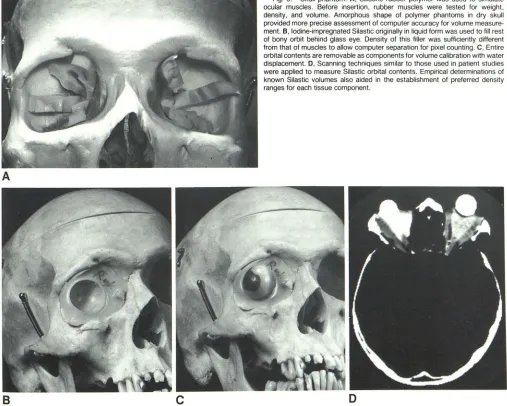
A more realistic phantom was then constructed to simulate an in vivo orbit study (fig. 3). Silicone was used to construct the simulated fat and muscle filling the orbit in a dry skull, and a glass marble was positioned to represent the globe. Irregularly shaped strips, used to represent muscle tissue, were cut from a solid block of pure silicone.
The volume of these strips was measured by water displacement (Archimedes principle) before they were attached to the orbital walls in the skull. Iodine-impregnated fluid silicone, representing fat tissue,
was poured into the remaining volume of the orbital cavity. After hardening of the iodine-impregnated silicone, the entire mass could be removed for volume measurement. The composite silicone masses were replaced into the skull and scanned with the same CT tech-niques used for the human studies described below. Display window controls were used to determine upper and lower CT attenuation number bounds of the silicone models between 900 and -100 H. The right phantom orbit was constructed after the left orbit with slightly increased iodine concentration in silicone, which provided improved definition of different material margins. Numerous runs empirically demonstrated the most accurate boundary range settings for densities of the test material. Range settings for the in vivo studies were then based on the densities of the measured structures.
For in vivo analysis, 29 examinations for volume measurements of the orbital soft tissues were performed in 29 normal patients. The study group consisted of 12 women, nine men, five girls, and three boys. Adult status was established at 25 years for complete stabili
-zation of orbitofacial growth. Adult ages ranged from 28 to 76 years; pediatric ages ranged from 6 months to 22 years. All patients were euthyroid without proptosis and generally were referred for orbital CT to evaluate the optic nerves for field cuts and scotomata. Results of all CT imaging examinations were normal in both orbits. Digital data from the CT examination were transferred by tape for the off-line analysis, as described above.
For clinical studies, computed volume measurements were deter -mined for total bony orbit, total orbital soft tissues exclusive of the globe, orbital neuromuscular tissue, and orbital fat. For computer analysis, the bony orbit was defined as the cone-shaped space bounded by the medial and lateral orbital walls, by the orbital roof and floor, and anteriorly by a line from the anterolateral wall to the anteromedial nasal prominence. The ocular muscles were all soft tissues within the soft-tissue-density range exclusive of the optic nerve. The orbital fat was represented by soft tissues below the isodense soft-tissue ranges used for muscle computations.
Results
Measurements were tabulated in three categories
:
(1) the
physical phantom
,
(2) the dry-skull-and-silicone-orbit
phan-tom
,
and (3) normal in vivo patient examinations.
Data from
the first two groups were used to determine levels of precision
and accuracy for the technique
.
The patient study group was
used fo
r
determination of actual orbital structure volumes
.
In the physical phantom
,
volume calculations of water in
the range of
20
-
50
cm
3Fig. 2.-A, In vivo density range selection. In orbit, wide range of different tissue densities provides good selection of ranges that can be used with
A
minimal overlap. B, In vivo pixel counting. Pixels within each specific density range (in this case, intraconal and extraconal fat) are summated in each slice.
Fig. 3.-Skull phantom. A, Silicone rubber polymer was used to simulate
ocular muscles. Before insertion, rubber muscles were tested for weight, density, and volume. Amorphous shape of polymer phantoms in dry skull provided more precise assessment of computer accuracy for volume measure -ment. B, Iodine-impregnated Silastic originally in liquid form was used to fill rest of bony orbit behind glass eye. Density of this filler was sufficiently different from that of muscles to allow computer separation for pixel counting. C, Entire orbital contents are removable as components for volume calibration with water
displacement. 0, Scanning techniques similar to those used in patient studies were applied to measure Silastic orbital contents. Empirical determinations of
[image:3.612.57.556.88.244.2] [image:3.612.50.557.327.733.2]422
FORBES ET AL.
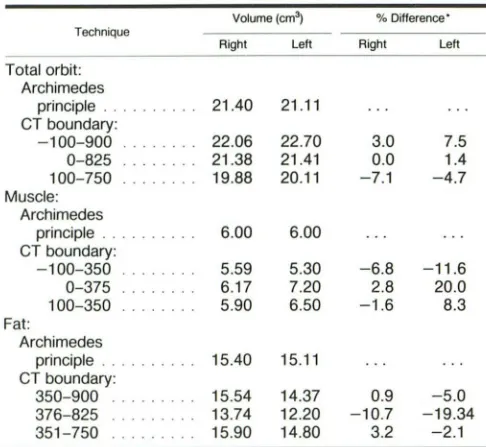
AJNR:6, May/June 1985TABLE 1: Volume Measurements in Orbital Phantom
Volume (cm3) % Difference· Technique
Right Left Right Left
Total orbit: Archimedes
principle ... 21.40 21.11
CT boundary:
-100-900 22.06 22.70 3.0 7.5
0-825 21.38 21.41 0.0 1.4
100-750 19.88 20.11 -7.1 -4.7
Muscle: Archimedes
principle ... 6.00 6.00
CT boundary:
-100-350 5.59 5.30 -6.8 -11.6
0-375 6.17 7.20 2.8 20.0
100-350 . .
.
.
.
.
.
. 5.90 6.50 -1.6 8.3Fat:
Archimedes
principle .. 15.40 15.11
CT boundary:
350-900 . . . . . . .
.
. 15.54 14.37 0.9 -5.0376-825 ... 13.74 12.20 -10.7 -19.34 351-750 15.90 14.80 3.2 -2.1
• % difference from Archimedes displacement value.
simulating
muscle groups
,
volume calculations were all with
i
n
7
%
of the actual measurements by water displacement.
lim-itations were due to observer
error
of boundary margins
,
overlap
of density ranges at the boundaries
for
tracing
algo-rithms
,
and
partial-volume effects.
Computer
calculations from
the
silicone-orbit-and-dry-skull
phantom were
compared
with water displacement values
.
Three
CT number
ranges tested
in
each
structure group
resulted
in comparative
differences of 0
%-
20
%.
After
empir-ical testing
,
boundary
ranges
properly
selected
for appropriate
structural
densities gave volume calculations within 7
.
5
%
-8
.3%
of water displacement values
.
These
ranges
are listed
in
table
1. A proper selection of boundary ranges was
impor-tant
to maintain
reproducibl
e results in both phantom and in
vivo
s
tudies
.
Ranges were chosen by observation to give the
most clearly
defined borders between different types of tissue.
For the in
vivo patient studies
,
attenuation ranges of -135 H
to
0
and
0 to
+
135 H were used
for
fat and muscle
,
respec-tively, although
these attenuation numbers for boundary
ranges would
likely vary among
scanners
of different type or
manufacture
.
For
the
in
vivo
patient
studies
,
volume
calculations
included
total
bony
orbit,
total orbital
soft
tissues e
x
clusive of
the
globe
,
neuromuscu
lar soft
tissue
,
and orbital fat. The mean
±
2
SOs was established
to
arbitrarily
define
a
normal range
for
s
ub
seq
uent
studies
of
ophthalmopathy
.
Adult male and
adult female values are
listed
in
table 2.
A wider
scale
in bony orbit volumes in men
than
in women
may
have
been due to scanning techniques
,
although this
was
not
appare
nt from
the
ima
ges
. The differences between
right and
l
eft
total bony orbit
volumes
in
all persons were
0
.
01
-1.95
cm
3.
Similar differences for fat and
muscle
meas-u
red
between right and
left
orbits in the same
person
are
l
isted
in
table
2
.
The range of total orbital soft-tissue volume exclusive of
the globe in the pediatric orbit was from 5
.
1 cm
3in an infant
to 13.93 cm
3in a young adult. Because of the developmental
span, there was less immediate significance to the individual
volume measurements in the eight pediatric subjects
,
al
-though relative fat
-
to-muscle ratios could be compared with
those in adults
.
The ratio of fat to muscle ranged from 1
.
00
to 1
.
86
,
with a mean of 1.54. No trend corresponding to either
age or gender was noted in the range of the ratio in the eight
pediatric subjects.
Discussion
The soft tissues of the orb
i
t compr
i
se the globe
,
largely
filled with aqueous and vitreous fluid
;
the muscle groups
;
small neurovascular structures often adjacent or intertwined
with the muscles
;
the lacrima
l
gland
;
and orbital fat. Infiltrative
processes
,
particularly Graves disease
,
frequently increase
the volumes of the muscle and fat compartments [15].
For-tunately
,
for the purposes of computer analysis
,
there is
significant contrast difference between these anatomic
com-partments to allow separation and measurement and thus to
establish normal volume ranges that can be used for future
comparisons with such infiltrat
i
ve d
i
seases
.
With CT volume measurements
,
the task of CT scanning
has been changed from creating images to determining the
number of pixels belonging to a predefined density range
.
Region-growing algorithms have then been used to determine
the number of pixels of each category for each slice
.
The
range
of CT attenuation values
,
along with a starting point
,
is
identified for the category of interest. The computer then finds
and
counts
all connected pixels that make up that region
,
and
the process is repeated for all
regions
of interest from all CT
slices
.
The summation of all pixels for each category when
multiplied by a conversion factor represents the estimate of
the total.
A
l
though there are variations among individuals
,
the range
of normal adult measurements generally lies within 2 SOs of
the mean
,
an indication of a relatively low variability about the
mean
.
We define the normal adult male bony orbit as one
with a volume that can range between 16 and 30 cm
3.
The
upper limit of normal is 30.1 cm
3,
and values above this
represent abnormally enlarged orbits
.
Similarly
,
the upper
limits of normal for orbital
soft
tissue exclusive of the globe
,
muscle
,
and
fat
are 20.0 cm
3,
6
.
5 cm
3,and 14.4 cm
3,respec-tively, when values 2 SOs above the mean are used. We
define
corresponding
values in the women as 17
.
2 cm
3,
6
.
2
cm
3,
and 12
.
3 cm
3.The bony and soft-tissue volumes are
slightly greater in men as a group than in women
.
Volumes of the bony orbit and total orbital soft tissue vary
from 0
%
to 8
%
between the right and left orbits when
measured
in
the same person
.
This likely reflects both small
anatomic differences and the accuracy of the technique
.
For
the smaller-volume compartments of fat and muscle, the
measurable difference between right and left orbits in the
same person is
11
%
and 17
%.
This in part reflects the greater
error
related to measurement of very small volumes
.
Thus,
[image:4.613.54.297.94.318.2]TABLE 2: Normal Values of Adult Orbital Tissues (42 Orbits)
Volume (em')
Structure Upper
Mean Range Mean ± 2 SO Limit of
Normal
Bony orbit:
Female
...
...
.
.
..
.
...
.
23.92 21.58-29.43 29.4Male . . . . .
.
. . . . . . . . . ..
.
. 23.63 16.18-30.11 30.1Difference (R vs. L)* . . . 0.43 0.01-1.95 8%t
Orbital soft tissues exclusive of globe:
Female . . . . . . . 14.83 12.70-17.30 12.49-17.17 17.2
Male . . . .
.
. 15.99 12.07-19.25 11.94-20.03 20.0Difference (R vs. L)*
...
...
..
.
.
.
0.30 0.10-1.29 8%tOrbital neuromuscular tissue:
Female . . . .... 4.69 3.66-6.20 3.19-6.19 6.2
Male . . . ... . . . . .
.
.
. 4.79 3.07-6.18 3.10-6.49 6.5Difference (R vs. L)* . . . .
.
. 0.01 0.01-0.83 17%tOrbital fat:
Female . . . ... 10.10 8.22-12.20 7.85-12.34 12.3
Male . . . ... 11.19 8.56-14.00 8.01-14.37 14.4
Difference (R vs. L)* . . . . . . . . 0.35 0.00-1.30 11%t
• Difference between right orbit measurement and left orbit measurement in the same person for all adults. t Upper limit of normal variance measured for one orbit compared with the other (in the same subject).
tissues would be necessary to reliab
l
y measure unilateral
ophthalmopathy in an individual subject. For specific
com-partments of smaller volume
,
such as fat and muscle
,
in
-creases greater than 11
%
and 17
%
,
respective
l
y, wou
l
d be
necessary to re
l
iably distinguish uni
l
ateral ophthalmopathy on
the basis of fat or muscle alone
.
Certain assumptions are made in establishing these values
as norma
l
standards
.
Tiny neurovascular
channels
are
iso-dense in CT imaging and
thus are
averaged
into
muscle
bundles in volume measurements
.
Because
the
anterior
bor-der of the orbit is open
,
it
is subject to
different definitions of
boundary. F
i
nally
,
the
values must be considered to have
an
error of 1
%-7%
,
depending on the
relati
ve
size
of the volume
measureme
n
t. Ne
v
ertheless, these values are un
i
form within
the g
r
o
u
p a
n
d may be used for compariso
n
studies
for
processes that resu
l
t in volume changes of orb
ital fat
or
muscle.
Various methods to evaluate orbital volumes have
been
used in the past,
including
linear measurements
,
stereora-diography
,
radiographic tomography
,
and in vitro dye studies
in animals
.
All prev
i
ous studies have been limited to bony
orbit volumes
,
dry-skull in vitro determinations
,
or gross
esti-mates of in vivo bony orbit volume
from
plain
radiographic
linear measurements. Linear methods suffer from gross
esti-mates of the irregular polymorph
i
c and s
l
ightly ellipsoid shape
of the bony orbit, and they led to vo
l
umetric determinations
of filler materials in dry skulls
.
In a description of rubber
implants for orbit volume stud
i
es in rabbits, Sarnat [16
,
17]
provided an excellent source of review
for
previous orbital
volume methods. Alexander et
al. [18]
determined bony orbit
volumes in human skulls by use of
sand,
but
they found
poor
correlation with estimated volumes from
radiographic meas
-urements
.
Feldon and Weiner
[19] reported
linear
outline
assessment on CT scans to estimate
the
normal muscle
volume in four patients, although neither description of normal
ranges i
n
differe
n
t subjects nor documentation of the
accu-racy
of
the
technique was
provided.
Although useful
for
estimating
bony orbit volume
,
none of
these
methods
could
evaluate soft-
tissue orb
ital contents or
be used
for
practical
in vivo
study
of clinical subjects
.
Sonography has been used in preliminary
studies
for
both
image
detection
and
assessment of
the
orbital muscles
in
Graves disease [13]
.
Yamamoto et al. [20]
used B-mode
sonography to
measure orbital
soft-tissue
volumes
in 31
patients with
Graves disease
and in six
normal
controls
.
Although no phantom studies
were
performed to
establish
the
accuracy
of their
technique
,
the
ranges determined for
normal and abnormal values were
closely similar for both in
vivo
techniques
.
In their six normal Japanese
controls
,
single
orbital muscle volume had a mean of 3.3
cm
3±
1.3
and total
bony orbit volume was 24
.
0-26
.
7
cm
3.
The mean
single orbital
muscle vo
l
ume in patients with Graves disease
was 6.6 cm
3± 2
.
7
.
Our own preliminary
application of these techniques to
patients with this disease
showed similar
increases
distributed
over a wide spectrum of
clinical variants
.
[image:5.614.125.490.95.289.2]424
FORBES ET AL.
AJNR:6, May/June 1985contrast are necessary to discriminate the measured object
from
surrounding
tissue for clinical in vivo studies. These
techniques may provide
a useful tool in a multitude of
situa-tions involving volume considerasitua-tions as part of a pathologic
process.
ACKNOWLEDGMENTS
We thank A. Bennett Reeves, maxillofacial prosthetist, Department
of Dentistry, Mayo Clinic, for aid in preparing the orbit phantom and Gerald McGrath, Section of Medical Pathology, Mayo Clinic, for aid in phantom volume measurement with Archimedes principle.
REFERENCES
1. Levi C, Gray JE, McCullough EC, Hattery RR. The unreliability of CT numbers as absolute values. AJR 1982; 139: 443-447 2. Rhodes ML. Towards fast edge detection for clinical 3-D
appli-cations of computer tomography. In: Proceedings of the Sixth
Conference on Computer Applications in Radiographic and
An-atomical Radiology Images. Newport Beach, CA: Institute of Electrical and Electronic Engineers, 1979:321-327
3. Rosenfeld A, Kak AC. Digital picture processing. New York: Academic, 1976
4. Brenner DE, Whitley NO, Houk TL, Aisner J, Wiernik P, Whitley
J. Volume determinations in computed tomography. JAMA
1982;247: 1299-1302
5. Heymsfield SB, Fulenwider T, Nordlinger B, Barlow R, Sones P, Kutner M. Accurate measurement of liver, kidney, and spleen volume and mass by computerized axial tomography. Ann Intern
Med 1979;90: 185-187
6. Moss AA, Friedman MA, Brito AC. Determination of liver, kidney, and spleen volumes by computed tomography: an experimental
study in dogs. J Comput Assist Tomogr 1981;5: 12-14
7. Forbes G, Gorman CA, Gehring 0, Baker HL Jr. Computer
analysis of orbital fat and muscle volumes in Graves
ophthal-mopathy. AJNR 1983;4:737-740
8. Riley FC. Orbital pathology in Graves' disease. Mayo Clin Proc 1972;47:975-979
9. Solomon DH, Chopra IJ, Chopra U, Smith FJ. Identification of subgroups of euthyroid Graves's ophthalmopathy. N Engl J Med 1977;296: 181-186
10. Trokel SL, Hilal SK. Recognition and differential diagnosis of enlarged extraocular muscles in computed tomography. Am J
Ophthalmol 1979; 87: 503-512
11. Trokel SL, Jakobiec FA. Correlation of CT scanning and patho-logic features of ophthalmic Graves' disease. Ophthalmology
1981 ;88: 553-564
12. Werner SC. Classification of the eye changes of Graves' disease (editorial). J Clin Endocrinol Metab 1969;29:982-984
13. We mer SC. Modification of the classification of the eye changes of Graves' disease: recommendation of the Ad Hoc Committee of the American Thyroid Association (editorial). J Clin Endocrinol
Metab 1977;44:203-204
14. Keller JM, Edwards FM, Rundle R. Automatic outlining of regions on CT scans. J Comput Assist Tomogr 1981;5:240-245 15. Forbes G. Computed tomography of the orbit. Radiol Clin North
Am 1982;20:37-49
16. Sarnat BG. The orbit and eye: experiments on volume in young
and adult rabbits. Acta Ophthalmol {Suppl] (Copen h)
1981;147:1-44
17. Sarnat BG. Orbital volume in young and adult rabbits. Anat Embryol (Berl) 1980;159:211-221
18. Alexander JCC, Anderson JE, Hill JC, Wortzman G. The deter-mination of orbital volume. Can J Ophthalmo/1961;24: 1 05-111 19. Feldon SE, Weiner JH. Clinical significance of extraocular muscle
volumes in Graves' ophthalmopathy: a quantitative computed
tomography study. Arch Ophthalmo/1982;100: 1266-1269
20. Yamamoto K, Itoh K, Yoshida S, et al. A quantitative analysis of orbital soft tissue in Graves' disease based on B-mode ultrason-ography. Endocrinol Jpn 1979;26:255-261
21. Forbes GS, Earnest F IV, Waller RR. Computed tomography of orbital tumors, including late-generation scanning techniques.