Baghdad Science Journal
Vol.16(2)2019
DOI:http://dx.doi.org/10.21123/bsj.2019.16.2.0419
Fog Computing Resource Optimization: A Review on Current Scenarios and
Resource Management
Ab Rashid Dar
1*D Ravindran
2Received 9/9/2018, Accepted 13/1/2019, Published 2/6/2019
This work is licensed under a Creative Commons Attribution 4.0 International License.
Abstract:
The unpredictable and huge data generation nowadays by smart computing devices like (Sensors, Actuators, Wi-Fi routers), to handle and maintain their computational processing power in real time environment by centralized cloud platform is difficult because of its limitations, issues and challenges, to overcome these, Cisco introduced the Fog computing paradigm as an alternative for cloud-based computing. This recent IT trend is taking the computing experience to the next level. It is an extended and advantageous extension of the centralized cloud computing technology. In this article, we tried to highlight the various issues that currently cloud computing is facing. Here in this research article, we present a comprehensive review of fog computing, differentiating it from cloud computing, also present various use-cases of fog computing in different domains, we came to conclude that Fog computing leads in an efficient energy resource management, leveraging the energy both in terms of consumption and cost scenarios. Further, we highlighted its key features, challenges and issues, resource optimization methods.
Key words: Actuators, Cisco, Cloud computing, Fog computing, Resource management, Sensors.
Introduction:
Cloud computing paradigm is an acronym used for Internet and is defined as computing paradigm model for enabling global, suitable, on-demand network accesses to the related configurable computing resources like networks, servers, storage, applications and services that can be rapidly provisioned and released with minimal efforts or service provider intervention(1). The most challenging concerns of centralized cloud computing are resource management, its optimization in utilization and cost analysis. (2).Edge computing optimizing cloud computing systems by taking the control of computing applications, data, and services away from some central nodes (the "core") to the other logical extreme (the "edge") of the Internet" which makes contact with the physical world (3). IoT and cloud together form a cloud of things (4). Fog computing taking into account both cloud and edge computing for proper resource management and highlighted the challenges and key issues of IoT devices and applications in a centralized distributed platform (5).
Department of Computer Science, St. Joseph’s College (Autonomous), Tiruchirappalli-620002, Tamil Nadu, India.
*Corresponding author:
It offers the same functionalities that of cloud, but with the greater extent and proximity as Fog nodes reside near to the edge devices of the end users and leverage the resources and decrease the latency (6). Since it extends the cloud capabilities, processing computational power at the edge device over the network, although cloud computing is offering seamless advantages (7).
In recent times, cloud computing is facing some serious issues and challenges like resource allocation and provisioning, adaptation, high latencies, bottlenecks, network congestions, privacy and security management (8).
Here in this article, we the authors consider fog computing as a suitable platform for real-time services and applications on a distributed platform, our contributions in this paper follows as:
We came with descriptive and motivational literature review study.
We put forward a review and explained cloud, edge and fog computing briefly.
We highlight various resource optimizations approaches and issues that currently fog computing facing.
We summarize the works which are relating to the present and future scope of the work and will provide future research directions.
Section 1 explains the future directions, feature and scenarios in fog computing, Section 2 highlights some of the recent articles and reviews in fog computing domain, explaining resource optimization and management. Section 3 is sub-divided into sub-sections, describes the new horizons and architectural layers of fog computing. Section 4 focuses on resource optimization in fog computing. Section 5 provides a brief study on the challenges in fog computing and finally, Section 6 present the conclusion and future work in the fog computing paradigm.
Fog Computing Future Directions:
A. Fog Computing Features:
Scalability:
Offers scale-in and scale-down
services according to the demand, traffic, and
seasonal spikes, with fog it becomes more
interactive and dynamic, any point of time,
one’s business may have the highest or lowest
peak in demands of the resources, so to reduce
the underutilized service costs can be under the
control at the edge of the network.
Business Agility & Flexibility:
Agility and
flexibility ads on the elasticity of the
infrastructure, act as a business-enabling aspect
of fog services that are appealing more and
more customers to adopt it (7).
Mobility
Support:
Smartwatches,
smartphones, and connected vehicles are
actively participating in the Fog-edge layer,
edge devices will communicate with other
devices directly or through fog smart gateways,
and offers them the hassle-free connectivity and
mobility (8).
Enhanced User-experience:
Long distance,
jitter delays, communication noise is much
improved than ever before by implanting the
fog intimidator layer between the edge devices
and cloud, it enriches the user experience.
Speed:
To run any service on a cloud platform,
speed plays a vital role to make the customers
stay glued and satisfied. Fog as an intermediate
layers
speed
up
the
processing
of
communication
among
various
IoT-edge
devices.
Maximize Network Bandwidth Utilization:
Fog computing, to some extent, make most of
the bandwidth channel and replace the idleness,
the communication among the fog nodes and
edge devices in edge networks, makes the idle
bandwidth useable.
Optimal Operational Expense:
the localized
and decentralized nature of fog, offers the cloud
users a choice how many resource are to be
utilized, and when to release, leads to the better
resource allocation, distribution and cost
estimation becomes optimal and prove to be
cost-efficient (9).
Security & Risk Management:
various nodes
are actively participating in fog environment
since devices maybe are connected with edge
devices directly. If one node is malfunctioning,
another node will overtake it, and not lead the
system to be in the complete halt. Security and
risk factor is being minimized in fog
environment.
Handling
Natural
Calamities:
Natural
calamities like cyclone, storm or earthquake,
the data stays safe and secure. It reduces the
risks associated with data loss, the automotive
industries can look at leveraging opportunities
as fog computing has the ability to make
automotive sector and its data processing and
storage faster, safer and better than ever before
(10).
Better Interconnectivity:
the centralized
distribution of computing resources leads to the
bottleneck issues, with fog, only the trimmed
data is being sent to the network through edge
devices making it efficient and elegant and
uncongested interconnectivity (11).
Geographical Distribution:
Fog offers the
resources and services to the end users
geographically dispersed. Decentralized fog
architecture is providing the data proximity to
end users than cloud centralized architecture,
and offers better location resource-awareness,
powerful processing computational capabilities,
and real-time decision making in a ubiquitous
computing environment. (12).
Interactive Cabin Systems:
The smart cars
enabled
with
IoT
based
peripherals,
entertainment systems installed in it, with use
of the IoT based GPS in the smart cars helping
the drivers to tackle the varied roads and traffic
situations.
interconnected, network-based heterogeneous
devices (13).
B. Fog Computing Scenarios:
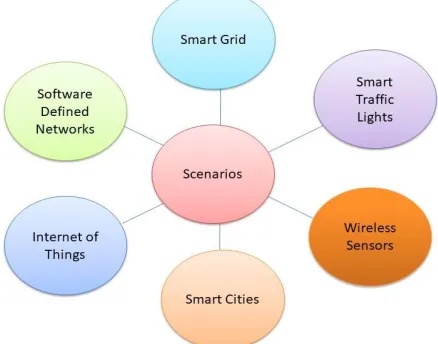
There are various areas where fog applications are being introduced and implemented successfully. Some of the scenarios of the fog computing are as; Connected Vehicles: The real-time operations in Connected Vehicles Fog computing is an ideal platform as it makes the communications between the connected devices, cars, access points and traffic lights safe and secure
Smart Grids: The smart grids are making way for green computing and removing the ageing effect of the old infrastructure when electricity was limited to customer utility. As more machines interact continuously, smart grids will help the electricity demands which would work in cooperation with the cloud.
Smart Cities: Fog computing is obtaining data generated by various sensors, actuators integrate it among the various tagged IoT edge devices to distribute and process the data uniformly
Smart Houses: Fog computing is an ideal platform for the initiative to bring automation in the houses in smart cities, Fog will offer real-time interaction and will be best for monitoring and controlling them remotely
Wireless Sensor and Actuators: Fog nodes and smart gateways can control itself the flow of the processes in IoT environment by forming the closed-loop system, further these devices in fog domain can monitor the sensor signalling and create alarm notification for emergency situations and avoid the unfavourable situations. These nodes can be of high importance in real-time scenarios like in railways, air traffic and mineral and tunnel mining (11, 14).
Figure 3. Fog Computing Scenarios
Related Work:
real time. Ivan Stojmenovic et al. (14) here the authors described the Cisco’s fog model which is going to cover every connected device up to 2020, briefly describe the importance & need of Cloud & edge paradigm in technology shift, Latency enhancement, location awareness, improved quality of services. Bhagyashree Dharaskar et al. (15) the authors here in their research article have briefly explained the goals and aims adopting the fog computing to enhance potency and scale back the number of knowledge transported to the cloud for process, analysis and storage, act as a key technology in IoT, suitable for smart cities, smart buildings and smart IoT tagged Objects like Vehicles Interoperability among the different computing paradigms. Mohammad Aazam et al. (16) has proposed a fog computing micro-datacenter model which leads to the estimation of resource and pricing model in IoT, as cloud is becoming congested with the IoT devices intervention, the fog computing plays the vital role in decision making, reduce the burden on the core network, The results generated by their proposed probability method, Customer’s Reliability-based
Dynamic Resource Estimation giving
comparatively better results in fog domain and are evaluated using the CloudSim toolkit. Zijiang Hao et al. (17) provide the detailed description about fog computing, challenges and problems, proposed a flexible software architecture WM-Fog offering flexible ways to explain the workflow and can be
easily deployed and executed, through which considerable enhancement in performance with various user workflow, system architecture, synchronous customizing policies with fog computing. Carla Mouradian et al. (18) came with a descriptive analysis of anything in fog. From fog basic to fog algorithms and to fog architecture, authors come out with proper taxonomical designing after “Future Direction in Fog by Redowan Mahmud” this paper is best one among all the review papers in fog computing. Yang Liu et al. (19) discussed and compared various important topics like latency, reliability cost and fault tolerance in fog computing, genetic algorithm with Dirichlet distribution sampling approach to conduct and solve the resource optimization problems in fog computing, results showed the tremendous impacts on fog scalability as well, presented the fog architecture and framework for resource allocation and latency enhancement. Mohammad Aazam et al. (20) proposed a method of collaboration both cloud and IoT paradigm for improved resource provisioning and better resource utilization, here the authors proposed a smart gateway of communication in a cloud of things environment, provide an architectural view of the smart gateway. Hops count is an important suit here for cloud and varied IoT components smooth interaction in distributed paradigm. Further experimental performance evolution criteria carried out on visual, audio media and bulk data.
Table.1: Fog Computing in Resource & Management
S.No. Authors Contribution Merits Demerits
1 Redowan Mahmud et al.,2016 (9)
Proposed the Fog Taxonomy, Overview of fog computing & its
terminologies, real-time latency bounded applications, review on
datacenters, identified the challenges and key features of
fog computing
Proper and clear-cut taxonomical graphical representation of various fog
computing terminologies, briefly explained ideas for better understanding with architectural diagrams
****
2 Mohammad Aazam et al.,2015 (10)
Untrimmed data is being communicated in cloud network
making it congested, the trimming, bifurcation is of importance, authors came with a
new concept, Smart Gateways, Fog nodes, only trimmed data, can be sent over the network for
communication purposes reducing the network congestion, bottlenecks, cost of the resources
Only the valid and desired data after fine-tuning are sent
over the fog network removing the overall burden of a core cloud network, Fog plays a vital role in resource management, data filtration.
****
3 Fatemeh Jalali et al.,2016 (11)
Nano servers are becoming popular with the advancement in
IoT, little attention was paid towards their energy consumption, Authors proposed
and used flow-based and time-based energy consumption models for shared and unshared
network equipment to study energy consumption of nDCs,
Nano Datacenters are energy efficient and consume less energy and can enhance the
core cloud data centre by fetching its applications, access network attached in its
domain, thus reducing and influencing the energy cost of
core cloud datacenters.
4
Mohammad Abdullah Al Faruque et al.,2015
(12)
Fog computing as the novel platform for energy management. By using energy
management as a service, authors proposed and implemented micro grid-level and home energy management
prototypes
By using energy management as a service over fog platform,
it offers the flexibility, interoperability, connectivity,
which is going to reduce the costs both in terms of implantation and energy
utilization
****
5
Mohammed A. Hassan et al.,2015
(13)
Fog computing reduces the latency issues in the cloud domain, Authors implanted fog
platform for resource-constrained mobile edge device
application offloading and storage expansion and improve
computing power of the edge devices
Latency, security and privacy issues of cloud, paving the
way to adopt the fog computing platform for resource-constrained mobile
edge devices
issues like service availability, security and
privacy remained untouched
6 Ivan Stojmenovic et al.,2014 (14)
Authors in their survey article elaborate and highlighted various
advantages of Fog computing, Smart Grid, smart traffic lights in vehicular networks and software-defined networks. further security and privacy
issues are explained
Explore the need and importance of fog computing
in IoT environment
mobile apps considered, man-in-middle attacks issues highlighted while
others not
7
Bhagyashree Dharaskar et al.,2017 (15)
The authors came with overall generic review paper explaining
the basic fog computing definitions and terminologies, a
brief introduction about its evolution, its importance in IoT
domain
The precise and briefly explained terminologies of fog computing, its importance
and implementation in IoT scenarios
Only theoretical outlining while the
conceptual and experimental review is
not conducting
8 Mohammad Aazam et al.,2018 (16)
The authors had proposed fog computing micro-datacenter
model which leads to an estimation of resource and pricing model in IoT Resource Estimation Challenges at the fog
layers,
Customer’s Reliability-based Dynamic Resource Estimation method based on historical records, minimize the resource underutilization.
Authors also carried out an extension of their previous
work “
****
New Horizons in Cloud Computing and Fog Layered Architecture:
A. Edge & Fog Computing:
Fog computing is a pervasive and ubiquitous computing infrastructure were information, computing power, and storage, applications are distributed in the most sophisticated way. In a real sense, it extends the cloud computing capabilities and services with proper network suit, delivering the benefits and processing power of the cloud nearer to the end-user devices, where the data is generated in real-time. The main purpose of fog is to enhance the capabilities of cloud computing over the edge of the network, sometimes it is regarded as edge computing, but Fog computing is a broader concept. It provides an opportunity in the field of IoT technology where the end-users devices like cellular smartphone, household items, traffic surveillance system are remotely accessible and manageable ( 21). Edge Computing is the model which optimizes and enhancing the cloud computing at the edge of
Figure 1. Fog Computing an Intimidator Layer
B. Fog Architectural Layers:
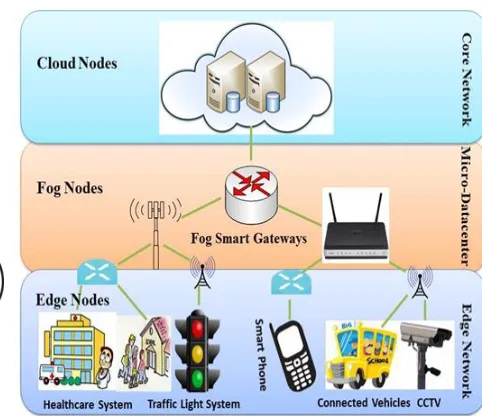
The latest and recent trend in IT is Fog computing and becoming the buzzword and is considered to be the solution to the centralized cloud computing, precisely defined by Cisco, “Fog is an extension of cloud computing to the edge of an enterprise's network. The technology allows massive amounts of data to be processed quickly as well” (3). Since fog platform is the recent one, offers the advantageous features to edge network entrepreneurs. It offers smooth functioning of IoT devices in the geographically dispersed distributed network. It incorporates the functionalities of cloud and provides the enriched experience to cloud users in real time. The localized and decentralized fog enhance the latency issues of cloud computing, the real-time content delivery which is of more importance in delay sensitive like healthcare, traffic, connected vehicles, smart grid systems, windmills, performs pre-processing computation before sending it permanently to cloud data centre for storing it. Fog has storage constraints as its micro data centre can’t hold the bulk-sized workloads because of storage limitations. The Fog operates on the data generated by the edge devices at the point of generation, intelligence and computational capabilities is being offered to the edge device over the network and can act according to the situation in real time environment (5). The layered architectural design in Figure 2 as the Cloud Core Network layer, Fog Nodes and Edge Device Network. All the three layers work in coordination in for the successful completion of a process. The process is distributed into small chunks and each chunk from the edge device to fog nodes for processing and temporarily stored in fog cloudlets (it provides reduced latency to mobile edge. It cannot hold and store the data permanently because
of storage space limitations. So from fog cloudlets, it is sent to Cloud’s Datacenter (Macro datacenter) for permanent storage.
Figure 2. Fog Computing Layers
Reduced Latencies & Resource Optimization in Fog Computing:
Cost analysis in cloud paradigm with Autoscaling methods had great influence in resource management and optimization, with scalability features offering resources accordingly to the user’s requirements on-demand basis (7). In the fog, price and billing calculation formulation given below is the one which considerably minimizing the cost of resources utilized and underutilized, the proper service level agreements of the cloud-fog user with the service providers. The formulated formulae define a set of parameters where services are not only offered on an ad-hoc basis but have to predict in advance to be fairly efficient in resource management.
MEdia FOg Resource Estimation is the model which is calculating the given-up ratios in resource optimization, by this both the parameters i.e. quality of service and experience (QoSE), this model is being carried in two ways, on the historical background of cloud consumer and manages the computing resources in an effective and proper way, and secondly by doing it indirectly have its impact on quality of services (4).
i*((1- (Pi(L/H)s))-σ 2
)*(1- i)*ф)
is required resources in the designed formula, The already existing heuristic genetic algorithm can be used in fog computing to minimize the latency oriented problems. Hops count play an important role in resource management, as the cloud centralized paradigm while the communication among the various entities leads to increase the number of hop count, while as in
Fog-Nodes
cloud-fog based computing, the hop count is reduced considerably. The latency of each dataset can categorize in Processing latency, and return latency. The overall latency of the fog computing system presented by makespan depending on various parts of the process (10).
T= Max
i(c
i/t
i+c
i/t
i+c
i/t
i+g (ci, p, q))
Cloud-based resource management with queuing theory is also an important aspect to optimize the resources according to the requirement while relinquishing the underutilized resources, reduce the service charges. The resources are not kept idle and utilized the utmost during cloud computational processes. Servers, CPU, memory resources are being used according to user demand (19).
Reduction in Latencies:
The latency issues in cloud computing were the serious issue for the time sensitive devices
(traffic, healthcare and smart connected vehicles),
incorporating the fog, it offers them reduced latency in a real-time environment, and low latency offers the big deal to the heterogenetic devices. It enables the business to look big virtually and operate extensively very near to end user. The handheld electrical appliances like computers, mobiles, and camera are provided within fog storage space to store their data over the cloudlets in the safe and secure way. Unanimously both Fog & Edge are going to be fully implemented in the manufacturing, telecommunication, education, health, traffic and automotive units, devices at the Fog-Edge-Layer acquire data generated and transmitted by IoT devices and are processed locally at the edge network rather than sending them to the core network(20). The reduction in hops count leads to the reduction in the distance that indirectly and enrich the data movement among the devices smoothly, the end to end communication becomes more interactive than ever before in a distributed environment. The latency scenarios in the cloud domain were something a lagging process, but the shift in computing paradigm (Cloud to fog computing), efficiently reduce the latency issues. End user’s viewpoint, latency is an important aspect which enriches the communication process, real-time sensitive decision making becomes even more real in IoT environment with the help of Fog-Edge computing (23).
Fog Computing Challenges:
Fog computing is the future of cloud computing, it comes with immense advantageous potential, like cloud, fog has some issues and
challenges as well both in terms of security and privacy, adoption and implementation, since being decentralized, each end users participating in IoT environment, make Fog computing to face various issues like availability of service in public cloud-fog storage. The end users devices are energy oriented, battery life, energy consumption are the concerns in its flawless streaming seamless operating functionalities, inactiveness of the edge device user will make fog unavailable in some circumstances. Although fog is termed a secure platform, it also has some security challenges. After reviewing some of the articles in the fog domain, most of the authors had cited the given below constraints, issues and challenges in fog computing (10, 14, 24, 25).
Privacy Issues:
In Cloud of things, privacy
became a challenging job to handle. Microdata
server or cloudlets are closer to end users,
continuously collecting and generating data
come sensitive. So privacy became a first
priority to secure the end users data at edge
network. Mask the location of various fog
nodes is important as well to enhance the
reliable communication in fog domain.
Access Control:
Accessing the various tagged
entities in IoT environment is a challenging
task to handle, as the edge devices get
connected continuously are gaining access to
the computing resources, it becomes an integral
part and parcel of fog computation, By
implementing the secured accessing protocols
means the guarantee of an authorized
authentication, it makes necessary check-ups to
identify the connected component in fog
computing platform.
Authentication:
In an IoT environment, a
number of smart gateways offer the services at
the front node, without proper authentication
mechanism, fog platform often preys on the
man-in-middle attacks. The data transmission.
Various face recognition, image processing,
biometric; fingerprint authentication methods
will be effective to remove this problem by
implanting various encryption and decryption
algorithms.
order to save and protect the data from the
malicious interference of the intruder.
Malicious Activities: Since fog is a decentralized distributed paradigm, latency is reduced, the process of communication becomes much easier, and to detect the malicious node becomes quite tough and challenging task to perform in fog computing. It affects the quality of service, interruption in services (DoS), man-in-middle attacks are the major concerns in fog due to the malicious activities. To get rid-off these issues, the Intrusion Detection System is the need of an hour to reduce the risk factor in fog systems. It will provide timely updates and notification regarding any malicious found activities.
Conclusion:
We authors, investigate Fog computing paradigm, it feature, scenarios in various domains, and provide the comprehensive study on the various security concerns of current centralized & decentralized computing paradigms, some of fog computational features and data storage will take care of data-intensive services and applications in future on Fog computing platform, as it requires less cloud storage and transmission power for long-term analysis data and has been applied successfully in healthcare, smart cities and geospatial information systems. Further, future work will consider Resource Management, Utilization and Cost Optimization for the enhanced efficiency in data-storage and security measures. Fog is finding a place in the smart traffic lighting system, connected vehicles, Smart Grid, IoT,
Cyber-physical
systems
, Wireless Sensor and Actuator Networks, Software Defined Networks (SDN). Fog Computing cannot be a solo technology to handle all these complicated tasks, to offer better and the best optimization and resource management services, its collaboration with cloud computing is mandatory.Conflicts of Interest: None.
References:
1. Madni H, Shafie A, Yahaya C, Abdulhamid Sh. Resource Scheduling for Infrastructure as a Service (IaaS) in Cloud Computing: Challenges and Opportunities. Journal of Network and Computer Applications. 2016; DOI: 10.1016/j.jnca.2016.04.016. 2. Madni H, Shafie A, Yahaya C, Abdulhamid Sh. Recent advancements in resource allocation techniques for cloud computing environment: A systematic review. Cluster Computing.2016; DOI: 10.1007/s10586-016-0684-4.
3. Cisco Fog Computing Solutions: Unleash the Power of the Internet of Things, CISCO, 2015, White Paper.
4. Aazam M, St-Hilaire M, Lung Ch, Lambadaris I. MeFoRE: QoE based resource estimation at Fog to enhance QoS in IoT. 2016; 1-5. DOI: 10.1109/ICT.2016.7500362.
5. OpenFog Architecture Overview. OpenFog Consortium Architecture Working Group. Accessed on Dec. 7, 2016.
6. Michaela I, Nedim G, Feldman RB, Michael JM, Charif M. Fog Computing Conceptual Model, NIST Special Publication 500-325, 2018; 1-15, DOI: 10.6028/NIST.SP.500-325.
7. Ab Rashid D, Ravindran D. Survey on Scalability in Cloud Environment, International Journal of Advanced Research in Computer Engineering & Technology.2016; 5(7):440-445.
8. Mustafa S, Nazir B, Amir H, Attaur RK, Madani S. Resource Management in Cloud Computing: Taxonomy, Prospects and Challenges. Computers and
Electrical Engineering. 2015.
DOI:10.1016/j.compeleceng. 2015.07.021.
9. Redowan M, Rajkumar B, Fog Computing: A Taxonomy, Survey and Future Directions. Internet of Everything - Algorithms, Methodologies, Technologies and Perspectives. 2016; DOI: 10.1007/978-981-10-5861-5_5.
10.Mohammad A, Eui-Nam H. Fog Computing Micro Datacenter Based Dynamic Resource Estimation and Pricing Model for IoT, in the proceedings of IEEE 29th International Conference on Advanced Information Networking and Applications, 2015; DOI: 10.1109/AINA.2015.254
11.Fatemeh J, Kerry H, Robert A, Tansu A, Rodney ST. Fog Computing May Help to Save Energy in Cloud
Computing. 2016. 34(5):1-12. DOI:
10.1109/JSAC.2016.2545559.
12.Mohammad AA, Vatanparvar K. 2015. Energy Management-as-a-Service over Fog Computing Platform. IEEE Internet of Things Journal. DOI:10.1109/JIOT.2015.2471260.
13.Hassan M, Xiao M, Wei Q, Chen S. Help Your Mobile Applications with Fog Computing. DOI: 10.1109/SECONW.2015.7328146.
14.Ivan S, Wen Sh. The Fog Computing Paradigm: Scenarios and Security Issues. 2014 Federated Conference on Computer Science and Information
Systems, FedCSIS 2014:1-8. DOI:
10.15439/2014F503.
15.Bhagyashree D, Geeta T. Review on Fog: A Future Support for Cloud Computing. International Journal of Research in Science & Engineering. 2017; 3(3):345-350.
16.Mohammad A, St-Hilaire M, Lung Ch, Lambadaris I, Huh, E. IoT Resource Estimation Challenges and Modelling in Fog. Fog Computing in the Internet of Things: Intelligence at the Edge. 2018; 17-31. DOI: 10.1007/978-3-319-57639-8_2.
17.Z. Hao E, Novak SY, Li Q. Challenges and Software Architecture for Fog Computing, in IEEE Internet
Computing.2017;21(2):44-53. DOI:
10.1109/MIC.2017.26
Research Challenges. Communications Surveys & Tutorials.2017;DOI:10.1109/COMST.2017.2771153 19.Liu Y, Fieldsend J, Min G. A Framework of Fog
Computing: Architecture, Challenges and
Optimization. 2017; DOI:
10.1109/ACCESS.2017.2766923.
20.Mohammad A, Huh E. Fog Computing and Smart Gateway Based Communication for Cloud of Things. 2014; 464-470. DOI: 10.1109/FiCloud.2014.83. 21.Shi W, Cao J, Zhang Q, Li, Y, Xu, L. Edge
Computing: Vision and Challenges. IEEE Internet of
Things Journal. 2016; DOI:
10.1109/JIOT.2016.2579198.
22.Rahman G, Chai W Ch. Fog Computing, Applications, Security and Challenges, Review.
International Journal of Engineering & Technology. 2018;DOI: 10.14419/ijet.v7i3.12612.
23.Ab Rashid D, Ravindran D. Fog Computing: An Efficient Platform for the Cloud-resource Management. International Journal of Emerging Technologies and Innovative Research. 2019; 6(2): 7-12.
24.Khan S. Parkinson S, Qin Y. Fog computing security: a review of current applications and security solutions. Journal of Cloud Computing. 2017; DOI: 6. 19. 10.1186/s13677-017-0090-3.
25.Mahmood HM, Ravindran D. LETISA: Latency optimal Edge computing Technique for IoT based Smart Applications,IJSRCSEIT.2017; 2(4):688-694
ضارعتسا :ةيبابضلا ةبسوحلا دراوم نيسحت
تاهويرانيسلل
ةيلاحلا
ةرادإو
دراوملا
Ab Rashid Dar
*D Ravindran
.دنهلا ،ليمات ،فيزوج ةيلك ،بوساحلا مولع مسق
:ةصلاخلا
ةيكذلا ةبسوحلا ةزهجا لبق نم اذه انموي يف ةعقوتم ريغلاو ةريبكلا تانايبلا ءاشنا نا
(
Wi-Fi هيجوت ةزهجأ ، تلاغشم ، تاسجم
)
اهدويق ببسب كللذو بعص نوكي يزكرم يباحس ماظن ةطساوب يلعفلا تقولا ةئيب يف اهيلع ةظاحملاو ةيباسحلا ةجلاعملا ةوق عم لماعتلل اهتايدحتو اهلكاشمو .
ةعومجم ىلا ةدنتسملا ةبسوحلل ليدبك ةبسوحلا جذومن وكسيس تمدق ةبوعصلا هذه ىلع بلغتلا ضرغل Fog
لا .ءارظن
ةيباحسلا ةبسوحلا ةينقتل ديفمو عسوم دادتما هنإ .يلاتلا ىوتسملا ىلإ ةبسوحلا ةبرجت تامولعملا ايجولونكتل ثيدحلا هاجتلاا اذه ذخأي
واح ،لاقملا اذه يف .ةيزكرملا مدقن ،يثحبلا لاقملا اذه يف انه .اًيلاح ةيباحسلا ةبسوحلا اههجاوت يتلا ةفلتخملا تلاكشملا ىلع ءوضلا طيلست انل
ةفلتخم تلااجم يف ةفلتخملا بابضلا ةبسوح مادختسا تلااح اًضيأ مدقنو ، ةيباحسلا ةبسوحلا نع اهزيمنو ،ةيبابضلا ةبسوحلل ةلماش ةعجارم ،
اتنتسا ىلإ انلصوت دقو كلاهتسلاا ثيح نم ءاوس ةقاطلا نم ةدافتسلاا عم ،ةقاطلا دراومل ةلاعف ةرادإ ىلإ يدؤت بابضلا ةبسوح نأ هدافم ج
دراوملا نيسحت قرطو اياضقلاو تايدحتلاو ةيسيئرلا هتازيم انزربأ ، كلذ ىلع ةولاع .ةفلكتلا تاهويرانيسو .
تاملكلا ةيحاتفملا :
،تاكرحملا ،وكسيس
ةبسوحلا ،ةيباحسلا ةبسوح
،بابضلا ةرادإ