drones
Article
Evaluation of a Baseline Controller for Autonomous
“Figure-8” Flights of a Morphing Geometry
Quadcopter: Flight Performance
Ye Bai1,†and Srikanth Gururajan2,*,†
1 Department of Aerospace and Mechanical Engineering, Parks College of Engineering,
Aviation and Technology, Saint Louis University, St. Louis, MO 63103, USA
2 Aerospace Engineering Parks College of Engineering, Aviation and Technology, Saint Louis University,
St. Louis, MO 63103, USA
* Correspondence: [email protected] † These authors contributed equally to this work.
Received: 5 July 2019; Accepted: 28 August 2019; Published: 31 August 2019
Abstract: This article describes the design, fabrication, and flight test evaluation of a morphing geometry quadcopter capable of changing its intersection angle in-flight. The experiments were conducted at the Aircraft Computational and Resource Aware Fault Tolerance (AirCRAFT) Lab, Parks College of Engineering, Aviation and Technology at Saint Louis University, St. Louis, MO. The flight test matrix included flights in a “Figure-8” trajectory in two different morphing configurations (21◦and 27◦), as well as the nominal geometry configuration, two different flight velocities (1.5 m/s and 2.5 m/s), two different number of waypoints, and in three planes—horizontal, inclined, and double inclined. All the experiments were conducted using standard, off-the-shelf flight controller (Pixhawk) and autopilot firmware. Simulations of the morphed geometry indicate a reduction in pitch damping (42% for 21◦morphing and 57.3% for 27◦morphing) and roll damping (63.5% for 21◦ morphing and 65% for 27◦
morphing). Flight tests also demonstrated that the dynamic stability in roll and pitch dynamics were reduced, but the quadcopter was still stable under morphed geometry conditions. Morphed geometry also has an effect on the flight performance—with a higher number of waypoints (30) and higher velocity (2.5 m/s), the roll dynamics performed better as compared to the lower waypoints and lower velocity condition. The yaw dynamics remained consistent through all the flight conditions, and were not significantly affected by asymmetrical morphing of the quadcopter geometry. We also determined that higher waypoint and flight velocity conditions led to a small performance improvement in tracking the desired trajectory as well.
Keywords: morphing geometry; quadcopter; flight tests
1. Introduction
Multi-copters, including commonly used platforms such as quadcopters, hexacopters, octocopters, or their variants, are popular as base aerial platforms for many civilian applications, including remote sensing [1–3], aerial imaging [4,5], firefighting [6,7], environmental measurement [8–10], law enforcement [11–13], disaster relief and emergency management [14–18], situational awareness [19] infrastructure surveys [20], and several other military and commercial applications. Quadcopters can be considered to be representative of this general class of aircraft, and can be maneuvered by varying the power of the four motors symmetrically or asymmetrically in order to achieve translational and rotational flight. While these platforms are well suited to execute a wide variety of aerial tasks, their physical geometry plays a significant role in defining the applicability of a particular platform for a particular task; for instance, if the Unmanned Aerial System (UAS) is required to carry a suite
Drones2019,3, 70 2 of 36
of sensors, such as large cameras, LIDAR, or hyperspectral imagers, it then follows naturally that the UAS platform should be large enough to carry all the sensors, and be capable of executing the mission according to requirements. On the other hand, if the quadcopter is physically small (to fly through confined spaces), it then restricts the amount of payload it can carry and its flight endurance. This poses a problem in cases where the UAS platform is required to carry a large payload, but still be able to navigate through confined spaces. A compromise option that would allow the quadcopter to carry a higher payload, while remaining capable of navigating through confined spaces, would be a platform that could change or morph from one geometry to another geometry, reducing its footprint in the process. Such a scenario is illustrated in Figure1.
Drones 2019, 3, x FOR PEER REVIEW 2 of 37
required to carry a suite of sensors, such as large cameras, LIDAR, or hyperspectral imagers, it then follows naturally that the UAS platform should be large enough to carry all the sensors, and be capable of executing the mission according to requirements. On the other hand, if the quadcopter is physically small (to fly through confined spaces), it then restricts the amount of payload it can carry and its flight endurance. This poses a problem in cases where the UAS platform is required to carry a large payload, but still be able to navigate through confined spaces. A compromise option that would allow the quadcopter to carry a higher payload, while remaining capable of navigating through confined spaces, would be a platform that could change or morph from one geometry to another geometry, reducing its footprint in the process. Such a scenario is illustrated in Figure 1.
Figure 1. Illustration of the rationale for morphing geometry capability on a quadcopter.
In this paper, we present the results from flight test experiments of an asymmetrical morphing geometry quadcopter [21], flying a “Figure-8” flight path under different conditions, conducted at the Aircraft Computational and Resource Aware Fault Tolerance (AirCRAFT) laboratory [2 2], at Saint Louis University, St. Louis, MO. This quadcopter can temporarily change its physical structure by shrinking its lateral dimension to switch between a normal “X” style quadcopter into a slimmer “X”
style quadcopter, with a reduced footprint.
Over the last few years there has been increasing interest in the development of multi-rotor UAS platforms with the ability to change their geometry in order to address similar problems. In a recent effort, the design of a morphing geometry quadcopter was explored, where the geometry of the quadcopter changes for short periods of time as and when traversing through a narrow opening i n controlled conditions [23]. In another application [24], a quadcopter was designed to actively change its attitude to a relatively high value and fly through a narrow gap or channel, while maintaining a high translation velocity. In this case, when the quadcopter was highly inclined, the thrust generated a large lateral force and an appreciable increase in its lateral velocity. In order to avoid that case, the quadcopter must fly through the narrow gap with high initial velocity in a short time in order t o avoid large lateral and vertical displacement. Another experimental quadcopter was designed with active morphing [25]. In this effort, a custom quadcopter was created with ability to morph by
mechanically changing its arms’ length and angle. The authors also investigated LQR control on the full model with partial simplification and linearization, and developed nonlinear numeric optimal
control approach; but the quadcopter’s flight with morphing was only tested in simulation. Other
efforts have taken a different approach to the concept of morphing geometry, including the design of multirotor platforms with multilink geometries, to serve different goals [26,27]. In [28], a X-style quadcopter was experimentally tested with a crash resilient structure (two of the arms could be detached using magnets). In this effort, a custom developed MRAC flight control algorithm was implemented to accommodate for the uncertainties resulting from morphing geometry. In [ 29], the authors explore the morphing by pivoting individual arms, thus generating what they term as “H”, “O” and “T” morphologies and evaluated the performance of the quadcopter in both hover
conditions and while executing circular trajectories. As with most of the other approaches, a customized Linear Quadratic Regulator (LQR) controller was implemented to maintain the stability and performance of the quadcopter in its morphed configurations.
Our effort is distinct in the fact that we are evaluating the effectiveness of readily available flight control algorithms (PID-based and without modifications)—this is typically included as a part of open source firmware (Ardupilot 3.4.1, in our case [30]) on COTS hardware (Pixhawk [31])—through flight tests in real world conditions, for longer durations as compared to ot her efforts. Additionally,
Figure 1.Illustration of the rationale for morphing geometry capability on a quadcopter.
In this paper, we present the results from flight test experiments of an asymmetrical morphing geometry quadcopter [21], flying a “Figure-8” flight path under different conditions, conducted at the Aircraft Computational and Resource Aware Fault Tolerance (AirCRAFT) laboratory [22], at Saint Louis University, St. Louis, MO. This quadcopter can temporarily change its physical structure by shrinking its lateral dimension to switch between a normal “X” style quadcopter into a slimmer “X” style quadcopter, with a reduced footprint.
Over the last few years there has been increasing interest in the development of multi-rotor UAS platforms with the ability to change their geometry in order to address similar problems. In a recent effort, the design of a morphing geometry quadcopter was explored, where the geometry of the quadcopter changes for short periods of time as and when traversing through a narrow opening in controlled conditions [23]. In another application [24], a quadcopter was designed to actively change its attitude to a relatively high value and fly through a narrow gap or channel, while maintaining a high translation velocity. In this case, when the quadcopter was highly inclined, the thrust generated a large lateral force and an appreciable increase in its lateral velocity. In order to avoid that case, the quadcopter must fly through the narrow gap with high initial velocity in a short time in order to avoid large lateral and vertical displacement. Another experimental quadcopter was designed with active morphing [25]. In this effort, a custom quadcopter was created with ability to morph by mechanically changing its arms’ length and angle. The authors also investigated LQR control on the full model with partial simplification and linearization, and developed nonlinear numeric optimal control approach; but the quadcopter’s flight with morphing was only tested in simulation. Other efforts have taken a different approach to the concept of morphing geometry, including the design of multirotor platforms with multilink geometries, to serve different goals [26,27]. In [28], a X-style quadcopter was experimentally tested with a crash resilient structure (two of the arms could be detached using magnets). In this effort, a custom developed MRAC flight control algorithm was implemented to accommodate for the uncertainties resulting from morphing geometry. In [29], the authors explore the morphing by pivoting individual arms, thus generating what they term as “H”, “O” and “T” morphologies and evaluated the performance of the quadcopter in both hover conditions and while executing circular trajectories. As with most of the other approaches, a customized Linear Quadratic Regulator (LQR) controller was implemented to maintain the stability and performance of the quadcopter in its morphed configurations.
Drones2019,3, 70 3 of 36
open source firmware (Ardupilot 3.4.1, in our case [30]) on COTS hardware (Pixhawk [31])—through flight tests in real world conditions, for longer durations as compared to other efforts. Additionally, the experiments flights featured longer flight durations under morphed geometry (approximately 15s on average over all the ~350 flights) and is appreciably different from the experiments described in references [24,30,32]. Furthermore, the flights were performed at different velocities, with a varying number of waypoints, and outdoors—this bringing with it the requirement of the flight controller to address real world disturbances, such as wind gusts.
This article is organized as follows. Section2describes the methods and materials used to fabricate the quadcopter and the onboard avionics. Section3describes the modeling of the moments of inertia of the quadcopter in its morphed geometry state, and Section4describes the simulation and flight test experiments, the results of the tests, as well as observations and conclusions.
2. Materials and Methods
The quadcopter UAS used in this effort was designed and fabricated in-house in the Aircraft Computational and Resource Aware Fault Tolerance (AirCRAFT) Laboratory, at Parks College of Engineering, Saint Louis University. Further details on the design and fabrication of this UAS are given in the following sections.
2.1. Design and Fabrication of the Morphing Geometry Quadcopter
The quadcopter was configured to be an “X-style” platform, with the forward direction of the UAS and the flight controller aligned in between the arms. The central hub of this platform was designed to serve as the morphing base; it is driven by a digital servo mounted on the bottom section of the hub and with its drive shaft aligned with the central axis of rotation of the hub for achieving geometry morphing. A wireframe drawing of the morphing quadcopter assembly is shown in Figure2a and the flight ready quadcopter is shown in Figure2b.
Drones 2019, 3, x FOR PEER REVIEW 3 of 37
the experiments flights featured longer flight durations under morphed geometry (approximately 15s on average over all the ~350 flights) and is appreciably different from the experiments described in references [24,30,32]. Furthermore, the flights were performed at different velocities, with a varying number of waypoints, and outdoors—this bringing with it the requirement of the flight controller to address real world disturbances, such as wind gusts.
This article is organized as follows. Section 2 describes the methods and materials used to fabricate the quadcopter and the onboard avionics. Section 3 describes the modeling of the moments of inertia of the quadcopter in its morphed geometry state, and Section 4 describes the simulation and flight test experiments, the results of the tests, as well as observations and conclusions.
2. Materials and Methods
The quadcopter UAS used in this effort was designed and fabricated in-house in the Aircraft Computational and Resource Aware Fault Tolerance (AirCRAFT) Laboratory, at Parks College of Engineering, Saint Louis University. Further details on the design and fabrication of this UAS are given in the following sections.
2.1. Design and Fabrication of the Morphing Geometry Quadcopter
The quadcopter was configured to be an “X-style” platform, with the forward direction of the
UAS and the flight controller aligned in between the arms. The central hub of this platform was designed to serve as the morphing base; it is driven by a digital servo mounted on the bottom section of the hub and with its drive shaft aligned with the central axis of rotation of the hub for achieving geometry morphing. A wireframe drawing of the morphing quadcopter assembly is shown in Figure 2a and the flight ready quadcopter is shown in Figure 2b.
(a) (b) (c)
Figure 2. (a) Wireframe of the Morphing Mechanism; (b) Flight Ready, Morphing Geometry quadcopter UAS; (c) Pixhawk flight controller.
2.1.1. Flight Controller
The morphing quadcopter features the widely available Pixhawk (Figure 2c) as the quadcopter’s
flight controller; the off the shelf controller includes a three-axis inertial measurement unit (IMU), three-axis gyroscopes, magnetometer, barometer, and redundant interfaces for external sensors and devices. This is augmented with a 3DR GPS module for positioning and to facilitate waypoint navigation. Salient specifications of the Pixhawk controller are listed in Table 1. Additional details can be found in [32].
Table 1. Specifications of the Pixhawk flight controller.
Component Description
CPU 168 MHz Cortex-M4F
IMU Invensense MPU6000; 3-axis gyroscope, 3-axis accelerometer, three 16-bit
analog-to-digital converters (ADCs) for gyroscope and accelerometer Figure 2.(a) Wireframe of the Morphing Mechanism; (b) Flight Ready, Morphing Geometry quadcopter UAS; (c) Pixhawk flight controller.
2.1.1. Flight Controller
Drones2019,3, 70 4 of 36
Table 1.Specifications of the Pixhawk flight controller.
Component Description
CPU 168 MHz Cortex-M4F
IMU
Invensense MPU6000; 3-axis gyroscope, 3-axis accelerometer, three 16-bit analog-to-digital converters (ADCs) for gyroscope and accelerometer outputs. User-programmable gyroscope full-scale range of±250,±500,±1000, and ±2000◦/s and accelerometer full-scale range of±2 g,±4 g,±8 g, and±16g.
Barometer MEAS MS5611
I/O 14 PWM Servo outputs
Extra connectivity UART, I2C, GPS Flight log Pluggable microSD card Firmware Version ArduPilot, 3.4.1
2.1.2. Propulsion System
The quadcopter is powered by widely available brushless motors and electronic speed controllers (ESC), as shown in Figure3and the specifications are given below in Table2.
Drones 2019, 3, x FOR PEER REVIEW 4 of 37
outputs. User-programmable gyroscope full-scale range of ±250, ±500, ±1000, and ±2000°/s and accelerometer full-scale range of ±2 g, ±4 g, ±8 g, and ±16g.
Barometer MEAS MS5611
I/O 14 PWM Servo outputs
Extra connectivity UART, I2C, GPS
Flight log Pluggable microSD card
Firmware Version ArduPilot, 3.4.1
2.1.2. Propulsion System
The quadcopter is powered by widely available brushless motors and electronic speed controllers (ESC), as shown in Figure 3 and the specifications are given below in Table 2.
Figure 3. Motor (left) and speed controller (right).
Table 2. Specifications of brushless DC motor and ESC.
Motor ESC
Model KDA 20–22 L Model Plush 18 A
Kv 924 Burst Current 22 A
Operating Current 6–14 A Constant Current 18 A
Max. Voltage 11 v BEC 5 v/2 A; Linear, 2–4 cells
Size/Weight 28 × 32 mm; 56 g Size/Weight 24 × 45 × 11 mm/19 g
2.1.3. Fabrication of the Quadcopter and Morphing Mechanism
As was briefly mentioned earlier in this section, the quadcopter was designed with a central cylindrical hub with two co-axial cylindrical shells. The outer shell was designed to house the digital servo (HiTec HS-5625MG, [33]), whose drive shaft was connected to the inner shell. The outer shell featured mount points for two of the arms of the quadcopter, while the inner shell featured mount points for the other two arms of the quadcopter. This central hub was fabricated using additive manufacturing techniques, which allowed for a quick turn around in between iterations of the design and the ability to quickly replace the morphing platform in case of crashes. The fabricated hub is shown below in Figures 4 and 5.
Figure 3.Motor (left) and speed controller (right).
Table 2.Specifications of brushless DC motor and ESC.
Motor ESC
Model KDA 20–22 L Model Plush 18 A
Kv 924 Burst Current 22 A
Operating Current 6–14 A Constant Current 18 A
Max. Voltage 11 v BEC 5 v/2 A; Linear, 2–4 cells
Size/Weight 28×32 mm; 56 g Size/Weight 24×45×11 mm/19 g
2.1.3. Fabrication of the Quadcopter and Morphing Mechanism
As was briefly mentioned earlier in this section, the quadcopter was designed with a central cylindrical hub with two co-axial cylindrical shells. The outer shell was designed to house the digital servo (HiTec HS-5625MG, [33]), whose drive shaft was connected to the inner shell. The outer shell featured mount points for two of the arms of the quadcopter, while the inner shell featured mount points for the other two arms of the quadcopter. This central hub was fabricated using additive manufacturing techniques, which allowed for a quick turn around in between iterations of the design and the ability to quickly replace the morphing platform in case of crashes. The fabricated hub is shown below in Figures4and5.
Drones2019,3, 70 5 of 36
Drones 2019, 3, x FOR PEER REVIEW 5 of 37
Figure 4. Morphing Hub.
Figure 5. Close-up of the Morphing Hub.
In order to power the servo driving the morping mechanism, an external battery elimination circuit (BEC) was used to provide sufficient input power on the servo rail of Pixhawk. This was necessary as the standard power module was only capable of powering the Pixhawk, receiver and the GPS module and not concurrently powering the drive servo. The specifications of the BEC are given in Table 3.
Table 3. Specifications of the BEC driving the morphing servo.
i. Input Voltage: 5–25 volts
ii. Selectable Output: 4.8–9.0 volts
iii. Mode: Switching
iv. LiPo Cells: 2–6
v. Size/Weight: 30 × 15 × 10 mm/11 g
The finalized power distribution of the morphing quadcopter is illustrated in Figure 6 below: Figure 4.Morphing Hub.
Drones 2019, 3, x FOR PEER REVIEW 5 of 37
Figure 4. Morphing Hub.
Figure 5. Close-up of the Morphing Hub.
In order to power the servo driving the morping mechanism, an external battery elimination circuit (BEC) was used to provide sufficient input power on the servo rail of Pixhawk. This was necessary as the standard power module was only capable of powering the Pixhawk, receiver and the GPS module and not concurrently powering the drive servo. The specifications of the BEC are given in Table 3.
Table 3. Specifications of the BEC driving the morphing servo.
i. Input Voltage: 5–25 volts
ii. Selectable Output: 4.8–9.0 volts
iii. Mode: Switching
iv. LiPo Cells: 2–6
v. Size/Weight: 30 × 15 × 10 mm/11 g
The finalized power distribution of the morphing quadcopter is illustrated in Figure 6 below: Figure 5.Close-up of the Morphing Hub.
Table 3.Specifications of the BEC driving the morphing servo.
Drones 2019, 3, x FOR PEER REVIEW 5 of 37
Figure 4. Morphing Hub.
Figure 5. Close-up of the Morphing Hub.
In order to power the servo driving the morping mechanism, an external battery elimination circuit (BEC) was used to provide sufficient input power on the servo rail of Pixhawk. This was necessary as the standard power module was only capable of powering the Pixhawk, receiver and the GPS module and not concurrently powering the drive servo. The specifications of the BEC are given in Table 3.
Table 3. Specifications of the BEC driving the morphing servo.
i. Input Voltage: 5–25 volts
ii. Selectable Output: 4.8–9.0 volts
iii. Mode: Switching
iv. LiPo Cells: 2–6
v. Size/Weight: 30 × 15 × 10 mm/11 g
The finalized power distribution of the morphing quadcopter is illustrated in Figure 6 below:
i.Input Voltage: 5–25 volts ii.Selectable Output: 4.8–9.0 volts iii.Mode: Switching
iv.LiPo Cells: 2–6
v.Size/Weight: 30×15×10 mm/11 g
DronesDrones 20192019,3, 70, 3, x FOR PEER REVIEW 6 of 37 6 of 36
Figure 6. General power distribution of the quadcopter.
3. Modeling of Quadcopter Moments of Inertia
The modeling and derivation of the equations of motion of a quadcopter are extensively addressed in published scientific literature, and can be found in the following references [34–42]. In the context of this experiment, the most critical aspect of the modeling of the quadcopter dynamics is in the derivation of the moment of inertia matrices for the nominal and morphed geometry configurations; in normal configuration, the quadcopter has a symmetric structure and so, the products of inertia are zero. On the other hand, morphed geometry results in an asymmetric configuration of the quadcopter, and consequently a change in the moments/products of inertia, particularly in non-zero products of inertia. In developing the inertia matrices for the normal and morphed configurations in this experiment, the following assumptions are made:
i The model can be represented as two thin (massless) sticks intersecting at its center;
ii The mass of the quadcopter is assumed to be concentrated at the ends of the intersecting arms, and are represented by point masses.
Based on these assumptions, the inertia matrix of the quadcopter, under normal geometry can be expressed as
𝑰 = [
𝑰𝒙𝒙 𝟎 𝟎
𝟎 𝑰𝒚𝒚 𝟎
𝟎 𝟎 𝑰𝒛𝒛
] (1)
where 𝑰𝒙𝒙, 𝑰𝒚𝒚 and 𝑰𝒛𝒛 are the moments of inertia about the 𝑿, 𝒀 and 𝒁 body axes. Referring to
Figure 7a for an illustration of the nominal configuration, these moments of inertia are determined as follows:
𝑰𝒙𝒙= 𝑰𝒚𝒚= 𝟐𝒎(𝑳𝐬𝐢𝐧 𝟒𝟓°)𝟐+ 𝟐𝒎(𝑳 𝐜𝐨𝐬 𝟒𝟓°)𝟐= 𝟐𝒎𝑳𝟐 (2)
𝑰𝒛𝒛= 𝟒𝒎𝑳𝟐 (3)
where 𝒎 is the mass of the point mass at the end of each arm, 𝑳 is the length of each arm, as measured from the center of the quadcopter to the shaft of the motor.
Figure 6.General power distribution of the quadcopter.
3. Modeling of Quadcopter Moments of Inertia
The modeling and derivation of the equations of motion of a quadcopter are extensively addressed in published scientific literature, and can be found in the following references [34–42]. In the context of this experiment, the most critical aspect of the modeling of the quadcopter dynamics is in the derivation of the moment of inertia matrices for the nominal and morphed geometry configurations; in normal configuration, the quadcopter has a symmetric structure and so, the products of inertia are zero. On the other hand, morphed geometry results in an asymmetric configuration of the quadcopter, and consequently a change in the moments/products of inertia, particularly in non-zero products of inertia. In developing the inertia matrices for the normal and morphed configurations in this experiment, the following assumptions are made:
i The model can be represented as two thin (massless) sticks intersecting at its center;
ii The mass of the quadcopter is assumed to be concentrated at the ends of the intersecting arms, and are represented by point masses.
Based on these assumptions, the inertia matrix of the quadcopter, under normal geometry can be expressed as I=
Ixx 0 0 0 Iyy 0
0 0 Izz
(1)
whereIxx,IyyandIzzare the moments of inertia about theX,YandZbody axes. Referring to Figure7a for an illustration of the nominal configuration, these moments of inertia are determined as follows:
Ixx =Iyy=2m
Lsin 45◦2+2mLcos 45◦2=2mL2 (2)
Izz=4mL2 (3)
wheremis the mass of the point mass at the end of each arm,Lis the length of each arm, as measured from the center of the quadcopter to the shaft of the motor.
Drones2019,3, 70 7 of 36
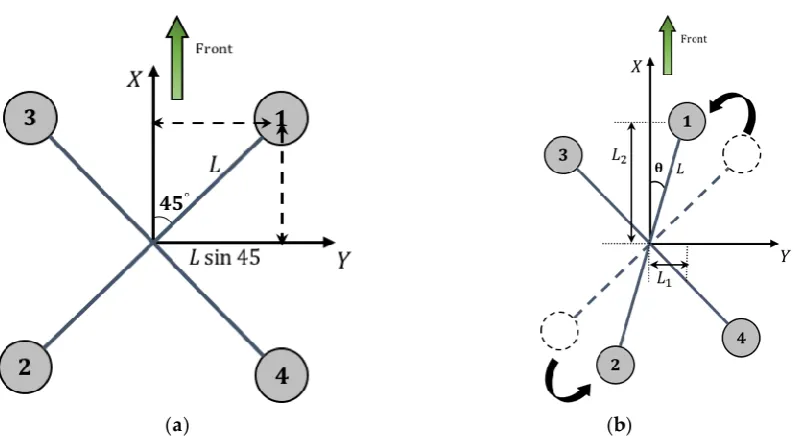
body fixed reference frame, as can be seen from the illustration in Figure7b. Note that the forward direction of the flight controller remains fixed even after transition to a morphed geometry. Also, as illustrated in Figure7b, the angleθrepresents the angle between the X-Axis and the arm supporting motors 1 and 2. It is the difference between nominal configuration and the angle of morphing. i.e.,
θ=45◦−angle_of_morphing21◦or27◦
Drones 2019, 3, x FOR PEER REVIEW 7 of 37
(a) (b)
Figure 7. Quadcopter in (a) normal configuration and (b) quadcopter transitioning from normal to morphed configuration.
In the X-style quadcopter, the 𝑿 and 𝒀 body axes are not aligned with the arms of the quadcopter but point to the forward and lateral direction, respectively. In this configuration, any rotation of two arms of the quadcopter results in a change from a symmetric to an asymmetric structure about the body fixed reference frame, as can be seen from the illustration in Figure 7b. Note that the forward direction of the flight controller remains fixed even after transition to a morphed geometry. Also, as illustrated in Figure 7b, the angle 𝜽 represents the angle between the X-Axis and the arm supporting motors 1 and 2. It is the difference between nominal configuration and the angle of morphing. i.e.,
𝜽 = 𝟒𝟓°− 𝐚𝐧𝐠𝐥𝐞_𝐨𝐟_𝐦𝐨𝐫𝐩𝐡𝐢𝐧𝐠 (𝟐𝟏° 𝒐𝒓 𝟐𝟕°)
Thus, at a smaller morphing angle, the quadcopter is closer to its nominal configuration than it is at the larger morphing angle.
In the normal symmetrical configuration, the products of inertia are zero; however, a morphed geometry results in an asymmetric structure of the quadcopter, which affects the moments and products of inertia as well as the moment distance, and results in a non-zero product of inertia, 𝑰𝒙𝒚
and 𝑰𝒚𝒙.
Under these conditions, the moments and products of inertia are given by the following expressions:
𝐼
𝑚𝑥𝑥= 2𝑚(𝐿 sin 45
°)
2+ 2𝑚(𝐿 sin 𝜃)
2 = 𝑚𝐿2+ 2𝑚𝐿2𝑠𝑖𝑛2𝜃(4)
𝐼𝑚𝑦𝑦= 2𝑚(𝐿 cos 45°)2+ 2𝑚(𝐿 cos 𝜃)2= 𝑚𝐿2+ 2𝑚𝐿2𝑐𝑜𝑠2𝜃
(5)
𝐼𝑧𝑧= 4𝑚𝐿2 (6)
𝐼𝑚𝑥𝑦= 𝐼𝑚𝑦𝑥= −2𝑚𝐿2sin45°cos 45° + 2𝑚𝐿2sin𝜃 cos𝜃 (7)
𝐼𝑚𝑥𝑧 = 𝐼𝑚𝑧𝑥= 𝑚𝐿2sin 45° − 𝑚𝐿2sin 45° + 𝑚𝐿2sin 𝜃 − 𝑚𝐿2sin 𝜃 = 0 (8)
𝐼𝑚𝑦𝑧= 𝐼𝑚𝑧𝑦= 𝑚𝐿2cos 45°− 𝑚𝐿2cos45°+ 𝑚𝐿2cos 𝜃 − 𝑚𝐿2cos 𝜃 = 0
(9)
where L is the length of the arm.
In the case of morphed geometry, the moment of inertia matrix is given by
𝐼𝑚= [
𝐼𝑚𝑥𝑥 𝐼𝑚𝑥𝑦 0
𝐼𝑚𝑦𝑥 𝐼𝑚𝑦𝑦 0
0 0 𝐼𝑚𝑧𝑧
] (10)
Figure 7. Quadcopter in (a) normal configuration and (b) quadcopter transitioning from normal to morphed configuration.
Thus, at a smaller morphing angle, the quadcopter is closer to its nominal configuration than it is at the larger morphing angle.
In the normal symmetrical configuration, the products of inertia are zero; however, a morphed geometry results in an asymmetric structure of the quadcopter, which affects the moments and products of inertia as well as the moment distance, and results in a non-zero product of inertia,IxyandIyx.
Under these conditions, the moments and products of inertia are given by the following expressions:
Imxx =2m
Lsin 45◦2+2m(Lsinθ)2=mL2+2mL2sin2θ (4)
Imyy =2m
Lcos 45◦2+2m(Lcosθ)2=mL2+2mL2cos2θ (5)
Izz=4mL2 (6)
Imxy =Imyx =−2mL
2sin 45◦
cos 45◦ +2mL2sinθcosθ (7)
Imxz =Imzx =mL
2sin 45◦
−mL2sin 45◦ +mL2sinθ−mL2sinθ=0 (8)
Imyz =Imzy = mL
2cos 45◦
−mL2cos 45◦+mL2cosθ−mL2cosθ=0 (9)
where L is the length of the arm.
In the case of morphed geometry, the moment of inertia matrix is given by
Im=
Imxx Imxy 0
Imyx Imyy 0
0 0 Imzz
Drones2019,3, 70 8 of 36
andI−m1=
Imyy ImxxImyy−Imxy2
−I
mxy
ImxxImyy−Imxy2 0
−Im_xy ImxxImyy−Imxy2
Im_xx
ImxxImyy−Imxy2 0
0 0 I1
mzz (11)
whereImis the moment of inertia of the morphed structure. 4. Simulation and Flight Test Experiments
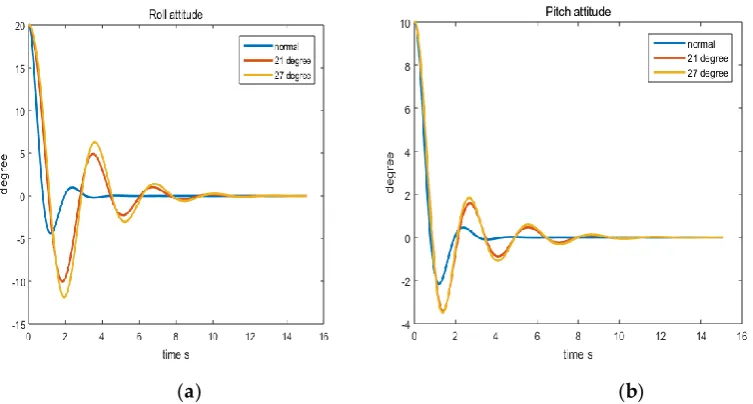
4.1. Simulation of UAS Dynamics and Validation of Stability of under Morphed Geometry Conditions It is necessary to evaluate the stability of different morphing geometries prior to executing complicated tasks such as the “Figure-8” flight path. In order to analyze the performance, the dynamics of the quadcopter were simulated within a custom developed Matlab simulation environment. The simulation was run using the same geometrical, physical and inertial parameters as that of the flight ready quadcopter. The parameters used in the simulation are listed below in Table4.
Table 4.Physical, inertial, and geometric properties of the quadcopter used in simulation.
Parameter Value Parameter Value
Roll attitude, φ 20◦ Kroll Kp=4.29,Ki=13,Kd=2
Pitch attitude, θ 10◦ Kpitch Kp=4.29,Ki=13,Kd=2
Yaw/heading angle, ψ 0◦ Kyaw Kp=2,Ki=5,Kd=0
mass 2.324 kg Kt 1.61× 10
−5
arm length 0.305 m Kb 1.90×10
−7
Ixx 0.0207 kg·m2 Imxx 0.0137(21
◦
); 0.0123(27◦) kg·m2
Iyy 0.0207 kg·m2 Imyy 0.0276(21
◦
); 0.0029 (27◦) kg·m2
Izz 0.0138 kg·m2 Imzz 0.0138(21
◦
); 0.0138(27◦) kg·m2 Imxy=Imxy −0.0027(21
◦
);−0.0043(27◦) kg·m2
The response of the quadcopter to a step change in its attitude, under different morphing geometries is listed in Table5and plotted in Figure8a,b below. Figure8a represents the roll attitude response and Figure8b the pitch attitude response. From the responses, it can be seen that at 27◦ morphing, the quadcopter has less damping than at 21◦ morphing, and in both cases significantly lower than the when under normal geometry. It can also be seen from the responses that the settling time increases with increasing morphing angle. The damping ratio corresponding to the second order roll and pitch dynamics of the quadcopter are shown in Figure9—as can be seen clearly, from both Figures8and9, a change in the geometry of the quadcopter affects the lateral stability (roll) of the quadcopter more than the longitudinal (pitch) stability, and further, a small morphing (21◦) has a smaller effect than a large morphing (27◦).
Table 5.Step response of roll and pitch attitude in simulation.
Roll Dynamics Pitch Dynamics
ωn, rad/s
Damping Ratio,ζ
Rise Time
Tr(s)
Settling TimeTs(s)
ωn, rad/s
Damping Ratioζ
Rise Time
Tr(s)
Settling TimeTs(s)
Drones2019,3, 70 9 of 36
Drones 2019, 3, x FOR PEER REVIEW 9 of 37
Table 4. Physical, inertial, and geometric properties of the quadcopter used in simulation.
Parameter Value Parameter Value Roll attitude, 𝝓 20° 𝑲
𝒓𝒐𝒍𝒍 𝐾𝑝= 4.29, 𝐾𝑖= 13, 𝐾𝑑= 2
Pitch attitude, 𝜽 10° 𝑲
𝒑𝒊𝒕𝒄𝒉 𝐾𝑝= 4.29, 𝐾𝑖= 13, 𝐾𝑑= 2
Yaw/heading angle, 𝝍 0° 𝑲
𝒚𝒂𝒘 𝐾𝑝= 2, 𝐾𝑖= 5, 𝐾𝑑= 0
mass 2.324 kg 𝑲𝒕 1.61 × 10⁻⁵
arm length 0.305 m 𝑲𝒃 1.90 × 10⁻⁷
𝑰𝒙𝒙 0.0207 kg · m2 𝑰
𝒎𝒙𝒙 0.0137(21
°); 0.0123(27°) kg · m2
𝑰𝒚𝒚 0.0207 kg · m2 𝑰
𝒎𝒚𝒚 0.0276(21°); 0.0029 (27°) kg · m2
𝑰𝒛𝒛 0.0138 kg · m2 𝑰
𝒎𝒛𝒛 0.0138(21
°); 0.0138(27°) kg · m2
𝑰𝒎𝒙𝒚= 𝑰𝒎𝒙𝒚 −0.0027(21°); −0.0043(27°) kg · m2
The response of the quadcopter to a step change in its attitude, under different morphing geometries is listed in Table 5 and plotted in Figure 8a, b below. Figure 8a represents the roll attitude response and Figure 8b the pitch attitude response. From the responses, it can be seen that at 27°
morphing, the quadcopter has less damping than at 21° morphing, and in both cases significantly
lower than the when under normal geometry. It can also be seen from the responses that the settling time increases with increasing morphing angle. The damping ratio corresponding to the second order roll and pitch dynamics of the quadcopter are shown in Figure 9—as can be seen clearly, from both Figures 8 and 9, a change in the geometry of the quadcopter affects the lateral stability (roll) of the quadcopter more than the longitudinal (pitch) stability, and further, a small morphing (21°) has a
smaller effect than a large morphing (27°).
(a) (b)
Figure 8. Simulation response of (a) roll (l) and (b) pitch (r) attitude between normal and morphed geometries.
Figure 8. Simulation response of (a) roll (l) and (b) pitch (r) attitude between normal and morphed geometries.
Drones 2019, 3, x FOR PEER REVIEW 10 of 37
Table 5. Step response of roll and pitch attitude in simulation.
Roll Dynamics Pitch Dynamics
𝝎𝒏, rad/s
Damping Ratio, 𝛇
Rise Time
𝑻𝒓(s)
Settling Time 𝑻𝒔
(s)
𝝎𝒏, rad/s
Damping Ratio 𝛇
Rise Time
𝑻𝒓(s)
Settling Time 𝑻𝒔(s)
𝟎° 5.8744 0.7310 0.5105 1.7783 5.5352 0.7984 0.5132 1.6368
𝟐𝟏° 14.8066 0.2667 0.7089 6.7685 8.7098 0.4630 0.5636 3.0997
𝟐𝟕° 15.3960 0.2563 0.7296 7.2485 11.6535 0.3410 0.57 4.2566
Figure 9. Trend of changing damping ratio, with changes in the morphing angle.
4.2. Flight Test Experiments
Following the validation of the stability of the quadcopter’s dynamic response under morphed
geometry, the following experiments were designed to evaluate the performance of the morphing
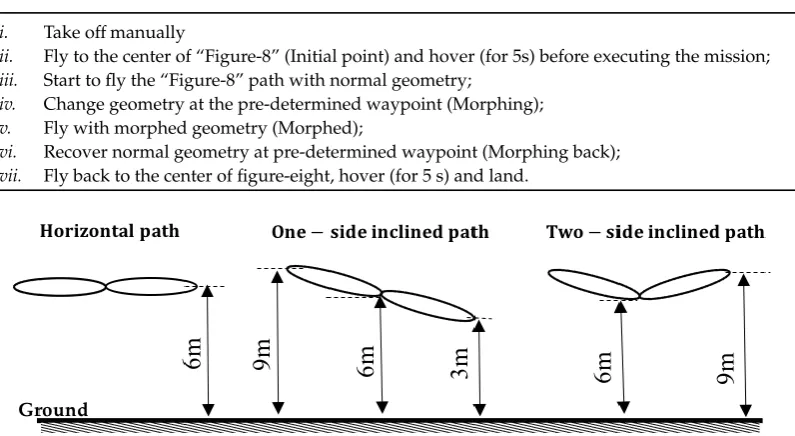
geometry quadcopter, while flying a “Figure-8” flight path. Each flight scenario (details of the flight test conditions are listed in Table 6) was repeated 10 times, following the steps described in Table 7, to ensure reasonably reliable statistics to assess flight performance. The “Figure-8” flight path was designed to be flown under different conditions by varying the velocity, number of waypoints, and angle of morphing. Due to limitations of the physical structure of the quadcopter (limitations imposed by the possibility of propeller overlap) the morphing angle was limited to 21°and 27°. In
addition, the experiments were designed to include “Figure-8” flight paths in three different planar
configurations: normal (single horizontal plane), single inclined (~16° inclined plane) and double
inclined (the two lobes of the “Figure-8” were in two different planes inclined at ~16° from the
horizontal plane)—these are illustrated in Figure 10 [43].
Figure 9.Trend of changing damping ratio, with changes in the morphing angle.
4.2. Flight Test Experiments
Drones2019,3, 70 10 of 36
(single horizontal plane), single inclined (∼16◦inclined plane) and double inclined (the two lobes of
the “Figure-8” were in two different planes inclined at∼16◦from the horizontal plane)—these are
illustrated in Figure10[43].
Table 6.Flight test parameters.
Flight Conditions Parameters
“Figure-8” flight path Horizontal, inclined and double inclined plane
Morphing Angle 0◦, 21◦, 27◦
Number of waypoints 20, 30 (over the entire path)
Waypoints with morphed Geometry No. 4–No. 7 (20), No. 5–No. 11 (30)
Velocity 1.5m/s, 2.5m/s
Table 7.General setup for flight test evaluation of morphed geometry quadcopter configurations.
i. Take offmanually
ii. Fly to the center of “Figure-8” (Initial point) and hover (for 5s) before executing the mission; iii. Start to fly the “Figure-8” path with normal geometry;
iv. Change geometry at the pre-determined waypoint (Morphing); v. Fly with morphed geometry (Morphed);
vi. Recover normal geometry at pre-determined waypoint (Morphing back); vii. Fly back to the center of figure-eight, hover (for 5 s) and land.
Drones 2019, 3, x FOR PEER REVIEW 11 of 37
Table 6. Flight test parameters.
Flight Conditions Parameters
“Figure-8” flight path Horizontal, inclined and double inclined plane
Morphing Angle 0°, 21°, 27°
Number of waypoints 20, 30 (over the entire path) Waypoints with morphed Geometry No. 4–No. 7 (20), No. 5–No. 11 (30)
Velocity 1.5m/s, 2.5m/s
Figure 10. Illustrations of the flight paths as described in Table 6.
Each flight was flown similarly with manual take off, followed by autonomous flights from the
center of the “Figure-8”, followed by a short hover (5 s) at the end of the flight, and landing, as described in Table 7 below. During autonomous flights, the pilot in command was always on standby to take over control of the quadcopter in case of abnormal behavior or other emergency situations.
Table 7. General setup for flight test evaluation of morphed geometry quadcopter configurations.
i. Take off manually
ii. Fly to the center of “Figure-8” (Initial point) and hover (for 5s) before executing the
mission;
iii. Start to fly the “Figure-8” path with normal geometry;
iv. Change geometry at the pre-determined waypoint (Morphing);
v. Fly with morphed geometry (Morphed);
vi. Recover normal geometry at pre-determined waypoint (Morphing back); vii. Fly back to the center of figure-eight, hover (for 5 s) and land.
4.2.1. Hover Flights, with Morphing
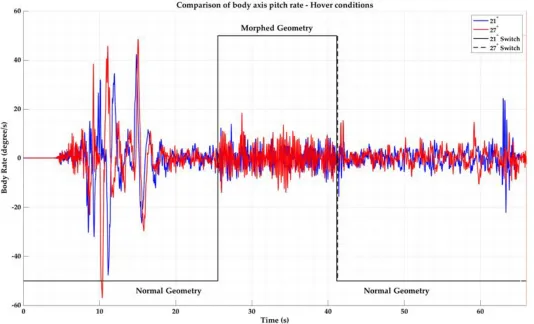
Following simulations, the quadcopter was tested under hover conditions, with morphing initiated, as the first step prior to full-fledged tests of the “Figure-8” flights. Following manual take-off and after reaching a desired altitude, the quadcopter was switched to the autonomous “position hold” mode and the geometry morphing was initiated to keep the new structure for approximately
15 s. This was followed by recovering its normal structure and landing (autonomous landing). The roll and pitch body axis rates during the 𝑛𝑜𝑟𝑚𝑎𝑙 𝑔𝑒𝑜𝑚𝑒𝑡𝑟𝑦 → 𝑚𝑜𝑟𝑝ℎ𝑒𝑑 𝑔𝑒𝑜𝑚𝑒𝑡𝑟𝑦 and switch back from 𝑚𝑜𝑟𝑝ℎ𝑒𝑑 𝑔𝑒𝑜𝑚𝑒𝑡𝑟𝑦 → 𝑛𝑜𝑟𝑚𝑎𝑙 𝑔𝑒𝑜𝑚𝑒𝑡𝑟𝑦 were analyzed under two conditions (21° and 27°),
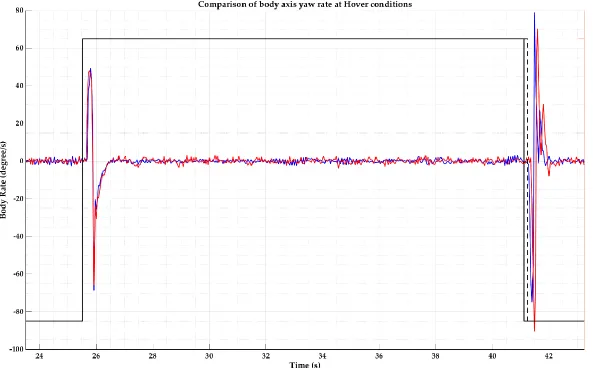
and the responses are shown in Figures 11–14 below. As can be seen from the figures, a larger morphing (27°) results in a larger oscillation of the pitch and roll rate than 21°morphing. As
morphing does not affect moment distance and inertia related to the z axis, the yaw rates under both morphing conditions were relatively similar, considering the small differences in flight conditions, as is shown in Figures 15 and 16.
Figure 10.Illustrations of the flight paths as described in Table6.
Each flight was flown similarly with manual take off, followed by autonomous flights from the center of the “Figure-8”, followed by a short hover (5 s) at the end of the flight, and landing, as described in Table7below. During autonomous flights, the pilot in command was always on standby to take over control of the quadcopter in case of abnormal behavior or other emergency situations.
4.2.1. Hover Flights, with Morphing
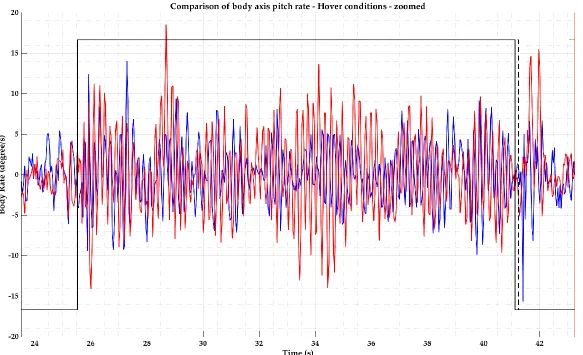
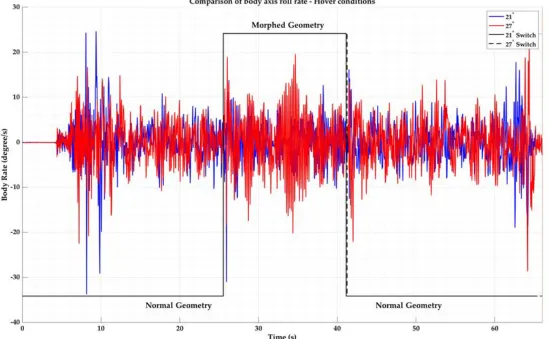
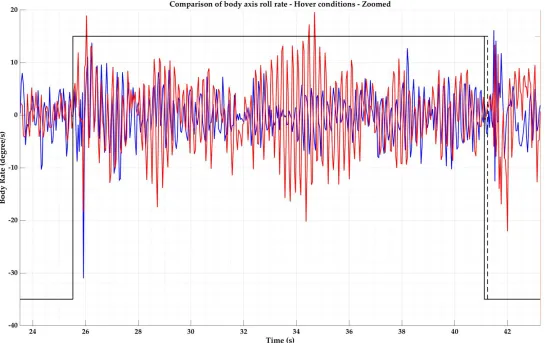
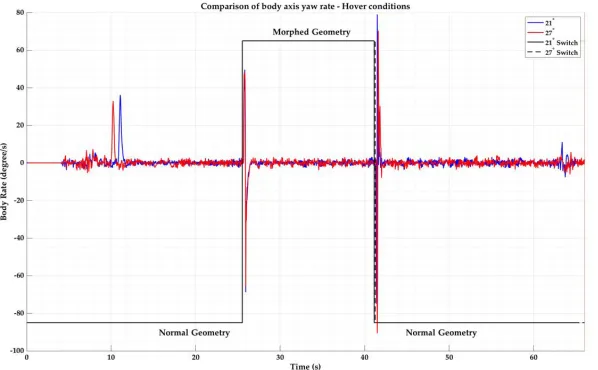
Following simulations, the quadcopter was tested under hover conditions, with morphing initiated, as the first step prior to full-fledged tests of the “Figure-8” flights. Following manual take-off and after reaching a desired altitude, the quadcopter was switched to the autonomous “position hold” mode and the geometry morphing was initiated to keep the new structure for approximately 15 s. This was followed by recovering its normal structure and landing (autonomous landing). The roll and pitch body axis rates during the normal geometry → morphed geometry and switch back from
morphed geometry → normal geometry were analyzed under two conditions (21◦ and 27◦), and the
Drones2019,3, 70 11 of 36
Data from 10 flights of each morphing condition (21◦, 27◦) are presented below in Table8. Note that in this article, flight performance worse than that in the normal geometry configuration is marked in red and flight performance better than that of normal geometry is marked in green.
Table 8.Mean value and standard deviation of body axis angular rates during hover tests.
Mean (◦/s) Standard Deviation (◦/s)
Roll Pitch Yaw Roll Pitch Yaw
0◦ −0.10162 0.149712 0.082135 3.754336 2.70556 1.154787 21◦ 0.052661 0.120368 0.066851 5.426002
(44.52%)
4.567562 (68.82%)
6.195452 (436.5%)
27◦ 0.071171 0.20745 0.079197 6.281651 (67.31%)
5.24529 (93.87%)
6.702127 (480.7%)
From the table, it is clear that the mean values of the averages are very close to each other—as few conclusions can be drawn. On the other hand, the standard deviation of all the angular rates (mean of the 10 runs of roll, pitch, and yaw rates) during hover show an increasing trend with increasing morphing angle, indicating higher oscillations around the mean value and a reduction in dynamic stability. On average, the larger morphing angle resulted in an approximately 1.5-fold increase in the standard deviation of the angular rates (roll and pitch) as compared to the smaller morphing angle. This could be attributed to the fact that a large morphing angle decreases the damping ratio of the system dynamics more, as compared to a smaller morphing angle.
4.2.2. Figure-8 Flights, with Morphing
The primary goal of this effort was to determine the flight performance of the quadcopter in various morphing configurations, while performing a complex mission; as previously described, 10 flights of the “Figure8” trajectory were executed in each configuration (morphing angle, #of waypoints, velocity and plane). Also note that the following flight conditions had a different number of flights than the standard 10 sets:
vel.=1.5 m/s; wp=30; morph=27◦; horizontal plane: 11 flights vel.=2.5 m/s; wp=20; morph=21◦; horizontal plane: 9 flights vel.=2.5 m/s; wp=30; morph=21◦; horizontal plane: 11 flights
DronesDrones 20192019,, 33, 70, x FOR PEER REVIEW 13 of 37 12 of 36
Drones2019,3, 70 13 of 36
Drones 2019, 3, x FOR PEER REVIEW 14 of 37
Drones2019,3, 70 14 of 36
Drones 2019, 3, x FOR PEER REVIEW 15 of 37
Drones2019,3, 70 15 of 36
Drones 2019, 3, x FOR PEER REVIEW 16 of 37
Drones2019,3, 70 16 of 36
Drones 2019, 3, x FOR PEER REVIEW 17 of 37
Drones2019,3, 70 17 of 36
Drones 2019, 3, x FOR PEER REVIEW 18 of 37
DronesDrones 20192019,, 33, 70, x FOR PEER REVIEW 19 of 37 18 of 36
Drones2019,3, 70 19 of 36
Drones 2019, 3, x FOR PEER REVIEW 20 of 37
Drones2019,3, 70 20 of 36
Drones 2019, 3, x FOR PEER REVIEW 21 of 37
DronesDrones 20192019,, 33, 70, x FOR PEER REVIEW 22 of 37 21 of 36
DronesDrones 20192019,, 33, 70, x FOR PEER REVIEW 23 of 37 22 of 36
DronesDrones 20192019,, 33, 70, x FOR PEER REVIEW 24 of 37 23 of 36
Drones2019,3, 70 24 of 36
The standard deviation of the body axis angular rates of the quadcopter from the “Figure-8” flights in the segments with morphing geometry active are tabulated in Tables9–14.
Table 9.Standard deviation of angular rates of different flights (flights in a horizontal plane).
v=1.5 m/s; Waypoints=20 v=2.5 m/s; Waypoints=20
p(◦/s) q(◦/s) r(◦/s) p(◦/s) q(◦/s) r(◦/s)
0◦ 5.7103 13.2743 23.5161 16.3689 17.0616 26.6821 21◦ 10.4814(83.6%) 15.597(17.5%) 22.7085(−3.43%) 23.3277(42.51%) 19.3982(13.7%) 25.7222(−3.6%)
27◦ 10.0744(76.4%) 13.1465(−0.96%) 24.2962(3.31%) 17.7324(8.33%) 18.4482(8.13%) 27.2056(1.96%)
Table 10.Standard deviation of angular rates of different flights (flights in a single inclined plane).
v=1.5 m/s; Waypoints=20 v=2.5 m/s; Waypoints=20
p(◦/s) q(◦/s) r(◦/s) p(◦/s) q(◦/s) r(◦/s)
0◦ 6.5744 11.4717 23.529 14.8538 15.7843 27.2415 21◦ 10.6581(62.11%) 14.6114(27.36%) 22.7722(−3.21%) 21.3364(43.64%) 17.2458(9.25%) 26.7324(−1.86%)
27◦ 9.9941(52%) 11.7458(2.39%) 24.3338(3.42%) 17.6113(18.56%) 16.8861(7%) 26.9048(−1.23%)
Table 11.Standard deviation of axis angular rates of different flights (flights in a double inclined plane).
v=1.5 m/s; Waypoints=20 v=2.5 m/s; Waypoints=20
p(◦/s) q(◦/s) r(◦/s) p(◦/s) q(◦/s) r(◦/s)
0◦ 6.4357 13.2678 23.4045 16.8838 16.9342 27.0096 21◦ 11.0187(71.21%) 14.4729(9%) 21.3538(−8.76%) 22.7902(35%) 16.0106(−5.45%) 28.1622(4.26%)
27◦ 10.3847(61.36%) 11.8751(−10.5%) 24.7663(5.81%) 19.7108(16.74%) 17.4828(3.23%) 28.4287(5.25%)
Table 12.Standard deviation of angular rates of different flights (flights in a horizontal plane).
v=1.5 m/s; Waypoints=30 v=2.5 m/s; Waypoints=30
p(◦/s) q(◦/s) r(◦/s) p(◦/s) q(◦/s) r(◦/s)
0◦ 7.6676 14.2476 21.0887 14.5061 18.2174 23.121 21◦ 12.3884(61.56%) 16.255(14%) 20.2024(−4.2%) 17.7009(22%) 20.703(13.64%) 24.4376(5.69%)
27◦ 10.1845(32.82%) 13.6735(−4%) 20.8213(−1.27%) 17.7756(22.54%) 19.7693(8.52%) 24.1675(4.52%)
Table 13.Standard deviation of angular rates of different flights (flights in a single inclined plane).
v=1.5 m/s; Waypoints=30 v=2.5 m/s; Waypoints=30
p(◦/s) q(◦/s) r(◦/s) p(◦/s) q(◦/s) r(◦/s)
0◦ 7.6265 13.9759 20.6477 13.7688 18.331 22.5695 21◦ 10.6458(39.6%) 16.2405(16.2%) 20.9114(1.28%) 17.0046(23.5%) 19.3913(5.8%) 23.4673(4%) 27◦ 12.698(66.5%) 15.9637(14.22%) 21.7133(5.16%) 18.1519(31.8%) 19.7393(7.68%) 23.782(5.37%)
Table 14.Standard deviation of angular rates of different flights (flights in a double inclined plane).
v=1.5 m/s; Waypoints=30 v=2.5 m/s; Waypoints=30
p(◦/
s) q(◦/
s) r(◦/
s) p(◦/
s) q(◦/
s) r(◦/
s)
Drones2019,3, 70 25 of 36
From the data, it can be observed that the standard deviation of the roll rate of the quadcopter during the morphing flight segments are consistently larger under all flight conditions (# of waypoints, velocity and plane) than the corresponding value under normal geometry flights. Additionally, it was also observed that both the number of waypoints and the velocity had a significant effect on the roll rate—the performance of the quadcopter under 27◦morphing was consistently better than that under 21◦morphing by approximately 10% for the flight path with 20 waypoints at the lower velocity (1.5 m/s), and at a higher velocity (and 20 waypoints), the difference was more pronounced with the 27◦morphing condition performing 2–5 times better than the 21◦condition.
In the 30 waypoints flight condition, the 21◦morphing condition performed better than the 27◦ two out of three times (in the inclined and double inclined plane) at the lower velocity (1.5 m/s). At the higher velocity condition, no significant difference was found in the performance (different morphing configurations) in all planes (horizontal, inclined and double inclined). From the data, it can be seen that under 20 waypoints and 1.5 m/s flight condition, the pitch rate follows the same trend as the roll rate—the 27◦morphing angle has smaller oscillations as compared to the 21◦morphing, although the magnitude of the differences between the two are not as pronounced as that for the roll rate. Except for one flight condition (21◦, 1.5 m/s and inclined plane), under all the other flight conditions the difference from the baseline performance was within±10%. In the case of yaw rate, while there were
some observed differences between the morphed geometry conditions and normal flight conditions, it was within±10% of the baseline performance.
The differences between the pitch and roll rate responses are consistent with the fact that morphing reduces the damping ratio of the roll dynamics more than that of the pitch dynamics. Additionally, the variations in the performance of the roll rate response in different morphing configurations and flight conditions—21◦performing better in some cases than 27◦and vice versa, could be attributed to uncontrolled/unaccounted factors, including environmental conditions and artefacts of the physical structure of the UAS, especially in the connections between the arms of the quadcopter and the central hub.
4.2.3. Position Error
Drones2019,3, 70 26 of 36
Drones 2019, 3, x FOR PEER REVIEW 26 of 37
Drones2019,3, 70 27 of 36
Drones 2019, 3, x FOR PEER REVIEW 27 of 37
Drones2019,3, 70 28 of 36
Drones 2019, 3, x FOR PEER REVIEW 28 of 37
Drones2019,3, 70 29 of 36
4.2.4. Splitting the Trajectory into Appropriate Segments Using a “Sliced Pie” Concept
In order to evaluate the performance of the quadcopter in following the desired flight path under both normal flight and morphed geometry, we introduce a method to split the “Figure-8” flight path data and analyze the position error. We term it the “sliced pie” method—similar to cutting a pizza pie into several slices. In this method, the trajectory is split (sliced) to correspond to segments between two consecutive waypoints. We then evaluate the position errors along each segment of the desired trajectory as the mean error of the recorded GPS trajectory from the desired straight-line segment. The process of splitting the trajectory into segments is as described in the Table15.
Table 15.Broad description of the “sliced pie” method to identify flight segments.
i. Approximate the “Figure-8” flight path using two circles, tangential to each other (or intersecting at one point) at the center of the “Figure-8”;
ii. Draw two larger circles, each centered at one lobe to encompass the flight path
iii. Draw radial lines from the center of each lobe through corresponding waypoints in each lobe; this “slices” the flight path (pizza cutting style). Thus, the two circles can be divided into several triangular segments.
iv. Identify the “slice” that a current GPS location belongs to, using the triangle method (described below). By using this method, the whole flight path can be divided into several segments resembling a “sliced pie”.
The following Figures26–29illustrate the process of generating segments of flight following the broad steps listed above.
Drones 2019, 3, x FOR PEER REVIEW 29 of 37
Drones2019, 3, x; doi: FOR PEER REV IEW www.mdpi.com/journal/drones
4.2.4. Splitting the Trajectory into Appropriate Segments using a “Sliced Pie” Concept
In order to evaluate the performance of the quadcopter in following the desired flight path under
both normal flight and morphed geometry, we introduce a method to split the “Figure-8” flight path data and analyze the position error. We term it the “sliced pie” method—similar to cutting a pizza pie into several slices. In this method, the trajectory is split (sliced) to correspond to segments between two consecutive waypoints. We then evaluate the position errors along each segment of the desired trajectory as the mean error of the recorded GPS trajectory from the desired straight -line segment. The process of splitting the trajectory into segments is as described in the Table 15.
Table 15. Broad description of the “sliced pie” method to identify flight segments.
i. Approximate the “Figure-8” flight path using two circles, tangential to each other (or intersecting at one point) at the center of the “Figure-8”;
ii. Draw two larger circles, each centered at one lobe to encompass the flight path
iii. Draw radial lines from the center of each lobe through corresponding waypoints in each lobe;
this “slices” the flight path (pizza cutting style). Thus, the two circles can be divided into
several triangular segments.
iv. Identify the “slice” that a current GPS location belongs to, using the triangle method
(described below). By using this method, the whole flight path can be divided into several
segments resembling a “sliced pie”.
The following Figures 26–29 illustrate the process of generating segments of flight following the broad steps listed above.
Drones2019,3, 70 30 of 36
Drones 2019, 3, x FOR PEER REVIEW 30 of 37
Figure 27. Step 2: “left lobe” trajectory split.
Figure 28. Step 2: “right lobe” trajectory split.
Figure 29. A complete “sliced pie” split of the flight path of the UAS, into segments between
waypoints.
-15 -10 -5 0 5 10 15
X (m) -8 -6 -4 -2 0 2 4 6 8 Y ( m ) Flight path Desired path Path splitter Figure 27.Step 2: “left lobe” trajectory split.
Drones 2019, 3, x FOR PEER REVIEW 30 of 37
Figure 27. Step 2: “left lobe” trajectory split.
Figure 28. Step 2: “right lobe” trajectory split.
Figure 29. A complete “sliced pie” split of the flight path of the UAS, into segments between
waypoints.
-15 -10 -5 0 5 10 15
X (m) -8 -6 -4 -2 0 2 4 6 8 Y ( m ) Flight path Desired path Path splitter Figure 28.Step 2: “right lobe” trajectory split.
Drones 2019, 3, x FOR PEER REVIEW 30 of 37
Figure 27. Step 2: “left lobe” trajectory split.
Figure 28. Step 2: “right lobe” trajectory split.
Figure 29. A complete “sliced pie” split of the flight path of the UAS, into segments between
waypoints.
-15 -10 -5 0 5 10 15
X (m) -8 -6 -4 -2 0 2 4 6 8 Y ( m ) Flight path Desired path Path splitter
Figure 29.A complete “sliced pie” split of the flight path of the UAS, into segments between waypoints.
4.2.5. Method of Triangles to Identify the Segments of Flight Path
Drones2019,3, 70 31 of 36
Assume that the current GPS location of the UAS and the pie slice are represented byPand ∆ABC, respectively. Six vectors related to the vertices of the triangle,A, B, C, and the GPS locationP are represented as
→ AB, → BC, → CA, → PA, → PB, →
PCrespectively. If the pointPlies within the triangle∆ABC, the direction of the cross product of the vectors
→ AB× → PB, → BC× → PC, and
→ CA×
→
PAshould all be out of the plane. On the other hand, if the pointPlies outside the triangle∆ABC, the direction of the cross
products will be into the plane,⊗.
Numerically, assume all three coordinates vectors are in the plane of∆ABC, which leads to the value of thezcoordinate of each vector being zero. After calculating the cross product, if the value of thezcoordinate of each result is all positive, it is indicative that the pointPlies inside the triangle ∆ABC. On the other hand, if one of the results are negative, it is indicative that the pointPlies outside of∆ABC. In a marginal condition,Pis on one of the sides of∆ABC, resulting in a zero value. This process is illustrated in Figures30and31below.
Drones 2019, 3, x FOR PEER REVIEW 31 of 37
4.2.5. Method of Triangles to Identify the Segments of Flight Path
Following the generation of the “sliced pie”, it is necessary to confirm whether a segment of flight path (GPS location of the UAS) lies within the region covered by the current pie slice or not, to be enable generation of trajectory position errors. In order to do so efficiently, we use the concepts of vectors and vector cross-products.
Assume that the current GPS location of the UAS and the pie slice are represented by 𝑃 and
∆𝐴𝐵𝐶, respectively. Six vectors related to the vertices of the triangle, 𝐴, 𝐵, 𝐶, and the GPS location 𝑃
are represented as 𝐴𝐵⃗⃗⃗⃗⃗ , 𝐵𝐶⃗⃗⃗⃗⃗ , 𝐶𝐴⃗⃗⃗⃗⃗ , 𝑃𝐴⃗⃗⃗⃗⃗ , 𝑃𝐵⃗⃗⃗⃗⃗ , 𝑃𝐶⃗⃗⃗⃗⃗ respectively. If the point 𝑃 lies within the triangle
∆𝐴𝐵𝐶, the direction of the cross product of the vectors 𝐴𝐵⃗⃗⃗⃗⃗ × 𝑃𝐵⃗⃗⃗⃗⃗ , 𝐵𝐶⃗⃗⃗⃗⃗ × 𝑃𝐶⃗⃗⃗⃗⃗ , and 𝐶𝐴⃗⃗⃗⃗⃗ × 𝑃𝐴⃗⃗⃗⃗⃗ should all be out of the plane ⊙. On the other hand, if the point 𝑃 lies outside the triangle ∆𝐴𝐵𝐶, the direction of the cross products will be into the plane, ⊗.
Numerically, assume all three coordinates vectors are in the plane of ∆𝐴𝐵𝐶, which leads to the value of the 𝑧 coordinate of each vector being zero. After calculating the cross product, if the value of the 𝑧 coordinate of each result is all positive, it is indicative that the point 𝑃 lies inside the triangle
∆𝐴𝐵𝐶. On the other hand, if one of the results are negative, it is indicative that the point 𝑃 lies outside of ∆𝐴𝐵𝐶. In a marginal condition, 𝑃 is on one of the sides of ∆𝐴𝐵𝐶, resulting in a zero value. This process is illustrated in Figures 30 and 31 below.
Figure 30. Triangle ABC with point P within.
Figure 31. Triangle ABC with point P outside. Figure 30.Triangle ABC with point P within.
Drones 2019, 3, x FOR PEER REVIEW 31 of 37
4.2.5. Method of Triangles to Identify the Segments of Flight Path
Following the generation of the “sliced pie”, it is necessary to confirm whether a segment of flight path (GPS location of the UAS) lies within the region covered by the current pie slice or not, to be enable generation of trajectory position errors. In order to do so efficiently, we use the concepts of vectors and vector cross-products.
Assume that the current GPS location of the UAS and the pie slice are represented by 𝑃 and
∆𝐴𝐵𝐶, respectively. Six vectors related to the vertices of the triangle, 𝐴, 𝐵, 𝐶, and the GPS location 𝑃
are represented as 𝐴𝐵⃗⃗⃗⃗⃗ , 𝐵𝐶⃗⃗⃗⃗⃗ , 𝐶𝐴⃗⃗⃗⃗⃗ , 𝑃𝐴⃗⃗⃗⃗⃗ , 𝑃𝐵⃗⃗⃗⃗⃗ , 𝑃𝐶⃗⃗⃗⃗⃗ respectively. If the point 𝑃 lies within the triangle
∆𝐴𝐵𝐶, the direction of the cross product of the vectors 𝐴𝐵⃗⃗⃗⃗⃗ × 𝑃𝐵⃗⃗⃗⃗⃗ , 𝐵𝐶⃗⃗⃗⃗⃗ × 𝑃𝐶⃗⃗⃗⃗⃗ , and 𝐶𝐴⃗⃗⃗⃗⃗ × 𝑃𝐴⃗⃗⃗⃗⃗ should all be out of the plane ⊙. On the other hand, if the point 𝑃 lies outside the triangle ∆𝐴𝐵𝐶, the direction of the cross products will be into the plane, ⊗.
Numerically, assume all three coordinates vectors are in the plane of ∆𝐴𝐵𝐶, which leads to the value of the 𝑧 coordinate of each vector being zero. After calculating the cross product, if the value of the 𝑧 coordinate of each result is all positive, it is indicative that the point 𝑃 lies inside the triangle
∆𝐴𝐵𝐶. On the other hand, if one of the results are negative, it is indicative that the point 𝑃 lies outside of ∆𝐴𝐵𝐶. In a marginal condition, 𝑃 is on one of the sides of ∆𝐴𝐵𝐶, resulting in a zero value. This process is illustrated in Figures 30 and 31 below.
Figure 30. Triangle ABC with point P within.
Figure 31. Triangle ABC with point P outside. Figure 31.Triangle ABC with point P outside.