R E S E A R C H A R T I C L E
Open Access
The development and theoretical
application of an implementation
framework for dialectical behaviour
therapy: a critical literature review
Gill Toms
1, Lynne Williams
1, Jo Rycroft-Malone
1, Michaela Swales
2*and Janet Feigenbaum
3Abstract
Background:Dialectical behaviour therapy (DBT) is a third wave behaviour therapy combining behaviour based components with elements of mindfulness. Although DBT effectiveness has been explored, relatively little attention has been given to its implementation. Frameworks are often the basis for gathering information about
implementation and can also direct how the implementation of an intervention is conducted. Using existing implementation frameworks, this critical literature review scoped the DBT implementation literature to develop and refine a bespoke DBT implementation framework.
Method and results:The initial framework was developed by consolidating existing implementation frameworks and published guidance on DBT implementation. The critical literature review retrieved papers from Medline, CINAHL, PsycInfo, PubMed, and the reference lists of included papers. Framework elements were used as codes which were applied to the literature and guided the synthesis. Findings from the synthesis refined the framework. The critical literature review retrieved 60 papers but only 14 of these explicitly focused on implementation. The DBT implementation framework captured all the execution barriers and facilitators described in the literature. However, the evidence synthesis led to a more parsimonious framework as some elements (e.g., research and published guidance) were seldom discussed in DBT implementation.
Conclusion:To our knowledge this is the first published review exploring DBT implementation. The literature synthesis suggests some tentative recommendations which warrant further exploration. For instance, if DBT implementation is not pre-planned, having someone in the organisation who champions DBT can be
advantageous. However, as the literature is limited and has methodological limitations, further prospective studies of DBT implementation are needed.
Keywords:Dialectical behaviour therapy, Implementation, Psychological therapy, Review
Background
Dialectical Behaviour Therapy (DBT) [1] synthesises be-havioural based therapy components (orientated towards change) with elements from mindfulness (orientated to-wards increasing acceptance). DBT is typically offered to people with a diagnosis of Borderline Personality Dis-order (BPD) and a history of suicidal and self-harming
behaviour. Therapists aim to impart new skills and de-velop clients’behavioural flexibility to draw on appropri-ate skills in any given social or emotional situation. Core treatment components include individual therapy, tele-phone skills coaching, skills group and a clinician con-sultation team (where DBT therapists access support and guidance from other DBT team members), although services may only deliver some of these components (e.g. [2]). Several reviews summarising the evidence for DBT effectiveness are available (e.g. [3,4]).
* Correspondence:[email protected]
2North Wales Clinical Psychology Programme, School of Psychology, Brigantia Building, Bangor University, Bangor, Gwynedd LL57 2DG, UK Full list of author information is available at the end of the article
Implementation is the process through which the up-take of evidence-based interventions in routine clinical practice is systematically promoted. Transdisciplinary implementation frameworks exist, for instance, Promoting Action on Research Implementation in Health Services (PARIHS: [5,6]), the Consolidated Framework for imple-mentation for impleimple-mentation research (CFIR: [7]), and the Core Implementation Components model ([8,9]). The PARIHS framework covers many of the core elements of these models: context, evidence, facilitation and interven-tion elements. Context refers to the environment or set-ting that the implementation takes place in. Evidence can be derived from research, clinical experience or patient preference. Facilitation refers to the people and processes that support implementation and the intervention element demotes the characteristics of the intervention to be plemented. CFIR has an additional element related to im-plementation processes, which describes the practical implementation tasks undertaken. Each of these elements are sub-divided. For instance, PARIHS sub-divides evi-dence into research and published guidance, clinical ex-perience and professional knowledge, preferences and experiences, and local knowledge. National implementa-tions refer to many of these elements in their guidance, for example, the Increasing Access to Psychological Therapies manual [10].
DBT has unique features, such as, a multicomponent therapy process, telephone skills coaching, and a con-sultation team. The characteristics of people with BPD (the core client group) could also necessitate bespoke implementation strategies. The question of how best to implement a DBT intervention arose in the context of the Enabling and Motivating people (with a Personality Disorder) in Occupation, Wellbeing, Education and Responsibility (EMPOWER) research programme (NIHR Programme Grant: RP-PG-1212-20,011), which is devel-oping and evaluating a DBT- Skills for Employment (DBT-SE) intervention. The evidence about DBT imple-mentation has seldom been reviewed and this work was undertaken with a view to developing an implementation toolkit for the DBT-SE intervention. We aimed to review the DBT implementation literature to develop and refine a bespoke DBT implementation framework.
Methods
Framework development
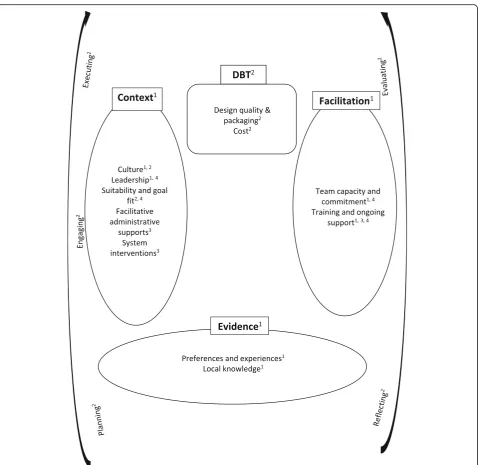
To create an initial DBT implementation framework, el-ements from the main transdisciplinary frameworks (PARIHS, CFIR, and the Core Implementation Compo-nents model) and from published DBT implementation guidance [11, 12] were synthesised. PARIHS [5, 6] was selected as the underpinning framework as it highlights the pivotal role of contextual factors. Although it devel-oped from existing models, this is the first framework to
incorporate implementation insights from the DBT
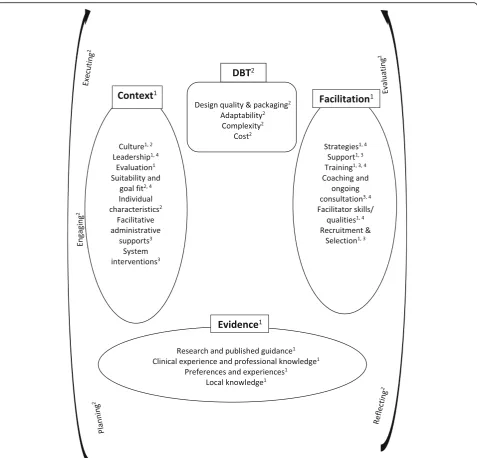
lit-erature. The initial framework is represented in Fig. 1
and is described in Additional file1.
Critical literature review
To refine the framework, a critical literature review [13] was conducted. In critical reviews, the synthesis process is used to create a new model or a model embodying existing theory which then provides a ‘launch pad’ for subsequent testing. One of the strengths of this type of review lies in the analysis undertaken to create the model [13].
Four databases were searched with the terms ‘DBT’
and ‘Implementation’ in January 2016; Medline
(EBSCO), CINAHL (EBSCO), PsycInfo (ProQuest), and PubMed (NCBI). These databases were selected as they hold health and psychology related literature. Reference lists of included papers were additionally screened as im-plementation issues might be discussed without this term being used as a key word or included in the ab-stract or title. DBT was defined as any combination of components or interventions which were identified as
DBT by the study authors (Additional file 2 contains an
example search). Implementation was defined as the process of introducing and sustaining DBT in routine practice. All retrievals were managed in RefWorks, an online bibliographic management programme. Only peer-reviewed papers were included but no date or evi-dence type restrictions were applied. For resource and time reasons, only papers published in English were in-cluded. The first author conducted the review and the eligibility of database retrieved papers was checked by a second reviewer (reviewer agreement was 97% with all disagreements resolved through discussion).
Consistent with the critical review approach, papers
were not excluded for methodological reasons [13].
However, prospective and retrospective studies of imple-mentation were considered to provide the strongest evi-dence due to their explicit focus on implementation. Discussion pieces were judged to form the weakest evi-dence as the experiences they are based on are often not accessible for review. The data extracted from papers included; the design, context, methodology, implementa-tion barriers and facilitators, as well as author
conclu-sions and recommendations (Additional file 3 contains
the data extraction template). Extracted data were dis-cussed by the review team and where necessary the text was re-reviewed.
Evidence synthesis
implementation framework as code labels and assigned them to the data segments. Where the extracted data did not fit any existing codes, a new code name was added and this process continued until all the data were categorised. Coding was conducted by the first author and a second reviewer checked the coding applied to sixteen papers (10 % of the papers coded): although con-servatively judged agreement was 66% (a criterion that the same sub-elements were coded in each paper), dif-ferences in coding were negligible and easily resolved through discussion. For instance, the most common cause for disagreement was which code best captured
the data. The team reviewed the final synthesis to ensure it presented an accurate reflection of the data.
Results
Critical literature review
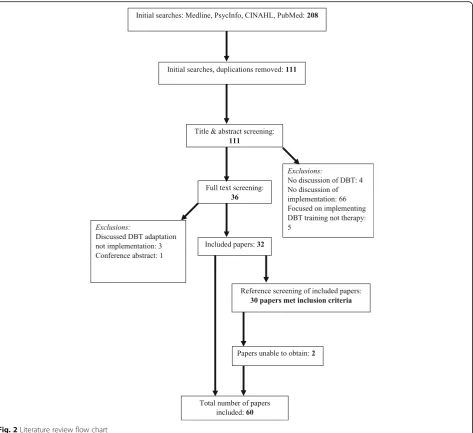
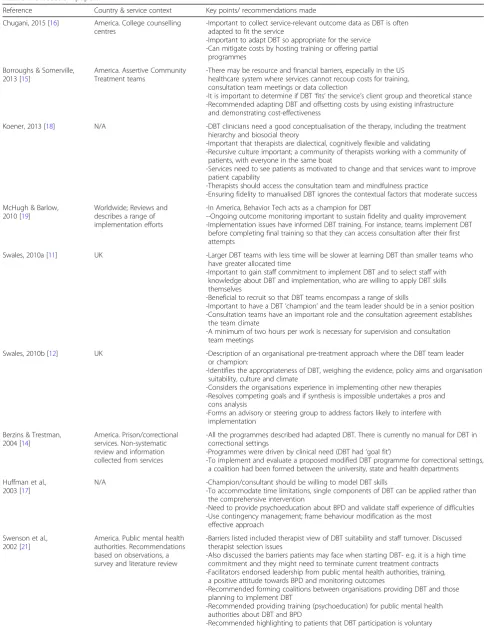
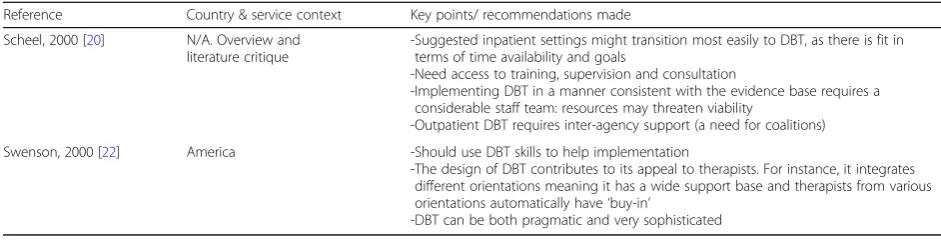
Sixty-two papers met the inclusion criteria (32 from data-base and 30 from reference list searches), although two pa-pers were unobtainable within the time limit of the review. The main reasons for exclusion were failure to consider DBT or a failure to discuss implementation issues (see Fig.2). There were 11 discussion papers ([11,12,14–22]) and as these were considered the weakest form of evidence
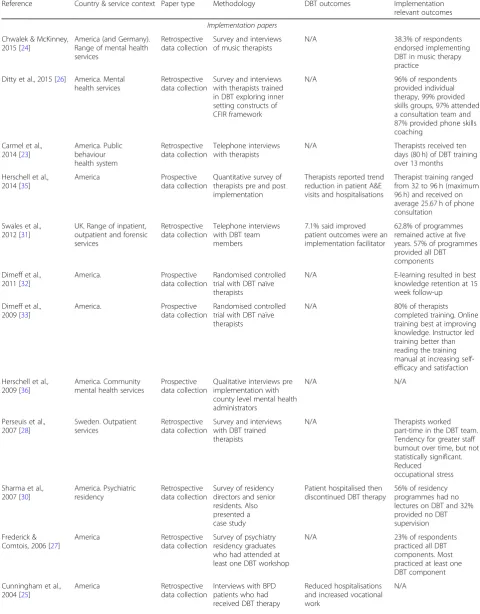
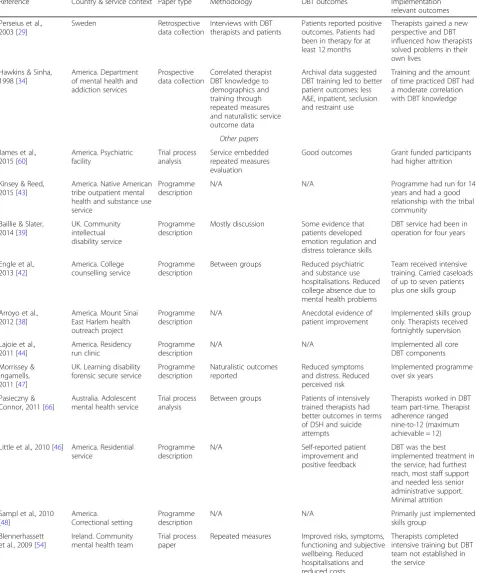
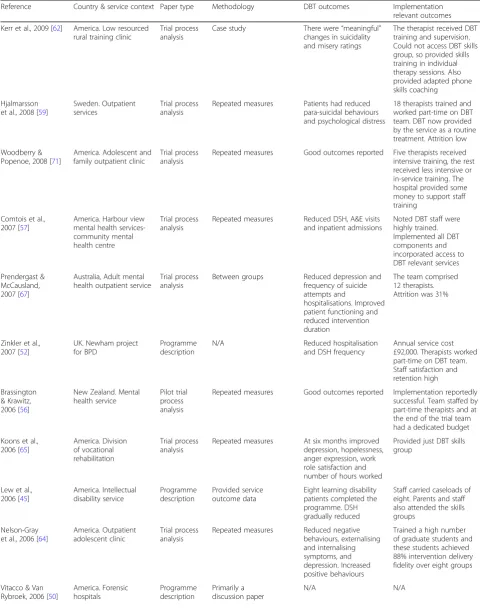
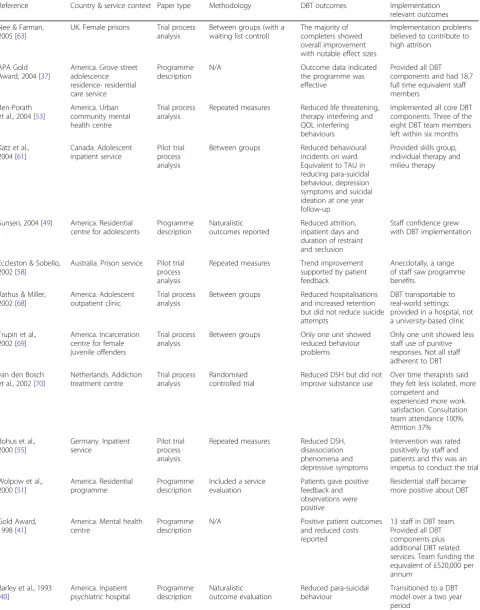
they were not included in the synthesis, but are detailed in Table1. As seen in Table2, nine papers collected retro-spective ([23–31]) and five papers ([32–36]) collected prospective implementation data. There were 16 programme descriptions ([37–52]) and 19 trial process analyses ([53–71]). The majority (N= 38) of papers were from the United States (US), and most implemen-tations of DBT were in mental health services.
Evidence synthesis
Overall, 788 framework codes were assigned to the ex-tracted data: 170 codes were allocated to studies specif-ically considering implementation, 209 codes to process analysis studies, 224 codes to programme descriptions, and the remainder were assigned to discussion papers
(see Additional file 4). The DBT implementation
frame-work is used to present the literature synthesis and, when possible, the data discussed is derived from the papers which explicitly studied implementation.
Context
Our initial DBT framework included seven context sub-elements (culture, leadership, evaluation, goal fit and suitability, individual characteristics, facilitative administrative supports and system interventions). Our
synthesis of the literature yielded five primary
sub-elements (culture, leadership, goal fit and suitability, facilitative administrative supports and system interven-tions), which are discussed below:
Table 1Discussion papers
Reference Country & service context Key points/ recommendations made
Chugani, 2015 [16] America. College counselling centres
-Important to collect service-relevant outcome data as DBT is often adapted to fit the service
-Important to adapt DBT so appropriate for the service -Can mitigate costs by hosting training or offering partial
programmes
Borroughs & Somerville, 2013 [15]
America. Assertive Community Treatment teams
-There may be resource and financial barriers, especially in the US healthcare system where services cannot recoup costs for training, consultation team meetings or data collection
-It is important to determine if DBT‘fits’the service’s client group and theoretical stance -Recommended adapting DBT and offsetting costs by using existing infrastructure
and demonstrating cost-effectiveness
Koener, 2013 [18] N/A -DBT clinicians need a good conceptualisation of the therapy, including the treatment hierarchy and biosocial theory
-Important that therapists are dialectical, cognitively flexible and validating
-Recursive culture important; a community of therapists working with a community of patients, with everyone in the same boat
-Services need to see patients as motivated to change and that services want to improve patient capability
-Therapists should access the consultation team and mindfulness practice
-Ensuring fidelity to manualised DBT ignores the contextual factors that moderate success
McHugh & Barlow, 2010 [19]
Worldwide; Reviews and describes a range of implementation efforts
-In America, Behavior Tech acts as a champion for DBT
--Ongoing outcome monitoring important to sustain fidelity and quality improvement -Implementation issues have informed DBT training. For instance, teams implement DBT
before completing final training so that they can access consultation after their first attempts
Swales, 2010a [11] UK -Larger DBT teams with less time will be slower at learning DBT than smaller teams who have greater allocated time
-Important to gain staff commitment to implement DBT and to select staff with knowledge about DBT and implementation, who are willing to apply DBT skills themselves
-Beneficial to recruit so that DBT teams encompass a range of skills
-Important to have a DBT‘champion’and the team leader should be in a senior position -Consultation teams have an important role and the consultation agreement establishes
the team climate
-A minimum of two hours per work is necessary for supervision and consultation team meetings
Swales, 2010b [12] UK -Description of an organisational pre-treatment approach where the DBT team leader or champion:
-Identifies the appropriateness of DBT, weighing the evidence, policy aims and organisation suitability, culture and climate
-Considers the organisations experience in implementing other new therapies -Resolves competing goals and if synthesis is impossible undertakes a pros and
cons analysis
-Forms an advisory or steering group to address factors likely to interfere with implementation
Berzins & Trestman, 2004 [14]
America. Prison/correctional services. Non-systematic review and information collected from services
-All the programmes described had adapted DBT. There is currently no manual for DBT in correctional settings
-Programmes were driven by clinical need (DBT had‘goal fit’)
-To implement and evaluate a proposed modified DBT programme for correctional settings, a coalition had been formed between the university, state and health departments
Huffman et al., 2003 [17]
N/A -Champion/consultant should be willing to model DBT skills
-To accommodate time limitations, single components of DBT can be applied rather than the comprehensive intervention
-Need to provide psychoeducation about BPD and validate staff experience of difficulties -Use contingency management; frame behaviour modification as the most
effective approach
Swenson et al., 2002 [21]
America. Public mental health authorities. Recommendations based on observations, a survey and literature review
-Barriers listed included therapist view of DBT suitability and staff turnover. Discussed therapist selection issues
-Also discussed the barriers patients may face when starting DBT- e.g. it is a high time commitment and they might need to terminate current treatment contracts -Facilitators endorsed leadership from public mental health authorities, training,
a positive attitude towards BPD and monitoring outcomes
-Recommended forming coalitions between organisations providing DBT and those planning to implement DBT
-Recommended providing training (psychoeducation) for public mental health authorities about DBT and BPD
Culture
There are two elements of culture that capture staff be-haviour within the organisation [5,6]:
Communication processes
Better ratings of organisation cohesion and communica-tion correlated with the implementacommunica-tion of more DBT components [26], perhaps because institutional adoption of DBT depends on the collaboration of many staff [34]. On-going external consultation helps achieve sustainable
programmes [23] and good communication was
import-ant within the DBT consultation team [29]. There were
examples of communication forming both a facilitator (e.g. [40]) and a barrier [46]. Communication within and across teams seemed particularly important when client charac-teristics, such as intellectual disability or offender status, meant collaborative working was essential (e.g. [45]).
Climate
Higher scores on the Team Climate Inventory correlated
with the implementation of more DBT components [26]
and limited understanding of staff and patients’ needs
could form a barrier [29]. The importance of team sup-port was endorsed by therapists [28]. Attitudes toward BPD seemed key. A non-judgemental, validating stance seems necessary to create the right environment [25], and better attitudes towards BPD correlated with increased use of DBT [35]. In one survey negative administrator atti-tudes reportedly impeded implementation [23].
Leadership
In a therapist survey, one of the most common reasons for DBT team cessation was a lack of leadership or
organisation ‘buy-in’. Where team leadership was
supportive, 19.6% of respondents said this facilitated
im-plementation [31]. Respondents in another study
simi-larly reported that a lack of understanding amongst service leaders constituted an implementation barrier
[28]. Often the implementation of DBT had not been
pre-planned and in these scenarios having a‘DBT
cham-pion’in the organisation seemed important. Champions
needed to have influencing skills (e.g. [51]), cultural
sensitivity, a willingness to undertake tasks, such as, se-curing funding [43], and an ability to model DBT skills
[46]. In many cases the DBT consultation team seemed
to undertake championing tasks through generating interest (e.g. [59]), establishing collaborations (e.g. [65]), offering expertise to other agencies (e.g. [52]) and pro-viding support to the wider staff team (e.g. [69]).
Goal fit and suitability
Sometimes DBT was viewed positively from the outset [36] and greater confidence in DBT effectiveness
corre-lated with increased use of DBT [35]. However, DBT
was not always seen as suitable [24,30]. DBT implemen-tation was also weakened by competing service priorities
[31]. For instance, in a substance abuse service, DBT
was incompatible with the delivery model of short visits
primarily providing methadone [23]. Some
administra-tors were concerned about the telephone coaching com-ponent of DBT, as telephone support had not worked
previously [36] and services need a minimum number of
patients to run DBT groups [30]. However, whilst belief in DBT suitability and fit could facilitate implementation (e.g. [58]), the lack of this belief was not necessarily a barrier, as perceptions could change during the imple-mentation process (e.g. [55]).
Facilitative administrative supports
Insufficient time could be a barrier, whereas the alloca-tion of sufficient time could be a facilitator [31]: in one survey, 42% of therapists reported having a lack of time to provide DBT [23]. Some therapists talked about need-ing to divide their time between different tasks [28] and administrators were concerned that DBT training would keep staff from their clinical duties [36]. Other required resources were finances [36] and space: having adequate space correlated with the implementation of more DBT
components [26]. The data also suggests that
contin-gency management has the potential to influence imple-mentation. For instance, organisations often failed to reduce other staff-held responsibilities to compensate
for new DBT commitments [23] thereby punishing
en-gagement in DBT. Enabling natural contingencies, such
Table 1Discussion papers(Continued)
Reference Country & service context Key points/ recommendations made
Scheel, 2000 [20] N/A. Overview and literature critique
-Suggested inpatient settings might transition most easily to DBT, as there is fit in terms of time availability and goals
-Need access to training, supervision and consultation
-Implementing DBT in a manner consistent with the evidence base requires a considerable staff team: resources may threaten viability
-Outpatient DBT requires inter-agency support (a need for coalitions)
Swenson, 2000 [22] America -Should use DBT skills to help implementation
-The design of DBT contributes to its appeal to therapists. For instance, it integrates different orientations meaning it has a wide support base and therapists from various orientations automatically have‘buy-in’
Table 2Implementation papers, programme descriptions and trial process analysis papers
Reference Country & service context Paper type Methodology DBT outcomes Implementation relevant outcomes
Implementation papers
Chwalek & McKinney, 2015 [24]
America (and Germany). Range of mental health services
Retrospective data collection
Survey and interviews of music therapists
N/A 38.3% of respondents endorsed implementing DBT in music therapy practice
Ditty et al., 2015 [26] America. Mental health services
Retrospective data collection
Survey and interviews with therapists trained in DBT exploring inner setting constructs of CFIR framework
N/A 96% of respondents provided individual therapy, 99% provided skills groups, 97% attended a consultation team and 87% provided phone skills coaching
Carmel et al., 2014 [23]
America. Public behaviour health system Retrospective data collection Telephone interviews with therapists
N/A Therapists received ten days (80 h) of DBT training over 13 months
Herschell et al., 2014 [35]
America Prospective data collection
Quantitative survey of therapists pre and post implementation
Therapists reported trend reduction in patient A&E visits and hospitalisations
Therapist training ranged from 32 to 96 h (maximum 96 h) and received on average 25.67 h of phone consultation
Swales et al., 2012 [31]
UK. Range of inpatient, outpatient and forensic services
Retrospective data collection
Telephone interviews with DBT team members
7.1% said improved patient outcomes were an implementation facilitator
62.8% of programmes remained active at five years. 57% of programmes provided all DBT components
Dimeff et al., 2011 [32]
America. Prospective data collection
Randomised controlled trial with DBT naïve therapists
N/A E-learning resulted in best knowledge retention at 15 week follow-up
Dimeff et al., 2009 [33]
America. Prospective data collection
Randomised controlled trial with DBT naïve therapists
N/A 80% of therapists completed training. Online training best at improving knowledge. Instructor led training better than reading the training manual at increasing self-efficacy and satisfaction
Herschell et al., 2009 [36]
America. Community mental health services
Prospective data collection
Qualitative interviews pre implementation with county level mental health administrators
N/A N/A
Perseuis et al., 2007 [28]
Sweden. Outpatient services
Retrospective data collection
Survey and interviews with DBT trained therapists
N/A Therapists worked part-time in the DBT team. Tendency for greater staff burnout over time, but not statistically significant. Reduced
occupational stress
Sharma et al., 2007 [30]
America. Psychiatric residency
Retrospective data collection
Survey of residency directors and senior residents. Also presented a case study
Patient hospitalised then discontinued DBT therapy
56% of residency programmes had no lectures on DBT and 32% provided no DBT supervision
Frederick & Comtois, 2006 [27]
America Retrospective data collection
Survey of psychiatry residency graduates who had attended at least one DBT workshop
N/A 23% of respondents practiced all DBT components. Most practiced at least one DBT component
Cunningham et al., 2004 [25]
America Retrospective data collection
Interviews with BPD patients who had received DBT therapy
Reduced hospitalisations and increased vocational work
Table 2Implementation papers, programme descriptions and trial process analysis papers(Continued)
Reference Country & service context Paper type Methodology DBT outcomes Implementation relevant outcomes
Perseius et al., 2003 [29]
Sweden Retrospective data collection
Interviews with DBT therapists and patients
Patients reported positive outcomes. Patients had been in therapy for at least 12 months
Therapists gained a new perspective and DBT influenced how therapists solved problems in their own lives
Hawkins & Sinha, 1998 [34]
America. Department of mental health and addiction services
Prospective data collection
Correlated therapist DBT knowledge to demographics and training through repeated measures and naturalistic service outcome data
Archival data suggested DBT training led to better patient outcomes: less A&E, inpatient, seclusion and restraint use
Training and the amount of time practiced DBT had a moderate correlation with DBT knowledge
Other papers James et al.,
2015 [60]
America. Psychiatric facility Trial process analysis Service embedded repeated measures evaluation
Good outcomes Grant funded participants had higher attrition
Kinsey & Reed, 2015 [43]
America. Native American tribe outpatient mental health and substance use service
Programme description
N/A N/A Programme had run for 14
years and had a good relationship with the tribal community
Baillie & Slater, 2014 [39]
UK. Community intellectual disability service
Programme description
Mostly discussion Some evidence that patients developed emotion regulation and distress tolerance skills
DBT service had been in operation for four years
Engle et al., 2013 [42]
America. College counselling service
Programme description
Between groups Reduced psychiatric and substance use hospitalisations. Reduced college absence due to mental health problems
Team received intensive training. Carried caseloads of up to seven patients plus one skills group
Arroyo et al., 2012 [38]
America. Mount Sinai East Harlem health outreach project
Programme description
N/A Anecdotal evidence of patient improvement
Implemented skills group only. Therapists received fortnightly supervision
Lajoie et al., 2011 [44]
America. Residency run clinic
Programme description
N/A N/A Implemented all core
DBT components
Morrissey & Ingamells, 2011 [47]
UK. Learning disability forensic secure service
Programme description
Naturalistic outcomes reported
Reduced symptoms and distress. Reduced perceived risk
Implemented programme over six years
Pasieczny & Connor, 2011 [66]
Australia. Adolescent mental health service
Trial process analysis
Between groups Patients of intensively trained therapists had better outcomes in terms of DSH and suicide attempts
Therapists worked in DBT team part-time. Therapist adherence ranged nine-to-12 (maximum achievable = 12)
Little et al., 2010 [46] America. Residential service
Programme description
N/A Self-reported patient improvement and positive feedback
DBT was the best implemented treatment in the service; had furthest reach, most staff support and needed less senior administrative support. Minimal attrition
Sampl et al., 2010 [48]
America.
Correctional setting
Programme description
N/A N/A Primarily just implemented
skills group
Blennerhassett et al., 2009 [54]
Ireland. Community mental health team
Trial process paper
Repeated measures Improved risks, symptoms, functioning and subjective wellbeing. Reduced hospitalisations and reduced costs
Table 2Implementation papers, programme descriptions and trial process analysis papers(Continued)
Reference Country & service context Paper type Methodology DBT outcomes Implementation relevant outcomes
Kerr et al., 2009 [62] America. Low resourced rural training clinic
Trial process analysis
Case study There were“meaningful”
changes in suicidality and misery ratings
The therapist received DBT training and supervision. Could not access DBT skills group, so provided skills training in individual therapy sessions. Also provided adapted phone skills coaching
Hjalmarsson et al., 2008 [59]
Sweden. Outpatient services
Trial process analysis
Repeated measures Patients had reduced para-suicidal behaviours and psychological distress
18 therapists trained and worked part-time on DBT team. DBT now provided by the service as a routine treatment. Attrition low
Woodberry & Popenoe, 2008 [71]
America. Adolescent and family outpatient clinic
Trial process analysis
Repeated measures Good outcomes reported Five therapists received intensive training, the rest received less intensive or in-service training. The hospital provided some money to support staff training
Comtois et al., 2007 [57]
America. Harbour view mental health services-community mental health centre
Trial process analysis
Repeated measures Reduced DSH, A&E visits and inpatient admissions
Noted DBT staff were highly trained. Implemented all DBT components and incorporated access to DBT relevant services
Prendergast & McCausland, 2007 [67]
Australia, Adult mental health outpatient service
Trial process analysis
Between groups Reduced depression and frequency of suicide attempts and
hospitalisations. Improved patient functioning and reduced intervention duration
The team comprised 12 therapists. Attrition was 31%
Zinkler et al., 2007 [52]
UK. Newham project for BPD
Programme description
N/A Reduced hospitalisation and DSH frequency
Annual service cost £92,000. Therapists worked part-time on DBT team. Staff satisfaction and retention high
Brassington & Krawitz, 2006 [56]
New Zealand. Mental health service
Pilot trial process analysis
Repeated measures Good outcomes reported Implementation reportedly successful. Team staffed by part-time therapists and at the end of the trial team had a dedicated budget
Koons et al., 2006 [65]
America. Division of vocational rehabilitation
Trial process analysis
Repeated measures At six months improved depression, hopelessness, anger expression, work role satisfaction and number of hours worked
Provided just DBT skills group
Lew et al., 2006 [45]
America. Intellectual disability service Programme description Provided service outcome data
Eight learning disability patients completed the programme. DSH gradually reduced
Staff carried caseloads of eight. Parents and staff also attended the skills groups
Nelson-Gray et al., 2006 [64]
America. Outpatient adolescent clinic
Trial process analysis
Repeated measures Reduced negative behaviours, externalising and internalising symptoms, and depression. Increased positive behaviours
Trained a high number of graduate students and these students achieved 88% intervention delivery fidelity over eight groups
Vitacco & Van Rybroek, 2006 [50]
Table 2Implementation papers, programme descriptions and trial process analysis papers(Continued)
Reference Country & service context Paper type Methodology DBT outcomes Implementation relevant outcomes
Nee & Farman, 2005 [63]
UK. Female prisons Trial process analysis
Between groups (with a waiting list control)
The majority of completers showed overall improvement with notable effect sizes
Implementation problems believed to contribute to high attrition
APA Gold Award, 2004 [37]
America. Grove street adolescence residence- residential care service
Programme description
N/A Outcome data indicated the programme was effective
Provided all DBT components and had 18.7 full time equivalent staff members
Ben-Porath et al., 2004 [53]
America. Urban community mental health centre
Trial process analysis
Repeated measures Reduced life threatening, therapy interfering and QOL interfering behaviours
Implemented all core DBT components. Three of the eight DBT team members left within six months
Katz et al., 2004 [61]
Canada. Adolescent inpatient service
Pilot trial process analysis
Between groups Reduced behavioural incidents on ward. Equivalent to TAU in reducing para-suicidal behaviour, depression symptoms and suicidal ideation at one year follow-up
Provided skills group, individual therapy and milieu therapy
Sunseri, 2004 [49] America. Residential centre for adolescents
Programme description
Naturalistic outcomes reported
Reduced attrition, inpatient days and duration of restraint and seclusion
Staff confidence grew with DBT implementation
Eccleston & Sobello, 2002 [58]
Australia. Prison service Pilot trial process analysis
Repeated measures Trend improvement supported by patient feedback
Anecdotally, a range of staff saw programme benefits
Rathus & Miller, 2002 [68]
America. Adolescent outpatient clinic
Trial process analysis
Between groups Reduced hospitalisations and increased retention but did not reduce suicide attempts
DBT transportable to real-world settings: provided in a hospital, not a university-based clinic
Trupin et al., 2002 [69]
America. Incarceration centre for female juvenile offenders
Trial process analysis
Between groups Only one unit showed reduced behaviour problems
Only one unit showed less staff use of punitive responses. Not all staff adherent to DBT
van den Bosch et al., 2002 [70]
Netherlands. Addiction treatment centre Trial process analysis Randomised controlled trial
Reduced DSH but did not improve substance use
Over time therapists said they felt less isolated, more competent and
experienced more work satisfaction. Consultation team attendance 100%. Attrition 37%
Bohus et al., 2000 [55]
Germany. Inpatient service
Pilot trial process analysis
Repeated measures Reduced DSH, disassociation phenomena and depressive symptoms
Intervention was rated positively by staff and patients and this was an impetus to conduct the trial
Wolpow et al., 2000 [51]
America. Residential programme
Programme description
Included a service evaluation
Patients gave positive feedback and observations were positive
Residential staff became more positive about DBT
Gold Award, 1998 [41]
America. Mental health centre
Programme description
N/A Positive patient outcomes and reduced costs reported
13 staff in DBT team. Provided all DBT components plus additional DBT related services. Team funding the equivalent of £520,000 per annum
Barley et al., 1993 [40]
America. Inpatient psychiatric hospital Programme description Naturalistic outcome evaluation Reduced para-suicidal behaviour
Transitioned to a DBT model over a two year period
Abbreviations: BPDBorderline Personality Disorder,CFIRConsolidated Framework for advancing Implementation science,DBTDialectical Behaviour
as, smaller caseloads and enabling staff to hold a highly visible role in the service seemed more effective (e.g. [40]) than providing tangible reinforcements (e.g. [65]) -although see [48] for an exception.
System interventions
In the US services need to ensure they receive suffi-cient referrals to remain viable and so coordination
with external agencies is necessary [36]. There were
five examples of coalitions facilitating implementation ([14, 42, 54, 55, 59]). One research group suggested that training courses and merging consultation teams
might foster coalitions [23] and there was an example
of a service establishing two consultation teams: one service-led, the other interagency [45].
Evidence
Informed by PARIHS our initial framework referred to the sub-elements of research and published guidance, clinical experience and professional knowledge, preferences and experiences and local knowledge. However, our search yielded just two primary sub-elements (preferences and experiences and local knowledge and evaluation):
Preferences and experiences
Some therapists expressed a preference for DBT [28] but 47% of therapists said there were challenges in recruiting sufficient patients [23]. Patients reported that they liked
many aspects of DBT [29], though they need sufficient
cognitive capacity to understand DBT skills and this may constitute a barrier for some [25]. The literature con-tained evidence that recruitment (e.g. [38]) and attrition (e.g. [52]) could be a problem and there were many at-tempts to reduce attrition including: ensuring
participa-tion was voluntary (e.g. [51]), careful selection of
patients (e.g. [42]), providing more information about what DBT would entail (e.g. [53]) and, when appropriate, involving caregivers (e.g. [46]). On two occasions tan-gible reinforcement was offered [40,64].
Local knowledge and evaluation
Evidence of clinical improvement can reinforce
imple-mentation attempts [24], although only 7% of
respon-dents in one survey agreed that improved patient outcomes were an implementation facilitator [31]. Some-times demonstrating good patient outcomes generated interest in DBT [37] and led to further funding [43]. However, there were only five examples of services rou-tinely evaluating outcomes ([37,39,42,47,48]).
Facilitation
Our initial framework referenced six sub-elements (strategies, support, training, coaching and ongoing con-sultation, facilitator skills/ qualities and recruitment and
selection). However, our search and synthesis yielded two primary sub-elements (team capacity and commit-ment, and training and ongoing support):
Team capacity and commitment
Some therapists thought the effectiveness of DBT was solely due to its techniques and theory [29], but this view was not universal. Several optimal therapist attri-butes were detailed including a stance of equality, an ability to synthesise validation and challenge, a good un-derstanding of DBT skills, as well as, group management and teaching abilities [25]. Therapist confidence also
seemed important [27] and this could be enhanced
through DBT implementation [24,28] and training [35]. Administrators selected staff based on their seniority and motivation and recruited to ensure team diversity [36]. Therapists’academic qualifications seem less import-ant [26], but they do need to be skilled clinicians [31].
Insufficient staffing can jeopardise sustainability
([23, 30, 36]) and staff turnover is a further barrier [23, 31]. For instance, in one prospective implementa-tion study 55% of therapists remained working at their original organisation at two year follow-up [35]. A possible reason for retention problems is that new DBT therapists initially reported increased stress levels and there was a tendency (although this was not statistically significant) for staff burnout to occur over time [28]. A small association suggested that
lar-ger teams implement more DBT components [26].
Smaller teams are likely to operate within larger ser-vices, with staff having additional roles. These nested programmes seem common as several therapists
re-ported working in the DBT team part-time [28] and
contrary to the Ditty et al. [26] findings, there were
examples of successful nested teams (e.g. [56]) and
teams dependent on part-time staffing (e.g. [52]).
Training and ongoing support
Clinicians from diverse disciplines can acquire a solid grounding in DBT through training [34]. Training facili-tates implementation [31] and attending more training is associated with greater confidence and use of DBT [27]. For instance, training significantly increased the use of skills training, treatment targets, daily diary cards and dialectic strategies [35]. DBT knowledge also moderately correlated with all indices of training [34]. Unfortu-nately, limited feedback about training has been col-lected. Therapists reported that training enabled them to use DBT in their practice but they wanted more detailed instruction on how to perform specific interventions, such as conducting chain analysis of problem behaviour [23]. In one study, E-learning was most successful in in-creasing reported application of DBT [32]. In an earlier
self-efficacy and satisfaction but no method increased therapist skilfulness [33]. There was some evidence that training could improve clinical outcomes (e.g. [66]) but a lack of training was not always a barrier: graduate stu-dents with minimal training achieved 88% fidelity with DBT methods when facilitating skills groups [64].
On-going consultation is important [23, 36] and lack-ing access to a DBT consultation team can be an imple-mentation barrier [27]. DBT consultation teams can help therapists achieve dialectical synthesis [25] and comple-ment [25, 28] or compensate for lack of training [34]. Access to individual supervision is also important [26]: lack of supervision was the most frequently reported barrier to using DBT skills in one report [33] and in a UK survey [31], 34% of respondents said supervision fa-cilitated the use of DBT. Limited feedback has been col-lected about supervision experiences: therapists reported that supervision increases both stress and coping [28].
DBT
Our initial framework identified four sub-elements re-lated to the intervention (design quality and packaging, adaptability, complexity and costs). Our search and syn-thesis yielded sub-elements related to the design quality, packaging and costs:
Design quality, packaging and costs
DBT can be a complex therapy to implement: several DBT skills can be difficult to understand and apply [25] and trainers have reported that therapists have difficulty apply-ing DBT’s behavioural components [34]. Aspects of DBT which seem important are its treatment contract emphasis-ing shared responsibility [29] and its adaptability [24, 30]. For instance, despite some authors believing that DBT’s manual-based nature is important [29, 34], there were many examples of adaptations (e.g. [48]) with adjustments often altering how telephone skills coaching was provided (e.g. [67]). In the US, limited reimbursement is a barrier to implementing DBT [27,36] and in the UK, 29% of survey respondents said that allocating sufficient finances to DBT delivery was an implementation facilitator [31].
Implementation process
CFIR separates the implementation process into
sub-elements related to execution, engagement, plan-ning, evaluation and reflection. It was not possible to dissect these individual components in the literature. However, there were two examples of clearly executed implementation plans [40,46] and five examples of ser-vices forming teams to oversee the implementation process ([41,49, 51, 57, 59]). A lack of an
implementa-tion plan can be an implementaimplementa-tion barrier [31] but
plans do not guarantee success. For instance, one study planned to introduce a number of resources (e.g.,
demonstration videos, an online forum and telephone consultation) to improve DBT adherence during imple-mentation [23]. During the study there were no requests for consultation and in post-implementation interviews therapists did not refer to any of the available resources. This study highlights that providing resources alone is unlikely to promote implementation.
Discussion
This critical literature review synthesised the DBT im-plementation literature to refine a DBT imim-plementation framework. The framework sufficiently captured the data and no new elements or sub-elements were required (see Additional file4). However, some refinements were made to create a more parsimonious and relevant frame-work for DBT. For instance, coding indicated that some sub-elements were capturing similar data. For example, the sub-elements ‘individual characteristics’, ‘facilitator skills/ qualities’, and ‘recruitment and selection’ were re-conceived into a sub-element called team capacity and commitment. Additionally, some sub-elements arose infrequently in the literature (e.g., research and pub-lished guidance) and these were therefore omitted (the refined framework is illustrated in Fig. 3). However, we acknowledge that limited literature on an implementa-tion barrier is not necessarily evidence that the barrier is not significant in DBT. For instance, cost may prevent both implementation and research meaning that the magnitude of barriers related to cost may not be suffi-ciently reflected in the framework, as the literature pri-marily reflects successfully funded work.
The utility of transdisciplinary implementation frame-works, such as PARIHS [5, 6], is highlighted by these findings: elements primarily derived from existing frame-works effectively captured DBT implementation barriers and facilitators. The critical review process also proved to be useful in guiding the framework refinement and the synthesis of the literature. However, only 14 papers were retrieved that specifically focused on DBT imple-mentation and this suggests that a DBT impleimple-mentation framework may usefully underscore the most important considerations for DBT implementers.
The DBT implementation framework is a useful re-source for DBT practitioners and service leaders who are planning (or overseeing current) DBT implementa-tions. The synthesis indicates that implementers should consider the following recommendations:
When introducing DBT into practice clinicians and
organisations should encourage the staff team to operate a benign approach to BPD and ensure there are good communication systems in place.
When establishing a DBT team, it seems important
flexibility, whose personal qualities align with those espoused by DBT, such as, having a
non-judgemental stance.
The DBT team will benefit from on-going
supervi-sion and consultation and therapists should receive adequate training.
Leadership support is beneficial and in situations where implementation is not pre-planned, a DBT champion can help.
It is beneficial for services to evaluate whether DBT needs adapting to suit their organisation.
Despite the apparent strengths of the DBT implementa-tion framework, the limitaimplementa-tions of the literature need to be taken into account. The framework’s generalisability can-not be ascertained as the reviewed literature only provided information about implementation in Western contexts and primarily reported on implementation in statutory outpatient mental health services. The most commonly retrieved papers were trial reports and implementing DBT in a research context may have significant differences from implementation in clinical services. Furthermore, the deci-sion to include only published literature biased the review
towards considering effective DBT implementations as most trials and programme descriptions reported positive results. In particular the literature reviewed, with the ex-ception of a DBT implementation with Native Americans [43], cannot inform how DBT implementation is achieved with marginalised and particularly high risk populations, such as cultural minority groups. When more information about DBT implementations with such populations be-come available, the framework may require refinement.
The implementation papers reviewed also had meth-odological limitations. Most data was collected retro-spectively and relied on self-reports of implementation success (e.g. [26]). Samples may not have been represen-tative, for instance, the response rate in one study was
approximately 14% [30]. Furthermore, survey
instru-ments had not always been validated (e.g. [35]) and most quantitative data was correlational (e.g. [26]), so caus-ation could not be inferred.
Limitations in the literature and framework provide opportunities for future research. It is acknowledged that interrater agreement when using the framework to code data could be improved. The current framework is suffi-ciently detailed for use by DBT practitioners and service leaders who are planning implementation, but in a re-search and academic context one next step will be to de-velop more precise definitions of some sub-elements. Although, the current literature cannot inform how im-plementation barriers and facilitators interact or how they are weighted in different contexts, a few tentative potential relationships warrant further exploration. For example, communication and contingency management might be particularly important in organisations provid-ing team approaches, such as, inpatient services. Access to on-going support may be particularly important if staff have not received comprehensive DBT training. The complexity of DBT may only form a barrier if cli-ents and staff have not been appropriately selected. To refine and further develop the DBT implementation framework in the academic context, another next step will be to undertake further research to explore these tentative ideas about how the framework elements inter-act and are weighted. To explore these relationships fur-ther, prospectively collected data will be needed as is planned in the EMPOWER research programme (NIHR Programme Grant: RP-PG-1212-20,011).
Conclusions
This review has explored the DBT implementation lit-erature and developed a bespoke framework to inform future implementations. The literature synthesis has highlighted some important implementation consider-ations but prospective DBT implementation studies are now needed to explore the relative weighting of and re-lationships amongst these barriers and facilitators.
Additional files
Additional file 1:A detailed description of the DBT implementation framework. Describes the DBT implementation framework and its elements in greater detail. (DOCX 22 kb)
Additional file 2:Critical literature review: example search. Provides the literature search used in the CINAHL (EBSCO) database. (DOCX 12 kb)
Additional file 3:Data extraction template. The data extraction form used in the critical literature review. (DOCX 12 kb)
Additional file 4:DBT implementation framework: overview of assigned codes. Illustrates how framework elements and sub-elements were operationalised into codes. Lists which codes were assigned by paper and study type. Also provides a tally of how many times each code was assigned. (DOCX 30 kb)
Abbreviations
BPD:Borderline Personality Disorder; CFIR: Consolidated Framework for Implementation Research; DBT: Dialectical Behaviour Therapy; DBT-SE: Dialectical Behaviour Therapy- Skills for Employment; EMPOWER: Enabling and Motivating people (with a Personality Disorder) in Occupation, Wellbeing, Education and Responsibility; PARIHS: Promoting Action on Research Implementation in Health Services
Acknowledgements
We would like to thank Rhiannon Whittaker and Stephen Stansfeld for their comments on an earlier draft of the paper.
Funding
EMPOWER (Enabling and Motivating people (with a Personality Disorder) in Occupation, Wellbeing, Education and Responsibility) is a NIHR funded programme (Programme Grant no RP-PG-1212-20011). The funder had no role in conduct or analysis of the critical literature review or the decision to submit the review for publication. The views expressed are those of the authors and not necessarily those of the NHS, the NIHR or the Department of Health.
Availability of data and materials
Not applicable as no new data collected or materials created.
Authors' contributions
GT conducted the critical literature review, drafted and revised the paper. JRM designed the framework and assisted in the revision of the paper. MS designed the DBT implementation framework and assisted in the revision of the paper. LW designed the DBT implementation framework, assisted with the critical literature review and revised the paper. JF designed the EMPOWER study and assisted in the revision of the paper. All authors read and approved the final manuscript.
Author information
GT: Was a Research Assistant on the EMPOWER project and has a background in clinical psychology.
JRM: Is the Pro-Vice Chancellor for Research and Impact at Bangor University. She developed the PARIHS implementation framework and is an established researcher in implementation science.
MS: Is one of the founders of the British Isles Dialectical Behaviour Therapy Training company. She is a Senior Lecturer in Clinical Psychology at Bangor University and works for Betsi Cadwaladr University Health Board. LW: Is Senior Lecturer in the School of Healthcare Sciences at Bangor University. She has a research interest in implementation science. JF: Is a Chartered Consultant Clinical Psychologist with North East London Foundation Trust and a Senior Lecturer in Clinical Psychology. She is the Clinical Lead for the Intensive Management of Personality disorder: Assessment and Recovery Team (IMPART) and is the designer and Chief Investigator of the EMPOWER study.
Ethics approval and consent to participate
N/A
Consent for publication
Competing interests
There are no financial competing interests. MS and JF are members of DBT Training British Isles.
Publisher’s Note
Springer Nature remains neutral with regard to jurisdictional claims in published maps and institutional affiliations.
Author details
1Gill Toms, School of Healthcare Sciences, Bangor University, Fron Heulog, Bangor, Gwynedd LL57 2EF, UK.2North Wales Clinical Psychology Programme, School of Psychology, Brigantia Building, Bangor University, Bangor, Gwynedd LL57 2DG, UK.3Research Department of Clinical, Education and Health Psychology, University College London, Gower Street, London WC1E 6BT, UK.
Received: 7 November 2018 Accepted: 5 February 2019
References
1. Linehan M. Cognitive-behavioral treatment of borderline personality disorder. New York: Guilford Press; 1993.
2. Valentine SE, Bankoff SM, Poulin RM, Reidler EB, Pantalone DW. The use of dialectical behavioral therapy skills training as stand-alone treatment: a systematic review of the treatment outcome literature. J Clin Psychol. 2015. https://doi.org/10.1002/jclp.22114.
3. Bendit N. Reputation and science: examining the effectiveness of DBT in the treatment of borderline personality disorder. Australas Psychiatry. 2014. https://doi.org/10.1177/1039856213510959.
4. Panos PT, Jackson JW, Hasan O, Panos A. Meta-analysis and systematic review assessment of the efficacy of dialectical behavior therapy (DBT). Res Soc Work Pract. 2014.https://doi.org/10.1177/1049731513503047. 5. Kitson A, Harvey G, McCormack B. Enabling the implementation of evidence
based practice: a conceptual framework. Qual Health Care. 1998.https://doi. org/10.1136/qshc.7.3.149.
6. Rycroft-Malone J. The PARIHS framework—a framework for guiding the implementation of evidence-based practice. J Nurs Care Qual. 2004.https:// doi.org/10.1097/00001786-200410000-00002.
7. Damschroder LJ, Aron DC, Keith RE, Kirsch SR, Alexander JA, Lowery JC. Fostering implementation of health services research findings into practice: a consolidated framework for advancing implementation science. Implement Sci. 2009.https://doi.org/10.1186/1748-5908-4-50.
8. Fixsen DL, Naoom SF, Blase KA, Friedman RM, Wallace F. Implementation research: a synthesis of the literature. Tampa FL, America: University of South Florida, Louis de la parte Florida mental health institute, The National Implementation Research Network (FMHI publication #231); 2005. 9. Fixsen DL, Blase KA, Naoom SF, Wallace F. Core implementation
components. Res Soc Work Pract. 2009.https://doi.org/10.1177/ 1049731509335549.
10. National Collaborating Centre for Mental Health. The improving access to psychological therapies manual. UK: NCCMH; 2018.
11. Swales MA. Implementing DBT: selecting, training and supervising a team. Cognitive Behaviour Therapist. 2010a.https://doi.org/10.1017/
S1754470X10000061.
12. Swales MA. Implementing dialectical behaviour therapy: organizational pre-treatment. Cognitive Behaviour Therapist. 2010b.https://doi.org/10.1017/ S1754470X10000115.
13. Grant MJ, Booth A. A typology of reviews: an analysis of 14 review types and associated methodologies. Health Inf Libr J. 2009.https://doi.org/10. 1111/j.1471-1842.2009.00848.x.
14. Berzins LG, Trestman RL. The development and implementation of dialectical behavior therapy in forensic settings. Int J Forensic Ment Health. 2004.https://doi.org/10.1080/14999013.2004.10471199.
15. Burroughs T, Somerville J. Utilization of evidenced based dialectical behavioral therapy in assertive community treatment: examining feasibility and challenges. Community Ment Health J. 2013.https://doi.org/10.1007/ s10597-012-9485-2.
16. Chugani CD. Dialectical behavior therapy in college counseling centers: current literature and implications for practice. J Coll Stud Psychother. 2015. https://doi.org/10.1080/87568225.2015.1008368.
17. Huffman JC, Stern TA, Harley RM, Lundy NA. The use of DBT skills in the treatment of difficult patients in the general hospital. Psychosomatics. 2003. https://doi.org/10.1176/appi.psy.44.5.421.
18. Koerner K. What must you know and do to get good outcomes with DBT? Behav Ther. 2013.https://doi.org/10.1016/j.beth.2013.03.005.
19. McHugh RK, Barlow DH. The dissemination and implementation of evidence-based psychological treatments: a review of current efforts. Am Psychol. 2010.https://doi.org/10.1037/a0018121.
20. Scheel KR. The empirical basis of dialectical behavior therapy: summary, critique and implications. Clin Psychol. 2000.https://doi.org/10.1093/ clipsy.7.1.68.
21. Swenson CR, Torrey WC, Koerner K. Implementing dialectical behavior therapy. Psychiatr Serv. 2002.https://doi.org/10.1176/appi.ps.53.2.171. 22. Swenson CR. How can we account for DBT’s widespread popularity? Clin
Psychol. 2000.https://doi.org/10.1093/clipsy.7.1.87.
23. Carmel A, Rose M, Fruzzetti AE. Barriers and solutions to implementing dialectical behavior therapy in a public behavioral health system. Admin Pol Ment Health. 2014.https://doi.org/10.1007/s10488-013-0504-6.
24. Chwalek CM, McKinney CH. The use of dialectical behavior therapy (DBT) in music therapy: a sequential explanatory study. J Music Ther. 2015.https:// doi.org/10.1093/jmt/thv002.
25. Cunningham K, Wolbert R, Lillie B. It’s about me solving my problems: clients’assessments of dialectical behavior therapy. Cogn Behav Pract. 2004. https://doi.org/10.1016/S1077-7229(04)80036-1.
26. Ditty MS, Landes SJ, Doyle A, Beidas RS. It takes a village: a mixed method analysis of inner setting variables and dialectical behavior therapy implementation. Admin Pol Ment Health. 2015.https://doi.org/10.1007/ s10488-014-0602-0.
27. Frederick JT, Comtois KA. Practice of dialectical behavior therapy after psychiatry residency. Acad Psychiatry. 2006.https://doi.org/10.1176/appi. ap.30.1.63.
28. Perseius K-I, Kåver A, Ekdahl S, Åsberg M, Samuelsson M. Stress and burnout in psychiatric professionals when starting to use dialectical behavioural therapy in the work with young self-harming women showing borderline personality symptoms. J Psychiatr Ment Health Nurs. 2007.https://doi.org/ 10.1111/j.1365-2850.2007.01146.x.
29. Perseius K-I, Öjenhagen A, Ekdahl S, Åsberg M, Samuelsson M. Treatment of suicidal and deliberate self-harming patients with borderline personality disorder using dialectical behavioral therapy: the patients’and therapists’ perceptions. Arch Psychiatr Nurs. 2003. https://doi.org/10.1053/S0883-9417(03)00093-1.
30. Sharma B, Dunlop B, Ninan PT, Bradley B. Use of dialectical behavior therapy in borderline personality disorder: a view from residency. Acad Psychiatry. 2007.https://doi.org/10.1176/appi.ap.31.3.218.
31. Swales MA, Taylor B, Hibbs RAB. Implementing dialectical behaviour therapy: programme survival in routine healthcare settings. J Ment Health. 2012.https://doi.org/10.3109/09638237.2012.689435.
32. Dimeff LA, Woodcock EA, Harned MS, Beadnell B. Can dialectical behavior therapy be learned in highly structured learning environments? Results from a randomized controlled dissemination trial. Behav Ther. 2011.https:// doi.org/10.1016/j.beth.2010.06.004.
33. Dimeff LA, Koerner K, Woodcock EA, Beadnell B, Brown MZ, Skutch JM, et al. Which training method words best? A randomized controlled trial comparing three methods of training clinicians in dialectical behavior therapy skills. Behav Res Ther. 2009.https://doi.org/10.1016/j.brat.2009. 07.011.
34. Hawkins KA, Sinha R. Can line clinicians master the conceptual complexities of dialectical behavior therapy? An evaluation of a state department of mental health training program. J Psychiatr Res. 1998.https://doi.org/10. 1016/S0022-3956(98)00030-2.
35. Herschell AD, Lindheim OJ, Kogan JN, Celedonia KL, Stein BD. Evaluation of an implementation initiative for embedding dialectical behavior therapy in community settings. Evaluation Program Planning. 2014.https://doi.org/10. 1016/j.evalprogplan.2013.10.007.
36. Herschell AD, Kogan JN, Celedonia KL, Gavin JG, Stein BD. Understanding community mental health administrators’perspectives on dialectical behavior therapy implementation. Psychiatr Serv. 2009.https://doi.org/10. 1176/appi.ps.60.7.989.
38. Arroyo H, Steinberg E, Katz CL. "El grupo": bringing psychotherapy to an underserved population. Psychiatr Serv. 2012.https://doi.org/10.1176/appi. ps.20120p718.
39. Baillie A, Slater S. Community dialectical behaviour therapy for emotionally dysregulated adults with intellectual disabilities. Adv Ment Health Intell Disabil. 2014.https://doi.org/10.1108/AMHID-05-2013-0033.
40. Barley WD, Buie SE, Peterson EW, Hollingsworth AS, Griva M, Hickerson SC, et al. Development of an inpatient cognitive-behavioral treatment program for borderline personality disorder. J Personal Disord. 1993.https://doi.org/ 10.1521/pedi.1993.7.3.232.
41. Award G. Integrating dialectical behavioral therapy into a community mental health program. Psychiatr Serv. 1998.https://doi.org/10.1176/ps.49.10.1338. 42. Engle E, Gadischkie S, Roy N, Nunziato D. Dialectical behavior therapy for a
college population: applications at Sarah Lawrence college and beyond. J Coll Stud Psychother. 2013.https://doi.org/10.1080/87568225.2013.739014. 43. Kinsey K, Reed PG. Linking native American tribal policy to practice in
mental health care. Nurs Sci Q. 2015.https://doi.org/10.1177/ 0894318414558616.
44. Lajoie T, Sonkiss J, Rich A. Development and clinical outcomes of a dialectical behavior therapy clinic. Acad Psychiatry. 2011.https://doi.org/10. 1176/appi.ap.35.5.325.
45. Lew M, Matta C, Tripp-Tebo C, Watts D. Dialectical behavior therapy (DBT) for individuals with intellectual disabilities: a program description. Ment Health Aspects Developmental Disabil. 2006;9:1–13.
46. Little L, Butler LS, Fowler J. Change from the ground up: bringing informed-dialectical behavioral therapy to residential treatment. Resid Treat Child Youth. 2010.https://doi.org/10.1080/08865711003712527.
47. Morrissey C, Ingamells B. Adapted dialectical behaviour therapy for male offenders with learning disabilities in a high secure environment: six years on. J Learning Disabil Offending Behav. 2011.https://doi.org/10.5042/jldob.2011.0024. 48. Sampl S, Wakai S, Trestman RL. Translating evidence-based practices from
community to corrections: an example of implementing DBT-CM. J Behav Analysis Offender Victim Treat Prevention. 2010.https://doi.org/10.1037/h0100463. 49. Sunseri PA. Preliminary outcomes on the use of dialectical behavior therapy to reduce hospitalization among adolescents in residential care. Resid Treat ChildYouth. 2004.https://doi.org/10.1300/J007v21n04_06.
50. Vitacco MJ, Van Rybroek GJ. Treating insanity acquittees with personality disorders: implementing dialectical behavior therapy in a forensic hospital. J Forensic Psychol Pract. 2006.https://doi.org/10.1300/J158v06n02_01. 51. Wolpow S, Porter M, Hermanos E. Adapting a dialectical behavior therapy
(DBT) group for use in a residential program. Psychiatr Rehabil J. 2000. https://doi.org/10.1037/h0095107.
52. Zinkler M, Gaglia A, Arokiadass SMR, Farhy E. Dialectical behaviour treatment: implementation and outcomes. Psychiatr Bull. 2007.https://doi. org/10.1192/pb.bp.106.011874.
53. Ben-Porath D, Peterson GA, Smee J. Treatment of individuals with borderline personality disorder using dialectical behavior therapy in a community mental health setting: clinical application and a preliminary investigation. Cogn Behav Pract. 2004. https://doi.org/10.1016/S1077-7229(04)80059-2.
54. Blennerhassett R, Bamford L, Whelan A, Jamieson S, O’Raghaillaigh JW. Dialectical behaviour therapy in an Irish community mental health setting. Ir J Psychol Med. 2009.https://doi.org/10.1017/S0790966700000227. 55. Bohus M, Haaf B, Stiglmayr C, Pohl U, Böhme R, Linehan M. Evaluation of
inpatient dialectical-behavioral therapy for borderline personality disorder- a prospective study. Behav Res Ther. 2000. https://doi.org/10.1016/S0005-7967(99)-00103-5.
56. Brassington J, Krawitz R. Australasian dialectical behaviour therapy pilot outcome study: effectiveness, utility and feasibility. Australas Psychiatry. 2006.https://doi.org/10.1080/j.1440-1665.2006.02285.x.
57. Comtois KA, Elwood L, Holdcraft LC, Smith WR, Simpson TL. Effectiveness of dialectical behavior therapy in a community mental health center. Cogn Behav Pract. 2007.https://doi.org/10.1016/j.cbpra.2006.04.023. 58. Eccleston L, Sorbello L. The RUSH program -- real understanding of
self-help: a suicide and self-harm prevention initiative within a prison setting. Aust Psychol. 2002.https://doi.org/10.1080/00050060210001706926. 59. Hjalmarsson E, Kåver A, Perseius K-I, Cederberg K, Ghaderi A. Dialectical
behaviour therapy for borderline personality disorder among adolescents and young adults: pilot study, extending the research findings in new settings and cultures. Clin Psychol. 2008.https://doi.org/10.1080/ 13284200802069035.
60. James S, Freeman KR, Mayo D, Riggs ML, Morgan JP, Schaepper MA, et al. Does insurance matter? Implementing dialectical behavior therapy with two groups of youth engaged in deliberate self-harm. Admin Pol Ment Health. 2015.https://doi.org/10.1007/s100488-014-0588-7.
61. Katz LY, Cox BJ, Gunasekara S, Miller AL. Feasibility of dialectical behavior therapy for suicidal adolescent inpatients. J Am Acad Child Adolesc Psychiatry. 2004.https://doi.org/10.1097/00004583-200403000-00008. 62. Kerr PL, Muehlenkamp JJ, Larsen MA. Implementation of DBT-informed
therapy at a rural university training clinic: a case study. Cogn Behav Pract. 2009.https://doi.org/10.1016/j.cbpra.2008.09.003.
63. Nee C, Farman S. Female prisoners with borderline personality disorder: some promising treatment developments. Crim Behav Ment Health. 2005. https://doi.org/10.1002/cbm.33.
64. Nelson-Gray RO, Keane SP, Hurst MR, Mitchell JT, Warburton JB, Chok JT, et al. A modified DBT skills training program for oppositional defiant adolescents: promising preliminary findings. Behav Res Ther. 2006.https:// doi.org/10.1016/j.brat.2006.01.004.
65. Koons CR, Chapman AL, Betts BB, O’Rourke B, Morse N, Robins CJ. Dialectical behavior therapy adapted for the vocational rehabilitation of significantly disabled mentally ill adults. Cogn Behav Pract. 2006.https://doi.org/10.1016/ j.cbpra.2005.04.003.
66. Pasieczny N, Connor J. The effectiveness of dialectical behaviour therapy in routine public mental health settings: an Australian controlled trial. Behav Res Ther. 2011.https://doi.org/10.1016/j.brat.2010.09.006.
67. Prendergast N, McCausland J. Dialectic behaviour therapy: a 12-month collaborative program in a local community setting. Behav Change. 2007. https://doi.org/10.1375/bech.24.1.25.
68. Rathus JH, Miller AL. Dialectical behavior therapy adapted for suicidal adolescents. Suicide Life Threat Behav. 2002.https://doi.org/10.1521/suli.32. 2.146.24399.
69. Trupin EW, Stewart DG, Beach B, Boesky L. Effectiveness of a dialectical behaviour therapy program for incarcerated female juvenile offenders. Child Adolesc Ment Health. 2002.https://doi.org/10.1111/1475-3588.00022. 70. van den Bosch LMC, Verheul R, Schippers GM, van den Brink W. Dialectical
behavior therapy of borderline patients with and without substance use problems. Implementation and long-term effects. Addict Behav. 2002. https://doi.org/10.1016/S0306-4603(02)00293-9.