POWER OPTIMIZATION IN
MIMO-IDMA SYSTEM USING DIFFERENTIAL
EVOLUTION ALGORITHM
S.TAMIL SELVI
Professor , Electronics and Communication Engineering Department National Engineering College, Kovilpatti,
Tamil Nadu, India. [email protected]
V.PADMAVATHI
II M.E Communication Systems, National Engineering College, Kovilpatti, Tamil Nadu, India. [email protected]
Abstract
The novel formulation of the objective function for Power optimization in MIMO-IDMA wireless communication system is presented. The method exploits the multipath fading effect of the channel and utilizes the power allocation efficiently for each user. Simulation results have been carried out to assess the performance of the system, which employs interleavers for user separation and multiple antennas at the transmitter and receiver. Numerical computations were also made to evaluate the performance of the system. Performance measures such as Bit Error Rate (BER), optimized power computed reveal that the Differential Evolution suggested for unequal power allocation to each user in MIMO-IDMA system performs better than the existing MIMO-IDMA system without any power allocation scheme. The results show that the MIMO-IDMA with optimized power allocation provides BER of 0.0006 when compared to MIMO-IDMA system without power allocation, which provides BER of 0.04 at the same Eb/No of 10dB.
Key terms: Interleave Division Multiple Access, Power optimization, Multiple Input Multiple Output, Differential
Evolution, Multi-user Detection. 1. Introduction
Modern wireless communication systems aim to achieve a high spectral efficiency. With this aim in mind a number of advanced techniques and algorithms are being developed. One such technique is multiple input-multiple output (MIMO) transmission, where more than one antenna is used in both transmitter and receiver [Tse.D, (2005)]. This technique aims to increase transmission data rates without requiring any additional bandwidth. For multi-user communications, CDMA is an attractive multiple-access technique [X Sergio, 1998, Tarable.A 2001,Wang (1999)]. However the performance of CDMA systems is mainly limited by multiple-access interference (MAI) and intersymbol interference (ISI). Because of the high complexity of optimal joint detection and decoding, sub optimal receiver techniques are commonly used. Recently, a new multiple access system, Interleave Division Multiple Access (IDMA) has been proposed [Kai.L, (2007) Xin Liu, (2009) Pei Lin, (2008) Ping.L, (2003,2004)] and with low-complexity iterative receivers it outperforms coded CDMA. In contrast to CDMA, which separates users by specific codes, IDMA separates users by unique interleaver sequence. IDMA can be regarded as a special case of chip interleaved CDMA, and therefore inherits many advantages of CDMA including diversity against fading and mitigation of the worst-case other-cell user interference problem. The power optimization for IDMA system with different target constraints has been discussed in [Petra (2007)].
The Differential Evolution (DE) optimization algorithm is considered for power optimization in MIMO-IDMA system. This proposed system achieves better BER performance compared to existing system.
The rest of the paper is organized as follows: the system model is presented in Section 2. Section 3 describes the problem formulation for power optimization in MIMO-IDMA system using DE algorithm, Section 4 explains the performance of simulation results for CDMA, IDMA and MIMO-IDMA with and without power allocation. Eventually conclusions are drawn in Section 5.
2. MIMO-IDMA system with power allocation
2.1 System Model
An uplink multiple-access scenario can be considered where each user (transmitter) has MT antennas at the
mobile station and employs spatial multiplexing and the base station (receiver) has MR antennas. The MIMO
channels are allowed to be time-varying and frequency-selective. At a given time instant n, the received vector r[n] can be expressed as
M
r [n] = ∑ Hm [n] Xm[n] +W [n] …….. (1)
m=1
where xm[n] = (x
1m[n],…...,xMT m[n]) is the data vector transmitted by the mth user, HM[n] is the MR×MT MIMO
channel matrix from the‘T’ antennas of mth user to the base station, M is the number of users,
w[n]= ( w1[n],…..,wMR[n] )T is a noise vector. For a single user, equation (1) can be rewritten as
r[n] = hk m xk m + ηk m ………. (2)
where ηk m consists of the interference from all other antennas of the same users, the interference from all other users
and the noise.
2.2 MIMO-IDMA Transmitter
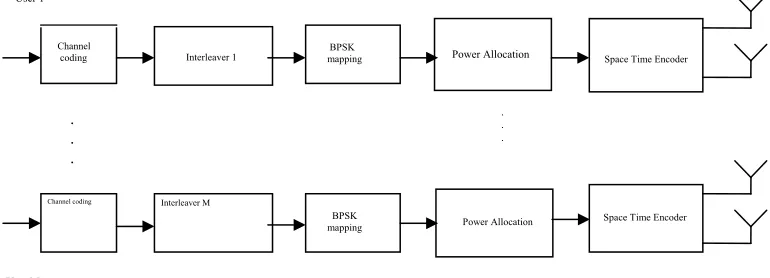
The fig.1 (a) shows the transmitter structure of MIMO-IDMA system with M simultaneous users. The data bit sequence of the mth users , b(m) = (b(m)[1],……,b(m)[K])T, is encoded into a code bit sequence
c(m)=( c(m) [1],…,c(m)[N])T. Here, R = K/N where R is the code rate. The channel code is a simple repetition code.
Fig 1a) Transmitter section of MIMO-IDMA System with Power allocation using DE algorithm User M . . . Interleaver 1 BPSK mapping . .. . ..
Space Time Encoder .
. . Channel
coding Power Allocation Space Time Encoder
Fig.1b) Receiver section of MIMO-IDMA System with space time decoder and PIC MUD
Next, the coded bit sequence c (m) is interleaved by a user-specific interleaver (m)(.), resulting in the
sequence d(m) with d(m)[n]=c(m) [π(m)(n)].The M interleavers are assumed to be randomly generated. The repeat
code together with the user-specific interleaver performs a kind of spreading. Finally, the interleaved bit sequence is BPSK-modulated using the mapping 0→ -1, 1→1. The optimized power is allocated to each user using DE algorithm based on i) the distance involved between the mobile station and the base station ii) SINR and BER constraints for quality reception of signal.
Then the sequence is split into blocks of length MT to yield the symbol vector x(m)[n] and is being transmitted by
the MT transmit antennas. A space–time code (STC) is employed to improve the reliability of data transmission in
wireless communication systems using multiple transmit antennas. This code provides good diversity gain over other normal codes [Ping.L.,(2003)]. Alamouti Encoder, which maps the symbols onto the transmit antennas, in which Tx1 transmit antenna transmit s(1)and –s*(2)symbols, and the Tx2 transmits s(2)and s*(1).
2.3 MIMO-IDMA Receiver
The structure of the MIMO-IDMA receiver is shown in fig.1(b). The receiver consists of space time decoder, a low-complexity PIC multi-user detector for parallel interfernce cancellation followed by M parallel demodulators, deinterleavers and channel decoders.
3. Problem formulation
The main aim of this paper is to optimize the total power allocated for the users in a MIMO-IDMA system environment and study of practically possible values of SINR for the target BER. The possible number of users under a sector of the cell for efficient communication is observed as 330, beyond which the quality of communication is affected. Each Mobile Station (MS) is in communication with Base Station (BS) continuously. The BS sends request and the MS acknowledges it. The power allocation for each MS under a cell is based mainly on the distance from its BS. It is sufficient that less power can be allocated for user near the BS and more power is required for user far away from the BS. The BS estimates the amount of power to be allocated to the user. The Mobile Switching Center (MSC) controls the power to be allocated and the MS implements it.
3.1Objective function for power optimization
To support higher loads, unequal power distribution of the users is necessary. The objective of the paper is to minimize the overall transmitted power Ptot and the optimized parameter is the power distribution. The
optimization problem can be expressed as
. . .
Channel Decoding
Deinterleaver 1
Parallel Interference Cancellation (PIC)
r
Space Time Decoder
Space Time Decoder Demodulator
Deinterleaver M Demodulator Channel
Decoding User 1
M
min ∑ Pm ……… (3) P1……PM m=1
Pm ≥ SINR min,m × σ2eff , m (max) …...……… (4)
where σ2
eff,m (max) is the effective variance of the mth user, SINRmin,m is the minimum required SINR of the user m.
The power profile varies with respect to the parameters such as Signal to Interference Noise Ratio (SINR), Bit Error Rate (BER), distance, distortion, timing advance and number of users. The practically observed values for best and worst cases of BER and SINR are given in the table 1.
Table 1. Best and Worst values of SINR and BER for effective communication
Case BER Accepted Power Level Required SINR in dB
Worst 12.8% -110dBm 12.8
Best 0.2% -48dBm 0.2
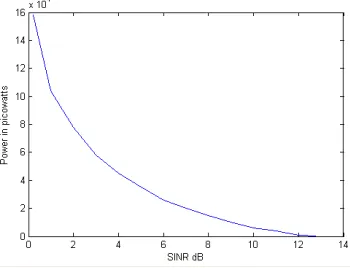
Here the problem formulation can be derived from the fig.2. An objective function for power optimization is derived from mathematical Lagrange’s Interpolation formula as shown in equation (5).
f(x)=12x4-495x3+7470x2-53000x+160000 ………… (5)
where x refers to SINR value in terms of percentage and f(x) is the optimized value of power of each individual user in the system.
Fig.2 Relation between SINR and power for practical scenario of wireless communication
Using the Differential Evolution algorithm, the optimized power is obtained from the objective function of the problem. This optimized power is allocated for each user in MIMO-IDMA to improve the performance of the system.
3.2. Power optimization using Differential Evolution (DE)
The DE algorithm is a population-based algorithm like genetic algorithms using the similar operators such as crossover, mutation and selection. DE is a parallel direct search method which utilizes NP parameter vectors Xi,G,
i=1,2,…,NP-1 as a population for each generation G. The parameter NP does not change during the minimization process. The DE algorithm [Storn.R.,(1997)] is summarized as follows.
Step 1).For each vector Xi,G, i=1,2,…,NP-1,a trial vector V is generated according to V=Xr1,G+F(Xr2,G-Xr3,G)
Step 2).After applying mutation and crossover, the objective function is evaluated for trail vector.
Step 3).The selection between target vector and trial vector is based on the lower cost survival and is considered for next population.
Step 4).The obtained vector is then used to replace or update the current vector with respect to Cr and F where F is the “mutation scale factor”, Cr the crossover, D the vector dimension, until the maximum number of function evaluation is completed.
The choice of the constants NP, F or Cr can definitely influence the search result. The value selected for NP is 5 to 10 times of number of parameter in a vector, the value of F is 0.8 and the value of Cr is 0.9.
4. Simulation results
The performance of the MIMO-IDMA with power optimization is illustrated in this section.
4.1 Simulation setup
The simulation of CDMA and IDMA has been carried out in SIMULINK for 5 users with 1024 bits/frames for each user, BPSK modulation and unique random interleavers and their performances are compared with each other. The CDMA system is simulated with Gold sequence codes for user separation and interleaving indices for user separation in IDMA. The simulation of MIMO-IDMA system has been carried out in SIMULINK with common short spreading codes for all users and different interleaving index for different users. The parameters used in the simulation are given in the table 2.
Table 2: Parameters used in the simulation of MIMO-IDMA systems
Parameters Specifications
No. of users 5
Data length 1024 bits/frame Modulation BPSK Interleaver Random Interleaver Tx.Antennas 2 Rx.Antennas 2 4.2 Results and discussion
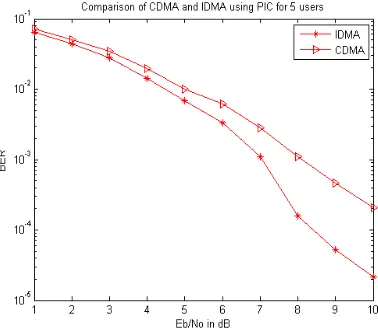
Fig. 3 shows the performance improvement in IDMA system compared to CDMA. In order to evaluate the power control parameter, the IDMA system is simulated with and without power allocation for users. DE algorithim is uesd for optimizing the power. From fig. 4 it is obserbed that IDMA with unequal power allocation provides better BER performance compared to system with equal power allocation.
Fig.4. BER performance of IDMA system with equal and unequal power allocation
The effectiveness of DE algorithm in MIMO-IDMA with equal and unequal power allocation is demonstrated in the frequency selective fading channel. The power of the desired users is optimized using DE optimization algorithm for the desired value of Signal to Interference noise ratio (SINR).
The MIMO-IDMA system with multiple antennas at transmitter and receiver provides better BER performance when compared to Single Input and Multiple Output system is shown in figure 5.
Fig.5 BER performance of MIMO-IDMA system with number of antennas
The MIMO-IDMA system along with power optimization using DE algorithm is simulated with and without Parallel Interfernce Cancellation Multi User Detection.(MUD). From fig .6, it is observed that MIMO-IDMA with PIC-MUD provides better BER perfromance when compared to without PIC-PIC-MUD.
The MIMO-IDMA system along with power optimization using DE algorithm is simulated with and without Parallel Interfernce Cancellation Multi User Detection.(MUD). From fig .6, it is observed that MIMO-IDMA with PIC-MUD provides better BER perfromance when compared to without PIC-PIC-MUD.
MIMO-IDMA system along with PIC-MUD at the receiver is simulated with and without power allocation for 5 users uing DE algorithm. Fig.7 shows the improvement in BER performance of the system
with power allocation. At Eb/No of 10dB, the system with optimized power allocation provides a BER of 0.0006
where as the system without power allocation provides a BER of 0.04 at the same Eb/No value.
Fig. 7 BER performance of MIMO-IDMA system with power allocation using DE algorithm and without power allocation
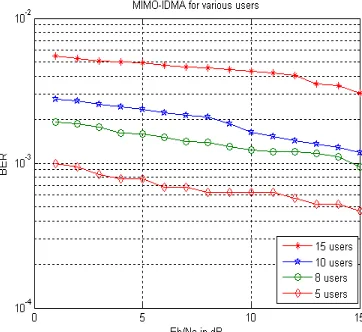
Fig.8 shows the performance of MIMO-IDMA system in Rayleigh fading channel with number of simultaneous users. From the fig.8, it is observed that the performance of the system degrades as the number of user’s increases.
Fig.8 BER performance of MIMO-IDMA system using Alamouti code with unequal power allocation for number of users
5. Conclusions
the receiver provides better performance when compared to existing system. In future, this MIMO-IDMA system can be extended with mobile Ad-hoc networks for disaster management.
Acknowledgements
The authors would like to thank the Management of National Engineering College, Kovilpatti for providing neccesary facilities to carry out this research.
References
[1] Tse.D and Viswanath.P (2005), Fundamentals of Wireless Communication, Boston (MA): Cambridge University Press. [2] X Sergio Verdú (1998), Multi-user detection, Cambridge University Press.
[3] Tarable.A, Montorsi.G and Benedetto.S (2001), Analysis and design of interleavers for CDMA systems, IEEE Communication Letters, vol.5, no.10, pp.420-422.
[4] Wang and H.V.Poor(1999), Iterative (turbo) soft interference cancellation and decoding for coded CDMA,IEEE Transactions on Wireless Communications, vol.47, pp.1046-1061.
[5] Kai.L, Xiaodong.W and Ping.L (2007), Analysis and optimization of interleave-division multiple-access communication systems, IEEE Transactions on Wireless Communications, vol.6, no.5, pp.1973-1983.
[6] Xin Liu,Xingzhong Xiong and Pingxian Yang(2009), Modeling and Simulation for IDMA Systems Based on Simulink ,IEEE conference on Circuits, Communication and System, pp.213-216.
[7] Pei Lin and Yongli Yang (2008), Power Optimization in IDMA with SNR and differential evolutions, IEEE Wireless Communication, pp.1-5.
[8] Ping.L, Liu.L, Wu.K.Y and Leung.W.K (2006), Interleave-division multiple access, IEEE Transactions on Wireless Communications, vol.5, no.4, pp.938-947.
[9] Ping.L, Liu.L, Wu.K.Y and Leung.W.K (2004), On Interleave-division multiple access, IEEE Transactions on Wireless Communications, vol.5, no.4, pp.2869-2873.
[10] Ping.L, Liu.L, Wu.K.Y and Leung.W.K (2003), Interleave-division multiple access (IDMA) communications,International Symposium on Turbo codes and Related Topics, pp.173-180.
[11] Petra weitkemper, Karl-Dirk Kammeyer (2007), Power optimization of IDMA systems with different target BER constraints, IEEE Transactions on Wireless Communications, pp.2812-2816.
[12] N.Seifi,A.S.Tehrani,and M.Viberg (2008), Simulation of a wideband Reconfigurable Multi-Antenna System with Space-Time Coding, in Nordic Matlab users Conference,Sweden.
[13] Roger Hammons.A(2000), On the Theory of Space-Time Codes for PSK Modulation, IEEE Transactions on Information Theory, vol.46, no.2, pp.524-542.
[14] Clemens Novak, Franz Hlawatsch and Gerald Matz (2007), MIMO-IDMA: Uplink multi-user MIMO Communications using IDMA and low-complexity iterative receivers, ICASSP vol.3, and pp.225-228.
[15] R. Storn, Differential Evolution, A Simple and Efficient Heuristic Strategy for Global Optimization over Continuous Spaces, Journal of Global Optimization, Vol. 11, pp. 341-359, 1997.
AUTHORS
S.Tamil Selvi is presently working as Professor in National Engineering College, Kovilpatti, Tamilnadu. She did her B.E from Mepco Schlenk Engineering College, Sivakasi and M.E Degree from Anna University, Chennai during 1988 and 1997 respectively. She obtained her Ph.D degree from Manonmaniam Sundaranar University, Tirunelveli during 2009. She has 20 years of teaching experience and 10 years experience in research in the field of wireless and optical communication.