Article
British Sign Language Recognition via Late Fusion of
Computer Vision and Leap Motion with Transfer
Learning to American Sign Language
Jordan J. Bird1 , Anikó Ekárt2 , and Diego R. Faria1
1 ARVIS Lab - Aston Robotics Vision and Intelligent Systems (https://arvis-lab.io/), Aston University,
Birmingham, United Kingdom; {birdj1, d.faria}@aston.ac.uk
2 School of Engineering and Applied Science, Aston University, Birmingham, United Kingdom;
Version August 13, 2020 submitted to Sensors
Abstract: In this work, we show that a late fusion approach to multi-modality in sign language recognition improves the overall ability of the model in comparison to the singular approaches of Computer Vision (88.14%) and Leap Motion data classification (72.73%). With a large synchronous dataset of 18 BSL gestures collected from multiple subjects, two deep neural networks are benchmarked and compared to derive a best topology for each. The Vision model is implemented by a CNN and optimised MLP and the Leap Motion model is implemented by an evolutionary optimised deep MLP topology search. Next, the two best networks are fused for synchronised processing which results in a better overall result (94.44%) since complementary features are learnt in addition to the original task. The hypothesis is further supported by application of the three models to a set of completely unseen data where a multi-modality approach achieves the best results relative to the single sensor method. When transfer learning with the weights trained via BSL, all three models outperform standard random weight distribution when classifying ASL, and the best model overall for ASL classification was the transfer learning multi-modality approach which scored 82.55% accuracy.
Keywords:Sign Language Recognition, Multi-modality, Late Fusion
1. Introduction
Sign language is the ability to converse mainly by use of the hands, as well as in some cases the body, face, and head. Recognition and understanding of Sign Language is thus an entirely visuo-temporal process performed by human beings. In the United Kingdom alone, there are 145,000 deaf adults and children who use British Sign Language (BSL) [1]. Of those people, 15,000 report BSL as their main language of communication [2] which implies a difficulty of communication with those who cannot interpret the language. Unfortunately, when another person cannot interpret sign language (of who are the vast majority), a serious language barrier is present due to disability.
In addition to the individuals who act as interpreters for those who can only converse in Sign Language, or who only feel comfortable doing so, this work aims to improve autonomous classification techniques towards dictation of Sign Language in real-time. The philosophy behind this work is based on a simple argument,if a building were to have a ramp in addition to stairs for easier access of the disabled, then why should a computer system not be present in order to aid with those hard of hearing or deaf? In this work, we initially benchmark two popular methods of sign language recognition with Computer Vision and a Leap Motion 3D hand tracking camera after gathering a large dataset of gestures. Following these initial experiments, we then present a multi-modality approach which
Infrared Camera Infrared
Camera
IR LED IR
LED LEDIR
Figure 1. Photograph and labelled sketch of the stereoscopic infrared camera array within a Leap
Motion Controller, illuminated by three infrared LEDs.
fuses the two forms of data in order to achieve better results for two main reasons; firstly, mistakes and anomalous data received by either sensor has the chance to be mitigated by the other, and secondly, a deep neural network can learn to extract useful complimentary data from each sensor as well as the standard approach of extracting information towards the class itself. The driving force behind improving the ability of these two sensors is mainly cost, in that the solution presented is of extremely minimal cost and with further improvement beyond the 18 gestures explored in this study, could easily be implemented within public places such as restaurants, schools, and libraries etc. in order to improve the lives of disabled individuals and enable communication with those they otherwise could not communicate with.
In this work, the approaches of single modality learning and classification are compared to multi-modality late fusion. The main scientific contributions presented by this work are as follows:
1. Collection of a large BSL dataset from five subjects and a medium-sized ASL dataset from two subjects.
2. Tuning of classification models for Computer Vision (processing layer prior to output), Leap Motion Classification (evolutionary topology search), and multi-modality late fusion of the two via concatenation to a neural layer. Findings show that multi-modality is the strongest approach for BSL classification compared to the two single-modality inputs as well as state of the art statistical learning techniques.
3. Transfer learning from BSL to improve ASL classification. Findings show that weight transfer to the multi-modality model is the strongest approach for ASL classification.
The remainder of this work is as follows, Section2explores the current state of the art for Sign Language Classification. Section3details the method followed for these experiments, which includes data collection, data pre-processing and the machine learning pipeline followed. The results for all of the experiments are presented in Section4including indirect comparison to other state of the art works in the field, before conclusions are drawn and future work is suggested in Section5.
2. Related Work
Figure 2.Screenshot of the view from Leap’s two infrared cameras and the detected hand reproduced in 3D. Note that this study uses a front-facing view rather than up-facing as shown in the screenshot.
more useful information than a video clip, studies have focused upon introducing this information towards stronger and more robust real-time classification of non-verbal languages. Sign language recognition with depth-sensing cameras such as Kinect and Leap Motion is an exciting area within the field due to the possibility of accessing accurate 3D information from the hand through stereoscopy similar to human depth perception via images from two eyeballs. Kinect allows researchers to access RGBD channels via a single colour camera and a single infrared depth-sensing camera. A Microsoft Kinect camera was used to gather data in [8], and features were extracted using a Support Vector Machine from depth and motion profiles. Researchers in [9] found that generating synchronised colour-coded joint distance topographic descriptor and joint angle topographical descriptor and used as input to a two-steam CNN produced effective results; the CNNs in this study were concatenated by late fusion similar to the multi-modality method in this study and results were around 92% for a 20-class dataset.
The Leap Motion Controller, a sketch of which can be observed in Figure1, is a device that combines stereoscopy and depth-sensing in order to accurately locate the individual bones and joints of the human hand. An example of the view of the two cameras translated to a 3D representation of the hand can be seen in Figure2. The device measures 3.5x1.2x0.5 inches and is thus a more portable option compared to the Microsoft Kinect. Features recorded from the 26 letters of the alphabet in American Sign Language were observed to be classified at 79.83% accuracy by a Support Vector Machine algorithm [10]. Similarly to the aforementioned work, researchers found that a different dataset also consisting of 26 ASL letters were classifiable at 93.81% accuracy with a Deep Neural Network [11]. Another example achieved 96.15% with a deep learning approach on a limited set of 520 samples (20 per letter) [12]. Data fusion via Coupled Hidden Markov Models was performed in [13] between Leap Motion and Kinect, which achieved 90.8% accuracy on a set of 25 Indian Sign Language gestures.
CNN (VGG16)
DEvoMLP MLP
Dense Interpretation Network
Final Prediction (Softmax)
Leap Data Image
Image Classification Network
Bone Data Classification Network
Text Bone Data
Extraction
Higher Order Function
RGB Channel Separation Preprocessing
Dense connections from previous networks
1D Vectors
Leap Motion Camera
Synchronous Data Recording
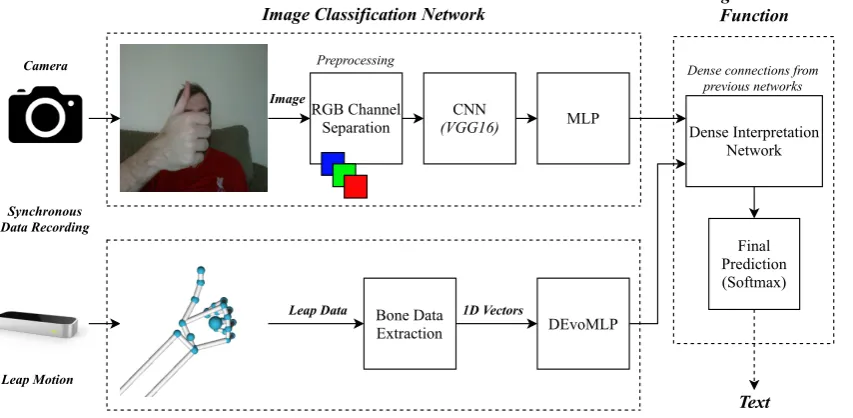
Figure 3.An overall diagram of the three benchmarking experiments. Above shows the process of
image classification and below shows Leap Motion data classification for the same problem of sign language recognition. The higher order function network shows the late fusion of the two to form a multi-modality solution.
The inspiration for the network topology and method of fusion in this work comes from [15] (albeit applied to scene recognition in this instance), similarly, this work fuses two differing synchronous data types via late-fusion by benchmarking network topologies at each step. In the aforementioned work though, weights of the networks were frozen for late fusion layer training (derived from benchmarking the two separate models). In this experiment, all weights are able to train from the start of the late fusion network from scratch, and thus, the networks can extract complimentary features from each form of data for classification in addition to the usual method of extracting features for direct classification and prediction.
3. Proposed Approach: Multi-modality Late Fusion of Deep Networks
Within this section, the proposed approach for the late fusion experiments are described. The experiments that this section mainly refers to can be observed in Figure3which outlines the image classification, Leap Motion classification, and multi-modality late fusion networks.
3.1. Dataset Collection and Pre-processing
Five subjects contributed to a dataset of British Sign Language. 18 differing gestures were recorded at a frequency of 0.2s each using a laptop, an image was captured using the laptop’s webcam and Leap Motion data is recorded from the device situated above the camera facing the subject. This allowed for ’face-to-face’ communication, since the subject was asked to communicate as if across from another human being. The ’task-giver’ was situated behind the laptop and stopped data recording if the subject made an error while performing the gesture.
Distal Intermediate Proximal Metacarpal (Not shown)
Thumb
Index
Middle
Ring
Pinky
Palm
Arm Wrist
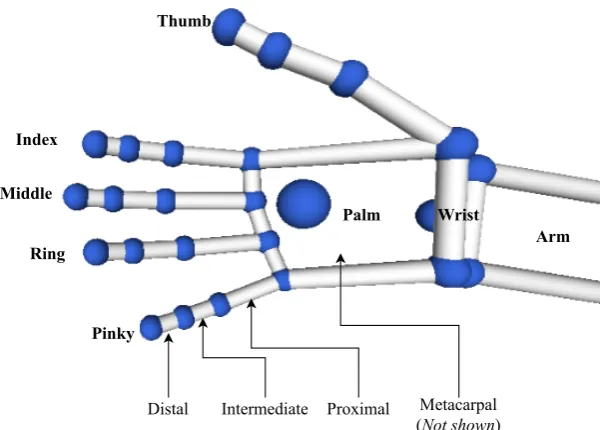
Figure 4.Labelled diagram of the bone data detected by the Leap Motion sensor. Metacarpal bones are
not rendered by the LMC Visualiser.
being performed. The pitch, yaw, and roll of the hands were also recorded. If one of the two hands were not detected then its values were recorded as ’0’ (eg. a left handed action will also feature a vector of zeroes for the right hand). If the sensor did not detect either hand, data collection was automatically paused until the hands were detected in order to prevent empty frames. Thus, every 0.2 seconds, a numerical vector is output to describe the action of both hands. The 3D angleθbetween two pointsa andbin space is calculated by the following:
θ=arccos
ab |a||b|
, (1)
where|a|and|b|are:
|a|=qax2+ay2+az2
|b|=
q
bx2+by2+bz2,
(2)
with regards to thex,y, andzco-ordinates of each point in space. The start and end points of each bone in the hand from the LMC are treated as the two points.
The 18 British Sign Language1gestures recorded were selected due to them being common useful words or phrases in language. A mixture of one and two-handed gestures were chosen. Each gesture was recorded twice where subjects switched dominant hands.
The useful gestures for general conversation were:
1. Hello/Goodbye 2. You/Yourself 3. Me/Myself 4. Name 5. Sorry 6. Good
Figure 5.The sign for ’Hello’ in British Sign Language
Figure 6.The sign for ’Hello’ in American Sign Language
7. Bad 8. Excuse Me
9. Thanks/Thank you 10. Time
The gestures for useful entities were:
1. Airport 2. Bus 3. Car 4. Aeroplane 5. Taxi 6. Restaurant 7. Drink 8. Food
Following this, a smaller set of the same 18 gestures but in American Sign Language2are collected from two subjects for thirty seconds each (15 per hand) towards the transfer learning experiment. ’Airport’ and ’Aeroplane/Airplane’ in ASL are similar, and so, ’Airport’ and ’Jet Plane’ are recorded
instead. Figures5and6show a comparison of how one signs ’hello’ in British and American sign languages; though the gestures differ, the hand is waved and as such it is likely that useful knowledge can be transferred between the two languages.
British Sign Language
Large Dataset
American Sign Language
Medium dataset
CV Model LM Model Multi-modalityModel
CV Model LM Model Multi-modalityModel Initial Weight
Transfer
BSL Models Trained
ASL Models Trained
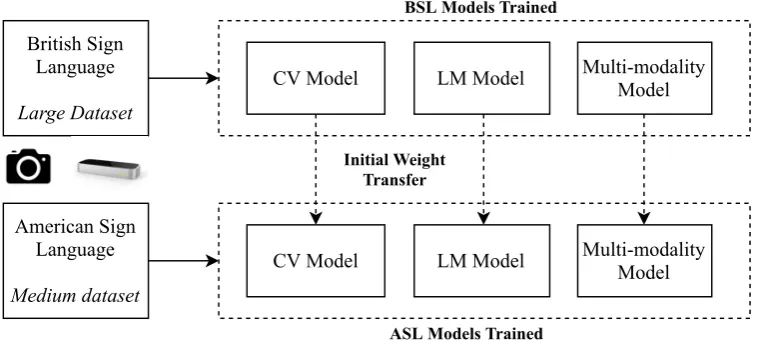
Figure 7. Transfer Learning Experiments which train on BSL and produce initial starting weight
distributions for the ASL models
3.2. Deep Learning Approaches
For the image classification network, VGG16 [16] convolutional layers are used as a starting point and the three 4096 neuron hidden layers are removed. The convolutional layers are followed by 2, 4, 8, ..., 4096 ReLu neuron layers in each of the ten benchmarking experiments to ascertain a best-performing interpretation layer. For the Leap Motion data classification problem, an evolutionary search is performed [17] to also ascertain a best-performing neural network topology; the search is set to a population of 20 for 15 generations, since during manual exploration, stabilisation of a final best result tends to occur at around generation 11. The evolutionary search is run three times in order to mitigate the risk of a local maxima being carried forward to the latter experiments.
With the best CNN and Leap Motion ANN networks derived, a third set of experiments is then run. The best topologies (with softmax layers removed) are fused into a single layer of ReLu neurons in the range 2, 4, 8, ..., 4096.
All experiments are benchmarked with randomised 10-fold cross validation, and training time is uncapped to a number of epochs and rather executed until no improvement of accuracy occurs after 25 epochs. Thus, the results presented are the maximum results attainable by the network within this boundary ofearly stopping.
Following the experiments on BSL, initial preliminary experiments for Transfer Learning between languages is performed. Figure 7shows the outline for the transfer experiments, in which the learnt weights from the three BSL models are transferred to their ASL counterparts as initial starting weight distributions and ultimately compared to the usual method of beginning with a random distribution. This experiment is performed in order to benchmark whether there is useful knowledge to be transferred between each of the model pairs.
3.3. Experimental Hardware
The deep learning experiments in this study were performed on an Nvidia GTX 980Ti which has 2816 1190MHz CUDA cores and 6GB of GDDR5 memory. Given the memory constraints, images are resized to 128x128 although they were initially captured in larger resolutions. All deep learning experiments were written in Python for the Keras [18] library and TensorFlow [19] backend.
2 4 8 16 32 64 128 256 512
1024 2048 4096
0 10 20 30 40 50 60 70 80 90 100
Interpretation Neurons
Image
Classification
Accuracy
(%)
Figure 8.Mean Image 10-fold Classification Accuracy corresponding to interpretation neuron numbers.
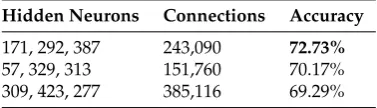
Table 1.Final results of the three Evolutionary Searches sorted by 10-fold validation Accuracy along
with the total number of connections within the network.
Hidden Neurons Connections Accuracy
171, 292, 387 243,090 72.73%
57, 329, 313 151,760 70.17%
309, 423, 277 385,116 69.29%
4. Experimental Results
4.1. Fine Tuning of VGG16 Weights and Interpretation Topology
Figure8shows the results for tuning of the VGG network for image classification. Each result is given as the classification ability when a layer of neurons are introduced beyond the CNN operations and prior to output. The best result was a layer of 128 neurons prior to output which resulted in a classification accuracy of 88.14%. Most of the results were relatively strong except for 2-8 neurons and, interestingly, layers of 256 and 2048 neurons. Thus, the CNN followed by 128 neurons forms the first branch of the multi-modality system for image processing alongside the best Leap Motion network (in the next section). The SoftMax output layer is removed for purposes of concatenation, and the 128 neuron layer feeds into the interpretation layer prior to output.
4.2. Evolutionary Search of Leap Motion DNN Topology
2 4 8 16 32 64 128 256 512
1024 2048 4096
0 10 20 30 40 50 60 70 80 90 100
Interpretation Neurons
Sign
Language
Recognition
Accuracy
(%)
Figure 9. Multi-modality 10-fold Classification Accuracy corresponding to interpretation neuron
numbers towards benchmarking the late-fusion network.
Table 2.Sign Language Recognition scores of the three models trained on the dataset
Model Sign Language Recognition Ability
Computer Vision 88.14%
Leap Motion 72.73%
Multi-modality 94.44%
neurons for Leap Motion data classification is connected to the dense interpretation network layer along with the 128 hidden neurons of the image network.
4.3. Fine Tuning the Final Model
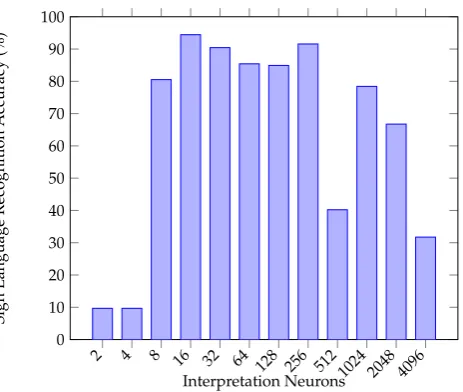
Figure9shows the results of fine-tuning the best number of interpretation neurons within the late fusion layer, the best set of hyperparameters found to fuse the two prior networks was a layer of 16 neurons which achieved an overall mean classification ability of 94.44%. This best-performing layer of 16 neurons receives input from the Image and Leap Motion classification networks and is connected to a final SoftMax output. Given the nature of backpropagation, the learning process enables the two input networks to perform as they were prior (that is, to extract features and classify data) but a new task is also then possible; to extract features and useful information from either data format which may compliment the other, for example, for correction of common errors, or for contributing to confidence behind a decision.
4.4. Comparison and Analysis of Models
Table 3.Comparison of other statistical models and the approaches presented in this work.
Model Input Sensor(s) Sign Language Recognition Ability
MM(DNN, CNN) LMC, Camera 94.44%
CNN Camera 88.14%
RF LMC 87.07%
SMO SVM LMC 86.78%
QDA LMC 85.46%
LDA LMC 81.31%
LR LMC 80.97%
Bayesian Net LMC 73.48%
DNN LMC 72.73%
Gaussian NB LMC 34.91%
Table 4.Results of the three trained models applied to unseen data
Approach Correct/Incorrect Classification Accuracy
Computer Vision 1250/1800 69.44%
Leap Motion 752/1800 41.78%
Multi-modality 1377/1800 76.5%
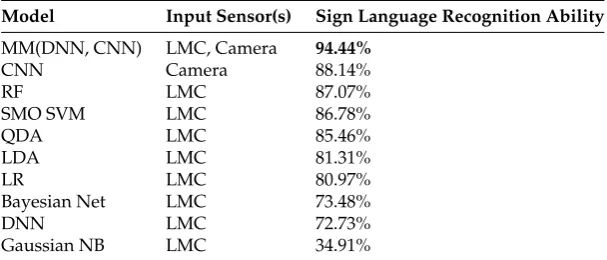
statistical approaches are far less computationally complex than deep learning approaches; should the host machine for the task not have access to a GPU with CUDA abilities, a single-modality statistical approach is likely the most realistic candidate. Should the host machine, on the other hand, have access to a physical or cloud-based GPU or TPU, then it would be possible to enable the most superior model which was the deep learning multi-modality approach.
Table4shows the final comparison of all three models when tasked with predicting the class labels of unseen data objects, 100 per class (18 classes). The error matrix for the best model, which was the multi-modality approach at 76.5% accuracy can be observed in Figure10. Interestingly, most classes were classified with high confidence with the exception of three main outliers; ’thanks’ was misclassified as ’bus’ in almost all cases, ’restaurant’ was misclassified as a multitude of other classes, and ’food’ was often mistaken for ’drink’ although this did not occur vice-versa. Outside of the anomalous classes which must be improved in the future with more training examples, the multi-modality model was able to confidently classify the majority of all other phrases.
Table5shows a comparison of state of the art approaches so Sign Language recognition. The training accuracy found in this work is given as comparison since other works report such metric, but it is worth noting that this work showed that classification of unseen data is often lower than the training process. For example, the multi-modality approach score of 94.44% was reduced to 76.5% when being applied to completely unseen data.
4.5. Transfer Learning from BSL to ASL
Table6shows the results for transfer learning from BSL to ASL. Interestingly, with the medium sized ASL dataset and no transfer learning, the Multi-modality approach is worse than both the Computer Vision and Leap Motion models singularly. This, and considering that the best model overall for ASL classification was the Multi-modality model with weight transfer from the BSL model, suggests that data scarcity poses an issue for multi-modality models for this problem.
HELLO
YOU
I
NAME SORRY GOOD BAD
EXCUSE_ME THANKS TIME AIRPORT BUS CAR PLANE TAXI RESTAURANT DRINK FOOD HELLO YOUI NAME SORRY GOOD BAD EXCUSE_METHANKS TIME AIRPORTBUS CAR PLANE TAXI RESTAURANTDRINK FOOD
1 0 0 0 0 0 0 0 0 0 0 0 0 0 0 0 0 0
0 0.94 0 0 0.06 0 0 0 0 0 0 0 0 0 0 0 0 0
0.03 0 0.8 0 0 0 0 0 0 0 0 0.16 0.01 0 0 0 0 0
0.05 0 0 0.95 0 0 0 0 0 0 0 0 0 0 0 0 0 0
0.28 0 0 0.05 0.59 0 0 0 0 0 0 0 0.08 0 0 0 0 0
0 0 0 0 0 0.96 0 0 0 0.01 0 0.01 0.01 0 0 0 0.01 0
0 0.02 0.02 0 0 0 0.95 0 0 0 0 0.01 0 0 0 0 0 0
0 0 0.02 0.02 0 0 0 0.94 0 0 0 0.01 0 0 0 0 0.01 0
0 0 0 0 0 0 0 0 0 0 0 0.99 0.01 0 0 0 0 0
0 0 0 0 0 0 0.01 0.02 0 0.86 0 0.07 0.02 0 0 0 0.02 0 0.01 0.01 0 0 0.01 0 0 0 0 0.03 0.83 0.07 0.02 0 0 0.01 0.01 0
0 0 0.05 0 0.03 0 0 0 0 0.01 0 0.91 0 0 0 0 0 0
0.01 0 0 0.03 0.11 0 0 0 0 0 0 0.03 0.82 0 0 0 0 0
0 0 0 0 0 0 0 0 0 0 0 0 0 0.99 0 0 0.01 0
0.02 0 0 0 0 0 0 0 0 0 0 0.03 0.01 0 0.94 0 0 0
0 0.01 0 0 0.01 0 0.01 0.04 0 0.09 0 0.56 0.15 0 0.01 0 0.12 0
0 0 0 0 0 0 0 0 0 0.01 0 0.01 0.06 0 0 0 0.92 0
0 0 0 0 0 0 0 0 0 0 0 0.01 0.1 0 0 0 0.52 0.37
Figure 10.Confusion matrix for the best model (multi-modality, 76.5%) on the set of unseen data (not
present during training).
Table 5.Other state of the art works in autonomous Sign Language Recognition, indirectly compared
due to operation on different datasets and with different sensors. Note: it was observed in this study that classification of unseen data is often lower than results found during training, but many works do not benchmark this activity
Study Sensor Input Approach Classes Score (%)
Huang et al. [21] Kinect Skeleton DNN 26 97.8
Filho et al. [22] Kinect Depth KNN 200 96.31
Morales et al. [23] Kinect Depth HMM 20 96.2
Hisham et al. [24] LMC Point Cloud DTW 28 95
Kumar et al. [25] LMC Point Cloud HMM, BLSTM 50 94.55
Quesada et al. [26] RealSense Skeleton SVM 26 92.31
Kumar et al. [9] MoCap Skeleton 2-CNN 20 92.14
Yang [27] Kinect Depth HCRF 24 90.4
Cao Dong et al. [28] Kinect Depth RF 24 90
Elons et al. [29] LMC Point Cloud MLP 50 88
Kumar et al. [30] Kinect Skeleton HMM 30 83.77
Chansri et al. [31] Kinect RGB, Depth HOG, ANN 42 80.05
Chuan et al. [10] LMC Point Cloud SVM 26 79.83
Quesada et al. [26] LMC Skeleton SVM 26 74.59
Chuan et al. [10] LMC Point Cloud KNN 26 72.78
Table 6.Results of pre-training and classification abilities of ASL models, with and without weight transfer from the BSL models
Model Non-transfer from BSL Transfer from BSL
Epoch 0 Final Ability Epoch 0 Final Ability
Computer Vision 2.98 80.68 13.28 81.82
Leap Motion 5.12 67.82 7.77 70.95
Multi-modality 5.12 65.4 21.31 82.55
between sign languages for image classification, Leap Motion classification, and late-fusion of the two towards multi-modality classification.
Though future work is needed for further explore the transfer learning hypotheses, the results in these initial experiments suggest the possibility of success when transferring knowledge between models and ultimately improving their recognition performances.
5. Conclusions and Future Work
This work has presented multiple experiments for the singular sensor and multi-modality approaches to British and American Sign Language. The results from the experiments suggest that a multi-modality approach outperforms the two singular sensors during both training and for classification of unseen data. This work also presented a preliminary Transfer Learning experiment from the large BSL dataset to a medium-sized ASL dataset, in which the best model for classification of ASL was found to be the multi-modality model when weights are transferred from the BSL model. All of the network topologies in this work that were trained, compared, and ultimately fused together towards multi-modality were benchmarked and studied for the first time. Accurate classification of Sign Language, especially unseen data, enables the ability to perform the task autonomously and thus provide a digital method to interpretation of non-spoken language within a situation where interpretation is required but unavailable. In order to realise this possibility, future work is needed. The hypotheses in these experiments were argued through a set of 18 common gestures in both British and American Sign Languages. In future, additional classes are required to allow for interpretation of conversations rather than the symbolic communication enabled by this study. In addition, since multi-modality classification proved effective, further tuning of hyperparameters could enable better results, and other methods of data fusion could be explored in addition to the late fusion approach used in this work. Transfer learning could be explored with other forms of non-spoken language such as, for example, Indo-Pakistani SL which has an ethnologue of 1.5 million people and Brazilian SL with an ethnologue of 200,000 people.
work is needed to enable the models a better ability to generalise towards real-time classification abilities that closely resemble their abilities observed during training.
Author Contributions
Conceptualization, Jordan J. Bird; Investigation, Jordan J. Bird; Methodology, Jordan J. Bird; Software, Jordan J. Bird; Supervision, Aniko Ekart and Diego R. Faria; Writing – original draft, Jordan J. Bird; Writing – review editing, Jordan J. Bird, Aniko Ekart and Diego R. Faria.
1. Ipsos, M.; others. GP patient survey–national summary report.London: NHS England2016. 2. ONS. 2011 Census: Key statistics for England and Wales, March 2011, 2012.
3. Wadhawan, A.; Kumar, P. Sign Language Recognition Systems: A Decade Systematic Literature Review.
Archives of Computational Methods in Engineering2019, pp. 1–29.
4. Starner, T.; Pentland, A. Real-time american sign language recognition from video using hidden markov models. InMotion-based recognition; Springer, 1997; pp. 227–243.
5. Assan, M.; Grobel, K. Video-based sign language recognition using hidden markov models. International Gesture Workshop. Springer, 1997, pp. 97–109.
6. Vogler, C.; Metaxas, D. Parallel hidden markov models for american sign language recognition. Proceedings of the Seventh IEEE International Conference on Computer Vision. IEEE, 1999, Vol. 1, pp. 116–122. 7. Haberdar, H.; Albayrak, S. Real time isolated turkish sign language recognition from video using hidden
markov models with global features. International Symposium on Computer and Information Sciences. Springer, 2005, pp. 677–687.
8. Agarwal, A.; Thakur, M.K. Sign language recognition using Microsoft Kinect. 2013 Sixth International Conference on Contemporary Computing (IC3). IEEE, 2013, pp. 181–185.
9. Kumar, E.K.; Kishore, P.; Kumar, M.T.K.; Kumar, D.A. 3D sign language recognition with joint distance and angular coded color topographical descriptor on a 2–stream CNN.Neurocomputing2020,372, 40–54. 10. Chuan, C.H.; Regina, E.; Guardino, C. American sign language recognition using leap motion sensor. 2014
13th International Conference on Machine Learning and Applications. IEEE, 2014, pp. 541–544.
11. Chong, T.W.; Lee, B.G. American sign language recognition using leap motion controller with machine learning approach. Sensors2018,18, 3554.
12. Naglot, D.; Kulkarni, M. Real time sign language recognition using the leap motion controller. 2016 International Conference on Inventive Computation Technologies (ICICT). IEEE, 2016, Vol. 3, pp. 1–5. 13. Kumar, P.; Gauba, H.; Roy, P.P.; Dogra, D.P. Coupled HMM-based multi-sensor data fusion for sign
language recognition. Pattern Recognition Letters2017,86, 1–8.
14. Wang, X.; Jiang, F.; Yao, H. DTW/ISODATA algorithm and Multilayer architecture in Sign Language Recognition with large vocabulary. 2008 International Conference on Intelligent Information Hiding and Multimedia Signal Processing. IEEE, 2008, pp. 1399–1402.
15. Bird, J.J.; Faria, D.R.; Premebida, C.; Ekárt, A.; Vogiatzis, G. Look and Listen: A Multi-modality Late Fusion Approach to Scene Classification for Autonomous Machines.arXiv preprint arXiv:2007.101752020. 16. Simonyan, K.; Zisserman, A. Very Deep Convolutional Networks for Large-Scale Image Recognition.
International Conference on Learning Representations, 2015.
17. Bird, J.J.; Ekart, A.; Buckingham, C.D.; Faria, D.R. Evolutionary optimisation of fully connected artificial neural network topology. Intelligent Computing-Proceedings of the Computing Conference. Springer, 2019, pp. 751–762.
18. Chollet, F.; others. Keras.https://keras.io, 2015.
20. Pedregosa, F.; Varoquaux, G.; Gramfort, A.; Michel, V.; Thirion, B.; Grisel, O.; Blondel, M.; Prettenhofer, P.; Weiss, R.; Dubourg, V.; Vanderplas, J.; Passos, A.; Cournapeau, D.; Brucher, M.; Perrot, M.; Duchesnay, E. Scikit-learn: Machine Learning in Python. Journal of Machine Learning Research2011,12, 2825–2830. 21. Huang, J.; Zhou, W.; Li, H.; Li, W. Sign language recognition using real-sense. 2015 IEEE China Summit
and International Conference on Signal and Information Processing (ChinaSIP). IEEE, 2015, pp. 166–170. 22. Costa Filho, C.F.F.; Souza, R.S.d.; Santos, J.R.d.; Santos, B.L.d.; Costa, M.G.F. A fully automatic method for recognizing hand configurations of Brazilian sign language. Research on Biomedical Engineering2017,
33, 78–89.
23. Caballero Morales, S.O.; Trujillo Romero, F. 3D modeling of the mexican sign language for a speech-to-sign language system. Computación y Sistemas2013,17, 593–608.
24. Hisham, B.; Hamouda, A. Arabic Static and Dynamic Gestures Recognition Using Leap Motion. J. Comput.
Sci.2017,13, 337–354.
25. Kumar, P.; Gauba, H.; Roy, P.P.; Dogra, D.P. A multimodal framework for sensor based sign language recognition. Neurocomputing2017,259, 21–38.
26. Quesada, L.; López, G.; Guerrero, L. Automatic recognition of the American sign language fingerspelling alphabet to assist people living with speech or hearing impairments. Journal of Ambient Intelligence and Humanized Computing2017,8, 625–635.
27. Yang, H.D. Sign language recognition with the kinect sensor based on conditional random fields.Sensors
2015,15, 135–147.
28. Dong, C.; Leu, M.C.; Yin, Z. American sign language alphabet recognition using microsoft kinect. Proceedings of the IEEE conference on computer vision and pattern recognition workshops, 2015, pp. 44–52.
29. Elons, A.; Ahmed, M.; Shedid, H.; Tolba, M. Arabic sign language recognition using leap motion sensor. 2014 9th International Conference on Computer Engineering & Systems (ICCES). IEEE, 2014, pp. 368–373. 30. Kumar, P.; Saini, R.; Roy, P.P.; Dogra, D.P. A position and rotation invariant framework for sign language
recognition (SLR) using Kinect.Multimedia Tools and Applications2018,77, 8823–8846.