
Bulletin Number 35d
Papers
in
Fruit and Nut Production
Department of Horticulture Landscape and Parks
Lincoln College, University College of Agriculture
B L U E B ERR Y PRO Due T ION
Proceedings of a course in "Fruit Production" at
Lincoln College in November 1980, with an additional paper /
from an earlier course in "Alternative Land Uses" held in
February 1979.
Published by the Rural Development and Extension Centre and Department of Horticulture,
LINCOLN COLLEGE
Blueberries. A Crop For The Future
D.J. DaviesBlueberry Cultivars
D.J. DaviesObservations On The Performance Of Different Cultivars
In U.S.A. Europe And New Zealand
A.L. Firmin
Blueberry Micropropagation - A Rapid Method To Increase
New Culti vars
D. Cohen
A Basic Approach To Land Preparation
A.L. FirminBlueberries - Planting. Management
&
Harvesting
E.M. Gray ...Pruning
A.L. FirminIrrigation Of Blueberries
L.H. WestonClimatic And Soil Factors In Blueberry Production
T.H. Webb ...Mycorrhizal Inoculation For Blueberries
Conway Powe IIBlueberry Diseases
E.H.C. McKenzie
&
P.R. JohnstonPests of Blueberries In New Zealand. Especially Canterbury
W.P. ThomasSuggested Spray Programme: Blueberries
Advisory Services Division, M.A.F ....The Cooperative Concept of Blueberry Growing
E.M. Gray ...A Summary of Blueberry Culture
J. Try1 11
20
31
35
41
51
59
62
66
70
...
76
84
86
INTRODUCTION
D.S.I.R.,
Lincoln.
The blueberry is a member of the heath family (Ericaceae)
and is native to North America and East Asia.
There are three main types of blue-berries - Highbush,
Vaccinium corymbosum;
Lowbush, Vaaainium angustifoZium,
V. myrtiZZoides, V. Zamarkii
and V. vaaiZZans and Rabbiteye,
Vaaainium ashei
Reade.
In the Northern Hemisphere Vaacinium austraZe is an
important species for southern regions and may be of value'
for the northern regions of New Zealand.
However for most
areas of this country Highbush V. aorymbosum is the species
that is attracting considerable interest amongst
horticultur-ists.
Blueberry cultivars were first introduced into New Zealand
by (Elliott 1950) in an attempt to find a suitable crop for
the large areas of peat.lands in
th,~ ..,Waikato.
Some of the
progeny of the original six cultivars are at present being
evaluated at the DSIR Lincoln Research Centre.
Further
improved North American selections were imported into this
country by the Ministry of Agriculture and Fisheries during
1973.
CLIMATE
within these Highbush and Rabbiteye species are a large
number of cu1tivars with a wide maturity range from November
through to March.
Both require a warm growing season and
-7
0C are necessary but Toleman (1976) considers that for
Waikato conditions 500 hrs produces satisfactory crops.
Blueberries can tolerate temperatures as low as -SoC when
in blossom and frosts of this magnitude are not common for
the flowering period September-October.
In New Zealand Todd (1975) recommends maintaining adequate
moisture, but warns against excessive irrigation to avoid
leaching nutrients.
Our experience with unusually high
water table conditions during 1977-78 seasons at Lincoln
confirms that blueberries will not tolerate prolonged
exposure to wet soils.
SOIL REQUIREMENTS
Blueberries are very exacting in their soil requirements
and this is particularly true' for Highbush cultivars.
They require a well drained acid soil that has a fairly
high content of organic matter.
Peatlands are the preferred
soils as they are composed almost completely of organic matter
and have the desirable pH level (acidity) of from 4.5 to 4.8.
Mineral soils that are less acid but have other correct
physical attributes can be made more acid with ground sulphur
or continued use of ammonium sulphate.
Any soil with pH
above 5 must be corrected at least six to twelve months before
planting.
Constant soil moisture
th~~is moist rather than
wet must be maintained at all times and a well drained soil
is essential to achieve this situation.
Where it is necessary
to lower the pH the following table gives a guide as to the
amount of sulphur that will be required:
Kg sUlphurrequired/9 m2 (100 sq ft)
To change pH from
Sandy soil
Loamy soil
6.5 to 4.5
0.68
2.1
6.0 to 4.5
0.54
1.6
5.5 to 4.5
0.36
1.08
5.0 to 4.5
0.18
1.54
*
weed suppression
*
maintains cooler soil temperature
*
retains soil moisture near surface
*
improves soil structure
*
assists in reducing and stabilising pH
*
prevents frost heave during winter
*
avoids erosion and soil compaction
The use of sawdust lowers the nitrogen available for plant
growth and additional nitrogen fertiliser should be used.
Recent work at Rukuhia, Toleman (1978), suggest that the
plastic mulch as used for strawberries combines most of
the above advantages.
Farmyard manure of any form should
not be used.
UTILISATION
In the U.S.A. it is estimated that up to 40% of the fresh
berries are used for culinary purposes and the remainder are
eaten fresh.
Of the total harvest in 1976 45% were sold
in the fresh or chilled state and;",'le remaining 55% were
processed immediately after harvest.
Blueberries have many uses and of course the famous pie
which many of you have tasted at this course is considered
by many to be unsurpassed.
G. Strachan (1978) lists the following forms of preservation:
Canning
In syrups (30-60%)
Freezing
As juice, both
cloudy
As pie filling
fillers)
clear and
(with starch
Syrup packs 0.4 - 0.9 kg
Also used for jam, jelly, preserves (less than 55% fruit),
yoghurt toppings, wine and syrups.
PROPAGATION
Blueberries must be propagated vegetatively from hardwood or
softwood cuttings.
Hardwood autting8
may be taken from May through August, and
vigorous growth, pencil thickness or greater, should be
chosen.
The shoot tips are removed and placed in an outdoor
propagating frame with a sawdust base over which is placed
15 cm of a peat/sand or peat/pumice mixture.
Cuttings 10 cm
long are inserted at least 2/3 of their length either
vertically or at an angle of 45°.
Cuttings are spaced at
5 cm x 5 cm centres.
During the first three months the temperature in cold frames
must not rise above 7°C and the humidity must be high.
Heavy
shading and restricted ventilation can give
~hiseffect. The
beds must not be allowed to dry out and once plants start to
grow they will benefit from fortnightly applications of a
,
general liquid fertiliser containing the nitrogen in the
form of Ammonium sulphate.
Cuttings can be considered to have established when late buds
or secondary shoots start to develop.
After nearly a year
in the beds the rooted cuttings are lifted and transferred
to nursery beds spaced at 25 cm in the row and 45 cm between
rows.
They remain in the nursery bed for one year before
planting out in the field.
in five to six weeks.
cuttings are taken as laterals when the terminal growing point has set usually from late November through January. About 7 cm in length with lower leaves removed, they should be dipped in rooting hormone No 1 or 2 depending on firmness of cutting.
Older cuttings or semi softwood should be wounded to promote callousing, dipped in appropriate fungicide and placed
firmly in prepared peat/pumice or peat/sand (beds about 12 cm in depth) . When summer temperatures are high they may be propagated in a shade house (70% light exclusion) cover the beds with white polythene film on wire supports and use black polythene under beds and perforate for drainage.
Covers should be removed periodically for watering, ventilation and control of fungus disease'. This is most important as
many failures are due to the high humidity conditions which favour fungus pathogens' development. Similar results can be obtained using bottom heat and mist systems inside a
glasshouse but once again hygiene is of paramount importance.
After a period of 10 weeks cuttings may be gently removed and placed in containers containing peat/sand or peat/pumice at a ration of 2:1 and water with a general liquid fertiliser. Obtain maximum growth in shade house ~nd allow to harden off before transplanting to nursery bed in the early spring. If necessary, plants may be retained in containers and grown on under shade before pruning back preparatory to field
planting.
PLANTING AND WEED CONTROL
Planting-out should be carried out in the early spring (August) to allow plants to establish before the commencement of hot weather. Nursery plants should be lifted with as large a mat of roots as possible and top growth should be pruned back
is envisaged and wider, 2l50/ha, where manual harvesting is preferred. For the first season in the:field all flowers should be removed to encourage plants to quickly reach maximum size.
Weed control may be achieved in several ways either using clean cultivation with Sinazine or if rows are mulched with plastic or other suitable material the interval between rows may be grassed and mown. It is advisable to delay grassing down until bushes are well established. Further research is required for the most economic method of establishment for mineral soils and to this end DSIR Lincoln will be evaluating low, medium, and high cost methods with trickle irrigation over the next few years.
PRUNING
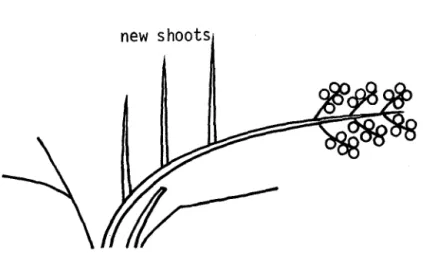
Because they bear their fruit on one-year-old wood
blueberries can be pruned in a similar way as for black-currants. An annual supply of one-year-old wood must be maintained by judicious thinning the centre of the bush, by removing all weak spindly growth and dead wood, both within the bush and close to the ground. When. the plants are mature 4th-5th year pruning to reduce the fruiting area will increase size of fruit. Any plants lacking vigour should also be pruned hard. There are two main types of growth habit with blueberrie~ - upright and spreading. Generally upright cultivars require centre pruning while spreading cultivars need low branch re~oval.
General guides for pruning - Shutak and Marucc (1966).
*
*
*
*
Remove all diseased or damaged canes
Remove or cut back the old or least vigorous canes Remove low branches and softwood
HARVESTING
In New Zealand cultivars will eventually be available that will extend the harvest period from mid-D~cember until February, as the mature blueberries change from green to red and then to blue. They are normally ready for harvest about one week after the last colour change. Since only a
few berries will be ripe in each cluster' at anyone time i t will mean up to three or four pickings at six day intervals for most cultivars.
Manual harvesting is best for high quality fresh market fruit and i t is most important for growers of blueberries to provide top quality fruit. If they are picked early they will reach the maximum size and sweetness, while over mature fruit quickly deteriorates, attracts birds and often
falls to the ground.
Blueberries can be machine harvested but many North American -growers employ both manual and mechanical methods. As the
scale of operation develops in New Zealand, mechanisation will become increasingly necessary to reduce labour costs. with mechanical harvesting some form of grading fruit would be required to sort out the different stages of maturity of the fruit. As an alternative to the vibrating mechanisms of the 'down the row' or 'strad,dle harvesters' hand held
vibrating fingers are available that shake the ripe fruit from the bush on to a portable canvas catching frame. The fruit is placed in a container and sent on to a cleaning unit for sorting and trash removal. Machines have been developed overseas that can be adapted to harvest both blackcurrants and blueberries and the growing of these two crops in combin-ation has merit and would increase the usefulness of such a high cost machine.
CULTIVARS
the North Island (Rukuhia Research Station) and should be available for testing under field conditi9ns in the next year or two. See appendix for varietal description.
Growing of seedling plants is not generally recommended as all plants will not come 'true to type' resulting in plants with quite distinct differences in shap~, maturity, fruit size and flavour. However for the home gardener interested in testing soils for suitability on a small scale, this
would be a cheap way to select and raise your own plants.
PESTS AND DISEASES
The major problem and an expensive one to overcome is protection from birds that are attracted to the small plantings in particular. Until chemical sprays such as
'Mesurol' have been proven as effective for New Zealand, potential growers would be wise to budget for use of either galvanised netting enclosures, or use of the lighter
polypropylene nets. Netted enclosures are being tested at Lincoln and the birds have been seen crawling through soft mud to gain entry to this delectable fruit.
Leaf rollers, scales, mites, black vine weevils botry~is
could be troublesome from time to time and will need to be sprayed with the appropriate compound for effective control. While many diseases are prevalent overseas, thanks largely to an efficient system of disease and' quarantine control we have remained virtually free of the more troublesome virus diseases in North America.
CONCLUSIONS
The potential for growing blueberries is rated very high by many experienced marketing authorities for export to North America and Europe where large developing markets exist, particularly in .the northern hemisphere winter.
Blueberrries grown on a large scale would generate processing of a high proportion of the crop and unless this was
every reason to believe that fresh fruit could be delivered by air and possibly by refrigerated containers tQ:the west coast of North America.
Our limited experience suggests that the crop can be grown and of course many people from Southland to Tauranga have shown that fruit of quality can be grown. Indeed, several have tested the market and received very satisfactory prices.
Because blueberries have very specific growth requirements particularly in relation to soil composition, i t will mean inevitably that the crop will be grown where these conditions can be met and maintained at relatively low cost. Nearness to airports which link easily with international flights will also be an important consideration. It is my view that
this country will develop a worthwhile industry, but a lot more work remains to be done' on a co-ordinated basis both at horne and in the market place if we are to achieve a similar reputation as to that won by 'kiwi fruit' growers and exporters over a fairly long period of time.
REFERENCES
SPACKMAN, G.S. and JACKSON, D.I.: Culture of blueberries and cranberries. Lincoln College Department of Horticulture. Bulletin 23.
TODD, J.S. 1973: Blueberries. Information Service Min. Agric. & Fisheries.
STRACHAN, G. 1978: Blueberry Processing, Plant Diseases Division DSIR. Report for Research Advisory Committee.
TOLEMAN, E. 1976: Blueberries - a crop with potential for N.Z. N.Z. J.A. 132: 26-30.
DAVIES, D.J.: Blueberries in Canterbury. MAF. Mid-Canty Fed. Farmers Horticultural Seminar October 1978.
ECK, P & CHILDERS, N.F. University Press.
66-18880.
BLUEBERRY VARIETIES (after Shoemaker, 1975)
Cultivar Season
Vigour Yield Berry Cluster Qual-
Other
size
Form-
ity
Comments
ation
Atlantic Mid
Mod.
High
Mod.
Open
Fair
Poor handling
(early Jan)
Berkeley Mid
High
High
Large Open
Med.
Very light
blue
Blueray
Early Mid
High
High
Very
Tight
High
Firm, sweet
season
large
Burling-
Late
High
High
Small Tight
Fair
Dense growth
ton
(Jan-Feb)
req. thinning
Darrow
Late
High
High
Large
?High
Light bl ue
Dixi
Mid-Late
High
High
Large Large
&High
Ripening not
open
uniform
Herbert
Late
High
High
Large
?High
Fruit rate
dark
Ivanhoe
Early
High
High
Large Tight
High
Harder to
propagate
Jersey
Mid
Mod.
Mod.
Mod.
Loose
High
Uni form
ripening
Rubel
Late
High
Mod.
Small
Very
Mod.
Excellent
loose
process
machine
harvest.
Stanley
Early
~lod.Fair
Mod.
Open
High
Erect growth
(Mid-late
a problem
DSIR, Lincoln
The selections of named Highbush cultivars currently being evaluated by
Government Research Workers and co-operating farmers throughout the temperate
regions of New Zealand, were first imported to the Waikato region by the
Ministry of Agriculture and Fisheries in 1950. Importations have continued
over the past two decades as new cultivars have been released by plant
breeding station in North America.
In 1911 Dr F.V. Goville of the U.S.D.A. began a series of crosses among six
native selections of three Vaccinium species (V. australe, V. corymbosum
and V. angustifoliam). This work led to the release of the first named cultivar
Pioneer in 1920. One wild selection Rubel and at least 55 other improved
cultivars have been propagated by vari9us experimental stations and private
bTeeders for release to growers up until 1960 and comprise most of the cultivars
currently under test in New Zealand.
Since 1960 and up to 1977 a further 15 Highbush Blueberry cultivars, have been
released to the USA industry by various public agencies and no doubt this
process of crop improvement by breeding and selection will be a permanent
feature of this country's fledgling industry.
In North America some of the older blueberry cultivars were not distributed
widely and disappeared soon after being introduced, but others such, as Jersey,
Weymouth, Rubel and Rancocas have remained in production.
Blueberries have a wide range of climate adaptability from Northern Florida to
British Columbia (North West) to Nova Scotia in the North East of the continent,
cultivars are being developed to meet the specific requirements of many
different environments. To a lesser extent the same will apply to New Zealand
from sub-tropical conditions in Northland to the very cool temperate climate
of the far South Island.
In other words a range of cultivars will be found that suit a particular set
of soils and climates. The question of what is the best Blueberry cultivar
to grow need never be asked, but some guidance can be given for some districts
now, in response to the question. What are currently the superior cultivars
-factors:
Disease resistance Fruit qua li ty Chilling requirement for bud initiation
Plant vigour
Growth habit
High yield
Ripening season
Firmness of fruit
Winter hardiness
Tolerance to heat
Soil requirements
Availabity of nursery stock
Because of the high investment costs associated with establishing one hectare
of Blueberries, most growers will naturally tend to concentrate on the export
market.
For the home market or garden situation almost any of the proven cultivars
currently in production in this country can be grown.
Export fruit is entirely another matter. Of paramount lmportance is the .
ability of the fruit to remain firm for as long a period as possible in
'order to arrive at the market place in excellent condition.
In general a grower has approximately a period of 10-14 days to pick, package
and dispatch the fruit from international airports including distribution to
the market and eventually to the consumer.
1. (a) Highbush cultivars in New Zealand ~19802
Early Mid Season Late
Year Year Year
Cv. Released Cv. Released Cv. Released
Collins 1971 Berkel~y ? Atlantic 1950
Ear lib lue 1971 Bluejay 1980 Burlington 1950
June 1970 Bluecrop 1971 Coville 1971
Weymouth 1970 Blueray 1971 Darrow 1971
Concord 1971 Dixi 1950
Ivanhoe 1971 Elliott 1980
Rancocas 1972 Herbert 1971
Spartan 1980 Jersey 1950
Stanley 1950 Rubel 1971
(b) Cultivars landed and held in Eost-entr~ guarantine:
B1uehaven, Cabot, Harrison, Late Blue, Northland, Patriot and
Trophat
(c) Permits issued for: Avonb1ue, Bluetta, Croatan, Flordablue,
Sharpb lue Wolcott *Coville *Rubel Blueray *Collins *Collins *Bluecrop
Avonblue Murphy Concord *Bluecrop Bluetta Washington *Coville *Dixi
Morrow *Berkeley Bluehaven *Collins Olympia *Bluecrop *Jersey
*Jersey Blueray Northland *Rancocas Bluetta *Weymouth
Blueray June *Spartan *Pemberton Earlib lue *Rubel
Harrison *Weyrnouth *Elliott *Berkeley *Burlington *Pemberton
Bluechip Earlib lue '\-Bluejay *Dixi *Jersey June
Bluetta *Jersey *Rubel Concord
*Collihs *Rubel Laniera Stanley ...
w
*Jersey *1613-A N51G Northland
*Burlington Patriot *1613A *Spartan
*Spartan *Bluejay
*Elliott
Bluehaven
be either hand or machine harvested.
3. Rabbiteye cu1tivars in U.S.A. (1980) (Vaccinium ashei Reade) M.E. Austin
The rabbiteye is a hexaploid species that is characterised by its excessive
height when mature (2-5m) long flowering to fruit ripening period, more
conspicuous seeds, and tolerant of wid~r range of climate and soil pH
(acidity) .
*
Desirable features include vigour, productiveness, drought resistance
low chilling requirement, good flavoured fruit, large size, small scar
and good shipping qualities.
CV Name Year of Release
---
Cross Agencyin USA Agen
Callaway 1950 Myers x Black Giant U.S.D.A.
Coastal 1950 Myers x Black Giant U.S.D.A.
Homebell 1955 Myers x Black Giant Georgia Exp. Stn
Menditoo 1958 Myers x Black Giant Nth Carolina Exp.
Garden Blue 1958 Myers x Clara Nth Carolina Exp.
*TH Blue 1955 Ethel x Clara Dr W. T. Brightwell Georgia
Woodard 1960 Ethel x Callaway Dr W.T. Brightwell Georgia
Briteb lue 1969 Ethel x Callaway U.S.D.A.
Delite 1969 Ethel x Garden Blue U.S.D.A.
Southland 1969 Ethel x Garden Blue U.S.D.A.
Bluegem 1970 Ethel x Callaway O.P. . Florida Exp. Stn
Bluebelle 1974 Callaway x Ethel Georgia Exp. Stn
*Climax 1974 Ethel x Callaway Georgia Exp. Stn
Premier 1978 Tifb lue x Homebell Nth Carolina Exp.
Powderb lue 1978 Tifblue x Menditoo Nth Carolina Exp.
Centurion 1978 w-4 x Callaway Nth Carolina Exp.
Beckyblue 1978 Fla 6-138 x E96 Florida Exp. Stn
Aliceb lue 1978 (Beckyb lue O. P. ) Florida Exp. Stn
Developed for machine harvest
Stn
Stn
Stn
Stn
Calloway 1950
Delite 1973
Clara 1950
*Climax 1980
Menditoo 1972
Myers 1950
Walker 1950
Centurion PEQ**
Garden Blue 1972
*Tif Blue 1972
Bluebelle 1980
Bri teb lue 1980
Beckyblue PI***
Abieblue.PI***
Bluegem PI***
Homebelle PI***
* Rabbiteye cultivars suitable for machine harvest
** Post Entry Quarantine
*** Permits Issued
Woodard 1972 .
Southland 1973
Powder Blue PEQ**
Premier PEQ**
Commercial production of rabbiteye blueberries began in the early 1890's
from selected plants grown in the wild from N.W. Florida. The first
commercial enterprise using plants from the breeding programmes in Georgia
was planted in 1955 and the Georgia Blueberry Association was organised
in 1970.
Growers that intend to market their rabbiteye fruit locally or export,
need to produce large firm fruit, that are light blue in colour and have
a dry stem scar.
Growers planning to eventually machine harvest for processing require
to grow cultivars where the fruit clusters ripen uniformly and berries
are small and firm.
Growers for a U-pick system,. need upright plants that ripen large fruit
over a long period of time. Several cultivars with different maturing
times will be an advantage for extending the harvest season.
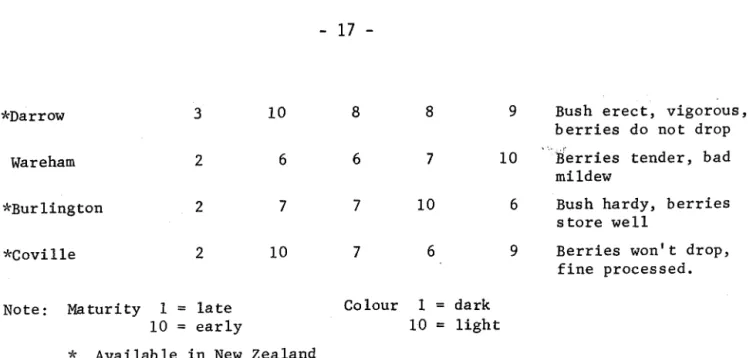
5. Rating System for Blueberry Cultivars
A rating system has been developed to express the relative value between
cultivars using a scale of 10 for the best and 1 for the harvest.
In North America a rating of less than 6 is considered unsatisfactory
for commercial use. Such a system makes it possible to compare the
Cv Maturity Size Colour Scar Flavour Remarks
Morrow 10 8 7 6 6 Very early
Angola 10· 8 5 7 6 Very fine bush
Wolcott 9 8 6 9 6 Very fine bush
*Croatan 9 8 7 8, 6 Very fine bush
*Weymouth 9 8 5 6 5 Poor bush, productive,
poor flavour
*Earlib 1ue 9 9 8 7 '7 Fine bush, good
machine harvest
*Collins 8 9 8 7 8 Fine bush, good
machine harvest
*Murphy 8 8 6 6 7 Spreading bush
*Cabot 8 5 7 6 5 Spreading bush,
berries crack
*June 8 5 6 5 6 Bush usually weak
. *Rancocas 7 6 7 6 6 Berries crack
*Ivanhoe 7 9 7 9 10 Buds not hardy,
difficult to propagate
*Stan1ey 7 6 7 4 9 Easy to prune, berry
size variable
*B1ueray 7 10 8 7 9 Bush hardy, easy to
propagate
*B1uecrop 6 9 9 9 7 Drought resistant,
hard~ fine colour
*Concord 6 7 7 6 8 Fine cluster size
Pioneer 6 6 6 6 9 Berries crack
Scammell 6 7 6 6 7 Sets too large.
c1us'ters
*Berk1ey 5 10 10 8 7 Berries drop,
light blue
*At1antic 4 8 7 7 8 Ber:ries drop
Pemberton 4 8 6 4 7 Bush very vigorous,
most productive
*Rube1 4 6 7 7 6 Bush hardy - difficult
to prune
*Jersey 4 7 7 7 6 Bush hardy - long
picking season
*Dixi 4 10 6 5 9 Berries crack, berry
size variab 1e
*Herbert 3 10 7 7 10 Bush hardy, berries
*Darrow 3
Wareham 2
*Burlington 2
*Coville 2
Note: Maturity 1
=
late 10=
early10
6
7
10
* Available in New Zealand
8 8
6 7
7 10
7 6
Colour 1 dark 10
=
light9
10
6
9
Bush erect, vigorous, berries do not drop
".-.,t'
bad Berries tender, mildew
Bush hardy, berries s tore well
Berries won't drop, fine processed.
These ratings are not absolute, for all cultivars mature earlier when
heavily pruned, compared with little or no pruning and some respond
more than others. The amount of pruning also can greatly affect berry
size. Colour tends to be lighter in dry seasons than wet ones, but in
general is least affected by environmental conditions. At Lincoln it has
been observed that difference~ of ma~urity within cultivars compared with
ratings established for North America as well as seasonal effects, e.g.
the current drought is maturing fruit considerably earlier than observed
in the past four years. Flavour of fruit in said to improve the further
north a cultivar is grown but in very cool climates berry acidity may
become too acid for the average taste. This of course, refers to the
Northern Hemisphere, therefore, for New Zealand the opposite would apply.
TABLE II
Ratings of Rabbiteye Blueberry's Characteristics (Darrow
&
Moore 1962)Cultivar Bush Size Maturity Berry Size Berry Colour Scar
Coastal 9 10 8 6 9
Garden Blue 10 10 6 8 9
Callaway 7 9 8 8 10
Ti~lue 9 9 7 10 10
Homebell 10 8 9 7 9
Menditoo 9 7 9 6 10
Woodard 8 10 9 10 7
Note: Bush size I
=
small Maturity I=
late 10 iii:: large 10 earlywith two rows of another. All have a relatively long ripening season
and some fruit can be picked for four to's1x weeks making the rabbiteye
well suited to home gardens. Rabbiteye may have some value as a grafting
stock for Highbush scion wood, to encourage earlier high fruit yields
and wide soil adaptability.
6. Pollination
A properly pruned blueberry bush, that has received good cultural care
is capable of setting almost 100 per cent of its blossoms. To yield a good commercial crop a set of about 80 per cent is required. In this respect blueberries are quite dissimilar to apples and peaches and
other fruits that may produce large yields with only 20 per cent blossom
set.
From observations made at D.S.l.R., Lincoln Research Centre by
Dr. Rod Macfarlane, insects have been identified that are attracted
to the fragrant blossom, the glands of which secrete nectar, sought
after by bees and other insects. Because the pollen grains are
rather heavy and tend to adhere in masses, they are not easily
propelled by wind. Bees and other insects are guided to the flower
by colour and odour. Merri1 (1936) found that nearly 80%
pistils of highbush blueberry remained receptive to pollen four days after the opening of blossoms.
Pollinators observed working flowers Lincoln 1980:
Long tongue bumble bee Bombus terrestris
Short tongue bumble bee Bombus hortorum
Honey bee
Native bee
Apis mellifera
Lasiog1ossum sordidum
SUMMARY
of the
for up to
1. A t leas t 10 years are required to accura te ly eva lua te a new impor ted cultivar.
2. At least 15 years are required to breed and field test a new cultivar.
3. A rating system should be established for all cultivars from age 5
longest shelf life for export.
5. Cu1tivars best suited for processing need to be identified
..
- ", for machineharvesting.
6. Cu1tivars that produce the best flavoured pies need to be identified.
7. Cu1tivars that produce the best wines / liqueurs need to be identified. 8. Many more years of research, properly financed and adequately staffed
is urgently required.
REFERENCES
ESK, P-.; & CHILDERS, N.F. 1966. Blueberry Culture. Rutgers University Press, New Brunswick, New Jersey.
DRUPER, A.D. 1979. Highbush Blueberry Cu1tivars. Fruit Varieties Journal
v33 N2. 48.
AUSTIN, M.E. 1979. Rabbiteye Blueberries. Fruit Varieties Journal V33 N2.
51.
DAVIES, D.J.G. 1979. Blueberries - A Crop of the Future. Alternative Land
A. L. Fi:rmin., Grower., Whakatane.
"Which is the best variety of Blueberry to plant?" is a question posed
by nearly every grower at some stage and therefore became one of my
prime reasons for visiting the U.S.A. and Europe last year - to make
observations on the performance of different Blueberry Ciltivars
-under commerciaZ conditions.
Firstly from three regions in U.S.A., different in topography, climate
and distance from their markets, and each in turn having some features
similar to New Zealand.
Do I hear an unspoken interjection, 'What does he mean "same as New
Zealand". We have djfferent climates from the South to the North
Island, from one province to another.' Sure, and .for this reason we
must attempt to classify our conditions in relation to where Blueberries
are a major farm crop - so back to U.S.A.
The nearest growing region for Blueberries to us here are the states of
Oregon and Washington; their coastal plains remind me verY'much of
parts of the South Island. They have a rainfall fairly evenly
distri-buted throughout the year but their winters are longer and hardE·r.
Blueberry farms I saw in this region ranged from 0.2 ha for a mixed
gate sale operation, to 40 ha and upwards. JERSEY is the predominant
variety yielding up to 2S tonnes per hectare, but it was also the latest
and was often at risk from early frosts. They let it hang to mature
STANLEY and CONCORD also grow in this region, but are older plantings
20 to 25 years old and are no longer being plant'ed. Why? -- The small
size of the fruit in the case of STANLEY (though the bushes were very
large carrying a heavy crop). CONCORD was disliked by the pickers.
This is a very important consideration. They were on piecework at
30c per kg and couldn't make decent money. Also, the growers had lost
interest in CONCORD as the fruit did not travel well as it was inclined
to go soft.
The best early variety was BLUETTA, but due to its breeding, which
appeared to indicate some lowbush ancestry, flower break was a problem
in a mild autumn (lowbush blueberries are native to cooler and more
northern regions), and they are accustomed to a longer period of dormancy.
Canadian researchers have done work on fruit bud initiation and the
influence of photoperiod on the commencement of dormancy. This is a
tricky one. Get a good early variety which hopefully has been bred
somewhere along the line from the Highbush - Lowbush cross; move it
to a region in a different latitude when day length between the seasons
is not as marked or where the winter is shorter or the autumn milder,
and some of its productivity will be lost. Or, at worst, the plant
will be thrown right out of gear and perform poorly. Howeve~, BLUETTA
had rich blue round large berries - a peculiar flavour, but I liked it!
BLUECROP and BERKELEY are the heaviest early/mid season croppers,
consistent in their bearing habit.
BLUECROP preferred most of all.
BLUERAY is also planted, but
From a region whose cash crops are hay and peas, where the superb local
steak was partly fed on green grass, to one where the roadside stalls
sold peaches and water melons and grapes, and fields bore crops of maize,
soya beans and tobacco. A much lighter soil type covered North
Carolina, mainly sandy and only after rain took on a darker look, the
humus content being quite low at 2% to 4%. The soil is similar to that
used in the same state for tobacco, except underlying pans which keep
the water from draining away, cause a higher water table.
misconception. Despite the heat, the droughts and les~_winter chilling,
95% of blueberries in commercial production in this state are of the
highbush type, because the farmers produce what the market requires.
The fruit of improved cultivars of the rabbiteye is very similar in
flavour, very good in fact when picked at maturity and at consistent
daily temperatures of 300C plus, but there is a certain seed awareness
which can be picked up straight away and can irritate those with
dentures. Notwithstanding these observations, there are many big cities
in the South of U.S.A. (the bulk of the crop of North Carolina goes
North to the early markets in Washington, New York, Boston etc.)
Atlanta, Birmingham, New Orleans or further west to Houston, Dallas and
Denver where North Carolina would have an advantage regarding freight
costs and where a market could be developed. But the fact remains
that they still do NOT produce
Vaccinium ashei
on any scale commercially. Another widely circulated idea was that IVANHOE was a variety bred forand grown in North Carolina beca)lse of its low winter chilling
require-ment. Well, I didn't see any IVANHOE in North Carolina (I did see it
growing in Oregon) and it doesn't even have one mention in the latest
booklet put out by the N.C. Agricultural Extension Service. It is
just another superseded variety. The ones in commercial production
are WOLCOTT, MURPHY, CROATAN, BLUERAY, BERKELEY and JERSEY.
Specially bred highbush types with less chilling requirements and a
resistance to stern canker which is a problem in this region, are not
crosses with the rabbi teye but wi th a na ti ve of Florida
Vaccinium
darrowii.
The latest releases bred from CROATAN and carrying depart-mental numbers at the moment show a lot of promise but will be underevaluation for another 5 years before commercial release.
But back to realities, not what we might have but what we do have to
select from in New Zealand at present. BERKELEY is prone to some
frost damage - if the temperature goes down as low as a severe North
American winter, but it crops heavily in North Carolina. Likewise
BLUERAY seems slightly more resistant to stem canker than BLUECROP,
but JERSEY which was formerly widely planted is now being pulled out
NEW JERSEY
The biggest blueberry farms in the world are situated in this state,
only a couple of hours by Highway to New York City. Huge areas,) up
to 440 ha in one operation, are run by private ownership. The
Galetta Bros for example, a family concern, has 2.25 ha paddocks of
the same variety, not planted north to south, and a nursery with
1,000,000 plants, many for export to Europe including Poland.
When you are dealing with a long term crop then what was planted 20
to 30 years ago and still yielding is not easily torn out, but there
was a replacement programme under way. Just a~out every variety was
represented, but the main cultivar being planted now in this State is
BLUECROP without a doubt.
JERSEY used to be the one - but I'll deal with the reason for its
demise later; WEYMOUTH is still the number one for early fruit but
has a poor flavour and some considerable effort is being made to find
a replacement. COLVILLE is the latest berry.
\
Why should a variety which yields 25 tonnes per hectare in Oregon and
Washington and once have been the biggest producer in New Jersey be
down to 10% or less of the acreage with declining yields?
The bees are to blame, or rather man and his indiscriminate use of
powerful insecticides. JERSEY is a variety preferred by wild bees.
Without good pollination, the fruit is parthenocarpic i.e. self fertile
and small, whilst honey bees go for BLUECROP - it's as simple ~s that.
Why they do has research workers puzzled; it is apparently not the
quantity of nectar. RUBEL for example, has far less nectar than
JERSEY but receives more visits by honeybees. BERKELEY seems very
dependent on wild bees (which can pollinate 4 flowers in the time a
honey bee takes to vist one), as does STANLEY. EARLIBLUE has a
variable or poor pollination record in the States, and for this reason
EUROPE
I hadn't been to Europe for 23 years and so my first impressions of blueberries and their environment, were that the summer was cooler than in America, and the light intensity even on a sunny day was noticeably lower than in New Zealand. There are European varieties bred from American material. HERMA I, HERMA II and others are vigorous growers, very winter hardy but lacking in size and flavour.
In Germany production was based on BLUERAY, BLUECROP, BERKELEY, IVANHOE and DARROW. All produced good looking berries, the best flavoured were DARROW, BLUERAY and IVANHOE, but all seemed to be lower in sugar content, to my taste at least, than here or in America. DARROW and IVANHOE were confined mainly to central or south Germany as they had difficulty in maturing in the north where the main growing region lies.
ENGLAND
England. despite being in the EEC, is still quite a different country and the blueberry either unknown or only within certain limited areas. The ~lantings are quite small, quite a big farm was 3.5 ha and BLUECROP,
BERKELEY and BLUERAY were the main cultivars. HERBERT and IVANHOE, although good in flavour, were considered 'too soft'.
The English autumn near to the South Coast is milder than Europe which permits an extended growing season for later varieties, including
COLVILLE. This advantage turns to disadvantage when the early cultivars EARLIBLUE and COLLINS are concerned. One year, flowers of these two appeared in January, their mid-winter!
SCOTLAND
Only the earliest varieties in the summer of '79 started to colour out-doors. EARLIBLUE for example, was taken inside a glasshouse to ripen by mid August. In a trial block BERKELEY, BLUERAY or BLUECROP were making better growth than other sorts, but all were considerably smaller
IRELAND
As Bullet-proof vests add to luggage weight when flying, I was not prepared to visit the Emerald Isle, but a first hand report informed me that DIXI was performing well, so were BERKELEY and BLUECROP. JERSEY failed to produce in one area, yet was 'best in another.
At this point it would be worth looking at heat requirements. There has been a lot of talk about winter chilling but what about the number of hours of warmth necessary for each cultivar to attain maximum
development in yield. size, quality and flavour. I can quote from no manual although I have corresponded and discussed this point with
overseas authorities, and there appears to hav~ been no specific work done to measure this. Therefore I make my own observations. The colour of the leaves on mature fruiting bushes in north Germany and Scotland in particular was the same as we see in spring-time in New Zealand. This copper red colour, I believe, is due to cooler temperatures. Take a plant in October or early November here and put it into a glass-house, and the colour is replaced by a healthy green and more vigorous growth within a week. Sweetness of fruit (i.e. sugar content), comes of course, from the activity within the leaves. If the growing season
is too cool some highbush cultivars will not mature their fruit at all whilst others will colour but lack flavour.
Therefore I recommend at least 6 weeks of 20°C plus as necessary prior to and during the ripening period. If you are in doubt, don't plant -they won't make export quality.
NOW TO NEW ZEALAND
Herefords through a herringbone twice a day - probably cut down on your milking time though!
BURLINGTON produces smaller berries. If you're planning to supply the processing market and machine pick, then fine, go ahead and plant
Burlington. The flavour is good and they keep well, but if you intend
to hand pick a dessert berry for overseas, then there are alternatives.
CONCORD I believe should not be planted at all (we have already pulled ours out and burnt them). In New Zealand as overseas, its tight clusters, delicate skin which often tears when being picked, and its reputation as a poor shipper rule it out other than for a home garden.
I don't believe ATLANTIC should be planted either. It has many good points and has been successfully exported from New Zealand, but it has a well earned reputation for dropping its fruit before you have time
to pick it, or if you are picking 'on one side of the bush they drop
off from the other!
DIXI is another cultivar I feel should not be planted and by adding this familiar name I know I am inviting controversy. Despite its record of consistent high yields,vigour and fruit flavour, it has two black marks which, from a corrnnepciaZ point of view, are high risk factors to be taken into consideration before any further plantings are under-taken.
*
*
Scar, (large MOIST scar) It is true that some of the new introductions have a large scar, BLUERAY for example, ,but DIXI also tends to be moist and this can lead to growth of mould during transit. Not, of course, if you soak them in a
fungi-cide before shipping, but I wouldn't advise any grower to try that preventative measure with the regular sampling for residues now being practised in U.S.A. ports of entry.
however, we have experienced loss from,s:pli tting .i.n~ our hot
summer after rain and this is despite regular irrigation before
the rains came. Splitting, or rather exploding, completely
ruins the blue fruit, the purple fruit and even the red/purple
stage. The mess spreads over immature green berries and 50%
of the crop can be lost overnight.
STANLEY, though discontinued overseas because of size, is still my
favourite for flavour amongst the early fruiting types. Care and
patience is necessary at picking time or tearing will result.
JERSEY crops well here, but in many districts doesn1t produce large
fruit after the first picking. This is usually due to one of two
reasons:
*
insufficient irrigation*
too much fruit.This cultivar must be regularly pruned to encourage younger wood because
older wood, althoug it crops heavily, produces small fruit which is not
suitable for export grade.
To date there are no lBig 7 1 cropping under commercial conditions in
New Zealand. There are plants which have fruited at Moanatuatua and
Lake Cameron near Hamilton, but these have not been managed as a
commercial block. Let me give an example. Due to lack 'of space,
young two year plants have been interplanted in blocks with 10 year olds
over 2 m high; there has been no regular irrigation and they have had
to compete for water and nutrients with the mature root systems of the
older plantation. Furthermore they have not been de-flowered or fruit
removed to aid establishment. Where they are managed in rows it has
been in the main for whip,production and this of course gives no cropping
data. Or, in another location, insufficient shelter has favoured plants
with a stronger vegetative growth - in a survival sense - which does
export quality fruit. A few growers have frui~~d indivi~~~,l specimens on a nursery scale, we have seen and tasted BLUECROP, BLUERAY, BERKELEY, COLLINS, COLVILLE, DARROW, IVANHOE at Whakatane and made comparisons with older selections.
The charts below are a summary, based on observations in New Zealand. Where an "Xli has been superimposed I consider the variety as unsuitable for intended export plantings and "?" to mean probably suitable, and "SO/SO" could be suitable if care is taken.
So, to sum up, in two Continents commercial growers favour BLUECROP, BERKELEY, and BLUERAY. These are the cultivars which appear as the backbone of
all new
plantings~ plus BLUETTA, COLLINS or EARLl BLUE as early croppers and DARROW and COLVILLE as late types.There are newer varieties releas~d from university experimental stations which have only a localised appeal overseas so far. For this reason, plus the fact that most are not in New Zealand (and those that are, still remain in quarantine), they are still five years away from the commercial planting stage.
This applies also to locally selected cultivars through the Ministry of Agriculture and private growers who have testing programmes under way.
PLUS POINTS
size - medium/large, flavour
- good, colour - good
keeps well, good shipper,
good for machine packing,
yield high, flavour good
colour good, flavour
-average to good
excellent cropper, good
flavour, good size
very good flavour, does not
burst, yield quite good if
close planted and well
pruned, colour and size of
early fruit good
good cropper, good colour,
firm berry, good shipper
good keeper, late flowering,
easy to pick
size, colour and flavour
all good, does not drop,
later fruit continues to size
VARIETY
MINUS POINTS
~
growth habit, fruit drop when ripeBurlington \50/50) Stanley
ISO/SOl
JerseyV
Collins ?.
tight fruit cluster for
first berries, small fruit
tedious to pick
tight fruit clusters, tears
easily, poor shipper
large moist scar, therefore
uncertain shipper, strong
tendency to burst after
rain
medium to large scar, care
needed when picking, colour
of late fruit dark, size
of late fruit - poor
needs hard pruning or size
too small, stems sometimes
hang on berry, flavour
just average. Bees?
Consider pollination for
large blocks
PLUS POINTS
yield, flavour, size all good, does not drop
light blue, hangs well, excellent shipper, drought resistant, hardy, fastest hand picking of all
cultivars
light blue, heavy bearer, good size and shipper
hardy, flavour, size all good, hardy in regard to wind
exceptional flavour, large berry, good colour
good cropper, colour, size and shipping, keeps sizing up to end of harvest, doesn't drop or burst
good cropper, excellent flavour and size, han,s well
VARIETY
Blueray../
Bluecrop ?.
Yield in N.Z. still
unproven Berkeley
v'
Darrow ?.
shipping quality unknown Col ville HerbertISO/SOl
MINUS POINTS
scar large, but not wet, shipping not as good as Bluecrop but still keeps well, tight cluster at first picking
flavour average, bends with weight of fruit, not best shape for machine harvesting, cropping season re overseas markets ??
flavour only fair to average, pollination ?? (large acreage only) Godronia cassandrae
cooler weather fungus disease overseas
not the best shipper, yield fair to average, grows a higher % of wood to fruit
vegetative vigour suspect, tight fruit cluster for first berries, danger of compulsive eating !!
risk (overseas) of Anthracnose"
Bees ?? (large acreage only)
D. Cohen,
Plant Physiology Division, D.S.I.R., Palmers ton North.
HDrticulture in New Zealand is in a phase Df rapid expansiDn creating a demand
fDr large numbers Df plants, Dften with little advance warning to' the
nursery-men who. are expected to. prDduce them. New varieties Df plants are being
impDrted and there is pressure fDr rapid multiplicatiDn after release Df the
plants frDm quarantine. Recent experience with blueberries prDvidesagDDd
demDnstratiDn Df SDme Df the prDblems invDlved.
In 1978, we cDmmenced a prDject at Plant PhysiDIDgy DivisiDn to. develDp a
micrDprDpagatiDn (tissue culture) methDd suitable fDr blueberries. Initial
methDd develDpment tDDk apprDximately eight mDnths and we then requested the
Blueberry Research AdvisDry CDmmittee to. nDminate five cultivars in shDrt
supply. We Dffered to. use Dur procedures to. prDpagate 1,000 plants Df each
variety Dver the next year. The five cultivars suggested were Berkeley,
IvanhDe, Blueray, BluecrDp and Earliblue. StDck plants were supplied to. us
by Ruakura Agricultural Research Centre. The methDds used have been Dutlined
in papers presented to. the annual meeting Df the InternatiDnal Plant
Propagators' SDciety in 1979 and 1980 and cDpies Df these papers are available.
Our initial wDrk was dDne with the cultivar Atlantic which has prDven to. be
Dne Df the easiest cu1tivars to. handle at all stages. StDck plants were grDwn
in a glasshouse and shoots collected at the end of a flush of growth. These
ShDOtS were surface sterilised using hypochlorite, cut into single node
sections and placed on sterile media. ShODtS developed from the axillary
buds on about 50% of the sections and produced shoots 2-4 cm long with 6-10
leaves after about six weeks. These ShODts were excised, cut into sections of
1-3 nodes and replanted on fresh medium in petri dishes. Most of the new
cultures prDduced axillary ShDDtS which were again cut into. sectiDns after
6-8 weeks. This prDcedure has been repeated, to. date, up to. nine times
giving a prDliferatiDn rate Df arDund 5-fDld per subculture.
In vitro grDwn ShDDtS were dipped in Seradix 2 rDDting hDrmDne pDwder, planted in a seedling flat cDntaining fine pumice:peat (50:50) and kept under high
humidity and two layers Df 50% shade CIDth. With the cultivar Atlantic 90-95%
-to a glasshouse bench.
Once rooting had taken place, the plants were fertilised twice weekly with a complete nutrient solution. When the shoots were 7-10 cm long they were
transferred to propagating tubes. Plants with 1-3 shoots over 30 cm long were produced within a further 2-3 months.
Other cultivars often behaved differently to the above description for Atlantic at some stage in the propagation sequence. The characteristics of the five varieties referred to above are noted:
BERKELEY:
Cultures established easily and proliferation was similar to Atlantic.
Rooting was excellent with root initials appearing in 10 days and about 95% of the cuttings were usually rooted within three weeks. Subsequent growth has been very good.
BLUERAY:
Cultures established easily but proliferation rate during the
first three subcultures was only 2-fold. At subsequent subcultures proliferation improved to approx. 4-fold.
Rooting of shoots was similar to Berkeley and Atlantic.
Subsequent growth has been vigorous. This is the most precocious variety and many of the shoots developed floral buds in the
greenhouse during the winter.
IVANHOE:
Cultures established easily but proliferation rate was intermediate between Berkeley and Blueray.
Rooting was slower than for the above varieties. Only about 70% were rooted after three weeks.
Subsequent growth has been very good. BLUECROP:
weeks.
Subsequent growth has been very good.
EARLIBLUE:
Culture establishment has been good. Shoot growth has been very
vigorous with good proliferation rates.
Rooting, however, has been poor. In one large trial only 51% of
cuttings formed roots in four weeks.
Subsequent growth has been very good.
The plants we produced have been offered for sale to growers and nurserymen
by New Zealand Berryfruit Propagators Limited. Plants of varieties Berkeley,
Blueray and Ivanhoe have already been distributed. Plants of Bluecrop and
Earliblue will be distributed in early December. Plants remaining after
these sales are being sent to research stations for further trial work.
Fears have often been expressed about trueness-to-type of tissue culture
grown material. There is no eviden~e to suggest that this will be a problem
with blueberries. Unfortunately, many early attempts at micropropagation
used systems involving callus culture followed by induction of adventitious
buds. In these cases, variation was found. In addition, some ornamental
plants are variegated and have a chimaera 1 structure, which is unstable in
any propagation system. This instability is put under even greater pressure
in a rapid propagation method.
The procedures recommended for blueberries are a most conservative approach
to micropropagation. If hormone levels are increased, more rapid
proliferation is possible but adventitious buds arise from basal callus and
from leaves. Although we have no evidence for any variation in such buds,
we nevertheless have not subcultured adventitious buds.
The plants produced in these procedures appear to be very vigorous and have
a number of characters similar to seedlings. This 'rejuvenation' has been
reported with a number of crops and is one of the advantages of
micropropagation over conventional propagation methods.
What then is the role of these methods in blueberry propagation? Several
commercial laboratories are currently propagating blueberries. As long as
there is a high demand for plants, any added costs of micropropagation
plants. The cost of the micropropagation procedure will vary depending on the overheads of the laboratory and the efficiency:wi th which:-i t is run.
References:
Cohen, D. and D. Elliott. (1979). Micropropagation methods for blueberries and tamarillos. Proc. Int. Plant Prop. Soc. Vol. 29.
A. L. Firmin, Grower, Whakatane.
How many times have you seen a wild bird with a blueberry in its mouth,
or so full that the seeds are coming out at the other end? The seeds
germinate on the surface :md a plantation grows. Well} maybe under
natural conditions millions of seeds are produc·ed but only a small
portion ever come to maturity. We want to try and understand a more
dependable way of preparing land for blueberries.
Firstly let us look at conditions.as they prevail in their country of
origin, looking specifically at the highbush blueberry. It grows
naturally when ground has been cleared from what we call second scrub
country. Americans call it pine barrens, country with low-growing
pine trees about as high as telephone poles, not like the towering
timber in Radiata. The soil is usually sandy but has a mixture of
decaying leaves, wood and bark. Undergrowth is not heavy, but there
is a top soil of variable thickness sitting on top of the free draining
sand. But, underneath is a pan which may vary in depth from 2 to 4
feet and it has the effect of retaining rainfall quite high in· the
soil.
So in effect it is only free-draining at the surface, and it supports
the blueberry by giving a continuous supply of moisture within easy
reach of the shallow root system. Furthermore/this moisture over the
pan is on the move towards an outlet, like a large shallow underground
reservoir.
How do these conditions compare with what we have here?
at three types of land.
35
Scrub
Usually covered with Manuka in this area. If not too large you could
rotary slash the whole area then disc into the surface and leave fallow
for a while. This would be similar ground preparation for pine
planting up to this stage. Follow this up with a further discing
and pulling a ripper through to tear any roots and aerate the ground.
Finally rotary hoe and level.
Reason Not to bury the valuable scrub or forest type top soil too deep as you would with ploughing - remember the surface rooting habit
of blueberries.
First consideration is to plan a drainage system that will enable you
to firstly work up the ground, but secondly serve as a water control
system after you have planted. In new swamp the whole operation may
take two full seasons, the first to put through a main drain with
feeder canals with some land clearing, and the second to plough in
order to bury rushes, sedge, flax and so on, and prepare the ground
for planting. If this work is hurried on new ground at least
-when it settles (and settle it will) an uneven surface will cause
ponding and loss of the new planting, so although two years man seem
to be working ahead too far this is what you will need.
Pasture
Most likely however you will be preparing ground out of pasture and
the aim here is to get rid of perennial weeds.
Ploughing There are many types of ploughs and most modern 3-point linkage ones turn the furrow over and Jeave it standing on edge at an
angle; fine if you are putting in a crop, but rushes, docks, paspalum
and others soon find their way in between. We want to get rid of
them so the type of plough with sufficient adjustment such as an old
![[M531.Ebook] PDF Download Mathematica Graphics Example Book For Beginners By Haiduke Sarafian.pdf](data:image/gif;base64,R0lGODlhAQABAIAAAP///wAAACH5BAEAAAAALAAAAAABAAEAAAICRAEAOw==)