S T U D Y P R O T O C O L
Open Access
Study protocol: Imaging brain development in
the Childhood to Adolescence Transition Study
(iCATS)
Julian G Simmons
1,2, Sarah L Whittle
3, George C Patton
2,6, Paul Dudgeon
1, Craig Olsson
2,5, Michelle L Byrne
1,
Lisa K Mundy
2,4, Marc L Seal
2,6and Nicholas B Allen
1*Abstract
Background:Puberty is a critical developmental phase in physical, reproductive and socio-emotional maturation that is associated with the period of peak onset for psychopathology. Puberty also drives significant changes in brain development and function. Research to date has focused on gonadarche, driven by the
hypothalamic-pituitary-gonadal axis, and yet increasing evidence suggests that the earlier pubertal stage of adrenarche, driven by the hypothalamic-pituitary-adrenal axis, may play a critical role in both brain development and increased risk for disorder. We have established a unique cohort of children who differ in their exposure to adrenarcheal hormones. This presents a unique opportunity to examine the influence of adrenarcheal timing on brain structural and functional development, and subsequent health outcomes. The primary objective of the study is to explore the hypothesis that patterns of structural and functional brain development will mediate the
relationship between adrenarcheal timing and indices of affect, self-regulation, and mental health symptoms collected across time (and therefore years of development).
Methods/Design:Children were recruited based upon earlier or later timing of adrenarche, from a larger cohort, with 128 children (68 female; M age 9.51 years) and one of their parents taking part. Children completed brain MRI structural and functional sequences, provided saliva samples for adrenarcheal hormones and immune biomarkers, hair for long-term cortisol levels, and completed questionnaires, anthropometric measures and an IQ test. Parents completed questionnaires reporting on child behaviour, development, health, traumatic events, and parental report of family environment and parenting style.
Discussion:This study, by examining the neurobiological and behavioural consequences of relatively early and late exposure to adrenarche, has the potential to significantly impact our understanding of pubertal risk processes.
Keywords:Puberty, Hormones, Adrenarche, Adolescence, Brain development, Protocol, MRI, Gonadarche
Background
The transition from childhood to adolescence is a period of opportunities (as young people physically and sexually mature, and peer and familial relationships change), challenges (as responsibilities and exposure to a range of risks, such as substance use and sexual activity, in-crease), and vulnerabilities (with half of all lifetime cases
of mental illness starting by age 14 years) [1]. The transi-tion coincides with the biological processes of puberty and changes in brain structure and function [2,3]. In-deed, it is increasingly being recognised that pubertal maturation may influence brain development, and in turn, psychosocial maturation. In this regard, the timing
of pubertal stage relative to peers is relevant. Early pu-bertal timing predicts adolescent onset mental illness and other poor outcomes during adolescence, and in some cases better accounts for sex differences in the on-set of psychopathology than age [4,5]. Specifically, early pubertal timing has been consistently associated with
* Correspondence:[email protected] 1
Melbourne School of Psychological Sciences, The University of Melbourne, VIC 3010, Australia
Full list of author information is available at the end of the article
depressive symptoms in girls [6,7], while findings for boys are mixed [8]. Further, advancing pubertal stage in-creases risk for both the onset and persistence of depres-sive symptoms in girls [9] and violent and anti-social behaviours in both sexes [10].
The current literature on puberty and brain devel-opment has many general methodological limitations [see 11], and specifically has not addressed the differen-tial effects of adrenarche (the earlier phase of pubertal de-velopment driven by the hypothalamic-pituitary-adrenal [HPA] axis) and gonadarche (the later phase driven by the hypothalamic-pituitary-gonadal [HPG] axis). Despite the fact that the timing of both phases of pubertal develop-ment have been associated with behavioural and develop-mental health problems [6,7,12], most research has focused on gonadarche and little is known about the earlier adrenal phase of pubertal development. This emphasis has likely been a product of the relative difficulty in assessing adre-narcheal development due to the paucity of early physical signs, and that adrenarche has only been detected in humans and some higher primates [13], limiting experi-mental animal work.
This paper is a methodological description of theImaging brain development in the Childhood to Adolescence Transition Study (iCATS), which was embedded in a
larger Childhood to Adolescence Transition Study (CATS)
[14]. Both of these studies aim to address existing gaps in knowledge. However, iCATS will specifically, and uniquely, examine the influence of adrenarcheal timing on brain development and function, and on mental health.
Puberty and adolescent brain development
The principal focus in studies of adolescent brain develop-ment was traditionally on age-related changes [e.g., 15]. Based on findings (e.g., peaks in grey matter density that appear to coincide with timing of puberty onset, [16]) researchers have more recently suggested that brain devel-opment patterns align better with pubertal changes rather than with age. It is well established that steroid hormones play critical roles in development [17]. However, the ex-tant literature remains sparse, and predominantly focuses on gonadarcheal indices. Importantly, although there is informative animal work regarding the links between gonadarcheal hormones and brain structure and function, relatively little is known about this relationship in humans [16] and particularly in relation to adrenarcheal hormones [18].
Recently, a small number of adolescent MRI studies have investigated, in more detail, the relationships among brain structure and function, gender, and hor-mones that change at puberty. A structural MRI study
by Peper and colleagues [19] with 10–15 year olds
showed an association between testosterone levels and global grey matter density in males (and not in females).
Neufang and colleagues [20] examined 46 participants
aged 8–15 years and found a positive relationship
be-tween Tanner stage and testosterone levels and grey matter volume in the amygdala, and a negative relation-ship between these measures and hippocampal volume, regardless of gender. In addition, males showed a nega-tive relationship between testosterone and parietal cor-tex grey matter. In a more recent study specifically examining adrenarcheal hormones, Nguyen et al. [21] explored associations between androgens and cortical thickness and found that DHEA levels were positively associated with cortical thickness in various frontal, par-ietal, and temporal cortical regions from various ages
be-tween 4–13 years. For instance, DHEA was positively
associated with cortical thickness of the left dorsolateral prefrontal cortex from ages 4 to 8 for males and females. Conversely, sex-specific changes were observed in the association between testosterone and cortical thickness. Specifically, pre-pubertal males (defined as Tanner Stage 1 or 2) typically demonstrated negative associations be-tween testosterone and cortical thickness, whereas pre-pubertal females demonstrated positive associations. Trajectories of white matter development have also been found to differ as a function of pubertal hormones. Peper and colleagues (2009) reported a positive associ-ation between gonadotropic hormones and white matter density at age nine. A study by Perrin and colleagues [22] found that trajectories of white matter development in males were related to expression levels of a gene en-coding a testosterone receptor, suggesting that effects of testosterone may be responsible for the sexually di-morphic relationship between age and white matter vol-ume. These studies demonstrate promising evidence that pubertal hormones influence structural brain develop-ment in humans.
Few studies have investigated the effects of puberty on brain function in normal samples. Forbes and colleagues [23] found that those with more advanced pubertal mat-uration (measured by Tanner stage) exhibited less stri-atal and more medial prefrontal reactivity to reward, and that testosterone was positively correlated with striatal reactivity in boys during reward anticipation and nega-tively correlated with striatal reactivity in girls and boys during reward outcome.
(72 females). Relatedly, we also found that pituitary vol-ume in early adolescence predicts HPA activity in mid-adolescence in the same cohort [25]. These findings are consistent with neurobiological mechanisms being re-sponsible for the link between early pubertal timing and depressive symptoms in adolescents.
However, as these studies only used self- and parent-report measures of pubertal development and did not differentiate adrenarche and gonadarche, they cannot differentiate the relationship between specific adrenarch-eal hormones, brain development and function. Further-more, the focus on one brain region (the pituitary gland), although important, did not allow investigation of the role of brain development more broadly in these processes.
Imaging brain development in the Childhood to Adolescence Transition Study (iCATS)
Funding was obtained from the Australian Research
Council (ARC; DP120101402, 2012 – 2014) to recruit
two groups of participants stratified by hormonal indices of pubertal timing, selected from the larger population-based CATS investigation (N = 1239 Grade 3 [667 females; 7.79–10.65 years of age]) [14]. This permitted the investi-gation of the associations between the timing of pubertal maturation (as assessed by gender-specific hormonal and body morphological changes) during early pubertal de-velopment, namely adrenarche (funded) and gonadarche (to be funded), on aspects of brain structure and func-tion implicated in emofunc-tional dysregulafunc-tion and mental disorder.
Aims
The broad aim of iCATS is to elucidate which children are most at risk for adverse outcomes as they pass through puberty. The specific aim of iCATS is to identify the neurobiological mechanisms that mediate this risk. The primary objective of this study is to explore the hy-pothesis that patterns of structural and functional brain development will mediate the relationship between pu-bertal timing and the indices of affect, self-regulation, and mental health symptoms collected across waves (and therefore years of development).
Current understanding of the relationship between pu-berty and brain development is rudimentary, with few studies looking specifically at the effects of pubertal tim-ing [24]. We hypothesise, based on extant literature, that earlier exposure to adrenarche will be associated with neurodevelopmental and behavioral outcomes that have been previously associated with greater risk for mental health problems. Our specific aims are to:
1. Investigate the relationship between adrenarcheal timing and brain structure in both sexes, by
examining associations between advanced adrenarcheal development, measured by DHEA, DHEA-S and testosterone, and (i) cortical grey matter, (ii) white matter, (iii) limbic, and (iv) striatal volumes.
2. Investigate the relationship between adrenarcheal timing and brain function (both at rest and in the context of affective processing) in both sexes, by examining associations between advanced adrenarcheal development and both function and connectivity in (i) limbic, (ii) prefrontal, and (iii) parietal regions.
3. Investigate if (i) stressful life events, (ii) long-term cortisol levels and (iii) immune system function moderate the associations between adrenarche and brain structure and function described in Aims 1 and 2.
4. Investigate the relationship between Aims 1–3, health and risk, by examining whether the patterns of structural and functional brain changes identified above mediate the relationship between pubertal development and indices of affect, self-regulation, and mental health symptoms.
Methods/Design
Design
The funded component of iCATS is a cross-sectional study of the relationship between pubertal timing and brain structure and function in children approximately 9 years old. At this time the processes of adrenarche are at the fore. Children were selected and invited to take part in iCATS based upon hormone levels collected at a baseline assessment from the broader CATS [14] (M age = 8.98, SD = 0.39 years). Children were grouped as either rela-tively early adrenarche or late adrenarche, based upon the entire distribution (see Selection Strategy below). Children took part in iCATS an average of 27.78 weeks (SD = 8.45) after their CATS participation. iCATS is based in the Melbourne School of Psychological Sciences at the University of Melbourne, Australia. Ethics approval was granted by the Royal Children’s Hospital Human Research Ethics Committee (#32171), and ratified by the University of Melbourne Human Research Ethics Office (#1238745).
Further funding will be sought to enable the current investigation to be repeated in later years, allowing examination of latter adrenarcheal and gonadarcheal processes, as well as longitudinal and prospective re-lationships with brain development and function and health outcomes.
Recruitment
parents of children selected for iCATS were sent partici-pant information and consent (PICF) documents by post, and followed up with a phone call at least seven days later. Parents were given the option to decline con-tact (and thus participation) via email, phone or mobile phone text message. School principals were notified and informed about the study two weeks prior to PICF docu-ments being sent to families, and teachers one week prior. Children attending schools and/or with parents who were identified by CATS staff as reticent about par-ticipation were not invited to take part in iCATS (N = 94 of total CATS cohort). However, their hormonal data was left in the total distribution calculations (see below).
Selection strategy
Participants were characterised, based upon stratification of their relative pubertal development in the CATS base-line assessment, into two groups: (1) a relatively early adrenarcheal group, and (2) a relatively late adrenarcheal group. Measuring pubertal development, i.e. progress in adrenarche, in children of this age remains an area of conjecture; particularly as few, if any, physical signs of development are detectable [11,26]. Therefore, as the primary aim of iCATS was to examine the effect of adre-narche on brain development, and the hypothesised mechanism of action is via hormones, adrenarcheal hor-mones (i.e. DHEA, DHEA-S, and testosterone) were assessed in order to inform the selection of groups. There was a high degree of correlation between DHEA and tes-tosterone in the larger cohort (males:r= .69,p= .000; fe-males:r= .65,p= .000), and previous work has established that DHEA and testosterone levels show strong corres-pondence with physical examinations and a picture based interview at Tanner stages I–V [26].
Although testosterone is typically associated with gonadarche, it is also metabolized in the adrenal zona reticularis and peripheral tissue after the conversion of DHEA to androstenedione [27,28]. Notably, these non-gonadal pathways are the primary source of testosterone in males and females pre-gonadarche, and females post gonadarche. Therefore, children with relatively advanced adrenarche will demonstrate high DHEA and testoster-one levels, and those with relatively delayed adrenarche will show low levels of DHEA and testosterone. Adre-narche was therefore modeled here by plotting DHEA and testosterone hormone levels from the baseline CATS saliva collection, with the crossover area of the upper tertiles of DHEA/testosterone characterised as relatively earlier development (ED), and the lower ter-tiles as relatively later development (LD). Group allo-cation will be re-examined with the iCATS hormone and parent report data collected (see below). Inclu-sions applied prior to this modeling were an age
be-tween 8 and 10 years, and a BMI bebe-tween the 5th and
95th percentiles of standardised growth for children
and adolescents [29].
Participants
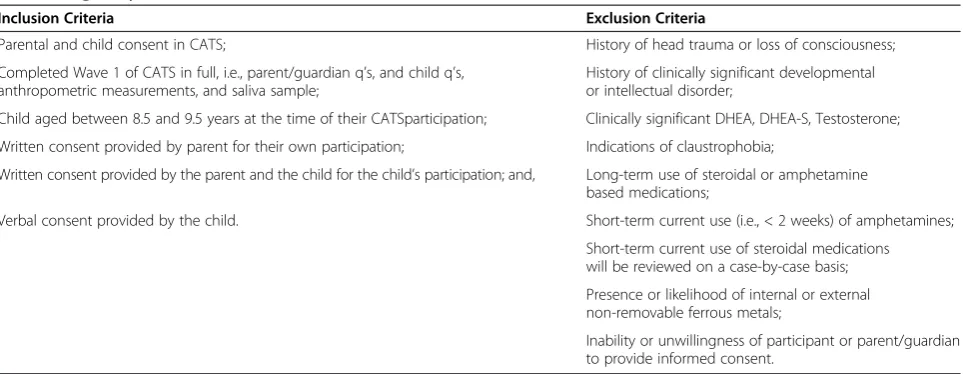
Participants comprise 128 children (M age = 9.51 years, SD = 0.36) and a parent/guardian (84% were mothers), with 66 children (35 female) participating from the ED group, and 62 (33 female) from the LD group. A total of 377 families were invited to take part, however 241 declined to participate and a further 8 were excluded based upon eligibility criteria (see Table 1).
Data collection
Participating families were visited at home, and then
asked to attend a session at The Royal Children’s
Hospital (RCH) in Melbourne, Australia.
Home visit
The home visit initially comprised a review of study par-ticipation requirements, eligibility, PICF documents, and MRI familiarization video, as well as questions from the family. Families were informed that participation in iCATS had no bearing on participation in the larger study, and that they were free to complete some compo-nents and not others. Families were advised that all their information is confidential, except where limited by law, and that information collected will not be fed back to them, except where clinically significant abnormalities were indicated. Signed consent from a parent/guardian and verbal consent from children was required.
Measures collected during the home visit included demographic and MRI safety information, anthropomet-ric measures, parent questionnaires, and the collection of a hair sample from the child. Further, the procedure for the collection of the saliva samples on the day of, and day prior to, the RCH visit were explained and demonstrated.
RCH Visit
Visit requirements and consent was reviewed, and chil-dren asked to complete questionnaires. Research staff reviewed children’s responses to questionnaires and any indications of risk or clinically significant pathology were followed up with investigators (at the time or later, dependent on level of risk), and parents and children as appropriate. Children and parents were then run through an MRI scanner familiarisation session, to de-crease anxiety, inde-crease participation rates and compliance/ stillness during the scans. All research staff administering the familiarisation sessions were required to undergo training at RCH through the Developmental Imaging Group of MCRI.
undertaking the MRI session, and children were asked to choose a cartoon or movie they would like to watch during the scans (excluding the fMRI sequences). Parents were asked to remain in the MRI room while scanning was carried out. Subsequently, children were positioned comfortably in a supine orientation with their head located in a head-RF coil that was electrically isolated. The participant viewed a screen, via an angled adjustable mir-ror, on which all visual stimuli or video were presented using a back-projection system attached to a computer. Children wore MR-compatible headphones to reduce MRI noise, to allow them to hear instructions and speak with the MRI technician, and to hear the audio of any car-toons or movies they watched. Children were provided with an“Emergency Stop” button, in order to indicate to research staff if at any stage during the scan they felt dis-tress and wanted to cease the procedure. Children com-pleted a T1-weighted MPRAGE structural sequence, followed by two fMRI sequences (rest [eyes closed], and an affective faces task), and finally a diffusion weighted imaging sequence.
In cases where technical error or movement required a particular sequence be repeated, a case-by-case assess-ment was made by research staff in discussion with the parent, child and MRI technician. Scanning took an average of 45 minutes.
After the scan families were given a break and then children completed the intelligence quotient (IQ) test. Finally, parents and children took part in a debriefing interview.
Measures
Demographics and health information
Detailed demographic information was collected as part of the larger study [14], including family composition, parental education and age, annual household income,
language spoken at home, ethnicity and adoption, and this data will be available for iCATS analyses. However, critical information was checked with parent and child, including names, dates of birth, and contact details. Questions were also asked covering health information related to eligibility criteria and MRI safety exclusions, as well as illnesses and stressful events experienced in the prior three months.
Magnetic resonance imaging
Neuroimaging data were acquired on the 3T Siemens TIM Trio scanner (Siemens, Erlangen, Germany) at the MCRI, RCH, Melbourne. Participants lay supine with their head supported in a 32-channel head coil.
Structural scanT1-weighted images were acquired dur-ing a 3.5 minute sequence (repetition time = 1900 msec; echo time = 2.24 msec; flip angle = 9°, field of view =
23 cm2), which produced 176 contiguous 0.9 mm thick
slices (voxel dimensions = 0.9 mm3).
DWI Two diffusion weighted sequences were included
in the protocol. The first sequence was optimised for generation for diffusivity maps (60 directions; b = 1000 s/ mm2, repetition time = 8800 msec; echo time = 99 msec; slices = 64; voxels = 2 x 2 x 2). The second diffusion se-quence was optimised for tractography (HARDI: 67 direc-tions; b = 3000 s/mm2;repetition time = 8100 msec; echo time = 113 msec; slices = 54, voxels = 2.3 x 2.3 x 2.3).
Resting fMRI A single 6-minute continuous functional gradient-recalled acquisition sequence was conducted at rest to acquire 154 whole-brain T2*-weighted echo-planar images (repetition time = 2400 ms, echo time = 35 ms, pulse angle = 90°) within a field of view of 126 mm, with a voxel size of 3.3 × 3.3 × 3.3 mm.
Thirty-Table 1 Eligibility criteria for iCATS
Inclusion Criteria Exclusion Criteria
Parental and child consent in CATS; History of head trauma or loss of consciousness;
Completed Wave 1 of CATS in full, i.e., parent/guardian q’s, and child q’s, anthropometric measurements, and saliva sample;
History of clinically significant developmental or intellectual disorder;
Child aged between 8.5 and 9.5 years at the time of their CATSparticipation; Clinically significant DHEA, DHEA-S, Testosterone;
Written consent provided by parent for their own participation; Indications of claustrophobia;
Written consent provided by the parent and the child for the child’s participation; and, Long-term use of steroidal or amphetamine based medications;
Verbal consent provided by the child. Short-term current use (i.e., < 2 weeks) of amphetamines;
Short-term current use of steroidal medications will be reviewed on a case-by-case basis;
Presence or likelihood of internal or external non-removable ferrous metals;
eight interleaved slices were acquired. Complex field maps were obtained in order to correct for distortion caused by magnetic field inhomogeneities.
Passive face viewing fMRI task Participants were ad-ministered a modified version of a common face emotion-viewing task used previously with children [30]. As in these prior studies, children were presented with a series of faces varying in affective content and asked to complete a simple button press each time a face ap-peared (to ensure maintenance of attention). A less con-strained response than other typical affective face paradigms was chosen given the young age of our child participants. Calm, happy, angry, and fearful facial ex-pressions from the Nimstim Set of Facial Exex-pressions (NimStim; http://www.macbrain.org/resources.htm) were presented in two 3 minute 40 second runs using a block design. Each run contained 1 block of each face type, with each containing 8 faces (randomly presented, 4 male and 4 female) presented for 3 seconds each, separated by a 1 second fixation. Blocks were separated by 15 second fix-ation rests. Given the high percentage of Caucasian partic-ipants, and the predominant use of Caucasian faces in Australian face-processing research, only Caucasian faces were used in the paradigm. Block order was counterba-lanced across participants. During each run, 70 whole-brain T2*-weighted echo-planar images (repetition time = 3000 ms, echo time = 40 ms, pulse angle = 85°) within a field of view of 120 mm, with a voxel size of 3 × 3 × 3 mm. Forty interleaved slices were acquired.
Saliva samples
Children, with the help of a parent/guardian, were asked to collect a saliva sample on the day of and day prior to their RCH visit immediately after waking, and prior to the consumption of food or tooth brushing. This was collected via the passive drool of whole saliva using a straw into test tubes (all equipment provided). Families were given a stopwatch to allow them to record how long it took the child to provide enough saliva to reach the marked 2.5 ml line on the tube. Samples were then frozen in family’s freezers in provided sealed containers, and subsequently transported in provided coolers packed
in Techni-IceTM to RCH on the day of the MRI visit.
Families were asked to minimize the time the samples spent out of the freezer, and no samples were found to have risen above 0°C upon arrival at RCH. Samples were then assayed an average of 7.72 weeks (SD = 4.84) after collection, with one freeze/thaw cycle. At time of assay, samples were defrosted and centrifuged, with the super-natant assayed for levels of testosterone, DHEA and DHEA-S, as hormonal markers of adrenarcheal develop-ment. Remaining supernatant was stored in 1 ml ali-quots in a -80C freezer for future assays. An aliquot was
subsequently assayed for immune system biomarkers, in-cluding C-reactive protein (CRP) and secretory immuno-globulin A (SIgA). Salivary assays of each of these biomarkers are now well-accepted substitutes for meas-uring serum levels [31,32], although there are methodo-logical idiosyncrasies for each. For example, DHEA-S must pass between cells to be excreted in saliva and thus salivary flow rate is an important determinant of the index. Hormonal assays were conducted at MCRI, using Salimetrics ELISA kits. Kits from the same lot numbers were used, as were in-house controls. The inter-assay coefficients of variation (CVs) were: DHEA = 5.45%, DHEA-S = 7.53%, testosterone = 13.54%. The intra-assay CVs were: DHEA = 8.56%, DHEA-S = 9.38%, testoster-one = 7.32%.
Hair sample
Hair samples were collected for the assay of long term cortisol levels. Cortisol levels are most commonly assessed via saliva, urine and serum collections. How-ever, variable findings in the cortisol/stress literature may be due to methodological differences in the timing, number and type of cortisol measures taken, likely due to circadian cycling, and high intra-individual variability and reactivity. Hair, a relatively new measure of cortisol, which although unable to demonstrate HPA reactivity temporally linked to a short term stressor, is able to pro-vide a reliable indicator of long term HPA function [in the order of months, 33]. Hair grows at approxi-mately 1 cm per month, thus 3 cm lengths of hair will provide an index of cortisol over the preceding three months. Samples were collected from an area approxi-mately 1 cm2on the posterior vertex of the scalp, as this has proven the most reliable area for stable cortisol levels. Hair samples were not collected where <3 cm of hair length was available, to minimize cosmetic impact, therefore significantly fewer boys provided these sam-ples. Hair cortisol assays were conducted by Stratech Scientific, where samples were cut down to 3 cm lengths, and processed and assayed as described previ-ously [34], using Salimetrics ELISA cortisol kits. The inter-assay coefficient of variation (CV) was 6.7%, and intra-assay CV 4.9%.
Anthropometry
Height Was measured to the nearest 0.1 cm using a port-able rigid Invicta stadiometer. Height was transformed to z-scores based upon age and gender related reference charts [35].
Weight Was measured to the nearest 0.1 kg using cali-brated Tanita THD 382 digital scales. Children were asked to remove shoes, coats and heavy clothing items. Body
Mass Index (kg/m2) was calculated and transformed,
along with student weight, to z-scores based upon age and gender related reference charts [35].
Waist circumference Was measured with a non-stretch anthropometric tape according to the International Society for the Advancement of Kinanthropometry (ISAK) proto-cols. Waist circumference is an acceptable, non-invasive and reliable indicator of intra-abdominal fat and was mea-sured to the nearest 0.1 cm [36].
Parent questionnaires
Questionnaires completed by parents/guardians comprised reports on child, and self-report. The broad domains ques-tionnaires fall into are child pubertal development, internalising-externalising behaviour, and traumatic events, as well as, parental report on the family environment and parenting style.
The Pubertal Development Scale Parent Report (PDS-PR) is a non-invasive questionnaire measure of pubertal development, and is based on the scale of Petersen and colleagues [37]. The version used is completed by par-ents, and for female children comprises nine items (in-cluding date of onset for menarche, if applicable), and for male children comprises 11 items. The PDS-PR has been demonstrated to be both a valid and reliable meas-ure of pubertal development in children, showing high levels of consistency with other more direct measures of development [26,38].
The Sexual Maturity Status Parent Report (SMS-PR) is a series of stylised line drawings of girls/boys bodies at differing stages of pubertal development [39]. Parents with a female child are asked to look at a page with five stages of breast development, and five stages of hip and pubic hair development, and asked to circle a number above the two images that most accurately represent their daughter’s development. Parents with a male child complete the same task, but with five stages of male genital and pubic hair development in the one set of five images. These images directly correspond to the Tanner stages of pubertal development, and have shown good reliability with physician ratings [11].
The Child Behaviour Checklist Parent Report (CBCL-PR) is a parent/guardian questionnaire in which a child's problem behaviours and competencies are rated, with a focus on internalising and externalising behaviours [40]. The age range for children is 6–18 years and it provides empirically based syndromes scales scored from factor analyses including Anxious/Depressed, Withdrawn/De-pressed, Somatic Complaints, Social Problems, Thought Problems, Attention Problems, Rule-Breaking Behaviour, and Aggressive Behaviour. The CBCL also provides DSM-IV scales, including Affective Problems, Anxiety Problems, Somatic Problems, Attention Deficit/Hyper-activity Problems, Oppositional Defiant Problems, and Conduct Problems. The CBCL has a comprehensive normative sample across ethnicities and SES [40].
The Lifetime Incidence of Traumatic Events Parent Report (LITE-PR) is a checklist covering aspects of a
child’s history of potentially traumatic events. The
checklist, devised by Greenwald and Rubin [41], allows parents to rate which types of traumas or losses their child has experienced, at what age, how many times, how upset the child was at that time, and how much it bothers them currently. Items can be classified into cat-egories: accidents, witnessing an injury to a loved one, bereavement, natural disasters, abuse (both physical, sex-ual and emotional), witnessing domestic violence and being a victim of crime. The 16 item LITE was adapted here, by removing the items on sexual assault, and add-ing two new items coveradd-ing mother-child separations and domestic relocation. The LITE was designed as a screener, and thus no agreed scoring system has been developed. For the purposes of the present investigation each item will be tallied to give a score for the total number of types of trauma, and another score for the overall number of traumas experienced. The level of upset/bother caused by each type of trauma indicated will also be scored (e.g., 0 = none, 1 = some, 2 = lots) and tal-lied to give a score for the level of emotional upset experi-enced when the trauma occurred, and how much it bothers them now.
The Alabama Parenting Questionnaire (APQ)
The Multidimensional Neglectful Behaviour Scale Parent Report (MNBS-PR) was developed to estimate the prevalence of neglect and specific sub-types of neg-lect in community samples, with differing versions for
different age probands [45,46]. The MNBS for 5–9 year
olds was used to measure the extent to which the fol-lowing needs of children are or have been neglected: physical needs such as food, clothing, shelter, medical care; emotional needs such as affection, companionship, support; supervision needs such as limit setting, attend-ing to misbehaviour, knowattend-ing child's whereabouts and friends; and, cognitive needs such as being played with or read to, assisting with school homework versions measure the following four aspects of neglect. Parents were asked to consider the past six months and report on each item. Adequate levels of reliability and validity have been reported [46].
Child questionnaires
The Children’s Depression Inventory 2 (CDI-2) Is a brief self-report test that helps assess cognitive, affective and behavioural signs of depression in children and ado-lescents 7 to 17 years old. The CDI-2 has two scales (Emotional Problems, Functional Problems) and four subscales (Negative Mood/Physical Symptoms, Negative Self-Esteem, Interpersonal Problems, Ineffectiveness). The CDI-2 has normative data in the relevant age range, as well solid evidence for reliability and validity [47].
The Spence Children’s Anxiety Scale (SCAS) Is a brief self-report test of anxiety symptoms broadly in line with the dimensions of anxiety disorder proposed by the DSM-IV. The scale assesses six domains of anxiety in-cluding generalized anxiety, panic/agoraphobia, social phobia, separation anxiety, obsessive-compulsive dis-order and physical injury fears. The SCAS has normative data in the relevant age range, as well solid evidence for reliability and validity [48,49].
Positive Affect and Negative Affect Schedule Child Form (PANAS-C) is a self-report questionnaire used to measure the respondent’s emotions. The state and trait forms of the questionnaire was used, indexing emotions for“right now”and during“the past few weeks”, respect-ively. It lists single commonly used adjectives (e.g., Inter-ested, Sad, Frightened, Alert), and items are grouped into subscales: positive affect and negative affect. The re-spondent is asked to read words that describe feelings and emotions and enter a number that corresponds to the value on a scale. The 5-item scale ranges from “not at all”, with a value of 1, to“a lot”with a value of 5. The PANAS-C has been used successfully on large studies of
children and exhibits high reliability and good conver-gent and discriminant validity [50].
Edinburgh Handedness Inventory (EHI) Can be ad-ministered as an interview, observational assessment or self-report questionnaire to establish the dominant hand [51]. Items consist of a series of activities, and partici-pants are asked to indicate their hand preference for each. The EHI is completed in the current study as an observational interview, where children are asked to mimic the activity described. This decreases self-report perceived dominant hand bias. The handedness prefer-ence score is used in the analysis and interpretation of MRI data and the examination of laterality effects.
Intelligence quotient test
The Wechsler Abbreviated Scale of Intelligence (WASI) is a standardized brief measure of general intelligence. Children completed the two-subtest form, comprising Vocabulary and Matrix Reasoning, which provides an es-timate of Full Scale IQ (FSIQ) and only takes 15 minutes to complete. Norms are based on a national U.S.A. co-hort of 2300 participants between the ages of 6 and 90 years.
Sample size
Using G*Power 3.1.5 [52], power analyses reveal that 120 participants will be sufficient to achieve power equal to at least 80% for standardized moderating effects of at least 0.26 between continuous variables (equivalent to an improvement in R-squared for the moderating term of 0.07) whenα= .05. The same sample size is sufficient to achieve power equal to at least 80% for moderate or lar-ger mediating effects (i.e., a standardized effect of about 0.39) where the independent variable to mediator, and mediator to dependent variable relations are of medium sizes (i.e., standardized regression paths of 0.26−0.39) [53]. Results reported in analogous published studies of brain structure and functioning in pubertal development have all reported much larger effect sizes with smaller sample sizes [e.g., 23, 24], thereby indicating that the current study has appropriate statistical power given current standing of knowledge in this area.
Data analysis
function, respectively. For aims 3–4, structural and func-tional measures will be extracted from ROIs defined ei-ther anatomically or based on the findings from aims 1– 2. The MRtrix package (JRD Tournier, Brain Research Institute, Melbourne, Australia, http://www.brain.org.au/ software/) will be used to perform white matter tracto-graphy with diffusion weighted MRI, resolving crossing fibres using Constrained Spherical Deconvolution [54].
Hypotheses 3 – 4 will be investigated using linear
re-gression models and bias-estimated bootstrapping tech-niques to test for moderated mediation.
Discussion
There are good reasons to suspect that pubertal hormo-nal changes affecting cognitive and affective systems in the brain, and the resultant psychological changes, most powerfully explain the emergence of symptoms of men-tal disorder. However the extant human literature on the relationship between pubertal processes and brain devel-opment is preliminary at best, and often confounds as-pects of pubertal development such as stage, timing and chronological age. Furthermore, although adrenarche and gonadarche are clearly distinct phases of pubertal development, with differing underlying biological mech-anisms, their differential impacts on brain development have not yet been examined in a comprehensive study. Compared to other phases of development, puberty and its disorders remain unexplored and poorly understood. This study, by examining the neurobiological and behav-ioural consequences of relatively early and late exposure to adrenarche, has the potential to profoundly change our understanding of pubertal risk processes. Work on preventive interventions suggests the feasibility of inter-vening in the social contexts of younger adolescents, but the further development of such interventions is now limited by our understanding of how puberty interacts with the social context and lifestyles of young people to generate health problems.
Abbreviations
APQ:The alabama parenting questionnaire; BMI: Body mass index; CBCL: Child behaviour checklist; CDI-2: Children’s depression inventory version 2; DHEA: Dehydroepiandrosterone; DHEA-S: Dehydroepiandrosterone sulphate; EHI: Edinburgh handedness inventory; HPA: Hypothalamic-pituitary-adrenal axis; HPG: Hypothalamic-pituitary-gonadal axis; iCATS: Imaging brain development in the childhood to adolescence transitions study; ISAK: International society for the advancement of kinanthropometry; LITE: Lifetime incidence of traumatic events; MRI: Magnetic resonance imaging; MNBS-PR: The multidimensional neglectful behaviour scale–parent report; PDS: Pubertal development scale; PANAS-C: Positive affect and negative affect schedule—child form; RA: Research assistant; SCAS: Spence children’s anxiety scale; TEM: Technical error of measurement.
Competing interests
The authors declare that they have no competing interests.
Authors’contributions
GP, NA, SW, CO and JS contributed to the overall design and conception of the study and assisted with the writing of the grant application. JS, SW and NA drafted and revised this manuscript. JS, SW, MB, LM, GP, MLS and NA contributed to study implementation and coordination. PD contributed to the statistical design of the study. All authors read and approved the final manuscript.
Acknowledgements
We would like to thank all of the families who have participated in this study. This study has been funded by a Discovery Project grant from the Australian Research Council (ARC; DP120101402). Dr. Whittle is supported by an NHMRC Career Development Fellowship (ID: 1007716). We would like to thank investigators and staff working on the Childhood to Adolescence Transition Study at the Murdoch Childrens Research Institute (MCRI) for making this investigation possible. MCRI research is supported by the Victorian Government’s Operational Infrastructure Program. We would also like to thank the research staff who contributed to the acquisition and processing of research data (Dr Megan Dennison, Dr Rebecca Davenport-Thomas and Ms Rachel Ellis).
Author details
1Melbourne School of Psychological Sciences, The University of Melbourne, VIC 3010, Australia.2Murdoch Childrens Research Institute, Melbourne, Australia.3Melbourne Neuropsychiatry Centre, Department of Psychiatry, The University of Melbourne, 1-100 Grattan Street, Parkville, VIC 3010, Australia. 4Centre for Adolescent Health, The Royal Children’s Hospital, Melbourne, Australia.5Deakin University, Melbourne, Australia.6Department of Paediatrics, The University of Melbourne, Melbourne, Australia.
Received: 21 February 2014 Accepted: 9 April 2014 Published: 30 April 2014
References
1. Kessler RC, Berglund P, Demler O, Jin R, Merikangas KR, Walters EE:Lifetime prevalence and age-of-onset distributions of DSM-IV disorders in the National Comorbidity Survey Replication.Arch Gen Psychiatry2005,
62(6):593–602.
2. Allen NB, Sheeber L (Eds):Adolescent emotional development and the emergence of depressive disorders.London, UK: Cambridge University Press; 2009.
3. Patton GC, Viner R:Pubertal transitions in health.Lancet2007,
369(9567):1130–1139.
4. Angold A, Costello EJ:Puberty and depression.Child Adolesc Psychiatr Clin N Am2006,15(4):919–937. ix.
5. Mendle J, Harden KP, Brooks-Gunn J, Graber JA:Development’s tortoise and hare: pubertal timing, pubertal tempo, and depressive symptoms in boys and girls.Dev Psychol2010,46(5):1341–1353.
6. Graber JA, Lewinsohn PM, Seeley JR, Brooks-Gunn J:Is psychopathology associated with the timing of pubertal development?J Am Acad Child Adolesc Psychiatry1997,36(12):1768–1776.
7. Kaltiala-Heino R, Kosunen E, Rimpela M:Pubertal timing, sexual behaviour and self-reported depression in middle adolescence.J Adolesc2003,
26(5):531–545.
8. Graber JA:Pubertal and neuroendocrine development and risk for depression.InAdolescent emotional development and the emergence of depressive disorders.Edited by Allen NB, Sheeber L. London, UK: Cambridge University Press; 2009.
9. Patton GC, Olsson C, Bond L, Toumbourou JW, Carlin JB, Hemphill SA, Catalano RF:Predicting female depression across puberty: a two-nation longitudinal study.J Am Acad Child Adolesc Psychiatry2008,
47(12):1424–1432.
10. Hemphill SA, Kotevski A, Herrenkohl TI, Toumbourou JW, Carlin JB, Catalano RF, Patton GC:Pubertal stage and the prevalence of violence and social/relational aggression.Pediatrics2010,126(2):e298–e305.
11. Dorn LD, Biro FM:Puberty and its measurement: a decade in review. J Res Adolesc2011,21(1):180–195.
13. Behringer V, Hohmann G, Stevens JM, Weltring A, Deschner T:Adrenarche in bonobos (Pan paniscus): evidence from ontogenetic changes in urinary dehydroepiandrosterone-sulfate levels.J Endocrinol2012,
214(1):55–65.
14. Mundy LK, Simmons JG, Allen NB, Viner RM, Bayer JK, Olds T, Williams J, Olsson C, Romaniuk H, Mensah F, Sawyer SM, Degenhardt L, Alati R, Wake M, Jacka F, Patton GC:Study protocol: the Childhood to Adolescence Transition Study (CATS).BMC Pediatr2013,13(1):160.
15. Giedd JN, Blumenthal J, Jeffries NO, Castellanos FX, Liu H, Zijdenbos A, Paus T, Evans AC, Rapoport JL:Brain development during childhood and adolescence: a longitudinal MRI study.Nat Neurosci1999,2(10):861–863. 16. Blakemore SJ, Burnett S, Dahl RE:The role of puberty in the developing
adolescent brain.Hum Brain Mapp2010,31(6):926–933.
17. McEwen BS:Steroid hormone actions on the brain: when is the genome involved?Horm Behav1994,28(4):396–405.
18. Campbell B:Adrenarche in comparative perspective.Am J Hum Biol2011,
23(1):44–52.
19. Peper JS, Brouwer RM, Schnack HG, van Baal GC, van Leeuwen M, van den Berg SM, de Waal HA D-V, Boomsma DI, Kahn RS, Hulshoff Pol HE:
Sex steroids and brain structure in pubertal boys and girls. Psychoneuroendocrinology2009,34(3):332–342.
20. Neufang S, Specht K, Hausmann M, Gunturkun O, Herpertz-Dahlmann B, Fink GR, Konrad K:Sex differences and the impact of steroid hormones on the developing human brain.Cereb Cortex2009,19(2):464–473. 21. Nguyen TV, McCracken JT, Ducharme S, Cropp BF, Botteron KN, Evans AC,
Karama S:Interactive effects of dehydroepiandrosterone and testosterone on cortical thickness during early brain development. J Neurosci2013,33(26):10840–10848.
22. Perrin JS, Herve PY, Leonard G, Perron M, Pike GB, Pitiot A, Richer L, Veillette S, Pausova Z, Paus T:Growth of white matter in the adolescent brain: role of testosterone and androgen receptor.J Neurosci2008,28(38):9519–9524. 23. Forbes EE:Healthy adolescents’neural response to reward: associations
with puberty, positive affect, and depressive symptoms.J Am Acad Child Adolesc Psychiatry2010,49(2):162–172. e1-5.
24. Whittle S, Yucel M, Lorenzetti V, Byrne ML, Simmons JG, Wood SJ, Pantelis C, Allen NB:Pituitary volume mediates the relationship between pubertal timing and depressive symptoms during adolescence.
Psychoneuroendocrinology2012,37(7):881–891.
25. Kaess M, Simmons JG, Whittle S, Jovev M, Chanen AM, Yucel M, Pantelis C, Allen NB:Sex-specific prediction of hypothalamic-pituitary-adrenal axis activity by pituitary volume during adolescence: a longitudinal study from age 12–17 years.Psychoneuroendocrinology2013,38:2694–2704. 26. Shirtcliff EA, Dahl RE, Pollak SD:Pubertal development: correspondence
between hormonal and physical development.Child Dev2009,
80(2):327–337.
27. Bordini B, Rosenfield RL:Normal pubertal development: part I: the endocrine basis of puberty.Pediatr Rev2011,32(6):223–229.
28. Rege J, Rainey WE:The steroid metabolome of adrenarche.J Endocrinol2012,
214(2):133–143.
29. Hammer LD, Kraemer HC, Wilson DM, Ritter PL, Dornbusch SM:
Standardized percentile curves of body-mass index for children and adolescents.Am J Dis Child1991,145(3):259–263.
30. Gaffrey MS, Barch DM, Singer J, Shenoy R, Luby JL:Disrupted amygdala reactivity in depressed 4- to 6-year-old children.J Am Acad Child Adolesc Psychiatry2013,52(7):737–746.
31. Granger DA, Kivlighan KT, Fortunato C, Harmon AG, Hibel LC, Schwartz EB, Whembolua GL:Integration of salivary biomarkers into developmental and behaviorally-oriented research: problems and solutions for collecting specimens.Physiol Behav2007,92(4):583–590. 32. Byrne ML, O'Brien-Simpson NM, Reynolds EC, Walsh KA, Laughton K,
Waloszek JM, Woods MJ, Trinder J, Allen NB:Acute phase protein and cytokine levels in serum and saliva: a comparison of detectable levels and correlations in a depressed and healthy adolescent sample. Brain Behav Immun2013,34:164–175.
33. Stalder T, Kirschbaum C:Analysis of cortisol in hair - State of the art and future directions.Brain Behav Immun2012,26(7):1019–1029.
34. Davenport MD, Tiefenbacher S, Lutz CK, Novak MA, Meyer JS:Analysis of endogenous cortisol concentrations in the hair of rhesus macaques. Gen Comp Endocrinol2006,147(3):255–261.
35. Cole TJ, Bellizzi MC, Flegal KM, Dietz WH:Establishing a standard definition for child overweight and obesity worldwide: international survey. BMJ2000,320(7244):1240–1243.
36. Taylor RW, Jones IE, Williams SM, Goulding A:Evaluation of waist circumference, waist-to-hip ratio, and the conicity index as screening tools for high trunk fat mass, as measured by dual-energy X-ray absorptiometry, in children aged 3–19 y.Am J Clin Nutr2000,
72(2):490–495.
37. Petersen AC, Crockett L, Richards M, Boxer A:A self-report measure of pubertal status: reliability, validity, and initial norms.J Youth Adolesc1988,
17(2):117–133.
38. Bond L, Clements J, Bertalli N, Evans-Whipp T, McMorris BJ, Patton GC, Toumbourou JW, Catalano RF:A comparison of self-reported puberty using the pubertal development scale and the sexual maturation scale in a school-based epidemiologic survey.J Adolesc2006,29(5):709–720. 39. Morris NM, Udry JR:Validation of a self-administered instrument to assess
stage of adolescent development.J Youth Adolesc1980,9(3):271–280. 40. Achenbach TM:Child Behavior Checklist. InEncyclopedia of Psychology.
Edited by Kazdin AE. New York: Oxford University Press; 1999. 41. Greenwald R, Rubin A:Brief assessment of children’s post-traumatic
symptoms: development and preliminary validation of parent and child scales.Res Soc Work Pract1999,9:61–65.
42. Shelton KK, Frick PJ, Wootton J:Assessment of parenting practices in families of elementary school-age children.J Clin Child Psychol1996,
25(3):317–329.
43. Essau CA, Sasagawa S, Frick PJ:Psychometric properties of the Alabama parenting questionnaire.J of Child and Fam Studies2006,15(5):595–614. 44. Dadds MR, Maujean A, Fraser JA:Parenting and conduct problems in
children: Australian data and psychometric properties of the Alabama parenting questionnaire.Aust Psychol2003,38(3):238–241.
45. Kantor GK, Holt M, Straus MA:The parent-report multidimensional neglectful behaviour scale.Durham: NH: Family Research Laboratory; 2004.
46. Kantor GK, Holt MK, Mebert CJ, Straus MA, Drach KM, Ricci LR, MacAllum CA, Brown W:Development and preliminary psychometric properties of the multidimensional neglectful behavior scale-child report.Child Maltreat2004,
9(4):409–428.
47. Kovaks M:Children’s depression inventory.Toronto, Canada: Multi-Health Systems; 2004.
48. Spence SH:Structure of anxiety symptoms among children: a
confirmatory factor-analytic study.J Abnorm Psychol1997,106(2):280–297. 49. Spence SH:A measure of anxiety symptoms among children.Behav Res
Ther1998,36(5):545–566.
50. Laurent J, Catanzaro SJ, Joiner TE Jr:Development and preliminary validation of the physiological hyperarousal scale for children. Psychol Assess2004,16(4):373–380.
51. Oldfield RC:The assessment and analysis of handedness: the Edinburgh inventory.Neuropsychologia1971,9(1):97–113.
52. Faul F, Erdfelder E, Lang AG, Buchner A:G*Power 3: a flexible statistical power analysis program for the social, behavioral, and biomedical sciences.Behav Res Methods2007,39(2):175–191.
53. Fritz MS, Mackinnon DP:Required sample size to detect the mediated effect.Psychol Sci2007,18(3):233–239.
54. Tournier JD, Calamante F, Connelly A:Robust determination of the fibre orientation distribution in diffusion MRI: non-negativity constrained super-resolved spherical deconvolution.Neuroimage2007,
35(4):1459–1472.
doi:10.1186/1471-2431-14-115
Cite this article as:Simmonset al.:Study protocol: Imaging brain
development in the Childhood to Adolescence Transition Study (iCATS).