R E S E A R C H A R T I C L E
Open Access
Pediatric screening urinalysis: a
difference-in-differences analysis of how a 2007 change in
guidelines impacted use
Clara E Filice
1*, Jeremy C Green
2, Marjorie S Rosenthal
1,3and Joseph S Ross
1,4Abstract
Background:Practice guidelines can promote higher-quality care, yet they are inconsistently adopted. The purpose of this study is to evaluate the impact of a 2007 American Academy of Pediatrics recommendation to discontinue routine screening urinalysis in children.
Methods:Using data from the National Ambulatory Medical Care Survey, we used a difference-in-differences approach to estimate visit-level screening urinalysis proportions before (2005-2006, n = 1,247) and after (2008-2009, n = 1,772) the 2007 AAP recommendation. We compared visits by children 4-18 years old to visits by young adults aged 19-32. Analyses were adjusted for continuous patient age, patient race/ethnicity, physician specialty, and stratified by patient gender and visit setting.
Results:The 2007 recommendation was associated with no significant change in adjusted visit-level screening urinalysis proportions in child visits (20.4% to 22.5%) compared to an increase in young adult visits (20.1% to 27.0%)–a differential impact of -4.8 percentage points (95% Confidence Interval [CI] -9.0, -0.5). In private practices, visit proportions differentially decreased by 7.6 percentage points (95% CI -13.7, -1.5) in female children and by 0.5 percentage points (95% CI -10.6, 9.6) in male children. In community health centers, visit proportions differentially decreased by 17.4 percentage points (95% CI -27.9, -6.8) in female children and by 33.5 percentage points (95% CI -47.4, -19.7) in male children.
Conclusions:A 2007 recommendation to discontinue routine screening urinalysis in children was associated with no change in use in child visits relative to an increase in use in adult visits. Overall, nearly one-quarter of child visits still included screening urinalysis.
Keywords:Preventive services, Practice guidelines, Screening urinalysis
Background
Standardized practice guidelines developed by profes-sional societies and other health entities can help physi-cians make informed decisions about appropriate use of preventive services. Yet physicians who care for children, like many physicians, inconsistently utilize preventive care guidelines [1-3]. Attention to evaluating the quality of pediatric preventive care has been growing, and many previous studies [4-8] have examined whether recom-mended services are being delivered to children. Less
attention has been devoted to evaluating whether services that are no longer recommended are being discontinued.
Recommendations regarding routine urine screening for the detection of renal or urologic disease in children have evolved over several decades. In both 1977 and 1991, the American Academy of Pediatrics (AAP) recom-mended routine urine screening at four time points dur-ing childhood [9]. Revised health supervision guidelines in 1995 [10] and 2000 [11] limited screening to only two age groups, five-year-olds and sexually active adolescents. Accumulated evidence now suggests that although inex-pensive, screening urinalysis is a poor screening test for disease, it can lead to false positives and associated costly and invasive diagnostic evaluations, and there is limited * Correspondence:[email protected]
1Robert Wood Johnson Foundation Clinical Scholars Program, Yale School of
Medicine, 333 Cedar Street, SHM IE-61, PO Box 208088, New Haven, CT 06520, USA
Full list of author information is available at the end of the article
evidence to suggest detection of abnormalities in child-hood improves long-term outcomes [12-14]. In light of the lack of clear benefit associated with screening urin-alysis relative to its associated costs and risks, the AAP in 2007 removed routine screening urinalysis for asymp-tomatic children and adolescents from its health supervi-sion guidelines altogether [15]. In 2005, a survey of pediatricians showed that many still reported routinely screening children in non-recommended age groups [9]. Little is known about how this recent change in recom-mendations has impacted physician practice.
Using data from the National Ambulatory Medical Care Survey (NAMCS), a nationally representative survey assessing provision of ambulatory medical care services in the United States, we used a difference-in-differences approach to determine whether the 2007 AAP recom-mendation resulted in a differential impact on the pro-portion of child visits that included screening urinalysis compared to young adult visits. Because visit setting and patient gender may have an impact on screening urinaly-sis we stratified our analyurinaly-sis by visit setting (community health center or private practice) and by patient gender. Our findings will inform clinicians and guideline devel-opers about current screening urinalysis practices among children, whether and how the AAP recommendation impacted physician behavior, and whether recommenda-tions alone are sufficient in changing physician behavior.
Methods
Data source
We analyzed data from the National Ambulatory Medical Care Survey (NAMCS), a nationally representative data set of ambulatory visits to office-based physicians in the United States. Physicians, office staff, or survey adminis-trators from the U.S. Bureau of the Census enter data, in-cluding demographic and clinical parameters, for a systematic random sample of visits; each visit is weighted to allow for extrapolation to nationally representative es-timates. Conducted on an annual basis, the NAMCS of-fers a unique opportunity to estimate pediatric screening urinalysis prevalence before and after enactment of the 2007 AAP recommendation. Our study period of interest included two years before and two years after the AAP recommendation in 2007: from 2005-2006 and from 2008-2009. Data from 2007 were excluded to allow for an implementation period. The study was determined to be exempt from Committee Review by the Yale University Human Investigation Committee. The research has ad-hered to the STROBE guidelines for observational studies as outlined at http://www.strobe-statement.org.
Study design and sample
We used a difference-in-differences approach [16] to
quantify the impact of the AAP’s 2007 recommendation
on the proportion of pediatric visits that included screen-ing urinalysis. The study design involves consideration of study and comparison groups, before and after an inter-vention is applied to only the study group, in order to help identify differences in an outcome associated with the intervention separately from differences in covariates and secular trends (i.e. trends in testing over time that are unrelated to the timing of the AAP recommendation change and time-invariant differences between the two age groups).
Our study sample included visits to physicians who commonly see children, defined for the purpose of this analysis as pediatricians and family practice physicians. Visits to internal medicine physicians were excluded because it was anticipated that they would care for only adult populations. Because the NAMCS survey instru-ment does not distinguish between screening and diagnostic urinalysis, we defined screening urinalysis as urinalysis ordered in the context of a preventive care visit as designated by the physician; for each surveyed visit, providers are asked to select a categorical reason for the patient’s visit (new problem, chronic problem-routine, chronic problem-flare up, pre/post surgery, or preventive care). We studied children for whom catheterization would not likely be necessary to perform a screening urinalysis, defined for this analysis as those over age 4 years. Therefore, our analysis included visits by chil-dren aged 4-18 years.
For comparison, we designated a sample of visits to represent secular trends in screening behavior. Given our interest in the AAP recommendation, an ideal compari-son group would be visits by children aged 4-18 years to physicians who were not exposed to the AAP recommen-dation. Due to the national applicability of the AAP guid-ance, data for such a comparison group was not available for visits in the United States. Rather, we selected as a comparison group preventive care visits to pediatricians or family practice physicians by young adults aged 19-32 years during the study periods of interest. To our know-ledge universal screening urinalysis for adults was not recommended at any point in the study period, so its pat-tern of use was expected to reflect secular trends in phys-ician screening practices and was not anticipated to be affected by the AAP guidance.
Our primary outcome of interest was the proportion of visits including screening urinalysis, defined as urin-alysis ordered in the context of a physician-identified preventive care visit.
Statistical analysis
patient gender, physician specialty, and visit setting. Our main analysis compared overall differences for visit-level rates of screening urinalysis in children before and after the 2007 AAP recommendation to the differences in young adults. We fit a nonlinear difference-in-differences model [16], adjusting for covariates, age category, and time period using probit regression.
Analyses were adjusted for or stratified by patient- and physician-level characteristics we anticipated might im-pact screening urinalysis use. We adjusted for the patient-level variable of continuous age because we antic-ipated it could affect prevalence of testing, given previous age-specific recommendations; analyses were also ad-justed for patient race/ethnicity (collapsed into three cat-egories, white, black, or other race/ethnicity because of small sample sizes in other categories). We also adjusted for physician specialty (pediatrician or family practi-tioner,) because we anticipated pediatricians may be dif-ferentially receptive to guidance from a pediatric-specific professional organization. Sample size limitations pre-cluded a stratified analysis by physician specialty type. We anticipated practice setting may have an impact on screening urinalysis use due to factors such as laboratory access, patient insurance mix, and provider characteris-tics, so analyses were stratified by the system-level vari-able of visit setting (private practice or community health center). Because screening urinalysis may be differentially utilized between females (for purposes such as pregnancy
testing) and males, we also stratified analysis by patient gender. Data from our NAMCS sample were weighted according to the National Center for Health Statistics weighting procedure to produce national estimates and adjusted for the survey design [17]. Computation was in Stata version 12 [18].
Results
Baseline characteristics
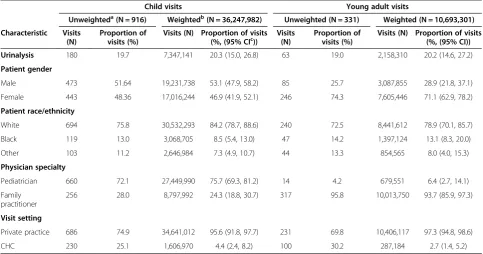
This analysis included preventive care visits from two time periods (2005-2006 and 2008-2009) involving two age groups (children 4-18 years and young adults 19-32 years). Overall, we analyzed 3,019 preventive care visits: 1,247 visits from 2005-2006 and 1,772 visits from 2008-2009. Before 2007, a majority of child and adult visits oc-curred in the private practice setting (95.6% and 97.3%, respectively). The majority of visits by children (75.7%) were to pediatricians while most visits by young adults (93.7%) were to family medicine practitioners; young adult visits were predominantly made by females (71.1%) (Table 1).
Screening urinalysis before and after the 2007 AAP policy statement
Overall, the adjusted proportion of visits including screening urinalysis prior to the 2007 AAP policy state-ment were similar in preventive care visits by children aged 4-18 years and visits by young adults aged 19-32
Table 1 Baseline characteristics of preventive care visits before 2007 (2005-2006)
Child visits Young adult visits
Unweighteda(N = 916) Weightedb(N = 36,247,982) Unweighted (N = 331) Weighted (N = 10,693,301)
Characteristic Visits (N)
Proportion of visits (%)
Visits (N) Proportion of visits
(%, (95% CIc)) Visits(N) Proportion ofvisits (%) Visits (N) Proportion of visits(%, (95% CI))
Urinalysis 180 19.7 7,347,141 20.3 (15.0, 26.8) 63 19.0 2,158,310 20.2 (14.6, 27.2)
Patient gender
Male 473 51.64 19,231,738 53.1 (47.9, 58.2) 85 25.7 3,087,855 28.9 (21.8, 37.1)
Female 443 48.36 17,016,244 46.9 (41.9, 52.1) 246 74.3 7,605,446 71.1 (62.9, 78.2)
Patient race/ethnicity
White 694 75.8 30,532,293 84.2 (78.7, 88.6) 240 72.5 8,441,612 78.9 (70.1, 85.7)
Black 119 13.0 3,068,705 8.5 (5.4, 13.0) 47 14.2 1,397,124 13.1 (8.3, 20.0)
Other 103 11.2 2,646,984 7.3 (4.9, 10.7) 44 13.3 854,565 8.0 (4.0, 15.3)
Physician specialty
Pediatrician 660 72.1 27,449,990 75.7 (69.3, 81.2) 14 4.2 679,551 6.4 (2.7, 14.1)
Family practitioner
256 28.0 8,797,992 24.3 (18.8, 30.7) 317 95.8 10,013,750 93.7 (85.9, 97.3)
Visit setting
Private practice 686 74.9 34,641,012 95.6 (91.8, 97.7) 231 69.8 10,406,117 97.3 (94.8, 98.6)
CHC 230 25.1 1,606,970 4.4 (2.4, 8.2) 100 30.2 287,184 2.7 (1.4, 5.2)
a
Unweighted estimates reflect the absolute number of visits in the study sample.
b
Weighted estimates are sample visits weighted using NAMCS patient visit frequencies to develop national estimates.
c
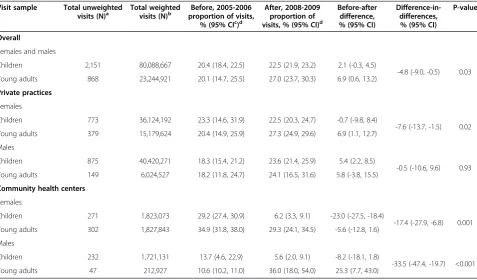
years. Adjusted screening urinalysis proportions before and after the 2007 recommendation remained flat in child visits, from 20.4% before to 22.5% after, but increased in young adult visits, from 20.1% to 27.0%, resulting in a dif-ferential impact on child visits of -4.8 percentage points (95% confidence interval [CI], -9.0 to -0.5, p = 0.03).
Compared to young adults, after stratifying analyses by visit setting and patient gender, adjusted screening urin-alysis proportions in female child visits to private prac-tices differentially decreased by 7.6 percentage points (95% CI -13.7 to -1.5, p = 0.02). In male child visits to pri-vate practices, proportions differentially decreased by 0.5 percentage points (95% CI -10.6 to 9.6, p = 0.93). In com-munity health center visits by female children, propor-tions differentially decreased by 17.4 percentage points (95% CI -27.9 to -6.8, p = 0.001); in community health center visits by male children, proportions differentially decreased by 33.5 percentage points (95% CI -47.4 to -19.7, p < 0.001) (Table 2). Of note, sample sizes were small for some cells, leading to imprecise estimates.
Discussion
In the two year periods before and after a 2007 recom-mendation to discontinue routine screening urinalysis in children, we observed no change in screening urinalysis use in child visits. In adult visits, screening urinalysis
rates rose, resulting in a differential decrease in child visits of nearly 5 percentage points. Our stratified ana-lyses by visit setting and patient gender also revealed dif-ferential impacts in child visits compared to young adult visits. Overall, screening urinalysis use persisted in nearly a quarter of pediatric preventive care visits after 2007.
The increase in urinalyses observed in adult visits could be explained by several factors. A concurrent change in adult guidelines could lead to an increase in the propor-tion of adult visits including screening urinalysis. However, at no time during the study period was universal screening urinalysis recommended by major adult preventive care guidelines developers such as the United States Preventive Services Task Force (USPSTF) [19,20] or the American Academy of Family Physicians (AAFP) [21,22], making this explanation less likely. Or, it could be attributed to an increase in adult visits by subgroups for whom urinalysis may be an appropriate screening test, such as pregnant women or patients with diabetes, kidney disease, or hyper-tension. Similarly, routine urine chlamydia tests could have been misclassified as urinalyses. However, we did not anticipate significant differences in the proportions of these subgroups visiting physicians in either age group in the short period before or after the AAP recommendation, so find this explanation to be less likely as well. Therefore, we interpret the absolute increase in the proportion of
Table 2 Adjusted proportion of child visits including urinalysis before and after 2007, compared to young adult visits
Visit sample Total unweighted
visits (N)a Total weightedvisits (N)b proportion of visits,Before, 2005-2006
% (95% CIc)d
After, 2008-2009 proportion of visits, % (95% CI)d
Before-after difference, % (95% CI)
Difference-in-differences,
% (95% CI)
P-value
Overall
Females and males
Children 2,151 80,088,667 20.4 (18.4, 22.5) 22.5 (21.9, 23.2) 2.1 (-0.3, 4.5)
-4.8 (-9.0, -0.5) 0.03 Young adults 868 23,244,921 20.1 (14.7, 25.5) 27.0 (23.7, 30.3) 6.9 (0.6, 13.2)
Private practices
Females
Children 773 36,124,192 23.3 (14.6, 31.9) 22.5 (20.3, 24.7) -0.7 (-9.8, 8.4)
-7.6 (-13.7, -1.5) 0.02 Young adults 379 15,179,624 20.4 (14.9, 25.9) 27.3 (24.9, 29.6) 6.9 (1.1, 12.7)
Males
Children 875 40,420,271 18.3 (15.4, 21.2) 23.6 (21.4, 25.9) 5.4 (2.2, 8.5)
-0.5 (-10.6, 9.6) 0.93 Young adults 149 6,024,527 18.2 (11.8, 24.7) 24.1 (16.5, 31.6) 5.8 (-3.8, 15.5)
Community health centers
Females
Children 271 1,823,073 29.2 (27.4, 30.9) 6.2 (3.3, 9.1) -23.0 (-27.5, -18.4)
-17.4 (-27.9, -6.8) 0.001 Young adults 302 1,827,843 34.9 (31.8, 38.0) 29.3 (24.1, 34.5) -5.6 (-12.8, 1.6)
Males
Children 232 1,721,131 13.7 (4.6, 22.9) 5.6 (2.0, 9.1) -8.2 (-18.1, 1.8)
-33.5 (-47.4, -19.7) <0.001 Young adults 47 212,927 10.6 (10.2, 11.0) 36.0 (18.0, 54.0) 25.3 (7.7, 43.0)
a
Unweighted visits reflect the absolute number of visits in the study sample.
b
Weighted visits are sample visits weighted using NAMCS patient visit frequencies to develop national estimates.
c
CI = Confidence Interval.
d
adult visits including screening urinalysis to a general
up-ward trend in screening tests – a trend that could be
accounted for in part by increased adoption of the medical record, which has been associated with increased provision of preventive health services generally [23,24].
The observed differential decrease in pediatric screening urinalysis in our study was consistent with the observed impact of another recently discontinued preventive care practice. In 2008, the USPSTF recommended discontinu-ation in older men of prostate cancer screening with the prostate-specific antigen test, which was shown to result in a small but significant impact on screening [25]. Un-fortunately, discontinued routine child preventive care screening tests are not common, so comparison in the pediatric population is difficult.
Our stratified analyses by visit setting and patient gen-der also revealed differential impacts. We observed
con-sistently larger differential decreases in screening
urinalysis proportions in the community health center setting than in the private practice setting for both gen-ders. This finding is consistent with previous studies demonstrating comparable or higher quality care delivery in community health center settings compared to other settings [26-28]. Community health centers have also been shown to provide cost-effective care [28], which could make it more likely that community health center practitioners would more rapidly discontinue a proced-ure such as urinalysis (which can be time-intensive and minimally revenue-generating) once it was no longer rec-ommended. Our gender-stratified results were mixed and thus more difficult to interpret; while urinalysis in female child visits differentially decreased in both settings, in male visits we observed a large differential decrease in the community health center setting compared to no change in the private practice setting.
Despite observed differential decreases, the overall pro-portion of pediatric visits including screening urinalysis remained high. The persistence of screening urinalysis use–in nearly a quarter of all child visits - could be ex-plained by a physician lack of awareness of the AAP guideline [1-3]. Additionally, physicians are subject to a wide array of clinical directives–a 2006 study [29] identi-fied over 340 AAP policy statements alone, of which 57 were deemed broadly relevant to pediatric practice. Alter-natively, physicians may have experienced previously cited barriers to guideline adoption, such as lack of awareness or familiarity, lack of self-efficacy in adopting a guideline, or inability to overcome the inertia of previous practice [30], many of which have been noted in studies of pedia-tricians and family practitioners [1-3,31]. Another possi-bility is that physicians were considering other, potentially conflicting, input when making decisions about the use of screening urinalysis. The appropriate use of screening urinalysis as a routine screening test has been debated for
decades and the discourse continues [32]. However, in this case, a relatively high degree of consensus regarding pediatric screening urinalysis had been reached with con-cordant guidelines from at least several major guideline developers, including the USPSTF [19,20], the AAFP [21,22], and the American Medical Association’s Guide-lines for Adolescent Preventive Services [33]. Physicians may also have conducted screening urinalyses for other reasons than to detect disease, for instance to meet re-quirements for school entry or sports participation that had not been changed to reflect new evidence about the utility of the screening test [34].
This study’s strengths include use of a strong, quasi-experimental, difference-in-differences approach [35] to evaluate the impact of the 2007 AAP recommendation. Our research design accounts for secular time trends in test use and differential time trends in unobserved co-variates between the age groups. Furthermore, it did not depend on physician report of screening practices to measure screening urinalysis rates. However, it is im-portant to consider the limitations of this analysis as well. Because the NAMCS visit form does not distin-guish between screening and diagnostic urinalyses, our sample could include visits by patients who presented for a preventive care visit who simultaneously had acute
complaints that would warrant a diagnostic urinalysis–
leading to misclassification. There are a number of other conditions and circumstances in which urinalyses would be warranted in the context of preventive care visits, noted above, that could have biased our results. Additionally, this sample includes only physicians; pat-terns of adherence may be different for other types of practitioners.
Conclusions
In conclusion, our study offers evidence that a 2007 standardized practice guideline differentially impacted routine screening urinalysis use in child compared to adult ambulatory care visits. Differential impacts were noted across visit settings and patient genders. However, screening urinalysis use persisted in nearly a quarter of pediatric preventive care visits. More research is needed to understand why and how females and males are im-pacted differentially by screening guidelines, what differ-entiates practice settings, and why physicians do or do not discontinue screening tests once they are no longer recommended.
Abbreviations
AAP:American Academy of Pediatrics; AAFP: American Academy of Family Physicians; CI: Confidence interval; NAMCS: National Ambulatory Medical Care survey; USPSTF: United States Preventive Services Task Force.
Competing interests
Dr. Filice is now employed by the United States Department of Health and Human Services. However, this article was conceived and drafted while Dr. Filice was a fellow in the Robert Wood Johnson Foundation Clinical Scholars Program at the Yale School of Medicine, and the findings and views in this article do not necessarily represent the views of the U.S. Department of Health and Human Services or the United States. Dr. Ross receives research grant funding from Medtronic Inc. to develop methods of clinical trial data sharing, from the Centers of Medicare and Medicaid Services (CMS) to develop and maintain performance measures that are used for public reporting, from the Pew Charitable Trusts to examine regulatory issues at the U.S. Food and Drug Administration and is a member of a scientific advisory board for FAIR Health, Inc.
Authors’contributions
CF conceptualized and designed the study, carried out the initial analysis, drafted the initial manuscript and subsequent revisions, and finalized the manuscript as submitted. JG designed and implemented the statistical analysis, reviewed and revised the manuscript, and finalized the manuscript as submitted. MR conceptualized the study, interpreted the data analysis, critically reviewed and revised the manuscript for important intellectual content, and approved the finalized manuscript as submitted. JR conceptualized and designed the study, interpreted the data analysis, critically reviewed and revised the manuscript for important intellectual content, provided supervision, and finalized the manuscript as submitted. All authors read and approved the final manuscript.
Acknowledgements
Douglas McKee, PhD, Yale University Department of Economics and School of Public Health, for his contributions to analysis and interpretation of the data.
This project was not directly supported by any external grants or funds. Dr. Filice was funded by the Robert Wood Johnson Foundation Clinical Scholars Program at the Yale School of Medicine. Dr. Ross is supported by the National Institute on Aging (K08 AG032886) and by the American Federation for Aging Research through the Paul B. Beeson Career Development Award Program. The named funders had no role in the design; in the collection, analysis, and interpretation of data; in the writing of the manuscript; or in the decision to submit the manuscript.
Author details
1Robert Wood Johnson Foundation Clinical Scholars Program, Yale School of
Medicine, 333 Cedar Street, SHM IE-61, PO Box 208088, New Haven, CT 06520, USA.2Department of Health Management and Policy, College for Public Health and Social Justice, Saint Louis University, Saint Louis, MO, USA. 3Department of Pediatrics, Yale School of Medicine, New Haven, CT, USA. 4
Department of Internal Medicine, Yale School of Medicine, New Haven, CT, USA.
Received: 23 April 2014 Accepted: 19 September 2014 Published: 10 October 2014
References
1. Christakis DA, Rivara FP:Pediatricians’awareness of and attitudes about four clinical practice guidelines.Pediatrics1998,101(5):825–830. 2. Flores G, Lee M, Bauchner H, Kastner B:Pediatricians’attitudes, beliefs, and
practices regarding clinical practice guidelines: a national survey. Pediatrics2000,105(3):496–501.
3. Wolfe RM, Sharp LK, Wang RM:Family physicians’opinions and attitudes to three clinical practice guidelines.J Am Board Fam Pract2004,
17(2):150–157.
4. Mangione-Smith R, DeCristofaro AH, Setodji CM, Keesey J, Klein DJ, Adams JL, Schuster MA, McGlynn EA:The quality of ambulatory care delivered to children in the United States.N Engl J Med2007,357(15):1515–1523. 5. Chung PJ, Lee TC, Morrison JL, Schuster MA:Preventive care for children
in the United States: quality and barriers.Annu Rev Public Health2006,
27:491–515.
6. Norlin C, Crawford MA, Bell CT, Sheng X, Stein MT:Delivery of well-child care: a look inside the door.Acad Pediatr2011,11(1):18–26.
7. Bethell C, Reuland CHP, Halfon N, Schor EL:Measuring the quality of preventive and developmental services for young children: national
estimates and patterns of clinicians’performance.Pediatrics2004,
113(6 Suppl):1973–1983.
8. Irwin CE Jr, Adams SH, Park MJ, Newacheck PW:Preventive care for adolescents: few get visits and fewer get services.Pediatrics2009,
123(4):e565–e572.
9. Sox CM, Christakis DA:Pediatricians’screening urinalysis practices. J Pediatr2005,147(3):362–365.
10. American Academy of Pediatrics, Committee on Practice and Ambulatory Medicine:Recommendations for preventive pediatric health care. Pediatrics1995,96:373–374.
11. American Academy of Pediatrics, Committee on Practice and Ambulatory Medicine:Recommendations for preventive pediatric health care. Pediatrics2000,105:645–646.
12. Sekhar DL, Wang L, Hollenbeak CS, Widome MD, Paul IM:A cost-effectiveness analysis of screening urine dipsticks in well-child care. Pediatrics2010,125(4):660–663.
13. Kaplan RE, Springate JE, Feld LG:Screening dipstick urinalysis: a time to change.Pediatrics1997,100(6):919–921.
14. Stephens MB, Wilder L, Hsu JT:Clinical inquiries. Is screening urinalysis in children worthwhile?J Fam Pract2003,52(11):894–895.
15. Committee on Practice and Ambulatory Medicine, Bright Futures Steering Committee:Recommendations for preventive pediatric health care. Pediatrics2007,120(6):1376.
16. Athey S, Imbens GW:Identification and inference in nonlinear difference-in-differences models.Econometrica2006,74(2):431–497.
17. Korn EL, Graubard BI:Analysis of Health Surveys.1st edition. New York, NY: Wiley-Interscience; 1999.
18. StataCorp:Stata Statistical Software: Release 12.College Station, TX: StataCorp LP; 2011.
19. U.S. Preventive Services Task Force:United States Preventive Services Guideline.2nd edition. U.S. Department of Health and Human Services; 1995. Available at: http://odphp.osophs.dhhs.gov/pubs/guidecps/PDF/ Frontmtr.PDF.
20. U.S. Preventive Services Task Force:Guide to Clinical Preventive Services.3rd edition. Department of Health and Human Services. Available at: www. uspreventiveservicestaskforce.org.
21. American Academy of Family Physicians:Summary of Policy Recommendations for Periodic Health Examinations.Kansas City, MO: American Academy of Family Physicians; 2002.
22. American Academy of Family Physicians:Summary of Policy Recommendations for Periodic Health Examinations, revision 6.0; 2005. Available at: http://www.aafp.org.
23. Chaudhry B, Wang J, Wu S, Maglione M, Mojica W, Roth E, Morton SC, Shekelle PG:Systematic review: impact of health information technology on quality, efficiency, and costs of medical care.Ann Intern Med2006,
144(10):742–752.
24. Fiks AG, Hunter KF, Localio AR, Allessandrini EA:Impact of clinical alerts within an electronic health record on routine childhood immunization in an urban pediatric population.Pediatrics2007,
120(4):707–714.
25. Ross JS, Wang R, Long JB, Gross CP, Ma X:Impact of the 2008 US preventive services task force recommendation to discontinue prostate cancer screening among male medicare beneficiaries.Arch Intern Med 2012,172(20):1601–1603.
26. Starfield B, Powe NR, Weiner JR, Stuart M, Steinwachs D, Scholle SH, Gerstenberger A:Costs vs quality in different types of primary care settings.JAMA1994,272(24):1903–1908.
27. Hicks LS, O’Malley AJ, Lieu TA, Keegan T, Cook NL, McNeil BJ, Landon BE, Guadagnoli E:The quality of chronic disease care in U.S. community health centers.Health Aff (Millwood)2006,25(6):1712–1723.
28. Proser M:Deserving the spotlight: health centers provide high-quality and cost-effective care.J Ambul Care Manage2005,28(4):321–330. 29. Belamarich PF, Gandica R, Stein REK, Racine AD:Drowning in a sea of
advice: pediatricians and American academy of pediatrics policy statements.Pediatrics2006,118(4):e964–e978.
30. Cabana MD, Rand CS, Powe NR, Wu AW, Wilson MH, Abboud PA, Rubin HR:
Why don’t physicians follow clinical practice guidelines? A framework for improvement.JAMA1999,282(15):1458–1465.
31. James PA, Cowan TM, Graham RP, Majeroni BA:Family physicians’ attitudes about and use of clinical practice guidelines.J Fam Pract1997,
32. Brown RS:Has the time come to include urine dipstick testing in screening asymptomatic young adults?JAMA2011,306(7):764–765. 33. American Medical Association:Guidelines for Adolescent Preventive Services
(GAPS): Recommendations Monograph.Chicago, IL: 1997. Available at: http://www.ama-assn.org/ama.
34. Primack W:AAP does not recommend routine urinalysis for
asymptomatic youths.AAP News2010,31(12):16 [Focus on Subspecialties]. 35. Van Cleave J, Dougherty D, Perrin JM:Strategies for addressing barriers to
publishing pediatric quality improvement research.Pediatrics2011,
128(3):e678–e686.
doi:10.1186/1471-2431-14-260
Cite this article as:Filiceet al.:Pediatric screening urinalysis: a difference-in-differences analysis of how a 2007 change in guidelines impacted use.BMC Pediatrics201414:260.
Submit your next manuscript to BioMed Central and take full advantage of:
• Convenient online submission
• Thorough peer review
• No space constraints or color figure charges
• Immediate publication on acceptance
• Inclusion in PubMed, CAS, Scopus and Google Scholar
• Research which is freely available for redistribution