REAL TIME IMPLEMENTATION OF A
FUZZY LOGIC CONTROLLER ON
FPGA USING VHDL FOR DC MOTOR
SPEED CONTROL
G.SAKTHIVEL* T.S.ANANDHI* S.P.NATARAJAN* Lecturer (SG) Reader Prof & Head
*Department of Electronics &Instrumentation Engineering, Annamalai University, Chidambaram, Tamilnadu, INDIA,
Abstract:
Fuzzy logic control (FLC) has met with growing interest in many motor control applications due to its non-linearity, handling features and independence of plant modelling. The hardware implementation of FLC on FPGA is very important because of the increasing number of fuzzy applications requiring highly parallel and high speed fuzzy processing. Implementation of a FLC and conventional PI controller on an FPGA using VHDL for DC motor speed control is presented in this paper. The proposed scheme is to improve tracking performance and rejection of load disturbances of D.C. motor as compared to the conventional PI control strategy .This paper describes the hardware implementation of two inputs (error and change in error), one output FLC and conventional PI controller using VHDL. Real time implementation of FLC and conventional PI controller is made on Spartan-3A DSP FPGA (XC3SD1800A). It is observed that FLC give better responses than the conventional PI controller for the speed control of dc motor.
Key words: Conventional controller, FLC, VHDL, FPGA
1.Introduction
Most of the fuzzy logic applications with the physical systems require a real-time operation to interface high speed constraints. The simple and usual way to implement these systems is to realize it as a software program on general purpose computers, these ways cannot be considered as a suitable design solution. Higher density programmable logic device such as Field Programmable Gate Arrays (FPGAs) can be used to integrate large amounts of logic in a single IC. FPGAs are one of the fastest growing parts of the digital integrated circuit market in recent times. Dynamically reconfigurable FPGA systems can adapt to various computational tasks through hardware reuse. FPGA becomes one of the most successful of technologies for developing the systems which require a real time operation. FPGAs are more sufficient than the simple way because they can cover a much wider range of operating conditions. Semi-custom and full-custom Application Specific Integrated Circuit (ASIC) devices are also used for this purpose but FPGA provide additional flexibility: they can be used with tighter time-to-market schedules. FPGA places fixed logic cells on the wafer, and the FPGA designer constructs more complex functions from these cells [9].In control applications, in order to get better control responses, [10], [11] Controller is implemented in FPGA.FPGA are two dimensional arrays of logic blocks and flip-flops with an electrically programmable interconnection between logic blocks. The interconnections consist of electrically programmable switches which is why FPGA differs from Custom ICs, as Custom IC is programmed using integrated circuit fabrication technology to form metal interconnections between logic blocks. FPGA provides its user a way to configure: The intersection between the logic blocks and the function of each logic block. Logic block of an FPGA can be configured in such a way that it can provide functionality as simple as that of transistor or as complex as that of a microprocessor. It can used to implement different combinations of combinational and sequential logic functions.
1.1Fuzzy Vs. Conventional Control
use in controller development, especially for many conventional control design procedures that require restrictive assumptions for the plant [12], [13].As an alternative, fuzzy control provides a formal methodology for representing, and implementing a human's heuristic knowledge about how to control a system, which may provide a new paradigm for nonlinear systems. Fuzzy controller is unique in its ability to utilize both qualitative and quantitative information. Qualitative information is gathered not only from the expert operator strategy, but also from the common knowledge [12], [13]. Fuzzy control should not be employed if the system to be controlled is linear, regardless of the availability of its model. PID control and various other types of linear controllers can effectively solve the control problem with significantly less effort, time, and cost.
The benefits of fuzzy controllers could be summarized as follows:
1. Fuzzy controllers are more robust than PID controllers because they can cover a much wider range of operating conditions than PID can, and can operate with noise and disturbances of different nature.
2. Developing a fuzzy controller is cheaper than developing a model-based or other controller to do the same thing.
3. It is easy to learn how fuzzy controllers operate and how to design and apply them to a concrete application. 1.2 Structure of Fuzzy Logic Controller
Fuzzy logic has rapidly become one of the most successful of today's technologies for developing sophisticated control systems. With its aid, complex requirements may be implemented in amazingly simple, easily maintained, and inexpensive controllers [12]. The fuzzy controller, have four main components:
The Rule-Base holds the knowledge, in the form of a set of rules, of how best to control the system. The Inference Mechanism evaluates which control rules are relevant at the current time and then
decides what the input to the plant should be.
The Fuzzification Interface simply modifies the inputs so that they can be interpreted and compared to the rules in the rule-base. And
The Defuzzification Interface converts the conclusions reached by the inference mechanism into the inputs to the plant.
2. FPGA-Based Fuzzy Logic Controller
There are a number of reasons for using fuzzy logic in the speed control of DC motor, the primary advantage being the flexibility offered by fuzzy logic. The backbone of any FLC is embodied in a set of fuzzy rules, with two implications:
• The fact that the control strategy is represented by a set of rules and not an elaborated set of equations. This allows the designer to change the basic characteristics of the Controller with minimal fuss, simply by redefining the rules.
. • The fuzzy aspect of the rules, deals with the imprecise definition of the system. This allows vagueness
in the design of the control system to be tolerated to a certain degree and eliminates the need for a well-defined mathematical model of the plant. The following sections describe the development of FLC for speed control of DC motor. The present design utilises three types of membership functions – Γ-function, L-function and Λ
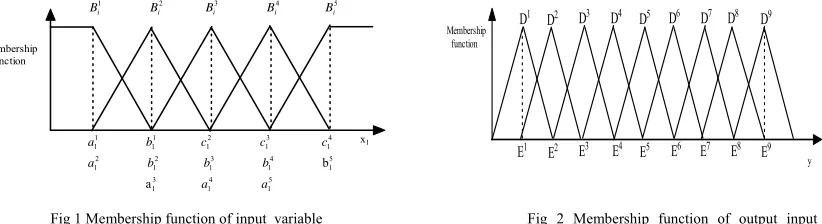
-function. These functions have been proven to produce good results for control applications and can be easily implemented into hardware. The universe of discourse of the input variables is partitioned into five fuzzy sets or
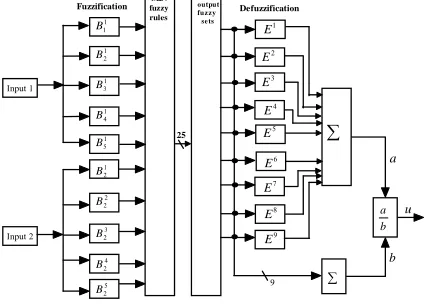
linguistic values (B1 to B5), while the output variable can take any of the nine linguistic values (D1 to D9).
Graphical representations of the membership functions are shown in Fig 1. and Fig 2.
Membership function x1
2 3 4 5
1
i i i i
i B B B B
B a b 5 1 4 1 3 1 5 1 4 1 3 1 2 1 2 1 4 1 3 1 2 1 1 1 1 1 a a b b b a c c c b a
D1 D2 D3 D4 D5 D6 D7 D8 D9
E1 E2 E3 E4 E5 E6 E7 E8 E9 Membership
function
y
The crisp values of the input variables are mapped onto the fuzzy plane using the equations above. It
gives each input variable a membership function relating to the fuzzy sets,( 1 5 i i to B
B ) . It has to be pointed out
that in these equations, j i
B is used to denote the linguistic value as well as membership function, while
membership function using
μ
Bi,j(
x
i)
.The universe of discourse of the output variable is divided into nine linguistic Values. The membership functions of the output values are intentionally made to be symmetrical, as this will simplify the defuzzification computation. E1 to E9 are the mean of each function and act as the weightings to the weighted average method of defuzzification.Each input variable can take any of the five linguistic values, therefore 25 (= 5 X 5) rules are formulated. The rules have the typical fuzzy rule structure, using linguistic variables in both the antecedent and consequent, and
are expressed in IF-THEN manner. They map the input states onto 25 output conditions (C1 to C25). The fuzzy
rules have the general form, RK : IF x1 is k
1
A
AND x2 isA
k 2 , THEN y is CK (1) Then the rule base can be represented by a fuzzy associative memory (FAM) table (Table 1).The FLC design in this work incorporates Mamdani’s implication method of inference, which is one of the most popular methods in fuzzy control applications. In essence, Mamdani’s implication for the fuzzy rule of (1) is given by
(2)
1,2,....25
k
)]]
(x
μ
),
(x
μ
[min[
max
(y)
μ
c k A 1 Ak 22 k
1
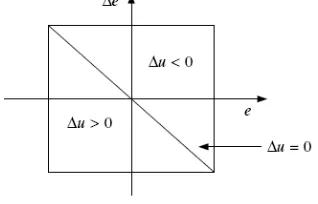
The implication has a simple min–max structure which makes it easy to incorporate into hardware. The block diagram in Fig.3 provides an overview of the controller’s internal structure. Two input variables are fuzzified, producing the corresponding linguistic values and membership functions . The first phase of Mamdani’s implication involves min-operation since the antecedent pairs in the rule structure are connected by a
logical ‘AND’. All the rules are then aggregated using a max-operation.
Input 2 Input 1 1 1 B 1 2 B 1 3 B 1 4 B 1 5 B 1 2 B 5 2 B 2 2 B 4 2 B 3 2 B 1 E 2 E 3 E 4 E 5 E 6 E 7 E 8 E 9 E b a a b u 9 MIN fuzzy rules MAX output fuz z y se ts
25
Fuzzification Defuzzification
The dominant criteria in the selection of defuzzification technique lies in the implementation stage. The weighted average method is viewed to be an appropriate technique for systems involving hardware implementation. Due to the fact that the output membership functions are symmetrical in nature, the mean of the fuzzy sets can be used as weightings for the defuzzification process. This technique requires several multiply-by-a-constant operations and only one division process. Rule base moulds the functionality of an FLC. The rules are most likely to be formulated based on some level of human understanding of the plant. The design of the FLC in this paper is based on PI controllers .The rule base is constructedfrom the control law of a PI system. 2.1 PI control
The proportional–integral (PI) controller is a well-known system in control engineering. It is, in essence, a lag compensator characterised by the transfer function
T.s 1 1 K G(s) where:
G(s) is the gain;K is the control parameter;T is the time constant.
The control law is given by the equation
p I tPI
e
dt
T
K
e
K
u
0
.
1
.
(3) where:
u is the control signal;e is the error, given by e = (input value) – (reference value).
Differentiating (3) gives
.e
Ip
K
dt
de
K
dt
du
(4) In discrete-time systems, (4) can be written as
( ) ( )
. ( ) .T) -u(kT
-u(kt) Kp eKT ekTT KIekT
e
K
e
K
u
p.
I.
(5) where:
u
is the change in u over one sampling periode
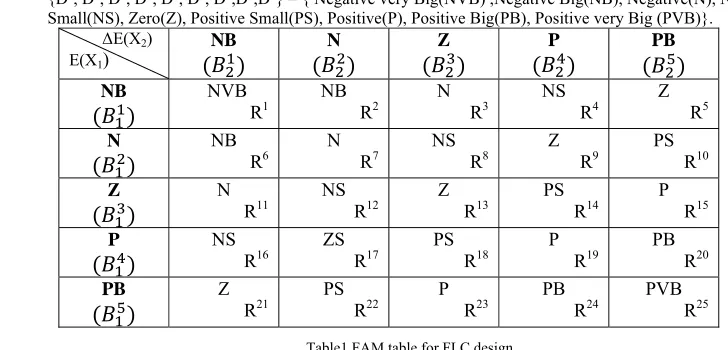
is the change in e over one sampling period.The values of controller parameters are found from Z-H tuning method. From the values found are Kp=0.12 and Ki= 0.0201. The characteristic of a PI controller can be represented by the phase plane diagram shown in Fig. 4. A diagonal line where
u
= 0 divides the area where
u
is positive and
u
is negative.Fig. 4 Characteristic of PI controller
2.2 PI-like fuzzy control
At this stage, the control law in (8) is not in fuzzy terms. In order to design a fuzzy controller based on the PI control structure, the following definitions are made:
Let E be the linguistic variable for the error e
E
be the linguistic variable for the change of error
e
U be the linguistic variable for the control output u.The maximum range of motor is +/- 1500 rpm. The possible error range is -750 to 750.The universe of Discourse of the change in error is based on experiment data from conventional controller which gives the range of error is +/- 150.Ouput of the controller ranges from +/- 8.Linguistic variables for E ,
E
, U are defined asLE = {Negative Big(-750rpm), Negative(-500rpm), Zero(0), Positive(500rpm), Positive Big(750 rpm)}
E
L = {Negative Big(-150rpm ), Negative(-75 rpm), Zero(0), Positive(75), Positive Big(150)}
LU = { Negative very Big(-8) ,Negative Big(-6), Negative(-4), Negative Small(-2), Zero(0), Positive Small(2),
Positive(4), Positive Big(6), Positive very Big(8) }
The corresponding PI control law in IF-THEN rules has the form:
RK: IF x1 is AND x2 is , THEN y is CK
where:
can take any linguistic value in the set LE
can take any linguistic value in the set LE
CKcan take any linguistic value in the set LU.
To implement this design into the FLC, let: x1 = E
x2 = E
{D1, D2, D3, D4, D5, D6, D7,D8,D9} = { Negative very Big(NVB) ,Negative Big(NB), Negative(N), Negative
Small(NS), Zero(Z), Positive Small(PS), Positive(P), Positive Big(PB), Positive very Big (PVB)}.
ΔE(X2)
E(X1)
NB N Z P PB
NB NVB
R1 NB R2 N R3 NS R4 Z R5
N NB
R6 N R7 NS R8 Z R9 PS R10
Z N
R11 NS R12 Z R13 PS R14 P R15
P NS
R16 ZS R17 PS R18 P R19 PB R20
PB Z
R21 PS R22 P R23 PB R24 PVB R25
Table1 FAM table for FLC design
Figure 5 shows a block diagram demonstrating the implementation of the FLC in a Speed control of DC motor .In this application, the input interface converts the output of the speed sensor into error and change of error which are used as the two inputs to the FLC.
FLC
1
Z
+
DC Motor
1
Z
REF V
+
+
+
-+
1 x
2 x
y
Rule base
u
u
Vdc
Fig 5 Overall block diagram of FLC based control system for Dc motor
Another interface converts the output into the required value for the plant. The characteristics of the interfacing blocks can be described by the following equations:
Input interface:
e = VREF – Vdc; x1 = e ; x2 = x1 – x1z-1
Output interface:
Δu = y ; u = Δu+ u z-1
3 FPGA Implementation
A Field Programmable Gate Array is a digital integrated circuit that can be programmed to do any type of digital function. When the FPGA-based system is used for implementing the desired FLC, many possible designs can be tried due to the reusability of the FPGA. Often, a hardware implementation on the FPGA-based system is supported by many existing EDA tools for modelling, synthesis, verification, and implementation. The major advantage of using the EDA tools is that the same hardware description language code for modelling can be directly used for synthesis, verification, and implementation. Also, the general architecture of the FLC is invariant except for the change in the number of input and output variables, the number of fuzzy terms, the membership functions, the bit resolutions, and the control rule base according to the different applications. The FPGA consists of three major configurable elements:
1) Configurable Logic Blocks (CLBs) arranged in an array that provides the functional elements and implements most of the logic in an FPGA.
The Target device in this case is Spartan®-3A DSP family (XC3SD1800A).The features of Spartan®-3A DSP – 2XC3SD1800A is tabulated in table2
Table 2.System resources of Spartan®-3A DSP family
System gates 1800k
Equivalent logic cells 37,440
CLB Array (one CLB = four slices)
Rows 88
Columns 48
Total CLB 4,160
Total slices 16,640
Distributed RAM bits 260k
Block RAM bits 1512k
DSP48As 84
DCMs 8
Maximum user I/O 519
Maximum Differential I/O pairs 227
The FLC is divided in to 5 VHDL components. Fig 6 shows a diagram of the FLC architecture . Each component is depicted with its VHDL code. The functionality of components Interface1, Interface2 and part of the component Infer will determine the characteristics of the FLC. Input and output variables are designed with a resolution of 8 bits.
Input Interface Output Interface
Fuzzification Inference Defuzzification
Input
1
x x2
5 1 1 1 to B
B
5 2 1 2 to B
B
9 1 to D
D
Rule base
output
Xilinx XC3SD1800A FPGA is available in several packages and the one used for this design is the PC-512 package which has 512 I/O pins in total. During the generation of the bitstream, the inputs and outputs of the design are mapped to the physical I/O pins of the FPGA. The allocation of pin numbers can either be automatically performed by the implementation tools or explicitly specified by the user. In this design, all the pins are specified by manually assigning the appropriate pin numbers. This enables the designer to have full control over the function of the physical pins in the FPGA. The allocation of pin numbers to the I/O pads is shown by the schematic diagram of the design in Fig. 7 Once the hardware specifications have been confirmed, the netlist is compiled into a bitstream file using the Implementation procedure in Xilinx Foundation Project
Manager.
4 Experimental setup
The experimental studies are carried out to evaluate the performance of the controller. Configuration is the Process by which the bit streams of a design, as generated by the development software are loaded into the
Fig 6 : Components of Fuzzy logic controller in FPGA
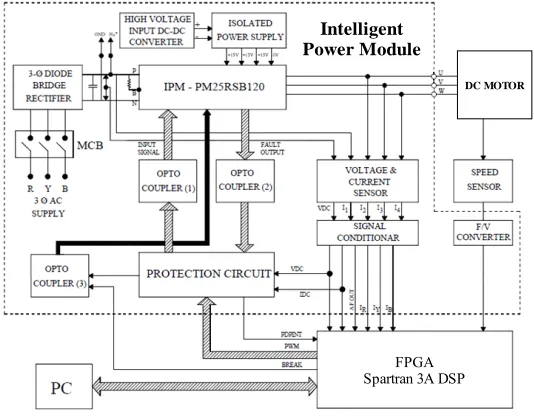
internal configuration memory of the FPGA. To verify the performance of the controller design on Hardware, the VHDL code (Bit file) is downloaded into the Target FPGA device (Spartan 3 family XC3S400) and the complete system is reset The experimental set up for this system consists of a DC motor , FPGA kit(with on board ADC, DAC, PWM modules), Intelligent power module. The overall block diagram of Dc motor speed control is shown in Fig 8.The DC shunt motor is chosen in this work whose parameters are shoe in table 3.
FPGA FPGA
Spartran 3A DSP
Intelligent Power Module
DC MOTOR
Fig 8 Overall block diagram of speed control of DC motor
Table 3: Parameters of DC motor
Type 3 PHASE DC Shunt Motor
SPEED 1500 Rpm
Voltage 220 v
Rating 1.0 HP
Current 0.3A
Electrical resistance 1 ohm
Electrical inductance 0.5H
Moment of Inertia of Motor 0.01Kgm2/s2
4.1 Intelligent power module :
Intelligent power modules (IPMs) are advanced hybrid power devices that combine high speed, low loss IGBTs with optimized gate drive and protection circuitry. The power stage consists of a Variable source converter (VSC) fed drive. It has two stages of power conversion ,a rectifier and converter .The rectifier converters a fixed voltage AC to either fixed or adjustable DC voltage .The converter is constituted of solid state switches(IGBT), that switch the DC power on and off to produce a controllable and desired DC voltage .FPGA generates firing pulses for the power switches in the converter. IPM consists of 1. Intelligent Power Module 2. Voltage and Current Sensor 3. Signal Conditioner 4. Protection Circuit 5. Optocoupler 6. Three phase Diode Bridge Rectifier 7. Speed Sensor 8. Frequency to Voltage converter.
IPM has sophisticated built-in protection circuits that prevent the power devices from being damaged. The protection schemes available in IPM are self protection, over temperature protection, over current protection, short circuit protection. Three phase diode bridge rectifier is used to give rectified DC voltage to IPM. Output voltages and current of IPM are not directly fed to control circuits ,because output voltage of IPM is high, but control circuit is operated in minimum voltage(5v).Hall effect transducers are used for these type of conversion .Signal conditioning circuits are used to give the reference signal of current and voltage to the protection circuit as well as to the ADC of FPGA kit. Optocoupler is used to isolate the control circuit from power circuit. Speed of the Dc motor is sensed by optical encoder which gives the output in terms of frequency proportional to speed. By means of Frequency to voltage converter , sensor output is converted in to voltage .
by toggle switches according to the requirement. Once this is done the ADC data will be read and Fuzzy Logic Controller implemented will calculate output value and the output of controller in term changes the duty cycle of PWM to increase or decrease the speed.IPM Module consists of Switching power converters are used in most DC motor drives to deliver the required energy to the motor. The energy that a switching power converter delivers to a DC motor is controlled by Pulse Width Modulated (PWM) signal applied to the gate of a power transistor coming from PWM module FPGA kit. Once the current speed equals the set speed, the motor starts running at the set speed. Again to change the set speed, the above procedure is repeated by changing the toggle switch position. As the set speed is varied, the ADC voltage also varies. It is observed that the current speed, which is displayed, on the ‘on board’ LCD display equals the set speed value. Fig. 10 shows the Photograph of the experimental setup and working model of FPGA based DC motor speed control system
Fig 9 FPGA Spartan®-3A DSP kit Fig 10 Real time experimental setup
5 Results and Discussion
The Fuzzy Logic Controller is implemented in FPGA for real time control of speed in DC motor .The Fuzzy logic controller is divided in 5 modules, input interface, fuzzifier, inference , defuzzification, output interface .The servo responses of the PI controller and FLC shown in Fig 11 and Fig 13. The set point is varied from 550 rpm to 1100 rpm .For the PI controller (shown in Fig 11), set point tracking performance is characterized by lack of smooth transition between set point, as well as presence of overshoot and higher rise time. From Fig 13 we can observe that the FLC having less oscillation , zero overshoots, less rise time. From the Fig 10 and Fig 13,it can be seen that FLC performs significantly better than PI controller .
The FLC is used to control the speed of the motor while applying a load change of +10%.The motor is also run with a PI controller while applying the same load changes. The variations in speed with time for 10% load change for PI controller and FLC is shown in Fig 12 and Fig 14.The FLC is able to compensate for the load changes considerably better than PI controller
Fig11 Servo response of PI controller for a
set point change from 550 rpm to1100rpm
Fig 13 Servo response of FLC for a set point change from 550 rpm to1100rpm
Fig14 Regulatory response of FLC under +10% change in speed as load
6.Conclusion
This paper presents an approach for the implementation of a fuzzy logic controller for DC motor on an FPGA using VHDL.The implementation of the fuzzy logic controller is very straightforward by coding each component of the fuzzy inference system in VHDL according to the design specifications. The design of the FLC is highly flexible as the membership functions and rule base can be easily changed. Moreover the performance of FLC is compared with PI controller for set point change and load change. The performance FLC was much superior to conventional PI controller and FLC is able to compensate load changes better than PI controller. By simply changing some parameters in the codes and design constraint on the specific synthesis tool, one can experiment with different design circuitry to get the best result in order to satisfy the system requirement. The FLC can also be used for control purposes in other applications.
References
[1] Jose l. Gonzalez-vazquez, oscar Castillo and luist. Aguilar-bustos,” A Generic Approach To Fuzzy Logic Controller Synthesis On FPGA”, IEEE international conference on fuzzy systems, p- 2317 - 2322, 2006.
[2]S.Poorani, T.V.S.Urmila Priya, K.Udaya Kumar and S.Renganarayanan," FPGA based fuzzy logic controller for electric vehicle", Journal of The Institution of Engineers, Singapore, Vol. 45 Issue 5 2005.
[3] Barriga, S. Sanchez-Solano, P. Brox, "Modeling and implementation of fuzzy systems based on VHDL", International Journal of Approximate Reasoning 41 (2006) 164–178.
[4] Shabiul islam, nowshad amin, m.s.bhuyan, mukter zaman, Bakri madon and masuri Othman, " FPGA Realization of Fuzzy Temperature Controller for Industrial Application", Wseas Transactions On Systems And Control, ISSN: 1991-8763, Issue 10, Volume 2, p. 484- 490, Sep. 17, 2007.
[5] Eric Monmasson, and Marcian N. Cirstea," FPGA Design Methodology for Industrial Control Systems—A Review. IEEE transactions on industrial electronics, vol. 54, no. 4, p. 1824- 1842, august 2007.
[6] Masmoudi n., hachicha m. and kamoun l." Hardware Design of Programmable Fuzzy Controller on FPGA", IEEE International Fuzzy Systems Conference Proceedings, Seoul, Korea, p. -1675- -1679, August 22-25, 1999.
[7]Daijin Kim," An Implementation of Fuzzy Logic Controller on the Reconfigurable FPGA System", IEEE transactions on industrial electronics, vol. 47, no. 3, p. 703- 715, JUNE 2000.
[8] MichaelMcKenna and Bogdan M. Wilamowski," Implementing a Fuzzy System on a Field Programmable Gate Array", IEEE International Joint Conference on Neural Networks, 2001. Proceedings. IJCNN '01, ISBN: 0-7803-7044-9, Volume: 1, p.189-194, 2001. [9]Philip t. Vuong, asad m. Madni and jim b. Vuong” VHDL implementation for a fuzzy logic controller”, BEI technologies, inc. 13100
telfair avenue, sylmar, california 91342 USA, 2006. http://www.wacong.org/wac2006/allpapers/isiac/isiac_248.pdf
[10] Mohammed Y. Hassan and Waleed F. Sharif, " Design of FPGA based PID-like Fuzzy Controller for Industrial Applications", IAENG International Journal of Computer Science, 34:2, IJCS_34_2_05, 17 November 2007.
[11] Masmoudi n., hachicha m. and kamoun l." Hardware Design of Programmable Fuzzy Controller on FPGA", IEEE International Fuzzy Systems Conference Proceedings, Seoul, Korea, p. -1675- -1679, August 22-25, 1999.
[12] H. Ying, "Fuzzy Control and Modeling, Analytical Foundations and Applications", Institute of Electrical and Electronic Engineers Inc., USA, 2000