R E S E A R C H
Open Access
Transforming tuberculosis (TB) service
delivery model in China: issues and
challenges for health workforce
Ziyue Wang
1,2, Weixi Jiang
3, Yuhong Liu
4,5, Lijie Zhang
4,5, Anna Zhu
3, Shenglan Tang
3and Xiaoyun Liu
1*Abstract
Background:China’s TB control system has been transforming its service delivery model from CDC (Centers for Disease Control and Prevention)-led model to the designated hospital-led model to combat the high disease burden of TB. The implications of the new service model on TB health workforce development remained unclear. This study aims to identify implications of the new service model on TB health workforce development and to analyze whether the new service model has been well equipped with appropriate health workforce.
Methods:The study applied mixed methods in Zhejiang, Jilin, and Ningxia provinces of China. Institutional survey on designated hospitals and CDC was conducted to measure the number of TB health workers. Individual questionnaire survey was conducted to measure the composition, income, and knowledge of health workers. Key informant interviews and focus group discussions were organized to explore policies in terms of recruitment, training, and motivation.
Results:Zhejiang, Jilin, and Ningxia provinces had 0.33, 0.95, and 0.47 TB health professionals per 10 000
population respectively. They met the national staffing standard at the provincial level but with great variety at the county level. County-designated hospitals recruited TB health professionals from other departments of the same hospital, existing TB health professionals who used to work in CDC, and from township health centers. County-designated hospitals recruited new TB health professionals from three different sources: other departments of the same hospital, CDC, and township health centers. Most newly recruited professionals had limited competence and put on fixed posts to only provide outpatient services. TB doctors got 67/100 scores from a TB knowledge test, while public health doctors got 77/100. TB professionals had an average monthly income of 4587 RMB (667 USD). Although the designated hospital had special financial incentives to support, they still had lower income than other health professionals due to their limited capacity to generate revenue through service provision.
Conclusions:The financing mechanism in designated hospitals and the job design need to be improved to
provide sufficient incentive to attract qualified health professionals and motivate them to provide high-quality TB services.
Keywords:Tuberculosis, Health system, Service delivery model, Vertical approach, Integrated approach
© The Author(s). 2019Open AccessThis article is distributed under the terms of the Creative Commons Attribution 4.0 International License (http://creativecommons.org/licenses/by/4.0/), which permits unrestricted use, distribution, and reproduction in any medium, provided you give appropriate credit to the original author(s) and the source, provide a link to the Creative Commons license, and indicate if changes were made. The Creative Commons Public Domain Dedication waiver (http://creativecommons.org/publicdomain/zero/1.0/) applies to the data made available in this article, unless otherwise stated.
* Correspondence:[email protected]
1China Center for Health Development Studies, Peking University, No.38 Xueyuan Road, Haidian District, Beijing 100191, China
Introduction
China has the world’s third largest TB epidemic. Eight hundred eighty-nine thousand new TB cases were de-tected in 2017, among which over 8% had multi-drug-resistant TB (MDR-TB), likely due to previously poor TB treatment in hospitals [1]. TB and MDR-TB cause great financial burden to patients and their family, which could in turn reduce patients’ adherence to treatment, especially for the poor [2,3]. To tackle the high TB bur-den, China needs a strong TB control system of good quality and high efficiency.
China’s TB control system has been experiencing significant transition. China has developed a TB con-trol system based on the Centers for Disease Concon-trol and Prevention (CDC) from early 1950s. In each county, a TB section within CDC or a separate TB dispensary was established to provide outpatient ser-vices and public health serser-vices. This CDC-led model was a unique design to combine both clinical and public health services within one institution [4]. While this model played a significant role in China’s TB control program, it has been facing great chal-lenges. The shortage of qualified human resources for health (HRH) and limited clinical expertise and la-boratory capacity in CDC cannot meet the increasing needs of TB care due to the high prevalence of MDR-TB and TB patients with co-morbidity [5]. In order to address these challenges, China started a new service delivery model in 2011, transferring the function of TB diagnosis and treatment from CDC to designated hospitals. CDC are responsible for TB con-trol planning, supervision, and health education. Pri-mary health care facilities are responsible for case management and patient referrals [6]. The new ser-vice delivery model was expected to improve the quality of TB health services. A vast majority of the Chinese provinces have now integrated the vertical TB control program into a general health service de-livery system. However, a few provinces (like Jilin) have still maintained the old program.
Constraints on human resources for health (HRH), including deficits in number, unbalanced distribution, and limited capacity of health workers, have been re-ported as the main barriers to achieving global TB control target [7, 8]. Yet, data on HRH for TB control are rarely available and reliable in high-burden coun-tries [9]. Whether the newly transformed TB service delivery model can achieve its objectives will largely depend on a TB health workforce with sufficient number, right knowledge and skills, and proper mo-tivation. Zou and his colleagues revealed that the doc-tors from designated hospitals had better capacity to treat TB patients than CDC and TB dispensaries were the strongest rationale for integration [10]. Yet, the
research questions of whether the new service deliv-ery model can attract a sufficient number of TB health workers and whether the newly recruited staff at designated hospitals have proper knowledge and skill and are properly motivated to provide TB-related services remain unanswered. This study aims to iden-tify implications of the new service model on TB health workforce development and to analyze whether the new service model has been well equipped with appropriate health workforce.
Methods
Study design and site selection
This study is part of a Gates Foundation-supported TB control program. Three provinces were selected for the study. Zhejiang represents the eastern devel-oped area, Jilin is in less-develdevel-oped central areas, and Ningxia is from the least-developed western area. For each province, a city with a higher GDP per capita and a city with a lower GDP per capita were selected. Then, we selected two counties in each city. For the county level, a county with a medium to high per capita GDP in each city and a county with a lower per capita GDP were selected. The total number of new and relapse TB patients registered should be more than 200 in 2014. If no county met this stand-ard, the county with the highest number of registered TB patients was selected. The sample institutions in-cluded provincial-designated hospital/CDC, city-level-designated hospital/CDC, and county-level-city-level-designated hospital/CDC.
The study applied mixed methods to answer the research questions. Institutional survey on designated hospitals and CDC was conducted to measure the number of TB-related health workers. Individual questionnaire survey with TB health workers was conducted to measure the composition of health workers, their income, and knowledge. Key informant interviews with health managers and focus group dis-cussions (FGDs) with TB health workers were orga-nized to explore policies in terms of recruitment, training, and motivation [11]. In addition, relevant policy documents were collected to analyze TB staff-ing standards.
Data collection Questionnaire survey
TB-related health workers who were on duty on the day of field work were invited to fill a survey question-naire. Survey contents included their education back-ground, workload, training, and income level. Questions in relation to TB diagnosis, treatment, and disease man-agement were prepared for clinical doctors and public health doctors to answer, in order to measure their knowledge level. The knowledge questions were pre-pared by national TB experts. Research team members were present during the survey for quality control. In total, 281 TB-related health workers completed the questionnaire survey.
Key informant interviews and focus group discussions (FGDs)
Key informant interviews were conducted with health policy makers at the provincial, prefecture, and county levels and managers of CDC and designated hospitals. Interview topic guides included issues on staff recruitment, service training, and financial in-centives. In each designated hospital, a FGD was con-vened with 6–8 health workers consisting of doctors, public health workers, nurses, and spear test techni-cians. Discussion topics included their workload, in-come, and training. In total, participants for key informant interviews and FGDs included 21 policy makers, 15 CDC managers, 21 managers of designated hospitals, and 21 groups of health professionals at designated hospitals.
A purposive sampling method was applied to cover different types of participants. The participants were recruited by coordinators from provincial- and county-level CDC. The interviews and FGDs were conducted in a quiet meeting room or office room. A senior researcher conducted the interviews and FGDs as interviewer or facilitator, with a junior re-searcher as observer and notetaker. There was no other person present during the interview/FGD. All interviews and FGDs were tape-recorded with in-formed consent.
Data process and analysis
Questionnaire survey data were double entered using Epidata 3.1 and were analyzed using SPSS 20.0. De-scriptive statistics was applied to analyze the HRH situation. T test and chi-square test were applied when it was necessary to compare between different groups. Ordinary least square (OLS) regression was conducted to identify influencing factors of staffing level (number of TB health workers per 10 000 popu-lation). Qualitative data were transcribed and analyzed using a thematic framework approach in MAXQDA 12. The analytical framework was developed based on
the topic guides and emerging issues from the inter-views and FGDs.
For both quantitative and qualitative data, analysis was conducted around three dimensions. First, staff-ing of TB health services included number and com-position of TB health workers and sources of TB health worker recruitment. The second dimension was about the health workers’ TB knowledge. The third was about health workers’ income and financial incentives.
Results
TB service delivery models in the three provinces
The three provinces were in different stages of service delivery model transformation. In Zhejiang, the ser-vice delivery model was completely transformed, i.e., TB service provision shifted from CDC to designated hospitals. County hospital as designated hospital pro-vided outpatient and inpatient services for TB pa-tients. County CDC was responsible for public health services for TB control. MDR-TB diagnosis and treat-ment services were provided at prefecture-level-designated hospital, a level higher than the county level but lower than the provincial level (Fig. 1). Jilin province still had the traditional CDC/TB dispensary model. Each county had a TB dispensary either within CDC or in separation. The TB dispensaries provided outpatient clinical services and public health services as well (Fig. 2). When a TB patient needs inpatient services, s/he could be referred to general hospitals. Ningxia applied a mixed model. At the county and prefecture levels, designated hospitals were developed to provide outpatient services for TB patients. But at the provincial level, there was a specialized TB hos-pital providing both clinical and public health ser-vices. Unlike in Zhejiang and Jilin, all MDR-TB patients in Ningxia received health services from pro-vincial- rather than prefecture-level hospitals.
Staffing of TB health services
Ningxia can meet this staffing norm. The TB detec-tion rates in Zhejiang, Jilin, and Ningxia in 2015 were 53.5, 47.1, and 39.2 per 100 000 population respect-ively, showing that the staffing level was not propor-tional to the TB prevalence in those regions.
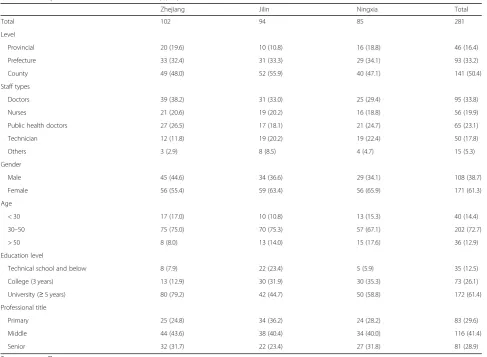
Among the survey of 281 TB-related health workers, 61.3% were female, 72.7% aged between 30 and 50 years old, and 61.4% had a university degree. TB health workers in Jilin had a lower education level, with only 44.7% having a university degree, comparing to 79.2% in Zhejiang (Table 2). In the OLS regression holding the workload, provinces, population, and GDP per capita of the county fixed, the new service delivery model had
0.494 less TB health workers per 10 000 population than the old CDC-led model (Table 5 inAppendix).
Key informants from Zhejiang and Ningxia reported that there was usually only one health worker in county CDC in charge of TB control. County hospital as TB-designed hospital also only had one doctor in a TB clinic providing outpatient services for TB pa-tients. In the wards, hospitals usually had more than one doctor in the department of infectious disease, providing inpatient services to patients diagnosed with TB and other infectious diseases. In Jilin where the traditional CDC model still dominated, TB dispensar-ies had more human resources. A FGD with TB
Fig. 1TB service delivery models in Zhejiang and Ningxia provinces. CDC, Center for Disease Control and Prevention; DOTS directly observed treatment, short course; MDR-TB, multi-drug-resistant tuberculosis; PHC primary healthcare
health professionals revealed that one county TB dis-pensary in Jilin had 10 doctors, 12 nurses, 7 public health workers, and 11 other health professionals.
When the TB diagnosis and treatment service were transferred from CDC to designated hospitals, hospitals need to recruit TB doctors, nurses, and technicians, while CDC needed to re-deploy the TB health profes-sionals who originally undertook these tasks. There were usually three sources for designated hospitals to recruit these cadres. The most common source of recruitment was from other departments of the same hospital. For
example, in Zhongning County, Ningxia, a doctor was transferred from a pediatric department to become a TB doctor after some basic training.
During the transmission period, most of the TB health professionals who used to work in CDC were moved to other positions within CDC, but still some designated hospitals tried to recruit TB doctors from CDC to staff their newly established TB clinic. This became the sec-ond source of TB doctors for designated hospitals. Changshan County in Zhejiang and Zhongwei Prefecture in Ningxia applied this model.
Table 1Number of TB health workers in three provinces in 2015
Province TB detection rate (per 100 000 population)
Number of TB health workers per 10 000 population
Number of counties unmet the national TB health workforce standard (N, %)
Zhejiang 53.5 0.33 27/89 (30.34%)
Jilin 47.1 0.95 1/60 (1.67%)
Ningxia 39.2 0.47 6/20 (30.00%)
Data source: Institution survey. National TB health workforce standard is 0.2 TB health workforces per 10 000 population
Table 2Composition of TB health workers (N, %)
Zhejiang Jilin Ningxia Total
Total 102 94 85 281
Level
Provincial 20 (19.6) 10 (10.8) 16 (18.8) 46 (16.4)
Prefecture 33 (32.4) 31 (33.3) 29 (34.1) 93 (33.2)
County 49 (48.0) 52 (55.9) 40 (47.1) 141 (50.4)
Staff types
Doctors 39 (38.2) 31 (33.0) 25 (29.4) 95 (33.8)
Nurses 21 (20.6) 19 (20.2) 16 (18.8) 56 (19.9)
Public health doctors 27 (26.5) 17 (18.1) 21 (24.7) 65 (23.1)
Technician 12 (11.8) 19 (20.2) 19 (22.4) 50 (17.8)
Others 3 (2.9) 8 (8.5) 4 (4.7) 15 (5.3)
Gender
Male 45 (44.6) 34 (36.6) 29 (34.1) 108 (38.7)
Female 56 (55.4) 59 (63.4) 56 (65.9) 171 (61.3)
Age
< 30 17 (17.0) 10 (10.8) 13 (15.3) 40 (14.4)
30–50 75 (75.0) 70 (75.3) 57 (67.1) 202 (72.7)
> 50 8 (8.0) 13 (14.0) 15 (17.6) 36 (12.9)
Education level
Technical school and below 8 (7.9) 22 (23.4) 5 (5.9) 35 (12.5)
College (3 years) 13 (12.9) 30 (31.9) 30 (35.3) 73 (26.1)
University (≥5 years) 80 (79.2) 42 (44.7) 50 (58.8) 172 (61.4)
Professional title
Primary 25 (24.8) 34 (36.2) 24 (28.2) 83 (29.6)
Middle 44 (43.6) 38 (40.4) 34 (40.0) 116 (41.4)
Senior 32 (31.7) 22 (23.4) 27 (31.8) 81 (28.9)
If neither of the two sources could work, county hospitals could recruit health workers from township health centers to become TB-related health workers. In Tongxiang County, Zhejiang, the county hospitals recruited three doctors from township health centers. After several months’ in-service training, two became TB doctors and the other became a technician for smear test.
The old doctor we recruited from CDC had fixed post in the TB clinic. When he is retired, other doctors from the ward will have rotation to work between the TB clinic and the ward. Young doctors are reluctant to work in the TB clinic. (Manager of county designated hospital in Zhejiang)
Health professionals’knowledge of TB control
During the survey, TB clinical doctors and public health workers were asked to answer some pre-designed questions to measure their knowledge on TB control. Out of a total score of 100, clinical doctors got 67 in average, and public health workers got 77. Doctors in Jilin and Ningxia had significantly lower performance in the exam than those in Zhejiang (p< 0.05, Table 3).
Key informants from designated hospitals revealed that they usually chose less competent doctors to staff the new TB clinic, with the justification that the TB clinic only provides basic free services which cannot raise revenues for the hospital. The new TB doctors in designated hospitals usually lack training with little clinical experiences, which consisted our findings in the data analysis.
Income level and motivation policies
TB health workers were paid 4587 RMB Yuan (667 USD) per month for their work. Those in Ningxia and Jilin had much lower income than in Zhejiang. Health workers at the county level (4356 Yuan, 634 USD), female (4220 Yuan, 614 USD), younger than
30 years old (3227 Yuan, 470 USD), without a bach-elor degree (4369 Yuan, 636 USD), and with primary professional title (3 678 Yuan, 535 USD) had lower monthly income than their counterparts (Table 4). Compared to 2014, the growth rate of average monthly wage for TB workers was 5.6% in 2015. 43.4% health workers reported their income were lower than the average level of their organization. The proportion was especially high among those < 30 years old (65.0%) and those with a primary profes-sional title (61.4%).
Key informant interviews showed that most desig-nated hospitals had special financial incentive policies to motivate TB-related health workers. Designated hospitals set up higher proportion of revenue return to the TB department. In one hospital in Zhejiang, 19% of total service revenues were returned to the TB department as bonus incentive to motivate the TB health workers, while other clinical departments only got a 12% revenue return. Special allowances for TB health workers were another commonly used incen-tive. A daily rate of 9 RMB Yuan (1.3 USD) was pro-vided as risk allowance to TB health workers at the infectious disease department.
Regardless of these incentive schemes towards TB health workers, they still reported lower income than their colleagues in other departments of the hospital.
We are a special department. Our department has higher consumption of supplies and therefore higher cost, but we have lower workload [to generate revenue]. Although our hospital had special financial policy to support our department, we still have the lowest income in the hospital. (TB health professional FGD in Zhejiang)
Discussion
This study tried to analyze the implications of TB service delivery model on HRH development in three provinces of China. It found that Zhejiang province has 0.33 health workers per 10 000 population, less than Jilin (0.95) and
Table 3TB knowledge of health workers in three provinces
Clinical doctors Public health workers
N Average score Tvalue N Average score Tvalue
Total 133 67 NA 81 77 NA
Zhejiang 50 84 Reference 29 83 Reference
Jilin 54 50 −4.39* 29 71 −2.54*
Ningxia 29 69 −2.29* 23 78 −1.59
Ningxia (0.47). TB clinical doctors showed limited TB knowledge compared to the public health workers. Al-though TB health professionals in the designated hospi-tals seemed to have higher income than their counterparts in CDC and TB dispensaries, they were still less motivated than their colleagues in other depart-ments of the hospital.
China transformed its TB service delivery system from a vertical, disease-specific control system to a more integrated system. A TB control program inte-grated within wider health systems is believed to
improve its performance [12, 13]. Previous studies confirmed that a more integrated system would bene-fit the service coverage and the treatment outcomes. Wei and his colleagues found that the new integrated TB service delivery model in China has shortened pa-tient treatment pathways, improved quality, and re-duced costs [14, 15].
This improvement of TB control outcomes in an inte-grated system largely depends on the availability of ad-equate workforce with appropriate competence and motivation. Adequate number of health professionals is
Table 4Monthly income of TB health workers
N Monthly income Tvalue Annual growth rate Tvalue Lower than average level (%) Chi-square value
Total 278 4 536 NA 5.6 NA 43.4 NA
Province
Zhejiang 100 5 815 Reference 6.5 Reference 57.0 Reference
Jilin 94 3 826 −9.11* 4.5 −1.13 35.1 10.85*
Ningxia 84 3 972 −7.84* 6.4 −0.04 39.8 8.10*
Level
Provincial 46 5 108 Reference 1.5 Reference 28.3 Reference
Prefecture 92 4 720 −1.30 6.1 1.58 47.3 5.12*
County 139 4 356 −3.62* 7.0 1.91 47.5 5.70*
Staff types
Doctors 94 4 993 Reference 5.1 Reference 46.8 Reference
Nurses 55 3 884 −3.97* 6.7 1.76 58.2 0.69
Public health doctors 65 4 532 −1.69 4.7 −1.73 28.1 10.73*
Technician 49 4 480 −1.72 5.0 −0.04 42.9 0.95
Others 15 3 972 −1.74 6.0 −0.07 53.3 0.63
Gender
Male 107 5 076 Reference 7.3 Reference 41.5 Reference
Female 170 4 220 −4.02* 4.6 −1.48 45.4 0.52
Age
< 30 40 3 227 Reference 13.9 Reference 65.0 Reference
30–50 201 4 574 4.12* 4.6 −3.65* 44.0 3.05*
> 50 35 5 361 5.23* 3.5 −3.48* 25.7 9.03*
Education level
Technical school and below 34 4 306 Reference 10.3 Reference 35.3 Reference
College (3 years) 73 4 398 0.67 5.2 −1.68 46.6 0.79
University (≥5 years) 171 4 987 3.15* 4.7 −2.14* 45.3 0.86
Professional title
Primary 83 3 678 Reference 8.5 Reference 61.4 Reference
Middle 115 4 614 6.09* 4.6 −1.68 43.0 6.29*
Senior 80 5 523 10.57* 4.6 −1.40 28.8 18.80*
The average overall monthly physician salary in Zhejiang, Jilin, and Ningxia are 8 392 Yuan, 4 479 Yuan, and 5 006 Yuan, respectively (data source: Zhejiang, Jilin, and Ningxia Statistical Yearbook 2016)
a pre-requisite for effective TB control. The national TB control program has set a minimum staffing norm of 0.2 per 10 000 population. This was set 10 years ago, before the transformation of the TB ser-vice delivery model [16]. In the new model, staffing norms need to be updated accordingly [8]. This study found that although the total number of TB health professionals at the provincial level met the national TB health workforce standard, they are not evenly distributed. About 30–50% counties with the new service delivery model cannot meet the staffing norm, implying that they still need to increase the staff supply for TB control.
Comparison of TB health workforce between the three provinces shows that the traditional CDC-led model has more health workers than the new model. This is mainly because most of the existing TB health workers in CDC cannot move to the desig-nated hospital, and they have to move to other dis-ease control programs within CDC. Designated hospitals need to recruit and train new health workers to provide TB health services. To some ex-tent, there is a waste of existing human resources in the transition of the TB service delivery model. Some studies also reported challenges of retaining and attracting skilled workforces during the TB ser-vice model transitions [10].
The quality of TB health professionals at designated hospitals is a key concern. Designated hospitals re-cruited TB doctors and other professionals from vari-ous sources (including other departments of the same designated hospital, CDC, or township health centers). Generally, the newly recruited health professionals are not highly qualified for TB diagnosis and treatment. Hospitals usually chose less-competent doctors from other departments to staff the TB department. Health professionals recruited from CDC and township health centers also had limited knowledge and skills in TB health services. This low qualification is reflected by their suboptimal performance in the knowledge test in the study. Because of the limited clinical qualification, designated hospitals usually put the newly recruited TB health professionals on fixed posts in the TB clinic. Most of them only provide TB outpatient services and do not have opportunity to practice in the inpatient wards and to treat patients with other diseases. This further limited their oppor-tunity to improve their knowledge and skills. Accord-ing to human resource management theory, exposure to inter-related multiple job tasks can enrich job ex-periences and help an employee learn new skills and reduce boredom [17, 18]. The job design of TB health professionals at designated hospitals needs improve-ment to maximize their job performance.
The financial management system in designated hospitals has important implications on TB health workforce development. Public hospitals in China largely depend on service revenues to cover personnel cost and operational cost [19]. Since most of TB diagnosis and treatment services are free ser-vices according to the national TB control program, the newly established TB department has limited capacity to generate revenues through service provision. When hospitals mobilize doctors from other departments to staff the TB department, usu-ally less-qualified doctors were selected to fill the positions. Although designated hospitals introduce special financial incentives to attract and motivate TB health workers, they still only have a modest in-come and have low motivation and high turnover rate. In recent years, China is scaling up public hos-pital reform, with zero markup of medicines as a key policy lever [20]. The profit-driven service provision behavior may have considerable changes. The rapidly changing context of public hospital reform will have considerable implications on TB HRH development and service provision, which needs further observa-tion and analysis.
The study has several limitations. First, the study depends on self-reported data to measure the HRH issues in TB control. Some of the information, espe-cially regarding the self-reported monthly income, may be underreported. Second, without pre-transformation data on health workforce, the cross-sectional survey design may not imply a direct causal relationship between model transformation and HRH change. The differences between the three provinces may reflect a combination of various factors includ-ing social economic development status and service delivery model. This study tries to analyze whether the staffing level under the new service delivery model is appropriate to the TB prevalence and can meet the national TB staffing norms. In addition, the qualitative study also helps explain the challenges in health worker attraction and retention under the new model.
Abbreviations
CDC:Centers for Disease Control and Prevention; FGDs: Focus group discussions; HRH: Human resources for health; MDR-TB: Multi-drug-resistant TB; RMB: Renminbi; TB: Tuberculosis; USD: United States dollar
Acknowledgements
We would like to thank all the key informants who participated in this study. We also thank Dr. Xiaolin Wang from the Fourth People’s Hospital of Ningxia, Dr. Xiaomeng Wang from Zhejiang CDC, Dr. Yiming Han from Hangzhou Red Cross Hospital, Dr. Yanli Yuan from Jilin provincial TB dispensary, and Dr. Yang Dong from Jilin Provincial Tuberculosis Hospital for their help during the field survey.
Authors’contributions
ZW participated in the field survey, performed the analysis, and drafted the paper. AZ participated in the field survey, collected the data, and performed the preliminary data analysis. WJ participated in the field survey and collected the data. YL gave advice to the study design, interpreted the data, and revised the study. LZ collected the data, interpreted the data, and revised the study. ST conceived and designed the evaluation, participated in the field survey, and revised the paper. XL designed the evaluation, participated in the field survey, collected the data, and wrote and revised the paper. All authors read and approved the final manuscript.
Funding
This study was supported by the Bill & Melinda Gates Foundation (“Monitoring, Learning & Evaluation for the Implementation of the Comprehensive Model of Tuberculosis (TB) Care & Control in China”). The funder of the study had no role in study design, data collection, data analysis, data interpretation, or writing of the report.
Availability of data and materials
The datasets used and analyzed during the current study are available from the corresponding author on reasonable request.
Ethics approval and consent to participate
Ethics approval was obtained from Duke Kunshan University and from Peking University Health Science Center. Respondents who agreed to participate in the study signed an informed written consent form.
Consent for publication
Not applicable.
Competing interests
The authors declare that they have no competing interests.
Author details
1China Center for Health Development Studies, Peking University, No.38 Xueyuan Road, Haidian District, Beijing 100191, China.2Department of Health Policy and Management, School of Public Health, Peking University Health Science Center, No.38 Xueyuan Road, Haidian District, Beijing 100191, China. 3Global Health Research Center, Duke Kunshan University, No. 8 Duke Avenue, Kunshan 215316, Jiangsu Province, China.4Beijing Chest Hospital, Capital Medical University, No. 97 Ma Chang, Tongzhou District, Beijing 101149, China.5Clinical Centre on Tuberculosis, Chinese Center for Disease Control and Prevention, No. 97 Ma Chang, Tongzhou District, Beijing 101149, China.
Received: 9 May 2019 Accepted: 20 September 2019
References
1. World Health Organization: Global tuberculosis report 2018. (2018). [http:// apps.who.int/iris/bitstream/handle/10665/274453/9789241565646-eng. pdf?ua=1]. Accessed 8 May 2019.
2. Long Q, Smith H, Zhang T, Tang S, Garner P. Patient medical costs for tuberculosis treatment and impact on adherence in China: a systematic review. BMC Public Health. 2011;11:393.
3. Tang SL, Wang LX, Wang H, Chin DP. Access to and affordability of healthcare for TB patients in China: issues and challenges. Infect Dis Poverty. 2016;5:10.
4. Jiang S, Zhang H, Wang LX. China’s service delivery system for TB control: current and future development. Chin J Anti-tuberculosis. 2012;9:557–9. 5. Jiang S, Zhang H, Liu XQ, Wang LX. TB designated hospitals: current and
future development. Chin J Anti-tuberculosis. 2013;10:765–7. 6. General Office of the State Council: National Tuberculosis control plan
(2011–2015). (2011). [http://www.gov.cn/zwgk/2011-12/06/content_2012869. htm]. Accessed 8 May 2019.
7. Drager S, Gedik G, Dal Poz MR. Health workforce issues and the Global Fund to fight AIDS, Tuberculosis and Malaria: an analytical review. Hum Resour Health. 2006;4:23.
Appendix
Table 5Influencing factors of TB health workers per 10 000 population—OLS model
Variables Dependent variable: TB health workers per 10 000 population
Old system 0.494*** (0.141) 0.432*** (0.114)
Rural −0.115 (0.149) 0.180 (0.125)
Missing TB health workers 0.177 (0.222) −0.113 (0.151)
Log (inpatient visit) −0.133 (0.105) 0.041 5 (0.041 9)
Log (outpatient visit) 0.246** (0.093 6)
Log (square) −0.013 2 (0.091 6) −0.006 04 (0.074 1)
Log (population) −0.463*** (0.132) −0.239*** (0.082 8)
Log (GDP per capita in 2015) 0.055 8 (0.121) −0.013 5 (0.099 3)
Constant 5.417*** (1.885) 3.490** (1.364)
Observations 101 138
R-squared 0.299 0.202
Old system: = 1 if the county still had the traditional CDC/TB dispensary model and = 0 if the service delivery model in the county was transformed Rural: = 1 if the county is a rural area and = 0 if the county is an urban area
Missing TB health workers: = 1 if more than one hospital in the county did not report the number of their TB health workers
Log (outpatient visit)/log (inpatient visit)/log (square)/log (population)/log (GDP per capita in 2015): natural logarithm of the total number of the outpatient visit/ inpatient visit/total square land area/permanent population/GDP per capita in 2015 within the county
8. Harries AD, Zachariah R, Bergstrom K, Blanc L, Salaniponi FM, Elzinga G. Human resources for control of tuberculosis and HIV-associated tuberculosis. Int J Tuberc Lung Dis. 2005;9:128–37.
9. Figueroa-Munoz J, Palmer K, Poz MR, Blanc L, Bergstrom K, Raviglione M. The health workforce crisis in TB control: a report from high-burden countries. Hum Resour Health. 2005;3:2.
10. Zou G, Wei X, Walley JD, Yin J, Sun Q. Factors influencing integration of TB services in general hospitals in two regions of China: a qualitative study. BMC Health Serv Res. 2012;12:21.
11. Tong A, Sainsbury P, Craig J. Consolidated criteria for reporting qualitative research (COREQ): a 32-item checklist for interviews and focus groups. Int J Qual Health Care. 2007;19:349–57.
12. Conseil A, Mounier-Jack S, Coker R. Integration of health systems and priority health interventions: a case study of the integration of HIV and TB control programmes into the general health system in Vietnam. Health Policy Plan. 2010;25:i32–6.
13. Atun R, de Jongh T, Secci F, Ohiri K, Adeyi O. Integration of targeted health interventions into health systems: a conceptual framework for analysis. Health Policy Plan. 2010;25:104–11.
14. Wei XL, Zou GY, Yin J, Walley J, Sun Q. Comparing patient care seeking pathways in three models of hospital and TB programme collaboration in China. BMC Infect Dis. 2013;13:93.
15. Sun Q, Yin J, Yin X, Zou GY, Liang ML, Zhong JM, Walley J, Wei XL. Does the integration of TB medical services in the general hospital improve the quality of TB care? Evidence from a case study in China. J Public Health. 2013;35:322–8.
16. Chinese Center for Disease Control and Prevention, Department of Disease Control MoH, Department of Medical Administration MoH: Guidelines for implementing the national tuberculosis control program in China. (2012). [http://tb.chinacdc.cn/zcfg/sszn/201207/t20120711_64166.htm]. Accessed 8 May 2019.
17. Herzberg F. One more time - how do you motivate employees. Harv Bus Rev. 1987;65:109–20.
18. Hackman JR, Oldham G, Janson R, Purdy K. A new strategy for job enrichment. California Manag Rev. 1975;17:57–71.
19. World Bank: China Health policy Notes: fixing the public hospital system in China. (2010). [http://documents.worldbank.org/curated/en/74886146821 8992891/pdf/584110NWP0v20c0l0Reform0chn0updated.pdf]. Accessed 8 May 2019.
20. Barber SL, Borowitz M, Bekedam H, Ma J. The hospital of the future in China: China’s reform of public hospitals and trends from industrialized countries. Health Policy Plan. 2014;29:367–78.
Publisher’s Note