Comparison of Skin-to-Skin (Kangaroo) and Traditional Care:
Parenting Outcomes and Preterm Infant Development
Ruth Feldman, PhD*; Arthur I. Eidelman, MD‡; Lea Sirota, MD§; and Aron Weller, PhD*
ABSTRACT. Objective. To examine whether the kan-garoo care (KC) intervention in premature infants affects parent– child interactions and infant development.
Methods. Seventy-three preterm infants who re-ceived KC in the neonatal intensive care unit were matched with 73 control infants who received standard incubator care for birth weight, gestational age (GA), medical severity, and demographics. At 37 weeks’ GA, mother–infant interaction, maternal depression, and mother perceptions were examined. At 3 months’ cor-rected age, infant temperament, maternal and paternal sensitivity, and the home environment (with the Home Observation for Measurement of the Environment [HOME]) were observed. At 6 months’ corrected age, cognitive development was measured with the Bayley-II and mother–infant interaction was filmed. Seven clusters of outcomes were examined at 3 time periods: at 37 weeks’ GA, mother–infant interaction and maternal per-ceptions; at 3-month, HOME mothers, HOME fathers, and infant temperament; at 6 months, cognitive develop-ment and mother–infant interaction
Results. After KC, interactions were more positive at 37 weeks’ GA: mothers showed more positive affect, touch, and adaptation to infant cues, and infants showed more alertness and less gaze aversion. Mothers reported less depression and perceived infants as less abnormal. At 3 months, mothers and fathers of KC infants were more sensitive and provided a better home environment. At 6 months, KC mothers were more sensitive and in-fants scored higher on the Bayley Mental Developmental Index (KC: mean: 96.39; controls: mean: 91.81) and the Psychomotor Developmental Index (KC: mean: 85.47; controls: mean: 80.53).
Conclusions. KC had a significant positive impact on the infant’s perceptual-cognitive and motor development and on the parenting process. We speculate that KC has both a direct impact on infant development by contrib-uting to neurophysiological organization and an indirect effect by improving parental mood, perceptions, and in-teractive behavior. Pediatrics 2002;110:16 –26; Kangaroo Care, parent–infant interaction, maternal depression, fa-thers, Bayley, infant development.
ABBREVIATIONS. KC, kangaroo care; SD, standard deviation; GA, gestational age; NICU, neonatal intensive care unit; CRIB, Clinical Risk Index for Babies; BDI, Beck Depression Index; NPI,
Neonate Parental Inventory; HOME, Home Observation for Mea-surement of the Environment; ICQ, Infant Characteristic Ques-tionnaire; MDI, Mental Developmental Index; PDI, Psychomotor Developmental Index; MANOVA, multivariate analysis of vari-ance.
A
lthough recent research has documented the beneficial effects of mother–infant skin-to-skin contact (kangaroo care [KC]) on the physiology and behavior of premature infants, few data exist on the long-term effects of KC on infant development or on the parenting process. Since the KC method was first introduced, skin-to-skin contact has been reported to improve infant state organiza-tion, thermal regulaorganiza-tion, respiratory patterns, and oxygen saturation; reduce apnea and bradycardia; increase rate of infant weight gain and maternal milk production; shorten hospital stay; and function as an analgesic during painful medical procedures.1–13KChas also been shown to have a positive impact on mothers’ sense of competence and on the mother– infant attachment process.14 –16 These studies,
how-ever, were conducted immediately after KC was in-stituted or before discharge from the hospital, relied on anecdotal reports or on small samples of infants, and are often less than rigorous in design.13Thus, the
question of whether the KC method has long-term effects on infant development or on the parent–infant relationship remains unanswered.
Premature birth exposes the infant to a range of developmental risks. Premature infants often exhibit lower cognitive and motor skills that persist into later childhood.17–20In addition, problems in the
at-tention system have been noted and premature in-fants spend shorter periods in alert-scanning states,21
are less competent in focused attention,22and exhibit
immature visual habituation.23This disorganized
at-tention, in turn, leads to difficulties in the mother– infant interaction and in the mother’s ability to read the infant’s messages, regulate arousal, and socially engage the infant.24,25
Thus, apart from the risks of premature birth itself, developmental outcomes may stem from difficulties in the mother–infant relationship. Interactions be-tween mothers and premature infants are often less than optimal in terms of lower maternal adaptation to infant signals, leading to decreased maternal touch, vocalization, and gaze.26Mothers of preterm
infants have been noted to provide a less responsive and stimulating home environment as compared with mothers of full-term infants,20and the quality of
the home environment has been shown, in turn, to From the *Department of Psychology Bar-Ilan University, Ramat Gan,
Israel; ‡Department of Neonatology, Shaare Zedek Medical Center, and Department of Pediatrics, Hebrew University School of Medicine, Jerusa-lem, Israel; and §Schneider Children’s Hospital and Department of Pediat-rics, Sackler School of Medicine, Tel-Aviv University, Israel.
Received for publication Jul 26, 2001; accepted Jan 9, 2002.
Reprint requests to (R.F.) Department of Psychology, Bar-Ilan University, Ramat-Gan, Israel, 52900. E-mail: [email protected]
relate to the cognitive development of premature infants.27,28 In addition, mothers of premature
in-fants often report higher levels of depression,29
which is considered to be an independent risk factor for infant cognitive and social development.30
Moth-ers often perceive their premature infants as less resembling the “ideal infant” as compared with term infants,31and such perceptions are important
deter-minants of maternal behavior that shape the quality of the mother–infant relationship. Although poten-tial confounding factors, such as maternal marital status, substance abuse, and milk provision, have not been fully controlled in most of the aforementioned studies, taken together, they support the conclusion that the increased risk posed by premature birth to infant cognitive development may result to a degree from problems in the mother–infant relationship.32
Various intervention programs applied in the neo-natal period have been reported to promote prema-ture infants’ attention, learning, psychomotor matu-ration, and cognitive growth. Interventions such as sensory enrichment,33 individualized development
care,34,35breathing bear,36and rhythmic beds37have
been shown to have a positive impact on attentive, cognitive, and psychomotor development. More spe-cific, tactile contact has been shown to affect prema-ture infants’ motor maturity and visual habitua-tion.38,39Skin-to-skin contact in the form of KC may
similarly contribute to the premature infant’s cogni-tive development, as the KC intervention integrates rhythmic, sensory, and tactile components into the mother–infant context. Furthermore, the contribu-tion of KC to infant state regulacontribu-tion11,13may promote
the development of cognitive skills, in light of the findings that link state organization in the newborn period and cognitive development in later child-hood.40
In addition to its impact on the infant’s attention system, physiologic maturation, and cognition, KC may contribute to the mother’s perceptions and be-havior. Mothers who provide KC report to have more positive feelings toward the infant and better sense of the parenting role.11,14The active care of the
infant and the physical bonding may reduce mater-nal depression and increase her familiarity with the infant and his or her interactive signals. Further-more, the effects of KC on infant state organization may improve infant alertness during mother– child interaction, resulting in increased maternal involve-ment. Finally, because mothers’ and fathers’ interac-tive behavior toward their infant is correlated,41
gains in mother–infant interactions after KC may also be expressed in the father’s relationship to the infant.
In light of the above, the goal of this study was to examine the effects of KC on 3 domains of early development: maternal and paternal perceptions, mother–infant and father–infant interactions, and the infant’s cognitive development across the first 6 months of life. We hypothesized that after KC, moth-ers would be less depressed and have a more posi-tive perception of the infant and that skin-to-skin contact would increase maternal behaviors such as gaze and touch.42 It was expected that KC mothers
and fathers would be more sensitive and adaptive toward their infant and would provide an environ-ment more suitable for the child’s developenviron-mental needs. Regarding gains for the infant, it was hypoth-esized that infants who received KC would be more alert, would have a less difficult temperament, and would show improved cognitive and psychomotor development in early infancy.
METHODS Participants
Participants were 146 premature infants whose mean birth weight was 1270 g (standard deviation [SD]: 343.49; range: 530-1720 g) and mean gestational age was 30.65 weeks (SD: 2.76; range: 25–34 weeks). Of these, 73 infants underwent KC and 73 served as controls. Infants in the 2 groups were matched for gender, birth weight, gestational age, and medical risk. Exclusion criteria were intraventricular hemorrhage grade 3 or 4, perinatal asphyxia, or metabolic genetic disease. All families were middle-class, repre-senting the majority of young families in the Israeli population.43
Families in the 2 groups were matched for maternal and paternal age, education, parity (primiparous versus multiparous), and ma-ternal employment (no, part-time, or full-time employment). Mothers all were married to the child’s father, and in all families at least 1 parent was employed. None of the mothers reported smoking or using drugs during the pregnancy, and drug-using mothers were not included. Recent immigrants were not included because of difficulties in completing questionnaires. Twins and singletons, equally numbered in the 2 groups, were matched separately for birth weight, gestational age, and medical risk. Family demographics and infant medical information for the 2 groups are summarized in Table 1. No group differences were found in mode of delivery, Apgar scores, and the amount of maternal milk the infants received or degree of breastfeeding. The level of mothers’ self-reported social support44was comparable in
the 2 groups.
Recruitment
As KC is a standardized care option in many hospitals in Israel and was not considered an experimental technique; prospective randomization of KC and control subjects was precluded by the institutional research boards. Comparison thus was performed between matched infants cared for in 2 different hospitals, one of which provided KC care and one that did not. This method of recruitment minimized the selection bias that would have oc-curred if all of the infants had been from the same hospital, and the comparison was of infants whose mothers chose KC and those who did not. Likewise, as this recruitment was during a defined time period, the problem of historical controls was resolved. The nurseries in the 2 hospitals were level 3 referral centers with a comparable number of admissions, case mix, physician level and experience, and nurse–patient ratios. Infants who participated in the study (both KC and control subjects) were cared for by the same physician-nurse team that cared for infants who were not in the study. Mothers delivered in a given hospital because of the geographic catchment area where they lived, not because of any care practice. The physical environment in both nurseries, as to light and noise level, was comparable. In both units, parents had unlimited privileges and were encouraged to participate actively in infant care routines.
were approached to participate as control subjects declined, citing time constraints as the main reason. These mothers and infants did not differ from the participating families on any demographic or infant medical variables.
Intervention
Infants were enrolled at 31 to 33 weeks’ postconception, when their medical situation stabilized and they were no longer being ventilated. KC was begun between 31 and 34 weeks’ GA. Infants who were receiving supplementary oxygen by nasal catheter and/or intravenous fluids were included in the study. Infants were enrolled when the mothers agreed to perform KC for at least 14 consecutive days for at least 1 hour daily. Infants were taken out of the incubator, undressed (wearing only a diaper and some-times a cap), and placed between the mother’s breasts. During KC, infants remained attached to a cardiorespiratory monitor and were observed by the nurses, who recorded the exact time that mothers and infants remained in skin-to-skin contact. Infants’ mean postnatal age at entry to the KC group was 12.45 days (SD: 11.11; range: 3– 40 days) and at entry in the control group was 13.0 days (SD: 11.56; range: 2– 41), with no group differences. During this period, mothers provided on average of 26.62 hours of kan-garoo contact (SD: 12.14). For 5 infants in hospital B (9.4%) and 2 infants in hospital A (10%), fathers also provided sporadic KC in addition to the mother, and developmental outcomes or partici-pation in follow-up was unrelated to paternal KC. During KC, mothers were seated in a standardized rocking chair and were provided with a bedside screen to ensure privacy. No change in nursery ambient light or sound level was performed during KC. Infants and their mothers were observed before discharge at 37 weeks’ GA and after discharge at 3 and 6 months’ corrected age. Twelve infants missed the 3-month visit, for 14 additional infants the fathers were not present during the 3-month visit, and 13 infants missed the 6-month visit. These infants and families did not differ from the remaining participants on any demographic or infant variables, including group assignment. Reasons for missing follow-up visits included inability to locate parents, families mov-ing to a far location, and time and schedulmov-ing difficulties. Reasons were comparable across groups. Assessment at 37 weeks’ GA took place in the hospital, the 3-month assessment was conducted at the family’s home, and the 6-month assessment was conducted at the developmental laboratory. At 37 weeks’ GA, mothers and infants were videotaped in a free mother–infant interaction in a separate room at the neonatal intensive care unit (NICU) for 10 minutes. At 3 months, trained observers visited the home for approximately 1.5 hours when mother and father were present. At 6 months, infants visited the laboratory for developmental testing. At all time points, mothers completed self-report measures.
The study received the approval of the institutional research board, and all mothers provided signed informed consent.
Measures
Infant medical risk was measured by the Clinical Risk Index for Babies (CRIB).45 Each of the following items receives a certain
score according to predetermined range: birth weight, GA, mini-mum and maximini-mum fraction of inspired oxygen, minimini-mum base excess during the first 12 hours, and the presence of congenital malformations. Scores were then summed to create the total CRIB score. Infants were grouped into high- and low-risk groups using the median split of the CRIB score.
Predischarge: 37 Weeks’ GA
Mother–Infant Interaction
Ten minutes of mother–infant interaction were videotaped. Coding of all tapes was conducted at a central university labora-tory by trained observers, unaware of the infant’s group member-ship or the study’s hypotheses. For each 10-second epoch, the coders marked 1 of several behaviors along 5 categories using the Mother–Newborn Coding System.46 Categories and behaviors
were as follows: Maternal Gaze, toward infant, toward stranger, ambiguous, gaze aversion; Maternal Affect, positive, negative, neutral; Maternal Talk, to infant, to stranger, sing, “mothereese”; Maternal Touch, touch, hug, cradle, and stimulate; Infant State, fuss, cry, alert-scanning, gaze aversion, and sleep. In addition, mother–infant interaction was globally rated on a 5-point scale (low to high) for Maternal Adaptation and Maternal Intrusiveness. Reliability was conducted for 15 mother–infant dyads, and mean reliability was 93%,⫽0.82. On the basis of the above behavioral categories, the following variables were calculated: Maternal Pos-itive Affect (the proportion of time mothers spent in posPos-itive affect), Maternal Touch (sum of the proportions of touch, hug, cradle, and stimulate), Maternal Vocalization (sum of talk, sing, and vocalize), Maternal Visual Regard (proportion of mother gaze at infant), Infant Alert and Infant Gaze Aversion (proportion of time infant spent in alert-scanning state and in gaze aversion), and the global Maternal Adaptation code.
The Beck Depression Inventory (BDI)47and the Neonate
Paren-tal Inventory (NPI)48 were completed by the mother. The NPI
includes two 6-item parts. The first part considers behaviors typ-ical of the “average infant,” and the second examines the same behaviors regarding “my infant.” The total score is the difference between the mother’s perception of the averaged infant and her child.
Three Months: Home Visit
Home Observation for the Measurement of the Environment (HOME)49evaluates the quality of the child’s home environment
and was administered at the home with both parents and child present. The HOME includes 55 items and information noted during a 1.5-hour observation period in addition to direct ques-tions of the parents. Six composites are computed (Table 2), and a total score is calculated by summing these composites. Research assistants, unaware of infant group assignment, were trained to 95% reliability and observed and questioned the mother and the father separately. Separate scores were calculated for mothers and fathers on composites 1, 2, and 5 and on the total HOME score.
Infant Characteristic Questionnaire (ICQ),50a measure of infant
TABLE 1. Family Demographic and Infant Medical Variables
KC (N⫽73) Control (N⫽73)
Mean SD Mean SD
Birth weight (g) 1245.85 328.21 1289.87 358.08
GA (wk) 30.38 2.50 30.82 2.98
CRIB (medical risk score) 2.29 2.98 2.25 2.96
Mother age (y) 29.63 4.72 29.07 6.14
Mother education (y) 14.70 1.94 14.11 2.32
Father age (y) 32.29 5.89 32.46 7.75
Father education (y) 14.47 2.27 14.55 3.78
M/F ratio 37/36 38/35
Primiparous/multiparous 36/37 36/37
Maternal milk (full,⬎50%, none) 27.5%, 27.5%, 45% 26%, 31.5%, 42.5%
Cesarean section (yes/no) 48/25 46/27
Apgar 1 7.21 1.90 7.56 1.30
Apgar 2 8.67 1.03 8.50 1.14
temperament that includes 24 items rated on a 9-point scale, was completed by mothers and fathers separately, and the Fussy-Difficult factor of the ICQ was used.
Six Months: Developmental Laboratory Visit
Infant cognitive development was assessed by a trained psy-chologist blind to group assignment, with the Bayley Scales of Infant Development, 2nd edition (Bayley-II).51 The Bayley-II
yields 2 developmental indices: Mental Development Index (MDI) and Psychomotor Developmental Index (PDI).
Mother–Infant Interaction
Five minutes of face-to-face mother–infant interactions were videotaped. Interactions were coded with the Coding Interactive Behavior.52 The Coding Interactive Behavior is a global rating
system of parent–infant interaction. It includes 42 codes rated from 1 (low) to 5 (high). The system has been validated in several studies and showed differences in parent–infant interactions re-lated to infant age, cultural background, and developmental risk conditions.41,53,54Two factors were calculated: 1) Maternal
Sensi-tivity based on 10 items: acknowledgment of the infant’s interac-tive signals, elaboration of the child’s vocalizations and move-ments, warm and positive affect, affectionate tone of voice, fluency of the interaction, consistency and predictability of style, resource-fulness in dealing with the infant’s negative states, appropriate range of affect, and adaptation to the infant’s state and signals (Cronbach␣⫽0.92); 2) Child Social Involvement calculated from 5 items: child initiation of interactive bids, child positive affect, child vocalization, child alertness, and infant-led interactions (Cronbach␣⫽0.86). Two coders, unaware of group assignment, were trained to 90% agreement. Reliability was measured on 15 mother–infant interactions and averaged 93% (⫽0.81).
Statistical Analysis
Each of the 7 clusters of outcome measures was examined with a separate multivariate analysis of variance (MANOVA) with intervention (KC, control) and medical risk (high, low) as the between-subject factors. Univariate analysis of variance followed significant main effect findings on the MANOVA, and post hoc comparisons followed significant interaction effects. The 7 clusters of outcomes were obtained as follows: 1) mother–infant interac-tion (predischarge), 2) maternal percepinterac-tions (BDI, NPI; predis-charge), 3) HOME mothers (3 months), 4) HOME fathers (3 months), 5) infant temperament (3 months), 6) infant cognitive development (MDI, PDI; 6 months), and 7) mother–infant inter-action (6 months). Two hierarchical multiple regression models
were computed to predict infants’ MDI and PDI scores by the 5 clusters of outcome variables across the first 6 months. The sample size provides sufficient power (d⫽0.85) to detect a medium effect size (0.5).55,56
RESULTS Predischarge
Mother–Infant Interaction
A MANOVA conducted for the mother–infant in-teraction variables showed an overall effect for KC intervention (Wilks’F[df⫽6, 137]⫽12.47;P⬍.001), ie, more positive interactions in the KC group. An overall effect was also found for medical risk (Wilks’
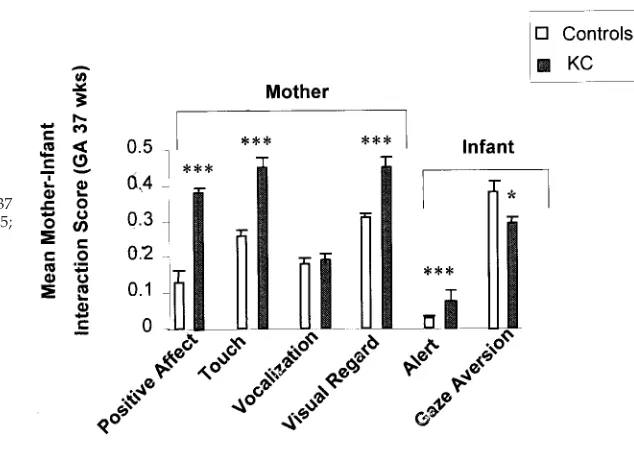
F [df ⫽ 6, 137] ⫽ 2.53; P ⬍ .05), ie, less optimal in-teractions between mothers and high-risk infants. Univariate tests, as tabulated in Table 3, indicated that after KC, mothers looked more at their infants, touched the infant more frequently, showed more positive affect, and were more adaptive to the in-fant’s signals. Infants who received KC had more alert-scanning episodes and showed less gaze aver-sion during mother–infant interactions. Univariate tests for medical risk showed that infants at lower risk were more alert (F[df⫽1, 137]⫽2.92;P⬍.01), and mothers of lower-risk infants displayed more positive affect (F[df ⫽ 6, 137] ⫽ 4.14; P⬍ .01) and looked more at the child (F[df⫽1, 137]⫽3.05;P⬍
.01) as compared with premature infants born at high risk. These findings are depicted in Fig 1.
Maternal Perceptions
A MANOVA conducted for the 2 maternal self-report measures at term (BDI, NPI) revealed an over-all positive effect for KC intervention (Wilks’F[df⫽
2, 141]⫽9.10;P⬍.001). Univariate tests showed that mothers who provided KC to their infants reported less depressive symptoms and perceived the infant as more normal and less divergent from the “average infant” (Table 3). An overall effect was also found for
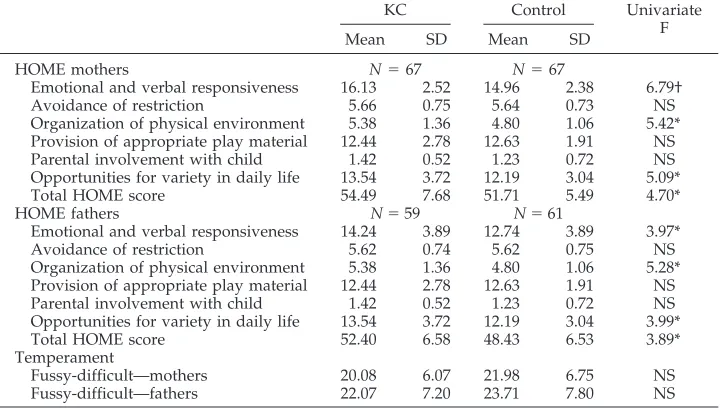
TABLE 2. Univariate Analysis of HOME
KC Control Univariate
F
Mean SD Mean SD
HOME mothers N⫽67 N⫽67
Emotional and verbal responsiveness 16.13 2.52 14.96 2.38 6.79†
Avoidance of restriction 5.66 0.75 5.64 0.73 NS
Organization of physical environment 5.38 1.36 4.80 1.06 5.42*
Provision of appropriate play material 12.44 2.78 12.63 1.91 NS
Parental involvement with child 1.42 0.52 1.23 0.72 NS
Opportunities for variety in daily life 13.54 3.72 12.19 3.04 5.09*
Total HOME score 54.49 7.68 51.71 5.49 4.70*
HOME fathers N⫽59 N⫽61
Emotional and verbal responsiveness 14.24 3.89 12.74 3.89 3.97*
Avoidance of restriction 5.62 0.74 5.62 0.75 NS
Organization of physical environment 5.38 1.36 4.80 1.06 5.28*
Provision of appropriate play material 12.44 2.78 12.63 1.91 NS
Parental involvement with child 1.42 0.52 1.23 0.72 NS
Opportunities for variety in daily life 13.54 3.72 12.19 3.04 3.99*
Total HOME score 52.40 6.58 48.43 6.53 3.89*
Temperament
Fussy-difficult—mothers 20.08 6.07 21.98 6.75 NS
Fussy-difficult—fathers 22.07 7.20 23.71 7.80 NS
NS indicates not significant. *P⬍.05.
medical risk (Wilks’F[df⫽ 2, 141]⫽ 4.86;P⬍ .01), with univariate tests showing that mothers of high-risk premature infants had significantly higher de-pression scores (mean: 9.35; SD: 1.74) than mothers of low-risk preterms, (mean: 6.85; SD: 1.74). A signifi-cant interaction effect of KC intervention by medical risk was found (Wilks’F[df⫽2, 141]⫽2.67;P⬍.05). Post hoc comparisons (Duncan’s test) revealed that among low-risk infants, differences between KC mothers (mean: 4.90; SD: 2.94) and control subjects (mean: 8.80; SD: 3.69) were highly significant (F[df⫽
1, 72]⫽ 20.92;P⬍.001). In the high-risk group, the differences between KC (mean: 9.03; SD: 4.54) and control subjects (mean: 9.62; SD: 4.16) were not sig-nificant (Fig 2).
Three Months
Mothers’ HOME
A MANOVA computed for the mothers’ HOME variables showed an overall effect for KC interven-tion (Wilks’F[df⫽7, 123]⫽2.99;P⬍.01), indicating that KC mothers provided a better home environ-ment.
Fathers’ HOME
A similar MANOVA for the fathers’ HOME vari-ables showed a comparable positive overall effect for KC intervention (Wilks’F [df⫽ 7, 110] ⫽ 2.45;P ⬍
.05), indicating that fathers also provided a more optimal environment for their infants. There was no overall effect on the mothers’ or fathers’ HOME scores when analyzed by medical risk. Univariate analyses, reported in Table 2, showed that both mothers and fathers of KC infants expressed higher levels of emotional and verbal responsiveness, were better adept at organization the physical and tempo-ral environment, and were more skilled in providing opportunities for variety in daily life. Mothers’ and fathers’ total HOME was higher for the KC group (Fig 3).
Infant Temperament
A MANOVA computed for the mothers’ and fa-thers’ fussy-difficult temperament scores from the ICQ revealed no significant effect of KC intervention or medical risk.
TABLE 3. Univariate Analysis of Mother–Infant Interaction and Maternal Self-Report at Term Age
KC (N⫽73) Control (N⫽73) Univariate
F
Mean SD Mean SD
Mother–infant interaction
Maternal positive affect* 0.38 0.10 0.13 0.29 22.39§
Maternal touch* 0.45 0.23 0.26 0.14 23.38§
Maternal vocalization* 0.19 0.14 0.18 0.14 NS
Maternal visual regard* 0.45 0.22 0.31 0.10 16.21§
Maternal adaptation† 4.00 1.12 3.32 1.13 10.89§
Infant alert* 0.07 0.08 0.03 0.05 8.18§
Infant gaze aversion* 0.29 0.15 0.38 0.27 4.86‡
Maternal attitudes
Maternal depression 6.68 5.55 9.05 4.27 5.68‡
Neonatal perception inventory 1.09 3.74 3.32 3.46 11.20§
NS indicates not significant.
* Numbers for states represent proportion of time for each behavior. † Numbers are coded globally on a scale of 1 to 5.
‡P⬍.05. §P⬍.001.
Six Months
Infant Cognitive Development
A MANOVA conducted for the 2 developmental indices of the Bayley-II (MDI and PDI) showed a significant overall effect for intervention (Wilks’ F
[df ⫽ 2, 128] ⫽ 5.41; P ⬍ .01), indicating improved infant development in the KC group. A separate overall effect was found for medical risk (F[df⫽ 2, 128] ⫽3.04;P⬍ .05), indicating that infants born at higher risk had slower development. An overall in-teraction effect of intervention and medical was also found (F [df ⫽ 2, 128] ⫽ 5.41; P ⬍ .01). Univariate
tests (Table 4) showed that after KC, infants scored higher on both the MDI and the PDI indices of the Bayley-II at 6 months’ corrected age. Univariate tests for medical risk showed that infants born at lower risk scored higher on the MDI (mean: 95.34; SD: 8.30) as compared with infants born at higher risk (mean: 92.22; SD: 9.55). Post hoc comparisons (Duncan’s test) revealed that among low-risk infants, differ-ences between the PDI scores of KC infants (mean: 87.31; SD: 20.32) and control subjects (mean: 84.09; SD: 12.02) were not significant. However, among high-risk infants, differences between KC infants
Fig 2. BDI scores of mothers of KC and control pre-mature infants born at high and low medical risk. ***P⬍.001.
Fig 3. Mothers’ and fathers’ total HOME scores at 3 months’ corrected age in KC and control subjects. *P⬍
.05.
TABLE 4. Univariate Analysis of Infants’ Mental and Psychomotor Development and Mother– Infant Interaction at 6 Months
KC (N⫽66)
Control (N⫽67)
Univariate F
Mean SD Mean SD
Infant development
MDI 96.39 7.23 91.81 9.80 6.55‡
PDI 85.47 18.42 80.53 13.33 4.68†
Mother–infant interaction
Maternal sensitivity* 4.20 0.64 3.86 0.76 5.36†
Infant social involvement* 2.42 0.68 2.27 0.89 NS
NS indicates not significant.
* Numbers are coded globally on a scale of 1 to 5. †P⬍.05.
(mean: 85.14; SD: 17.88) and control subjects (mean: 77.91, SD: 13.68) were significant (F [1, 62] ⫽ 6.27;
P ⬍ .01). These findings indicate that KC has an especially positive impact on the motor development of high-risk premature infants (Fig 4).
To control for the infant’s home environment in assessing cognitive development, a MANOVA with MDI, and PDI as the dependent variables, KC as the between-subject factor, and parents’ HOME as a co-variate was computed. Results indicated that, while controlling for mothers’ HOME, the cognitive devel-opment of KC infants was significantly higher as compared with controls (F [2, 126]⫽ 3.34;P⬍ .05). Similar results were found for the KC group while controlling for the fathers’ HOME (F[2, 114]⫽3.02;,
P⬍ .05).
Mother–Infant Interaction
A MANOVA conducted for the 2 mother–infant interaction factors—maternal sensitivity and child social involvement—revealed an overall effect for the KC intervention (Wilks’ F [df ⫽ 2, 128] ⫽ 4.21;
P ⬍.05), suggesting that mother–infant interactions were more optimal in the KC group. The medical risk status of the infant did not effect these interaction scores. Univariate tests (Table 4) indicated that ma-ternal sensitivity was higher at 6 months among
mothers who provided KC in the neonatal period (Fig 5).
Prediction of Infants’ Mental and Psychomotor Development at 6 Months
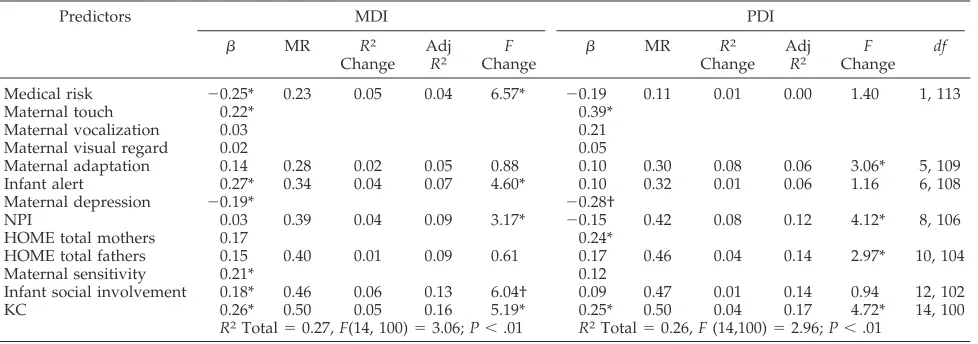
For examining the hypothesis that maternal, pater-nal, and infant variables each contribute to the in-fant’s cognitive development, 2 hierarchical regres-sion models were computed to predict infants’ mental and psychomotor development at 6 months by the parents’ perceptions and behaviors in the first half-year. Predictors were entered in 7 hierarchical blocks in a predetermined order. In the first block, infant medical risk was entered as a covariate, to partial out variance related to the infant’s biological risk. In blocks 2 to 4, neonatal measures were entered (maternal interactive behavior, infant interactive be-havior, maternal perceptions). In the fifth block, the 3-month measures were entered (mothers’ and fa-thers’ total HOME scores). In the sixth block, moth-er–infant interaction factors were entered (maternal sensitivity, infant social involvement). Finally, KC was entered as a binary variable to examine whether the provision of skin-to-skin contact contributed to infants’ mental and psychomotor development above and beyond all other variables in the model.
Results of the 2 regression models are presented in
Fig 4. MDI and PDI scores of KC and control pre-mature infants born at high and low medical risk. **P⬍.01.
Table 5. Infants’ MDI was independently predicted by medical risk at birth, by infant alertness during mother–infant interaction at 37 weeks’ GA, by lower maternal depression, and by higher maternal sensi-tivity and infant social involvement at 6 months. KC had an independent contribution to the prediction of infants’ mental development of 5% above and be-yond all other variables in the model. In combina-tion, all of the predictor variables including KC ex-plained 27% of the variability in infants’ mental development.
Infants’ PDI was predicted by mothers’ behavior during mother–infant interaction at 37 weeks’ GA, in particular the amount of maternal touch, by de-creased maternal depression, and by the mother’s total HOME score at 3 months. Again, KC had a unique contribution to the prediction of infants’ PDI scores of 4% above and beyond all other variables in the model. In combination, all of the predictor vari-ables including KC explained 26% of the variability in infants’ psychomotor development.
DISCUSSION
Results of this study, among the first to demon-strate long-term impact of the KC intervention method, indicate that KC had a positive contribution to 3 dimensions of early development: maternal and paternal perceptions, maternal and paternal behav-ior, and infant development, independent of the in-fant’s medical status. Mothers who provided KC were less depressed, perceived their infants as less abnormal, and provided increased maternal affilia-tive behaviors during the hospitalization period. Par-ents from the KC group provided a more sensitive and appropriately stimulating home environment, and KC mothers were more sensitive, adaptive, warm, and resourceful during social interactions at 6 months. Infants who had received KC were more socially alert, and their Bayley developmental scores at 6 months were higher in the mental (MDI) and motor (PDI) domains. Thus, these findings indicate that KC had a positive impact on both the child’s early development and the development of mother-ing and fathermother-ing across the first 6 months of life. The
gains in infants’ mental skills were independently related to parental perceptions, maternal and pater-nal behaviors, and infant attention. These findings are in line with previous research that pointed to the joint contribution of maternal behavior and infant attention to cognitive development,32independent of
the neonatal medical status.
Several theoretical models may provide a frame-work for understanding these findings. The first re-lates to the effects of maternal proximity and sepa-ration in the immediate postbirth period on infants’ physiologic homeostasis, attention, and exploration. Hofer’s work57 in animals delineated the complex
relations between various aspects of maternal prox-imity, ie, maternal touch, smell, body heat, and nurs-ing, on arousal regulation and attention. In prema-ture human infants, interventions that provide separate components of the “maternal proximity” complex, such as rhythmic stimulation or sensory enrichment, have been shown to affect infants’ cog-nitive skills.33,37Maternal–infant skin-to-skin contact
provides maternal proximity during a period when maternal separation is common and functions to in-crease infant attention, alertness, and exploratory skills, leading ultimately to better infant mental and motor skills.
The second perspective considers the effects of early mother–infant separation on maternal behavior in addition to its impact on the infant. The psycho-biological system implicated in the process of attach-ment has been associated with oxytocin, a hormone released during parturition and nursing as well as during contact, touch, and fondling.42 Oxytocin has
been shown to play a role in the initiation of mater-nal affiliative behavior and to affect positively the mother’s mood.58 Skin-to-skin contact is considered
to function as an oxytocin-releasing agent and has been shown to increase maternal milk volume.4It is
possible that the increase in maternal affiliative be-havior (eg, touch, gaze, positive affective display) and the decrease in depression are related to these underlying biological processes as well as to the psychological process of maternal attachment. Fur-thermore, the improvement in maternal affiliative
TABLE 5. Predicting Infants’ Mental and Psychomotor Development at 6 Months
Predictors MDI PDI
 MR R2
Change Adj
R2
F
Change 
MR R2
Change Adj
R2
F
Change
df
Medical risk ⫺0.25* 0.23 0.05 0.04 6.57* ⫺0.19 0.11 0.01 0.00 1.40 1, 113
Maternal touch 0.22* 0.39*
Maternal vocalization 0.03 0.21
Maternal visual regard 0.02 0.05
Maternal adaptation 0.14 0.28 0.02 0.05 0.88 0.10 0.30 0.08 0.06 3.06* 5, 109
Infant alert 0.27* 0.34 0.04 0.07 4.60* 0.10 0.32 0.01 0.06 1.16 6, 108
Maternal depression ⫺0.19* ⫺0.28†
NPI 0.03 0.39 0.04 0.09 3.17* ⫺0.15 0.42 0.08 0.12 4.12* 8, 106
HOME total mothers 0.17 0.24*
HOME total fathers 0.15 0.40 0.01 0.09 0.61 0.17 0.46 0.04 0.14 2.97* 10, 104
Maternal sensitivity 0.21* 0.12
Infant social involvement 0.18* 0.46 0.06 0.13 6.04† 0.09 0.47 0.01 0.14 0.94 12, 102
KC 0.26* 0.50 0.05 0.16 5.19* 0.25* 0.50 0.04 0.17 4.72* 14, 100
R2Total⫽0.27,F(14, 100)⫽3.06;P⬍.01 R2Total⫽0.26,F(14,100)⫽2.96;P⬍.01
behavior in the neonatal period seems to persist across the first months of life, and at 6 months moth-ers who provided KC were more sensitive, warm, and adaptive.
The third perspective is provided by the transac-tional model of early development.59 According to
this view, maternal and infant behaviors affect each other in an ongoing, mutually influencing manner to shape developmental outcomes. Infants who are more alert as newborns may elicit more sensitive mothering, leading to further improvement in the maternal style and to better developmental out-comes. Similarly, increase in maternal adaptation in the neonatal period may promote infant social atten-tion and outcomes. The separate effects of KC on mother and infant continue to influence the mother– child relationship, have an impact on the father– child relations, and create a better environment for development. Previous studies assessing interven-tion outcomes and cognitive development in low-birth-weight premature infants have confirmed the separate and cumulative effects of biological and social risk on development,60 – 62 emphasizing the
need to address both infant liabilities and maternal difficulties in devising intervention programs.
The home environment of the KC infants was found to be more optimal in terms of maternal and paternal sensitivity, parental organization of the en-vironment, and the availability of variety in the in-fant’s daily life. Because families in the 2 groups came from similar socioeconomic backgrounds, with comparable levels of education, income, and social support networks, we view these differences as re-sulting from the KC intervention, which contributed to the parents’ responsiveness to the needs of their premature infant. Moreover, KC was still found to have a positive impact on infants’ cognitive develop-ment while controlling for both maternal and pater-nal HOME scores, indicating that the relations be-tween the KC intervention and infant cognitive development were independent of the home envi-ronment.
KC had a significantly more positive impact on the motor development of high-risk as compared with low-risk preterm infants. These findings may be in-terpreted in line of the evolutionary perspectives on “differential susceptibilities to rearing environ-ment.”63This perspective suggests that infants who
are born at higher risk are more dependent on cor-rective environmental inputs, as their preparedness to extract necessary experiences for development from their environment is limited. We suggest that high-risk infants may be less skilled in eliciting ma-ternal touch as a result of factors such as incoherent signals or higher levels of withdrawal behavior dur-ing mother–infant interaction.64 Therefore,
struc-tured intervention involving maternal contact, such as KC, may be particularly beneficial to the develop-ment of motor skills in high-risk infants, especially because touch therapy has been shown to improve motor maturity in preterm infants.39
Although there is no doubt that the severity of the medical condition in preterm infants is a factor in the
infant’s ultimate development, it is important to em-phasize that our findings were independent of med-ical risk, as infants in the 2 groups were matched for medical risk and risk was statistically controlled in the regression analyses. Previous studies have noted that mothers look less and display less positive affect toward high-risk infants, while such infants are less alert,24,26 and these maternal and infant behaviors
are possibly mutually distracting. Mothers of high-risk infants are also more depressed, a process that potentially minimizes positive interactions and bonding with the infant. Thus, interventions in the NICUs should be aimed at increasing emotional in-vestment in the parenting process among mothers of very sick preterm infants, and our results suggest that KC is a successful intervention for achieving this goal.
Results of the 2 regression models point to the different predictors of infants’ attentive-perceptual (MDI) and perceptual-motor (PDI) competencies at 6 months. Infants’ mental score was predicted by infant alertness during social interaction with the mother in the neonatal period, pointing to the rela-tionship between infant attention and ultimate cognitive skills. Infants whose mothers were less de-pressed also showed better cognitive abilities, find-ings consistent with previous research regarding the detrimental impact of maternal depression on children’s cognition.30 Furthermore, infants whose
mothers were more sensitive and were more socially active at 6 months had higher MDI scores, pointing to the ongoing relations at various developmental periods between maternal and child social behavior and infant developmental outcomes. Psychomotor development (PDI), however, was predicted by ma-ternal touch during social interaction in the neonatal period and by the nature of the home environment. These results indicate that early maternal touch had an impact on psychomotor skills 6 months later. Such findings extend previous reports on the concurrent relations between massage therapy and motor matu-rity during the neonatal period.38,39 Similarly, the
findings indicate that an organized, enriched, and sensitive home environment—as measured by the HOME— had a unique contribution to the premature infant’s psychomotor development.
other than the mother, such as fathers, grandparents, personnel, or volunteers, has similar effects on the development of premature infants. Finally, compar-ison of outcomes with other intervention methods, such as massage therapy, minimal handling, or en-riched environments, is required to determine which method or combination thereof best fits a specific patient population to provide the most optimal in-tervention for the high-risk premature infant and his or her parents.
ACKNOWLEDGMENTS
This study was supported by the Irving B. Harris Early Devel-opment Education Program of the Shaare Zedek Medical Center and in part by Kibbutz Maabarot.
REFERENCES
1. Acolet D, Sleath K, Whitelaw A. Oxygenation, heart rate and tempera-ture in very low birth infants during skin-to-skin contact with their mothers.Acta Paediatr Scand. 1989;78:189 –193
2. Cleary GM, Spinner SS, Gibson E, Greenspan JS. Skin-to-skin parental contact with fragile preterm infants.J Am Osteopath Assoc. 1997;97: 457– 460
3. Ludington-Hoe SM, Hashemi MS, Argote LA, Medellin G, Rey H. Selected physiologic measures and behavior during paternal skin con-tact with Columbian preterm infants.J Dev Physiol. 1992;18:223–232 4. Bier JA, Ferguson AE, Morales Y, et al. Comparison of skin-to-skin
contact with standard contact in low-birth-weight infants who are breast-fed.Arch Pediatr Adolesc Med. 1996;150:1265–1269
5. Gray L, Watt L, Blass E. Skin-to-skin contact is analgesic in healthy newborn.Pediatrics. 2000;105(1). Available at: www.pediatrics.org/cgi/ content/full/105/1/e14
6. Fohe K, Dropf S, Avenarius S. Skin-to-skin contact improves gas ex-change in premature infants.J Perinatol. 2000;20:311–315
7. Messmer PR, Rodriguez S, Adams J, et al. Effect of kangaroo care on sleep time for neonates.Pediatr Nurs. 1997;23:408 – 414
8. Kambarami RA, Chidedo O, Kowo DT. Kangaroo care versus incubator care in the management of well preterm infants: a pilot study.Ann Trop Paediatr. 1998;18:81– 86
9. Ludington-Hoe SM, Anderson GC, Simpson S, Hollingsead A, Argote LA, Rey H. Birth-related fatigue in 34 –36-week preterm neonates: rapid recovery with very early kangaroo care.J Obstet Gynecol Neonatal Nurs. 1999;28:94 –103
10. Tornhage CJ, Stude E, Lindberg T, Serenius F. First week kangaroo care in sick very preterm infants.Acta Paediatr. 1999;88:1402–1404 11. Anderson GC. Current knowledge about skin-to-skin (kangaroo) care
for preterm infants.J Perinatol. 1991;11:216 –226
12. Conde-Agudelo A, Diaz-Rossello JL, Belizan JM. Kangaroo mother care to reduce morbidity and mortality in low birthweight infants (Cochrane Review).Cochrane Database Syst Rev. 2000;4:CD002771
13. Charpak N, Ruiz-Palaez JG, de Calume ZF. Current knowledge of kangaroo mother intervention.Curr Opin Pediatr.1996;8:108 –112 14. Affonso D, Bosque E, Wahlberg V, Brady JP. Reconciliation and healing
for mothers through skin-to-skin contact provided in an American tertiary level intensive care nursery.Neonatal Netw.1993;12:25–32 15. Tessier R, Cristo M, Velez S, et al. Kangaroo mother care and the
bonding hypothesis.Pediatrics.1998;102:e17
16. Neu M. Parents’ perception of skin-to-skin care with their preterm infants requiring assisted ventilation.J Obstet Gynecol Neonatal Nurs. 1999;28:157–164
17. Vohr BR, Garcia Coll CT. Neurodevelopmental and school performance of very low birthweight infants: a seven-year longitudinal study. Pedi-atrics.1985;76:345–350
18. Vohr BR, Wright LL, Dusic AM, et al. Neurodevelopmental and func-tional outcomes of extremely low birth weight infants in the Nafunc-tional Institute of Child Health and Human Development Neonatal Research Network, 1993–1994.Pediatrics. 2000;105:1216 –1226
19. Allin M, Matsumoto H, Santhouse AM, et al. Cognitive and motor function and the size of the cerebellum in adolescents born very pre-term.Brain. 2001;124:60 – 66
20. Barrera ME, Rosenbaum PL, Cunningham CE. Corrected and uncor-rected Bayley scores: longitudinal developmental patterns in low and high birth weight preterm infants.Infant Behav Dev. 1987;10:337–346 21. Holditch-Davis D. The development of sleeping and waking states in
high-risk preterm infants.Infant Behav Dev. 1990;13:513–531
22. Ruff HA. Attention and organization of behavior in high-risk infants.J Dev Behav Pediatr.1986;7:298 –301
23. McCall RB, Carriger MS. A meta-analysis of infant habituation and recognition memory performance as predictors of later IQ.Child Dev. 1993;64:57–79
24. Eckerman CO, Hsu HC, Molitor A, Leung EH, Goldstein RF. Infant arousal in an en-face exchange with a new partner: effects of prematu-rity and perinatal biological risk.Dev Psychol. 1999;35:282
25. Malatesta CZ, Grigoryev P, Lamb C, Albin M, Culver C. Emotion socialization and expressive development in preterm and full-term infants.Child Dev. 1986;57:316 –330
26. Minde K, Whitelaw A, Brown J, Fitzhardinge P. Effect of neonatal complications in premature infants on early parent-infant interaction.
Dev Med Child Neurol. 1983;25:763–777
27. Beckwith L, Parmelee AH. EEG patterns of preterm infants, home environment, and later IQ.Child Dev. 1986;57:777–789
28. Lester BM, Boukydis CF, Garcia-Coll CT, et al. Developmental outcome as a function of the goodness of fit between the infant’s cry character-istics and the mother’s perception of her infant’s cry.Pediatrics.1995; 95:516 –521
29. Brooten D, Gennaro S, Brown L, et al. Anxiety, depression, and hostility in mothers of preterm infants.Nurs Res. 1988;37:213–216
30. Goodman SH, Gotlieb IH. Risk for psychopathology in the children of depressed mothers: a developmental model for understanding mecha-nisms of transmission.Psychol Rev. 1999;106:458 – 490
31. Levy-Shiff R, Sharir H., Mogilner MB. Mother- and father-preterm infant relationship in the hospital preterm nursery.Child Dev. 1989;60: 93–102
32. Bornstein MH. How infant and mother jointly contribute to developing cognitive competence in the child.Proc Natl Acad Sci U S A. 1985;82: 7470 –7473
33. Resnick MB, Eyler FD, Nelson RM, Eitzman DV, Bucciarelli RL. Devel-opmental intervention for low birth weight infants: improved early developmental outcome.Pediatrics.1987;80:68 –74
34. Als H, Lowhon G, Duffy FH, McAnulty GB, Gibes-Grossman R, Blick-man JG. Individualized developmental care for the very low birth-weight preterm infant: medical and neurofunctional effects.JAMA. 1994;272:853– 858
35. Buehler DM, Als H, Duffy FH, McAnulty GB, Liederman J. Effective-ness of individualized developmental care for low-risk preterm infants: behavioral and electrophysiologic evidence.Pediatrics.1995;96:923–932 36. Thoman EB, Ingersoll EW. Learning in premature infants.Dev Psychol.
1993;29:692–700
37. Barnard KE, Bee HL. The impact of temporally patterned stimulation on the development of preterm infants.Child Dev. 1983;54:1156 –1167 38. Field T. Massage therapy for infants and children.J Behav Dev Pediatr.
1995;16:105–111
39. Scafidi FA, Field TM, Schanberg SM, et al. Massage stimulates growth in preterm infants: a replication.Infant Behav Dev. 1990;13:167–188 40. Thoman EB, Denenberg VH, Sievel J, Zeidner LP, Becker P. State
orga-nization in neonates: developmental inconsistency indicates risk for developmental dysfunction.Neuropediatrics.1981;12:45–54
41. Feldman R. Parents’ convergence on sharing and marital satisfaction, father involvement, and parent-child relationship at the transition to parenthood.Infant Mental Health J. 2000;21:176 –191
42. Insel TR. A neurobiological basis of social attachment.Am J Psychiatry. 1997;154:726 –735
43. Harlap S, Davies AM, Grover MB, Prywes B. The Jerusalem perinatal study: the first decade (1964 –1973).Isr J Med Sci.1977;13:1073–1091 44. Crockenberg S. Predictors and correlates of anger toward and punitive
control of toddlers by adolescent mothers.Child Dev.1987;58:964 –975 45. International Neonatal Network. The CRIB (clinical risk index for
ba-bies) score: a tool for assessing initial neonatal risk and comparing performance of neonatal intensive care units.Lancet.1993;342:193–198 46. Feldman R. Mother-Newborn Coding System Manual. Bar-Ilan, Israel:
Bar-Ilan University; 1998
47. Beck AT.Beck Depression Inventory. San Antonio, TX: The Psychological Corporation; 1978
48. Broussard ER, Hartner MS. Maternal perception of the neonate as related to development.Child Psychol Hum Dev.1970;1:16 –25 49. Caldwell B, Bradley R.Home Observation for Measurement of the
Environ-ment. Little Rock, AR: University of Arkansas; 1978
50. Bates JE, Freeland CA, Lounsbury ML. Measurement of infant difficult-ness.Child Dev. 1979;50:794 – 803
52. Feldman, R.Coding Interactive Behavior (CIB) Manual.Unpublished Man-ual. Bar-Ilan University; 1998
53. Feldman R, Masalha S, Nadam R. Cultural perspective on work and family: dual-earner Jewish and Arab families at the transition to par-enthood.J Fam Psychol. 2001;492–509
54. Keren M, Feldman R, Tyano S. Emotional disturbances in infancy: diagnostic classification and interactive patterns of infants referred to a community-based infant mental health clinic.J Am Acad Child Adolesc Psychiatry. 2001;40:27–35
55. Cohen J. A power primer.Psychol Bull. 1992;112:155–159
56. Cohen J.Statistical Power Analysis for the Behavioral Sciences. 2nd ed. Hillsdale, NJ: Erlbaum; 1988:55
57. Hofer MA. Hidden regulators: implication for a new understanding of attachment, separation, and loss. In: Goldberg S, Muir R, Kerr J, eds.
Attachment Theory: Social, Developmental, and Clinical Perspectives. Hills-dale, NJ: The Analytic Press; 1995:203–230
58. Carter SC. Neuroendocrine perspectives on social attachment and love.
Psychoneuroendocrinology.1998;23:779 – 818
59. Sameroff AJ. Understanding the social context of early psychopathol-ogy. In: Noshpitz J, ed.Handbook of Child and Adolescent Psychiatry. New York, NY: Wiley; 1997:224 –235
60. Bendersky M, Lewis M. Environmental risk, biological risk and devel-opmental outcome.Dev Psychol. 1994;30:484 – 495
61. Weisglas-Kuperus N, Baerts W, Smrkovsky M, Sauer PJ. Effects of biological and social factors on the cognitive development of very low birth weight children.Pediatrics. 1993;92:658 – 663
62. McCarton CM, Brooks-Gunn J, Wallace IF, et al. Results at age 8 years of early intervention for low-birth-weight premature infants.JAMA.
1997;277:126 –132
63. Belsky J. Theory testing, effect-size evaluation, and differential suscep-tibility to rearing influence: the case of mothering and attachment.Child Dev. 1998;68:598 – 600
64. Keren M, Feldman R, Eidelman AI, Sirota L, Lester B. Clinical Interview for high-risk parents of premature infants (CLIP): relations to mother-infant interaction.Infant Mental Health J. In press
THE CHINESE ARE COMING! THE CHINESE ARE COMING!
“. . . The [New York Times] Education Life supplement just reported that the best-selling book in China for the past 16 months is a book, in Chinese, about how to get your teenager into Harvard, titled ‘Harvard Girl Yiting Liu.’ In this book, a Chinese mother shares her ‘scientifically proven methods’ for getting her daughter into Harvard. It has sold more than 1.1 million copies and triggered 15 copycats for how to get into Columbia, Oxford, or Cambridge. In the same week it was reported that the normally intelligent Saudi ambassador in London, Ghazi Algosaibi, had published a poem in Al-Hayat in praise of the 18-year-old Palestinian girl who blew herself up in an Israeli supermarket, saying to her, ‘You died to honor God’s word’. . . A society that makes a best-seller about how to get its teenagers into Harvard will eventually build Harvards of its own. But leaders who glorify a teenager who committed suicide in a supermarket full of civilians will never build a country.”
Friedman TL.New York Times.April 24, 2002
DOI: 10.1542/peds.110.1.16
2002;110;16
Pediatrics
Ruth Feldman, Arthur I. Eidelman, Lea Sirota and Aron Weller
Outcomes and Preterm Infant Development
Comparison of Skin-to-Skin (Kangaroo) and Traditional Care: Parenting
Services
Updated Information &
http://pediatrics.aappublications.org/content/110/1/16
including high resolution figures, can be found at:
References
http://pediatrics.aappublications.org/content/110/1/16#BIBL
This article cites 53 articles, 8 of which you can access for free at:
Subspecialty Collections
sub
http://www.aappublications.org/cgi/collection/fetus:newborn_infant_
Fetus/Newborn Infant
following collection(s):
This article, along with others on similar topics, appears in the
Permissions & Licensing
http://www.aappublications.org/site/misc/Permissions.xhtml
in its entirety can be found online at:
Information about reproducing this article in parts (figures, tables) or
Reprints
http://www.aappublications.org/site/misc/reprints.xhtml
DOI: 10.1542/peds.110.1.16
2002;110;16
Pediatrics
Ruth Feldman, Arthur I. Eidelman, Lea Sirota and Aron Weller
Outcomes and Preterm Infant Development
Comparison of Skin-to-Skin (Kangaroo) and Traditional Care: Parenting
http://pediatrics.aappublications.org/content/110/1/16
located on the World Wide Web at:
The online version of this article, along with updated information and services, is
by the American Academy of Pediatrics. All rights reserved. Print ISSN: 1073-0397.