1116
Quantify The Reviewer Genunity Based On Behavior
Metrics And Past Trust Analysis
Pankaj Chaudhary, Dr. Anurag Aeron, Dr. Sandeep Vijay
Abstract— Internet has become easily accessible now days due to exponential growth of mobile and data networks. Smart phones have become easily accessible to a large number of people. This has made social networking an integral part of human life. People are sharing their comments and reviews on the forum or portal about their views and experiences. Even in taking the final decisions about the brand selections for best hotels, people are gradually depending on the previous online reviews. In such scenario, some companies may indulge themselves in generating the fake reviews with wrong intentions to create the positive or negative hype about the particular products. It may mislead the customers and decision makers. Several individual theories have been proposed by the researchers for fake review detection approaches, but effective integrated implementation is still underway. In this paper, some specific parameters are proposed to develop a robust model for identifying fake reviews and fake reviewers based on behavior matrix and past trust analysis. Although this work is specifically proposed for helping customers in selection of the best hotels by analyzing the previous online reviews, and help in concluding the right decision based on Location, Security, Price, Quality, Ambiance etc. Yet the something similar model may be designed after minor modifications for taking right decision in selecting the best colleges, best products etc.
Index Terms— Past trust analysis, behavior matrix, customer priority, deviation rate, bias rate, review similarity rate, review quality, relevance, content length, illustration, burst rate.
—————————— ——————————
1 INTRODUCTION
IN the large collection of reviews of a hotel several reviews and reviewers may be phony and these bogus reviews may mislead the overall conclusion about the hotel, therefore a robust mathematical model is proposed to identify the genuinity of the reviews and reviews to filter these reviews.
2 PARAMETERS TO IDENTIFY THE BEHAVIOR OF
REVIEWERLiu, Xu, Ai and Wang [21] proposed 8 mathematical characteristics for unusual behaviour of data sets. With some modification, we may propose following quantified indicators for hotel reviewers.
(1) Customer priority (2) Deviation rate (3) Bias rate
(4) Review Similarity rate (5) Review Quality Relevance (6) Content Length
(7) Illustration. (8) Burst rate
2.1 Customer priority
Hotel Customer rank information may be defined as below through the survey
Where u denotes a customer and α is booking coefficient, we
assume α = 1 if reviewer has booked that hotel earlier otherwise α = 0.2. Purpose of different values of α is to give more importance to the customer that booked the hotel.
T denotes the booking day coefficient.
T= 1.0 if reviewer has stayed 3 or more days in that hotel. T= 0.9 if reviewer has stayed 2 days in that hotel.
T= 0.7 if reviewer stayed for one day in that hotel. T= 0.2 if user did not stayed at that hotel.
Significance of T can be explained as giving more importance to the reviewer that has stayed 3 days in that hotel.
YOR: Yearly occupancy rate refers to how frequently the reviewer stayed in various hotels in a year.
This factor can vary between 0 to 1, e.g. if yearly a customer stayed at hotels for 100 days in some hotels that it will be 1, if customer stayed for 10 days per year that it will be 0.1. Significance of YOR is to give more importance to the reviews of the customer that stayed more in the hotels.
Customer priority will be between 0 to 1, lesser the value of CP means more importance to the customer.
2.3 DEVIATION RATE
We define the deviation rate of a review r as follows:
Where rp denotes the review rating of the hotel p given by the review r, and avg(rp) is the average review rating of the hotel p.
The Hotel's highest review rating is generally set to 5 in our investigation. So, we set the coefficient 5 in the formula. Reasonable reviews are consistent with the hotel‘s quality and do not deviate from all reviews' average. According to this feature, we can judge whether a review is irrelevant and hence fake.
————————————————
Pankaj Chaudhary, Research Scholar, FST, ICFAI University, Dehradun, India.
Dr. Anurag Aeron, Associate Professor, FST, ICFAI University, Dehradun, India.
Dr. Sandeep Vijay, Director, Shivalik College of Engineering,Dehradun, India
CP (u) = 1 – α × T × YOR
RD(r)
=
| ( ) | 5r pa v g r p
1117
Best part of above formula is that review ratings rp and avg(rp) can be taken on any scale but deviation rate will be come on scale of 5 only.
2.4
B
IAS RATEMultiple reviews of the same customer about a hotel may not be consistent. The customer‘s first review of a hotel may not represent the hotel's real experience, and the second review often reflects the user's true experience of the hotel. However, if a customer has written 3 or more reviews for the same hotel, those reviews were likely to contain bias to the hotel. Thus, we define the bias rate of the customer u for as follows:
0.6, if Cp=1 0.9, if Cp=2 B.R(u,r)=
1.0 if Cp>=3
Where cp denotes the number of reviews of the same hotel by the user u. Note that since multiple reviews of the customer on a product may contain prejudice, and Its just a convention based on the observations that some e-commerce websites only allow customers to write reviews two times for a product. Bias rate must be less.
2.5 REVIEW SIMILARITY RATE
To save time, some reviewers often copy other customer‘s reviews, using them as their own reviews without or with a few slight modifications. These plagiarized reviews come from the same hotel or similar hotels. The review similarity rate between two reviews ra and rb is defined as follows:
Ra RSR(Ra,Rb)=
cos
Rb
ra and rb will be first quantified based on some rating scale. Than cosine of the ratio will give us a glimpse of review similarity rate.
2.6 REVIEW QUALITY RELEVANCE
The review sometimes has nothing to do with the hotel itself, such as an advertisement, or a link, or a pre-prepared irrelevant content. The review quality relevance refers to the relevancy between the review content and the hotel. Each hotel has a unique topic to describe its characteristics, such as the hotel facilities, location, and range, to facilitate the customer‘s booking. The review quality relevance is defined as follows:
where W(s) is the set of all segmented words of the hotel‘s
quality parameters, and W(r) is the set of all segmented words of a review. The higher review quality relevance a review has, the more plausible the review.
Significance: If no expected words are found in W(s) and W(r) then Review similarity rate will be zero. If all words are found the it will be the highest e – 1.
2.7 C
ONTENT-LENGTHThe review's length is also an important indicator to identify spam reviews. When the review content is too short, we think the reviewer did not consider the hotel's experience seriously. So, this kind of review does not make much sense for data analysis. We use a piecewise linear
function to describe the review content's length as follows:
where r.length denotes the length of the review r, and
is a threshold to judge the effectiveness of the length of the review content. Very small reviews need to be ignored if they do not pass the other tests also.2.8 ILLUSTRATION
Most of the e-commerce websites now provide a function of uploading the product's pictures under use. To save review time, generally, the spam reviewer does not offer a picture of the product as the appendix of the review. Thus, we can use this feature to detect the spam reviews. The illustration of the review r is defined as follows:
where pr denotes the number of pictures that have been uploaded, and Limit denotes the maximum number of pictures that are allowed to be uploaded on the website.
2.9 BURST-REVIEW
Burst review refers to the case in which a customer has written a high volume of reviews for different products.
0, t < ,β N(u,t)
B.R(u,t)
1- ,
t ,βN(u)
where β is the time coefficient, N(u, t) denotes the number of reviews written by the customer u within t, and N(u) denotes the total number of reviews written by the customer u. as a convention, if the customer has written four or more reviews within half hour, these reviews may be spamming reviews
RQR (r ) =
e
( |W (s) ∩ W (r ) | / W(s) ) −10, r l e n g t h.
CL=
1, r l e n g t h.
Pic(r) =
2 P r /
lim
(
* *
1118
3
D
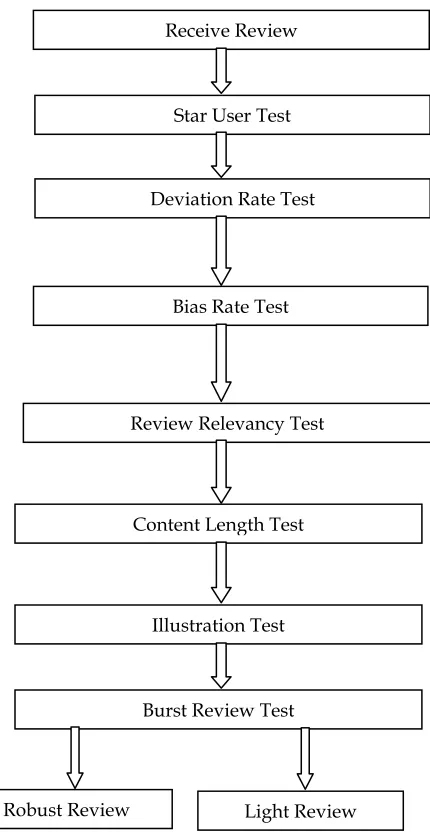
EVELOPMENT OF OPTIMAL MODEL FOR REVIEWERTRUST ANALYSIS:As per proposed algorithm, all reviews will be categorized into two categories.
Fig 1: Review categorisation tests
1. Robust Reviews (RR)- Robust reviews are that reviews that pass above tests.
2. Light Reviews (LR)- Light reviews are that reviews that do not pass above tests.
While consideration for further steps, importance to reviews is also given accordingly. A Sample survey was conducted on 638 Reviews and following were the results of filtration of quality reviews based on behavior matrix analysis
Table 1 Behavior Matrix
SN Parameters Genuine Reviews
1 Percentage Reviews that passed
Customer priority test 76%
2 Percentage Reviews that passed
Review Similarity rate test 82%
3 Percentage Reviews that passed
Review Quality Relevance test 83%
4 Percentage Reviews that passed
Content-Length test 78%
5 Percentage Reviews that passed Illustration test
84%
6 Percentage Reviews that passed
Burst Rate test 89%
68% 70% 72% 74% 76% 78% 80% 82% 84% 86% 88% 90%
Genuine Reviews
Customer priority test
Review Similarity rate test
Review Quality Relevance test
Content-Length test
Illustration test
Burst Rate test
Fig 2: Genuine reviews passed behavior matrix tests
4
A
NALYZE AND QUANTIFY THE PAST TRUST ANALYSISOF THE REVIEWER.
In this section, we describe an iterative model with a purpose to calculate the overall trustworthiness of the reviewers and use it as an indicator to determine the likelihood of being a review spammer.
Specifically, we first introduce a random walk with restart approach to infer the perceived trustworthiness of one user for another user based on the social relations between them, and then present our trust-based rating prediction model to derive proximity-based predictions to overcome the data sparsity problem.
Finally, we elaborate the design of the iterative model to compute an overall trustworthiness score for each user as the spamicity indicator.
Receive Review
Star User Test
Deviation Rate Test
Bias Rate Test
Review Relevancy Test
Content Length Test
Illustration Test
Burst Review Test
1119
4.1. INFERRING TRUST FROM SOCIAL RELATIONS
The goal of the work is to detect suspicious content and actions in online review systems based on the third-party user generated content concept.
It is conceivable that social relations among users can be utilized to measure the trustworthiness of a user perceived by others and extend it to the the third party he/she submits. Trust-aware recommendation systems or social collaborative recommendation systems are developed based on the assumption that users have similar tastes with other users they trust or connect to.
Such belief can be generated from the interactions among the users. In particular, we consider two relationships available in our dataset collected from Yelp.com: the social friendship that often reflects a strong tie between users with mutual and cooperative interactions, and the unilateral compliment relationship (similar to up-votes, helpfulness votes, etc. in other online review systems) that does not require a confirmation in the reverse direction.
Under our definition of trust, for a target user, the one-way compliment relationship represents an equally trustful relationship as the two-way friendship to other users since it indicates a subjective perception of trust.
Based on these considerations, we propose to represent the inherent relational structure among the users in a graph G and model the trustworthiness that a user i gives to other users as the proximity from node i to any other nodes in G.
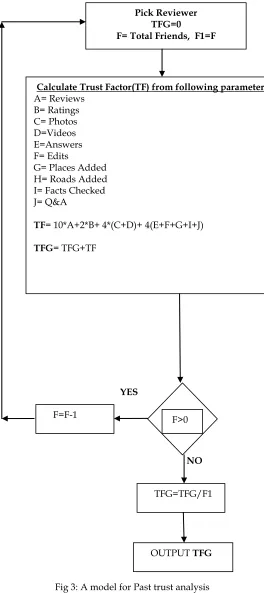
4.2 PROPOSED MODEL AND PARAMETERS TO ASSES PAST TRUST
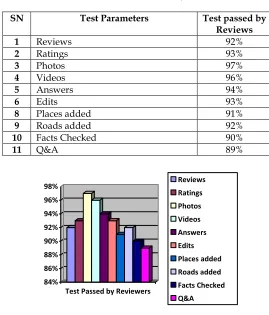
Once social relationship has been identified with the help of a graph individual user can be assessed based on following parameters that are available in public domain also. These are Reviews generated by the user in past, Ratings provided, Photos uploaded , Videos uploaded , Answers, Edits , Places added, Roads added, Facts Checked, Q&A
YES
NO
Fig 3: A model for Past trust analysis
Pick Reviewer TFG=0
F= Total Friends, F1=F
Calculate Trust Factor(TF) from following parameters
A= Reviews B= Ratings
C= Photos D=Videos E=Answers F= Edits
G= Places Added H= Roads Added I= Facts Checked J= Q&A
TF= 10*A+2*B+ 4*(C+D)+ 4(E+F+G+I+J)
TFG= TFG+TF
F>0 F=F-1
TFG=TFG/F1
1120
Table 2: Past Trust Analysis
SN Test Parameters Test passed by Reviews
1 Reviews 92%
2 Ratings 93%
3 Photos 97%
4 Videos 96%
5 Answers 94%
6 Edits 93%
8 Places added 91%
9 Roads added 92%
10 Facts Checked 90%
11 Q&A 89%
84% 86% 88% 90% 92% 94% 96% 98%
Test Passed by Reviewers
Reviews Ratings Photos Videos Answers Edits Places added Roads added Facts Checked Q&A
Fig 4: Past trust analysis
5.CONCLUSION AND FUTURE WORK
Above methods of quantification of genuine reviews are based on mathematical models and can give better results and less important or fake reviews and fake reviewers may further be ignored while calculate genuine conclusion about the parameters of the hotels.
Our model can further be improved by mathematically improving the procedures to calculate Customer priority, Deviation rate, Bias rate, Review Similarity rate, Review Quality Relevance, Content Length, Illustration, Burst rate. Also web regulators may be requested to provide more information about the activities of the reviewers in public domain in addition to Reviews, Ratings, Photos, Videos, Answers, Edits,Places added, Roads added, Facts Checked, Q&A
R
EFERENCES[1]. Xue H., Li F., Seo H. and Pluretti R., (2015), ―Trust-Aware Review Spam Detection‖, IEEE Computer Society Trustcom/BigDataSE/ISPA, pp. 726-733.
[2]. Fontanarava J., Pasi G. and Viviani M., (2017), ―Feature Analysis for Fake Review Detection through Supervised Classification‖, proceedings of IEEE International Conference on Data Science and Advanced Analytics, pp. 658-666.
[3] Liu P., Xu Z., Ai J. , Wang F., (2017), ―Identifying Indicators of Fake Reviews
Based on Spammer‘s Behavior Features‖, proceedings of IEEE International Conference on Software Quality, Reliability and Security, pp. 396- 403.
[4] Chauhan S.K., Goel A., Goel P., Chauhan A. and Gurve M.K., (2017), ―Research on Product Review Analysis and Spam Review Detection‖, proceedings of IEEE 4th International Conference on Signal Processing and Integrated Networks (SPIN), pp. 399- 393.
[5] Christopher S.L. and Rahulnath H. A., (2016), ―Review authenticity verification using supervised learning and reviewer personality traits‖, proceedings of IEEE International Conference on Emerging Technological Trends, pp. 16- 23.
[6] Fei G., Mukherjee A., Liu1 B., Hsu M., Castellanos M., Ghosh R., (2013), ―Exploiting Burstiness in Reviews for Review Spammer Detection‖ Proceedings of the Seventh International AAAI (Association for the Advancement of Artificial Intelligence) Conference on Weblogs and Social Media, pp. 175- 185.
[7] Shojaee S., Azman A., Murad M., Sharef N. and Sulaiman N., (2017), ―A Framework for Fake Review Annotation‖, proceedings of 17th IEEE Computer Society UKSIM-AMSS International Conference on Modelling and Simulation, pp. 153- 159.
[8] Ahsan M.N.I., Nahian T., Kafi A.A., Hossain I., Shah F.M., (2017), ―An Ensemble approach to detect Review Spam using hybrid Machine Learning Technique‖, IEEE 19th International Conference on Computer and Information Technology, pp. 381- 388.
[9] Ahsan M.N.I., Nahian T., Kafi A.A., Hossain I., Shah F.M., (2016), ―Review Spam Detection using Active Learning‖, IEEE 19th International Conference on Computer and Information Technology, pp. 368- 375.
[10] Ohana B and Tierney B, ―Sentiment classification of reviews using SentiWordNet‖ , 9th. IT & T Conference. 2009: pp 1232-1243
[11] Mudinas A., Zhang D. Levene M., ―Combining lexicon and learning based approaches for concept-level sentiment analysis‖, Proceedings of the First International Workshop on Issues of Sentiment Discovery and Opinion Mining. ACM, 2012: (5). pp 347-359.
[12] Jindal N., LIU B.. ―Review spam detection‖, Proceedings of the 16th international conference on World Wide Web. Canada. New York: ACM Press ,2007: pp 1189- 1190.
[13] Jindal N. and Liu B., ‗Opinion spam and analysis‖, Proceedings of the 2008 International Conference on Web Search and Data Mining. New York: ACM Press , 2008: pp 219-230.
[14] Jindal N., Liu B., Lim E., et al. ― Finding unusual review patterns using unexpected rules‖, Proceedings of the 19th ACM International Conference on Information and Knowledge Management. New York: ACM Press -2010 ; pp 1549-1552
[15] Wang G., Xie S., Liu B.,et al. ― Identify online store review spammers via social review graph‖ , ACM Transactions on Intelligent Systems and Technology, 2011,3(4):61.1-61.21.
[16 ] S. Feng, R. Banerjee, Y. Choi, ―Syntactic Stylometry for Deception Detection‖, ACL (2011), pp. 171-175.
1121 Consumer Reviews‖, International Conference on World Wide Web ACM, 2012,
pp. 191-200.
[18] G. Fei, A. Mukherjee, B. Liu, M. Hsu, M. Castellanos, R. Ghosh, R. ―Exploiting Burstiness in Reviews for Review Spammer Detection‖, ICWSM, 2013. pp 201-211
[19] A. Mukherjee, B. Liu, J. Wang, N. Glance, N. Jindal, ―Detecting Group Review Spam‖, International Conference on World Wide Web ACM, 2011, pp. 93-94.
[20] A. Mukherjee, A. Kumar, B. Liu, et al, ―Spotting opinion spammers using behavioral footprints‖ ACM SIGKDD International Conference on Knowledge Discovery and Data Mining. ACM, 2013, pp. 632-640.
[21] F. Li, M. Huang, Y. Yang, X. Zhu, ―Learning to Identify Review Spam‖ IJCAI, 2011, pp. 2488–2493.
[22] E.P. Lim, V.A. Nguyen, N. Jindal, B. Liu, H.W. Lauw, ―Detecting product review spammers using rating behaviors‖, Acm International Conference on Information & Knowledge Management ACM, 2012, pp. 939-948.
[23] T. Mikolov, I. Sutskever, K. Chen, et al, ―Distributed Representations of Words and Phrases and their Compositionality‖, Advances in Neural Information Processing Systems, 2013,vol. 26, pp. 3111-3119.
[24] B. Liu and L. Zhang. ―A Survey of Opinion Mining and Sentiment Analysis‖, Jour. Mining Text Data, 2012.
[25] Y. Zhang, G. Lai, M. Zhang, Y. Zhang, Y. Liu, and S. Ma, ―Explicit Factor Models for Explainable Recommendation based on Phraselevel Sentiment Analysis‖, SIGIR, 2014.
[26] Settles, Burr. "Active learning literature survey." University of Wisconsin, Madison 52.55-66 (2010): 11.
[27] Feng, S., Xing, L., Gogar, A., and Choi, Y. "Distributional Footprints of Deceptive Product Reviews". ICWSM. 2012
[28] T. Elsayed, J. Lin, and D. W. Oard, "Pairwise document similarity in large collections with MapReduce," in Proceedings of the 46th Annual Meeting of the Association for Computational Linguistics on Human Language Technologies: Short Papers, 2008, pp. 265-268.
[29] G. Esposito, LP-type methods for Optimal Transductive Support VectorMachines. Gennaro Esposito, PhD, 2014, vol. 3.
[30] P. Kalaivani and K. L. Shunmuganathan, "Sentiment classification of movie reviews by supervised machine learning approaches," Indian Journal of Computer Science and Engineering, vol. 4, no. 4, pp. 285-292, 2013.
[31] B. Pang and L. Lee, ―A sentimental education: Sentiment analysis usingsubjectivity summarization based on minimum cuts,‖ in Proceedings ofthe 42nd annual meeting on Association for Computational Linguistics.Association for Computational Linguistics, 2004, p. 271. [Online]. Available from: http://www.cs.cornell.edu/People/pabo/movie%2Dreview%2Ddata/
[32] S. Hassan, M. Rafi, and M. S. Shaikh, ―Comparing svm and naive bayesclassifiers for text categorization with wikitology as knowledge enrich-ment,‖ in Multitopic Conference (INMIC), 2011 IEEE 14th International.IEEE, 2011, pp. 31– 34..
[33] C.-H. Chu, C.-A. Wang, Y.-C. Chang, Y.-W. Wu, Y.-L. Hsieh, and W.-L. Hsu, ―Sentiment analysis on chinese movie review with distributedkeyword vector representation,‖ in Technologies and Applications ofArtificial Intelligence (TAAI), 2016 Conference on.IEEE, 2016, pp.84–89
AUTHORSPROFILE
Pankaj Chaudhary has completed his B.Tech and M.Tech, he is Ph.D(CSE) reasearch scholer at ICFAI University, Dehradun . He has published 16 National and International research papers in jounrals of repute. He has also attended several conferences.Currently he is doing his reasearch in analysing the genuinity of the online reviews of hotels.
Dr. Anurag Aeron is Associate professor(CSE) at ICFAI University, Dehradun, He has completed his Ph.D from
IIT Roorkee. His research areas are Remote Sensing and
GIS, Open Source Systems, Disaster Management, AI, Android Operating System, Machine Learning, IOT, NLP.
.