International Journal of Synergy and Research
Vol. 7, 2018 pp. 59-79
Teachers’
Perceived
Factors of
Deviant
Behavior among
Secondary
School Students
in Kwara State:
Implication for
Educational
Managers
Teachers’ Perceived Factors of Deviant
Behavior among Secondary
School Students in Kwara State:
Implication for Educational
Managers
Yusuf Suleiman
Unicaf University, Cyprus
[email protected]
https://orcid.org/0000-0002-4740-6839
Jamiu Mahmood Suleiman
Kwara State College of Arabic & Islamic Legal Studies, Nigeria
[email protected]
Mahmud Aremu Musa
Kwara State College of Arabic & Islamic Legal Studies, Nigeria
[email protected]
Yusuf Abiola Abubakar
Kwara State Universal Basic Education Board, Nigeria
[email protected]
Abstract
This study investigates students’ deviant behaviors as perceived by their teachers in secondary schools with the aim of knowing the factors responsible for such behaviors. The study adopts the quantitative approach to carry out the research. Stratified and simple random techniques were used to select 380 participants that participated in the study. An instrument tagged “Factors of Deviant Behaviors and Measures Questionnaire” (FDBMQ) was used to elicit data from the respondents. Partial Least Square (PLS) software was used to assess the psychometric properties of the items contained in the questionnaire, while Statistical Package for Social Sciences (SPSS) was used to do the descriptive analysis. In addition, the analysis of variance (ANOVA) was used to test the three hypotheses formulated for the study. Results of the study revealed three factors (parent, society and school) that contribute to deviant behaviors. Findings also indicate measures that can be used to minimize deviant behaviors. Also, the results of the ANOVA showed a significant difference, while Duncan’s Multiple Range Test (DMRT) was used as a post-hoc test to determine the group that
IJSR
7
contributes to the significant difference. The results of the three hypotheses confirmed that significant difference exists on the basis of religion, age, and educational qualifications. Based on the findings of the study, implication for educational managers and future research direction were provided.
Keywords – teachers’ perception, deviant behavior, educational managers, secondary school, Kwara State
1. Introduction
Deviant behavior is seen as any behavior that does not fit in to the established rules of
a group of individuals or the society at large (Idris, 2016; Orsati and Causton-Theoharis, 2013; Vieno et al., 2011; Zakaria et al., 2013). Deviant behavior is an activity which
conflicts with the societal norms. It can also be described as engagement of people
in criminal offences, antisocial and unethical behavior. Deviant behavior could also be any form of behavior that contravenes the rules and regulations or even laws that govern an establishment (Esere, 2008; Dyregrov et al., 2013; Richardson, 2014; Ryan
and Shim, 2012). According to Bolu-Steve and Esere (2017), a teenager finds it hard to
conform to the customs of the society because he or she is in adolescence stage during which an individual progresses from the point of initial appearance of the secondary sexual characteristics to that of sexual maturity. This period is escorted by various
modifications that are significant in intellectual, emotional, physical and social areas.
Ibrahim (2009) noted that an adolescent is someone who is unstable, angry, moody, self-conscious and inexperienced in handling emotional problems. Adolescence, from a psychological point of view, is a stage or period dominated by pressures and stress due
to inner emotional volatility and as a result of disagreeing external influence.
The demonstration of deviant behavior among students in school, often leads to ineffective teaching and learning. The unruly behavior among students leads to great consequences in their academic pursuit (Ojedokun et al., 2013; Ololube, 2013; Pas
and Bradshaw, 2014). Researchers have identified different types of deviant behavior
among students in school; these include cultism, stealing, bullying, smoking, raping, examination malpractice, truancy (Esere, 2008; Polanin and Low, 2014). Ponfua (2015)
classified types of deviant behavior into three categories; they include cases relating to
disobedience to school authority (e.g. assault on and insult to teachers and non-teachers); cases relating to the collective misbehavior of students groups (e.g., vandalism, mass protest and cultism) and cases relating to poor habits (e.g. speaking pidgin English, chewing gum in class, examination malpractice, wearing dirty and wrong uniform,
fighting, drug abuse, alcoholism, and idleness).
Generally, deviant behavior is common among youth (irrespective of their age, religion, culture, creed, and sex) and it is seen as a global phenomenon. In Africa, report shows that prevalence of bullying in South African schools ranges from 12% to 61%. Reported bullying victimization occurrence rates in schools in other African countries are as follows: Botswana 52%, Ghana 59%, Kenya 57%, Mauritius 40%, Namibia 52%, Tanzania 28%, Uganda 46%, and Zambia 65%. The foregoing information highlights the pervasive rate of deviant behavior among African adolescents. In Nigeria, it is reported that bullying victimization prevalence is 78% among junior secondary school students (Owusu et al., 2010). In 2017, primary school pupils in Kaduna protested against the
sack of 21,780 teachers by the state government (Pulse News, 7 November 2017). The Nation newspaper of 8 August 2017 reported that 30 people were killed in cult clashes among youths in Kwara State, Nigeria.
Idowu (2008) and Ukwayi et al. (2012) reported that peer pressure influenced students
to involve in tobacco smoking. Boyd (2015) noted that many students are involved in the use of amphetamines, tobacco barbiturates and heroin. Similarly, Idris (2016) gives details of several cases of cultism, smoking, sexual abuse, destruction, extortion, threats and coercions as reported by school principals. Studies revealed that factors of deviant behavior are yet to be fully explored, which prompts the present study to investigate teachers’ perceived factors responsible for deviant behavior in secondary schools in Kwara State.
2. Literature review
Several studies have been conducted on deviant behaviors of students as something that is inimical to their educational pursuit. For instance, Espelage et al. (2014) studied on
bullying, family violence, alcohol and drugs taking as it influences students’ behaviors
in the school system. The study employed quantitative approach for the study. The respondents for the study were drawn out from among African and American students in four middle schools in the United State of America. Survey instrument was completed
by the participants. The outcome of the study found that family violence influences
the male students in the school to engage in deviant behaviors. Also, females who were exposed to family violence and bullying had greater probability of engaging in unwholesome behaviors in the school. The study recommended that future studies should focus on other forms of deviant behaviors among students.
Cluver et al.’s (2010) investigation revealed that internal personal conflict witnessed
by children enables them to behave in an immoral way in the school. Research conducted on adolescent misperceives and behaviors among students in the school
system demonstrated that associate group generalizations are personifications. The
study showed that teenagers misinterpret their peers’ high-risk practices, and such an
understanding encourage young adolescents to behave in a specific way, related to danger
(Efstratopoulou et al., 2012; Helms et al., 2014; Jamiu, 2011; Oyerinde, 2004).
Reid (1999) found that students who come from poor background engaged in truancy in school, while Gray and Jesson (1990) found that students from the single-parent family have a poorer attendance rate than those from the more traditional family. Siziya et al. (2007) reported that some parents rarely checked homework; they neither understood
the difficulties and concerns of students nor supervised the students and this often leads
to students to engage in situations that are not in line with societal norms. Akseer et al. (2014) focused their study on the perceptions of teachers concerning shyness among male and female students in Canadian elementary schools. In their study, they found that teachers perceived differences in shyness between boys and girls in the classroom. They concurred that shyness is more common among boys than girls. Malak et al. (2014) studied teachers’ perception of deviant behaviors of students in Bangladesh schools. Selected teachers were interviewed in order to know their perceived perception of their students in the school system. The above-mentioned authors found that teachers viewed the behaviors as disruptive, aggressive and disrespectful and they were of the opinion that these behaviors of students are unacceptable, intentional and not likely to change.
Teachers’
Perceived
Factors of
Deviant
Behavior among
Secondary
School Students
in Kwara State:
Implication for
Educational
Managers
IJSR
7
The study concluded that lack of punishment in school and poor parenting could be responsible for the behaviors. The study suggested that measures should be implemented in order to curb these annoying behaviors.
Ponfua (2015) examined the students’ indiscipline in secondary schools in Cameroon and found that student-based factor, parent-based factor and school-based factor are causes of students’ deviant behavior. Garry (2001), Omoegun (1995), Osarenren (1996)
and Owodunni (2008) reported that insufficiencies at home and lack of capacity to make
petty cash to augment family income and unfavorable home conditions cause unruly behavior such as truancy. Yarduma and Abdulamid (2007) found that the dynamic explosion of the media system through Facebook, Twitter, LinkedIn, WhatsApp, Imo, YouTube, television, radio, magazines and newspapers as well as computer have contributed to the inculcation of deviant practices among students in school. They noted that some programs which are broadcast on radio and television usually promote violence and pornography among students.
Salami and Aremu (2006) investigated the relationship between problem-solving ability and study behavior among school-going adolescents in south-western Nigeria. They found that deviant conduct starts when students show immoral acts, for example,
pick-stashing, fleeing from home, group association, involvement in illicit sexual activities and
truancy. Estévez et al. (2005) limited their studies to victimization and violent behaviors of students in the school by examining the role of teachers and parents. The results indicated
that a victimized student, which is also having a conflict relationship with the parents,
affects the psychological problems of such student. The results also suggest that peer victimization leads to psychological depression among students. The study concluded that other behaviors among students should be examined to know whether it will give
similar findings or not. Yaroson (2006) reported that unrealistic school rules are the causes
of indiscipline and concluded that rules and regulations are meant to guide and control activities in school but when they become too much and unenforceable, they tend to breed indiscipline. Asiyai (2005), Iheanyi and Ikechi (2012), Oyesola (2002) and Rothman (2001) concluded that students’ emotional instability and unconducive school environment are responsible for deviant behavior such as truancy in secondary school.
Furthermore, literature on the subject shows that, according to the social learning
theory, family and peer relationships exert a significant influence on adolescent alcohol
or liquor use as they constitute the primary environment where good and bad morals are learned. Social learning theory postulates that an individual learns to take alcohol or drugs in small and informal groups. Undeniably, it is in these formal groups that adolescents learn favorable or unfavorable behavior of alcohol use. Therefore, the emphasis of many social learning theorists is on peers as a result of the importance which children or adolescents give to their friends as they reach adulthood and gradually gain independence from their parents (Akers, 1998; Akers and Sellers, 2004; Akers and Jensen, 2005). In the same vein, Sigmund Freud’s psychological theory suggests that individuals are predisposed to deviant
behavior when they are fixed at any stage of development and that human beings have natural drives and compulsions that are stifled in the unconscious. Freud also believed
that all human beings have criminal propensities and their behaviors are curbed through the process of socialization. A child that does not socialize properly can develop antisocial
stages, such an individual can engage in deviant behavior. Freud stressed the importance
of early years of childhood fixation in defining the adult personality (Omotosho, 2009).
Bolu-Steve and Esere (2017) found that the experience of the counselors differ in terms of an appropriate strategy for managing deviant behavior among in-school adolescents irrespective of their years of service, religion and school type. The gender of the counselor tends to modify the strategies applied in the management of deviant behavior among in-school adolescents. Studies conducted by Ojo (2000) and Sulaiman (2011) examined several strategies that can be used to reduce deviant behaviors in secondary schools. They concluded that students need to be assisted in handling contemporary challenges and that information-based intervention is an effective strategy in handling deviant behavior, so counselors should always provide right information to in-school adolescents about the negative effects of deviant behaviors.
In view of the foregoing studies, the focus of the present study is to investigate teachers’ perceived factors of deviant behavior among students in secondary schools.
Research Questions
1. What are the factors responsible for deviant behavior among students?
2. What are the measures that can be used to reduce deviant behavior among students?
3. Is there any significant difference in perception of deviant behavior based on teach
-ers’ religion, age and educational qualification?
Research Objectives
1. To identify possible factors responsible for deviant behavior among students. 2. To provide measures that can be used to reduce deviant behavior among students.
3. To find out if there is a significant difference in perception of deviant behavior based on teachers’ religion, age and educational qualification.
Research Hypotheses
1. There is no significant difference in teachers’ perception of deviant behaviors based on religious affiliation.
2. There is no significant difference in teachers’ perception of deviant behaviors based
on age.
3. There is no significant difference in teachers’ perception of deviant behaviors based on educational qualification.
3. Materials and methods
Population/sampling techniques
The study adopted the descriptive survey research design method. The target population for this study consisted of secondary schools teachers (both public and private).
Specifically, 320 teachers were selected (using stratified and simple random techniques) from five secondary schools in the Ilorin metropolis area of Kwara State, Nigeria
(Creswell and Clark, 2007; Sekaran and Bougie, 2009).
Teachers’
Perceived
Factors of
Deviant
Behavior among
Secondary
School Students
in Kwara State:
Implication for
Educational
Managers
IJSR
7
Study instrument
The instrument adopted for the study is questionnaire entitled “Factors of Deviant Behaviors and Measures Questionnaire” (FDBMQ). The items in the questionnaire were adapted from the work of Iheayi and Ikechi (2012) and Ponfua (2015) to investigate teachers’ perceived factors of deviant behavior among students. The respondents to the instrument indicated one response option on a 4-point Likert-type summated rating scale of agreement with assigned values of “Strongly Disagree” (SD) – 1, “Disagree” (D) – 2, “Agree” (A) – 3, and “Strongly Agree” (SA) – 4 in order of agreement. The design of the questionnaire was based on the research questions and hypotheses raised in this study (Creswell, 2009; Sekaran and Bougie, 2009).
Content validity and reliability of the instrument
Content validity can be defined as a measure of how well a test measures what it supposed
to measure. In order to ensure good validity of the adapted instrument, the instrument
was given to experts in the field of the study who read through the items and made useful suggestions which were later incorporated into the final copy before administering it to
the respondents (Creswell, 2009). In the same vein, reliability refers to the degree to which the items that make up the scale are all measuring the same underlying attribute. Therefore, in order to ensure reliability of the instrument, a pilot study was conducted by using 50 teachers in one of the secondary schools selected study for the main study. The Cronbach’s alpha of the pilot study revealed 0.83 for the adapted instrument (Creswell and Clark, 2007; Pallant, 2010).
Data collection and analysis procedure
In order to increase response rate in this study, we employed two research assistants who assisted us in collecting data. All the questionnaires distributed and administered to the respondents were collected by the researchers (Creswell and Clark, 2007). Both Partial Least Square (PLS) and Statistical Package for Social Sciences (SPSS) were used for data analysis. The PLS software was used to assess the psychometric properties of the instrument, while SPSS was used for the descriptive analysis. Also, the analysis of variance (ANOVA) technique was used to test the three hypotheses formulated,
while Duncan’s Multiple Range Test was used to determine the direction of significant
difference (Creswell and Clark, 2007; Sekaran and Bougie, 2009).
4. Data analysis
Response rateA total of 380 questionnaires were distributed to teachers in five selected secondary
schools located in the Ilorin metropolis area of Kwara State, Nigeria. In order to ensure high response rate, we made several visits to schools, with a view to ensuring high return questionnaires (Pallant, 2010). Out of 380 questionnaires distributed, 342 questionnaires were returned, while 38 were not. Because substantial parts of the
questionnaires were not properly filled by the participants, we have a total number of
40 unusable questionnaires, and the remaining 302 duly completed questionnaires were
used for the analysis. Therefore, 90% of response rate is considered appropriate for the analysis in this study which is in line with Sekaran and Bougie’s (2009) suggestion that a response rate of 30% and above is good enough for the survey research. Table 1 shows the response rates to the questionnaires.
Response Rate
Questionnaires distributed 380 Questionnaires returned 342 Questionnaires not returned 38 Invalid questionnaires 40 Valid questionnaires 302 Response rate 90%
Source: Authors’ own study.
Respondents’ profile
Variable Category Frequency Percentage
Gender
Male 178 59 Female 124 41 Total 302 100 Age
21–30 8 3 31–40 230 76 41–50 36 12 51 and above 28 9 Total 302 100 Religion
Islam 173 57 Christianity 129 43 Total 302 100 Academic
qualification
NCE and ND 212 70 BSc, HND and above 90 30 Total 302 100 Working experience
Less than 1 year 35 12 1–5 years 131 43 6–10 years 120 40 10 and above 16 5 Total 302 100
Source: Authors’ own study.
Table 2 explains the profile of the respondents who participated in the study. The profile includes: gender (male – 178 (59%) and female – 124 (41%)); age (21–30 (3%), 31–40 (76%), 41–50 (12%), 51 and above (9%)); religion (Islam – 173 (57%), Christianity – 129 (43%)); academic qualification (NCE-ND – 212 (70%), BSc, HND and above 90 (30%)); and workingexperience (less than 1 year – 35 (12%), 1–5 years – 131 (43%), 6–10 years – 120 (40%), 10 years and above – 16 (5%)).
Table 1.
Response rates
Teachers’
Perceived
Factors of
Deviant
Behavior among
Secondary…
Table 2.
Profile of the respondents
IJSR
7
Assessment of psychometric properties of the variables
The assessment of individual item reliability of the variables is considered necessary for this study so as to know whether items adapted measure what they suppose to measure (Duarte and Raposo, 2010). According to Hair et al. (2012), individual item reliability of the variables can be assessed by examining the outer loadings of each construct’s measure. To achieve that, the individual items of the study were assessed by examining the outer loadings of the construct’s measure. In line with rule of thumb for retaining items with loadings between .40 and .84, as recommended by Hair et al. (2012), therefore, the items in this study had loadings between .734 and .987 (see Table 3).
Variable Code Loadings
Parent Factor (PF)
PF1 .801 PF2 .987 PF3 .851 PF4 .818 PF5 .897 PF6 .866 Societal Factor (SF)
SF1 .810 SF2 .826 SF3 .815 SF4 .866 SF5 .817 School Factor (SF)
SF1 .828 SF2 .834 SF3 .812 SF4 .844 SF5 .821 SF6 .872 SF7 .734 SF8 .831 SF9 .846 SF10 .789 SF11 .811 Reducing Deviant Behavior
RD1 .846 RD2 .833 RD3 .901 RD4 .875 RD5 .809 RD6 .869 RD7 .961 RD8 .902 RD9 .892 RD10 .861
Source: Authors’ own study.
Table 3.
Item loadings
Response to Research Questions
Research Question No. 1:What are the factors responsible for deviant behavior among students?
Item SD D A SA Remark
PF1 Over pampering of children by parents – – (26%)78 (74%)224 Agreed PF2 Rejection of children by parents (1%)2 (3%)8 (1%)2 (96%)290 Agreed PF3 Parents’ separation (12%)35 (2%)5 (19%)58 (67%)204 Agreed PF4 Lack of value for education demonstrated by parents (21%)64 (4%)12 (67%)203 (8%)23 Agreed PF5 Father’s or mother’s death (7%)20 (3%)8 (23%)70 (67%)202 Agreed PF6 Parents with financial difficulties (2%)7 (8%)23 (40%)120 (50%)152 Agreed
Source: Authors’ own study.
Results presented in Table 4 show that respondents supported the statement (78 respondents agreed) that over pampering leads to students’ deviant behavior, while majority of the respondents concurred (224 respondents strongly agreed) that over pampering of children by parent causes a student to exhibit deviant behavior in school. Most of the respondents also agreed that rejection of children by parents (290 respondents strongly agreed) and parents’ separation (204 respondents strongly agreed) result in students’ maladaptive behaviors. Similarly, the results presented in Table 4 revealed that lack of value for education demonstrated by parents is one of the factors responsible for students’ indiscipline in school (203 respondents agreed). In addition, it was revealed that most of the respondents agreed (202 respondents strongly agreed) with the statement that father’s or mother’s death leads to students’ misbehavior, whereas 152 respondents
strongly agreed with the statement that parents with financial difficulties often make
students involve in all kinds of deviant behaviors.
Item SD D A SA Remark
SF1 Poor value system (7%)20 (8%)27 (34%)102 (51%)153 Agreed SF2 Injustice in the society (2%)5 (2%)7 (3%)10 (93%)280 Agreed SF3 Unwholesome mass media (0%)– (0%)– (42%)128 (58%)174 Agreed SF4 Peer influence (0%)– (0%)– (41%)124 (59%)178 Agreed SF5 Lack of preaching about good deeds by religious leaders (4%)12 (17%)50 (73%)220 (6%)20 Agreed
Source: Authors’ own study.
Teachers’
Perceived
Factors of
Deviant
Behavior among
Secondary
School Students
in Kwara State:
Implication for
Educational
Managers
Table 4.
Parent factor
Table 5.
Societal factor
IJSR
7
Results in Table 5 indicate that societal factors contribute to deviant behavior among students in secondary school as agreed by the majority of the respondents. One hundred
and fifty-three respondents strongly agreed with the statement that poor value system
contributes to deviant behavior. With regard to social injustice, 280 respondents strongly agreed with the fact that it leads to maladaptive behavior, and 174 respondents were of the same opinion as far as the unwholesome mass media is concerned. In the same vein,
the statement that peer influence contributed to students’ deviant behavior was shared by
178 respondents, whereas the fact of no preaching about good deeds by religious leaders as a factor which leads to such behaviors received 220 positive responses. Therefore, it can be said that the foregoing student factor is responsible for students’ involvement in behaviors that are not in line with school rules and regulations.
Item SD D A SA Remark
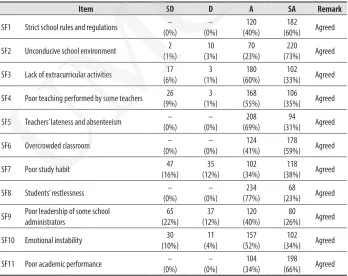
SF1 Strict school rules and regulations (0%)– (0%)– (40%)120 (60%)182 Agreed SF2 Unconducive school environment (1%)2 (3%)10 (23%)70 (73%)220 Agreed SF3 Lack of extracurricular activities (6%)17 (1%)3 (60%)180 (33%)102 Agreed SF4 Poor teaching performed by some teachers (9%)26 (1%)3 (55%)168 (35%)106 Agreed SF5 Teachers’ lateness and absenteeism (0%)– (0%)– (69%)208 (31%)94 Agreed SF6 Overcrowded classroom (0%)– (0%)– (41%)124 (59%)178 Agreed SF7 Poor study habit (16%)47 (12%)35 (34%)102 (38%)118 Agreed SF8 Students’ restlessness (0%)– (0%)– (77%)234 (23%)68 Agreed SF9 Poor leadership of some school administrators (22%)65 (12%)37 (40%)120 (26%)80 Agreed SF10 Emotional instability (10%)30 (4%)11 (52%)157 (34%)102 Agreed SF11 Poor academic performance (0%)– (0%)– (34%)104 (66%)198 Agreed
Source: Authors’ own study.
The research results in Table 6 reveal that majority of the respondents agreed that strict school rules and regulations lead to deviant behavior among secondary school students (182 respondents strongly agreed, 120 respondents agreed). As for unconducive school environment, 220 respondents strongly agreed and 70 respondents agreed with the statement that it is a school-based factor of deviant behavior among students in secondary schools. Also, lack of extracurricular activities was perceived as such a factor by 180 (agreed) and 102 (strongly agreed) respondents, indicating that it is responsible for deviant behavior. Similarly, 168 respondents agreed and 106 respondents strongly
Table 6.
School factor
agreed with regard to poor teaching performed by some teachers as it contributes to deviant behavior among students, while in case of teachers’ lateness and absenteeism, such an opinion is shared by 208 (agreed) and 94 (strongly agreed) respondents. Also, overcrowded classroom contributes to students’ maladaptive behavior (124 agreed, 178 respondents strongly agreed) and similarly, poor study habit (102 agreed, 118 strongly agreed). Furthermore, students’ restlessness is also a school-based factor that leads to the above-mentioned behavior (234 respondents agreed, 68 respondents strongly agreed). The same opinion is shared in case of poor leadership of some schools (120 respondents agreed, 80 respondents strongly agreed). The research result concerning the last two school-based factors presented in Table 6 reveal that emotional instability and poor academic performance are perceived as factors leading to students’ deviant behavior (157 respondents agreed, 102 respondents strongly agreed, and 104 respondents agreed, 198 respondents strongly agreed, respectively).
Research Question No. 2: What are the measures that can be used to reduce deviant behavior among students?
S/N Item SD D A SA Remark
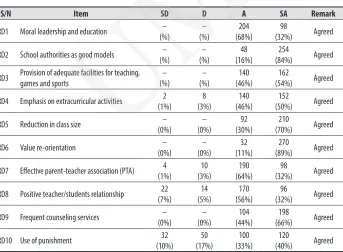
RD1 Moral leadership and education (%)– (%)– (68%)204 (32%)98 Agreed RD2 School authorities as good models (%)– (%)– (16%)48 (84%)254 Agreed RD3 Provision of adequate facilities for teaching, games and sports (%)– (%)– (46%)140 (54%)162 Agreed RD4 Emphasis on extracurricular activities (1%)2 (3%)8 (46%)140 (50%)152 Agreed RD5 Reduction in class size (0%)– (0%)– (30%)92 (70%)210 Agreed RD6 Value re-orientation (0%)– (0%)– (11%)32 (89%)270 Agreed RD7 Effective parent-teacher association (PTA) (1%)4 (3%)10 (64%)190 (32%)98 Agreed RD8 Positive teacher/students relationship (7%)22 (5%)14 (56%)170 (32%)96 Agreed RD9 Frequent counseling services (0%)– (0%)– (44%)104 (66%)198 Agreed RD10 Use of punishment (10%)32 (17%)50 (33%)100 (40%)120 Agreed
Source: Authors’ own study.
As displayed in Table 7, results show 12 measures that can be used to reduce deviant behavior among students in secondary schools as suggested by the majority of the respondents. The measures include: moral leadership and education (204 respondents agreed and 98 respondents strongly agreed); school authorities as role models (48 respondents agreed and 254 respondents strongly agreed); provision of adequate
Teachers’
Perceived
Factors of
Deviant
Behavior among
Secondary
School Students
in Kwara State:
Implication for
Educational
Managers
Table 7.
Measures of reducing deviant behavior
IJSR
7
facilities (140 respondents agreed and 162 respondents strongly agreed); emphasis on extracurricular activities (140 respondents agreed and 152 respondents strongly agreed). In addition, among the measures that can be used to minimize deviant behavior there were also: reduction in class size (92 respondents agreed and 210 respondents strongly agreed); value re-orientation (32 respondents agreed and 270 respondents strongly agreed); effective communication between parents and teachers (190 respondents agreed and 98 respondents strongly agreed); positive teacher and students’ relationship (170 respondents agreed and 96 respondents strongly agreed); frequent counseling services (104 respondents agreed and 198 respondents strongly agreed) and use of punishment with 100 respondents who agreed and 120 respondents who strongly agreed with the statement that such measures could reduce deviant behaviors among students.
Research Question No. 3: Is there any significant difference in perception of deviant behavior based on teachers’ religion, age and educational qualification?
Hypothesis 1:
There is no significant difference in teachers’ perception of deviant behaviors based on religious affiliation.
Source of variable Df Sum of squares Mean squares Calculated F-ratio CriticalF-ratio
Between groups 2 454.49 22.172
5.18* 3.00 Within groups 300 2617.76 43.81
Total 302 3072.25
Source: Authors’ own study.
* significant level, p<0.05
In Table 8, it is revealed that the calculated F-ratio of 5.18 is greater than the critical F-ratio of 3.00. Since the calculated F-ratio is greater than the critical F-ratio,
the hypothesis which stated that there is no significant difference in the perception of teachers on deviant behavior based on religious affiliation was rejected because a significant difference was found.
Group Value X (mean) Count
2 Islam 46.86 160 1 Christianity 45.78 142
Source: Authors’ own study.
The result of DMRT indicated that group 2, which has a mean score of 46.86,
significantly differed from group 1 whose mean score is 45.78. Table 8.
ANOVA result comparing the respondents’ perception of prevention of deviant behaviors on the basis of religious affiliation
Table 9.
Duncan’s Multiple Range Test (DMRT) showing the direction of significant difference
Hypothesis 2:
There is no significant difference in teachers’ perception of deviant behaviors based
on age.
Source Df Sum of squares Mean squares CalculatedF-ratio CriticalF-ratio
Between groups 2 631.030 31.552
7.11* 3.00 Within groups 300 13616.14 34.01
Total 302 14247.17
Source: Authors’ own study.
* significant level, p<0.05
The analysis from Table 4 showed that the calculated F-value (7.11) is greater than the critical F-ratio (3.00). It revealed that the null hypothesis, which states that there is
no significant difference in the perception of teachers based on their age, is rejected; F (df=2 & 300)=7.11, p<0.05.
Group Value X (mean) Count
1 20–35 years old 48.82 145 2 36 years and above 39.87 157
Source: Authors’ own study.
The result of DMRT indicated that group 1, with a mean score of 48.82 differed
significantly from group 2 whose mean score is 39.87.
Hypothesis 3:
There is no significant difference in teachers’ perception of deviant behaviors based on educational qualification.
Source Df Sum of squares Mean squares Calculated F-ratio CriticalF-ratio
Between groups 2 531.30 31.552
6.11* 3.00
Within groups 300 13616.12 34.01
Total 302 14147.42
Source: Authors’ own study.
* significant level, p<0.05
Table 12 revealed the result of the ANOVA showing that the calculated F-value (6.11) is greater than the critical F-ratio (3.00), hence, the null hypothesis, which states
that there is no significant difference in the perception of teachers based on educational qualification, is rejected; F(df=2 & 300)=6.11, p<0.05.
Table 10.
ANOVA result comparing the respondents’ perception of prevention of deviant behavior on the basis of age
Teachers’
Perceived
Factors of
Deviant
Behavior among
Secondary…
Table 11.
DMRT showing the direction of significant difference
Table 12.
ANOVA result comparing the respondents’ perception of prevention of deviant behaviors on the basis of educational qualifications
IJSR
7
1Group OND, NCE and equivalenceValue X (mean)38.50 Count1822 First degree, HND and above 37.59 120
Note: OND – Ordinary National Diploma; NCE – National Certificate in Education; HND – Higher
National Diploma
Source: Authors’ own study.
The DMRT showed that group 1, which has a mean score of 38.50, significantly
differed from group 2 with a mean score of 37.59.
5. Discussion
The discussion is based on research questions and objectives formulated for the study.
The first research question was: What are the factors responsible for deviant behavior among students? In line with the first research question, the first research objective
was to identify possible factors responsible for deviant behavior among students.
Thus, the findings of the present study revealed three factors that are responsible for
students’ behavior, they are: parent factor, societal factor and school factor. With regard to the parent factor, our analysis indicated that over pampering of children by parents, rejection of children by parents and parents’ separation lead to students’ maladaptive behavior. We also found that lack of value for education demonstrated by parents and father’s or mother’s death make students exhibit deviant behavior. Our research results are in line with the study conducted by Reid (1999) who reported that students with poor background involved in truancy and other form of behavior in school. The results are also in consonance with the study conducted by Gray and Jesson (1990) who found that students from single-parent families have poorer attendance rate than those from the
complete family. Our finding agrees with the work of Siziya et al. (2007) who reported that some parents rarely checked homework or they neither understood the difficulties and concerns of students nor supervised them. Our finding finds confirmation in the
research conducted by Omoegun (1995), Osarenren (1996), and Owodunni (2008) who concluded that children from aggressive home environment would rather prefer to spend most of his/her days in the midst of his/her peers where he/she would be
happier and more relaxed. Furthermore, our analysis indicates that parents with financial difficulties are responsible for student unacceptable behaviors such as stealing. The findings corroborate the study of Siziya et al. (2007) who concluded that many students
go hungry sometimes because of lack of food at home. This, in turn, often results in truancy, a situation in which students miss class because they need an opportunity to
fend for themselves. According to Garry (2001), insufficiencies in the home and lack
of capacity to make petty cash to augment family income as well as unfavorable home
conditions cause truancy. Our finding is also in line with the studies conducted by
Bolu-Steve and Esere (2017) and Osarenren (1996) who concluded that deviant behavior is caused by lack of effective parental upbringing.
With regard to the societal factor, our study revealed that poor value system, injustice in the society and unwholesome mass media contribute to students’ deviant
behavior. Our research results showed that peer influence and lack of preaching about Table 13.
DMRT showing the direction of significant difference
good deeds by religious leaders cause students’ deviant behaviors such as smoking, cultism, Internet scam, raping, lateness, idleness, vandalism, bullying, etc. In agreement
with the foregoing finding is the study by Yarduma and Abdulamid (2007) who found
that the dynamic explosion of the media system through Facebook, Twitter, LinkedIn, WhatsApp, Imo, YouTube, television, radio, magazines and newspapers have contributed to the inculcation of deviant practices among students in school. Nowadays, the majority
of students spend too much time on social media, which definitely has a negative impact on their lives. The finding also concurs with Danso (2010) who noted that some programs
which are broadcast on radio and television usually promote violence and pornography among students. The study is also consistent with the study of Ponfua (2015) who found that unwholesome mass media was responsible for students’ disobedient conducts in
secondary schools. The finding is also supported by the social learning theory, which postulates that family and peer relationships exert a significant influence on adolescent
alcohol use as they constitute the primary institutions where good or bad morals are learned. It also emphasizes the importance children or adolescents place on their friends as they reach adulthoods and gradually gain freedom from their parents (Akers, 1998;
Akers and Sellers, 2004; Akers and Jensen, 2005). The finding is also in line with Sigmund
Freud’s psychological theory which suggests that when a child is not well socialized, he/
she can develop antisocial behavior instincts and when such deviant attitudes get fixed
at any of the psychosocial stages, such an individual can engage in deviant behavior.
Freud stressed the importance of early years of childhood fixation in defining the adult
personality (Omotosho, 2009).
As for the school factor, our finding revealed that strict school rules and regulations,
unconducive school environment, lack of extra-curricular activities, poor teaching performed by some teachers, lateness and absenteeism demonstrated by teachers and overcrowded classrooms are responsible for deviant behavior among secondary schools
students. The finding is in consonance with the study conducted by Ponfua (2015) who
found that school-based factor was responsible for students’ deviant behaviors such as teachers’ lateness and absenteeism in class, overcrowded classrooms, unconducive school environment, unenforceable school rules and regulations, poor teaching and
poor leadership by school administrators. The finding is in support of Asiyai (2005)
and Osarenren (1996) who reported that unconducive school environment characterized by an acute shortage of facilities for teaching, games and sports, engendered unrest and crippled academic activities and resulted in students’ unacceptable behaviors in school. Owodunni (2008) and Yaroson (2006) reported that unrealistic school rules were the causes of indiscipline and concluded that rules and regulations are meant to guide and control activities in school but when they become too much and unenforceable, they tend to breed misbehavior. In the same vein, studies conducted by Rothman (2001) and Oyesola (2002) agree with the present study results on unconducive school environment. Furthermore, our study found that poor study habit, students’ restlessness, poor leadership of some school administrators, emotional instability and poor academic
performance are responsible for students’ deviant behavior. The finding is supported by
the study conducted by Iheanyi and Ikechi (2012) and Ponfua (2015) who concluded that students’ emotional instability was responsible for deviant behavior such as truancy in secondary school.
Teachers’
Perceived
Factors of
Deviant
Behavior among
Secondary
School Students
in Kwara State:
Implication for
Educational
Managers
IJSR
7
The second research question was: What are the measures that can be used to reduce deviant behavior among students? In line with the second research question, the second research objective was to provide measures that can be used to reduce deviant behavior
among secondary schools students. Our findings reveal ten measures which can be
used to reduce deviant behavior in secondary schools. The measures include provision of moral leadership and education, need for school authorities to be role models for students, provision of adequate facilities for teaching, games and sports and emphasis
on extracurricular activities. Our findings showed that reduction in class size, value
re-orientation, as well as establishment of an effective parent-teacher association (PTA), are measures that can be used to minimize deviant behavior among students. In addition, our results indicate that positive teacher/students relationship, frequent counseling services and use of punishment are effective measures that can be implemented to reduce deviant behavior. The above-mentioned measures support the study of Asonibare (2016) who concluded that punishment can be used in reducing deviant behavior in school. Punishment refers to the use of aversive stimuli to decrease undesirable behavior and it is often used when all other techniques have failed. He opined that two major types of punishment: positive punishment (when the counselor applies aversive consequences
like kneeling down and flogging) and negative punishment (this involves the withdrawal of certain privileges) can be used to significantly reduce deviant behavior in school. The finding is also in consonance with the work of Salami and Aremu (2006) who explains
that punishment that will be used to reduce deviant behavior in school must be retributive; it should serve as a deterrent and must be reformative and that punishment should be applied immediately after a negative behavior. Also, Sulaiman (2011) who explains that school counselors should help students improve their wellbeing, alleviate distress, resolve crises and apply counseling strategies in order to correct maladjusted behavior
among students. The findings of the current study also support the earlier study conducted
by Bolu-Steve and Esere (2017) who said that students need to be assisted in handling contemporary challenges and that information-based intervention is an effective strategy in handling deviant behavior, so counselors should always provide right information
to in-school adolescents about the negative effects of deviant behaviors. The finding is
also in line with the study of Ponfua (2015) who suggests effective strategies that can be used to reduce deviant behaviors. They include positive teacher-students relationship, availability of facilities and effective supervision.
The third research question was: Is there any significance difference in perception of deviant behavior based on teachers’ religion, age and educational qualification? The third research objective of the study was to know if there was a significant difference
in perception of perceived behavior based on teachers’ religion, age and educational
qualification. In order to answer the research questions and objectives, three hypotheses were formulated and tested. The first hypothesis stated that there was no significant difference in teachers’ perception of deviant behaviors based on religious affiliation. Our findings confirm that there is a significant difference (the calculated F-ratio of
5.18 was greater than the critical F-ratio of 3.00.) in teachers’ perception of deviant
behavior based on their religious affiliation. The second hypothesis stated that there was no significant difference in teachers’ perception of deviant behaviors based on age. The present findings confirm that there is a significant difference (calculated F-value 7.11 is
greater than the critical F-ratio 3.00) in teachers’ perception of deviant behavior based on
their age. Lastly, the third hypothesis stated that was no significant difference in teachers’ perception of deviant behaviors based on educational qualification. Our research results revealed that there is a significance difference (calculated F-value 6.11 is greater than
the critical F-ratio 3.00) in teachers’ perception of deviant based on their educational
qualification. The findings is in congruent with the study of Bolu-Steve and Esere (2017)
who found that the experience of the counselors differ in terms of an appropriate strategy for managing deviant behavior among in-school adolescents irrespective of their years of service, religion and school type. The gender of the counselor tends to modify the strategies applied in the management of deviant behavior among in-school adolescents.
6. Implication of findings for educational managers
Based on the study results, there are some implications for educational managers in school. Firstly, educational managers should take cognizance of the fact that deviant behavior is a general phenomenon cutting across all levels of education (primary, secondary and tertiary) and that three factors (parent factor, societal factor and school factor) cause student’ maladaptive behaviors. Secondly, measures such as effective punishment and rules and regulations should be implemented to stem the unwholesome behaviors of students in schools. Thirdly, an effort should be made by educational managers to make students’ parents aware of the fact that they need to play an active role in correcting the attitude of their children. Fourthly, since school counselors are under the supervision of educational managers, educational managers should provide an enabling environment for counselors to carry out their counseling duties so as to meet students’ behavioral challenges. Additionally, educational managers should take note of the following:
1. School counselors should focus more on behaviors of students, apart from paying more attention to learning subject-matter in schools alone.
2. While handling the problem of students’ behaviors, solving procedures should be adopted and taught by the counselors/psychologists so that students could handle other academic problems as well as other deviant behaviors.
3. School counselors need to cooperate with teachers in reaching out to the society through religious programs. This could be done by preaching and campaigns in religious centers.
4. Counselors should consider students’ socio-economic factors such as parents’ finan
-cial difficulties, students’ broken home, etc. when offering counseling to students.
7. Conclusions
Based on the findings, it has been established that three main factors (parent, societal and
school) are responsible for students’ deviant behavior as expressed by teachers. It can be said that deviant behavior is antithetical to students’ learning and bad omen for the development of the school. Therefore, effective measures suggested in the study should be used to reduce deviant behaviors such as cultism, truancy, examination malpractice, drug abuse, bullying, stealing, etc. Taken together, our study has successfully provided answers to the three research questions and the three research objectives have been
Teachers’
Perceived
Factors of
Deviant
Behavior among
Secondary
School Students
in Kwara State:
Implication for
Educational
Managers
IJSR
7
achieved. Therefore, this study contributes to the body of knowledge in three ways (practically, theoretically and methodologically). From the practical perspective, the
findings of the study will be useful to educational managers and other stakeholders
(e.g. government, parents, traditional rulers, non-governmental organizations (NGOs), etc.) in education on how to identify and manage deviant behaviors among secondary schools students. From the theoretical perspective, the research results of the present
study validate the social learning theory, which postulates that peers exert a significant influence on an individual who learns to take alcohol or drugs in small and informal
groups. Similarly, this study validates Sigmund Freud’s psychological theory, which suggests that a child that is not well socialized can develop antisocial behavior instincts
and when such a child gets fixated at any of the psychosocial stages, such an individual
can engage in deviant behavior. Furthermore, our study contributes methodologically to the body of knowledge in two ways. Firstly, this study adapted instrument from the studies conducted by Iheanyi and Ikechi (2012) and Ponfua (2015) to investigate the teachers’ perceived deviant behavior among students in secondary schools in Kwara State. Secondly, the psychometric properties of the items in the adapted instrument were assessed using Partial Least Square (PLS) software to ensure adequate loadings of the items, which exceeded .40 minimum loading as suggested by researchers.
Future research direction
Firstly, since this study investigated teachers’ perceived factors of deviant behavior in secondary schools via the quantitative approach and found that three factors (parent, societal and school) cause deviant behavior among students, an additional study is needed to investigate it via a qualitative approach so that a detailed explanation of the factors can be understood. Secondly, in the future, researchers could use mixed-method approaches (a combination of quantitative and qualitative approach) to investigate deviant behavior. Thirdly, the scope of the present study was limited to the Ilorin metropolis area of Kwara State, hence, additional studies are needed in other zones (Kwara South and Kwara
North) so as to know whether similar findings will be found or not. Lastly, in order to collect scientific data, this study used only teachers as respondents; therefore, future
studies should include students as well.
References
Akers, R.L. (1998), Social Learning and Social Structure: A General Theory of Crime and Deviance, Northeastern University Press, Boston, MA.
Akers, R.L., and Jensen, G.F. (2005), “Empirical status of social learning theory of crime and deviance: The past, present, and future”, in: F.T. Cullen, J.P. Wright, K.R. Blevins (eds.), Advances in Criminological Theory, vol. 15, Transaction Publishers, Piscataway, NJ, pp. 37–76. Akers, R.L., and Sellers, C.S. (2004), Criminological Theories: Introduction, Evaluation, and
Application, Roxbury Publishing Los Angeles, CA.
Akseer, T., Bosacki, S.L., Rose-Krasnor, L., and Coplan, R.J. (2014), “Canadian elementary school teachers’ perceptions of gender differences in shy girls and boys in the classroom”, Canadian Journal of School Psychology, vol. 29, no. 2, pp. 100–115.
Asiyai, R.I. (2005), Trade union disputes and their perceived impacts on the University in Nigeria, unpublished doctoral thesis, Delta State University, Abraka.
Asonibare, J.B. (2016), Modifying Maladaptive Behavior in Schools. Guidance and Counselling in Education, University Press, Ilorin.
Bolu-Steve, F.N., and Esere, M.O. (2017), “Strategies for managing deviant behavior among in-school adolescents as expressed by secondary in-school counsellors in Kwara State”, Inkanyiso Journal of Humanities and Social Sciences, vol. 9, no. 1, pp. 87–98.
Boyd, J.L. (2015), National institute on drug abuse, brains and behavior, available at: http://www. livestrong.com/disease_and_conditions (accessed: 3 June 2015).
Cluver, L., Bowes, L., and Gardner, F. (2010), “Risk and protective factors for bullying victimization among AIDS-affected and vulnerable children in South Africa”, Child Abuse & Neglect, vol. 34, no. 10, pp. 793–803.
Creswell, J. (2009), Research Design: Qualitative, Quantitative, and Mixed Methods Approaches, Sage Publications, USA.
Creswell, J.W., and Clark, V.L.P. (2007), Designing and Conducting Mixed Methods Research, Sage Publications, Thousand Oaks, CA.
Duarte, P., and Raposo, M. (2010), “A PLS model to study brand preference: An application to the mobile phone market”, in: V. Esposito Vinzi, W.W. Chin, J. Henseler, H. Wang (eds.), Handbook of Partial Least Squares, Springer, Berlin–Heidelberg, pp. 449–485.
Dyregrov, A., Dyregrov, K., and Idsoe, T. (2013), “Teachers’ perceptions of their role facing children in grief”, Emotional and Behavioural Difficulties, vol. 18, no. 2, pp. 125–134.
Efstratopoulou, M.A., Janssen, R., and Simons, J. (2012), “Children’s deviant behavior in primary education: Comparing physical educator’s implicit theory with diagnostic criteria”, Journal of Attention Disorders, DOI: 1087054712449479.
Esere, M.O. (2008), Effect of sex education programme on at-risk sexual behavior of school-going adolescents in Ilorin, Nigeria. African Health Sciences, vol. 8, no. 2, pp. 120–125. Retrieved December 19, 2017 from: http://www.bioline.org.br/abstract?id=hs08026&lang=en
Espelage, D.L., Polanin, J.R., and Low, S.K. (2014), “Teacher and staff perceptions of school environment as predictors of student aggression, victimization, and willingness to intervene in bullying situations”, School Psychology Quarterly, vol. 29,no. 3, pp. 287–305.
Estévez, E., Musitu, G., and Herrero, J. (2005), “The influence of violent behaviour and victimization at school on psychological distress: The role of parents and teachers”, Adolescence, vol. 40, no. 157, pp. 183–196.
Garry, E.N. (2001). Truancy: First Step in a Lifetime of Problems, Official Bulletin of Juvenile, Justice and Delinquency Prevention. Washington: Office of Juvenile Justice and Delinquency Prevention, United States Department of Justice.
Gray, J., and Jesson, M. (1990), “Truancy in secondary schools amongst fifth year pupils”, Links, vol. 15, pp. 25–33.
Hair, J.F., Sarstedt, M., Ringle, C.M., and Mena, J.A. (2012), “An assessment of the use of partial least squares structural equation modeling in marketing research”, Journal of the Academy of Marketing Science, vol. 40, no. 3, pp. 414–433.
Helms, S.W., Choukas-Bradley, S., Widman, L., Giletta, M., Cohen, G.L., and Prinstein, M.J. (2014), “Adolescents misperceive and are influenced by high-status peers’ health risk, deviant, and adaptive behavior”, Developmental Psychology, vol. 50, no. 12, pp. 2697–2714.
Ibrahim, F.A. (2009), Teachers’ perception on the causes of deviant behavior among secondary school students in Ilorin East Local Government Area, unpublished B.Ed Thesis in the Department of Counsellor Education University of Ilorin, Nigeria.
Idowu, A.I. (2008), Prevalence of Smoking and Drug Use among Students in Ilorin Metropolis: Implications for Counselling, available at: http://www.google.com/articles (accessed: 2 October 2009).
Idris, O. (2016), Causes of deviant behavior among in-school adolescents in Lagos. Unpublished M.Ed Project Submitted to the Department of Educational Foundation, Lagos State University.
Teachers’
Perceived
Factors of
Deviant
Behavior among
Secondary
School Students
in Kwara State:
Implication for
Educational
Managers
IJSR
7
Iheanyi, N.O., and Ikechi, O.O. (2012), “Causes and levels of truancy among secondary school students: A case study of Rivers State, Nigeria”, Problems of Education in the 21st Century, vol. 45, pp. 51–62.
Jamiu, M.S. (2011), Causes and remedies of deviant behaviors, unpublished Master’s thesis, University of Ilorin, Nigeria.
Malak, S., Deppeler, J.M., and Sharma, U. (2014), “Bangladeshi teachers’ perceptions about student behaviour in primary schools”, International Journal on School Disaffection, vol. 11, no. 1, pp. 59–78.
Ojedokun, O., Ogungbamila, A., and Kehinde, D. (2013), “Perception of parental bonding and tendency to perpetrate aggressive behaviour in a sample of Nigerian students”, Frontiers, vol. 2, no. 3, pp. 117–124.
Ojo, A.I. (2000), Strategies for improving guidance and counselling services as perceived by teachers and counsellors in secondary schools in Ogbomosho Metropolis. Unpublished B.Ed Project submitted to the Department of Counsellor Education University of Ilorin.
Ololube, N.P. (2013), “School safety and security: Concerns and forms of deviant behaviours and rejoinder to educational goals”, International Journal of Education Economics and Development, vol. 4, no. 2, pp. 147–169.
Omoegun, M. (1995), The Adolescent and You, Mobolak Publishing Co., Lagos.
Omotosho, F. (2009), Relationship between boredom and deviant behavior among adolescents in Ilorin metropolis, unpublished B.Ed thesis in the Department of Counsellor Education University of Ilorin.
Orsati, F.T., and Causton-Theoharis, J. (2013), “Challenging control: Inclusive teachers’ and teaching assistants’ discourse on students with challenging behaviour”, International Journal of Inclusive Education, vol. 17, no. 5, pp. 507–525.
Osarenren, N.A. (1996), “Absenteeism and truancy”, in: E.O. Obe (ed.), School Indiscipline and Remedies, Premier Press Publishers, Lagos.
Owodunni, A.A. (2008), “Prevalence of cigarette smoking behavior among school truants in Ijebu Ode, Ogun State, Nigeria: Implications for counseling”, African Journal of Cross-Cultural Psychology and Sport Facilitation, vol. 10, pp. 170–181.
Owusu, A., Hart, P., Oliver, B., and Kang, M. (2010), “Association between bullying and psychological health among senior high school students in Ghana, West Africa”, Journal of School Health, vol. 81, no. 5, pp. 231–238.
Oyerinde, O.O. (2004), Sports preference of secondary school student smokers and non-smokers in the South Western States of Nigeria. Department of Physical and Health Education, University of Ilorin, available at: http://www.com/articles (accessed: 9 April 2018).
Oyesola, G.O. (2002), “Discipline in schools”, in: F. Durosaro, S. Ogunsaju (eds.), The Craft of Educational Management, Haytee Press and Publishing Co., Ilorin.
Pallant, J. (2010), SPSS Survival Manual: A Step-By-Step Guide To Data Analysis, Sage Publications, Thousand Oaks, CA
Pas, E.T., and Bradshaw, C.P. (2014), “What affects teacher ratings of student behaviors? The potential influence of teachers’ perceptions of the school environment and experiences”, Prevention Science, vol. 15, no. 6, pp. 940–950.
Ponfua, Y.N. (2015), “Students’ indiscipline: types, causes and possible solutions: The case of secondary schools in Cameroon”, Journal of Education and Practice, vol. 6, no. 22, pp. 64–73. Primary school pupils protest sack of 21,780 teachers (2017), available at: http://www.pulse.ng/ communities/student/primary-school-pupils-protest-sack-of-21-780-teachers-video-id7568443. html (accessed: 9 April 2018).
Reid, K. (1999), Truancy and Schools, Routledge, London.
Richardson, N. (2014), Teachers’ perceptions of resistant behaviour of children in the middle childhood developmental phase, doctoral dissertation, North-West University.
Rothman, S. (2001), “School absence and students’ background factors: A multilevel analysis”, International Educational Journal, vol. 2, no. 1, pp. 59–68.
Ryan, A.M., and Shim, S.S. (2012), “Changes in help seeking from peers during early adolescence: Associations with changes in achievement and perceptions of teachers”, Journal of Educational Psychology, vol. 104, no. 4, pp. 1122–1134.
Salami, S.O., and Aremu, A.O. (2006), Relationship between problem-solving ability and study behaviour among school-going adolescents in southwestern Nigeria, available at: https:// scholar.google.com/scholar?hl=en&as_sdt=0%2C5&q=Salami%2C+S.+O.%2C+%26+Are mu%2C+A.+O.+%282006%29.+Relationship+between+problemsolving+ability+and+stud y+behaviour+among+schoolgoing+adolescents+in+southwestern+Nigeria.+Retrieved+xxx x+&btnG (accessed: 10 August 2018).
Sekaran, U., and Bougie, R. (2009), Research Methodsfor Business: A Skill Building Approach (5th ed.), John Wiley & Sons, UK.
Siziya, S., Muula, S., and Rudatsikira, E. (2007), “Prevalence and correlates of truancy among adolescents in Swaziland: Findings from the Global School-Based Health Survey”, Child and Adolescent Psychiatry and Mental Health, vol. 1, pp. 1–15.
Sulaiman, J.M. (2011), Causes and remedies of deviant behavior among adolescents as expressed by teachers in Kwara State, unpublished M.Ed thesis in the Department of Counsellor Education University of Ilorin.
Ukwayi, J.K., Eja, O.F. and Unwanede, C.C. (2012), “Peer pressure and tobacco smoking among undergraduate students of the University of Calabar, Cross River State”, Higher Education Studies, vol. 2, no. 3, pp. 92–101.
Vieno, A., Gini, G., Santinello, M., Lenzi, M., and Nation, M. (2011), “Violent behavior and unfairness in school: Multilevel analysis of Italian schools”, Journal of Community Psychology, vol. 39, no. 5, pp. 534–550.
Worries as 30 killed in Ilorin cult clashes (2017), available at: https://thenationonlineng.net/worries-30-killed-ilorin-cult-clashes (accessed: 9 April 2018).
Yarduma, A.C., and Abdulamid, Y.F. (2007), “A survey of behavior problems among secondary schools in Akwanga Local Government Area of Niger State”, Journal of Arts Education, vol. 3, no. 1, pp. 11–19.
Yaroson, M.C. (2006), Strategies for curbing indiscipline in Nigeria secondary schools, available at: http://www.Accs.org.uk (accessed: 9 April 2018).
Zakaria, N., Reupert, A., and Sharma, U. (2013), “Malaysian primary pre-service teachers’ perceptions of students’ disruptive behaviour”, Asia Pacific Education Review, vol. 14, no. 3, pp. 371–380.