INTERNATIONAL JOURNAL OF PHARMACEUTICAL, CHEMICAL AND BIOLOGICAL SCIENCES
Available online at
www.ijpcbs.com
DESIGN AND DEVELOPMENT OF SPRAY DRIED TELAPREVIR
FOR IMPROVING THE DISSOLUTION FROM TABLETS
Purna Chandra Reddy Guntaka
*and Srinivas Lankalapalli
GITAM Institute of Pharmacy, Gandhi Institute of Technology and Management
(GITAM), Rushikonda, Visakhapatnam, Andhra Pradesh, India.
INTRODUCTION
Hepatitis C is a complex liver disease. Its medical importance and the need to rapidly identify new therapeutic approaches has resulted in intensive study of its causative agent, hepatitis C virus (HCV). The hepatitis C virus (HCV) is a single-stranded RNA virus of the Hepacivirus genus in the Flaviviridae family. Humans are the only known natural hosts of HCV. Even after two decades since its discovery, HCV continues to be major cause of concern and a huge burden on public health systems worldwide. The WHO estimates that a minimum of 3 per cent of the world’s population is chronically infected with HCV1, 2. HCV is a prototype member of the Hepacivirus genus (from the Greek hepar, hepatos, liver) and is further classified into at least seven major genotypes that differ by about 30 per cent in their nucleotide sequence. These genotypes (1, 2, 3, 4, 5, 6 & 7) show differences with regard to their worldwide distribution, transmission and disease progression3, 4. These genotypes have been further classified into sub-types (a, b, c, d, etc). In fact, HCV circulates in infected individuals as a population of diverse but closely related variants referred to as
“quasispecies”. HCV is most commonly spread by direct contact with infected blood and blood products.
According to the Centers for Disease Control and Prevention, 21% of all acute viral hepatitis in the United States may be attributed to hepatitis C viral infection. Infection with hepatitis C almost always results in chronic infection. Sixty-seven percent of all cases develop chronic liver disease with accompanying elevation of liver enzymes. Hepatitis C viral infection is also thought to be a major contributing factor to hepatocellular carcinoma. Discovered in 1990 as a causative agent for post-transfusion non-A, non-B hepatitis, ~3% of the U.S. population is now infected with hepatitis C (between 4–5 million seropositive individuals). There are approximately 30,000 new cases of acute hepatitis C diagnosed each year in the United States. Neutralizing antibodies appear to be produced during the course of a natural infection, yet the virus mutates to escape surveillance5. When liver fails to clear the virus, the individuals become chronic carriers. However, within this chronically infected population the disease outcomes vary, it can be ABSTRACT
Telaprevir acts against the virus that causes hepatitis C infection and is used to treat chronic hepatitis C infection in adult patients (aged 18–65 years) in combination with peginterferon alfa and ribavirin. Telaprevir is available as tablet at the dose of 375 mg in the market under the brand name of incivik. The primary aim of the study was to develop a pharmaceutically equivalent, stable, robust and quality improved formulation of tablets. Telaprevir is having very low solubility, which will reduce the bioavailability of the dosage form hence premix of telaprevir was prepared by spray drying using combination of hypromellose acetate succinate (HPMC-AS) and different surfactants sodium lauryl sulphate (SLS), Polysorbate-80, Docusate sodium as carriers. Further the spray dried telaprevir was formulated into tablets and evaluated. Among the tablets formulation F3 containing HPMC-AS and SLS as carrier demonstrated better drug release comparable to that of the innovator. Hence the present study clearly indicated usefulness of spray drying technology in improving the dissolution rate of telaprevir.
Keywords: Telaprevir, Hepatitis C, Spray Drying, Sodium Lauryl Sulphate and Polysorbate.
mild (minimal inflammation of the liver) or severe and can lead to scar tissue formation. Chronic infection eventually causes cirrhosis leading to hepatocellular carcinoma (HCC) and ultimately death. Currently, there is no vaccine to prevent hepatitis C. Availability of injectable therapies and a drug has had a remarkable influence on HCV epidemiology. The incubation period of HCV, though ranging up to several months, averages 6-8 wk. HCV infection is often asymptomatic, making it a very difficult to detect it at an early stage. This is the major reason why early treatment is difficult. Therefore, hepatitis C is often referred to as a “silent disease”. In a majority of infected people, virus infection does not resolve naturally. Telaprevir acts against the virus that causes hepatitis C infection and is used to treat chronic hepatitis C infection in adult patients (aged 18– 65 years) in combination with peginterferon alfa and ribavirin. Telaprevir belongs to a group of medicines called ‘NS3-4A protease inhibitors’. The NS3-4A protease inhibitor reduces the amount of hepatitis C virus in your body. Telaprevir must not be taken alone and must be taken in combination with peginterferon alfa
and ribavirin to be sure your treatment works. Telaprevir can be used for patients with chronic hepatitis C infection who have never been treated before or can be used in patients with chronic hepatitis C infection who have been treated previously with an interferon-based regimen.
Fig. 1: Chemical Structure of Telaprevir
Solid dispersions have been widely used to enhance the solubility, dissolution rate, and bioavailability of poorly soluble drugs. Telaprevir is a poorly soluble drug to enhance dissolution rate spray drying technology was used 6, 7.
Fig. 2: Spray dryer
The objective of this study is to prepare a pharmaceutically equivalent, stable robust formulation using Hypromellose acetate succinate, Sodium lauryl sulfate, Polysorbate 80, Docusate sodium, Di calcium phosphate, Microcrystalline cellulose, croscarmellose sodium, Colloidal silicon dioxide, Megnisium stearate and Opadry white by using spray dry technology. Telaprevir drug substance is a white
MATERIALS AND METHODS
Telaprevir was obtained as free gift sample from M/s Hetero labs ltd, Excipients used were Hypromellose acetate succinate – Shin-Etsu, Sodium lauryl sulfate - Stepan.co, Polysorbate 80 – Croda Singapore Pvt ltd, Docusate sodium – Cytec Industries, Di calcium phosphate - Innophos, Microcrystalline cellulose – FMC international, croscarmellose sodium – DFE Pharma, Colloidal silicon dioxide – Evonik Degussa, Megnisium stearate – Peter Greven, Opadry white - Colorcon.
Pre-compression Parameters
All pre-compression parameter including bulk density, tapped density, compressibility index, Hausner’s ratio and angle of repose were evaluated.
Preformulation Studies
Preformulation involves the application of bio pharmaceutical principles to the physical chemical parameters of the drug with the goal of designing an optimum drug delivery system 8. Preformulation studies are an important tool in the development of drug products. The interaction between the drug components and the excipient used in the formulation are generally included in the study, resulting in intelligent selection of excipients.
Flow Property Studies
Flow property of lubricated blend can be determined by angle of repose, compressibility index and hausner ratio.
Angle of Repose
The angle of repose is a characteristic related to interprticulate friction or resistance to movement between particles. A funnel was kept vertically in a stand at a specified height with bottom closed and a paper was placed below on a horizontal surface. Twenty grams of lubricated blend was added to the funnel. The funnel was then opened slowly to release the sample to form a conical heap. Radius and height of the heap was measured. The angle of repose was determined using the formula [Angle of repose (tan θ) = (Height of the heap) / (Radius of the heap)]. Flow property of the angle of repose can be done using table 1. (Table 1: Flow properties of Angle of repose).
Compressibility Index and Hausner Ratio The compressibility index and the hausner ratio are determined by measuring both bilk volume and the tapped volume of a powder. Compressibility index was determined using formula [Compressibility Index = (Tapped
Density - Bulk Density)/ (Tapped Density) Χ 100] and Haussner’s ratio was determined using formula [Haussner ratio = (Tapped Density) / (Bulk Density)]. However, bulk density of the sample was determined by pouring a known quantity of sample into a measuring cylinder and measured the volume. Calculate the bulk density using formula [Bulk Density = Mass of the sample / Bulk volume of the sample]. Whereas, tapped density of the sample was determined by tapping the cylinder containing sample from a specific height in a given time. Calculate the tapped density using formula [Tapped Density = Mass of the sample / Tapped volume of the sample]. Interpretation of flow property of the sample was done using table 2. (Table 2: Scale of Flowability).
Preparation of Telaprevir Tablets
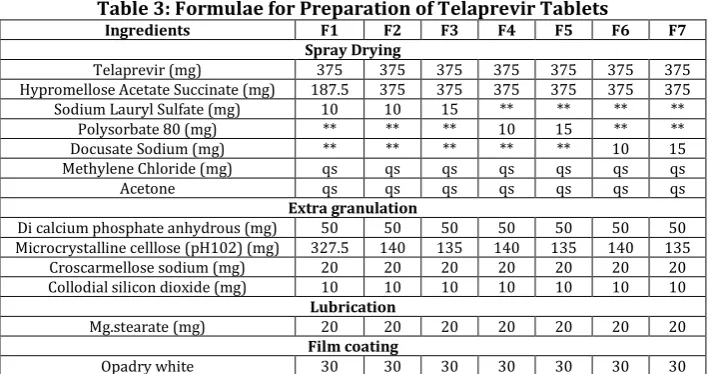
Weighed quantity as shown in table 3 of telaprevir was taken and dissolved in methylene chlorine and add Acetone. Weighed quantity of Hypromellose acetate succinate and surfactant (SLS, Polysorbate 80 and Docusate sodium) was dissolved in above solution. Both the solution was mix together and the resultant mixture was spray-dryed. Spray-dryed material was collected and added sifted material of A-tab, MCC, CCS and Aerosil loaded to suitable blender and blend for 10 min. finally added Mg.stearate in to blender and blend for 5 min. (Table 3: Formulae for Preparation of Telaprevir Tablets).
Evaluation of Telaprevir Tablets Post Compression Parameters
The prepared tablets were evaluated as per standard procedure to various quality control tests such as uniformity of weight, thickness (vernier caliper), hardness (Pfizer hardness tester), friability (Roche friabilator), drug content and in vitro dissolution studies.
Uniformity of Weight
For uniformity of weight, 20 tablets were selected at random, weighed together and then individually 9. The mean and standard deviation were determined.
Hardness
Five tablets were selected at random and the hardness of each tablet was measured using Monsanto hardness tester 10.
Friability
completion of rotations, the tablets were dedusted by using camel hair brush and weighed (w). The percent loss in weight or friability (f) was calculated by the
formula given below.
Friability = [(W1-W2)100]/W1 Where,
W1= Weight of tablet before test, W2 = Weight of tablet after test.
Drug Content Estimation
Telaprevir content of all the prepared tablets was estimated by the following procedure. Weigh the single tablet of each batch was taken and transferred into a 100 ml volumetric flask. 50 ml of purified water was added and vigorously shaken for 15 minutes. The solution was then sonicated for 15 minutes. After this the solution was kept aside for 15 min for equilibration and made up to volume with water. The resulted solution was filtered through 0.45 μm filter paper and suitably diluted and the drug content was estimated spectrometrically by measuring the absorbance12, 13.
Dissolution Studies
Dissolution studies were carried out using a USP dissolution apparatus type II with 900ml dissolution mediums at 37 °C ± 0.5 and 50 rpm in 1% SLS in water. Fresh media (10 ml), which was pre-warmed at 37 °C, was replaced into the dissolution medium after each sampling to maintain its constant volume throughout the test. Dissolution studies were performed in three replicates (n = 6), and calculated mean values of cumulative drug release were used while plotting the release curves.
Drug Release Kinetics
The analysis of the mechanism of drug release from pharmaceutical dosage form is an important but complicated problem and is practically evident in case of multi particulate dosage form. The dissolution data obtained was fitted to zero order 14-16 first order 17, Higuchi 18 to understand the order and mechanism of Telaprevir release from prepared tablets.
Zero Order Release Kinetics
It defines a linear relationship between the fraction of drug released versus time. It is caluculated using equation Q = kot; where, Q is the fraction of drug released at time t and ko is the zero order release rate constant. A plot of the fraction of drug released against time will be linear if the release obeys zero order release kinetics.
First Order Release Kinetics
Exposed surface area of a tablet decreased exponentially with time during dissolution process, suggested that drug release from most slow release tablets could be described adequately by apparent first-order kinetics. The equation used to describe first order kinetics is, ln (1-Q) = k1t where, Q is the fraction of drug released at time, (t) and k1 is the first order release rate constant. Thus, a plot of the logarithm of the fraction of drug remained against time will be linear if the release obeys first order release kinetics.
Higuchi Equation
It defines a linear dependence of the active fraction released per unit of surface (Q) on the square root of time. Q = k2t½; where, k2 is the release rate constant. A plot of the fraction of drug released against square root of time will be linear if the release obeys Higuchi equation.
Erosion Equation
This equation defines the drug release based on erosion alone. Q = 1-(1-k3t)3; where, Q is the fraction of drug released at time t, k3 is the release rate constant. Thus, a plot between [1-(1-Q)1/3] against time will be linear if the release obeys erosion equation.
Stability Studies
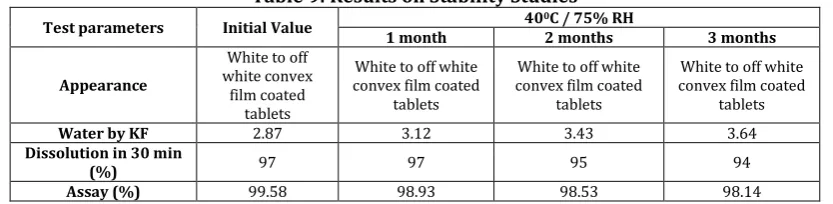
The purpose of stability study is to provide evidence on the quality of a drug substance or drug product which varies with time under the influence of a variety of environmental factors such as temperature, humidity and light 19, 20. The Telaprevir tablets of F4 were packed in High-density Polyethylene bottles with Child Resistance Caps (CRC) and induction sealed. These bottles were charged for stability study at 400C/75% RH. Sampling time was done at initial, 1st, 2nd and 3rd month and evaluated for appearance, water content, in-vitro dissolution and assay.
RESULTS AND DISCUSSION
Drug – Excipient Compatibility Study
Flow Properties
Lubricated blends were subjected to various flow property tests such as Compressibility index, Hausner’s ratio, angle of repose and results are tabulated in Table 5. Blend showed improved flow property than its pure drug. (Table 5: Flow properties of drug and lubricated blend).
Post Compression Evaluation Parameters Assay
The prepared formulations of telaprevir tablets were done for assay studies and the results as showed in table 6 were found to be in the range from 97.50 % to 99.58 %. (Table 6: Comparative assay profile from F1 – F7).
Weight Variation, Thickness, Friability, Hardness and Disintegration
There was no difficulty in the preparation of the telaprevir tablets by using spray dry technology. Quality control tests such as weight variation, thickness, friability, hardness and disintegration for all the formulations were carried out and the results are given in Table 7. The tablets prepared in each batch showed uniformity of weight, thickness and the weight variation of the tablets was within the limits (as per IP Not more than two of the individual weights deviate from the average weight by more than 5% for the tablets with average weight more than 250 mg and 7.5% for the tablets with average weight more that 80 mg but less than 250 mg and none
deviates by more than twice the stated percentage). All prepared tablets showed good strength. The hardness for Telaprevir tablets was in the range of 12-14 KP. The friability values were found to be less than 1% for all the prepared batches of tablets. The results from prepared formulations showed that all tablets were disintegrated in less than 40 seconds. (Table 7: Post Compression Evaluation Parameters).
Dissolution Studies
The results of in vitro dissolution studies as shown in fig. 4 and indicated that release of telaprevir was uniform for a period of 30 min from the tablets prepared by using spray drying technology. In case of F-1, F-2 and F-3 tablets prepared by using sodium lauryl sulfate showed drug release of 57.0 %, 93.0 % and 96.0 % in 30 minutes; and 91.0 %, 92.0 % drug was released from formulations F-4, F-5 prepared with polysorbate 80. The formulations F-6 and F-7 prepared with docusate sodium showed 92.0 % of telaprevir release in 30 minutes and innovator showed 95.0 % drug release in same 30 minutes. Among all prepared formulation F-3 i.e. prepared with 10 mg of sodium lauryl sulfate (SLS) showed highest percentage of drug relase of 96.0 % in 30 minutes when compared with innovator.
The kinetics of dissolution release profile of telaprevir tablets formulations was subjected for zero order, first order, Hixson-Crowell equation Higuchi diffusion and erosion equation and the correlation coefficient (r) values are given in Table 8. The results showed that telaprevir tablet formulations followed first order release kinetics as indicated by the correlation coefficient ‘r’ values (r = 0.920 to 0.990). The results also indicated that the release best fits to Higuchi diffusion (r=0.923 to
0.974) showing the particulate dissolution nature of telaprevir tablets. (Table 8: Different release kinetics of telaprevir tablets).
Stability Studies
Stability studies of F3 demonstrated no significant changes in physical parameters, water content, assay and dissolution profile after 400C / 75% RH 3 months. (Table 9: Results on Stability Studies).
Table 1: Flow properties of Angle of repose
Flow Property Angle of repose (degrees)
Excellent 25 - 30
Good 31 - 35
Fair 36 - 40
Passable 41 - 45
Poor 46 – 55
Very poor 56 -65
Very very poor >66
Table 2: Scale of Flowability
Compressibility
Index (%) Flow character Hausner Ratio
≤10 Excellent 1.00 – 1.11
11 - 15 Good 1.12 – 1.18
16 - 20 Fair 1.19 – 1.25
21 - 25 Passable 1.26 – 1.34
26 - 31 Poor 1.35 – 1.45
32 - 37 Very poor 1.46 – 1.59
>38 Very very Poor >1.60
Table 3: Formulae for Preparation of Telaprevir Tablets
Ingredients F1 F2 F3 F4 F5 F6 F7
Spray Drying
Telaprevir (mg) 375 375 375 375 375 375 375
Hypromellose Acetate Succinate (mg) 187.5 375 375 375 375 375 375
Sodium Lauryl Sulfate (mg) 10 10 15 ** ** ** **
Polysorbate 80 (mg) ** ** ** 10 15 ** **
Docusate Sodium (mg) ** ** ** ** ** 10 15
Methylene Chloride (mg) qs qs qs qs qs qs qs
Acetone qs qs qs qs qs qs qs
Extra granulation
Di calcium phosphate anhydrous (mg) 50 50 50 50 50 50 50
Microcrystalline celllose (pH102) (mg) 327.5 140 135 140 135 140 135
Croscarmellose sodium (mg) 20 20 20 20 20 20 20
Collodial silicon dioxide (mg) 10 10 10 10 10 10 10
Lubrication
Mg.stearate (mg) 20 20 20 20 20 20 20
Film coating
Table 4: Results of Drug Excipients Compatibility studies
S.No Composition Details Initial *30 days #30 days
1 Telaprevir White to off-white @NCC NCC
2 Telaprevir + Hypromellose acetate succinate White to off-white NCC NCC
3 Telaprevir + Sodium lauryl sulfate White to off-white NCC NCC
4 Telaprevir + Polysorbate 80 White to off-white NCC NCC
5 Telaprevir + Docusate sodium White to off-white NCC NCC
6 Telaprevir + Di calcium phosphate anhydrate White to off-white NCC NCC
7 Telaprevir + Microcrystalline cellulose (pH 102) White to off-white NCC NCC
8 Telaprevir + Croscarmellose sodium White to off-white NCC NCC
9 Telaprevir + Colloidal silicon dioxide White to off-white NCC NCC
10 Telaprevir + Mg.stearate White to off-white NCC NCC
11 Telaprevir + Opadry white White to off-white NCC NCC
@ NCC = No Characeristic change ; * 30 days at 40oC/75% RH ; # 30 days at 60oC
Table 5: Flow properties of drug and lubricated blend
S.NO Formulation Compressibility index (%) Hausner’s ratio Angle of repose (o)
1 Drug 27.78 1.38 47.21
2 F1 13.79 1.16 33.20
3 F2 11.44 1.13 32.17
4 F3 14.02 1.16 34.47
5 F4 12.16 1.14 32.83
6 F5 12.63 1.14 34.65
7 F6 13.33 1.15 31.18
8 F7 13.56 1.16 31.93
Table 6: Comparative assay profile from F1 – F7
Formulation batch no F1 F2 F3 F4 F5 F6 F7
Assay (%) 97.50 98.21 99.58 99.21 98.12 98.84 98.53
Table 7: Post Compression Evaluation Parameters
Batch Code
Weight Variation Test (n=5)
Thickness (mm) (n=5)
Friability test (<1%) (n=6)
Hardness (KP) (n=5)
Disintegration (Sec)
F1 1002 ± 5.23 6.98 ± 0.07 Pass 14.87 ± 0.7 30
F2 1000 ± 4.13 6.96 ± 0.06 Pass 13.27 ± 0.9 29
F3 1001 ± 4.73 6.95 ± 0.08 Pass 14.83 ± 0.8 25
F4 1003 ± 5.22 6.97 ± 0.05 Pass 12.57 ± 0.9 37
F5 1002 ± 4.87 6.94 ± 0.07 Pass 14.31 ± 0.8 29
F6 1004 ± 5.29 6.94 ± 0.09 Pass 13.83 ± 0.9 34
F7 1002 ± 5.73 6.97 ± 0.06 Pass 14.81 ± 0.8 32
Table 8: Different release kinetics of telaprevir tablets
Formulation Correlation coefficient (r2)
Zero Order First order Hixson Crowel’s Higuchi Peppas
F-1 0.8777 0.922 0.909 0.969 0.925
F-2 0.7895 0.990 0.947 0.974 0.853
F-3 0.6791 0.962 0.883 0.923 0.827
F-4 0.7525 0.958 0.905 0.959 0.846
F-5 0.7218 0.947 0.888 0.945 0.835
F-6 0.7961 0.984 0.941 0.975 0.862
F-7 0.7119 0.920 0.870 0.939 0.833
Table 9: Results on Stability Studies
Test parameters Initial Value 400C / 75% RH
1 month 2 months 3 months
Appearance
White to off white convex
film coated tablets
White to off white convex film coated
tablets
White to off white convex film coated
tablets
White to off white convex film coated
tablets
Water by KF 2.87 3.12 3.43 3.64
Dissolution in 30 min
(%) 97 97 95 94
Assay (%) 99.58 98.93 98.53 98.14
CONCLUSION
The primary aim of the study was to develop a pharmaceutically equivalent, stable, robust and quality improved formulation of Telaprevir tablets. Telaprevir was having very low solubility, hence to improve its dissolution rate spray drying technique was selected. Hypromellose acetate succinate was selected as a carrier polymer with different surfactants like SLS, polysorbate-80, docusate sodium. From the results it was concluded that the spray dried telaprevir formulated as tablets formulation F3 by using hypromellose acetate succinate and sodium lauryl sulfate showed better dissolution profile comparable to the innovator. The formulation also showed promising results during accelerated stability studies. Hence, the tablet formulation (F3) with spray dried hypromellose acetate succinate and SLS of telaprevir was best formulation.
ACKNOWLEDGEMENTS
The authors would like to acknowledge M/s. GITAM Institute of Pharmacy, GITAM University, Visakhapatnam, Andhra Pradesh, India for providing facilities and giving support to conduct this work. The authors are thankful to M/s. Hetero Labs Ltd., Hyderabad for giving telaprevir as a gift sample.
REFERENCES
1. Global surveillance and control of hepatitis C. Report of a who consultation organized in collaboration with the viral hepatitis prevention board, antwerp, belgium. J Viral hepat. 1999;6: 35-47.
2. Alter MJ. Epidemiology of hepatitis C virus infection. World J Gastroenterol. 2007;13:2436-41.
3. Gottwein JM, Scheel TK, Jensen TB, Lademann JB, Prentoe JC and Knudsen ML. Development and characterization of hepatitis C virus genotype 1-7 cell culture systems: Role of cd81 and scavenger receptor class b type i and
effect of antiviral drugs. Hepatol. 2009;49:364-77.
4. Kuiken C and Simmonds P. Nomenclature and numbering of the hepatitis C virus. Methods mol biol (Clifton) NJ. 2009;510:33-53.
5. von Hahn T, Yoon JC, Alter H, Rice CM, Rehermann B and Balfe P. Hepatitis C virus continuously escapes from neutralizing antibody and t-cell responses during chronic infection in vivo. Gastroenterology. 2007;132:667-78.
6. More swati K and Wagh MP. Review on spray drying technology. 2014;4(2): 219-225.
7. Woo MW, Mujumdar AS and Daud WRW. Spray drying technology. Volume 1.
8. Gopinath R and Naidu RAS. Pharmaceutical preformulation studies-Current Review. 2011;2(5):1391-1400. 9. Subhramanyam CVS. Text book of
physical pharmaceutics. Delhi 1st edition. 1998;215-223.
10. Shah D, Shab Y and Rampradhan M. Development and evaluation of controlled release diltizem hydrochloride microparticles using cross linked polyvinyl alchol. Drug Dev Ind Pharm. 1997;23: 567-574.
11. Subhramanyam CVS and Thimmasetty T. Laboratory manual of physical pharmaceutics. Vallabh prakashan, Delhi 1st edition. 2002;24(32):46-53. 12. Thimmasetty T. Laboratory manual of
physical pharmaceutics. Vallabh prakashan, Delhi 1st edition. 2002;24,32 and 46-53.
13. Yelole PG, Galgatte babla IB and Nakhat PD. Design and evaluation of xanthan gum based sustained release matrix tablets of diclofenac sodium. Indian J Pharm Sci. 2006;68:185-189.
data, Goodman and Gillman The pharmacological basis of therapeutics. McGraw-Hill Medical publishing Division, London 2006.
15. Merchant HA, Shoaib HM, Tazeen J and Yousuf RI. Once daily tablet formulation and in vitro release evaluation of cefpodoxime using hydroxypropyl methyl cellulose. A technical note AAPS Pharm Sci Tech. 2006;7:1028-1037. 16. Bourne DW. Pharmacokinetics, Modern
Pharmaceutics, Marcel Dekker, New York. 2002.
17. Peppas NA, Gurny R, Doelker E and Buri P. Modelling of drug diffusion through swellable polymeric systems. J Membr Sci. 1980;7:241–253.
18. Higuchi T. Mechanism of sustained-action medication, Theoretical analysis of rate of release of solid drugs dispersed in solid matrices. J Pharm Sci. 1963;52:1145–1149.
19. Thorat P, Warad S, Solunke R, Sargar A and Bhujbal A. Stability study of dosage form: An innovative step. World Journal of Pharmaceutical Science. 2013;3(2):1031-1050.