RESEARCH AND DEVELOPMENT OF A PROBABILISTIC METHOD TO
DETERMINE THE NUMBER OF SPARE PARTS
Miho Yankov Mihov
Institute of soil science, agricultural technology and plant protection "N. Pushkarov" Sofia
Abstract: A probabilistic method is studied for determining the required number of spare components to maintain the efficiency of the fleet of
machines using the characteristic of the flow of refusals
Analyzed the influence of the parameters of the laws of distribution of work off failure (resource) of elements on the parameters and characteristics of the stream of refusals for recurrent stream late and for general stream of refusals and identify areas of their influence. It was found that with an increase in the quality of new and recovered items (the assemblies and parts) increases the level of reliability of the plant and reducing the cost of replacement parts.
The analysis of the literature shows that most - suitable for determining the amount of spare components / assemblies, nodes and parts / are methods using information on the reliability of components, assemblies and components for tractors in the first 5-6 years, then the average methods as a fleet of machines is stabilized. These methods are based on the theory of the rehabilitation and can be divided into two main groups: methods based on asymptomatic formulas, in particular, by using the average values of the construction of the elements and methods based on the immediate flow of failures.
The aim of the work is to develop and explore probabilistic method for determining the required number of spare components to maintain the efficiency of the fleet of machines using the characteristic of the flow of refusals
The required fund of spare components (aggregates, nodes and spare parts) to maintain the efficiency of the machines can be defined by the formula:
N =H(to).N.m
Where Н(t0) is a function of the repair influence (characteristic of
stream of refusals);
N 0 - number of machines in question set;
m - Number of identical elements in the specific machine. Normalization period of t0 prognosis is determined by the
formula:
t0=t /q
t
, (2)Where t is the period of predicting the number of failures (reserve components);
t
- The average value of the resource a new element; q - factor considering climate resource of replacement components in comparison to the resources of the new elements (0,8≤q≥1,0).The average number of failures, respectively the anticipated need for spare elements to maintain the working capacity of the machines in the interval [0, t], which is a function H (t) [1; 2; 3] for any flow of waivers are defined with the formula:
H(t)=
∑
∞
=1
k
F
(k)(t), (3)where F(k)(t) is the k-th composition of the distribution function
of the resource elements, i.e. F(k)(t)=P{tk
≤
t}; tk=tH+tp1+tp2+tkrespectively the moment of rejection of the new element tH and
spare elements tpi..
In other words, Fk(t) is the probability that in the interval [0, t]
there will be no less than k elements of the failures. Then F(1)(t)=P{tн≤t}=F(t), where F (t) is the value of the distribution
function of the resource of the new element or likelihood of return for the new element in the range [0.1 ]; F(2)(t)=P{(tH+tp1)<t} – probability of not less than two failures in
the interval [0, t], etc.
To determine the necessary stock of spare components for maintaining operability of the machines are designed tables [4] with the values of the function H(t0) depending on the coefficient
of variation ν, normalized period of forecasting t0 and the law of
distribution of the resource elements (law of Weibull, normal law).
Ceteris paribus (All other conditions equal) with increasing the coefficient of variation ν at t0<1 function H(t0) increases. So
worst case is when the distribution of resource elements is exponential law, which corresponds to the greatest distraction of the resource elements. When t0>1 increases the coefficient of
variation ν, the function H (t0) decreases in the normal and increases with Weibull law distribution.
If we want to determine the fund of spare components for maintaining the machines’ work performance at a given probability γ, normalized period toγ prognosis is determined by
the formula:
t0γ=t/qtγ, (2 ')
Where tγ percentage range is characteristic of the resource of the new element.
For practical calculations is given an estimate of H (t) [1; 5], which is expressed with the following disparities:
F(t)≤H(t)≤F(t)/(1-F(t)).
From this assessment it follows that the initial area of operation where F(t)≤1, H(t)≈ F(t).
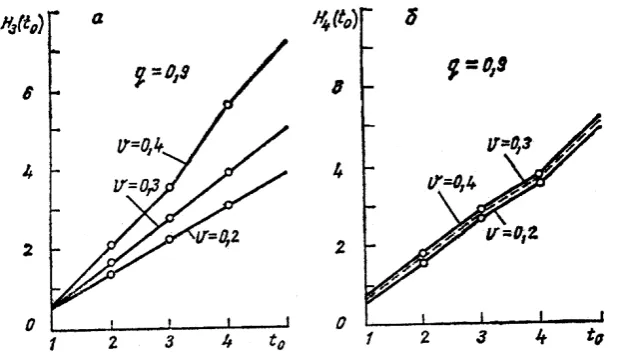
Fig.1. Altering the function of the repair effects (characteristic of the flow of failures) H (t) for different values of the coefficient of variation of the resource elements а) υ=0,2; б) υ=0,3 в) υ=0,4.
Fig. 2. Amendment characteristic of the flow of failures Hi (t) for different values of the coefficient of variation of resource items calculated by the following relationships: a) 3; b) 4.
H(t0)≈(to-1)/q + (1+ν12)/2, (4)
Where ν1 is the coefficient of variation for resource of
replacement items.
Dependence (4) is used to determine the necessary stock of spare elements to maintain the working capacity of the machinery [1; 2].
Fig. 1 and fig. 2 show the nature of change of the function H (t) of the elements calculated by the relations (3) Н3(t)and (4) Н4(t).
Based on the analysis of results obtained by these dependencies results has been found that the relationship (4) can only be used in cases where the resource elements allocated to the normal law with variation coefficient ν=0,3. When the coefficient of variation ν<0,3 (fig..1 a), Н4(t) << H3(t),, and
ν
>0,3H4(t)>H3(t) (fig.1v). Only at ν=0,3 (fig.1b) H3(t)=H4(t).
Change of the function of repair impacts (waivers) H4(t) virtually
depends on the value of ν (Figure 2), the function H3(t) e
sensitive to climate ν (Fig. 2a), which corresponds fully to the physical nature of review process.
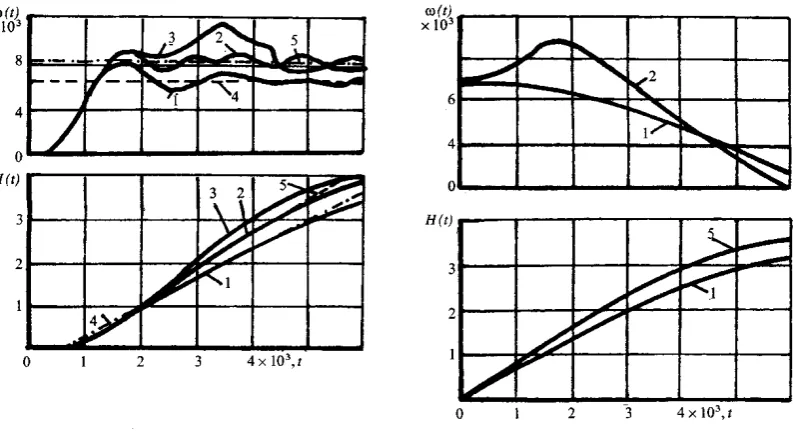
Based on the proposed numerical method [6] to determine the parameter of the flow of failures
ω
(
t
)
and the characteristic of the flow of failures H(t) of the recurrent flow is established that the less is the ratio to to/σ
, the faster the parameter of the flowof failures seeks its stationary value and it's a greater value
ω
(
t
)
Figure 3. Parameter characterization and flow of failures: a) with normal law of work off distribution: 1-recurrent stream; 2-recurrent stream late; 3 common recurrent stream; 4 asymptotic dependencies for recurrent stream; 5 asymptotic dependencies for recurrent stream late; b) exponential law of work off distribution: 1-recurrent stream; 2 general recurrent stream.
These graphical dependencies are obtained by applying the proposed numerical method for determining the functional characteristics ω(t) and H (t) of the flow of failures, which is based on dependencies [1]:
),
(
)
(
);
(
)
(
1 1
) ( )
(
t
F
t
H
t
f
t
n n
n n
∑
∞∑
=
∞
=
=
=
ω
Where f(n)(t) and F(n)(t)are respectively the n-fold compositions of f(t) and F(t).
Figure 4. Asymptotic dependencies are brought for H (t) distribution work off of items subject to normal and exponential law [1]. And since the asymptotic formulas are true for any law
of distribution of work off of the elements of the machines, then the difference between H (t) is determined by the magnitude of the coefficient of variation
υ
, and also between and the ratiot
1Figure 4. Asymptotic dependencies for flow characteristics of failures: 1-recurrent stream and exponential law of distribution of work off;
2-recurrent flow and normal law of distribution; 3-2-recurrent stream late and exponential law of distribution; 4-2-recurrent flow with lateness and normal law.
Simplicity and convenience for determining the cost of spare parts by using the asymptotic formula is obvious, however, their
error in the initial interval
0
,
t
is commensurate with the average of work off to first refusalt
ort
1, or greater.To improve the accuracy of the method for determining
ω
(
t
)
and
H
(
t
)
the proposed numerical method [4,7] set of tables are developed [4] for recurrent and recurrent stream flow with a delay of work off to failure (normal, Weibull and others. Laws of distribution) with inputs: the coefficient of variation of work off denial v on new elements and regulatory work off failure (tµ), which is determined by the formula),
/(
t
q
t
t
µ=
oWhere t is the period for which must determine the characteristics of the stream of refusals;
t
o- Average work off till failure of new elements;
q
=
t
1/
t
o -Coefficient of durability of elements;
t
o−
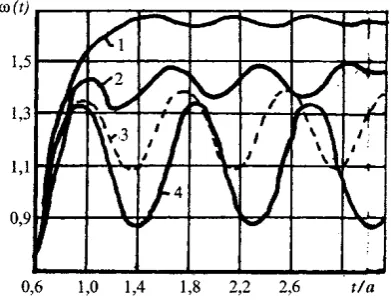
Average work off of elements that are used to exchange for giving elements.Climate parameter stream of failures in recurrent stream belatedly shown in Figure 5. With the increase of q parameter stream of failures
ω
(
t
)
has sinusoidal graphic form in q = 0,8 and q = 0,9, and at q = 0,6 - slightly wavy, ie period when adopting stationary type occurs at t / a> 1,2-1,4. By increasing the value of q the stationary value ofω
(
t
)
decreases, i.e. the level of reliability of the object is higher.Figure 5. Parameter flow of failures depending on t / a in the
normal law of distribution, v = 0,3 = const. and delay q: q = 0,6
(curve - 1); q = 0,7 (curve - 2); q = 0,8 (curve - 3); and q = 0,9 (curve - 4)
With increasing the delay in recurrent flow at a given value of the parameter b of the law of Weibull value of H (t) increases (Figure 6) for values of t / a> 0,6 and is indispensable for any q in interval 0
≤
t
/
a
≤
0
,
6
.
And to reduce the delay, i.e. with increasing q, H (t) decreases (Figure 7).
Figure 6. Amendment of characteristic flow of failures at b =
const. and q = 0,6; 0.7; 0.8; 0.9
Figure 7. Modification of H (t) depending on the delay q at t/a =
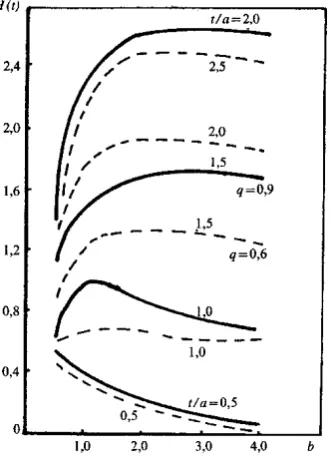
Fig. 8. Modification of H (t) depending on the parameter b, q =
0,6 and q = 0,9 and t / a = 0,5; 1,0; 1,5; 2,0; 2,5.
Influence of the parameter "a" of the law of Weibull on H (t), reflected by the ratio t/a, where q = 0,6 and 0.9 is shown in Figure 8. From the analysis of the graph that, with an increase of the parameter of the form b, or in other words, with lowering of the coefficient of variation of work off till failure of the objects, wherein the flow of failures, initially increases, and then is almost constant or lower for t / a = 0,5-1,0.
The required number of spare components to maintain the efficiency of the fleet of machines is determined by the following relationship:
N=H(t).No.neKeWg/Wc,
Where No is the number of tractors (norms are set for 100
machines No = 100 pcs.);
H (t) –characteristics of flow of failures (characteristic of repairs impacts);
Ке -factor, considering the average lifespan of the machines;
Wg -planned annual production of the machine in the area for
which norm is crated, l. main fuel [2];
Wc -average annual production at which certain characteristics of
the stream of refusals l. main fuel [2]. Conclusions:
1. Proposed common non-parametric approach to determine the parameters and characteristics of the flow of failures of elements of machines with recurrent stream recurrent stream late and total recurrent stream.
2. Analyze the impact of the parameters of the laws of distribution of work off till failure (the resource) of elements on the parameters and characteristics of the stream of refusals for
recurrent stream late and for general stream of refusals and identify areas of their influence.
3. It was found that with an increase in the quality of new and repaired aggregates and nodes (elements) increases the level of reliability of the plant and reducing the cost of replacement parts.
Literature:
1..Кокс Д.,В.Смит Теория восстановления. М.,1967.
2.Спиридонов Г.,Г.Тасев,Цв.Крумов Инженерен метод за определяне на необходимия фонд от резервни части .-Н.тр.на ВНВУ ”ВЛевски” В.Търново, 1979.
3. Агзамов С.И. и др.Методика для нормирование расхода запасных частей к тракторов и с.х. машин,М.,1984.
4.Тасев Г.,Г.Спиридонов,П.Проданов Вероятностен метод за определяне количеството на резервните елементи при ремонтното обслужване на машините.-С.,ССТ,1983,1,с.84-88.
5.Феллер В. Введение в теорию вероятностей и ее приложения, т.1,2, М., 1984.
6.Тасев Г. ,М.Михов Изследване и определяне показателите на безотказност на ремонтируемите обекти-ССТ,1996,7-8,с.46-51.