Evaluation on the Surface Modification of Recycled Fine Aggregates
in Aqueous H
2SiF
6Solution
Hwa-Sung Ryu
1), Deuck-Mo Kim
1), Sang-Heon Shin
1), Seung-Min Lim
2), and Won-Jun Park
3),*
(Received September 11, 2017, Accepted February 6, 2018)
Abstract: Recycled aggregates (RAs) production techniques are essential for the material circulation society because RAs from demolished concrete waste can sustainably be reused as a concrete material. However, RAs can bring about several performance decreases when they are used for recycled aggregate concrete (RAC) because of the low qualities (i.e., high water-absorption rate and low density) caused by the attached hydrated cement paste on the RA surface. Therefore, both the production of high-quality RAs and the surface modification of RAs are significantly important for the extension of RAC utilization. This paper focuses on the surface modification of RFA to reduce the water absorption rate and increase density. Hydrofluorosilicic acid (H2SiF6), which is one of the by-products in phosphoric acid manufacture, is used herein for the surface modification of the RFA. The physical properties and mechanical performance of mortar using RFA were evaluated after RFA modification. Consequently, the proposed method is effective in reducing water absorption rate and increasing density of RFA. The density of RFAs was slightly increased by 0.5–2.6% after modification. On the other hand, the water absorption rate decreased by 4–18% after modification. The compressive strengths of mortar at 28 days ages showed 18.1 MPa with modified RFA and 16.2 MPa with RFA.
Keywords:recycled aggregate, recycled fine aggregate, surface modification, hydrofluorosilicic acid, mortar.
1. Introduction
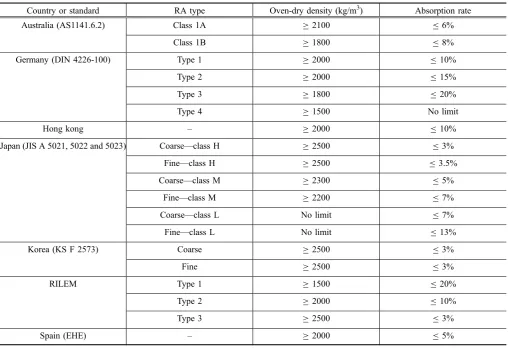
The current annual industrial waste in South Korea amounts to approximately 130 million tons, with more than 50% of that being construction waste such as excess con-crete. Specifically, the amount of concrete waste comprises 70% of construction waste, which is approximately 40% of all industrial waste (46 million tons). More than 90% of concrete waste, or 40 million tons each year, is produced as recycled aggregates (RAs) after going through recycling processes. The reproduced RAs are mainly reused as sub-base materials for roads, roadbed materials, and RAs for concrete (Noguchi et al.2015; Shi et al.2015). The quality of RAs produced from waste concrete via processes such as crushing, rubbing, smashing, and heating varies, and stan-dards dependent on the physicochemical properties of the aggregates have been established for various countries as shown in Table1 (AS 1996; DIN 4226–100 2002;
Construction standard 2013; BS 812: Part 2 1994; JIS A 50212005; JIS A 50222007; JIS A 50232007; KS F 2573
1999; RILEM TC 121-DRG 1994; Spanish Minister of Public Works2008).
The current standardized quality grades of RAs are divi-ded according to aggregate absorption rate and specific gravity, and they are classified into structural concrete aggregates, non-structural concrete aggregates, roadbed materials, and so on, based on these grades as shown in Table2(Shi et al.2015; Behera et al.2014). In general, the reason that RAs are lower in quality than natural aggregates is because mortar adheres to the surface of RA (cement matrix). Low-quality RAs having a high absorption rate and low weight have limitations in terms of being reused for concrete (Behera et al.2014; Choi et al. 2014; Ismail and Ramli 2014). Accordingly, most RAs are not used as con-crete aggregates, but as roadbed and sub-base materials; however, this demand is gradually decreasing, while the demand for their use in concrete is continuously required. In addition, regarding RAs for roads and landfills, there are concerns about alkali extraction due to Ca(OH)2, which is contained in adhered mortar (cement matrix) on the surface of aggregates, and also other long-term problems of envi-ronmental concern (Shi et al.2015; Chen et al.2017; Tam et al.2007).
For the sustainable recycling of resources, in order to recycle the waste concrete that is produced in large quanti-ties, not only an active use, but also an eco-friendly use of RAs is important (Choi et al.2014; Ismail and Ramli2014; Chen et al.2017; Tam et al.2007; Kong et al.2010). This
1)
Hanyang Experiment and Consulting Co., 1271 Sa 3-dong, Ansan 15588, Republic of Korea.
2)
Inovative Durable Building and Infrastructure Research Center, Hanyang University, 1271 Sa 3-dong, Ansan 15588, Republic of Korea.
3)
Department of Building System Engineering, Kangwon National University, Samcheok 25913, Republic of Korea. *Corresponding Author; E-mail: [email protected] CopyrightÓThe Author(s) 2018. This article is an open access publication
International Journal of Concrete Structures and Materials DOI 10.1186/s40069-018-0256-5
requires taking measures to simultaneously address the problems of low weight, high absorption rate, and alkali extraction that RAs currently have, and also requires the quality improvement of aggregates for use in concrete (Kong et al.2010; Al-Bayati et al.2016; Zhan et al.2014).
There have been numerous studies reporting on surface modifications of RAs using carbonation and acid treatment, focusing on the fact that mortar adhered to the surface of RAs (cement matrix) contains profuse Ca(OH)2(Chen et al. 2017; Tam et al. 2007; Kong et al. 2010; Al-Bayati et al.
2016; Zhan et al. 2014). The surface modification with carbonation is a method that uses accelerated carbonation,
which reacts highly concentrated carbon dioxide with Ca(OH)2 of the adhered mortar on the aggregate surface under dry or wet environments (Zhan et al. 2014; Zhang et al.2015). The mechanism of surface modification used for RAs by accelerated carbonation is described below.
Ca(OH)2þCO2!CaCO3þH2O ð1Þ
CSHþCO2 !CaCO3þSiO2nH2O ð2Þ
On the other hands, the hydration products of cement in hardened paste can be dissolved in acid solution (Shi et al.
2015; Tam et al.2007; Al-Bayati et al.2016). Thus, acidic
Table 1 Acceptance criteria regarding RA
Country or standard RA type Oven-dry density (kg/m3) Absorption rate
Australia (AS1141.6.2) Class 1A C2100 B6%
Class 1B C1800 B8%
Germany (DIN 4226-100) Type 1 C2000 B10%
Type 2 C2000 B15%
Type 3 C1800 B20%
Type 4 C1500 No limit
Hong kong – C2000 B10%
Japan (JIS A 5021, 5022 and 5023) Coarse—class H C2500 B3%
Fine—class H C2500 B3.5%
Coarse—class M C2300 B5%
Fine—class M C2200 B7%
Coarse—class L No limit B7%
Fine—class L No limit B13%
Korea (KS F 2573) Coarse C2500 B3%
Fine C2500 B3%
RILEM Type 1 C1500 B20%
Type 2 C2000 B10%
Type 3 C2500 B3%
Spain (EHE) – C2000 B5%
Table 2 Reference for categorizing concrete made with recycled coarse aggregate (RCA).
Category Coarse aggregate Aggregates for concrete
High quality Medium quality Low quality
Dried density (t/m3) Over 2.5 Over 2.3 – Over 2.5
Absorption rate (%) Below 3.0 Below 5.0 Below 7.0 Below 3.0
Fine aggregate content (%) Below 1.0 Below 1.5 Below 2.0 Below 7.0
No. JIS A 5021 A 5022 A 5023 A 5005
Categorization of usage Identical to natural aggregate or structural
concrete
Concrete construction elements not affected by
dry shrinkage
Non-structural elements that do not require durability
and strength
solution can be used to remove the adhered mortar effec-tively and enhance the quality of RA. Phosphoric acid, Sulfuric acid and hydrochloric acid are used in a typical acid treatment. The mechanisms of surface modification used for RAs by acid treatments are described below.
Reactions under HCl:
CaOþ2HCl!CaCl2H2O ð3Þ
Fe2O3þ6HCl!2FeCl33H2O ð4Þ
Al2O3þ6HCl!2AlCl33H2O ð5Þ
Reactions under H2SO4:
CaOþH2SO4!CaSO4H2O ð6Þ
Al2O3þ3H2SO4!Al2ðSO4Þ33H2O ð7Þ
Fe2O3þ3H2SO4!Fe2ðSO4Þ33H2O ð8Þ
Reactions under H3PO4:
2CaOþH3PO4 !2Ca2þþHþþPO34þ2OH ð9Þ
Al2O3þ2H3PO4!2Al3þþ3Hþþ2PO34þ3OH ð10Þ
Fe2O3þ2H3PO4!2Fe3þþ3Hþþ2PO34þ3OH ð11Þ
In the ‘‘mechanical’’ first processing stage, RAs are duced and then subjected to the ‘‘chemical’’ second pro-cessing stage, in which carbonation and acid treatment are applied. Ultimately, both methods improve the physical properties of RAs. Ca(OH)2 within the adhered mortar is converted to CaCO3by carbonation, and the porosity of the adhered mortar decreases, leading to an increase in the specific gravity of aggregates and a decrease in its absorption rate (Ryou and Lee2014; Ondova and Sicakova2016). The acid treatment results in an increased specific gravity of the aggregates and a decreased absorption rate through partially removing the adhered mortar and neutralizing the hydroxide (OH-) ions simultaneously. However, carbonation is asso-ciated with problems such as high costs of equipment, lim-ited processed amount of aggregates per unit time, and difficult retrieval of unreacted carbon dioxide (Al-Bayati et al.2016; Zhan et al. 2014; Zhang et al. 2015). Further-more, for acid treatment, there are issues with high pro-cessing costs, secondary contaminated water, and contaminated water (Shi et al.2015; Chen et al.2017; Tam et al.2007; Kong et al.2010; Al-Bayati et al.2016). Thus, a new processing method that can both achieve surface mod-ification of RAs and improve the issues associated with existing methods is required.
This study focused on achieving efficient surface modifi-cation of RAs through acid treatment. In order to overcome the problems of high costs and secondary contaminated water generation, we applied strongly acidic hydrofluo-rosilicic acid (H2SiF6) as an industrial by-product that is
usually generated in processing and production stages of phosphogypsum or phosphatic fertilizer (Yang et al. 2005; Kim et al. 2004). The uses of H2SiF6 are various such as metal refinement, soil hardening agent, surface treatment agent, sterilizer and water system purification. In this research, for RFAs, we evaluated the decrease in absorption rate, increase in specific gravity, and reduction in pH, in order to develop a method to achieve surface modification of RAs using H2SiF6. In addition, we evaluated the physical properties of mortar with modified RFAs using a physico-chemical analysis, through which we were able to verify the usefulness of the RFAs, surface-modified by the method proposed in this study, as concrete aggregates.
2. Experimental Procedure
2.1 Materials
In the experiments, H2SiF6of pH 1.0 (10% solution) was used as acid treatment for surface modification of RFAs. And both natural fine aggregate (NFA) and RFAs were used, and the basic physical properties of the fine aggregates are shown in Table3. Three types of recycled aggregates (RFA 1, 2 and 3) were used in this study. As shown in Tables1and
2, RFA-2 and 3 are considered low-quality recycled aggre-gates used as roadbed. RFA-1 can be used as aggregate for mortar or concrete because it has higher physical quality than relatively different recycled aggregate. The chemical composition of cement is shown in Table4.
2.2 Experiment Outline
In order to evaluate the surface modification of RFAs by the H2SiF6proposed for use in this research, we measured the change in pH, specific gravity, and absorption rate of the fine aggregates. To evaluate the physical–mechanical prop-erties of the mortar before and after surface modification of the fine aggregates, the setting time, flow, and compressive and flexural strengths were measured. Additionally, we performed Scanning Electron Microscope (SEM), Thermo-gravimetric Differential Thermal Analysis (TG/DTA), Mer-cury Intrusion Porosimetry (MIP), and X-ray diffractometer (XRD) as chemical analyses. The mortar specimens were created by using natural, recycled, and modified-RFAs. Table5 shows the test items and methods for RFAs pre-soaking in water and acid. And Table6shows the test items and method for mortar and their related standards.
2.2.1 Specific Gravity and Absorption Rate of Fine Aggregates
As shown in Tables3 and 5, we measured the specific gravity and absorption rates of natural and RFAs that were used in our experiments and also the air-dried specific gravity and over-dry one for the specific gravity of aggregates.
2.2.2 pH Measurement
H2SiF6in the state of aqueous solutions under three different conditions, as displayed in Table5. First, RFAs and distilled water were combined with a weight ratio of 1:6 and mea-sured the pH values for different stirring times of the solu-tion (0, 1, 3, and 5 min). Also, we conducted the first stirring of distilled water and RFAs for 5 min, deposited 8, 10, and 12 g of H2SiF6into three different solutions, and measured their pH values based on second stirring times of 0, 1, 3, and 5 min. Lastly, we mixed RFAs and distilled water with a weight ratio of 1:6, and deposited 4, 6, 8, and 10 g of H2SiF6 into four different solutions, and measured their pH values based on different stirring times if 0, 1, 3, and 5 min.
2.2.3 Evaluation of Material Properties of Mortar Mortar specimens were produced using natural and RFAs. For the mortar specimen with modified-RFAs, the method having the best surface modification was used.
3. Results and Analysis
3.1 pH
Table7 displays the pH measurement results based on different stirring times of the distilled water and RFAs (Method-1 in Table5). It was shown that the RFAs had a pH of about 10.51 when soaked in distilled water and the pH
Table 3 Physical properties of fine aggregates.
Aggregate type Density (t/m3) Water absorption rate (%)
NFA 2.52 0.54
RFA-1 2.34 5.12
RFA-2 2.19 8.37
RFA-3 2.27 7.64
Table 4 Chemical composition of cement.
Chemical composition (%) Specific gravity
SiO2 Al2O3 Fe2O3 CaO MgO SO3 LOI
21.95 6.59 2.81 60.12 3.32 2.11 2.58 3.15
LOIloss on ignition.
Table 5 Test items and methods (RFAs) (ASTM International2012).
Items Fine aggregates Conditions Number of measurement Standard
Specific gravity and absorption rate
NFA, RFA Air-dried specific gravity, over-dry specific gravity
More than twice each ASTM C 128
pH RFA [Method-1]
RFAs (50 g)?distilled water (300 g)
More than 3 times each –
RFA [Method-2]
RFAs (50 g)?distilled water (300 g) 1st stirring
?H2SiF6input?2nd
stirring
More than 3 times each
RFA [Method-3]
RFAs (50 g)?distilled water (300 g)?H2SiF6
stirring
More than 3 times each
Table 6 Test items and methods (Mortar) (ASTM International2006,2012,2013,2013,2014).
Items Fine aggregates Conditions Number of measurement Standard
Setting time NFA, RFA, Modified RFA Initiation and termination More than twice each ASTM C 191
Flow NFA, RFA, Modified RFA – More than twice each ASTM C 230
Compressive strength, flexural strength
tended to increase depending on the stirring time of the solution. We also confirmed consistent alkali extraction due to the Ca(OH)2in the adhered cement matrices.
Table8 shows the results of the pH measurements based on the second stirring times after conducting the first stirring of distilled water and RFAs for 5 min and depositing H2SiF6 into the solutions (Method-2 in Table5). For the solutions containing 8, 10, and 12 g of H2SiF6, the pH values mea-sured immediately after the addition of H2SiF6 were less than 5.0, implying that the solutions were acidic. The solu-tions that had less than 10 g of H2SiF6added after 3 min of stirring showed pH values of less than 10, implying alka-lescence. For a solution to have a pH range under 10 in up to 5 min of stirring, more than 10 g of H2SiF6was required.
Meanwhile, the pH measurements after depositing RFAs into distilled water and adding H2SiF6are shown in Table 9 (Method-3 in Table5). When the properties of the solutions with 4, 6, 8, and 10 g of H2SiF6 were evaluated, for the unextracted RFAs, the pH values of the solutions fell within the ‘‘acidic’’ range under 3.0; when each specimen was stirred, its pH tended to increase inversely proportional to the amount of H2SiF6added.
3.2 Specific Gravity and Absorption Rates of Fine Aggregates
The results of testing the specific gravity and absorption rates of NFA and RFAs are shown in Table10. The test
results of the modified RFAs correspond to the case with 10 g of H2SiF6 added and 5 min of stirring in Table9 (Method-3 in Table5). The density of RFAs was slightly increased by 0.5–2.6% after modification. On the other hand, the water absorption rate decreased by 4–18% after modi-fication. The decrease of the absorption rate of the aggregate due to the modification was found to be an increase of the aggregate density.
3.3 Mortar Setting Times and Flows
Three types of recycled aggregates (RFA 1, 2 and 3) were used in this study. RFA-2 and 3 are considered low-quality recycled aggregates used as roadbed materials because of their high water uptake after modification. However, it has confirmed the alkali leaching reduction effect and can be used as a more environmentally stable roadbed material. RFA-1 can be used as aggregate for mortar or concrete because it has higher physical quality than relatively dif-ferent recycled aggregate. Therefore, RFA-1 and modified RFA-1 were used in the preparation of mortar specimens for the following experiments and analyzes.
Table11 indicates the results of testing the flows and setting times of mortar using NFA, RFA-1, and modified RFA-1. In this case, the modified RFAs with 10 g of H2SiF6 added and 5 min of stirring in Table9was used for mortar. The RFA had relatively smaller flows when compared to the NFA, and the flows of the modified RFA were found to
Table 7 Stirring times of distilled water and RFAs and changes in pH.
Number of tests pH by stirring time
0 min 1 min 3 min 5 min
1 10.67 11.26 11.43 11.51
2 10.36 11.29 11.44 11.57
3 10.60 11.30 11.32 11.53
4 10.44 11.28 11.45 11.51
Table 8 Changes in pH by stirring times with H2SiF6.
H2SiF6 pH before stirring pH by stirring time
0 min 1 min 3 min 5 min
8 g mixed 11.53 4.39 5.85 9.84 10.32
10 g mixed 11.52 3.84 4.89 8.24 9.52
12 g mixed 11.51 3.63 4.17 6.58 8.64
Table 9 Changes in pH pH by stirring time after mixing H2SiF6.
H2SiF6 pH before stirring pH by stirring time after mixing H2SiF6
0 min 1 min 3 min 5 min
4 g mixed 10.64 3.80 9.15 10.78 11.04
6 g mixed 10.45 3.50 6.54 9.24 10.20
8 g mixed 10.36 3.30 4.01 8.04 9.80
be greater than those of the RFA (unmodified). Because of the high absorption rates of RFA, the values of their flows appeared to be relatively low, but on the other hand, there was a positive effect on the flows of the modified RFA. Even though there were relative differences among the mortar samples with different setting times, it was found that the initiation and termination times satisfied their prescribed ranges in all levels.
3.4 Mechanical Properties of Mortar
The results of the compressive strength test and flexural strength test of the mortar using each type of aggregates are shown in Figs.1 and 2. The results show that the com-pressive strength of mortar with RFAs was lower than that of mortar with NFA, and the compressive strength of mortar with modified RFA was smaller than that of mortar with NFA, but greater than that of mortar with RFA. The improvement in compressive strength of the modified RFA appears to result from the enhancement of its specific gravity and reduction in its absorption rates. Because of the char-acteristics of fine aggregates, it is very difficult to control their moisture content in a surface-dry state, but even when taken into consideration, it can be seen that there is an evi-dent relationship between the enhancement of material properties of RFA through surface modification and the compressive strength of mortar. In addition, after testing the flexural strength of mortar, the flexural strengths of mortar were in the same descending order as the compressive strengths (28 days ages): NFA (22.7 MPa), modified RFA (18.1 MPa), and RFA (16.2 MPa).
3.5 Chemical Analysis
Figure3shows the SEM results based on different mortar curing periods. CSH and ettringite were clearly observed in the NFA and RFA in the early age. CH, CSH, and ettringite were observed on the 28th day regardless of the fine aggregate type. When modified RFA was used, the hydration reaction proceeded relatively late, but the effect of porosity and compressive strength was better than that of RFA. The
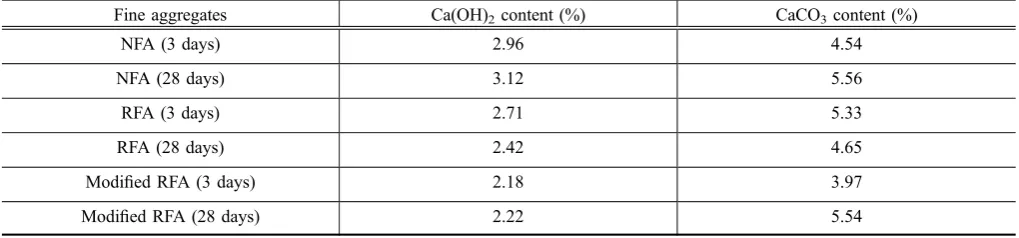
effect of CaF2, SiO2 and residual H2SiF6 formed on the modified aggregate surface were affected. However, the decrease of the water absorption rate and the density of the aggregate increased the compressive strength of mortar. TG– DTA regarding three different types of mortar at the ages of 3 and 28 days, and the contents of Ca(OH)2and CaCO3are shown in Table12.
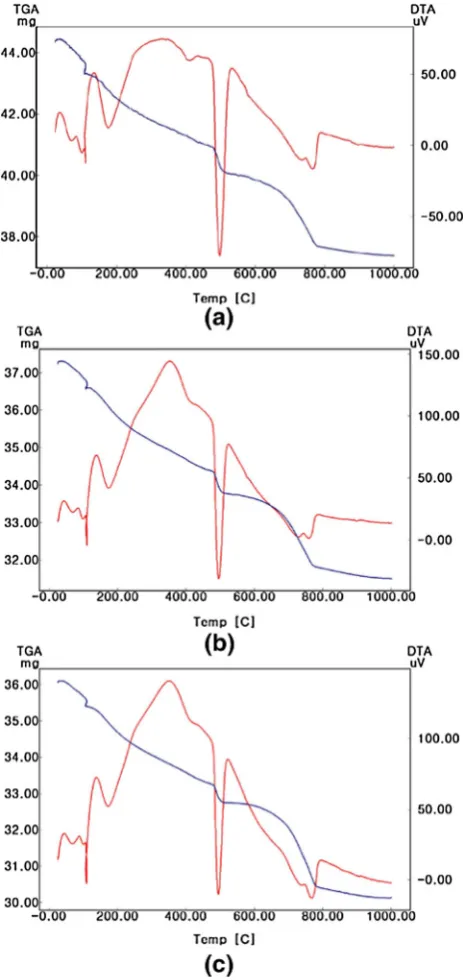
In addition, Fig. 4represents the result of TG/DTA for the mortar at the age of 28 days. There were changes in weight
0 5 10 15 20 25
3 days 7 days 28 days
Co
mp
res
si
ve St
ren
gt
h (MP
a)
Mortar ages NFA RFA Modified RFA
Fig. 1 Compressive strength of mortar.
0 2 4 6 8
3 days 7 days 28 days
Fle
xur
al
Str
eng
th (M
Pa
)
Mortar ages NFA RFA Modified RFA
Fig. 2 Flexural strength of mortar. Table 10 Changes in the specific gravity and absorption rate of fine aggregates.
Aggregate type Before After
Density (t/m3) Water absorption rate (%) Density (t/m3) Water absorption rate (%)
NFA 2.52 0.54 2.51 0.55
RFA-1 2.34 5.12 2.39 4.88
RFA-2 2.19 8.37 2.20 6.84
RFA-3 2.27 7.64 2.33 6.58
Table 11 Mortar setting times and flows.
Used aggregate type of mortar Flow (mm) Initiation (min) Termination (min)
NFA 180 250 450
RFA 130 200 400
for all specimens during the pyrolysis of Ca(OH)2 and CaCO3, and based on this result, the existence of Ca(OH)2 and CaCO3was verified within the analyzed specimens. At up to 100°C on DTA, the physically bonded water within the matrices evaporated, and there was physical dehydration of C3A ettringite between 140 and 180°C, ettringite and aluminate-based hydrates between 270 and 330°C, and aluminate-based hydrates at around 570°C. In the case of mortar with RFA and modified RFA, their Ca(OH)2contents were lower than that of mortar with NFA, and the CaCO3 contents of mortar with NFA and modified RFA, respec-tively, were measured lower than that of mortar with RFAs. As a result, the modification of RFA by H2SiF6appeared to be effective.
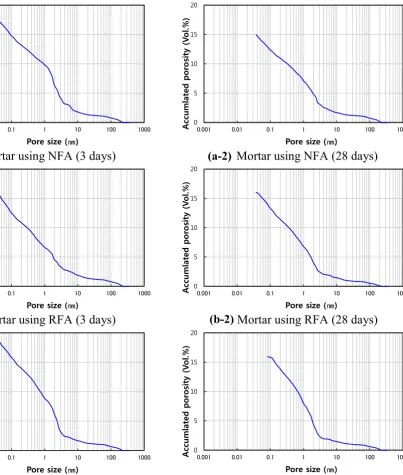
The mortar porosity rate distribution dependent on mortar age is displayed in Fig.5. The porosity at 3 days of age showed 20.025, 20.295, and 19.428% of NFA mortar, RFA mortar and modified RFA mortar respectively. On the other hand, the porosity at 28 days of age showed 16.950, 15.991, and 15.903% of NFA mortar, RFA mortar and modified RFA mortar respectively. The all mortar showed similar porosity. The smaller the pore size, the higher the distribution in NFA mortar. Modified RFA mortar showed a distribution of pores similar to NFA mortar than RFA mortar.
An XRD compound analysis was conducted on the test bodies of NFA, RFA, and modified RFA, and the results from day 3 and day 28 are shown in Fig.6. Modified RFA mortar showed different compound composition compared
Fig. 3 SEM analysis based on mortar curing (95000).aNFA,bRFA, andcmodified RFA.
Table 12 Analysis of contents of Ca(OH)2and CaCO3by the age of mortar.
Fine aggregates Ca(OH)2content (%) CaCO3content (%)
NFA (3 days) 2.96 4.54
NFA (28 days) 3.12 5.56
RFA (3 days) 2.71 5.33
RFA (28 days) 2.42 4.65
Modified RFA (3 days) 2.18 3.97
to RFA mortar. For the mortar on day 3, the early stage amount of Ca(OH)2 was relatively higher for mortar with RFA than for mortar with modified RFA. This is considered to result from the increase in the hardened cement paste attached to the surface of the RFA resulting from Ca(OH)2. Meanwhile, a relatively higher CSH generation was verified for mortar with modified RFA. For the mortar on day 28 with modified RFA, the amount of CSH generation was found to be increasing, which was considered to result from the supply of Si ions in the H2SiF6.
To investigate the RA surface modification method proposed in this paper, the absorption rates and specific gravity of RFA before and after treating with H2SiF6were
measured. Additionally, a physicochemical property eval-uation and chemical analysis of mortar with modified RFA were conducted. The results verified the surface modifi-cation effect and the presence of changes in the physical properties of the RFA owing to the H2SiF6 in each experiment. The values of various mechanical properties of the modified RFA mortar were also found to be rela-tively high. The RFA surface modification method pro-posed in this study is based on the chemical reaction mechanism between H2SiF6 and abundant Ca(OH)2 con-tained in the hardened cement paste in the aqueous solu-tion state as below.
Reactions under H2SiF6
H2SiF6þ3CaðOHÞ2!2H
þþSi2þþ6Fþ3Ca2þ
þ6OH
ð12Þ
2HþþSi2þþ6Fþ3Ca2þþ6OH
!3CaF2þSiO2þ4H2O ð13Þ
The reaction between the Ca(OH)2and H2SiF6involves a chemical reaction that produces inorganic fine powders of CaF2and SiO2. Wastewater is generated in recycled aggre-gate processing using the proposed method. Removal of fluoride from wastewater may be worse than acid wastew-ater. However, the fluoride in the wastewater is precipitated as an insoluble CaF2form as described in the paper. During the wet process, CaF2precipitate can be collected and dis-posed of separately.
On the other hand, it is thought that this reaction pro-gresses gradually from the surface of the hardened cement paste attached to the RFA towards the inside, causing the cement matrix to become denser. The decrease in the absorption rate and the consequent increase in specific gravity are considered to be the filling effect of the surface porosity due to the densification of the matrix inside the hardened cement paste. A decreased aggregate absorption rate and an increased specific gravity were revealed as increased mortar compression strength compared to before the modification as the compressive strengths (28 days ages): NFA (22.7 MPa), modified RFA (18.1 MPa), and RFA (16.2 MPa). Therefore, it has been confirmed that the acid treatment of the RFA and H2SiF6in aqueous solution, as proposed in this study, shows a surface modification effect similar to that of conventional carbonation treatment and acid treatment.
4. Conclusions
In this study, RFAs with high absorption rates and low specific gravities were wet-reacted with H2SiF6having rel-ative strong acidity, and various physical properties of the RFAs and mortar using the byproduct were confirmed. The results of this study are summarized as follows.
1. When large amounts of Ca(OH)2from hardened cement paste were attached to the surface of the RFAs and mixed with distilled water, alkaline ions are continu-ously eluted, resulting in pH values exceeding 11.5. When low quality RFAs were chemically treated in an aqueous solution containing H2SiF6, the absorption rate decreased and the specific gravity increased.
2. The proposed surface modification method is considered to result from the chemical reaction occurring on the RFA surface between H2SiF6 and Ca(OH)2, which is contained in abundance in the hardened cement paste attached to the surface of the RFA. Because of the production of CaF2and SiO2 on the surface of the RFA
as the result of the reaction with H2SiF6, an improve-ment in aggregate specific gravity and absorption rate was found to occur, and mortar test results confirmed enhanced strength.
3. By surface modification, mortar by using modified RFA showed improvements of mechanical properties in both compressive strength and flexural strength relatively tin comparison with mortar by using RFA.
4. Therefore, it was confirmed that the proposed RFA surface treatment method using H2SiF6, which is an industrial byproduct, is effective in improving the physical properties (high water absorption rate and low density) of RFA.
㻜㻚㻜㻜㻝 㻜㻚㻜㻝 㻜㻚㻝 㻝 㻝㻜 㻝㻜㻜 㻝㻜㻜㻜
#EEWONCVGFRQT
QUKV[8
QN
2QTGUK\G ᎔
㻜㻚㻜㻜㻝 㻜㻚㻜㻝 㻜㻚㻝 㻝 㻝㻜 㻝㻜㻜 㻝㻜㻜㻜
#EEWONCVGFRQT
QUKV[8
QN
2QTGUK\G ᎔
(a-1)
Mortar using NFA (3 days)
(a-2)
Mortar using NFA (28 days)
㻜㻚㻜㻜㻝 㻜㻚㻜㻝 㻜㻚㻝 㻝 㻝㻜 㻝㻜㻜 㻝㻜㻜㻜
#EEWONC
VG
F
RQT
Q
UKV[
8
Q
N
2QTGUK\G ᎔
㻜㻚㻜㻜㻝 㻜㻚㻜㻝 㻜㻚㻝 㻝 㻝㻜 㻝㻜㻜 㻝㻜㻜㻜
#EEWONCV
GFRQT
QUKV[
8
QN
2QTGUK\G ᎔
(b-1)
Mortar using RFA (3 days)
(b-2)
Mortar using RFA (28 days)
㻜㻚㻜㻜㻝 㻜㻚㻜㻝 㻜㻚㻝 㻝 㻝㻜 㻝㻜㻜 㻝㻜㻜㻜
#EEWONCVGFRQT
QUKV[8
QN
2QTGUK\G ᎔
㻜㻚㻜㻜㻝 㻜㻚㻜㻝 㻜㻚㻝 㻝 㻝㻜 㻝㻜㻜 㻝㻜㻜㻜
#EEWONCVGFRQT
QUKV[
8
QN
2QTGUK\G ᎔
(c-1)
Mortar using modified RFA (3 days)
(c-2)
Mortar using modified RFA (28 days)
Acknowledgements
This research was supported by 2015 Research Grant from Kangwon National University, a research grant from Tech-nology Advancement Research Program (TARP) funded by Ministry of Land, Infrastructure and Transport of Korean Government (15CTAP-C097331-01), and by the National Research Foundation of Korea (NRF) grant funded by the Korea government (No.NRF-2015R1D1A1A09059522).
Open Access
This article is distributed under the terms of the Creative Commons Attribution 4.0 International License (http:// creativecommons.org/licenses/by/4.0/), which permits un restricted use, distribution, and reproduction in any medium, provided you give appropriate credit to the original author(s)
and the source, provide a link to the Creative Commons license, and indicate if changes were made.
References
Al-Bayati, H. K. A., Das, P. K., Tighe, S. L., & Baaj, H. (2016). Evaluation of various treatment methods for enhancing the physical and morphological properties of coarse recycled concrete aggregate. Construction and Building Materials, 112,284–298.
AS. (1996). Particle density and water absorption of aggre-gates (AS 1141.6.2-1996). Sydney: Australian Standard. ASTM International. (2006).Standard test method for time of
setting of hydraulic cement by vicat needle; ASTM C 191. West Conshohocken: ASTM International.
1)$ 5)$ 0RGLILHG5)$
(WWULQJLWH
*\SVXP &D2+
0RQRVXOIDWH
&6+
(a)
3 days
(WWULQJLWH *\SVXP
&D2+
0RQRVXOIDWH
&6+
1)$ 5)$ 0RGLILHG5)$
(b)
28 days
ASTM International. (2012).Standard test method for density, relative density (specific gravity), and absorption of fine aggregate; ASTM C128-12. West Conshohocken: ASTM International.
ASTM International. (2013a).Standard test method for flow of hydraulic cement mortar; ASTM C1437-13. West Con-shohocken: ASTM International.
ASTM International. (2013b). Standard test method for com-pressive strength of hydraulic cement mortars (using 2-in. or [50 mm] Cube Specimens); ASTM C109 M-13. West Conshohocken: ASTM International.
ASTM International. (2014). Standard specification for flow table for use in tests of hydraulic cement; ASTM C230/ 230 M-14. West Conshohocken: ASTM International. Behera, M., Bhattacharyya, S. K., Minocha, A. K., Deoliya, R.,
& Maiti, S. (2014). Recycled aggregate from C&D waste & its use in concrete-a breakthrough towards sustainability in construction sector: A review. Construction and Building Materials, 68,501–516.
BS 812: Part 2. (1994).Testing aggregates. Method for quali-tative and quantiquali-tative petrographic examination of aggregates. London: BSI.
Chen, P., Wang, J., Wang, L., Xu, Y., Qian, X., & Ma, H. (2017). Producing vaterite by CO2 sequestration in the waste solution of chemical treatment of recycled concrete aggregates.Journal of Cleaner Production, 149,735–742. Choi, H. S., Kitagaki, R., & Noguchi, T. (2014). Effective recycling of surface modification aggregate using micro-wave heating. Journal of Advanced Concrete Technology, 12,34–45.
Construction standard CS3. (2013). Construction standard CS3: 2013-Aggregates for concrete, Civil engineering and development department of Hong Kong. http://www.cedd. gov.hk/eng/publications/standards_handbooks_cost/stan_cs3_ 2013.html.
DIN 4226–100. (2002).Aggregates for mortar and concrete– Part 100: Recycled aggregates. Berlin: Deutsches Institut fu¨r Normung.
Ismail, S., & Ramli, M. (2014). Influence of surface-treated coarse recycled concrete aggregate on compressive strength of concrete.International Journal of Civil, Environmental, Structural, Construction and Architectural Engineering, 8, 862–866.
JIS A 5021. (2005).Recycled aggregate for concrete-class H. Tokyo: Japan Concrete Institute.
JIS A 5022. (2007).Recycled concrete using recycled aggregate class M. Tokyo: Japan Concrete Institute.
JIS A 5023. (2007).Recycled concrete using recycled aggregate class L. Tokyo: Japan Concrete Institute.
Kim, J. O., Nam, J. H., Kim, D. S., & Lee, B. K. (2004). Changes in hydration and watertightness of cement con-taining two-component fluosilicate salt based chemical admixture. Journal of the Korean Ceramic Society, 41, 749–755.
Kong, D. Y., Lei, T., Zheng, J. J., Ma, C. C., & Jiang, J. (2010). Effect and mechanism of surface-coating pozzalanics materials around aggregate on properties and ITZ microstructure of recycled aggregate concrete. Construc-tion and Building Materials, 24,701–708.
KS F 2573. (1999). Recycled aggregate for concrete. Seoul: Korea Standard Association.
Noguchi, T., Park, W. J., & Kitagaki, R. (2015). Risk evaluation for recycled aggregate according to deleterious impurity content considering deconstruction scenarios and produc-tion methods.Resources, Conservation and Recycling, 104, 405–416.
Ondova, M., & Sicakova, A. (2016). Evaluation of the influence of specific surface treatments of RBA on a set of properties of concrete.Materials, 9,156.
RILEM TC 121-DRG. (1994). Specifications for concrete with recycled aggregates. Materials and Structures, 27, 557–559.
Ryou, J. S., & Lee, Y. S. (2014). Characterization of recycled coarse aggregate (RCA) via a surface coating method. In-ternational Journal of Concrete Structures and Materials, 8,165–172.
Shi, C., Li, Y., Zhang, J., Li, W., Chong, L., & Xie, Z. (2015). Performance enhancement of recycled concrete aggregate-A review.Journal of Cleaner Production, 12,466–472. Spanish Minister of Public Works. (2008). Instruccio´n de
Hor-migo´n Estructural EHE-08 (Spanish Structural Concrete Code).
Tam, V. W. Y., Tam, C. M., & Le, K. N. (2007). Removal of cement mortar remains from recycled aggregate using pre-soaking approaches. Resources, Conservation and Recy-cling, 50,82–101.
Yang, I. S., Yun, H. D., Kim, D. S., Khil, B. S., & Han, S. G. (2005). Experimental study on engineering properties of concrete using fluosilicates based composite. Korea Con-crete Institute Structure Journal, 17,769–774.
Zhan, B., Poon, C. S., Liu, Q., Kou, S., & Shi, C. (2014). Experimental study on CO2 curing for enhancement of recycled aggregate properties. Construction and Building Materials, 67,3–7.