https://doi.org/10.5194/ms-10-465-2019
© Author(s) 2019. This work is distributed under the Creative Commons Attribution 4.0 License.
Failure analysis of a re-design knuckle
using topology optimization
Yung-Chuan Chen, Hsing-Hui Huang, and Chen-Wei Weng
Department of Vehicle Engineering, National Pingtung University of Science & Technology, Pintung, R.O.C.
Correspondence:Hsing-Hui Huang ([email protected])
Received: 6 September 2018 – Revised: 9 July 2019 – Accepted: 3 August 2019 – Published: 26 August 2019
Abstract. In this study, a systematic design process is carried out for the design of the knuckle. A systematic method is proposed for the design and analysis of a lightweight steering knuckle in an electric vehicle. In the proposed approach, a finite element (FE) model of the knuckle is constructed based on an inspection of the suspension and steering requirements of the target vehicle and the results of a kinematic analysis. A two-stage topology optimization method is then applied to refine the material distribution within the FE model in such a way as to minimize the knuckle weight. Finally, FE simulations are performed to evaluate the strength of the knuckle under road impact conditions and to determine the fatigue life of the knuckle for four ISO 8608 road classes (A–D). The results show that the optimized knuckle has a weight of 3.64 kg (approximately 6.2 % lighter than the original knuckle of the same strength and material) and achieves fatigue lives of 2.512×10¹¹, 2.972×10⁸, 5.598×10³and 2.432×101cycles for road classes A, B, C and D, respectively.
1 Introduction
The overall feeling that a vehicle brings to its drivers and passengers is governed mainly by the design of the chassis. The knuckle, which connects the wheel to the steering and suspension systems, is one of the most important parts of the chassis and has a critical effect on the handling and steering characteristics of the vehicle. Modern vehicles rely on the use of lightweight designs to improve the energy efficiency. Moreover, to improve the handling, it is essential to mini-mize the unsprung mass. Thus, the problem of minimizing the weight of the knuckle component, thereby reducing the load imposed on the suspension system, has attracted signif-icant attention in the automotive industry in recent decades.
Among the various methods available for achieving weight reduction in the design process, optimization methods pro-vide a particularly attractive approach. Song and Lee (2011) employed a reliability-based design optimization technique based on the moving least squares method (MLSM) to min-imize the weight of a knuckle component under bump and brake loading conditions subject to given stress, deforma-tion and frequency constraints. Muhamad et al. (2012) com-bined a shape optimization technique with HyperWorks
466 Y.-C. Chen et al.: Failure analysis of a re-design knuckle using topology optimization
strength was evaluated under static loads only. However, un-der real-world driving conditions, the knuckle load varies dy-namically as the wheel travels over the road surface and the vehicle performs braking, accelerating, and turning maneu-vers. Therefore, when designing and analyzing a knuckle, it is necessary to consider not only the static load acting on the knuckle, but also the fatigue strength of the knuckle under the effects of long-term cyclic load. Zoroufi and Fatemi (2004) contended that fatigue is the main factor determining the ser-vice life of a knuckle and thus serves as a useful indicator for evaluating the performance of competing manufacturing pro-cesses and materials. Vijayarangan et al. (2013) investigated the optimal design of a knuckle fabricated of metal matrix composite (MMC) and found that the area of the knuckle connected to the shock absorber was particularly prone to fa-tigue damage.
The literature contains many studies on the use of nu-merical modeling techniques to reduce the weight of the knuckle component or investigate its fatigue behavior. Ac-cordingly, the present study proposes a framework based on topology optimization and finite element analysis (FEA) sim-ulations for minimizing the weight of the knuckle component in a real-world five-seat electric vehicle (EV) under the pre-scribed design space, load and boundary conditions, and then evaluating the strength and fatigue life of the knuckle under various road class conditions.
2 Methodology
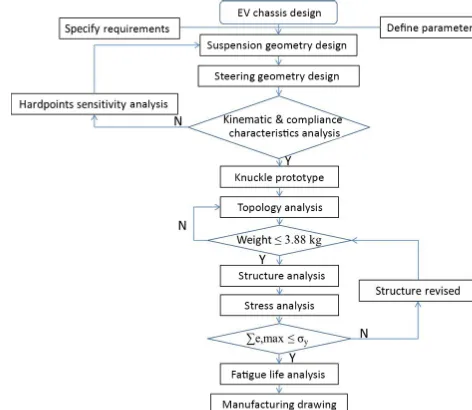
Figure 1 shows the main steps in the methodology proposed in this study for the lightweight design and analysis of the knuckle. Figure 2a and b show a photograph of the target vehicle and the vehicle specification, respectively. As shown in Fig. 1, the design process commences by establishing the geometry designs of the suspension and steering systems of the target EV. Having conducted a kinematic and hardpoints sensitivity analysis, TOSCA simulations are performed us-ing an ABAQUS finite element (FE) model to optimize the material layout of the prototype knuckle design. Once the weight of the knuckle has been reduced to a value less than that of the original knuckle (3.88 kg), further simulations are performed to analyze the strength of the designed knuckle. If the strength fails to meet the prescribed requirement, the structure of the knuckle is modified accordingly. Finally, FE-Safe analyses are performed to evaluate the fatigue strength of the knuckle under various road roughness conditions.
3 Topology Analysis of Knuckle
Based on an analysis of the suspension and steering charac-teristics of the target vehicle, the physical constraints for the topology optimization process were set as follows: (1) an in-clination angle must conform to the analysis result of 13.2◦; (2) the hardpoint thickness for a shock absorber of 26 mm;
Figure 1.Design flow chart for lightweight design and analysis of steering knuckle.
(3) the hardpoints spacing between the two strut mount points of 53 mm; (4) a brake caliper hardpoints spacing of 131 mm; and (5) a wheel bearing inner diameter of 71 mm. Furthermore, the overall dimensions of the knuckle were set as 219 mm (length), 137 mm (width) and 239 mm (height) (see Fig. 3).
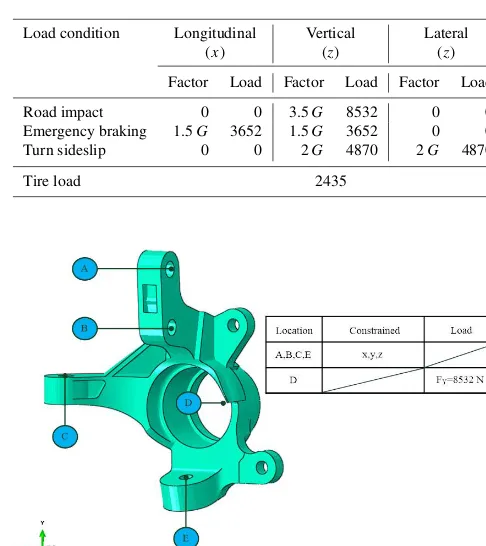
Given the constraints above, the aim of the topology opti-mization process is to find the optimal material distribution within the specific design space for the specified loading con-ditions. In performing the optimization process, it was as-sumed that the knuckle was fabricated of GCD450 material. Furthermore, to avoid affecting the strength of the hardpoints for the caliper, tie rod and lower control arm, the optimization process was confined only to certain regions of the model, as shown in Fig. 4. The topology optimization analysis process considered three static loading conditions, namely road im-pact, emergency braking, and turn sideslip. For each condi-tion, a force was applied to the upper seat of the shock ab-sorber in an upward direction as a single wheel load weight and specific load conditions relating to the particular static condition were then added to the center of the wheel bearing (see Table 1).
Figure 2.Photograph of 5-seater electric vehicle and vehicle specification.
Figure 3.Dimensional constraints for optimized knuckle compo-nent.
Figure 4.Structural planning of knuckle prototype.
Table 1.Vehicle load factor and specific load conditions (Fan et al., 2011). Unit: Newton.
Load condition Longitudinal Vertical Lateral (x) (z) (z)
Factor Load Factor Load Factor Load
Road impact 0 0 3.5G 8532 0 0 Emergency braking 1.5G 3652 1.5G 3652 0 0 Turn sideslip 0 0 2G 4870 2G 4870
Tire load 2435
Figure 5.Boundary conditions for impact load case.
468 Y.-C. Chen et al.: Failure analysis of a re-design knuckle using topology optimization
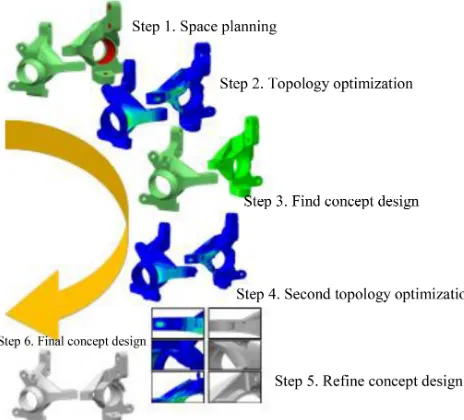
Figure 6.Topology optimization process for steering knuckle.
Figure 7.Finite element model of knuckle.
design (3.88 kg). In addition, the knuckle arm connecting rib thickness wasTa=5 mm and the shock absorber rib thick-ness wasTr=6.5 mm.
4 Structure Analysis of Knuckle
Strength and fatigues analyses of the redesigned knuckle were conducted using static and dynamic three-dimensional (3-D) elasto-plastic finite element (FE) models, respectively (see Fig. 7). In both cases, the model was meshed using 3-D hexahedron eight-node elements.
In performing the fatigue life analysis of the knuckle, the suspension system was simplified as a 3-D two-node beam element model with spring (K) and damping (C) parameters (see Fig. 8). In addition, a load displacement signal was in-put to the FE model through the hardpoints of the knuckle support arm to simulate the total load of the vehicle
(includ-Table 2.Material properties of knuckle used in finite element sim-ulations.
Mechanical Properties of GCD450
Young’s Modulus (GPa) 170 Yield Stress (MPa) 370 Ultimate Stress (MPa) 450 Poisson’s Ratio 0.29 Density (kg m−3) 7900
ing the weights of the driver, passenger, power system and battery system, respectively).
Table 2 shows the material properties of the knuckle used in the FE simulations. As described above, the impact load was input to the wheel center of the model and the simulation process then calculated thex,y andzdirection forces at the hardpoints of the knuckle using a quarter vehicle suspension model.
4.1 Boundary conditions for strength analysis
In evaluating the strength of the knuckle under impact loads, the aim of the FE simulations was to determine the displace-ment of the wheel when the vehicle passed over a large bump, thereby imposing a large stress on the related components of the suspension system. Accordingly, the degrees of freedom of the FE model were constrained in all six directions at D (the center of the wheel axis), and the forces shown in Fig. 9 were applied in thex,y andzdirections at points A and B (suspension strut hardpoints), C (tie rod hardpoint), and E (lower control arm hardpoint). In addition, a load of 8532 N was applied at the center of the wheel (see Table 1).
4.2 Boundary conditions for fatigue life analysis
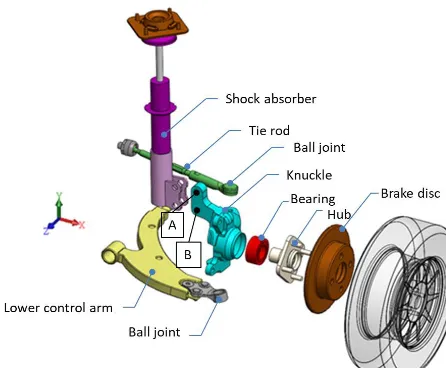
To perform the fatigue life analysis of the knuckle, the load displacement signal of the knuckle strut was ob-tained using the quarter vehicle suspension system model shown in Fig. 10 consisting of a shock absorber, knuckle, hub, ball joint, bearing, lower control arm, and tie rod. The stiffnesses of the front suspension spring and tire were set asKf=60 N mm−1andKt=310 N mm−1, respec-tively, while the damping coefficients were set as 0.912 and 0.0031 N s mm−1, respectively. In calculating the service life of the knuckle under different road roughness conditions (i.e., different ISO road classes), two input signals were considered, namely ay direction displacement signal at the shock absorber hardpoints (A and B in Fig. 10) and the dis-placement signal of the road surface at the tire position (see Fig. 11).
Figure 8.Finite element model of suspension system.
Figure 9.Boundary condition setting for impact load simulation.
Figure 10.Geometric quarter model of vehicle suspension system.
total of 8 classes (A–H). According to the ISO standard, the power spectral density function of the road displacement can be expressed in the following wave number form:
≤0
Sg()=Sg()
0 −N1
(1)
Figure 11.Boundary conditions for fatigue life analysis.
≥0
Sg()=Sg()
0 −N2
(2)
470 Y.-C. Chen et al.: Failure analysis of a re-design knuckle using topology optimization
Figure 12.Road profile signal (class A) and corresponding input displacement signal to shock absorber hardpoint. (Note that vehicle velocity V is equal to 40 km h−1.)
Table 3.ISO road roughness classes.
Grade of roughnessSg()
unit: 10−6(m2(cycles m−1)−1)
Road Class Range Geometric Mean
A (Very Good) <8 4
B (Good) 8–32 16
C (Average) 32–128 64
D (Poor) 128–512 256
E (Very Poor) 512–2048 1024
F 2048–8192 4096
G 8192–32 768 16 384
H >32 768
Sg() is the roughness function of the road surface (cy-cle m−1). In addition, N1 is the frequency index related to the frequency structure of the road spectrum and has a value in the range of 1.75–2.25 with an average value of 2,N1=2. Table 3 shows the ISO roughness of the eight road classes (ISO 8608, 1995).
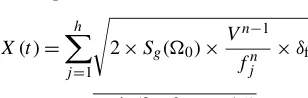
The ISO specification for the road roughness has the form of a frequency signal. However, the input to the tire system used in the present fatigue analyses should have the form of a time-domain signal. Thus, a Matlab program was used to convert the ISO-standard frequency domain signal into a time-domain signal in accordance with the following rela-tionship (Soliman et al., 2006):
X(t)=
h X
j=1 s
2×Sg(0)×
Vn−1
fjn ×δf
×sin(2π fjtk+ψj) (3)
whereX(t) is the displacement signal of the road profile and is composed of multiple sine waves of different frequencies; his the number of sine waves,kis the current sampling point of the signal;V is the vehicle speed (m s−1);ψis the phase
angle;Sg() is the roughness value of the road surface class;
δfis the frequency interval;f is the frequency; andnis the road surface roughness and usually has a value between 2 and 3.
Consider the general road surface level (class A) as an ex-ample and assume that the maximum speed of the target vehi-cle isV =40 km h−1. Assume further that the road surface is composed ofh=1000 sine waves with a frequency interval ofδf=0.05 Hz. In other words, the road surface covers the frequency range of 0.05 to 50 Hz. According to Table 3, the maximum value can be used as the input of the road grade, Sg(). Therefore, the Sg() values of classes A, B, C and D road roughness are 8, 32, 128 and 512, respectively. From Eq. (3), the time domain signal of the road surface profile (class A) can be obtained with the form shown in Fig. 12a. The corresponding input displacement signal applied to the shock absorber hardpoint is shown in Fig. 12b.
5 Model verification
Figure 13.Knuckle arm deformation measurement under applied load of 450 N.
Figure 14.Finite element analysis of knuckle bending deformation.
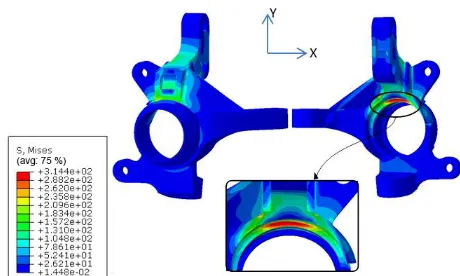
Figure 15.Von Mises stress distribution of knuckle under impact load conditions.
redesigned knuckle meets the requirements of the commer-cial knuckle.
6 Strength and Fatigue Analyses
In performing the impact load analysis, the boundary condi-tions and applied load were set as shown in Fig. 9. Moreover,
Figure 16.Fatigue life estimation of redesigned knuckle.
the upward force acting on the knuckle in theydirection was set as 3.5G(see Table 1). Figure 16 shows the simulation re-sults for the resulting von Mises stress distribution. It is seen that the regions of maximum stress are located mainly under the knuckle strut arm and at the corners of the strut arm ribs. From inspection, the von Mises stress (σe,max) has a maxi-mum value ofσe,max=314 MPa. This value is less than the material yield stress (370 MPa), and hence the mechanical integrity of the knuckle under the considered impact load is confirmed.
472 Y.-C. Chen et al.: Failure analysis of a re-design knuckle using topology optimization
Figure 17.Fatigue life analysis of knuckle for class A road surface.
Figure 18.Fatigue life of redesigned knuckle for road classes A–D.
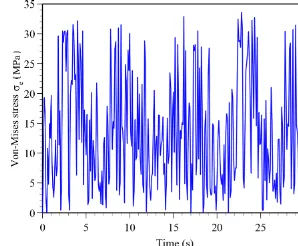
at the point of maximum von Mises stress was taken and the rain flow counting method was used to count the num-ber of occurrences of the maximum stress. The fatigue life, Nf, was then calculated in accordance with the occurrences ni of amplitudeσa corresponding to the average stress σm. Finally, Miner fatigue theory was used to accumulate the fa-tigue damage values under various fafa-tigue strengths in order to calculate the total fatigue life of the knuckle (see Fig. 16). At a vehicle speed of 40 km h−1, the maximum ampli-tudes of the road surface in the time-domain signal dia-grams are approximately 10, 25, 50 and 100 mm for road classes A, B, C and D, respectively. Figure 17a shows the von Mises stress distribution in the re-designed knuckle for the class A road surface. It can be seen that the von Mises stress reaches a maximum value of 32 MPa at a point just beneath the knuckle cone. Figure 17b shows the von Mises stress history at the corresponding location. Substituting the stress history results into FE-Safe, the fatigue life is found to beNf=2.512×10¹¹ cycles. The fatigue life is greater than 1×10⁶cycles, and hence the knuckle can be assumed to have
Table 4.Fatigue life of knuckle for various road classes and vehicle speed of 40 km h−1.
Road Surface Class Total Damage (D) Fatigue Life (N)
A 3.980×10⁻¹² 2.512×10¹¹
B 3.365×10⁻⁹ 2.972×10⁸
C 1.786×10⁻⁴ 5.598×10³
D 4.112×10⁻² 2.432×101
an infinite life when operating on a Class A road. Table 4 and Fig. 18 summarize the fatigue test results for road classes A– D. As expected, the fatigue life reduces with an increasing road roughness. However, in general, the results show that the knuckle has an infinite life for general road classes (A and B)
7 Conclusions
This study has proposed a systematic framework for the de-sign and analysis of a lightweight knuckle for a commercial electric vehicle (EV). In the proposed framework, the design space is identified from an inspection of the steering and sus-pension systems of the target EV and a hardpoints sensitiv-ity analysis. A finite element model of the knuckle is con-structed in ABAQUS and two-stage topology optimization is then performed to minimize the weight of the knuckle. Fi-nally, finite element simulations are conducted to analyze the strength of the knuckle and evaluate its fatigue life under four ISO 8608 road classes (A–D). The simulation results support the following main conclusions:
The original knuckle has a weight of 3.88 kg. By con-trast, the redesigned knuckle has a weight of just 3.64 kg for the same material and strength constraints. In other words, the redesigned knuckle achieves a weight saving of approxi-mately 6.2 %.
Mises stress has a value ofσe,max=314.4 MPa and occurs beneath the knuckle strut arm. The maximum stress is less than the yield strength of the knuckle material (GCD450). Hence, the mechanical integrity of the knuckle under impact loads is ensured.
The fatigue life analysis results show that the redesigned knuckle has fatigue lives of 2.512×10¹¹, 2.972×10⁸, 5.598×10³ and 2.432×101 under ISO 8608 road classes A, B, C and D, respectively. For general road classes (A and B), the fatigue life is greater than 1×10⁶cycles, and hence the knuckle can be regarded as having an infinite life.
Data availability. All the experimental data can be obtained from the author.
Author contributions. YCC and HHH conceived of the pre-sented idea. We developed the theory and CWW performed the CAE. YCC and HHH verified the analytical methods and super-vised the findings of this work. All authors discussed the results and contributed to the final manuscript.
Competing interests. The authors declare that they have no con-flict of interest.
Financial support. This research was supported by MOST (project no. MOST 107-2637-E-020-001).
Review statement. This paper was edited by Guimin Chen and reviewed by Shuang Xu and three anonymous referees.
References
Bhardwaj, S., Ashok, B., Lath, U., and Agarwal, A.: Design and Op-timization of Steering Upright to Reduce the Weight Using FEA, SAE Technical Paper 2018-28-0081, SAE International, USA, https://doi.org/10.4271/2018-28-0081, 2018.
Fan, P., Zhao, B., and Qiu, L.: The Analysis on Destruc-tion Forms of Steering Knuckle, Third International Conference on Measuring Technology and Mechatron-ics Automation, IEEE, Shanghai, China, Vol. 3, 677–679, https://doi.org/10.1109/ICMTMA.2011.740, 2011.
ISO 8608: Mechanical Vibration – Road Surface Profiles – Report-ing of Measured Data, International Standardization Organiza-tion, Geneva, Switzerland, 1995.
Muhamad, W. W., Sujatmika, E., Hisham, H., and Tarlochan, F.: De-sign Improvement of Steering Knuckle Component Using Shape Optimization, International Journal of Advanced Computer Sci-ence, 2, 65–69, 2012.
Shelar, M. L. and Khairnar, H. P.: Design Analysis and Optimiza-tion of Steering Knuckle using Numerical Methods and Design of Experiments, International Journal of Engineering Develop-ment and Research, 2, 2958–2967, 2014.
Sivananth, V. and Vijayarangan, S.: Fatigue Life Analysis and Optimization of A Passenger Car Steering Knuckle under Operating Conditions, International Journal of Au-tomotive and Mechanical Engineering, 11, 2417–2429, https://doi.org/10.15282/ijame.11.2015.22.0203, 2015.
Soliman, A. M. A., Abd Alla, S. A., El-Mashed, Y. A., and Hamid, M. S. A.: Improvement of Vehicle Ride Performance Using a Hydro-pneumatic Active Suspension System, SAE Technical Paper No. 2006-01-1298, SAE International, USA, https://doi.org/10.4271/2006-01-1298, 2006.
Song, C. Y. and Lee, J.: Reliability-based Design Optimization of Knuckle Component using Conservative Method of Moving Least Squares Meta-models, Probabilist. Eng. Mech., 26, 364– 379, https://doi.org/10.1016/j.probengmech.2010.09.004, 2011. Vijayarangan, S., Rajamanickam, N., and Sivananth, V.:
Evaluation of Metal Matrix Composite to Replace Spheroidal Graphite Iron for a Critical Component Steering Knuckle, Materials and Design, 43, 532–541, https://doi.org/10.1016/j.matdes.2012.07.007, 2013.
Wang, J. X., Ou, K. H., Liu, S. H., and Chen, J. H.: Simulation of knuckle strength based on multi-body dynamics, Chang’an Auto-mobile Engineering Research Institute CAE Department, Chang An, 2002.