Available online on 19.06.2019 at http://jddtonline.info
Journal of Drug Delivery and Therapeutics
Open Access to Pharmaceutical and Medical Research© 2011-18, publisher and licensee JDDT, This is an Open Access article which permits unrestricted non-commercial use, provided the original work is properly cited
Open Access
Research Article
Development and Validation of a RP-UPLC Method for Determination of
Linezolid in Pharmaceutical Formulation
Bhusnure Omprakash G.1*, Suryawanshi Shivraj2, Vijayendra Swamy S.M.3, Gholve Sachin B.1, Girm padmaja S.2, Birajdar Mahesh J4.
1.Channabasweshwar pharmacy Collage, Dept of Quality Assurance, Latur (MS), India. 2.Channabasweshwar pharmacy Collage, Dept of Pharmacology, Latur (MS), India. 3.Channabasweshwar pharmacy Collage, Dept of Pharmaceutics, Latur (MS), India.
4.Channabasweshwar pharmacy Collage, Dept of Pharmaceutical chemistry, Latur (MS), India.
ABSTRACT
A simple, sensitive and accurate RP-UPLC method has been developed for the determination of Linezolid in Tablet formulation. The mix of the Linezolid was found to be 251nm in Acetonitrile: Buffer [40:60(v/v)]. The method shows high sensitivity with linearity 5 to 3 0μg/ml (regression r2 = 0.999). This method was tested and validated for various parameters according to ICH guidelines and USP. The Detection limit
and quantitation limit were found to be 50mg ml–1 and 150 mg ml–1 in Acetonitrile: Buffer [40:60(v/v)] respectively. The results demonstrated that the procedure is accurate, precise and reproducible (relative standard deviation < 2%), while being simple, cheap and less time consuming and can be suitably applied for the estimation of Linezolid in Tablet pharmaceutical formulation.
Keywords: linezolid, Acetonitrile: Buffer 40:60 (v/v). RP-UPLC, Methanol.
Article Info: Received 04 May 2019; Review Completed 06 June 2019; Accepted 10 June 2019; Available online 19 June 2019 Cite this article as:
Bhusnure OG, Suryawanshi S, Vijayendra Swamy SM, Gholve SB, Development and Validation of a RP-UPLC Method for Determination of Linezolid in Pharmaceutical Formulation, Journal of Drug Delivery and Therapeutics. 2019; 9(3-s):654-658 http://dx.doi.org/10.22270/jddt.v9i3-s.3072
*Address for Correspondence:
Bhusnure Omprakash G, Channabasweshwar pharmacy Collage, Dept of Quality Assurance, Latur (MS), India.
INTRODUCTION
Analytical chemistry is a scientific discipline that develops methods, instruments and strategies to obtain information on the composition and nature of matter. Analytical chemistry is concerned with the chemical characterization of matter and thus pharmaceutical analysis covers matter having pharmaceutical applications. Knowledge of chemical composition of many substances is important in our daily life. Analytical chemistry plays an important role in nearly all aspects of chemistry viz. agricultural, clinical, environmental, forensic, manufacturing, metallurgical, and pharmaceutical
chemistry.
UPLC refers to Ultra Performance Liquid Chromatography. It improves in three areas: chromatographic resolution, speed and sensitivity analysis. It uses fine particles and saves time and reduces solvent consumption. The UPLC is based on the principal of use of stationary phase consisting of particles less than 2 μm (while HPLC columns are typically filled with particles of 3 to 5 μm). The underlying principles of this
FigURE 1: Structure of Linezold
Molecular Formula : C16H20FN3O4 Molecular Weight : 337.346 g/mol
IUPAC Name : (S)-N-({3-[3-fluro-4-(morphine-4-yl)phenyl1]-2-oxo-1,3xazolidi-5-yl}methyl)acetamide
Description: white to off white powder
Melting Point: 154°C
Solubility: Linezolid is slightly soluble in acetone, and Insoluble in water, ethanol.
Mode of action: Protein synthesis inhibitors
Dose: 400mg / 600 mg
Therapeutic Category: Synthetic Antibacterial Agent of the oxazolidine class (Antibiotic)
MATERIALS AND METHOD
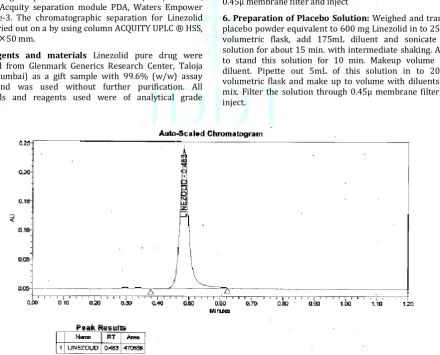
1. Instrument The liquid chromatographic system consisted of following components UPLC SYSTEM – TL/ARF/UPLC-05, Waters Acquity separation module PDA, Waters Empower Software-3. The chromatographic separation for Linezolid was carried out on a by using column ACQUITY UPLC ® HSS,
1.8µ 2.150 mm.
2. Reagents and materials Linezolid pure drug were obtained from Glenmark Generics Research Center, Taloja (Navi Mumbai) as a gift sample with 99.6% (w/w) assay value and was used without further purification. All chemicals and reagents used were of analytical grade
(MERCK, RANKEM India). Linezolid tablets were purchased from local market and used with in self-life period. Each tablet was labeled contain 400mg of Linezolid.
3. Chromatographic Conditions the mobile phase was prepared by dissolving 2.72gm of K2HPO4 and 2ml TEA in 1000 ml water adjust pH 3.0 with OPA. From the previous solution, 600 ml was mixed with 400 ml of acetonitrile. Prior to use the mobile phase was filtered through 0.45 μm membrane filters and degassed by sonication for 10 min. the analysis was carried out on an UPLC Water Acquity system. The analytes were conducted on an analytical column
ACQUITY UPLC ® HSS, 1.8µ 2.150 mm with a detection
wavelength of 251 nm. The operating temperature of the column was set at 30°C. the injection volume was 0.5 μL, and the flow rate was maintained at 0.4 mL/min. the run time was 1.2 min. Column temperature 40°C0.
4. Preparation of Linezolid standard solution:
Weigh and transfer 30 mg of Linezolid working Standard into 50 mL volumetric flask, add 30mL diluent and sonicate to dissolve. Dilute to volume with diluent and mix well. Further dilute 5.0 ml of the solution into 50ml volumetric flask (60ppm), dilute to volume with diluent and mix well.
5. Preparation of sample solution:
Take a 5 tablet and crush. Weighed and transfer powder equivalent to 600 mg Linezolid in to 250mL volumetric flask, add 175mL diluent and sonicate this solution for about 15 min. with intermediate shaking. Allow to stand this solution for 10 min. Makeup volume with diluent. Pipette out 5mL of this solution in to 200mL volumetric flask and make up to volume with diluents and mix. Filter the solution through 0.45µ membrane filter and inject
6. Preparation of Placebo Solution: Weighed and transfer placebo powder equivalent to 600 mg Linezolid in to 250mL volumetric flask, add 175mL diluent and sonicate this solution for about 15 min. with intermediate shaking. Allow to stand this solution for 10 min. Makeup volume with diluent. Pipette out 5mL of this solution in to 200mL volumetric flask and make up to volume with diluents and mix. Filter the solution through 0.45µ membrane filter and inject.
Method Validation 1. System suitability:
The standard solution was injected five times into chromatograph & measured the area counts of Linezolid. The tailing factor of the main peak should be NMT 2.0. The theoretical plates of the main peak should be NLT 2000. The %RSD of the main peak area for five standard injections should be NMT 2.0%.
2. Specificity:
The specificity of the method was determined by checking for interference with the drug from placebo components. This method was proven by the no change in absorbance of the drug with and without excipients at respective wavelength. Therefore, proposed method was specific and selective for the drug.
3. Linearity and Range:
A series of Standard preparations of Linezolid to be prepared over a range of 50% to 150% of the working concentration of Linezolid in Linezolid Tablet. (Minimum Five points should be in the range 80-120% of standard/ sample concentration for Assay). Since the working concentration is 100 µg per ml, of Linezolid, the range proposed is about 50 µg per ml to 150 µg per ml of Linezolid.
4. Accuracy (Recovery):
Placebo of Linezolid will be spiked Linezolid with drug substance at three different levels: 80%, 100% and 120% of the label claim in triplicate (total nine determinations) and then to be prepared as described under Appendix A. Each of the sample preparations will be injected in duplicate and the average area count to be taken for calculation. Transfer accurately API and Placebo as given in the table below in volumetric flasks.
5. Precision:
Method Precision: Six sample preparations of Linezolid Injections are to be prepared and injected into the UPLC
using the method as described under Appendix A.
Ruggedness (Intermediate Precision) Six sample preparations of the same lot of Linezolid Injections is made by a different analyst, using different column on a different day and injected in duplicate into a different UPLC than using the method as described under Appendix A, along with Standard preparation.
6. Robustness
Robustness of the method was carried out by deliberately made small change in the Flow rate by ±10% (1.35 and 1.65 ml/min), Column temperature by ±50C, Mobile phase composition by ±5% of ACN: Phosphate buffer (81:19, v/v and 79:21, v/v) and change in pH of Phosphate Buffer 6.5±0.2 units had no significant effect on the retention time and chromatographic response of linezolid.
Assay Method Validation Report
UPLC method has been developed for the Assay of in Linezolid Tablet. This report is intended for the validation of UPLC method for the Assay of Linezolid in Linezolid Tablet Specificity
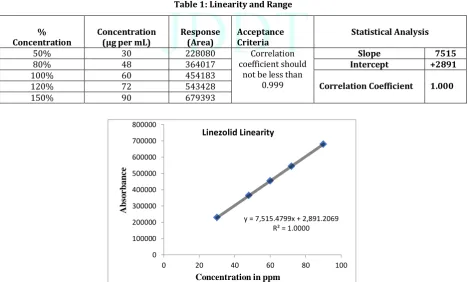
Linearity and Range
A series of Standard preparations of Linezolid to be prepared over a range of 50% to 150% of the working concentration of Linezolid in Linezolid Tablet. (Minimum Five points should be in the range 80-120% of standard/ sample concentration for Assay). Since the working concentration is 100 µg per ml, of Linezolid, the range proposed is about 50 µg per ml to 150 µg per ml of Linezolid.
Table 1: Linearity and Range
%
Concentration Concentration (µg per mL) Response (Area) Acceptance Criteria Statistical Analysis
50% 30 228080 Correlation
coefficient should not be less than
0.999
Slope 7515
80% 48 364017 Intercept +2891
100% 60 454183
Correlation Coefficient 1.000
120% 72 543428
150% 90 679393
Table 2: Calibration curve of Linezolid y = 7,515.4799x + 2,891.2069
R² = 1.0000
0 100000 200000 300000 400000 500000 600000 700000 800000
0 20 40 60 80 100
Linezolid Linearity
Concentration in ppm
A
b
so
rb
an
Conclusion: Correlation coefficient is 1.000 Therefore, the UPLC method for the determination of Assay of Linezolid in Linezolid Tablet is linear.
Accuracy (Recovery):
Placebo of Linezolid were spiked with Linezolid drug substance at three different levels: 80%, 100%, 120% of the label claim in
triplicate (total nine determinations) and then to be prepared as described under Methodology. Each of the sample
preparation was injected in duplicate and average area count to be taken for calculation.
Table 3: Accuracy data of the developed method Sample No. Amount Added
(mg) Acceptance Criteria Amount Recovered (mg) % Recovery
Acc. 80% -1 48.2 Mean recovery should be in
the range of 98.0% to 102.0%. The RSD should not more than 2.0%
47.45 98.81
Acc. 80% -2 48.2 47.45 98.81
Acc. 100% -1 60.3 59.45 99.04
Acc. 100% -2 60.3 59.45 99.04
Acc. 120% -1 72.1 71.15 98.80
Acc. 120% -2 72.1 71.15 98.80
Mean 98.88
SD 0.134
% RSD 0.135
Conclusion: Mean recovery is 98.88% & RSD is 0.135%. Therefore, the UPLC method for the determination of Assay of Linezolid in Linezolid Tablet is accurate.
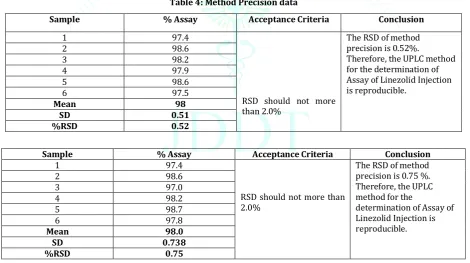
Precision: Method Precision:
Six sample preparation of Linezolid were prepared and injected into the UPLC using the method as described under
Methodology.
Table 4: Method Precision data
Sample % Assay Acceptance Criteria Conclusion
1 97.4
RSD should not more than 2.0%
The RSD of method precision is 0.52%.
Therefore, the UPLC method for the determination of Assay of Linezolid Injection is reproducible.
2 98.6
3 98.2
4 97.9
5 98.6
6 97.5
Mean 98
SD 0.51
%RSD 0.52
Sample % Assay Acceptance Criteria Conclusion
1 97.4
RSD should not more than 2.0%
The RSD of method precision is 0.75 %. Therefore, the UPLC method for the
determination of Assay of Linezolid Injection is reproducible.
2 98.6
3 97.0
4 98.2
5 98.7
6 97.8
Mean 98.0
SD 0.738
%RSD 0.75
Intermediate Precision:
Six sample preparation of Linezolid were prepared and injected into the UPLC using the method as described under
Methodology. Robustness:
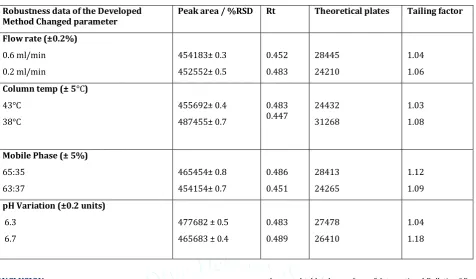
Robustness of the method was verified by applying minor and deliberate changes in the experimental parameters, for example: (i) Column temperature: ±5°C
(ii) Flow rate: ±0.2 mL/min (iii) pH Variation (±0.2 units)
Table 5: Robustness data of the Developed Method Changed parameter Robustness data of the Developed
Method Changed parameter Peak area / %RSD Rt Theoretical plates Tailing factor Flow rate (±0.2%)
0.6 ml/min 0.2 ml/min
454183± 0.3 452552± 0.5
0.452 0.483
28445 24210
1.04 1.06
Column temp (± 5°C)
43°C 38°C
455692± 0.4 487455± 0.7
0.483
0.447 24432
31268
1.03 1.08
Mobile Phase (± 5%)
65:35 63:37
465454± 0.8 454154± 0.7
0.486 0.451
28413 24265
1.12 1.09
pH Variation (±0.2 units)
6.3 6.7
477682 ± 0.5 465683 ± 0.4
0.483 0.489
27478 26410
1.04 1.18
CONCLUSION
Linezolid is Synthetic Antibacterial Agent of the oxazolidine class. It is official in United States Pharmacopoeia. The study was undertaken to develop and validate analytical methods to estimate Linezolid.
REFERENCES
1. Settal, F.A., 2004. Handbook of Instrumental Techniques of
Analytical Chemistry, 1st Edition, 19-21.
2. Kazakevich, Y., Introduction to HPLC process [serial online].
Available from URL: http://hplc.chem.shu.edu/NEW/Graduate/Modern.Sep.2006/ Lect.%201%20Intro%20(2-day).ppt
3. Chatwal, G.R., Anand, S.A., 1998. Instrumental Methods of
Chemical Analysis, Himalaya Publishing House, New Delhi, 180-198
4. ICH Guideline, “Validation of analytical procedures: text and
methodology,” in Proceedings of International Conference on
Harmonization, Topic Q2 (R1), Geneva, Switzerland, November
2005.
5. K. Sharma and A. Parle, “Development and validation of
HPTLC method for estimation of AL gliptin benzoate in bulk
drugs and tablet dosage forms,” International Bulletin of Drug
Research, vol. 5, no. 8, pp. 81–89, 2015.
6. Sanofi-Aventis, Multaq Prescribing Information, Bridgewater,
NJ: 2013, March.
7. Bhatt KK, Emanual Michael Patelia and Ishani Amin,
Development of a Validated Stability-Indicating RP-HPLC Method for Dronedarone Hydrochloride in Pharmaceutical Formulation, Journal of Analytical & Bioanalytical Techniques,
2013; 4(1):1-6
8. Rajyalakshmi. Ch, Benjamin. T and Rambabu.C, Forced
degradation study on dronedarone and application of validated stability-indicating HPLC-UV method in stability testing of dronedarone tablets, Der Pharma Chemica, 2013; 5(1):189-195.
9. Naresh Tondepu, Shakil S. Sait, K. V. Surendranath, Ravi Kiran
Kaja and Suresh Kumar, A Stability Indicating HPLC Method for Dronedarone in Bulk Drugs and Pharmaceutical Dosage Forms, American Journal of Analytical Chemistry, 2012; 3, 544-551.
10. Arpan Patel and Jawed Akhtar, RP-HPLC Method
Development and Validation of Dronedarone HCl in Its Pure Form and Tablet Dosage Form, Journal of Chemical and