Successful Implementation of a Neonatal Pain and
Sedation Protocol at 2 NICUs
abstract
OBJECTIVE: To evaluate the implementation of a neonatal pain and sedation protocol at 2 ICUs.
METHODS:The intervention started with the evaluation of local prac-tice, problems, and staff satisfaction. We then developed and imple-mented the Vienna Protocol for Neonatal Pain and Sedation. The protocol included well-defined strategies for both nonpharmacologic and pharmacologic interventions based on regular assessment of a translated version of the Neonatal Pain Agitation and Sedation Scale and titration of analgesic and sedative therapy according to aim scores. Health care staff was trained in the assessment by using a video-based tutorial and bedside teaching. In addition, we performed reevaluation, retraining, and random quality checks. Frequency and quality of assessments, pharmacologic therapy, duration of mechanical ventilation, and outcome were compared between baseline (12 months before implementation) and 12 months after implementation.
RESULTS:Cumulative median (interquartile range) opiate dose (base-line dose of 1.4 [0.5–5.9] mg/kg versus intervention group dose of 2.7 [0.4–57] mg/kg morphine equivalents; P = .002), pharmacologic interventions per episode of continuous sedation/analgesia (4 [2– 10] vs 6 [2–13]; P= .005), and overall staff satisfaction (physicians: 31% vs 89%;P,.001; nurses: 17% vs 55%;P,.001) increased after implementation. Time on mechanical ventilation, length of stay at the ICU, and adverse outcomes were similar before and after implementation.
CONCLUSIONS:Implementation of a neonatal pain and sedation pro-tocol at 2 ICUs resulted in an increase in opiate prescription, pharma-cologic interventions, and staff satisfaction without affecting time on mechanical ventilation, length of intensive care stay, and adverse out-comes.Pediatrics2013;132:e211–e218
AUTHORS:Philipp Deindl, MD,a,bLukas Unterasinger, MSc,a Gregor Kappler, PhD,cTobias Werther, MD, PhD,aChristine Czaba, MD,aVito Giordano, MSc,aSophie Frantal, MSc,d Angelika Berger, MD,aArnold Pollak, MD,aand Monika Olischar, MDa
aDepartment of Pediatrics and Adolescent Medicine, Division of Pediatric Neonatology, Intensive Care, and Neuropediatrics, and dCenter for Medical Statistics, Informatics, and Intelligent Systems, Medical University of Vienna, Vienna, Austria; bDepartment of Neonatology, Charité University Medical Center, Berlin, Germany; andcFaculty of Psychology, Institute for Applied Psychology, University of Vienna, Vienna, Austria
KEY WORDS
clinical practice guidelines, N-PASS, quality improvement project, Vienna Protocol for Neonatal Pain and Sedation, mechanical ventilation
ABBREVIATIONS
IQR—interquartile range
N-PASS—Neonatal Pain, Agitation, and Sedation Scale V-PNPS—Vienna Protocol for Neonatal Pain and Sedation Dr Deindl conceptualized and designed the study, drafted the initial manuscript, and approved thefinal manuscript as submitted; Mr Unterasinger programmed the software of the patient documentation system to implement the assessment tool, collected patient data, and approved thefinal manuscript as submitted; Dr Kappler performed statistical analysis of mechanical ventilation data and outcome variables and approved thefinal manuscript as submitted; Dr Werther was responsible for recruitment of eligible patients and data collection, reviewed and revised the manuscript, and approved thefinal manuscript as submitted; Dr Czaba and Mr Giordano were responsible for recruitment of eligible patients and data collection and approved thefinal manuscript as submitted; Ms Frantal carried out statistical analyses and approved thefinal manuscript as submitted; Dr Berger was involved in critical discussions and planning of the study, helped write the manuscript, and approved thefinal version as submitted; Dr Pollak critically reviewed the manuscript and approved thefinal manuscript as submitted; and Dr Olischar substantially contributed to the conception and design of the study, coordinated and supervised data collection, was involved in writing the manuscript, and approved thefinal manuscript as submitted. All authors equally contributed substantial work to this study and were equally involved in multiple discussions throughout the entire study period.
(Continued on last page)
health care takers to provide them with an adequate level of sedation and an-algesia. International guidelines for adults1–4and children5,6recommend to titrate analgesics and sedative medi-cation according to defined patient-specific end points. This goal is best accomplished by means of validated pain/agitation and sedation assess-ment using standardized scales. Out-come investigations provide strong evidence that the use of pain and se-dation protocols resulted in a decrease in duration of mechanical ventilation4,7,8 and days of drug administration1,4in adults and children. The American Academy of Pediatrics and the Cana-dian Pediatric Society policy state-ments on prevention and management of pain in neonates advocate routine pain assessment and the use of pro-tocols for the management of pain and sedation in neonates.9Until May 2010, neither an instrument to assess nor a protocol to treat pain, agitation, and sedation existed in our institution. The management of pain, agitation, and sedation had thus far been based on irregular and subjective evaluations of the patient’s condition in terms of pain and sedation and resulted in team dissatisfaction.
We hypothesized that implementing a protocol for the management of neonatal pain and sedation on the basis of a validated assessment instrument would improve frequency and quality of pain and sedation assessment. Our secondary aim was to show how this implementation affected analgesic and sedative treatment, mechanical venti-lation, short-term outcome, and staff satisfaction.
METHODS
Setting
The Medical University of Vienna is a tertiary perinatal center with∼3000
year. The project started in May 2010 at two 10-bed NICUs with the establish-ment of a study protocol upon approval by the local ethics committee.
Implementation Plan
Choice and Translation of a Pain, Agitation, and Sedation Assessment Tool
A multidisciplinary team including neonatologists, NICU nurses, a psychol-ogist, and a pharmacist extensively reviewed the published literature and agreed on the introduction of the Neo-natal Pain, Agitation, and Sedation Scale (N-PASS). The N-PASS allows assess-ment of both sedation and pain for a wide range of patients from a gesta-tional age of 23 weeks onward to older neonates.10,11The 5 parameters of the N-PASS are crying/irritability, behavior/ state, facial expression, extremities/ tone, and vital signs. These criteria are graded 0, 1, or 2 for pain/agitation and 0,21, or22 for sedation. A score
.3 on the pain subscale indicates pain, whereas a score between22 and
25 on the sedation subscale indicates light sedation and a score between26 and 210 indicates deep sedation. We involved 2 professional certified translators to translate the original English version of the N-PASS into German and subsequently back into English. Upon discussions of the po-tential comprehensibility, clarity, and unambiguousness of different word-ings, we reached a consensus on the
final German version of the N-PASS.
Development of the Vienna Protocol for Neonatal Pain and Sedation
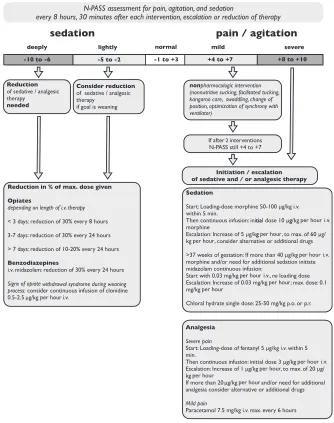
We discussed the best possible practice including published evidence1,5,10–20 and our own clinical experience to de-velop the Vienna Protocol for Neonatal Pain and Sedation (V-PNPS) (Fig 1). The V-PNPS is a detailed protocol for the
assessments, drug type, dosage, and a flowchart indicating when to use which drug according to N-PASS values. Strategies for nonpharmacologic in-terventions such as swaddling, non-nutritive sucking,12and sucrose16for escalation and deescalation of contin-uous sedative and analgesic drugs were defined. We aimed for N-PASS values between 0 and 3 with regard to the pain subscale to avoid pain/ agitation and for values between 0 and25 with regard to the sedation subscale to avoid oversedation.
Regular N-PASS assessments were performed in patients receiving con-tinuous analgesia or sedation; in those receiving mechanical ventilation or continuous positive airway pressure; in patients requiring.40% oxygen; in cases of severe dyspnea, postoperative care, sepsis, indwelling pleural or ab-dominal drains, or large skin defects; and in patients receiving palliative care. The N-PASS was assessed 30 minutes after any procedure, escala-tion, or deescalation of continuous sedative or analgesic drug infusions but at least every 8 hours. In all cases, the physicians gave the orders to change medication according to the presented protocol, following the
flowchart with regard to N-PASS values established by the bedside nurse.
Staff Training and Education
observe the patient in a calm, un-disturbed state, then during a routine care procedure, and finally during consolation after the care procedure. Nurses were shown movie sequences demonstrating these 3 steps of as-sessment for each of the presented patients. The video sequences showed well-settled patients, patients in pain, as well as sedated patients.
Evaluation of Baseline Level of Care
We evaluated local problems and as-sessed staff satisfaction before the intro-duction of the V-PNPS. We administered
anonymous questionnaires to the NICU nursing staff and physicians. The team was asked to rate by using a 4-item rating scale the following aspects of pain, agitation, and sedation manage-ment: (1) frequency of documentation, (2) incidence of severe pain/agitation, (3) time to intervention in case of se-vere pain/agitation, (4) effectiveness of sedative/pain therapy, (5) frequency of withdrawal symptoms, and (6) overall quality of pain and sedation manage-ment. There was also a free comments section (possible contributing factors that should be improved).
Intervention Phase
Analysis Plan
The primary end point was frequency of pain and sedation assessments. Sec-ondary end points included duration and amount of analgesic and sedative drug therapy, time on mechanical ventilation, time to discharge from the NICU, morbidity, and mortality. To ana-lyze effects on therapy and short-term outcome, we compared patients trea-ted during the 12-month intervention phase with a retrospective control group treated during a 12-month
FIGURE 1
Vienna Protocol for Neonatal Pain and Sedation (V-PNPS). i.v., intravenous; max, maximum; p.o., per os; p.r., per rectum.
Interobserver Agreement
Reassessment and retraining of the staff was performed throughout the entire intervention phase. Trained mem-bers of the study team randomly eval-uated patients independently of the care-giving nurse to ensure quality of assessments. Patients were assigned for simultaneous assessment by using simple randomization. Twelve months after implementation of the V-PNPS, we established a new set of short training movies.
Evaluation of Staff Interaction, Communication, and Satisfaction
With the use of anonymous ques-tionnaires, nurses and physicians were asked to estimate the incidence of pain and agitation in neonatal patients and to score the success rate of the ad-ministered pain relief as well as the interaction and communication be-tween physicians and nurses.
Documentation of N-PASS Assessments
The N-PASS tool was integrated into our electronic patient data management system as part of the“vital sign” cate-gory.
Statistical Analysis
We usedx2tests to compare categor-ical variables between the study groups and the Wilcoxon-Mann-Whitney 2-sample rank-sum test to compare continuous variables. We used a linear regression model for the comparison of the mean number of N-PASS as-sessments per patient and day over time. Linear regression models with segmented relationships between week of intervention and number of N-PASS assessments were calculated. A segmented relationship was defined by the slope parameters and the break
was calculated to determine the effect of implementation of the V-PNPS and the influence of staff profession on each question of the questionnaire by using SPSS 19.0 (IBM SPSS Statistics, IBM Corporation, Armonk, NY). Analysis was performed by using R 2.12 (R Foundation for Statistical Computing, Institute for Statistics and Mathemat-ics, Vienna, Austria). P values ,.05 were considered statistically signifi -cant.
RESULTS
Impact of the Implementation on Therapy and Outcome
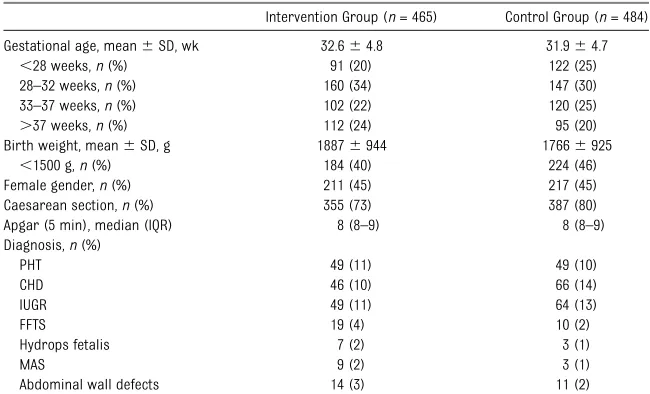
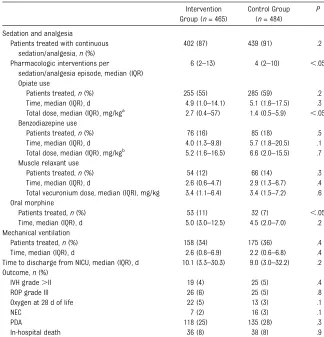
Control and intervention groups were similar (Table 1). At baseline, 59% of all patients received continuous opiate infusions for a median (interquartile range [IQR]) duration of 5.1 (1.6–17.5) days at a median (IQR) cumulative dose of 1.4 (0.5–5.9) mg/kg morphine equiv-alents. After intervention, the median (IQR) cumulative dose significantly in-creased to 2.7 (0.4–57) mg/kg mor-phine equivalents (P = .002). After
the median (IQR) duration of treatment (4.9 [1.0–14.1] days;P= .3). In the in-tervention group, significantly more pharmacologic interventions (escala-tion and deescala(escala-tion) were performed per episode of continuous sedation/ analgesia compared with baseline (4 [2–10] vs 6 [2–13]; P = .005). At baseline, 32 (7%) patients received oral morphine for a median (IQR) time of 4.5 (2.0–7.0) days. After intervention, signifi -cantly more patients received oral mor-phine (53 [11%];P= .02) but for a similar time period (5.0 [3.0–12.5] days;P= .2). Before and after intervention, the number of patients receiving benzodiazepines and muscle relaxants was the same, as was the duration of continuous treatment and cumulative doses. The number of patients receiving bolus injections of paracetamol and oral chloral hydrate was similar before and after the in-tervention, as was the number of doses (Table 2).
At baseline, patients spent a median (IQR) of 2.2 (0.6–6.8) days on mechan-ical ventilation and 9.0 (3.0–32.2) days
TABLE 1 Baseline Characteristics
Intervention Group (n= 465) Control Group (n= 484) Gestational age, mean6SD, wk 32.664.8 31.964.7
,28 weeks,n(%) 91 (20) 122 (25)
28–32 weeks,n(%) 160 (34) 147 (30) 33–37 weeks,n(%) 102 (22) 120 (25)
.37 weeks,n(%) 112 (24) 95 (20)
Birth weight, mean6SD, g 18876944 17666925
,1500 g,n(%) 184 (40) 224 (46)
Female gender,n(%) 211 (45) 217 (45) Caesarean section,n(%) 355 (73) 387 (80) Apgar (5 min), median (IQR) 8 (8–9) 8 (8–9) Diagnosis,n(%)
PHT 49 (11) 49 (10)
CHD 46 (10) 66 (14)
IUGR 49 (11) 64 (13)
FFTS 19 (4) 10 (2)
Hydrops fetalis 7 (2) 3 (1)
MAS 9 (2) 3 (1)
Abdominal wall defects 14 (3) 11 (2)
in the NICU. After intervention, both time on mechanical ventilation (2.6 [0.8–6.9] days; P = .4) and length of NICU stay (10.1 [3.3–30.3] days;P= .2) remained unchanged (Table 2). The main adverse outcomes, including intraventricular hemorrhage, reti-nopathy of prematurity, necrotizing enterocolitis, persistent ductus arte-riosus, and mortality, were similar in both groups (Table 2).
Frequency, Distribution, and Time Expenditure of N-PASS
Assessments
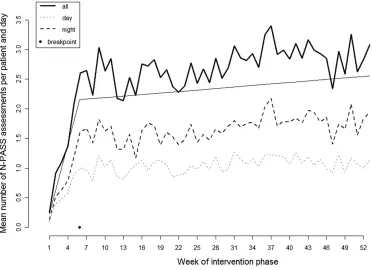
A total of 20 740 N-PASS assessments in 376 (81% of all treated NICU) patients on 5304 patient days were performed during the intervention phase. On
average, 36.5 scores per patient and 2.9 scores per patient-day were docu-mented. Figure 2 shows the frequency of N-PASS assessments per eligible patient throughout the 12-month in-tervention phase. A total of 1843 (8.9%) N-PASS assessments were revealed to be in the goal range for sedated patients, 13 609 (65.6%) were in the comfort range for nonsedated patients, 3731 (18.0%) were in the range indicating moderate pain/agitation, 416 (2.0%) were in the range indicating severe pain, and 1141 (5.5%) were in the range in-dicating deep sedation (Fig 1). Nurses spent a mean (SD) of 4.9 (1.9) minutes to assess and 0.3 (0.1) minutes to docu-ment the N-PASS. In a random sample of 20 patients, the time expenditure for
N-PASS assessments was measured. Patients from both NICUs were select-ed by using simple randomization. The mean time expenditure remained constant throughout the intervention phase.
Assessment Quality
The study team agreed on“goal”N-PASS values for 6 patients presented in short movies (3 patients before the in-tervention phase [patients A, B, C], 3 patients after the intervention phase [patients D, E, F]). For each patient, goal values for both the pain and the seda-tion subscale of the N-PASS were
de-fined. Fifty-three nurses were tested before the intervention and 55 were tested after the intervention (2 addi-tional nurses participated in the second session). We considered per-formance of N-PASS assessment as
“very good” when the N-PASS assess-ment for both the pain and the sedation subscale differed only in 1 point or was identical with goal values. In thefirst (second) training session 76% (98%) of nurses performed “very good” with respect to the pain subscale and 95% (87%) with respect to the sedation subscale. The median (IQR) deviation in N-PASS assessments from goal scores did not differ significantly between training sessions (0 [0–1]; P = .4). During the intervention phase, trained members of the study team randomly evaluated patients independently of the regular evaluation by the care-giving nurse to ensure the quality of assess-ments. Ninety percent of the simulta-neous assessments both of the N-PASS sedation and pain subscale yielded a very good assessment quality (in a subset of 30 patients).
Evaluation of Staff Comfort and Satisfaction
Thirteen (52%) physicians and 46 (84%) nurses answered the questionnaire at baseline and 19 (76%) physicians and 42 (76%) nurses after implementation TABLE 2 Comparison of Neonatal Intensive Care Therapy and Outcomes
Intervention Group (n= 465)
Control Group (n= 484)
P
Sedation and analgesia
Patients treated with continuous sedation/analgesia,n(%)
402 (87) 439 (91) .2
Pharmacologic interventions per
sedation/analgesia episode, median (IQR)
6 (2–13) 4 (2–10) ,.05
Opiate use
Patients treated,n(%) 255 (55) 285 (59) .2 Time, median (IQR), d 4.9 (1.0–14.1) 5.1 (1.6–17.5) .3 Total dose, median (IQR), mg/kga 2.7 (0.4–57) 1.4 (0.5–5.9) ,.05 Benzodiazepine use
Patients treated,n(%) 76 (16) 85 (18) .5 Time, median (IQR), d 4.0 (1.3–9.8) 5.7 (1.8–20.5) .1 Total dose, median (IQR), mg/kgb 5.2 (1.6–16.5) 6.6 (2.0–15.5) .7 Muscle relaxant use
Patients treated,n(%) 54 (12) 66 (14) .3 Time, median (IQR), d 2.6 (0.6–4.7) 2.9 (1.3–6.7) .4 Total vecuronium dose, median (IQR), mg/kg 3.4 (1.1–6.4) 3.4 (1.5–7.2) .6 Oral morphine
Patients treated,n(%) 53 (11) 32 (7) ,.05 Time, median (IQR), d 5.0 (3.0–12.5) 4.5 (2.0–7.0) .2 Mechanical ventilation
Patients treated,n(%) 158 (34) 175 (36) .4 Time, median (IQR), d 2.6 (0.8–6.9) 2.2 (0.6–6.8) .4 Time to discharge from NICU, median (IQR), d 10.1 (3.3–30.3) 9.0 (3.0–32.2) .2 Outcome,n(%)
IVH grade.II 19 (4) 25 (5) .4
ROP grade III 26 (6) 25 (5) .8
Oxygen at 28 d of life 22 (5) 13 (3) .1
NEC 7 (2) 16 (3) .1
PDA 118 (25) 135 (28) .3
In-hospital death 36 (8) 38 (8) .9
Pvalues were calculated by Mann-WhitneyUtest for continuous variables and by Pearson’sx2test for categorical variables.
IVH, intraventricular hemorrhage; NEC, necrotizing enterocolitis; PDA, persistent ductus arteriosus; ROP, retinopathy of prematurity.
aExpressed in morphine equivalents. bExpressed in midazolam equivalents.
of the V-PNPS. The most frequently mentioned contributing factors for nurse dissatisfaction with pain and se-dation management at baseline were as follows: no assessment tool available (36%), treatment not effective (26%), no protocol available (28%), and medical intervention initiated too late (10%). Staff members were considered as being satisfied when they judged management as good or very good (separate analysis for physicians and nurses). Overall staff satisfaction of both physicians and nurses improved significantly from baseline to intervention (31% vs 89%;
P,.001; and 17% vs. 55%;P,.001). In addition, we found significant improve-ment before and after impleimprove-mentation with regard to the following aspects: frequency of documentation of pain and sedation (P,.001), time to intervention in case of severe pain/agitation (P = .004), and evaluation of pain/agitation relief (P , .001) (P values indicate
significance for both professions to-gether and were corrected for mul-tiplicity).
DISCUSSION
We report a successful implementation of a protocol for the management of pain and sedation in a neonatal environment. Our quality-improvement project in-volved 55 nurses and 25 physicians from 2 NICUs that included a broad diversity of neonatal care settings (eg, critically ill patients with chronic diseases up to 6 months of age versus specialized care for extremely premature neonates). Starting with the idea to change local attitudes and to standardize strategies of patient care, the entire team of nurses and physicians discussed deliberately and critically every step of the imple-mentation process. The impleimple-mentation process included consistent teaching and evaluation, ongoing reassessments, and repeated questionnaires.
Impact on Therapy and Outcome
The implementation of a protocol to manage neonatal pain and sedation resulted in a more aggressive pain control using higher doses of opiates and a significant increase in pharma-cologic interventions, without impact-ing morbidity or mortality. Patients spent the same time on mechanical ventilation and the same time in the NICU, with the same survival rate, when compared with the baseline. In contrast to previous studies in children and adults,1,4 which revealed a reduction in analgesic drug use, our protocol resulted in a more liberal prescription of continuous opiate infusions. In ad-dition, the number of patients treated with oral morphine also increased significantly (Table 2). This effect might be due to the enhanced team aware-ness for neonatal pain and agitation but could also reflect a higher in-cidence of drug withdrawal in the
intervention group. However, the du-ration of continuous analgesic therapy as well as the duration of oral mor-phine therapy was the same in both groups. Regular pain and sedation assessment resulted in a marked in-crease in the number of pharmacologic interventions when a patient received continuous analgesic/sedative therapy. This observation reflects the increased effort of the treating team to titrate medication until a patient reached the desired N-PASS (Fig 1). Outcome varia-bles, including intraventricular hem-orrhage, retinopathy of prematurity, necrotizing enterocolitis, and persistent ductus arteriosus, were unaffected by the implementation of the V-PNPS. We therefore conclude that managing pain and sedation according to a defined protocol is safe and effective in neonatal patients.
Quality of Teaching
We trained medical staff in the as-sessment of neonatal pain and sedation by using an interactive video tutorial in addition to individual bedside teaching. We achieved good interobserver agree-ment regarding both the pain and sedation subscale of the N-PASS. Video-based teaching can be an effective way when training large teams. In-cluding the N-PASS into our electronic patient data management system in the
“vital sign” category, in combination with regular training sessions, may have facilitated the process of consid-ering pain as a“vital sign.”1
Nurse Compliance
We observed a steep increase in nurse compliance during thefirst 2 months
after implementation of the V-PNPS and a sustained increase through-out the entire study period reflected by an increasing number of N-PASS assessments per eligible patient (Fig 2). Interestingly, nurses assessed the N-PASS more frequently during night shifts. The assessment of pain and sedation is time consuming. Our nurses spent ∼15 minutes per pa-tient and per shift assessing pain and sedation. Night shifts might be less busy than day shifts, when most elective admissions, patient trans-fers, and routine interventions take place, allowing more time to perform regular assessments. We think that the positive attitude of the staff, in combination with an adequate lead-ership support, as well as an overall spirit of teamwork and collaboration greatly contributed to the high level of compliance and the sustained success of this quality-improvement project.
Limitations
Evaluation of pain and sedation by in-dependent observers is desirable and relatively simple to obtain in adult patients.7Neonates represent a unique group of patients with a very specific behavior. Behavior assessment of neo-nates requires extensive clinical expe-rience and cannot be taught to students who could then have served as independent observers. When plan-ning our study we did not reach team consensus on the idea of training a fraction of the nursing staff only. The main concerns were that pain assess-ment without direct clinical con-sequences and for the sole purpose
of generating data before implement-ing a new protocol might be ethically problematic. There was agreement that the V-PNPS would need to be implemented in a timely manner to ensure that high levels of pain were treated as soon as possible. Therefore, we are not able to present data on incidences of pain or agitation before the study started. Another limitation is the fact that we compared our results with a retrospective control group. The data were collected in a single univer-sity hospital only. However, the fact that we included all nurses and physicians of 2 NICUs caring for very different patients strengthens this study.
CONCLUSIONS
We report a successful way of de-veloping and implementing a protocol for the management of neonatal pain and sedation at 2 NICUs. The imple-mentation resulted in more liberal opiate use and an increase in phar-macologic interventions without af-fecting short-term outcome. Quality of pain and sedation assessment, staff compliance, and staff satisfaction im-proved significantly. In our study set-ting, managing pain and sedation according to a defined protocol appears to be safe and effective in neonatal patients. Our multilayer approach, which includes medical staff education using interactive video-based tutorials, bedside teaching, questionnaires, regular assessments with defined responses, reassessments, and feed-back, could be adopted whenever new protocols need to be accepted and implemented by a large team.
REFERENCES
1. Deeter KH, King MA, Ridling D, Irby GL, Lynn AM, Zimmerman JJ. Successful imple-mentation of a pediatric sedation protocol for mechanically ventilated patients. Crit
Care Med. 2011;39(4):683–688
2. Jacobi J, Fraser GL, Coursin DB, et al; Task Force of the American College of Critical Care Medicine of the Society of Critical Care Medicine; American Society
of Health-System Pharmacists; American
College of Chest Physicians. Clinical practice guidelines for the sustained use of sedatives and analgesics in the criti-cally ill adult.Crit Care Med. 2002;30(1):
119–141
lation. Crit Care Med. 1999;27(12):2609– 2615
4. Girard TD, Kress JP, Fuchs BD, et al. Efficacy and safety of a paired sedation and venti-lator weaning protocol for mechanically ventilated patients in intensive care (Awakening and Breathing Controlled tri-al): a randomised controlled trial.Lancet. 2008;371(9607):126–134
5. Playfor S, Jenkins I, Boyles C, et al; UK Paediatric Intensive Care Society Sedation,; Analgesia, and Neuromuscular Blockade Working Group. Consensus guidelines on sedation and analgesia in critically ill children. Intensive Care Med. 2006;32(8): 1125–1136
6. Hartman ME, McCrory DC, Schulman SR. Efficacy of sedation regimens to facilitate mechanical ventilation in the pediatric intensive care unit: a systematic review.
Pediatr Crit Care Med. 2009;10(2):246– 255
7. Chanques G, Jaber S, Barbotte E, Violet S, Sebbane M, Perrigault P-F, et al. Impact of systematic evaluation of pain and agitation in an intensive care unit.Crit Care Med. 2006;34(6):1691–1699
8. Blackwood B, Alderdice F, Burns K, Cardwell C, Lavery G, O’Halloran P. Use of weaning
meta-analysis.BMJ. 2011;13;342:c7237
9. Canadian Paediatric Society Fetus and Newborn Committee. Prevention and management of pain and stress in the
neonate. American Academy of Pediatrics. Committee on Fetus and Newborn. Com-mittee on Drugs. Section on Anesthesiology.
Section on Surgery.Pediatrics. 2000;105(2): 454–461
10. Hummel P, Puchalski M, Creech SD, Weiss MG. Clinical reliability and validity of the
N-PASS: neonatal pain, agitation and sedation scale with prolonged pain. J Perinatol. 2008;28(1):55–60
11. Hummel P, Lawlor-Klean P, Weiss MG. Val-idity and reliability of the N-PASS
assess-ment tool with acute pain. J Perinatol. 2010;30(7):474–478
12. Cignacco E, Hamers JPH, Stoffel L, et al. The efficacy of non-pharmacological
inter-ventions in the management of procedural pain in preterm and term neonates: a sys-tematic literature review.Eur J Pain. 2007;
11(2):139–152
13. Suraseranivongse S, Kaosaard R, Intakong P, et al. A comparison of postoperative pain scales in neonates.Br J Anaesth. 2006;97
(4):540–544
item-based scales. Eur J Pain. 2010;14(8): 878–881
15. Allegaert K, Veyckemans F, Tibboel D. Clin-ical practice: analgesia in neonates.Eur J Pediatr. 2009;168(7):765–770
16. Stevens B, Yamada J, Ohlsson A. Sucrose
for analgesia in newborn infants un-dergoing painful procedures. Cochrane Database Syst Rev. 2010; (1):CD001069
17. Duhn LJ, Medves JM. A systematic in-tegrative review of infant pain assessment
tools. Adv Neonatal Care. 2004;4(3):126– 140
18. Carbajal R, Lenclen R, Jugie M, Paupe A, Barton BA, Anand KJS. Morphine does not provide adequate analgesia for acute pro-cedural pain among preterm neonates.
Pediatrics. 2005;115(6):1494–1500
19. Playfor S, Jenkins I, Boyles C, et al; UK Paediatric Intensive Care Society Sedation, Analgesia, and Neuromuscular Blockade Working Group. Consensus guidelines for
sustained neuromuscular blockade in crit-ically ill children.Paediatr Anaesth. 2007;17 (9):881–887
20. Hummel P, van Dijk M. Pain assessment: current status and challenges.Semin Fetal
Neonatal Med. 2006;11(4):237–245
(Continued fromfirst page)
www.pediatrics.org/cgi/doi/10.1542/peds.2012-2346 doi:10.1542/peds.2012-2346
Accepted for publication Mar 5, 2013
Address correspondence to Philipp Deindl, MD, Department of Pediatrics and Adolescent Medicine, Division of Neonatology, Pediatric Intensive Care, and Neuropediatrics, Medical University of Vienna, Waehringer Guertel 18-20, 1090 Vienna, Austria. E-mail: [email protected]
PEDIATRICS (ISSN Numbers: Print, 0031-4005; Online, 1098-4275). Copyright © 2013 by the American Academy of Pediatrics
FINANCIAL DISCLOSURE:The authors indicated they have nofinancial relationships relevant to this article to disclose.
DOI: 10.1542/peds.2012-2346 originally published online June 3, 2013;
2013;132;e211
Pediatrics
Olischar
Czaba, Vito Giordano, Sophie Frantal, Angelika Berger, Arnold Pollak and Monika
Philipp Deindl, Lukas Unterasinger, Gregor Kappler, Tobias Werther, Christine
Successful Implementation of a Neonatal Pain and Sedation Protocol at 2 NICUs
Services
Updated Information &
http://pediatrics.aappublications.org/content/132/1/e211
including high resolution figures, can be found at:
References
http://pediatrics.aappublications.org/content/132/1/e211#BIBL
This article cites 17 articles, 3 of which you can access for free at:
Subspecialty Collections
http://www.aappublications.org/cgi/collection/neonatology_sub Neonatology
sub
http://www.aappublications.org/cgi/collection/fetus:newborn_infant_ Fetus/Newborn Infant
following collection(s):
This article, along with others on similar topics, appears in the
Permissions & Licensing
http://www.aappublications.org/site/misc/Permissions.xhtml
in its entirety can be found online at:
Information about reproducing this article in parts (figures, tables) or
Reprints
http://www.aappublications.org/site/misc/reprints.xhtml
DOI: 10.1542/peds.2012-2346 originally published online June 3, 2013;
2013;132;e211
Pediatrics
Olischar
http://pediatrics.aappublications.org/content/132/1/e211
located on the World Wide Web at:
The online version of this article, along with updated information and services, is
by the American Academy of Pediatrics. All rights reserved. Print ISSN: 1073-0397.