Abstract: Image segmentation is one of the most significant ways to simplify complex images into human or machine readable form. The main purpose of image segmentation ways is to extract or segment out particular area or region of image. It can also be used to separate foreground image from the background image. Image segmentation methods for depicting images have gained a great achievements but the color image segmentation method based on statistical theory have exposed some limitation. The color image segmentation main purpose is to reduce the undesired limitations of the conventional segmentation method. Ant Colony Optimization (ACO) and Particle Swarm Optimization (PSO) are the two main methods for swarm intelligence have great potential in color image segmentation method. This paper introduces color image segmentation using the Hybrid Clustering based Ant Colony Optimization and Particle Swarm Optimization methods. The experimental result of segmentation method has been evaluated by determining the PSNR and accuracy values of the input images. The proposed HCACOPSO method is compared with the existing methods of Otsu and CPSO-FCM methods which gives better result.
Index Terms: Background Image, Particle Swarm Optimization, Ant Colony Optimization, Region, Segmentation
I. INTRODUCTION
Image segmentation is more meaningful and could be analyzed easily which thus simplifies the processing of complete image. The optimization process in ACO based approaches is carried out by a collective classification of ants [11]. Each ant contributes to the solution but convergence to the solution is possible by the collective behavior of ants. The ants are worked in parallel towards obtaining the solution of any problem. Also the ants can exchange information between them to obtain a better solution.
Particle swarm optimization is one of the modern heuristic algorithms that can be applied to nonlinear and continuous optimization problems [9]. PSO term refers to a relatively new family of algorithms that may be used to find optimal solutions to numerical and qualitative problems. It is easily implemented in most programming languages and has proven both very effective and quick when applied to a diverse set of optimization problems [2].
Genetic algorithm with the ACO method simultaneously puts the swarm degree function into the ant colony method,
Revised Manuscript Received on May 06, 2019
V.Sheshathri, Ph.D Research Scholar, Department of Computer Science, Erode Arts and Science College, Erode-638 009, Tamilnadu, India.
Dr.S.Sukumaran, Associate Professor in Computer Science, Erode Arts and Science College, Erode-638 009, Tamilnadu, India.
and increases the ant colony method traversal optimization ability [7]. Combination of this method and the FCM method carry on the fuzzy clustering. On the one hand, the ant colony method robustness can effectively overcome the FCM method to the sensitive of the initialize. The parallel distributed computing can accelerate the convergence and improve the efficiency of clustering. The most important thing is the methods adaptive and intelligent search features can be achieved global optimal. The images imperfections can be the result of light reflection over the image or real imperfections that can be used as an aid in medical diagnosis [4].
PSO is used in different industrial areas such as power systems, parameter learning of neural networks and modeling, etc. However, observations reveal that PSO converges sharply in the early stages of the searching process, but saturates or even terminates in the later stages [6]. It behaves like the traditional local searching methods that may be trapped in local optima. It is hard to obtain any significant improvements by examining neighboring solutions in the later stages of the search.
The paper is organized as follows. Section 2 discussed the summary of related literature. Section 3 describes the methodology. The image segmentation method based on the proposed method is presented together with the experimental results in Section 4. The results are discussed and compared with the existing and proposed method. Finally Conclusions and future works are discussed in section 5.
II. LITERATUREREVIEW
A hybrid method of fuzzy clustering and Particle Swarm Optimization (PSO) technique is used for image segmentation [23]. The Spatial Credibilistic Clustering (SCC) and PSO, and clustering factor were introduced to PSO velocity and particles searching with the help of SCC results. Clustering factors are discussed and two combination types of learning factors and the clustering factor. This type integration is not only for SCC and PSO, but it also generalized to form hybrid methods of other fuzzy clustering and PSO. Clustering approach generally found the number of clusters by partitioning the data set into a relatively large number of clusters to try to reduce the effect of initial conditions.
Segmentation method combined Otsu and particle swarm optimization is presented with the improvements of particle best fitness value [28]. The inertia weight of PSO is method is tried to improve the selecting
speed of the threshold of Otsu. But its application is
A Hybrid Clustering Based Color Image
Segmentation using Ant Colony and Particle
Swarm Optimization Methods
limited by its shortcomings like large amount of computation and long execution time. The particle swarm optimization into the selection process of the threshold and the inertia weight was determined by the improvements of the particle best fitness value, which makes the particles have more reasonable updating step lengths at different stages of the algorithm. It cannot meet the requirements of real-time processing because it calculates a variance for each gray value and thus it has rather long execution time and low efficiency.
The development of optimization method of GA and PSO based hybrid method is utilized to optimize the calculation process [22]. The fast convergence of particle swarm optimization and diversity of genetic algorithm are introduced to optimize the search parameters by GA and PSO hybrid method. When it apply lines image not only benefit the noise of low quality image, to improve the recognition accuracy, but it also try to reduce the processing time. The image noise interference is very serious because the general weather conditions, surrounding environment are complex. A novel image segmentation method based on Particle Swarm Optimization and Fuzzy C means method to evaluate the fitness function [17].
MRI Brain Image segmentation based on Hybrid Parallel Ant Colony Optimization (HPACO) with Fuzzy C-Means (FCM) Algorithm is used to find the optimum label [10]. It tries to minimize the maximizing a posterior estimate to segment the image. The segmentation of brain tumor from MRI is an important but time consuming task performed by medical experts. Segmentation determines the regions of interest in an image and does not try to determine the type of the region, but merely determine the pixels in an image. HPACO method determine the optimal threshold value of in an image to select the initial cluster point then the Fuzzy C Means clustering algorithm calculates the adaptive threshold for the brain tumor segmentation. Image segmentation is used to find the region of interest (ROI) and divided into different segments [18]. The problem in segmentation is that after segmentation the edges and the logical information extract from images. The image segmentation penalty based fuzzy c-mean clustering has been implemented which segment the regions of the image on the basis of penalty value. For increase the performance of a particular method artificial intelligence approaches have to be implement that optimize the results using fitness evaluation for each value of image.
Particle swarm optimization and genetic algorithm based hybrid method determines the optimal clustering of an image dataset, with minimum user intervention [6]. It implies that the user does not need to predict the optimal number of clusters and required to partition the dataset. This PSO based dynamic clustering approach to predict the optimal number clusters which is required to partition the data set. This prediction is then used by the GA based module to improve the final result of the PSO based method. The best number of clusters is obtained by using cluster validity criterion using Gaussian distribution.
Image segmentation method optimizes the basic FCM algorithm by using hybrid of Genetic algorithm and Particle swarm optimization [5]. A hybrid method for the segmentation of medical images is introduced and that the medical images like CAT and X-ray images are corroded by
noise from equipment and environment. The segmentation process is comparatively difficult is try to segment the incertitude and blur images. The most prominent disadvantage of FCM is sensitive to noise, including noise of CT-scan and any other equipment. An optimal multilevel thresholding algorithm is employing an improved variant of PSO [13]. The capability of the hybrid PSO is enhanced by cloning of fitter particles at the expense of worst particles to determine on the basis of their fitness value.
RGB color space and Otsu method is used to realize an image, one need to isolate the objects in it and have to find relation among them [14]. An effort is made to defeat the problems encountered while segmenting an object by using the color properties of the image. Pre-processing image is converted from RGB image to Gray Scale image and colors pixels are classified using the nearest neighbor rule. It has been found that segment regions and there is overlapping and gives the larger object. Fuzzy C-mean method (FCM) has been sensitive to initial clustering center and membership matrix to the local minimum, which causes the quality of image segmentation lower [24]. A new image segmentation method combines the chaos particle swarm optimization (CPSO) and FCM clustering. The segmentation method tries to solve the problem of easing to fall into local extremum, but also tries to solve the problem of premature phenomenon in the PSO-FCM algorithm and it tends to affect the segmentation of images. The drawback of this method is that the number of clusters need to obtained by specified method and does not consider the space of the edge and neighborhood information, people often gets the segmentation results which do not meet the vision effects.
III. METHODOLOGY
A. Ant Colony Optimization (ACO)
Ant colony optimization was introduced by Macro Dorigo and a colleague in the early 90‟s is one of the most successful strands of swarm intelligence [23]. An individual ant can only do simple tasks on its own, while with the ant colony cooperation, they can do very complex tasks. Each ant while walking deposits a chemical on the ground called a pheromone that guides the future ants, by exploiting pheromone trails, ants can find shortest paths between their nest and the food sources. ACO algorithm just was inspired by the foraging behavior of ant colonies and it has been applied in many domains.
B. Particle Swarm Optimization (PSO)
Particle swarm optimization is one of the modern heuristic optimization methods, which was inspired by the research of artificial life and developed by Eberhart and Kennedy in 1995 using social analogy of swarm behavior in populations of natural organisms such as a flock of birds [2]. PSO optimizes a problem by maintaining a population of particles and moving these particles around in the search space according to simple formulae. The movements of the particles are guided by the best found
are found by the particles, because its algorithmic simplicity and fast convergence the PSO algorithm has been developed.
C. Hybrid Clustering based Ant Colony Optimization and Particle Swarm Optimization Method (HCACOPSO) This paper introduces the hybrid clustering based ant colony optimization and particle swarm optimization method is proposed for color image segmentation. This method combines cluster based ACO and PSO methods. The goal of the HCACOPSO method is used to segment the single and multiple objects in color images. The proposed color image segmentation method `of HCACOPSO includes the following steps.
Preprocessing
Preprocessing is considered as a critical step in picture handling. The exactness of this progress decide to remove noise, poor image contrast, weak boundaries and unrelated parts are usual traits of clinical images. It will influence the substance of the medicinal images. These issues can be reviewed by preprocessing methods. Gaussian filters are considered as a perfect time domain filter and also it is one of the low pass filters. It has a minimum possible group delay. The main function of Gaussian filter is to limit the low and high signals from distortion.
Extraction of Color Components
The input color image can be represented by three color components which is a resultant of three separate components. The input image is decomposed into R-image, G-image and B-image providing individual details of the components. The Gaussian blur image begins with separation of individual R, G and B color components of the RGB image. Each color components is individually processed for extraction of object regions.
Extraction of Regions of R, G, B
Region geometrically located between object and background and it is composed of intermediate gray values. For extraction of region a number of descriptors are available. The local variance as region described as the area having higher variance generally contains edges, whereas the homogeneous regions have less variation. For m x m local neighbourhood centered at a pixel, the local variance can be calculated as
LV(i, j) = ...(1)
Where, (x, y) denote a local coordinate in a given
neighbourhood of the sub image f and is a gray level mean of that neighbourhood.
In the first stage ACO method to optimize the partition of image that creates the transfer probability. It decides the class label of the current sample that is according to the pheromone and heuristic information. Each ant in ACO method is try to find a good solution on search space by wondering step by step on search space states.
This state transition probability between states i to j determined as follows:
if j ... (2) Where α and β are two adjustable constant parameters
ij is trail level of pheromone between state i and j
ij is a heuristic function and
Ω is set of the unvisited states
Ants deposit pheromone on their solution paths. Once all tour constructions are completed by ants pheromone evaporation mechanism is also applied at the same time with pheromone depositing. This pheromone depositing step is stated as pheromone updating and generally it is applied on each step of the solution paths of ants using equation (3)
...(3) Where ρ is pheromone decay constant, m is the number of ant
...(4) Where fk is the fitness function value
Q is a parameter which is usually set as 1 Tk is the trip of the kth ant
Update pheromone according to the quality leads ants to search new better solution around good solutions for the successive iterations.
Setting the Clustering Center
The ACO method requests that each pixel value does a classification for color image in each round of cycle. Even though the analysis of color image characteristics, the improved clustering center is determined. Using color RGB values the gradient and neighborhood that match with the different content in an image as a clustering center. The method attempts adaptively to define number of color clusters and cluster center points optimally, and assigns pixels to their nearest clusters. It terms out to be faster and more efficient. For each ant, calculate the distance dij from the current pixel to all clustering centers in (5). If dij is 0, then the membership from the pixel to the class is 1. Or if dij < r, then calculate the amount of information of path ij in (6), and obtain the guide function in (7);
Calculate the transition probability of the pixel to the clustering center in 8. If the result is greater than λ, then adjust the path information in 9.
, if j S ...(8)
Finish the cycle if the value meets the end condition. Namely if the cycle times
to step 7.
In the second stage of PSO to discover better centroids according to equation (8), which takes the result of ACO as an input. The enhancements in PSO includes the position of each particle is initialized which is set to the centroid from ACO with an additional random bias. The obtained particles have the ability to move and search for other homogeneous particles where the representative feature vector takes part as the particle. For having the particles in the motion give them position and velocity and these parameters will be updated during this procedure using equation
...(10) Where,
‘vi’ and ‘xi’ are velocity and position
M is the mass related to the region W is a factor
rand is a random number k indicates the iteration number
Then W is introduced as a descending parameter which is
initially set to a higher value, and finally it
becomes = 0.5 Therefore a linear relation is defined per iteration to update W according to:
It provides a space for unseen particles to have movement and see other similar particles. More regions combine to each other and this will reduce the number of particles and region. The random characteristic of velocity has been updated using equation (6) to help more regions and particles. All ungrouped pixels are detected and then the distance to all existing regions is calculated and the closet regions to join the ungrouped particles.
Intersection of Object Regions
The object regions obtained for R-component, G-component and B-component represents three separate object regions which may vary from component to component resulting in some isolated or spurious pixels. To eliminate those isolated or spurious pixels an intersection operation is performed on the object regions of the three components. The resultant intersection portion provides an accurate object contour which is denoted as „0‟ and „1‟. The „0‟ represent background where as „1‟ represents the foreground creating segmentation mask.
Background Elimination
The total variance is used as initial global best to start and examine of threshold. Foreground and background ratio (fbratio) with the initial global best is calculated, fbratio is used as the feature which corresponds to the position and velocity of basic procedure of PSO method. The total variance computed is used as an initial threshold.
...(12) Where v total variance, m is mean of the pixels in the image
and x(i) each pixel from the set of pixels Q. Now all the
variance among the pixels corresponding to each intensity level of an image is computed and with that variance corresponding feature is also computed. The outcome of the image segmentation process is a collection of segments which
combine to form the entire image. Algorithm (HCACOPSO)
Step 1: Select the color image
Step 2: Remove the noise using Gaussian filter
Step 3: From the color image separate R, G and B Components
Step 4:Split the regions of the image 1. The first stage ACO
Step 5: initialization of swarm matrix pheromone Step 6: For each g in the iterations
Step 7: Initialize the ant colony, to place randomly ants on the different samples and assign randomly a class label to the sample
For each ant t in ants:
Compute the adaptive probability value
Compute the label value of the samples according to (2-5)
Compute the centroids and the evaluation value using equation (9)
Compute the positive feedback factor and update the pheromone matrix according to (8)
Update the global optimal best optimum is found, otherwise
Compute the unimproved iteration count If g is greater than the maximum iteration, stop 2. The second stage PSO
Step 8: Initialize the positions and velocities of a group of particles randomly according to (10) and (11) Step 9: Evaluate each initialized particles fitness value and
Pb is set as the positions of the current particles, while Pg is set as the best position of the initialized particles
For each particle p in the particle swarm: If ffitness (Xp) > ffitness (pbestp) then pbestp= Xp For each particle k in the neighborhood of Xp If ffitness (Xk) > ffitness (gbest) then gbest= Xk
For each dimension d in the dimensions of the centroid:
vp,dnew = w * vp,d old + c1 * rand1 * (pbestp,d - xp,dold) + c2 * rand2 * (gbestd - xp,d old).
xp,d new
= xp,d old
+ vp,d new
If xp,dmax < xp,d new then xp,d new = xp,dmax, vp,dnew = 0 If xp,d
new < xp,d
min
then xp,d new
= xp,d min
, vp,d new
= 0 Step 10: Iteration g increased.
Step 11: If the unimproved count exceeded 3, reset gbest to 0
Step 12: Delete the failed swarm and repeat the step 5 Step 13: Recompute the region having the shortest path Step 14: Extraction object from background
Step 15: Finally get the segmented image
IV. RESULTSANDDISCUSSION
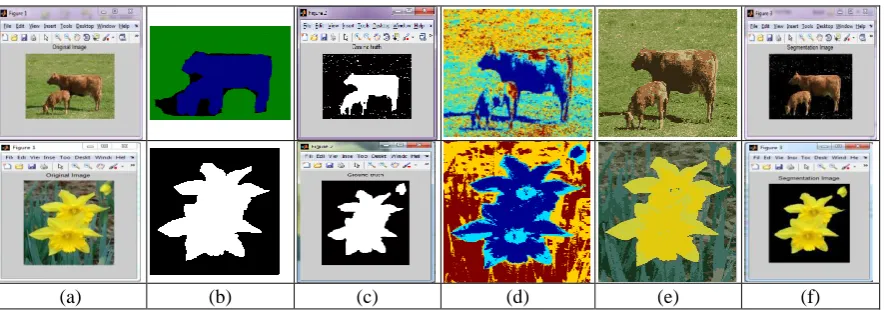
The experiments are used sample input color images containing single objects and multiple objects images. The input color images have different types of dimensions. The
single objects input image dimensions such as Horse (207 X 243) and Flower (555
as Cow (320 X 213) and Flower (500 X 704). The proposed HCACOPSO method is tested for different parameters. All the images segment simultaneously using the HCACOPSO method for single and group of color image. Compute the PSNR and accuracy calculated on the foreground pixels. The experiment is implemented through Matlab R2013a. The segmentation accuracy is measured by the ratio of the number of pixels classified correctly as either foreground or background in agreement with the ground truth segmentation to the total number of pixels. It is calculated as,
...(13)
Where, TP (True Positive), TN (True Negative), FP (False Positive), FP (False Negative)
The true positive is the number of foreground pixels that are detected as foreground and true negative is the number of background pixels that are detected as background. The false positive is the number of background pixels that are incorrectly detected as foreground and false negative is the number of foreground pixels that are incorrectly detected as background.
PSNR is most commonly used to measure the fidelity of processed image to the original image. PSNR shows the similarity of an image against a reference image based on the mean square error of each pixel.
PSNR = 20 log10 …(14)
MSE=
(a) (b) (c) (d) (e) (f)
Fig. 2.Single Object Image, Column (a) Original Image, Column (b) Ground Truth in DB, Column (c) HCACOPSO Ground Truth and Column (d) Otsu (e) CPSO - FCM (f) HCACOPSO Segmented Image
[image:5.595.68.534.223.395.2](a) (b) (c) (d) (e) (f)
Fig. 3.Multiple Object Image, Column (a) Original Image, Column (b) Ground Truth in DB, Column (c) HCACOPSO Ground Truth and Column (d) Otsu (e) CPSO – FCM (f) HCACOPSO Segmented Image
Table 1. Comparison of Accuracy for Single Object Images
Images/ Methods
Existing Methods Proposed Method
Otsu
CPSO - FCM HCACOPSOHorse 90 93 97
[image:5.595.79.525.428.583.2]Table 2. Comparison of PSNR Values for Single Object Images
Images/ Methods
Existing Methods Proposed Method
Otsu
CPSO - FCM HCACOPSOHorse 18.2237 19. 8647 25.9842
Flower 20.8832 22.9448 27.8927
Table 3. Comparison of Accuracy for Multiple Object Images
Images/ Methods
Existing Methods Proposed Method
Otsu
CPSO - FCM HCACOPSOCow 88 92 96
Flower 91 92 99
Table 4. Comparison of PSNR Values for Multiple Object Images
Images/ Methods
Existing Methods Proposed Method
Otsu
CPSO - FCM HCACOPSOCow 19.2397 19.9931 25.2372
Flower 21.1276 22.9928 27.9984
V.CONCLUSION
Ant colony optimization algorithm and Particle swarm optimization as two new artificial intelligence methods, owing to their intelligent behavior, they have great potential in the research field of image segmentation. This paper demonstrates segmentation process using hybrid clustering. This paper presented the HCACOPSO method for constructing the clusters and it provided a new method for color image segmentation to single and multiple objects. Our experimental results show that the proposed HCACOPSO method can efficiently improve the segmentation accuracy and PSNR values.
REFERENCES
1. Amruta B. Patil and J.A.shaikh, “OTSU Thresholding Method for Flower Image Segmentation”, International Journal of Computational Engineering Research (IJCER), Vol. 06, Issue 05, pp.1-6, May 2016. 2. Anita Tandan, Rohit Raja and Yamini Chouhan, “Image Segmentation
based on Particle Swarm Optimization Technique”, International Journal of Science, Engineering and Technology Research (IJSETR), Vol. 3, Issue. 2, pp. 257-260, 2014.
3. Chenxue Wang and Junzo Watada, “Robust Color Image Segmentation by Karhunen-Loeve Transform based Otsu Multi-thresholding and K-means Clustering”, Fifth International Conference on Genetic and Evolutionary Computing, IEEE, pp. 377-380, 2011.
4. Chi-Yu Lee, Jin-Jang Leou and Han-Hui Hsiao, “Saliency-Directed Color Image Segmentation using Modified Particle Swarm Optimization”, Signal Processing, Elsevier, Vol. 92, pp. 1-18, 2012. 5. Dilpreet Kaur and Yadwinder Kaur., “Intelligent Medical Image
Segmentation Using FCM, GA and PSO”, International Journal of Computer Science and Information Technologies (IJCSIT), Vol. 5, No. 5, pp. 6089-6093, 2014.
6. Dipak Kumar Kole and Amiya Halder , “An Efficient Dynamic Image Segmentation Algorithm using a Hybrid Technique based on Particle Swarm Optimization and Genetic Algorithm”, International Conference on Advances in Computer Engineering, IEEE, pp. 252-255, 2010. 7. [7] Hemmateenejad Bahram, Shamsipur Mojtaba and Zare-Shahabadi
Vali, “Building Optimal Regression Tree by Ant Colony System-genetic Algorithm: Application to Modeling of Melting Points”, Analytica Chimica Acta, Vol. 704, Issue. 1-2, pp. 57–62, Oct 2011.
8. Jing Yang and Lei Zhu, “Color image segmentation method based on the RGB color space”, Computer and Modernization, Vol. 8, pp. 147-149, 2010.
9. Kanika Gupta and Akshu Gupta., “Image Enhancement using Ant Colony Optimization”, IOSR Journal of VLSI and Signal Processing (IOSR-JVSP), Vol. 1, Issue 3, ISBN No. : 2319 – 4197, pp. 38-45, 2012. 10. M. Karnan and N. Nandha Gopal, “Hybrid Markov Random Field with
Parallel Ant Colony Optimization and Fuzzy C Means for MRI Brain Image segmentation”, IEEE, 978-1-4244-5967-4/10, 2010.
11. Kavita Khanna and Shaifali Madan Arora, “Ant Colony Optimization towards Image Processing”, Indian Journal of Science and Technology, Vol. 9, Issue 48, ISSN (Print): 0974-6846, December 2016.
12. Kiran Ashok Bhandari and Manthalkar Ramanchandra R, “A New Watershed Segmentation (NWS) and Particle Swarm Optimization (PSO-SVM) Techniques in Remote Sensing Image Retrieval”, Proceedings of 3rd International conference on Reliability, Infocom Technologies and Optimization, ISBN: 978-1-4799-6895-4, IEEE, 2014.
13. Madhubanti Maitra and Amitava Chatterjee , “A hybrid Cooperative–Comprehensive Learning based PSO Algorithm for Image Segmentation using Multilevel Thresholding”, Expert Systems with Applications, Elsevier, Vol. 34, pp. 1341-1350, 2008.
14. D.Napoleon, A.Shameena and R.Santhoshi, “Color Image Segmentation using OTSU Method and Color Space”, IJCA Proceedings on International Conference on Innovation in Communication, Information and Computing (ICICIC), No. 1, pp. 5-8, 2013.
15. S. Pathak and V. Sejwar., “A Review on Image Segmentation Using Different Optimization Techniques”, International Journal of Computer Sciences and Engineering, Vol. 5, Issue 5, ISSN: 2347-2693, pp. 217-221, 2017.
16. Rahul Kakar and Akansha Singh, “Image Segmentation using Hybrid PSO-FCM”, International Journal of Innovative Science, Engineering & Technology (IJISET), Vol. 2, Issue. 7, pp. 415-418, ISSN: 2348 – 7968, July 2015.
17. V. Rajinikanth, M. S. Couceiro, “RGB Histogram based Color Image Segmentation Using Firefly Algorithm”, International Conference on Information and Communication Technologies (ICICT), Procedia Computer Science, Science Direct, Vol. 46, pp. 1449 – 1457, 2015. 18. Raminderjit Kaur and Navjot jyoti, “Image Segmentation using Hybrid
Particle Swarm Optimization & Penalized Fuzzy C-Mean Clustering”, International Journal of Engineering Research and General Science, Vol. 4, Issue 1, pp. 256-261, ISSN 2091-2730, 2016.
19. Sandip Dey, Siddhartha Bhattacharyya and Ujjwal Maulik., “Quantum Behaved Multi-objective PSO and ACO Optimization for Multi-level Thresholding”, Sixth International Conference on Computational Intelligence and Communication Networks, IEEE, pp. 242-246, 2014. 20. X.H. Shi, Y.C. Liang, H.P. Lee, C. Lu and L.M. Wang, “An improved
GA and a novel PSO-GA-based hybrid algorithm”, Information Processing Letters, Vol. 93, pp. 255–261, 2005.
21. [21] Shima Afzali, Bing Xue, Harith Al-Sahaf and Mengjie Zhang, “A Supervised Feature Weighting Method for Salient Object Detection using Particle Swarm Optimization”, IEEE Symposium Series on Computational Intelligence (SSCI), ISBN: 978-1-5386-2727-3, 2017. 22. Sun Feng-jie and Tian Ye, “Transmission Line Image Segmentation
Based GA and PSO Hybrid Algorithm”, International Conference on Computational and Information Sciences, pp. 677-680, 978-0-7695-4270-6/10, 2010.
23. P. Wen, D. Zhou, M. Wu and S. Yi., “Hybrid Methods of Particle Swarm Optimization and Spatial
the IEEE IEEM, pp. 1443-1447, 2016.
24. XiaoHong Zhang, HongMei Ning, “Fuzzy Clustering Color Image Segmentation Algorithm Based on CPSO”, Advanced Materials Research, Vol. 461, pp. 526-531, 2012.
25. Xin Zhao, Myung-Eun Lee and Soo-Hyung Kim, “Improved Image Thresholding using Ant Colony Optimization Algorithm”, International Conference on Advanced Language Processing and Web Information Technology, IEEE, pp. 210-215, 2008.
26. W. Yang and L. Guo, “Image segmentation method based on region growing and ant colony clustering”, computer application research, China, Vol. 25, No. 4, pp. 1579-1581, 2008.
27. Zhang Xue-Xi and Yang Yi-Min, “Hybrid Intelligent Algorithms for Color Image Segmentation”, Chinese Control and Decision Conference (CCDC), IEEE, pp. 264-268, 2008.
28. Zhenhua Zhang and Ningning Zhou, “A Novel Image Segmentation Method Combined Otsu and Improved PSO”, IEEE Fifth International Conference on Advanced Computational Intelligence (ICACI), October 18-20, pp. 583-586, 2012.
AUTHORSPROFILE
V.Sheshathri was born in Chidambaram, Tamil Nadu (TN), India, in 1989. He received the Bachelor of Computer Science (B.Sc.) degree from the Thiruvalluvar University, Vellore, TN, India, in 2009 and the Master of Computer Applications (M.C.A.) degree from the Bharathiar University, Coimbatore, TN, India, in 2013. He also recieved the M.Phil degree from the Bharathiar University, Coimbatore, in 2014. He is pursuing Ph.D degree in computer science at Bharathiar University. His research interests include digital image processing.