Open Access
Study protocol
Effect of the consumption of a fermented dairy product containing
Bifidobacterium lactis
DN-173 010 on constipation in childhood: a
multicentre randomised controlled trial (NTRTC: 1571)
Merit M Tabbers*
1, Ania Chmielewska
2, Maaike G Roseboom
1,
Claire Boudet
3, Catherine Perrin
4, Hania Szajewska
†2and Marc A Benninga
†1Address: 1Department of Paediatric Gastroenterology and Nutrition, Emma's Children's Hospital/Academic Medical Centre, Amsterdam, The
Netherlands, 22nd Department of Paediatrics, The Medical University of Warsaw, Warsaw, Poland, 3Altran, Levallois-Perret, France and 4Altran,
Danone Research, Palaiseau, France
Email: Merit M Tabbers* - [email protected]; Ania Chmielewska - [email protected]; Maaike G Roseboom - [email protected]; Claire Boudet - [email protected]; Catherine Perrin - [email protected]; Hania Szajewska - [email protected]; Marc A Benninga - [email protected]
* Corresponding author †Equal contributors
Abstract
Background: Constipation is a frustrating symptom affecting 3% of children worldwide. Randomised controlled trials show that both polyethylene glycol and lactulose are effective in increasing defecation frequency in children with constipation. However, in 30–50%, these children reported abdominal pain, bloating, flatulence, diarrhoea, nausea and bad taste of the medication. Two recent studies have shown that the fermented dairy product containing Bifidobacterium lactis strain DN-173 010 is effective in increasing stool frequency in constipation-predominant irritable bowel syndrome patients with a defecation frequency < 3/week and in constipated women with a defecation frequency < 3/week. Goal of this study is to determine whether this fermented dairy product is effective in the treatment of constipated children with a defecation frequency < 3/week.
Methods/design: It is a two nation (The Netherlands and Poland) double-blind, placebo-controlled randomised multicentre trial in which 160 constipated children (age 3–16 years) with a defecation frequency <3/week will be randomly allocated to consume a fermented dairy product containing Bifidobacterium lactis DN-173 010 or a control product, twice a day, for 3 weeks. During the study all children are instructed to try to defecate on the toilet for 5–10 minutes after each meal (3 times a day) and daily complete a standardized bowel diary. Primary endpoint is stool frequency. Secondary endpoints are stool consistency, faecal incontinence frequency, pain during defecation, digestive symptoms (abdominal pain, flatulence), adverse effects (nausea, diarrhoea, bad taste) and intake of rescue medication (Bisacodyl). Rate of success and rate of responders are also evaluated, with success defined as ≥ 3 bowel movements per week and ≤1 faecal incontinence episode over the last 2 weeks of product consumption and responder defined as a subject reporting a stool frequency ≥ 3 on the last week of product consumption. To demonstrate that the success percentage in the intervention group will be 35% and the success percentage in the control group (acidified milk without ferments, toilet training, bowel diary) will be 15%, with alpha 0.05 and power 80%, a total sample size of 160 patients was calculated.
Conclusion: This study is aimed to show that the fermented dairy product containing Bifidobacterium lactis strain DN-173 010 is effective in increasing stool frequency after 3 weeks of product consumption in children with functional constipation and a defecation frequency < 3/week.
Published: 18 March 2009
BMC Pediatrics 2009, 9:22 doi:10.1186/1471-2431-9-22
Received: 22 December 2008 Accepted: 18 March 2009 This article is available from: http://www.biomedcentral.com/1471-2431/9/22
© 2009 Tabbers et al; licensee BioMed Central Ltd.
Page 2 of 6
Background
Chronic constipation is a common problem in childhood with an estimated prevalence of 3% in the western world [1]. Constipation is a debilitating condition characterized by infrequent painful defecation, faecal incontinence and abdominal pain. It causes distress to child and family and results in severe emotional disturbance and family dis-cord. The pathophysiology underlying functional consti-pation is undoubtedly multi-factorial, and not well understood. Withholding behaviour is probably the major cause for the development of constipation and might be caused by the previous production of a large, hard painful stool, anal fissures, a primarily behavioural mechanism or the resistance to go to another toilet than their own [2]. A study in a tertiary hospital showed that despite intensive medical and behavioural therapy, 30% of the patients who developed constipation before the age of 5 years continued to have severe complaints of consti-pation, infrequent painful defecation and faecal inconti-nence, beyond puberty [3].
Presently, there is no proper therapy available, mainly due to a lack of pathophysiological insight. In a recently pub-lished systematic review on the effect of laxative treatment and dietary measures in childhood constipation, the authors found insufficient evidence supporting that laxa-tive treatment is better than placebo in children with con-stipation due to a lack of placebo controlled trials [4]. Furthermore, RCT's performed in children with constipa-tion showed that both polyethylene glycol (PEG) and lac-tulose increased defecation frequency and decreased faecal incontinence frequency. However, in 30–50% of the patients using these compounds, adverse side-effects were observed such as: abdominal pain, bloating, flatu-lence, diarrhoea, nausea and bad taste [4,5]. Low compli-ance is probably of major importcompli-ance with respect to the low percentage of children cured after 6 months of laxa-tive treatment, suggesting that development of new treat-ment strategies is of great importance.
Rationale for the efficacy of the fermented dairy product containing Bifidobacterium lactis DN-173 010 in
childhood constipation
Probiotics are defined as live micro-organisms which when administered in adequate amounts confer a health benefit on the host [6]. It is suggested that there is a dys-biosis in the gut flora in constipated patients which might be improved by probiotics [7]. This is important because colonic microflora influences the peristalsis of the colon. Furthermore, Bifidobacteria can lower the pH of the colon by producing lactic, acetic and other acids. A lower pH enhances peristalsis of the colon and subsequently decreases colonic transit time which is beneficial in the treatment of constipation [7,8]. Activia® is a fermented
milk manufactured with lactic cultures including yoghurt
starter cultures (Lactobacillus bulgaricus and Streptococcus thermophilus) and a specific probiotic strain, Bifidobacte-rium lactis DN-173 010. Recently, studies have shown that this fermented milk significantly decreased transit time in young and elderly healthy adults [9-13] and in constipa-tion-predominant IBS patients [14]. Moreover, a recent randomised double-blind controlled trial in IBS patients with constipation showed a significant increase, as com-pared to controls, in stool frequency over the 6-weeks product consumption in the subgroup of patients with a defecation frequency <3/week [15]. Another recent ran-domised double-blind controlled study demonstrated a significant increase of stool frequency in constipated women with a defecation frequency <3/week following consumption of the fermented milk for 2 weeks compared to control group [16]. In a small pilot study in The Neth-erlands, 8 consecutive children with untreated constipa-tion with a defecaconstipa-tion frequency < 3 per week and hard stools were treated with the fermented milk 2 times/day for one month. A normalization of the defecation fre-quency and improvement from hard to soft stools were seen in five of them. In the three other children no improvement was found. None of the children reported side effects. Based on these data, a multi-centre RCT is required to assess whether Activia® is effective in the
treat-ment of childhood constipation. We hypothesize that the compliance increases by taking fermented milk contain-ing Bifidobacterium lactis DN-173 010. If this study indeed shows a significant better effect of active product com-pared to control product, this will change the treatment of newly diagnosed children with constipation. This paper describes the rationale and the design of this study.
Methods/design
Study objectives
The study objective is to show that the fermented milk containing Bifidobacterium lactis DN-173 010 is effective in increasing defecation frequency after 3 weeks of product consumption in children with functional constipation.
Primary endpoint
The primary endpoint is the stool frequency change from baseline to 3 weeks of product consumption.
Secondary endpoints
Secondary endpoints are:
- Stool frequency over 3 weeks and at week 1 and 2 of product consumption.
- Stool consistency over 3 weeks and per week of product consumption.
- Pain during defecation over 3 weeks and per week of product consumption.
- Digestive symptoms: abdominal pain and flatulence over 3 weeks and per week of product consumption.
- Adverse effects: nausea, diarrhoea and bad taste over 3 weeks and per week of product consumption.
- Intake of Bisacodyl over 3 weeks and per week of product consumption.
- Rate of success with success defined as 3 or more bowel movements per week and less than 1 faecal incontinence episode in 2 weeks over the last 2 weeks of product con-sumption
- Rate of responders with a responder defined as a subject who reports a stool frequency = 3 on the last week of prod-uct consumption
Design
Double-blind, placebo-controlled randomised multicen-tre, two nation (the Netherlands and Poland) trial.
Setting
Children able to participate in this study will be recruited in two countries in Europe: from three academic hospitals (Academic Medical Centre Amsterdam, University Hospi-tal Groningen, The Netherlands and the Medical Univer-sity of Warsaw, Poland), 12 Dutch non-academic hospitals and general practitioners (region of Rotterdam) in The Netherlands.
Patients
A total of 160 functional constipated children, boys and girls, aged from 3 to 16 years will be randomised.
Study products
Test product: fermented milk Activia® (125-g pot)
manu-factured with lactic cultures including yoghurt starter cul-tures (Lactobacillus delbrueckii ssp. bulgaricus and Streptococcus thermophilus) [at least 1,2 × 10⁹ colony
form-ing units (cfu) per pot] and a specific strain, Bifidobacte-rium lactis DN-173 010 [at least 6 × 10⁹cfu per pot].
Control: milk-based non-fermented dairy product (125-g pot) without probiotics and with low content of lactose < 4 g/pot as in the test product.
Every patient has to take two pots of study products per day (test or control) to be consumed in two times (one at the breakfast and one at the evening meal) for 3 consecu-tive weeks. During the entire study, all children are instructed to try to defecate on the toilet for 5–10 minutes after each meal (3 times a day) and to complete daily a
standardized bowel diary. They were also instructed not to consume other fermented dairy products or yoghurts dur-ing all the study.
Eligibility criteria Inclusion criteria
-Children (boys and girls) aged from 3 to 16 years
-Children with a diagnosis of functional constipation according to Rome III criteria [17]:
- subjects must present defecation frequency < 3/week and:
- subjects must present 1 or more of the following criteria:
faecal incontinence > 1/week
large amount of stools which clog the toilet
painful defecation
withholding behaviour
abdominal or rectal faecal impaction upon physical exam-ination
-Children with a diagnosis of functional constipation according to Rome III criteria fulfilled for the last 2 months
-Children with usual consumption of dairy products and ready to consume 2 pots per day
-Children having given written consent to take part in the study (in The Netherlands: children and parents for chil-dren above 12 years and only parents for chilchil-dren under 12 years; in Poland: children and parents for children above 16 years and only parents for children under 16 years).
Non-inclusion criteria
-Children with a diagnosis of IBS according to Rome III criteria
-Children treated for constipation less than 2 weeks before intake in the study
-Children with mental retardation or metabolic disease (hypothyroidism)
-Children with Hirschsprung's disease or spinal anoma-lies or anorectal pathology
Page 4 of 6
-Children with functional non-retentive faecal inconti-nence
-Children with lactose intolerance or known allergy to product component (milk protein for example)
-Children who started a medication with antibiotics in the prior month
-Children receiving medication influencing gastrointesti-nal motility (for examples Cisapride, Motilium, Erythro-mycin, laxatives, Loperamide)
During the study it is not allowed to consume any other fermented dairy product or yoghurt.
Randomisation criteria (checked at visit 2)
After inclusion in the study, all patients with a defecation frequency < 3 per week between visit 1 and visit 2 and who did not use any laxative between V1 and V2 are ran-domised at visit 2.
Ethics, informed consent
This study is conducted in accordance with the principles of the Declaration of Helsinki and 'good clinical practice' guidelines (ICH E6). The independent ethics committee of all participating hospitals approved the final protocol. Written informed consent is obtained from the patient and/or parents before inclusion in the trial at visit 1.
Safety
To date, no adverse events associated with the consump-tion of the fermented milk containing Bifidobacterium
lac-tis DN-173 010 were observed in clinical studies done
with this product. During consumption of the study prod-uct, both the patient and medical staff are asked to register any potential side effect or adverse event. All adverse events will be monitored and discussed by an independ-ent Clinical Research Organisation.
Statistical analysis Intention-to-treat
The analysis will be performed on the basis of an inten-tion-to-treat (ITT) population and with respect to ITT principles. Also a protocol (PP) analysis will be per-formed.
Sample size
We assume that the success percentage in the intervention group (fermented milk containing Bifidobacterium lactis DN-173 010, toilet training, bowel diary) will be 35% and the success percentage in the control group (acidified milk without ferments, toilet training, bowel diary) will be 15%, and "alpha" is 0.05 and the power ("beta") is 80%. The choice of 15% is justified by a previous study of van der Plas et al. showing that 15% of children with
untreated chronic defecation problems can be helped by an approach of toilet training and a daily bowel diary alone[18]. The total number of randomised subjects in this study has to be 146. To allow withdrawal a number of 160 subjects will be randomised. This means each group consists of 80 subjects. The number of randomised sub-jects per country will be 80 (± 20%).
Randomisation
The assignment of subjects to test or control groups will be carried-out by randomisation in well balanced blocks performed by Danone Research prior to the study onset. These randomisation lists (one per country) used for assigning each subject to a treatment group will be pre-pared and kept confidentially. It will be forwarded to the person responsible of the preparation of study products and their labelling. Subjects will be then included sequen-tially in both countries per randomisation lists (incremen-tally by randomisation number by the IWRS system).
Blinding
The two treatments, fermented milk containing Bifidobac-terium lactis DN-173 010 and control product, are identi-cal in weight, colour, smell, taste and package. All doctors, research staff and patients involved are unaware of the treatment administered to the patient.
Treatment program
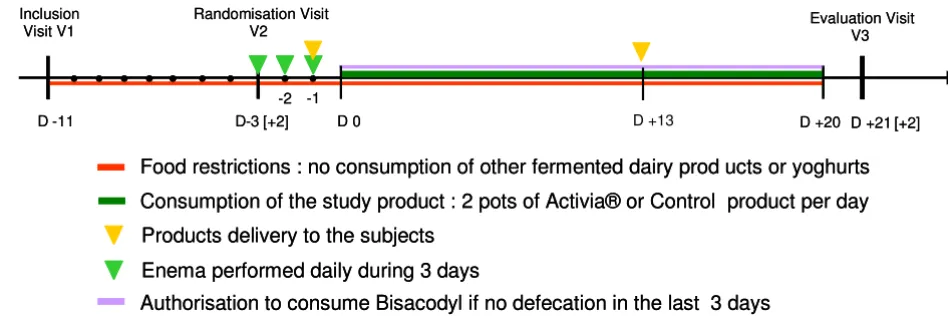
See figure 1 for the study planning. The total duration of the study is approximately 5 weeks for each subject. Each patient will attend 3 clinic appointments: Inclusion visit V1 (baseline), randomisation visit (V2) and clinical eval-uation at weeks 3 (V3). When a child is eligible for inclu-sion, a list of non-authorized products will be discussed with the child and parents at visit 1. The first 8 days will be used to obtain baseline values for the outcome param-eters. After 3 days of enemas, the 3 subsequent weeks (day 0 to day 20) will constitute the treatment phase. The sub-jects will receive and consume 2 products (test or control product) per day. Between days 7 and 10, the subjects will receive new products, to be consumed during the second part of the treatment period, to ensure consumption before end of shelf-life of the products. They will cease consumption of the study product at the end of week 3 (day 20) and will then have their last visit on day 21. Dur-ing the treatment phase, patients can take Bisacodyl 5 mg if they have no defecation for 3 consecutive days.
consumption of the study products, any unauthorised products and Bisacodyl and any other concomitant treat-ment.
Monitoring
Independent Clinical Research Associates (CRA) will visit at least twice every site in order to monitor all the patients' data.
Follow-up
After finishing the study, all children will get an appoint-ment at the outpatient clinic in their hospital for treat-ment of their constipation.
Discussion
Only children with a defecation frequency < 3/week will be included in this study. This seems inconsistent with the ROME-III definition for functional constipation, since 2 out of 6 defecation related criteria should be present. However, in our experience approximately 100% of chil-dren with a defecation frequency < 3/week fulfil one or more other symptoms of the Rome definition for func-tional constipation. An advantage of this strategy is that a more homogenous population of children with func-tional constipation will be included. Furthermore, a recent double-blind controlled trial showed beneficial effect of the fermented milk containing Bifidobacterium
lactis DN-173 010 in increasing stool frequency in IBS patients with constipation and a defecation frequency <3/ week and another one showed an increase in stool quency in constipated women also with a defecation fre-quency <3/week following consumption of this product.
Recently 4 human double-blind randomised studies using
1–3 portions of fermented milk containing
Bifidobacte-rium lactis strain DN-173 010 all reported a significant reduction of transit time in healthy subjects, especially in those with slow transit[7,9,11-13], and also in IBS patients with constipation[14]. No adverse effects associ-ated with the consumption of the fermented milk con-taining Bifidobacterium lactis DN-173 010 were observed in clinical studies done with this product. In the healthy adults, three portions per day proved to be more effective than two, whereas two portions appeared more effective than one. In this study we have chosen for two portions of fermented milk containing Bifidobacterium lactis DN-173. In these studies a reduction in transit time was observed within two weeks. Therefore we expect that three weeks of ingestion of the fermented milk containing Bifidobacte-rium lactis DN-173 010 are sufficient to determine its effectiveness.
Bisacodyl is a laxative of the triarylmethane group, which is hydrolyzed in the bowel by local enzymes into the
Study planning in days (D-11 to D+21) Figure 1
Study planning in days (D-11 to D+21).
Consumption of the study product : 2 pots of Activia® or Control product per day Inclusion
Visit V1
D -11
Evaluation Visit V3
D +21 [+2] Randomisation Visit
V2
D 0
Enema performed daily during 3 days
Authorisation to consume Bisacodyl if no defecation in the last 3 days
Food restrictions : no consumption of other fermented dairy prod ucts or yoghurts -2 -1
D-3 [+2]
Frequency of defecation, episodes of fecal incontinence and toil et training: Daily self-evaluation by the children and/or the parents during the entire study.
Consistency of stools and pain during defecation : Self-evaluation for each passed stool by the children and/or the parents during the entire study.
Digestive symptoms (abdominal pain and flatulence) and adverse e ffects (nausea, diarrhoea and bad taste): Daily self-evaluation by the children and/or the parents during the entire study.
Intake of Bisacodyl: Daily self-evaluation by the children and/or the parents during the entire study. D +20
Products delivery to the subjects
Consumption of the study product : 2 pots of Activia® or Control product per day Inclusion
Visit V1
D -11
Evaluation Visit V3
D +21 [+2] Randomisation Visit
V2
D 0
Enema performed daily during 3 days
Authorisation to consume Bisacodyl if no defecation in the last 3 days
Food restrictions : no consumption of other fermented dairy prod ucts or yoghurts -2 -1
D-3 [+2]
Frequency of defecation, episodes of fecal incontinence and toil et training: Daily self-evaluation by the children and/or the parents during the entire study.
Consistency of stools and pain during defecation : Self-evaluation for each passed stool by the children and/or the parents during the entire study.
Digestive symptoms (abdominal pain and flatulence) and adverse e ffects (nausea, diarrhoea and bad taste): Daily self-evaluation by the children and/or the parents during the entire study.
Intake of Bisacodyl: Daily self-evaluation by the children and/or the parents during the entire study. D +20
Products delivery to the subjects
Page 6 of 6
active agent bis-(p-hydroxyphenyl)-pyridyl-2-methane
(BHPM). Bisacodyl, in contrast to polyethylene glycol and lactulose, directly stimulates colonic peristalsis and does not interfere with the microflora of the gut. Therefore Bisacodyl has been chosen as rescue medication in case children do not defecate for three consecutive days during the study period.
Conclusion
This is the first double-blind, placebo-controlled ran-domised multicentre trial that aims to show that the fer-mented milk containing Bifidobacterium lactis DN-173 010 is effective in increasing stool frequency after 3 weeks of product consumption in children with functional consti-pation.
Abbreviations
BHPM: bis-(p-hydroxyphenyl)-pyridyl-2-methane; CFU:
colony-forming unit; CRA: Clinical Research Associates; IBS: irritable bowel syndrome; ICH: International Confer-ence on Harmonisation; ITT: intention-to-treat; IWRS: Interactive Web Response System; PEG: polyethylene gly-col; PP: per protogly-col; RCT: randomised controlled trial.
Competing interests
The authors declare that they have no competing interests.
Authors' contributions
MMT drafted the manuscript. MAB, AA and HS edited the manuscript. All authors participated in the design of the study. All authors read and approved the final manuscript.
Acknowledgements
Clinical centres and local principal investigators
Poland: The Medical University of Warsaw, H. Szajewska
The Netherlands: Emma Children's Hospital/Academic Medical Centre Amsterdam: M.A. Benninga, University Hospital Groningen, E. Rings, Amphia Hospital Breda, S. De Pont, Antonius Hospital Nieuwegein, A. Vlieger, Isala Hospital Zwolle, O. Norbruis, Zuwe Hofpoort Hospital Woerden, W. Verwijs, Academic Hospital Rotterdam, M.Y. Berger, Medi-cal Centre Alkmaar, E.K. George, Gelderse Vallei Hospital Ede, GJ van der Burg, Spaarne Hospital Hoofddorp, J. Bokma, Catharina Hospital Eind-hoven, R. Pelleboer, Flevo Hospital Almere, M. Trijbels-Smulders, Rijnstate Hospital Arnhem, E. Leijn.
The authors wish to thank Danone Research, Palaiseau, France, for funding this study, especially for the supply of products. Danone Research is spon-sor of this study.
References
1. Berg MM van den, Benninga MA, Di LC: Epidemiology of child-hood constipation: a systematic review. Am J Gastroenterol
2006, 101(10):2401-9.
2. Benninga MA, Voskuijl WP, Taminiau JA: Childhood constipation: is there new light in the tunnel? J Pediatr Gastroenterol Nutr 2004,
39(5):448-64.
3. Berg MM van den, van Rossum CH, de LF, Reitsma JB, Di LC, Benninga MA: Functional constipation in infants: a follow-up study. J Pediatr 2005, 147(5):700-4.
4. Pijpers MA, Tabbers MM, Benninga MA, Berger MY: Currently rec-ommended treatments of childhood constipation are not evidence based: a systematic literature review on the effect of laxative treatment and dietary measures. Arch Dis Child
2009, 94(2):117-31.
5. Voskuijl W, de LF, Verwijs W, Hogeman P, Heijmans J, Makel W, et al.: PEG 3350 (Transipeg) versus lactulose in the treatment of childhood functional constipation: a double blind, ran-domised, controlled, multicentre trial. Gut 2004,
53(11):1590-4.
6. Gill HS, Guarner F: Probiotics and human health: a clinical per-spective. Postgrad Med J 2004, 80(947):516-26.
7. Picard C, Fioramonti J, Francois A, Robinson T, Neant F, Matuchansky C: Review article: bifidobacteria as probiotic agents – physi-ological effects and clinical benefits. Aliment Pharmacol Ther
2005, 22(6):495-512.
8. Szajewska H, Setty M, Mrukowicz J, Guandalini S: Probiotics in gas-trointestinal diseases in children: hard and not-so-hard evi-dence of efficacy. J Pediatr Gastroenterol Nutr 2006, 42(5):454-75. 9. Marteau P, Cuillerier E, Meance S, Gerhardt MF, Myara A, Bouvier M,
et al.: Bifidobacterium animalis strain DN-173 010 shortens the colonic transit time in healthy women: a double-blind, randomized, controlled study. Aliment Pharmacol Ther 2002,
16(3):587-93.
10. Bouhnik Y, Raskine L, Simoneau G, Vicaut E, Neut C, Flourie B, et al.:
The capacity of nondigestible carbohydrates to stimulate fecal bifidobacteria in healthy humans: a double-blind, rand-omized, placebo-controlled, parallel-group, dose-response relation study. Am J Clin Nutr 2004, 80(6):1658-64.
11. Meance S, Cayuela C, Turchet P: A fermented milk with a Bifido-bacterium probiotic Strain DN-173 010 shortened oro-fecal gut transit time in elderly. Microb Ecol Health Dis 2001,
13:217-27.
12. Meance S, Cayuela C, Raimondi A: Recent advances in the use of functional foods: Effects of the commercial Fermented Milk with Bifidobacterium Animalis Strain DN-173 010 and Yoghurt strains on gut transit time in the elderly. Microb Ecol Health Dis 2003, 15:15-22.
13. Nishida S, Ushikawa Y, Iino H: Effect of Bifidobacterium lactis DN-173010 on the intestinal transit time, the condition of defe-cation and intestinal microflora: a randomized, double-blind, placebo-controlled, cross-over study among healthy Japa-nese women. Pharmacometrics (Oyo Yakuri) 2008, 74(5/6):99-106. 14. Agrawal A, Houghton LA, Morris J, Reilly B, Guyonnet D, Goupil FN,
et al.: Clinical trial: the effects of a fermented milk product containing Bifidobacterium lactis DN-173-010 on abdominal distension and gastrointestinal transit in irritable bowel syn-drome with constipation. Aliment Pharmacol Ther 2008. 15. Guyonnet D, Chassany O, Ducrotte P, Picard C, Mouret M, Mercier
CH, et al.: Effect of a fermented milk containing Bifidobacte-rium animalis DN-173 010 on the health-related quality of life and symptoms in irritable bowel syndrome in adults in primary care: a multicentre, randomized, double-blind, con-trolled trial. Aliment Pharmacol Ther 2007, 26(3):475-86. 16. Yang YX, He M, Hu G, Wei J, Pages P, Yang XH, et al.: Effect of a
fermented milk containing Bifidobacterium lactis DN-173010 on Chinese constipated women. World J Gastroenterol
2008, 14(40):6237-43.
17. Rasquin A, Di LC, Forbes D, Guiraldes E, Hyams JS, Staiano A, et al.:
Childhood functional gastrointestinal disorders: child/ado-lescent. Gastroenterology 2006, 130(5):1527-37.
18. Plas RN van der, Benninga MA, Redekop WK, Taminiau JA, Buller HA:
How accurate is the recall of bowel habits in children with defaecation disorders? Eur J Pediatr 1997, 156(3):178-81.
Pre-publication history
The pre-publication history for this paper can be accessed here: