University of Pennsylvania
ScholarlyCommons
Publicly Accessible Penn Dissertations
2017
Stochastic Optimization For Multi-Agent Statistical
Learning And Control
Alec Koppel
University of Pennsylvania, [email protected]
Follow this and additional works at:
https://repository.upenn.edu/edissertations
Part of the
Electrical and Electronics Commons
,
Operational Research Commons
, and the
Statistics and Probability Commons
This paper is posted at ScholarlyCommons.https://repository.upenn.edu/edissertations/2400
Recommended Citation
Koppel, Alec, "Stochastic Optimization For Multi-Agent Statistical Learning And Control" (2017).Publicly Accessible Penn Dissertations. 2400.
Stochastic Optimization For Multi-Agent Statistical Learning And Control
Abstract
The goal of this thesis is to develop a mathematical framework for optimal, accurate, and affordable complexity statistical learning among networks of autonomous agents. We begin by noting the connection between statistical inference and stochastic programming, and consider extensions of this setup to settings in which a network of agents each observes a local data stream and would like to make decisions that are good with respect to information aggregated across the entire network. There is an open-ended degree of freedom in this problem formulation, however: the selection of the estimator function class which defines the feasible set of the stochastic program.
Our central contribution is the design of stochastic optimization tools in reproducing kernel Hilbert spaces that yield optimal, accurate, and affordable complexity statistical learning for a multi-agent network. To obtain this result, we first explore the relative merits and drawbacks of different function class selections.
In Part I, we consider multi-agent expected risk minimization this problem setting for the case that each agent seems to learn a common globally optimal generalized linear models (GLMs) by developing a stochastic variant of Arrow-Hurwicz primal-dual method. We establish convergence to the primal-dual optimal pair when either consensus or ``proximity" constraints encode the fact that we want all agents' to agree, or nearby agents to make decisions that are close to one another. Empirically, we observe that these convergence results are substantiated but that convergence may not translate into statistical accuracy. More broadly, optimality within a given estimator function class is not the same as one that makes minimal inference errors. The optimality-accuracy tradeoff of GLMs motivates subsequent efforts to learn more sophisticated
estimators based upon learned feature encodings of the data that is fed into the statistical model. The specific tool we turn to in Part II is dictionary learning, where we optimize both over regression weights and an encoding of the data, which yields a non-convex problem.
We investigate the use of stochastic methods for online task-driven dictionary learning, and obtain promising performance for the task of a ground robot learning to anticipate control uncertainty based on its past experience. Heartened by this implementation, we then consider extensions of this framework for a multi-agent network to each learn globally optimal task-driven dictionaries based on stochastic primal-dual methods. However, it is here the non-convexity of the optimization problem causes problems: stringent conditions on stochastic errors and the duality gap limit the applicability of the convergence guarantees, and impractically small learning rates are required for convergence in practice.
Thus, we seek to learn nonlinear statistical models while preserving convexity, which is possible through kernel methods ( Part III). However, the increased descriptive power of nonparametric estimation comes at the cost of infinite complexity. Thus, we develop a stochastic approximation algorithm in reproducing kernel Hilbert spaces (RKHS) that ameliorates this complexity issue while preserving optimality: we combine the functional generalization of stochastic gradient method (FSGD) with greedily constructed low-dimensional subspace projections based on matching pursuit. We establish that the proposed method yields a controllable trade-off between optimality and memory, and yields highly accurate parsimonious statistical models in practice.
Then, we develop a multi-agent extension of this method by proposing a new node-separable penalty function and applying FSGD together with low-dimensional subspace projections. This extension allows a network of autonomous agents to learn a memory-efficient approximation to the globally optimal regression function based only on their local data stream and message passing with neighbors. In practice, we observe agents are able to stably learn highly accurate and memory-efficient nonlinear statistical models from streaming data. From here, we shift focus to a more challenging class of problems, motivated by the fact that true learning is not just revising predictions based upon data but augmenting behavior over time based on temporal incentives. This goal may be described by Markov Decision Processes (MDPs): at each point, an agent is in some state of the world, takes an action and then receives a reward while randomly transitioning to a new state. The goal of the agent is to select the action sequence to maximize its long-term sum of rewards, but determining how to select this action sequence when both the state and action spaces are infinite has eluded researchers for decades. As a precursor to this feat, we consider the problem of policy evaluation in infinite MDPs, in which we seek to determine the long-term sum of rewards when starting in a given state when actions are chosen according to a fixed distribution called a policy. We reformulate this problem as a RKHS-valued compositional stochastic program and we develop a functional extension of stochastic quasi-gradient algorithm operating in tandem with the greedy subspace projections mentioned above. We prove convergence with probability 1 to the Bellman fixed point restricted to this function class, and we observe a state of the art trade off in memory versus Bellman error for the proposed method on the Mountain Car driving task, which bodes well for incorporating policy evaluation into more sophisticated, provably stable reinforcement learning techniques, and in time, developing optimal collaborative multi-agent learning-based control systems.
Degree Type Dissertation
Degree Name
Doctor of Philosophy (PhD)
Graduate Group
Electrical & Systems Engineering
First Advisor Alejandro Ribeiro
Keywords
machine learning, multi-agent systems, optimization, signal processing, statistical learning, stochastic control
Subject Categories
STOCHASTIC OPTIMIZATION FOR MULTI-AGENT
STATISTICAL LEARNING AND CONTROL
Alec Koppel
A DISSERTATION
in
Electrical and Systems Engineering
Presented to the Faculties of the University of Pennsylvania
in Partial Fulfillment of the Requirements for the
Degree of Doctor of Philosophy 2017
Supervisor of Dissertation
Alejandro Ribeiro, Rosenbluth Associate Professor of Electrical and Systems Engineering
Graduate Group Chairperson
Alejandro Ribeiro, Rosenbluth Associate Professor of Electrical and Systems Engineering
Dissertation Committee
Vijay Kumar, Nemirovsky Family Dean of School of Engineering and Applied Science at the University of Pennsylvania
Brian M. Sadler, Principal Scientific Lead and Fellow of the U.S. Army Research Laboratory
STOCHASTIC OPTIMIZATION FOR MULTI-AGENT
STATISTICAL LEARNING AND CONTROL
COPYRIGHT
2017
Acknowledgments
My father’s hero Richard Feyman once said “I would rather have questions that can’t be answered than answers that can’t be questioned.” As I think back over the course of my
doctorate, one of the key characteristics that has defined my evolution from apprentice
to principle investigator has been the honing of my ability to ask good questions. The development of this skill has transpired alongside changes to my personality and perspective.
This is a tribute to the people who played a crucial role in this evolution.
I am deeply grateful for the opportunity I’ve had to work with my doctoral advisor
Alejandro Ribeiro over the years. When I began graduate school, 80−90% of what I would
say is wrong, and despite familiarity with mathematics, I did not speak the language, nor did I have any clue how to ask questions. Through his tireless efforts, dedication, and
meticulous mentorship style, I truly feel transformed into a literate member of our research
community. I hope I can pay forward his efforts on my behalf to future generations of researchers.
I would like to further thank Drs. Jonathan Fink and Brian M. Sadler of the U.S. Army
Research Laboratory as well as Dean Vijay Kumar for agreeing to serve on my doctoral committee. I am grateful to have had countless constructive conversations with Dr. Sadler
over the years deepening the theoretical foundations of my work. On the other hand,
discussions with Dean Kumar and Dr. Fink have helped me ensure the questions I ask are of practical importance to intelligent systems and robots, rather than wandering too far
down the rabbit hole of learning theory.
Over the course of my Phd, I’ve been fortunate to make some meaningful friendships that have strengthened my research purpose. Specifically, I benefited greatly from working
closely with Drs. Garrett Warnell and Ethan Stump of the U.S. Army Research
Labora-tory who shifted my focus from pure optimization problems to those in the intersection of optimization and statistical learning. Parts II and III of this thesis would not have been
possible without their contributions. I’d also like to acknowledge Professor Daniel D. Lee
of UPenn for taking the time out over the past year to listen and exchange ideas regarding learning in robotics. These discussions were invaluable for embarking upon the next great
I would also like to extend a deep sense of gratitude to the friends in the laboratory to
which I belonged over the past five years. I would especially like to thank Aryan Mokhtari, with whom I’ve collaborated on several side projects that were crucial to my understanding
of optimization, and have had many insightful discussions on personal and professional goals.
I will really miss being labmates but I know we’ll continue being friends for a lifetime. I’d also like to mention other friends in graduate school with me, whose presence has made the
whole process much more enjoyable, and includes but is not limited to: Felicia Jakubiec,
Ceyhun Eksin, Santiago Segarra, Santiago Paternain, Weiyu Huang, Mahyar Fazlyab, Luiz Chamon, Behnaz Arzani, Ekaterina Tolstaya, Konstantinos Gatsis, Tarik Tosun, and Erdem
Varol. Your friendships during graduate school really made the experience whole.
Lastly, I’d like to thank my family for the role they’ve had in continually pushing me forward over the years. Their role in the story of my graduate school arc has little to do
with my evolving professional perspective, but everything to do with shaping my heart and
mind, and I would not have achieved this feat without their love and support. In particular, my mother and grandfather, whose continual belief in me and talking me through tough
times made completing graduate school possible.
ABSTRACT
STOCHASTIC OPTIMIZATION FOR MULTI-AGENT
STATISTICAL LEARNING AND CONTROL
Alec Koppel
Alejandro Ribeiro
The goal of this thesis is to develop a mathematical framework for optimal, accurate, and affordable complexity statistical learning among networks of autonomous agents. We
begin by noting the connection between statistical inference and stochastic programming,
and consider extensions of this setup to settings in which a network of agents each observes a local data stream and would like to make decisions that are good with respect to information
aggregated across the entire network. There is an open-ended degree of freedom in this
problem formulation, however: the selection of the estimator function class which defines the feasible set of the stochastic program. Our central contribution is the design of stochastic
optimization tools in reproducing kernel Hilbert spaces that yield optimal, accurate, and affordable complexity statistical learning for a multi-agent network. To obtain this result,
we first explore the relative merits and drawbacks of different function class selections.
In Part I, we consider multi-agent expected risk minimization this problem setting for the case that each agent seems to learn a common globally optimal generalized linear models
(GLMs) by developing a stochastic variant of Arrow-Hurwicz primal-dual method. We
establish convergence to the primal-dual optimal pair when either consensus or “proximity” constraints encode the fact that we want all agents’ to agree, or nearby agents to make
decisions that are close to one another. Empirically, we observe that these convergence
results are substantiated but that convergence may not translate into statistical accuracy.
More broadly, optimality within a given estimator function class isnot the same as one that
makes minimal inference errors.
The optimality-accuracy tradeoff of GLMs motivates subsequent efforts to learn more sophisticated estimators based upon learned feature encodings of the data that is fed into
the statistical model. The specific tool we turn to inPart II is dictionary learning, where
we optimize both over regression weights and an encoding of the data, which yields a non-convex problem. We investigate the use of stochastic methods for online task-driven
dictio-nary learning, and obtain promising performance for the task of a ground robot learning to
anticipate control uncertainty based on its past experience. Heartened by this implementa-tion, we then consider extensions of this framework for a multi-agent network to each learn
globally optimal task-driven dictionaries based on stochastic primal-dual methods.
conditions on stochastic errors and the duality gap limit the applicability of the convergence
guarantees, and impractically small learning rates are required for convergence in practice. Thus, we seek to learn nonlinear statistical models while preserving convexity, which
is possible through kernel methods (Part III). However, the increased descriptive power
of nonparametric estimation comes at the cost of infinite complexity. Thus, we develop a stochastic approximation algorithm in reproducing kernel Hilbert spaces (RKHS) that
ame-liorates this complexity issue while preserving optimality: we combine the functional
gener-alization of stochastic gradient method (FSGD) with greedily constructed low-dimensional subspace projections based on matching pursuit. We establish that the proposed method
yields a controllable trade-off between optimality and memory, and yields highly accurate
parsimonious statistical models in practice. Then, we develop a multi-agent extension of this method by proposing a new node-separable penalty function and applying FSGD together
with low-dimensional subspace projections. This extension allows a network of autonomous
agents to learn a memory-efficient approximation to the globally optimal regression func-tion based only on their local data stream and message passing with neighbors. In practice,
we observe agents are able to stably learn highly accurate and memory-efficient nonlinear
statistical models from streaming data.
From here, we shift focus to a more challenging class of problems, motivated by the fact
that true learning is not just revising predictions based upon data but augmenting behavior over time based on temporal incentives. This goal may be described by Markov Decision
Processes (MDPs): at each point, an agent is in some state of the world, takes an action and
then receives a reward while randomly transitioning to a new state. The goal of the agent is to select the action sequence to maximize its long-term sum of rewards, but determining
how to select this action sequence when both the state and action spaces are infinite has
eluded researchers for decades. As a precursor to this feat, we consider the problem of policy evaluation in infinite MDPs, in which we seek to determine the long-term sum of rewards
when starting in a given state when actions are chosen according to a fixed distribution called
a policy. We reformulate this problem as a RKHS-valued compositional stochastic program and we develop a functional extension of stochastic quasi-gradient algorithm operating in
tandem with the greedy subspace projections mentioned above. We prove convergence with
probability 1 to the Bellman fixed point restricted to this function class, and we observe a state of the art trade off in memory versus Bellman error for the proposed method on the
Mountain Car driving task, which bodes well for incorporating policy evaluation into more
Contents
Acknowledgments iv
Abstract vi
Contents viii
List of Tables xii
List of Figures xiii
1 Introduction 1
1.1 Summary of Initial Findings . . . 3
1.2 Main Contribution . . . 7
I Generalized Linear Models 12 2 Online learning in homogeneous networks 13 2.1 Regret Minimization for Distributed Learning . . . 15
2.1.1 Distributed recursive least squares . . . 17
2.1.2 Decentralized Online Support Vector Machines . . . 18
2.2 Arrow-Hurwicz Saddle Point Algorithm . . . 19
2.3 Regret Bounds . . . 22
2.4 Empirical Regret Performance . . . 31
2.4.1 Network size . . . 33
2.4.2 Node connectivity . . . 35
2.4.3 Topology and Diameter . . . 35
2.4.4 Algorithm Comparison . . . 36
2.5 Computer Network Security . . . 38
2.5.1 Feature Vectors . . . 39
2.6 Takeaways for Decentralized Consensus Learning of GLMs . . . 43
3 Online learning in heterogeneous networks 45 3.1 Multi-Agent Optimization with Proximity Constraints . . . 46
3.2 Primal-Dual Method . . . 49
3.3 Convergence in Expectation . . . 53
3.4 Random Field Estimation . . . 64
3.5 Source Localization . . . 66
3.5.1 Consensus Comparison . . . 70
3.5.2 Impact of Network Size . . . 71
3.5.3 Effect of Spatial Deployment . . . 72
3.6 Perspective on Collaborative Adaptive GLM Learning . . . 73
II Task-Driven Dictionary Learning 75 4 Dictionary Learning 76 4.1 Data-Driven Signal Representations . . . 77
4.2 Predicting Control Uncertainty in Ground Robots . . . 79
4.2.1 Control Uncertainty Forecasting . . . 81
4.3 Online Task-Driven Dictionary Learning . . . 83
4.3.1 Formal Development . . . 83
4.3.2 Implementation Details . . . 86
4.4 Experiments on Robotic Platform . . . 89
4.4.1 Empirical Stability . . . 91
4.4.2 Predictive Performance . . . 92
5 Dictionary Learning in Multi-Agent Systems 94 5.1 Task-Driven Dictionaries for Multi-Agent Systems . . . 95
5.2 Block Saddle Point Method . . . 96
5.3 Convergence Analysis . . . 101
5.4 Empirical Evaluation of Multi-Agent Dictionaries . . . 109
5.4.1 Feature Generation . . . 110
5.4.2 Loss Function and Performance Metrics . . . 112
5.4.3 Implementation Details . . . 112
5.4.4 Results on Texture Database . . . 113
5.5 Collaborative Robotic Network Experiments . . . 119
III Reproducing Kernels and Nonparametric Estimation 123
6 Memory-Efficient Kernel Methods 124
6.1 Statistical Optimization in Reproducing Kernel Hilbert Spaces . . . 128
6.1.1 Supervised Kernel Learning . . . 128
6.1.2 Online Kernel Learning . . . 131
6.2 Parsimonious Online Learning with Kernels . . . 131
6.2.1 Functional Stochastic Gradient Descent . . . 132
6.2.2 Model Order Control via Stochastic Projection . . . 133
6.3 POLK Convergence . . . 137
6.3.1 Iterate Convergence . . . 142
6.3.2 Model Order Control . . . 146
6.4 Experiments with Efficient Nonparametric Methods . . . 150
6.4.1 Tasks . . . 151
6.4.2 Data Sets . . . 152
6.4.3 Results . . . 153
6.5 On the Promise and State of Memory-Efficient Kernel Methods . . . 159
7 Decentralized Efficient Nonparametric Stochastic Optimization 161 7.1 Decentralized Functional Stochastic Programming . . . 163
7.1.1 Function Estimation in Reproducing Kernel Hilbert Spaces . . . 165
7.2 Greedily Projected Penalty Method . . . 167
7.2.1 Functional Stochastic Gradient Method . . . 168
7.2.2 Local Sparse Subspace Projections . . . 170
7.3 Convergence of Multi-Agent Efficient Kernel Learning . . . 172
7.4 Experiments with Decentralized Kernel Learning . . . 182
7.5 Perspectives on Efficient Multi-Agent Kernel Learning . . . 186
8 From Inference to Control: Markov Decision Processes 187 8.1 Policy Evaluation in Markov Decision Processes . . . 187
8.2 Policy Evaluation as Compositional Stochastic Programming . . . 190
8.3 Functional Stochastic Quasi-Gradient Method . . . 191
8.3.1 Sparse Projection of Stochastic Quasi-Gradient Method . . . 193
8.4 Convergence Analysis via Coupled Supermartingales . . . 197
8.5 Experiments with Stochastic Quasi-Gradient-Based Policy Evaluation . . . 213
8.6 Implications of Gradient Temporal Difference Learning in infinite MDPs . 216
List of Tables
2.1 User connection features for computer network intrusion detection. . . 40
2.2 Content features tracking suspicious user to host behavior. . . 40
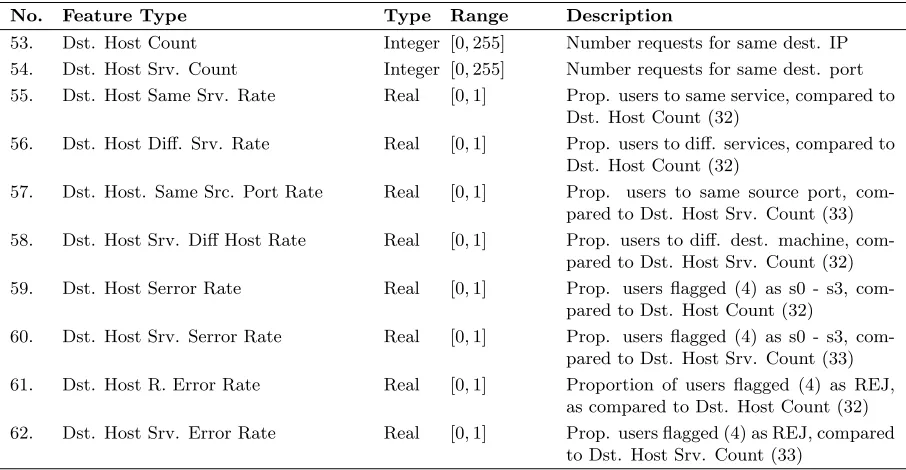
2.3 Time traffic features for computer security application. . . 41
2.4 Machine traffic features via user to host connections. . . 41
6.1 Convergence for memory-efficient kernels for different parameter selections. 150 6.2 Comparison of optimization tools for kernel learning on Gaussian mixtures. 157 6.3 Opt. tools comparison for kernel learning on MNIST, Brodatz data. . . 158
7.1 Stability for decentralized kernel methods for different parameter selections. 182 8.1 Stable parameter selections for nonparametric solutions to infinite MDPs. . 214
List of Figures
1.1 Motivation for nonparametric methods based on initial research threads . . 3
1.2 Summary of main contributions based on greedily compressed kernel methods. 7
2.1 Online saddle point method for a distributed least squares problem. . . 31
2.2 Saddle point performance on least squares problem for different sized networks. 32
2.3 Saddle point algorithm performance on networks of varying connectivity. . . 34
2.4 Saddle point algorithm performance for different network topologies. . . 34
2.5 Saddle point algorithm performance relative to existing methods. . . 37
2.6 Online saddle point method for detecting attackers in computer networks. . 42
2.7 Time average empirical probability of failing to detect an attacker ¯βj,T =
PT
t=1P(ˆyj,t =−1 |yj,t = 1) on a test set of T = 1×10⁴ user connections.
The error rate stabilizes between [0.10,0.15] as the host learns to deny service
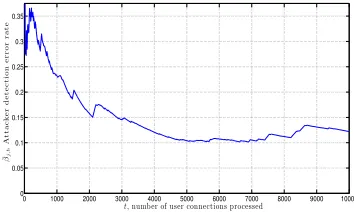
to a variety of attacker profiles. . . 43
3.1 Saddle point algorithm for estimating a correlated random field. . . 64
3.2 Saddle point algorithm for random field estimation in different sized networks. 66
3.3 Saddle point compared to consensus methods for random field estimation. . 68
3.4 Primal-dual method for a source localization task. . . 70
4.1 Block diagram of a dictionary learning architecture on a ground robot. . . . 83
4.2 Specific implemented dictionary learning architecture for robot experiments. 86
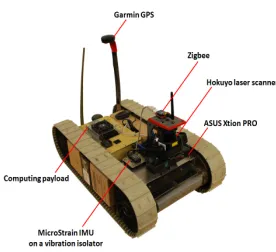
4.3 iRobot Packbot used in our experiments. . . 87
4.4 Example observations recorded by the Packbot for learning experiments. . . 87
4.5 Comparison of methods to predict control uncertainty on ground robot. . . 90
4.6 Dictionary learning stably adapts as robot changes its environment. . . 90
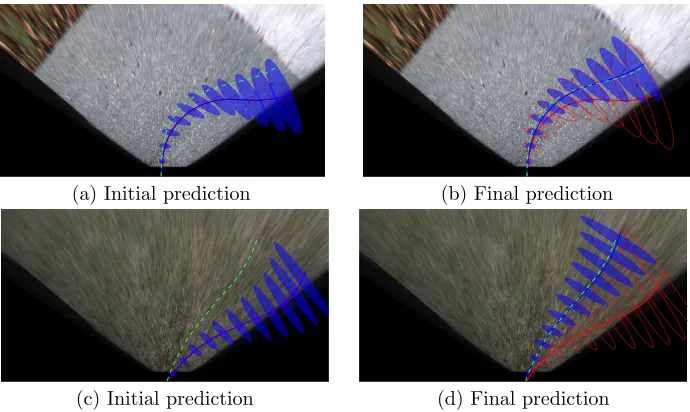
4.7 Future uncertainty ellipses generated by having robot learn from experience. 91
4.8 Dictionary-based predicted control uncertainty matches platform experience. 93
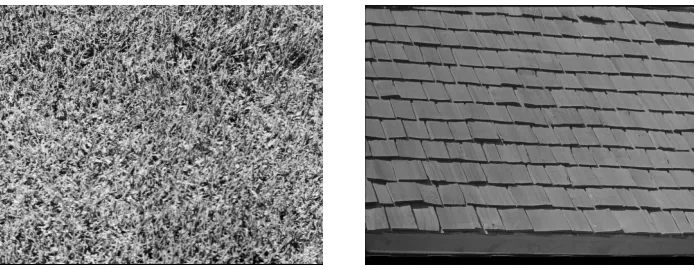
5.1 Sample images from the Brodatz texture database. . . 109
5.3 An agent learning a task-driven dictionary in differently sized networks. . . 111
5.4 An agent learning a task-driven dictionary in different network topologies . 114 5.5 Agent learning a global dictionary based on local incomplete data. . . 116
5.6 Feature extraction for multi-robot dictionary learning experiments. . . 118
5.7 Task-driven dictionaries: one robot to anticipates mistakes made by another. 118 6.1 Visualizations of the data sets used in experiments. . . 152
6.2 Greedily compressed online kernel multi-class SVM on Gaussian mixtures. . 154
6.3 Decision surfaces resulting from greedily compressed online kernel learning. 154 6.4 Greedily compressed online kernel Logistic Regression on Gaussian mixtures 155 6.5 Stably sparsified online multi-class kernel SVM on MNIST data . . . 156
6.6 Memory-efficient online multi-class kernel SVM on Brodatz data . . . 156
6.7 Stably sparsified online kernel Logistic Regression on MNIST data . . . 156
6.8 Memory-efficient online kernel Logistic Regression on Brodatz data . . . 157
7.1 Visualizations of decentralized adaptive accurate statistical learning. . . 183
7.2 Stable decentralized memory-efficient kernel learning. . . 184
7.3 Stable decentralized memory-efficient kernelized SVM. . . 185
Chapter 1
Introduction
In recent years, decreasing computing costs alongside pervasive data availability has fueled the transition of learning systems from imagination to just another feature in technologies
such as smart devices [74], autonomous automobiles [25], medical imaging [210], and even
robot assistants [124]. However, there is a large gap between the adoption of off-the-shelf learning methods which require all observations to be available at once [1] and the design
learning systems that can maycontinually adapt to new evidence. Our focus is on developing
a principled framework for convergent, accurate, and lightweight supervised learning in collaborative decentralized systems such as robotic [11] or computer networks [3].
From a scientific perspective, supervised learning is statistical inference [66]. We are
given a batch of dataN data points {xn, yn}Nn=1 ⊂Rp×R which are samples of a pair of
random variables (x, y), and want to devise a mathematical model (estimator) ˆyn=f(xn)
of an input-output relationship among it. For example, consider a batch of U.S. census
data that contains demographic and salary information. Given the demographic profile of a new individual, we may try to predict her income. Alternatively, given a video feed,
some of whose frames contain an object of interest such as a person’s face, we may try to
identify whether that person’s face appears in a future video. The aforementioned examples correspond to regression or classification, respectively, and more generally are referred to
as estimation [204].
To make inferences that adhere closely to the ground-truth, however, in addition to designing an estimator, one must define a merit of its quality, which, practically speaking, is
whether the estimator predicts correctly1{yˆn=yn}[18], also called its statistical accuracy.
Thus, in principle, we’d like to find an estimator which minimizes the number of mistakes made averaged over all possible data:
f? = argmin
f∈F Ex,y
Here1{E}denotes the indicator function of an event E, which in (1.1) is 1 if the estimator
makes a mistake, and null otherwise. Optimizing inference accuracy (1.1) (Baye’s risk) directly is an intractable integer program, and thus we replace the indicator by a convex
surrogate loss function`(f(x), y) which is small whenf(x) and y are close and large when
they’re far. One example is a probabilistic model of the odds ratio of whether or not an outcome will happen [133] in the case of the logistic model of classification. Then, we
seek to optimize the estimatorf(xn) that defines the statistical model with respect to this
surrogate loss`(f(xn), yn) averaged over all data points:
˜
f∗= argmin
f∈F Ex,y
[`(f(x), y)] (1.2)
Moreover, F denotes some function class to which the estimator f belongs – we defer
details of the estimator function class for the moment, but clearly a good selection is one
which makes the optimization problem solvable, admits a moderate complexity solution, and closes the gap between optimizing statistical (1.1) and optimizing our surrogate loss
(1.2). The formulation (1.2), of which maximum likelihood estimation (MLE) is a special
case [163], is referred to as thegeneral learning setting or expected risk minimization [202],
and establishes a mathematical foundation linking optimization and statistics.
Our goal is to develop optimal, moderate complexity solutions to (1.2) that are also
statistically accurate, i.e., to obtain solutions to (1.2) which are not far from the one that minimizes the error rate (1.1). We focus on the case where the number of training examples
N is infinite (which necessitates the expectation in (1.1)-(1.2)), or independent samples
(xn, yn) are arriving in a streaming fashion, and further when data is scattered across an
interconnected networkG = (V,E) of autonomous agents. We note that currently, there are
little to no methods which meet these specifications, even for the centralized setting. Thus,
we propose investigating this problem space through different selections of F in order to
find an appropriate choice. An overview of our preliminary findings is given in Figure 1.1,
and the first half of the following subsection. These results then motivate the main result of this thesis developed in Part III.
Motivation for Decentralized Methods There are two technological settings in
which decentralized information processing is important. The first is industrial-scale ma-chine learning [32], in which billions of training examples are available at a centralized
location, and one would like to find an optimal statistical model in terms of all data. It is
beneficial in terms of the number of samples one may process per iterative optimization step to decentralize/parallelize data processing in order to obtain computational speedup [158].
The later setting in which decentralized learning may be beneficial is networked
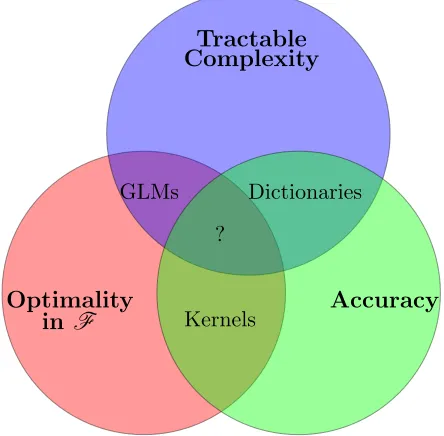
Tractable Complexity
Optimality
in F Kernels Accuracy
?
Dictionaries GLMs
Figure 1.1: A summary of existing statistical learning tools in terms of different choices of estimator
function class F: generalized linear models (GLMs) are low complexity and yield solutions whose
convergence follows from classical stochastic approximation methods. Part Idevelops a convergent
framework for multi-agent statistical learning with GLMs but their lack of statistical accuracy on
empirically important problems motivates the pursuit of dictionary methods in Part II. Here we
observe that in centralized settings dictionaries can obtain state of the art statistical accuracy, but their convergence is limited by the non-convexity defined by their training, which precludes the ability to find the optimal dictionary representation and causes numerical instabilities that must be surmounted by heuristics. These drawbacks motivate the central question of this thesis regarding how to learn nonlinear statistical models while preserving convexity. We address this question by noting that kernel methods yield a framework that meet these criteria, but at the cost of defining a convex optimization problem over an infinite dimensional function space. Thus we are faced with the question of how to ameliorate this complexity issue while preserving the optimality and accuracy properties of nonparametric methods.
aggregation of data (“flooding”) exceeds the cost of local-only computations and communi-cations with neighboring nodes. We note that we are in this regime when the data available
to each node is consistently in flux, i.e.,streaming data settings: in this situation, it would
be necessary to do centralized aggregation of data at each time slot, whose computational and communication cost exceeds a decentralized online processing strategy. This setup is
the focus of the work pursued in this thesis.
1.1
Summary of Initial Findings
Part I of this thesis develops distributed stochastic optimization tools for (1.2) for the
linear models (GLMs): fi(xi) = wTi xi for some wi ∈ Rp and F = Rp. In Chapter
2, we first address the case that the hypothesis that each agent’s data is sampled from
a common distribution, which appeared as [93]. When the random pairs (xi, yi) have a
common distribution for eachi∈ V then convexity implies that at optimality, each agents’
statistical models coincide: wi = wj for each (i, j). Under this hypothesis, we are in
the province of online consensus optimization [136]. We develop a decentralized stochastic
optimization tool to solve multi-agent extensions of (1.2) exactly based on primal-dual
method [9]. Then, inChapter 3, we draw upon the lessons learned for the case that each
agent observes samples from a common distribution to develop tools which are applicable to
more general settings where agents seek to collaborate but not coincide, so as to retain the
distinct perspective induced by their possibly unique local data stream [97]. Part I primarily focuses on addressing the issues of how to learn globally optimal statistical model parameters
which are of low complexity, while ignoring whether the space of GLMs is sufficiently rich
to attain practically useful inference performance, i.e., to come close to (1.1).
John Tukey once said, “far better an approximate answer to the right question, which is
often vague, than an exact answer to the wrong question, which can always be made precise”
[201]. In Part I, we solve the problem (1.2) when (xi, yi) have a common distribution for each
i∈ V and each agent learns a GLM exactly, but observe that this class of estimators is not
rich enough to solve inference tasks that arise in practice, such as computer network security
(Section 2.5). This suggests that solving an optimization problem does not necessarily
translate to satisfactory statistical accuracy, unless the optimization problem hews closely
to the actual inference problem (1.1). The result of this research thread is that multi-agent online learning with linear statistical models belongs firmly to the intersection of methods
which yield optimality within their function class, are moderate complexity, but are not
statistically accurate (see Figure 1.1).
An active research question is how to specify the function classF to which estimator the
f(xn) belongs so as to preserve computational tractability of (1.2) but come within striking
distance of f? that solves (1.1), the one which directly optimizes statistical accuracy [18].
Typically, increasing the complexity of function space F yields more accurate estimates
at the price of additional computational cost [28]. Numerous approaches exist to bridge
the gap between ˜f∗ and f?: neural networks [72], nonparametric methods [192], and those
which exploit specialized knowledge of the data domain, called feature extraction/signal
representation (unsupervised learning) techniques. This later approach addresses the
dis-crepancy between (1.1) and (1.2) by transforming the data vectorsxninto a form which may
be more amenable to statistical inference through dimensionality reduction [84],
transfor-mation into a Fourier domain [145], or its multi-resolution extensions [122]. Alternatively,
task one is attempting to solve [12], which is referred to as dictionary learning.
In Part II of this thesis, we investigate the use of dictionary learning methods for
solving (1.2) when the estimators are a generalization of GLMs ˆy =α(x,D)Tw that allow
for a feature encodingα=α(x,D)∈Rk of the dataxto be learned alongside the statistical
model parameters w ∈ Rk (Chapter 4). The feature encoding is obtained by defining a
separate “representation” losss(αt,D;xt) that depends on the proximity betweenDαtand
the data point xt and may incentivize, for instance, sparsity. Here D is a matrix of size
p×k, where k is the number of dictionary elements (or atoms) which is fixed, but chosen
by us. The feature encoding is computed as the following projection [2]
α(D;xt) := argmin
αt∈Rk
s(αt,D;xt). (1.3)
In standard dictionary learning [58], we seek to optimize (1.3) with respect to D, but in
task-driven dictionary learning, we instead use the feature encoding directly for statistical
inference. Therefore, our statistical loss1 for this setting becomes
(D∗,w∗) := argmin
D∈D,w∈WEx,y
h
` α(D,x)Tw,y)i. (1.4)
The estimator α(D,x)Tw has more descriptive power than a GLM since we are allowed
to search over the space of signal representations in the form of dictionary matrices while
simultaneously searching for regression weights. However, this increased descriptive power
comes at the cost of making the optimization problem (1.4) non-convex, a difficulty shared with neural networks. Nonetheless, for the centralized setting, by optimizing over both the
data representation and the statistical model parameters using stochastic gradient descent,
we obtain superior performance on a truly challenging estimation problem: that of an autonomous robot attempting to forecast where it will experience more steering mistakes
based on its past experience (Chapter 4.2), which appeared as [92]. This is in contrast to
the lackluster performance of GLMs on the real problem of attacker detection in computer networks in Section 2.5.
Heartened by this successful application, in Chapter 5, we develop a mathematical
framework for online task-driven dictionary learning in multi-agent systems by building upon the computational tools developed in Chapter 2. In particular, we again associate
each agent i in a digraph G with a unique sequence of training examples (xi,n, yi,n) and
1
In Chapter 4, we use the notation` D,w;x,y) =` α(D,x)Tw,y) to emphasize that the dictionary D
and model parametersware our choice, whereas the data, mathematically represented as a pair of random
consider the decentralized stochastic program
{D∗i,w∗i}Vi=1 := argmin
Di∈D,wi∈W
V
X
i=1
Exi,yi
h
`i(α(Di,xi)Twi, yi)
i
s.t. Di =Dj, wi =wj, j ∈ni. (1.5)
where estimators take the formfi(x) =α(Di,xi)Twi. We solve (1.5) using similar
primal-dual optimization methods, but it is here that we run into the limitations of dictionary methods. In the centralized setting (1.4), the non-convexity of the optimization problem
does not empirically cause problems, since there is no duality gap (the difference between
the solution to the primal problem and dual problem [139]). But to obtain exact solu-tions for consensus-constrained problems, the duality gap becomes a problem. Moreover,
we theoretically and empirically observe the stochastic approximation error, i.e., the
direc-tional error caused by the fact that we use stochastic gradients instead of true gradients of the Lagrangian, contributes more to instability in non-convex settings than for convex
multi-agent settings [95]. Despite these drawbacks, we obtain satisfactory performance in
practice for control uncertainty prediction problems in robotic teams. In this application, we have a network of interconnected robots traversing distinct paths and recording sensory
observations, and we successfully apply solutions to (1.5) such that the steering mistakes of
one robot may be anticipated by another (Section 5.5).
A major drawback of substituting an alternative signal representation into the general
learning problem and optimizing jointly over the representation and regression weights, as is done in supervised dictionary learning, is that we lose convexity, which is fundamental
to computational efficiency. Theoretically and empirically, we observe instability due to
non-convexity is more prominent in multi-agent settings than centralized settings due to complications arising from Lagrange duality. This observation disincentivizes investigating
more sophisticated statistical techniques for multi-agent learning that also yield non-convex
problems, namely, neural networks [103]. Nascent optimization tools have been developed for non-convex optimization methods in decentralized settings [52], but their applicability
to streaming data (online) settings has not yet materialized, and thus it is unclear whether
task-driven dictionaries or neural networks can be stably trained in online multi-agent settings. This remark motivates a broader question: is there a way to achieve or surpass the
increased expressive power of dictionary learning methods relative to GLMs while preserving
convexity, and ensure the resulting estimator is of moderate complexity? This question is
addressed in Part IIIof this thesis, whose contributions are summarized in the following
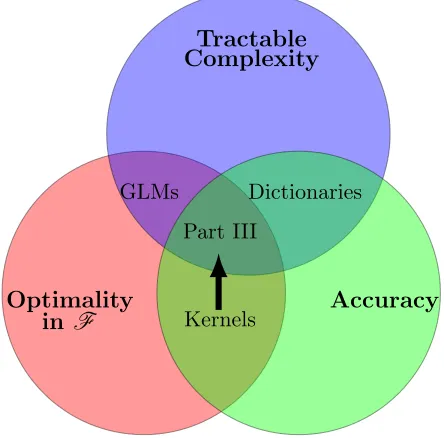
Tractable Complexity
Optimality
in F Accuracy
Part III
Dictionaries GLMs
Kernels
Figure 1.2: Part I allowed multi-agent networks to learn low complexity optimal linear statistical models, but their statistical accuracy in practice is limited. Part II developed decentralized dictio-nary methods for statistical learning based on the fact that in centralized settings which obtain state of the art statistical accuracy on a real robotics problem. However, the non-convexity defined by their training precludes our ability to find optimal dictionary-based statistical models. Thus Part III proposes using nonparametric estimation methods using reproducing kernels to learn accurate statistical models defined by infinite-dimensional stochastic convex programs. We develop methods such that we obtain moderate complexity kernel representations whose optimality properties are preserved (Chapter 6) and show how it may be used for multi-agent settings in Chapter 7. Then, we leverage tools of Chapter 6 to address a long-standing open problem in reinforcement learning: how to solve Bellman’s evaluation equation (Chapter 8).
1.2
Main Contribution
Elements of Statistical AccuracyWhen designing estimators that are optimal within a
function class that are also as accurate as possible, it is important to first understand from
whence accuracy comes. The accuracy of an estimatorf ∈F hinges on a few contributing
factors: the number of data samples, the representation complexity off for a fixed function
class F, and whether the optimal Baye’s risk estimator (1.1) belongs to F to begin with.
The best achievable accuracy forN fixed samples is proportional to 1/N [202,204]. The third
source of statistical error regarding whether the estimator that truly makes the minimal number of mistakes, i.e., how close it is to the one which achieves the minimal Baye’s risk
regardless of function classF is not addressed in this thesis, and is an active research area.
Our focus is on the second source: how to obtain an as-accurate-as-possible estimator
for a fixed function classF whose complexity is at-worst moderate. By selecting arbitrarily
[109] or neural networks [103], it is possible to drive down the statistical error close to
zero, but at the cost of high complexity estimates that are not applicable to light-weight autonomous systems and rapid adaptation. Thus, instead, in pursuit of methods
well-suited to adaptive systems, we seek accurate and optimal estimators of at-worst moderate
complexity. We are able to establish that the statistical error vanishes with an estimator
offixed complexity. The mathematical formalism for this development isreproducing kernel
Hilbert spaces and nonparametric estimation, the focus ofPart III of this dissertation. In
Chapter 6, in particular, we consider the centralized statistical optimization problem
f∗= argmin
f∈H Ex,y
[`(f(x), y)] + λ
2kfk
2
H, (1.6)
which is a special case of (1.2) when the function class F =H is a Hilbert space equipped
with a “feature map” called reproducing kernel κ:X × X →R. Here X ⊂Rp denotes the
feature space to which training examples xn belong. We defer an exact discussion of the
technicalities ofκ to Chapter 6, but note that common examples include polynomial kernel
and the radial basis kernel, i.e., κ(x,x0) = xTx0+qb
and κ(x,x0) = expn−kx−x0k22
2˜σ2
o
,
re-spectively, wherex,x0 ∈ X. The benefit of this kernel function is that Riesz Representation
Theorems from functional analysis [212] allow us to transform an optimization problem over
a function space into one over a weighted combination of kernel evaluations over training
examples [169]:
f(x) =
N
X
n=1
wnκ(xn,x). (1.7)
where N in (1.7) coincides with the training sample size. The Hilbert-norm regularizer
λ 2kfk
2
H in (1.7) is needed to guarantee the applicability of (1.7). Observe that the
expec-tation in (1.6) means that the data sample size N = ∞ is infinite, which implies that f
has infinite complexity. Worse yet, when applying functional generalizations of stochastic
gradient method (SGD) to (1.6)
ft+1=ft−ηt∇f`(ft(xt), yt) (1.8)
and inductively applying the Representer Theorem (1.7), we obtain a parametric
represen-tation of ft that has complexity comparable tot, the iteration index [89].
In Chapter 6, we address the complexity explosion of f∗ as well as ft [cf. (1.8)], the
functional generalization of SGD (also referred to as kernel adaptive filtering [193]), through
the use of greedily constructed subspace projections so that we may guarantee exact
conver-gence offttof∗ when the projection-based error attenuates over time [98] – see Figure 1.2.
which is guaranteed to be close to f∗. The resulting empirical statistical accuracy of this
approach far surpasses methods developed in Parts I and II, and yieldsonline training
per-formance that is comparable to nonparametric statistical methods which aretrained with all
data available in advance. Thus, carefully sparsified nonparametric methods suggest a path
forward for intelligent systems to accurately learn from streaming data while maintaining provable global stability due to convexity.
Chapter 7 builds upon the lessons learnt from Chapter 6 to address the problem of
kernelized stochastic optimization in multi-agent systems. This setting is one in which each
agent among a network of interconnected agents seeks to learn a memory-efficientnonlinear
statistical model which is approximately optimal with respect to information aggregated
across the entire network based upon only its local data stream {xi,n, yi,n}. We consider
the case that each agent’s data stream{xi,n, yi,n}is drawn from random pairs (xi, yi) which
have a common distribution. Therefore at optimality we would like to satisfy the consensus
constraint fi =fj ,(i, j)∈ E, where fi denotes the statistical mode of nodei. This setting
is captured by the nonparametric decentralized stochastic program
f∗ = argmin
{fi}∈H
X
i∈V
Exi,yi
h
`i(fi x), yi
i
+λ
2kfik
2
H
such that fi=fj ,(i, j)∈ E (1.9)
whose (even approximate) solution has eluded the research community for a decade, al-though some prior attempts have been made [67, 141]. In this chapter, we develop a
decen-tralized stochastic approximation-based method to nearly exactly solve (1.9). However, due
to the subtleties of the RKHSH, i.e., the fact that the Representer Theorem has not been
established for RKHS-valued stochastic saddle point problems, we cannot make use of
La-grange duality to directly address the constraint in (1.9), and therefore cannot make use of
the primal-dual stochastic methods wielded to address consensus and proximity constraints in Parts I - II. Instead, we adopt an approximate primal-only approach based on penalty
methods, which in the context of multi-agent optimization is called distributed gradient
de-scent [136]. In particular, we apply functional SGD to the proposed node-separable penalty function operating with greedily constructed subspace projections akin to the techniques in
Chapter 6 to obtain a true method for decentralized statistical learning. We obtain a
prov-ably stable and memory-efficient method for each individual in the network to find, based on its local data stream and message passing with its neighbors, a close approximation to
the globally optimal regression function [96]. We further observe that the resulting protocol translates well into practice: we obtain state of the art performance for decentralized
on-line multi-class classification in Section 7.4 that attains comparable accuracy to centralized
for stable collaborative statistical learning from streaming data in multi-agent systems, in
contrast to our attempts to extend dictionary methods to decentralized settings.
Path Forward for Collaborative Statistical Learning Up until now, we have
ad-dressed the problem of statistical inference from streaming data in centralized and
decen-tralized settings. That is, from a training examplesxn, we seek to predictynas ˆyn=f(xn).
Based on the function classF to whichf belongs, the difficulty of the optimization problem
that defines finding f varies, as does its statistical performance. By exploiting structural
properties of the choice of F in a principled way, while also making use of convex
op-timization techniques such as Lagrange duality and penalty methods, we have developed
tools that successfully allow a network of interconnected agents to collaboratively learn
accurate statistical models from their local data streams and message passing with their neighbors. While we have not solved nonparametric multi-agent stochastic programs
ex-actly, we have solved them approximately in a memory-efficient way that isprovably stable
and yields good performance in practice. It is left to future directions, discussed in more
detail in Chapter 9, to solve multi-agent nonparametric stochastic programs exactly using
Lagrange duality, as well as extend this framework to settings such as, e.g., RKHSs with
compositional multi-layer kernels (and possibly come within striking distance of the off-line accuracy benchmarks set forth by deep learning) and different hypotheses regarding agents’
data which may motivate use of proximity constraints as in Chapter 3.
From Statistical Learning to Stochastic Control From here, we shift focus to a
more challenging class of problems, motivated by the fact that for true learning, making
good predictions is not enough. We would also like an autonomous agent to augment its behavior over time based on rewards. This notion of tailoring actions to incentives may be
formulated by assuming the agent, starting at statext∈ X ⊂Rp at timet, selects an action
vectorat∈ A ⊂Rq at time twhose choice influences the state of the worldxt+1 ∈ X ⊂Rp
at time t+ 1, where we denote xt+1 as yt for disambiguation. Moreover, when the agent
transitions to stateyt, an instantaneous rewardr(xt,at,yt) is assigned which quantifies, for
instance, proximity to a goal location, platform stability, or portfolio revenue. We consider
the case where the action selection at ∈ A causes a transition to next state yt ∈ X that
follows some state and action dependent conditional probability density yt ∼ P(·xt,at).
and the reward function is a map r : X × A × X → R. This situation may be modeled
by a Markov decision process (MDP) [185] with a continuous state and action space which
is a quintuple (X,A,P, r, γ), whereP is the action-dependent transition probability of the
process and r is the reward map, as noted above. The general goal in an MDP is for the
agent to choose actions{at}∞t=1 which maximize the reward accumulation starting from an
V(x,{at}∞t=0) =Ey
hX∞
t=0
γtr(xt,at,yt)
x0 =x,{at}∞t=0 i
. (1.10)
The determination of the optimal action sequence{at} in (1.11) is a mathematically
chal-lenging problem when X and A are continuous whose efficient solution has eluded the
re-search community for decades [20, 23]. Rather than attempt to harpoon the “white whale”
of reinforcement learning directly, i.e., the determination of how to choose the action
se-quence, in Chapter 8, we first answer a long-standing question of how to determine how
good an action sequence is with respect to the long term accumulation of rewards. This
task is known aspolicy evaluation.
In policy evaluation, control decisions at are chosen according to a fixed stationary
stochastic policy π : X → ρ(A), where ρ(A) denotes the set of probability distributions
over A. Policy evaluation underlies methods that seek optimal policies through repeated
evaluation and improvement [104]. In policy evaluation, we seek to compute thevalue of a
policy when starting in state x, quantified by the discounted expected sum of rewards, or
value functionVπ(x):
Vπ(x) =Ey
hX∞
t=0
γtr(xt,at,yt)
x0 =x,at=π(xt)}∞t=0 i
. (1.11)
The value function (1.11) is parameterized by a discount factorγ ∈(0,1), which determines
the agent’s farsightedness, and guarantees the series in (1.11) is always finite. In this
chap-ter, we build upon the lessons learned regarding how to use greedily projected stochastic approximation tools in reproducing kernel Hilbert spaces for statistical inference in
Chap-ter 6 to develop a method for policy evaluation in infinite spaces. To do so, we consider
Bellman’s evaluation equation which we reformulate as a compositional stochastic program, and then derive a stochastic quasi-gradient algorithm in a RKHS which operates together
with the subspaces projections designed in Chapter 6. The benefit of the proposed
nonpara-metric approach is that we are able to learn a value function estimate for a fixed policy that is guaranteed to converge to the true value function almost surely and is guaranteed to be
of moderate memory. We observe a state of the art trade off of Bellman error (a measure of
the quality of the value function estimate) and memory efficiency of our proposed approach on the Mountain Car navigation task, which bodes well for more challenging applications
in robotics and econometrics. Moreover, the result of this chapter lays a foundation for
finding optimal policies through alternating policy evaluation and improvement steps, and possibly finding optimal action-value functions directly through Bellman optimality
equa-tions. InChapter 9we summarize the major lessons learned from Chapters 2 - 8 in terms
Part I
Chapter 2
Online learning in homogeneous
networks
In this chapter, we address supervised learning from streaming data in multi-agent systems,
where each agent seeks to learn, based on its local data stream and message passing with its
neighbors, a common parameter vector that defines a linear statistical model that is as good as a centralized agent which has access to all data in advance. The specific setting considered
here consists of convex cost functions that are sequentially revealed to individual agents. In offline centralized learning the functions of all agents and all times are known beforehand
and a constant and common action is selected for agents to play. In online centralized
learning, functions are still available at a central location but are revealed sequentially.
The common action to be played by agents is selected ex ante using past observations and
incurs a cost ex post after the current functions become available. In distributed online
learning the agents select actions based on previous cost functions observed locally and messages received from neighbors in past communication exchanges. This chapter proposes
the use of a saddle point algorithm so that distributed online strategies achieve comparable
performance to centralized offline strategies.
Centralized online learning problems can be formulated in the language of regret
min-imization [176, 202]. In this setting, a learner makes a sequence of plays to which Nature
provides the answer in the form of a loss function. Regret accumulates over time of the loss difference between the online learner and a clairvoyant offline learner to which cost
functions have been revealed beforehand, which we interpret as a measure of the price for
causal prediction. For convex losses, several algorithms are known to achieve regret whose
growth with the accumulated operating time T is sublinear – which entails vanishing cost
differences between online and offline plays at specific times. Germane to this chapter is
in the current function, online gradient descent achieves regret that grows not faster than
a function of order O(√T) in general and not faster than O(logT) under more stringent
conditions [228]. Other methods to control regret growth are proximal maps [54], mirror
descent [157, 177], and dual averaging [187]. All of these strategies may be understood as
special cases of a strategy known as “follow the regularized leader” [176].
We develop methods for distributed online learning by building upon methods for
de-terministic settings. In dede-terministic settings, optimal actions of separable convex costs
are computed using distributed optimization algorithms which can be categorized into
pri-mal methods, dual methods, and pripri-mal-dual methods. In primal methods agents
de-scent along their local gradients while averaging their signals with those of their
neigh-bors, [77, 134, 157, 223]. In dual methods agents reformulate distributed optimization as an agreement constrained optimization problem and ascend in the dual domain using the fact
that dual function gradients can be computed while cooperating with neighboring nodes
only [78, 154]. Variations of dual methods include the alternating direction method of mul-tipliers [110, 167] and second order methods that rely on approximate Newton steps [224].
Primal-dual methods combine primal descent with dual ascent [9,134,140]. Primal methods
have been generalized to distributed online learning and have proved effective for particular cases where averaging is advantageous [197, 220].
We develop a variant of the saddle point method [9, 135] to solve distributed online
learning problems which achieves a regret that grows at a rate not faster thanO(√T). We
introduce of the concept of regret and extend it to networked settings, which we illustrate
with applications to decentralized recursive least squares (Section 2.1.1) and decentralized online support vector machines (Section 2.1.2). The saddle point algorithm is developed in
Section 2.2 by drawing parallels with deterministic and stochastic optimization. The method
relies on the addition of equality constraints and the definition of an online Lagrangian associated with the instantaneous cost function. Primal descent steps on the Lagrangian are
used to update actions and dual ascent steps are used to update the multipliers associated
with the equality constraints. As in the case of online gradient descent, there is a mismatch between descending on past online Lagrangians to find an action to be played at the current
time and incur a cost associated with a function that can be arbitrarily different. Despite
this mismatch, and again, analogous to online gradient descent, the saddle point method
achieves regret of order O(√T) (Section 2.3). This result is first established in terms
of the global networked regret (Theorem 1) and then shown to hold for the regrets of
individual agents as well (Theorem 2). Implementations of decentralized recursive least squares and decentralized online support vector machines demonstrate that the theoretical
2.1
Regret Minimization for Distributed Learning
We consider formulations of learning problems with instantaneous actions ˜wt ∈ X ⊆ Rp
chosen by a player, instantaneous functions `t:Rp→ Rq chosen by nature, and associated
losses lt( ˜wt, `t) that indicate how good the choice of playing ˜wt is when nature selects the
function`t. In offlinelearning the functions `t for times t= 1, . . . T are known beforehand
at time t = 0 and used to select a fixed strategy ˜wt = ˜w for all times. The total loss
associated with the selection of ˜w is PT
t=1lt( ˜w, `t). In online learning the function `t is
revealed at time t and we are required to choose ˜wt without knowing `t but rather the
functions fu that nature played at earlier times u < t. The total loss associated with the
variables ˜wt played for times 1≤ t≤ T is the sum PTt=1lt( ˜wt, `t). The regret associated
with these plays is defined as the difference between their aggregate cost and the minimum aggregate cost achievable by offline policies
RegCT :=
T
X
t=1
lt( ˜wt, `t)− inf ˜ w∈X
T
X
t=1
lt( ˜w, `t). (2.1)
In regret formulations of online learning the goal is to design strategies that observe past
functions fu played by nature at times u < t to select and action ˜wt that makes the regret
RegCT in (2.1) small. In particular, we say that a strategy learns optimal plays if RegCT/T
vanishes with growingT. We emphasize that the functions`t are arbitrary and that while
the offline strategy has the advantage of knowing all functions beforehand, online strategies have the advantage of changing their plays at each time.
In this chapter we subsume the functions`tand the lossltinto the function`t:Rp→R
such that`t( ˜w) =lt( ˜w, `t) and consider cases in which functions `t are written as a sum of
components available at different nodes of a network. To be specific start by defining the
optimal offline strategy as ˜w∗ = argminw˜ PT
t=1`t( ˜w) and rewrite the regret in (2.1) as
RegCT =
T
X
t=1
`t( ˜wt)− T
X
t=1
`t( ˜w∗). (2.2)
Further consider a symmetric and connected networkG = (V,E) with V nodes forming the
vertex set V = {1, . . . , V} and E = |E| directed edges of the form e = (j, k). That the
network is symmetric means that ife= (j, k)∈ E it must also be thate0 = (k, j)∈ E. That
the network is connected means that all pairs of nodes are connected by a chain of edges.
We also define the neighborhood of j as the set of nodes nj :={k : (j, k) ∈ E} that share
an edge with j. Each node in the network is associated with a sequence of cost functions
the global network cost at time tis then given by
`t( ˜w) = V
X
i=1
`i,t( ˜w). (2.3)
The functions`i,t in (2.4), and as a consequence the functions`tare assumed convex for all
times tbut are otherwise arbitrary.
Combining the definitions in (2.2) and (2.3) we can consider a coordinated game where
all agents play a common variable ˜wt at time t. The accumulated regret associated
with playing the coordinated sequence {w˜t}Tt=1, as opposed to playing the optimal ˜w∗ =
argminw˜ PT
t=1`t( ˜w) for all times t, can then be expressed as
RegCT =
T
X
t=1 V
X
i=1
`i,t( ˜wt)− T
X
t=1 V
X
i=1
`i,t( ˜w∗). (2.4)
An alternative formulation is to consider that agents play their own variableswi,t to incur
their own local cost`i,t(wi,t). In this case we have the aggregate costPVi=1`i,t(wi,t) which
leads to the definition of the uncoordinated regret by time T as
RegUT =
T
X
t=1 V
X
i=1
`i,t(wi,t)− T
X
t=1 V
X
i=1
`i,t( ˜w∗). (2.5)
This formulation is of little interest because agents are effectively independent of each other.
Indeed, to reduce the regret in (2.5) it suffices to let agents learn strategies that are good with
respect to their local costsPT
t=1`i,t(wi,t). A simple local gradient descent policy can achieve
small regret with respect to the optimallocalactionwi∗= argminwiPT
t=1`i,t(wi) [113]. This
uncoordinated strategy is likely to result in negative regret in (2.5) since the variable ˜w∗ is
chosen as common across all agents.
A more appropriate formulation is to consider games where agents have an incentive to
learn the cost functions of their peers. Suppose then that each agent in the network plays
his own variables wi,t which are not necessarily identical to the variables wj,t played by
other agentsj6=iin the same time slot. However, we still want each agent to learn a play
that is optimal with respect to the global cost in (2.3). Thus, we formulate a problem in
which thelocal regret of agentj is defined as
RegjT =
T
X
t=1 V
X
i=1
`i,t(wj,t)− T
X
t=1 V
X
i=1
`i,t( ˜w∗). (2.6)
The regret formulations in (2.4) and (2.6) are identical. This means that (2.6) corresponds
be learned by a centralized agent that has access to the cost functions `i,t of all agents i.
However, the assumption here is that only the local functions `j,t are known to agentj.
By further considering the sum of all local regrets in (2.6) we define global networked
regret as
RegT := 1
V
V
X
j=1
RegjT = 1
V
T
X
t=1 V
X
i,j=1
`i,t(wj,t)− T
X
t=1 V
X
i=1
`i,t( ˜w∗), (2.7)
where we used (2.6) and simplified terms to write the second equality. In this chapter
we develop a variation of the saddle point algorithm of Arrow and Hurwicz [9] to find a
strategy whose local and global network regrets [cf. (2.6) and (2.7)] are of order not larger
thanO(√T). We also show that the proposed algorithm can be implemented by agents that
have access to their local cost functions only and perform causal variable exchanges with peers in their network neighborhood. This saddle point algorithm is presented in Section
2.2 presenting two examples.
2.1.1 Distributed recursive least squares
As an example problem that admits the formulation in (2.7) consider a distributed version
of recursive least squares (RLS). Suppose we want to estimate a signal ˜w∈Rp when agents
collect observations yit ∈ Rq that relate to ˜w according to the model yit = Hi,tw˜ +wi,t,
where the noise wi,t is Gaussian and independent and identically distributed across nodes
and time. The optimal estimator ˜w∗ given the observations yi,t for alli and t is the least
mean squared error estimator ˜w∗ = argminxPT
t=1
PV
i=1kHi,tw˜ −yi,tk2. If the signals yi,t
are known for all nodes iand timestthe optimal estimator ˜w∗ can be easily computed. In
this chapter we are interested in cases where the signal yj,t−1 is revealed at time t−1 to
sensorjwhich then proceeds to determine the causal signal estimatewj,t∈Rp as a function
of past observationsyj,uforu= 1, . . . , t−1 and information received from neighboring nodes
in previous time slots. This is tantamount to a distributed RLS problem because signals
are revealed sequentially to agents of a distributed network. Setting aside for the moment
the issue of how to select wj,t the regret in (2.6) is a measure of goodness for wj,t with
respect to a clairvoyant centralized estimator. The particular form of (2.6) becomes
RegjT =
T
X
t=1 V
X
i=1
kHi,twj,t−yi,tk2− T
X
t=1 V
X
i=1
kHi,tw˜∗−yi,tk2. (2.8)
The regret RegjT in (2.8) is measuring the mean squared error penalty that agent j is
incurring by estimating the signal ˜w as wj,t instead of the optimal estimator ˜w∗. In that
sense it can be interpreted as the penalty for distributed causal operation with respect to