O R I G I N A L R E S E A R C H
Ef
fi
cacy, Practicality, and Safety of Inhaled
Methoxy
fl
urane in Elderly Patients with Acute
Trauma Pain: Subgroup Analysis of a Randomized,
Controlled, Multicenter, Open-Label Trial (MEDITA)
This article was published in the following Dove Press journal: Journal of Pain Research
Sossio Serra1
Antonio Voza 2
Germana Ruggiano3
Andrea Fabbri 4
Elisabetta Bonafede 5 Antonella Sblendido6
Amedeo Soldi 6
Alberto Farina 6
On behalf of the MEDITA Study Group
1Emergency Department, Maurizio
Bufalini Hospital, Cesena, Italy;
2Emergency Department, IRCCS
Humanitas Research Teaching Hospital,
Rozzano, Milan, Italy;3Emergency
Medicine Department, Santa Maria Annunziata Hospital, Florence, Italy;
4Department of Emergency Medicine,
Morgagni-Pierantoni Hospital, Forlì, Italy;
5YGHEA, CRO Division of Ecol Studio
Bioikos S.r.l., Bologna, Italy;6Medical
Affairs Department, Mundipharma Pharmaceuticals Srl, Milan, Italy
Purpose: Acute trauma pain management in the elderly population is a challenge. Inhaled methoxyflurane represents a promising treatment option; however, data in the elderly popu-lation are limited.
Patients and Methods:Subgroup, post hoc analysis including 69 patients aged≥65 years from a randomized, active-controlled, open-label study in the emergency setting. Key inclu-sion criterion was moderate-to-severe pain (Numerical Rating Scale [NRS] score≥4]) sec-ondary to trauma in a single limb. Patients received inhaled methoxyflurane (3 mL) or standard analgesic treatment (SAT; IV paracetamol 1 g or ketoprofen 100 mg for moderate pain [NRS 4–6] and IV morphine 0.1mg/kg for severe pain [NRS≥7]). The primary endpoint was the overall change in visual analog scale (VAS) pain intensity from randomization to the next 3, 5, and 10 min. Secondary endpoints included time to onset of pain relief (TOPR), efficacy up to 30 min, judgment of operators and patients, and safety.
Results:Pain reduction over time was similar in both groups. Median TOPR was shorter for methoxyflurane (9 min; 95% CI: 7.8, 10.2 min) than SAT (15 min; 95% CI: 10.2, 19.8 min). In terms of treatment satisfaction, patients and operators rated treatment efficacy and practicality, respectively, as“Excellent”or“Very good”5.7 times and 3.4 times more frequently than SAT. A similar rate of adverse events (methoxyflurane: 6 events; SAT: 7 events) was recorded, all non-serious. No clinically significant changes in vital signs parameters were observed, and
methoxy-flurane did not result in cases of bradycardia or hypotension.
Conclusion: In elderly patients with trauma pain, inhaled methoxyflurane shows similar pain relief and safety compared to SAT, offering advantages in terms of onset of effect and user’s satisfaction. Although this analysis presents some methodological limitations, it provides thefirst specific evidence of the use of inhaled methoxyflurane in the elderly population. Trial Registration: EudraCT number: 2017-001565-25; Clinicaltrials.gov identifier NCT03585374.
Keywords:acute pain, trauma, elderly, analgesia, emergency department, methoxyflurane, prehospital
Introduction
Acute pain represents a critical and frequent issue in the emergency setting and requires an effective, safe, and manageable therapeutic approach. In elderly
patients, treatment of acute pain presents additional difficulties due to cognitive
and physical status, and concurrent conditions and medications.1 Commonly used
Correspondence: Alberto Farina Medical Affairs Department,
Mundipharma Pharmaceuticals Srl, Milan, Italy
Tel +39 02 3182881
Email [email protected]
Journal of Pain Research
Dove
press
open access to scientific and medical research Open Access Full Text Article
Journal of Pain Research downloaded from https://www.dovepress.com/ by 118.70.13.36 on 27-Aug-2020
drugs may cause potential adverse events (eg, nephrologi-cal and/or gastrointestinal events with nonsteroidal
anti-inflammatory drugs [NSAIDs])2or may be inadequate for
severe pain (eg, paracetamol).3Opioids for severe pain in
the elderly may cause cognitive impairment, delirium, respiratory depression, sedation, and other potentially
severe side effects,4limiting their routine use.
Low-dose-inhaled methoxyflurane (Penthrox®, 3 mL
dose, Medical Developments International, Scoresby,
Australia) is a non-opioid, volatile fluorinated analgesic,
self-administered through an easy-to-use device handled
by the patient.5–7Methoxyflurane is currently available in
Europe for the emergency relief of moderate-to-severe pain
in conscious adults with trauma and associated pain,6based
on clinical evidence from a randomized, placebo-controlled trial (STOP!) conducted in UK emergency departments
(EDs).8 More recently, the MEDITA (Methoxyflurane in
Emergency Department in Italy) trial9–11 demonstrated
superiority of methoxyflurane versus standard analgesic
treatment (SAT), consisting of intravenous (IV) paraceta-mol or ketoprofen for moderate pain and IV morphine for severe pain, in terms of pain reduction up to 30 min after randomization, onset of pain relief, and satisfaction of healthcare professionals and patients. Subgroup analyses according to baseline pain (moderate, severe) showed that
methoxyflurane was more effective than SAT in both cases.
Currently, the evidence in the literature and the therapeu-tic indication refer to the whole adult population aged over
18 years, and specific efficacy and safety data in the elderly
population are missing. The objective of this post-hoc
ana-lysis of the MEDITA study is to evaluate the efficacy, safety,
and user-satisfaction of inhaled methoxyflurane vs SAT in
patients with acute trauma pain aged 65 years or older.
Patients and Methods
Study Design
MEDITA was designed as a Phase IIIb, randomized, active-controlled, parallel-group, open-label study. Patients were enrolled from 08 February 2018 to 22 February 2019 at 16 prehospital units and EDs in Italy. The study was registered with EudraCT number 2017-001565-25, and Clinicaltrials.
gov identifier NCT03585374. Previous published papers
reported methods and rationale of the protocol,9results for
the full study population,10 and results for the population
with severe pain.11
Briefly, patients who went to the hospital emergency
department on their own or were rescued in extra-hospital
setting, and who had moderate (NRS 4–6) to severe (NRS
7–10) pain due to trauma in a single limb, were
rando-mized (1:1) to inhaled methoxyflurane (experimental arm)
or SAT (control arm). Treatment and evaluations were performed on the day of randomization, and 14 days after discharge, a phone call was made to gather additional information.
The study was performed following current and local ethical standards, Good Clinical Practices, 1964 Helsinki Declaration and its later amendments. Before the start of the study, Italian Medicines Agency (AIFA) and local Ethics Committees reviewed and approved the protocol. Each patient had to express their informed consent prior to enroll-ment. Due to clinical conditions, if the patient was unable to provide written consent, a verbal consent was obtained with
the presence of an impartial witness, and the patient’s
sig-nature was obtained as soon as conditions permitted. In addition to the monitoring carried out by the Contract Research Organization, an external GCP audit and a GCP inspection by AIFA have been carried out.
Participants
The original study included adult (≥18 years old) patients
with moderate-to-severe pain (numerical rating score ≥4)
secondary to a trauma (fracture, dislocation, crushing, contusion) to a single limb. In the present subgroup
ana-lysis, only patients aged≥65 years were included. This cut
off was selected as it is commonly accepted to define an
elderly population. The complete list of inclusion and exclusion criteria was previously reported by Fabbri
et al.9Briefly, patients were medically stable, conscious,
and collaborating in order to express informed consent and follow the study procedures. Patients must not have taken any medicines for chronic pain or any other analgesic in the previous 5 h (8 h for diclofenac). Patients were
excluded also in case of contraindications to methoxyfl
ur-ane administration as per the Summary of Product
Characteristics (SPC)12or to any of the SAT.
Randomization and Interventions
Non-stratified blocks of four were used for randomization,
and the procedure started with the verification of the
elig-ibility criteria. Treatment allocation was concealed to investigators thanks to a centralized Interactive Web Response System integrated with the electronic case report form (eCRF). The study was open-label because of feasi-bility reasons: the sponsor and the investigator believed that adopting a double-blind, double-dummy design (to
Journal of Pain Research downloaded from https://www.dovepress.com/ by 118.70.13.36 on 27-Aug-2020
mask the different routes of administration) in the emer-gency context was too complex.
After randomization, drug administration took place in the shortest possible time. Patients in the experimental arm
received only one 3 mL methoxyflurane inhaler, prepared
by trained study staff in agreement with SPC recommen-dations. Administration was supervised by the investigator and started intermittently. Subsequently, patients could increase the frequency of inhalation or cover the diluting hole to obtain a greater analgesic effect, according to
a patient-controlled analgesia. The patient’s exhalation
takes place through the same mouthpiece of the inhalation,
in fact the outgoing air is filtered by activated carbon,
preventing environmental release of methoxyflurane and
potential occupational exposure. A single 3 mL inhaler provides approximately 25 to 60 min analgesia based on the intensity and frequency of inhalation of the individual
patient.12 The sponsor provided methoxyflurane in packs
containing inhaler and a 3 mL methoxyflurane vial.
Patients randomized to the control arm received treat-ment according to the individual baseline pain intensity. Study procedures assigned patients with moderate pain
(NRS 4–6) to IV paracetamol (1 g) or ketoprofen (100 mg),
based on the practice of the individual center and any contraindications for the patient. Patients with severe
pain (NRS ≥7) were assigned to IV morphine (0.10 mg/
kg). Venous access, in agreement with local practice, was taken before randomization; then, dilution and infusion of the drug occurred within 10 min. SATs were commercially available products supplied locally by study centers.
Rescue medications were up to the investigator’s
choice and were allowed at any time after randomization in case pain was not adequately controlled by study treatment.
Study Assessments
The primary objective of the full study was to demonstrate
that the efficacy of inhaled methoxyflurane was
non-inferior to the SAT up to 10 min, measured through the overall change in the VAS scale from baseline to 3, 5, and
10 min. To collect additional efficacy data, pain intensity
was measured up to 30 min (15, 20, 25, and 30 min), or until administration of rescue medication. Patients had to independently mark the VAS scale; however, if clinical conditions (eg, trauma to the hand) did not allow this operation, a properly trained operator could offer support. The NRS scale was used only for enrollment. For the
efficacy measures, the VAS scale was chosen because it
is continuous and able to increase the sensitivity and
power of the study. Additional efficacy parameters
included time from randomization to the onset of analgesic effect reported by the patient and administration of any rescue medication. The satisfaction parameters included
the judgment of patients on efficacy and investigators on
practicality. In both cases, the measurement was done with a 5-point Likert scale (poor, fair, good, very good, excel-lent) at 30 min after randomization.
Safety parameters were incidence of adverse events (AEs), serious AEs not related to the trauma presentation, and vital signs (systolic and diastolic blood pressure [SBP and DBP], heart rate, and respiratory rate). Safety evalua-tions were performed at baseline and 10 and 30 min after randomization.
For all evaluations, randomization was selected as baseline. Given that the next sequential operations were the preparation or dilution of the medicine, and therefore the start of administration, also the practicality and speed of preparation, in addition to the intrinsic effect of the
drug, had a role on efficacy.
Statistical Analysis
To compare the VAS pain intensity variation from baseline between study treatments, a linear mixed-effect model for repeated measures adjusted for VAS baseline score, and the interaction between time point and treatment was used. The primary analysis was the overall test for treatment effect at 3, 5, and 10 min. For each analysis, the treatment difference
(methoxyflurane-control) was presented with 95% confi
-dence interval (CI): if the upper limit was <1,
non-inferiority of methoxyflurane vs control was concluded; if
the upper limit was <0, superiority was concluded. The mean change from baseline in VAS pain intensity at following time points (15, 20, 25, 30 min) was estimated for
each group with 95% CI and thet-test for equality of means
was used to compare treatment effects. Time to onset of pain
relief was presented with Kaplan–Meier curves, with“
survi-val time” representing the event “onset of pain relief”.
Frequency of rescue medication administration between
groups was tested using Fisher’s exact test. User satisfaction
(efficacy for patients and practicality for investigators)
between groups was compared using the Mann–Whitney
U-test. For efficacy variables, the intention-to-treat (ITT)
population approach was adopted, and no imputation of missing data was performed.
Only analyses of the ITT population were performed since it was a post-hoc, exploratory study on a small
Journal of Pain Research downloaded from https://www.dovepress.com/ by 118.70.13.36 on 27-Aug-2020
population, and since in the total population10the ITT and PP results were similar. Furthermore, only 2 cases would have been excluded in the PP analysis.
AEs were classified using the Medical Dictionary for
Regulatory Activities version 22.0 and presented for the safety population (based on administered treatment). Statistics were performed with IBM SPSS Statistics ver-sion 23.0.
Sample Size
The sample size calculation for the full study is reported in
a previous paper9and planned to randomize 136 patients
per treatment arm. In this report, data from 69 elderly patients are presented, and as a post-hoc analysis, a formal sample size was not calculated. Thus, the present analysis was conducted in an exploratory manner only. Furthermore, the proportion of elderly patients at the beginning of the study was not predictable, thus.
Results
Study Patients
Among the 272 patients randomized in the full study,1069
(25%) were≥65 years of age and included in the present
post hoc analysis. Baseline characteristics of elderly
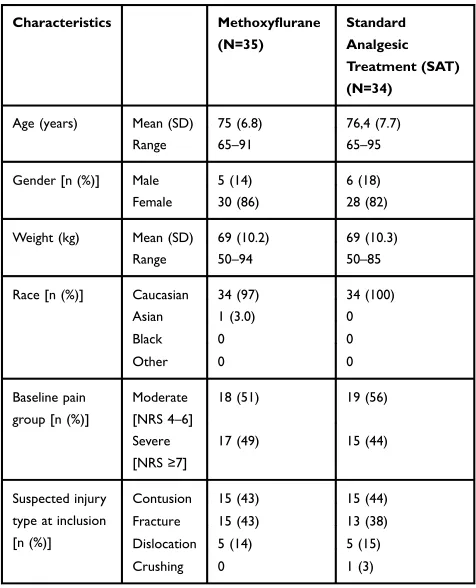
patients subgroup are shown in Table 1; 35 (50.7%,
mean age 75) of those received methoxyflurane and 34
(49.3%, mean age 76.4) received SAT. In both groups, most patients were female and Caucasian, a similar pro-portion of severe and moderate pain level was present. Contusion and fracture were the most common suspected injury types at inclusion. In the control group, all patients with severe pain (15; 44.1%) were treated with IV mor-phine, and patients with moderate pain were treated with IV paracetamol (16; 47.1%) or IV ketoprofen (3; 8.8%). At baseline, mean VAS pain intensity was 73 (±18[SD]) in the overall elderly population, 71 (±20[SD]) in the
meth-oxyflurane group, and 76 (±16[SD]) in the control group.
Ef
fi
cacy Results
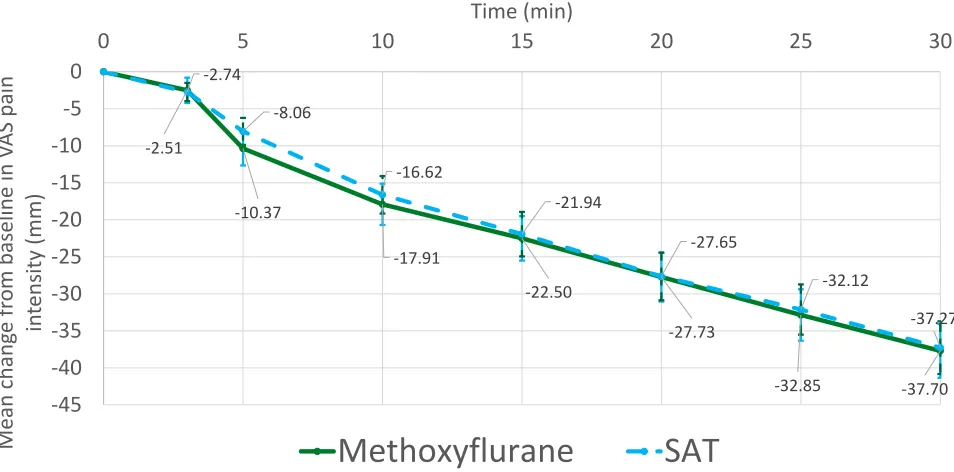
Pain reduction according to VAS over time was very
similar in both study groups (Figure 1). Median time to
onset of pain relief was shorter for methoxyflurane (9 min;
95% CI: 7.8, 10.2 min) than SAT (15 min; 95% CI: 10.2, 19.8 min), with the faster time to pain relief for
methoxy-flurane evident in Kaplan–Meier curves up to ~25 min
(Figure 2). At 10 min about 80% of patients reported
pain relief the methoxyflurane group vs about 40% of
patients in the SAT group. There was no difference between the treatment groups in the proportion of patients
who received rescue analgesic medication (methoxyfl
ur-ane: 2 patients [5.7%]; SAT: 1 patient [2.9%]; p=1.000). In terms of treatment satisfaction, patients rated
treat-ment efficacy as“Excellent”or“Very good”5.7 times more
frequently than SAT (34.3% vs 6%), and healthcare
profes-sionals rated practicality as“Excellent”or“Very good”3.4
times more frequently than SAT (60.0% vs 17.7%). Overall, the distribution of patients’efficacy ratings and physicians’
practicality was significantly different between treatments
(p=0.040 and p=0.003, respectively,Figure 3).
Safety Results
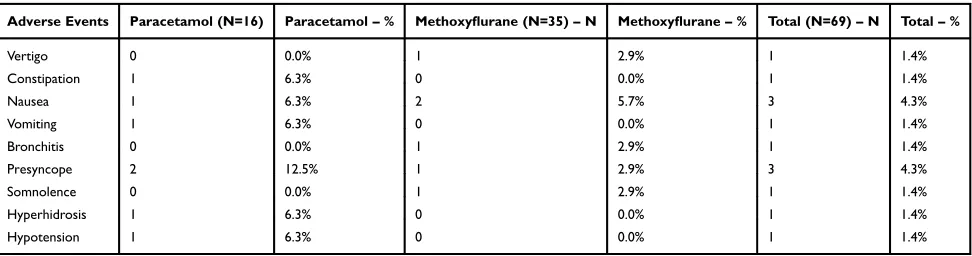
A total of 13 adverse events (methoxyflurane: 6 events;
SAT: 7 events) were recorded during the study (all
non-serious; Table 2). Six events were related or possibly
related to study treatment (methoxyflurane, 4 events: 1
vertigo, 2 nausea, 1 somnolence; paracetamol, 2 events: 1 presyncope, 1 hypotension). Three patients discontinued
methoxyflurane treatment due to AEs.
There were no clinically significant changes in vital signs
parameters (blood pressure, heart rate, respiratory rate) in
both groups, complete data are reported inTables S1–S9.
Table 1Baseline Characteristics
Characteristics Methoxyflurane (N=35)
Standard
Analgesic Treatment (SAT)
(N=34)
Age (years) Mean (SD) 75 (6.8) 76,4 (7.7)
Range 65–91 65–95
Gender [n (%)] Male 5 (14) 6 (18)
Female 30 (86) 28 (82)
Weight (kg) Mean (SD) 69 (10.2) 69 (10.3)
Range 50–94 50–85
Race [n (%)] Caucasian 34 (97) 34 (100)
Asian 1 (3.0) 0
Black 0 0
Other 0 0
Baseline pain group [n (%)]
Moderate [NRS 4–6]
18 (51) 19 (56)
Severe [NRS≥7]
17 (49) 15 (44)
Suspected injury type at inclusion [n (%)]
Contusion 15 (43) 15 (44)
Fracture 15 (43) 13 (38)
Dislocation 5 (14) 5 (15)
Crushing 0 1 (3)
Journal of Pain Research downloaded from https://www.dovepress.com/ by 118.70.13.36 on 27-Aug-2020
-2.51
-10.37
-17.91
-22.50
-27.73
-32.85 -37.70 -2.74
-8.06
-16.62
-21.94
-27.65
-32.12
-37.27
-45
-40
-35
-30
-25
-20
-15
-10
-5
0
0
5
10
15
20
25
30
ni
a
p
S
A
V
ni
e
nil
es
a
b
m
or
f
e
g
n
a
hc
n
a
e
M
)
m
m(
yti
s
n
et
ni
Time (min)
Methoxyflurane
SAT
Figure 1Pain reduction. Mean ± standard error. n=69. SAT: standard analgesic treatment (moderate pain: IV paracetamol or IV ketoprofen; severe pain: IV morphine).
Figure 2Time to pain relief.
Journal of Pain Research downloaded from https://www.dovepress.com/ by 118.70.13.36 on 27-Aug-2020
Discussion
This subgroup analysis of the randomized,
active-controlled trial MEDITA showed similar efficacy and
safety of inhaled methoxyflurane compared to SAT in
terms of pain intensity up to 30 min after randomization.
On the other hand, inhaled methoxyflurane showed two
relevant advantages over SAT: faster onset of analgesia, and higher user satisfaction. To the best of our knowledge,
this is thefirst study which specifically addresses the use
of inhaled methoxyflurane in the elderly population. Our
results support the use of the inhaled methoxyflurane in
the elderly population as a new therapeutic option, able to offer a faster reduction of pain and a better user experi-ence. Given the urgency and complexity of pain manage-ment in the emergency situations, and the peculiarity of the study population, these results are clinically relevant.
As recommended by current SmPC,12 caution should
be paid in elderly patients because of potential effects on blood pressure and heart rate were reported with high dose
methoxyflurane used in anesthesia. As the risk may
poten-tially be increased for older people with hypotension and
bradycardia, caution should be paid in the elderly due to possible reduction in blood pressure. According to the exclusion criteria of the present study, patients had normal signs at inclusion. Overall, a low number of adverse events, all non-serious and transient, occurred in the
study, and vital signs did not change significantly. Since
analgesia is controlled by the patient, it is possible to control and limit the occurrence of adverse events related to drug exposure, modulating drug intake according to subjective need and tolerability. Furthermore, since the overall dose is low (up to 6 mL with 2 consecutive admin-istrations allowed in clinical practice), the risk of overdose is reduced. Any adverse event can be controlled through the temporary or permanent suspension of treatment. Therefore, our results support a safe use of inhaled
meth-oxyflurane in the elderly population. For these patients, an
additional therapeutic option may be useful, since comor-bidities and potential adverse or contraindication may limit the use of other common agents, eg, NSAID, and opioids. In addition, intravenous drugs may be non-administrable due to the low venous patrimony in some patients.
0% 10% 20% 30% 40% 50% 60% 70% 80% 90% 100%
Methox. SAT Methox. SAT
Excellent Very Good Good Fair Poor
HCP
PTS.
Figure 3Overall treatment efficacy evaluated by patients and practicality by HCPs. Cumulative proportions of 5-point Likert qualitative scale (“Poor”,“Fair”,“Good”,“Very Good”, or“Excellent”) at 30 min after randomization. SAT: standard analgesic treatment (moderate pain: IV paracetamol or IV ketoprofen; severe pain: IV morphine). P-value = 0.04 (Mann–WhitneyU-test).
Table 2Adverse Events
Adverse Events Paracetamol (N=16) Paracetamol–% Methoxyflurane (N=35)–N Methoxyflurane–% Total (N=69)–N Total–%
Vertigo 0 0.0% 1 2.9% 1 1.4%
Constipation 1 6.3% 0 0.0% 1 1.4%
Nausea 1 6.3% 2 5.7% 3 4.3%
Vomiting 1 6.3% 0 0.0% 1 1.4%
Bronchitis 0 0.0% 1 2.9% 1 1.4%
Presyncope 2 12.5% 1 2.9% 3 4.3%
Somnolence 0 0.0% 1 2.9% 1 1.4%
Hyperhidrosis 1 6.3% 0 0.0% 1 1.4%
Hypotension 1 6.3% 0 0.0% 1 1.4%
Journal of Pain Research downloaded from https://www.dovepress.com/ by 118.70.13.36 on 27-Aug-2020
The higher user’s satisfaction is a particularly relevant result in this setting. The elderly population often presents complex and fragile conditions and is generally more suspicious of new technologies than young people.
Inhaled methoxyflurane offers less invasive treatment
than IV therapies, and requires active patient participation in controlling analgesia. In an emergency context, both in the hospital and especially in an out-of-hospital setting, a better perception of the therapy may potentially reduce tension/stress and facilitate the treatment process.
Treatment of acute pain is important to stop the stress reaction. The stress reaction triggered by pain causes physio-pathological reactions such as increased arterial pressure, tachycardia, tachypnea, and other endocrine-metabolic
phenomena,13which can precipitate the clinical pictures in
patients with comorbidities and reduced functional reserves such as the elderly. Follow-up studies on long-term post-traumatic pain have shown that pain at the time of trauma is considered the main independent factor of chronic and long-term pain.14In this perspective, it is important to relieve acute trauma pain quickly and effectively.
The limitations of the present study include the explora-tory, post-hoc nature of the analysis, and the absence of
sample size calculation to detect differences of efficacy and
safety between the two groups. For this reason, the results, although encouraging and in line with the previous evidence in the literature, must be interpreted with caution and cannot
be considered definitive. Additional limitations of the study,
as previously discussed,10 include the open-label design
which represents an intrinsic bias, but it was necessary to guarantee the feasibility of the study considering the emer-gency setting. Given these limitations, further adequately designed head-to-head studies are needed to detect treatment
differences in the efficacy of inhaled methoxyflurane vs SAT
in elderly patients with trauma pain.
In conclusion, inhaled methoxyflurane showed similar
pain relief and safety compared to IV standard in elderly patients with moderate to severe trauma pain, providing advantages in terms of onset of effect and user’s satisfaction. Although the study presents a number of limitations due to the post hoc analysis of a randomized open-label study, it provides thefirst specific evidence of the use of inhaled methoxyflurane in the elderly population.
Data Sharing Statement
The datasets generated, analyzed and reported within this manuscript may be requested in accordance with the Data
Sharing Policy of Mundipharma Research Limited
avail-able fromwww.mundipharma-rd.eu.
Ethics Approval and Informed
Consent
The trial was approved by the Italian Medicines Agency (AIFA). The co-ordinating ethics committee, Comitato
Etico Regione Toscana – Area Vasta Centro, Florence,
Italy, approved the trial protocol on 1 December 2017. The trial was approved by local Ethics Committees at each center. Written informed consent was obtained from all patients before enrollment. Registration in public data-bases: EudraCT (2017-001565-25), 02 March 2018; ClinicalTrials.gov (NCT03585374), 13 July 2018.
Acknowledgments
The investigators of the MEDITA Study Group are: Germana Ruggiano, Guido Tota, Michela Zerini, Alessandra Semino, Sara Rasla, Elena Mecatti, Gabriele Panci, Catia Fronduti,
Patrizia Signoroni, Alessandro Corradini, Alessandra
Benucci (Emergency Medicine Department, Santa Maria Annunziata Hospital, Florence, Italy); Isabella Bartoli,
Davide Messina (SUES 118 Catania-Ragusa-Siracusa,
Cannizzaro Hospital, Catania, Italy); Giuseppe Carpinteri, Paola Noto, Chiara Giraffa (Department of Emergency Medicine, Vittorio Emanuele University Hospital, Catania, Italy); Andrea Fabbri (Department of Emergency Medicine,
Morgagni-Pierantoni Hospital, Forlì, Italy); Francesco
Bermano (118 Service, San Martino Hospital, Genova.
Italy); Maurizio Chiesa; Beatrice Sabini (Emergency
Department, S. Antonio Hospital - ULSS 16, Padova, Italy); Mario Oppes, Vincenzo Pretti (Emergency Department,
Sassari University Hospital, Sassari, Italy); Peppino
Masciari, Antonietta Comito, Lucia Orlando (Emergency Department, Pugliese-Ciaccio Hospital, Catanzaro, Italy); Davide Torti, Giorgio Carbone, Gianfrancesco Alberto (Emergency Department, Gradenigo Hospital, Torino, Italy); Vittorio Iorno (Anesthesia, Resuscitation and Emergency Department, Fondazione IRCCS Cà Granda Ospedale Maggiore Policlinico di Milano, Milan, Italy); Antonio Voza, Alessandro Barraco, Fabio Intelligente, Monica Suardi, Claudio Addari (Emergency Department, IRCCS Humanitas Research Teaching Hospital, Rozzano, Milan, Italy); Piero Paolini, Nicola Bertocci (118 Unit, Azienda USL Toscana Centro, Pistoia, Italy); Sossio Serra, Stefano Tranelli, Pasquale Di Conza, Alessandro Valentino, Patrizia Cuppini, Elisabetta Lucchi, Carlo Garaffoni (Emergency Department,
Journal of Pain Research downloaded from https://www.dovepress.com/ by 118.70.13.36 on 27-Aug-2020
Maurizio Bufalini Hospital, Cesena, Italy); Gianfilippo
Gangitano, Giuseppe D’Antuono, Lorena Bertozzi, Giulia
Montanari (Emergency Department, Infermi Hospital,
Rimini, Italy), Raffaella Francesconi (Faenza Hospital, Faenza, Italy).
We thank the Contract Research Organization YGHEA, Division of Ecol Studio SPA, Bologna, for the operational support.
Penthrox® is a registered trade mark of Medical
Developments International (MDI) Limited and used under license.
Author Contributions
All named authors meet the International Committee of Medical Journal Editors (ICMJE) criteria for authorship for this manuscript, take responsibility for the integrity of
the work as a whole, and have givenfinal approval to the
version to be published.
All authors contributed to data analysis, drafting or revising
the article, gavefinal approval of the version to be published,
and agree to be accountable for all aspects of the work.
Funding
The study was sponsored and funded by Mundipharma Pharmaceuticals srl, Milan, Italy. The study sponsor was involved in study design and overview, data interpretation, and report revision. The sponsor had no role in data collection or analysis. The corresponding author had full
access to all the data in the study and hadfinal
responsi-bility for the decision to submit for publication. Editorial costs were funded by Mundipharma Pharmaceuticals srl.
Disclosure
Antonio Voza, Sossio Serra, Germana Ruggiano reports
non-financial support from Mundipharma, Andrea Fabbri, have
nothing to disclose. Elisabetta Bonafede is an employee of the clinical research organization that conducted the study. Antonella Sblendido, Amedeo Soldi and Alberto Farina are employees of Mundipharma Pharmaceuticals srl.
References
1. Kaye AD, Baluch A, Scott JT. Pain management in the elderly population: a review.Ochsner J.2010;10(3):179–187.
2. Boers M, Tangelder MJ, van Ingen H, Fort JG, Goldstein JL. The rate of NSAID-induced endoscopic ulcers increases linearly but not expo-nentially with age: a pooled analysis of 12 randomised trials. Ann Rheum Dis.2007;66(3):417–418. doi:10.1136/ard.2006.055012 3. Raccomandazioni Intersocietarie Italiane (SIAARTI, SIMEU, SIS 118,
AISD, SIARED, SICUT, IRC) sulla gestione del dolore in emergenza. Available from:http://www.aisd.it/e107_files/downloads/raccintersocie tarie_it_complete31052014.pdf. Accessed February 27, 2020. 4. Chau DL, Walker V, Pai L, Cho LM. Opiates and elderly: use and
side effects.Clin Interv Aging.2008;3(2):273–278. doi:10.2147/cia. s1847
5. Hansen MS, Dahl JB. Limited evidence for intranasal fentanyl in the emergency department and the prehospital setting: a systematic review.Dan Med J.2013;60:A4563.
6. Porter KM, Dayan AD, Dickerson S, Middleton PM. The role of inhaled methoxyflurane in acute pain management. Open Access Emerg Med.2018;10:149–164. doi:10.2147/OAEM.S181222 7. Jephcott C, Grummet J, Nguyen N, Spruyt O. A review of the safety
and efficacy of inhaled methoxyflurane as an analgesic for outpatient procedures. Br J Anaesth. 2018;120:1040–1048. doi:10.1016/j. bja.2018.01.011
8. Coffey F, Wright J, Hartshorn S, et al. STOP!: a randomised, double-blind, placebo-controlled study of the efficacy and safety of methoxyflurane for the treatment of acute pain. Emerg Med J. 2014;31:613–618. doi:10.1136/emermed-2013-202909
9. Fabbri A, Carpinteri G, Ruggiano G, et al. Methoxyflurane versus standard of care for acute trauma-related pain in the emergency setting: protocol for a randomised, controlled study in Italy (MEDITA). Adv Ther. 2019;36:244–256. doi:10.1007/s12325-018-0830-x
10. Mercadante S, Voza A, Serra S, et al.; MEDITA Study Group. Analgesic efficacy, practicality and safety of inhaled methoxyflurane versus standard analgesic treatment for acute trauma pain in the emergency setting: a randomised, open-label, active-controlled, mul-ticentre trial in Italy (MEDITA). Adv Ther. 36;2019:3030–3046. doi:10.1007/s12325-019-01055-9
11. Voza A, Ruggiano G, Serra S. Inhaled methoxyflurane versus intra-venous morphine for severe trauma pain in the emergency setting: subgroup analysis of MEDITA, a multicenter, randomized, con-trolled, open-label trial. J Pain Res. 2020;13:1–12. doi:10.2147/ JPR.S240911
12. Penthrox®summary of product characteristics. Available from:https:// www.medicines.org.uk/emc/medicine/31391. Accessed November 27, 2019.
13. Desborough JP. The stress response to trauma and surgery. Br J Anaesth.2000;85(1):109–117. doi:10.1093/bja/85.1.109
14. Castillo RC, MacKenzie EJ, Wegener ST, Bosse MJ; LEAP Study Group. Prevalence of chronic pain seven years following limb threa-tening lower extremity trauma. Pain. 2006;124(3):321–329. doi:10.1016/j.pain.2006.04.020
Journal of Pain Research
Dove
press
Publish your work in this journal
The Journal of Pain Research is an international, peer reviewed, open access, online journal that welcomes laboratory and clinicalfindings in thefields of pain research and the prevention and management of pain. Original research, reviews, symposium reports, hypothesis formation and commentaries are all considered for publication. The manuscript
management system is completely online and includes a very quick and fair peer-review system, which is all easy to use. Visit http:// www.dovepress.com/testimonials.php to read real quotes from pub-lished authors.
Submit your manuscript here:https://www.dovepress.com/journal-of-pain-research-journal
Journal of Pain Research downloaded from https://www.dovepress.com/ by 118.70.13.36 on 27-Aug-2020