STRUCTURE OF WORKING CAPITAL
MANAGEMENT IN PHARMA
COMPANIES – A SELECT STUDY
Dr. D. NARENDER NAIK
Faculty, Department of Commerce & Business Management, University PG College, Subedari, Hanamkonda,
Kakatiya University, Warangal, Telangana.
Abstract
Working Capital is the life blood of every business firm. Idle working capital indeed is very much needed for the firm to undertake its day to day activities. Inadequate working capital means shortage of inputs, whereas excess of it leads to extra cost. So, the quantum of working capital in every business firm should be neither more nor less than what is actually required. In modern times efficient management of working capital has come to be recognized as one of the basic functions of finance for successful conduct of business operations. It not only influences the profit-earning capacity of business undertakings but also determines largely, their scope and content of operation. The management of working capital is concerned with the management of the firm’s current accounts, which include currents assets and current liabilities. It is one of the most important facets of the firm’s overall financial management. Working capital sphere throws open a welcome challenge and an opportunity for the finance manager to play a key role for effective planning, controlling, directing and utilizing the working funds in an enterprise.
Current assets are those which are used in the conduct of business operations of an enterprise and are held for short periods of time. In other words, they are defined as ‘those that are expected to be converted into cash within one year’. As stated there are basically five major items or
current assets which are briefly explained as a prefix to the analysis of working capital structure in sample units.
Keywords: Working Capital, Life Blood, Current assets
I. INTRODUCTION
Working capital is also known as circulating capital or current capital. The use of the term circulating capital instead of working capital indicates that its flow is circular in nature. A better perceptivity of the working capital situation in the sample pharma companies would be possible through the analysis of their structure of working capital comprising of current assets and current liabilities. The former includes current investment, inventories, trade receivables, cash and bank balances, short term loans and advances and other current assets, whilst the latter consists of short term borrowings, trade payables, short term provisions, and other current liabilities.
Review of Literature
Bhunia and Khan (2011) examined liquidity management effectiveness of selected Indian steel companies based on secondary data with 230 companies for 9 years period between 2002 and 2010 using statistical techniques. They established a diminutive relationship between the liquidity indicators of liquidity and profitability.
for cement companies in India. Some results of the study are in complete departure from previous results. He founded that there exists on relationship between days sales outstanding and cash conversion cycle and profitability of a firm in cement industry in India.
Sharma A K and Kumar Satish (2011) in their study on, Effect of Working Capital Management on Firm Profitability, on a sample of 263 non-financial BSE 500 firms listed at the Bombay Stock (BSE) from 2000 to 2008; reveal that working capital management and profitability is positively correlated in Indian companies. The study further reveals that inventory of number of days and numbers of day‟s accounts payable are negatively correlated with a firm‟s profitability, whereas number of days accounts receivables and cash conversion period show a positive relationship with profitability.
Statement of the problem
From the analysis on review of literature, it is clearly observed that no comprehensive study is made specifically focusing on the pharmaceutical companies. Pharmaceutical companies have long been the envy of other industries, given their strong balance sheets, high operating margins, and access to cash.
As a result of these competitive advantages, members of the industry have historically paid little attention to releasing structure of Working Capital Management. The industry faces significant challenges in different areas related to patent expirations, pricing and regulatory pressures, shifting demographics, and efficacy issues.
Faced with these challenges, companies in industry are now seeking to preserve the value they have created while at the same time executing new transformational strategies to create value. The present study differs to the previous studies in the
sense, the study focuses on five pharmaceutical companies operating in the state of Telangana and further, the dimensions including structure of Working Capital management of five pharmaceutical companies helps to analyze the practices of pharmaceutical companies.
As such these companies have to struggle the stiff competition from other nations, they have to adopt the better working capital management practices to be victorious especially units operating in the state of Telangana. Thus, to bring the focus on Telangana pharmaceuticals companies, the study has been carried out in the form of “Inventory Management in Pharma Companies – A Select Study”.
II. OBJECTIVES
The study is aimed at achieving the following objectives.
1. To examine the Structure of Working Capital Management of the select units of pharmaceutical Industry.
2. To study the conclusions on the basis of analysis.
Hypothesis
1. There is no significant difference in Mean among the select units as far as the “Indices of Current Assets” is concerned.
2. There is no significant difference in Mean among the select units as far as the “Indices of Current liabilities” is concerned.
3. There is no significant difference in Mean among the select units as far as the “Indices of Net Working Capital” is concerned.
III. SCOPE
analyzing the Structure of Working Capital management in the five companies.
Methodology of the Study
The detailed methodology to be adopted for the research study is presented below.
Sources of Data
The study is based on the secondary data sources. It includes:
Annual reports of five select pharmaceutical Industries.
Published and Unpublished reports of various seminars and conferences held
on Pharma Industry.
Journals and magazines in the field of pharma Industry and on finance.
Reports of the Stock Exchanges of India. Sample of the Study
There are about 278 pharma companies are operating with manufacturing life science and medicine products in the then united Andhra Pradesh. Of these five top pharma companies in Telangana were selected. Thus, the study is based on the critical examination of five select pharmaceutical companies selected on the basis of convenience sampling. These include
Dr. Reddy‟s laboratories limited Divi‟s laboratories limited Aurobindo pharma limited Granuels India limited Suven Life Sciences Limited Period of the Study
In order to maintain uniformity on statistical analysis on various statements of the select pharmaceutical companies, the study period is taken from 2006-07 to 2015-16, i.e., ten years for the present study.
Tools and Techniques of Analysis
The following tools and techniques of financial analysis are used as measures of judging the structure of Working Capital management of select pharmaceutical companies.
The Ratio Technique and Statistical Methods
Financial ratio analysis refers to the mathematical expression of the relationship between two accounting figures drawn either from balance sheet or from profit and loss account or both. To appraise, interpret and review the effectiveness of the working capital management and also statistical methods such as Percentages, Averages, were worked out in appropriate contexts. Analysis of Structure of Working Capital in
Select Units
Table – 1.1 Structure of Working Capital in Dr. Reddy’s Laboratories limited
(Rupees in Lakhs)
Particulars 2006-07 2007-08 2008-09 2009-10 2010-11 2011-12 2012-13 2013-14 2014-15 2015-16
Short term Investments ---- ---- ---- ---- ---- 20,700
(1.83) 19,660 (1.57) 1,06,640 (6.65) 2,10,220 (11.30) 2,11,220 (10.66)
Inventories 48,758
(10.08) 64,090 (11.95) 73,510 (12.27) 1,33,940 (25.10) 1,59,920 (17.84) 1,94,330 (17.16) 2,17,070 (16.10) 2,41,880 (15.18) 2,56,990 (13.87) 2,57,990 (12.89) Trade Receivables 105,570
(22.05) 89,770 (16.74) 1,41,970 (23.70) 1,15,990 (21.73) 1,76,110 (19.64) 2,53,680 (22.40) 3,18,040 (23.58) 3,32,530 (20.74) 4,10,120 (22.05) 4,16,670 (20.82) Cash and Bank Balances 1,45,671
(30.46) 53,670 (10.01) 38,440 (6.41) 66,000 (12.36) 57,510 (6.41) 1,60,610 (14.18) 2,01,710 (14.96) 2,30,060 (14.44) 1,87,240 (10.16) 1,83,580 (9.17) Short term Loans and
Advances 70,442 (14.70) 89,220 (16.64) 1,30,850 (21.84) 66,090 (12.38) 82,840 (9.24) 66,290 (5.85) 86,130 (6.77) 1,09,890 (6.86) 1,07,470 (5.77) 1,00,580 (5.03)
Other Current Assets --- --- ---- ---- 5,120
(0.57) 4,290 (0.67) 10,060 (0.75) 11,570 (0.72) 15,630 (0.84) 11,970 (0.59) Total Current Assets (A) 370,441
(77.31) 296,750 (55.35) 3,84,770 (64.23) 3,82,020 (71.59) 4,81,500 (53.72) 6,99,900 (61.81) 8,52,670 (63.22) 10,32,570 (64.42) 11,87,670 (63.86) 11,82,010 (59.07) Net Fixed Assets (B) 1,05,658
(22.68) 2,39,350 (44.64) 2,14,210 (35.76) 1,51,560 (28.40) 4,14,810 (46.27) 4.32,520 (38.18) 4.96.050 (36.77) 5,70,390 (35.57) 6,72,110 (36.13) 8,19,030 (40.92) Total Assets (A+B) 4,76,099
(100.00) 5,36,100 (100.00) 5,98,980 (100.00) 5,33,580 (100.00) 8,96,310 (100.0) 11,32,420 (100.00) 13,48,720 (100.00) 16,02,960 (100.00) 18,59,780 (100.00) 20,01,040 (100.00)
Short term Borrowings ---- ---- ---- ---- 1,83,190
(20.43) 1,58,880 (14.03) 1,89,860 (14.07) 2,06,070 (12.85) 2,18,570 (11.75) 2,27,180 (11.35)
Trade Payables ---- ---- ---- ---- 63,450
(7.07) 75,660 (6.68) 96,570 (7.16) 89,320 (5.57) 86,730 (4.66) 92,890 (4.64) Short term Provisions 63,343
(13.30) 9,010 (1.68) 1,05,020 (17.53) 1,67,460 (31.38) 41,320 (4.61) 49,680 (4.38) 67,410 (4.99) 81,570 (5.08) 1,14,390 (6.15) 1,19,460 (5.96) Other current Liabilities 10,285
(2.16) 68,090 (12.70) 13,350 (2.22) 35,020 (6.56) 1,32,890 (14.82) 75,660 (15.44) 2,12,040 (15.72) 2,02,080 (12.60) 2,62,440 (14.11) 2,43,950 (12.19) Total Current Liabilities (C) 73,627
(15.46) 77,100 (14.38) 118,370 (19.76) 202,480 (37.94) 420,850 (46.95) 4,59,140 (40.54) 5,65,880 (41.95) 5,79,040 (36.12) 6,82,130 (36.67) 6,83,480 (34.15) Long Term Funds (D) 4,02,472
(84.53) 4,59,000 (85.61) 4,80,610 (80.23) 3,31,100 (62.05) 4,75,460 (53.04) 6,73,280 (59.45) 7,82,840 (58.04) 10,23,920 (63.87) 11,77,650 (63.32) 13,17,560 (65.84) Total Liabilities (C+D) 4,76,099
Particulars 2006-07 2007-08 2008-09 2009-10 2010-11 2011-12 2012-13 2013-14 2014-15 2015-16
Net Working Capital (A-C) 296,814 219,650 266,400 179,540 60,650 240760 286790 453530 5,05,540 4,98,530 I. Indices of Current Assets
(2007=100) 100.00 80.10 103.86 103.12 129.98 188.93 230.17 278.74 320.60 319.08
II. Indices of Current
Liabilities (2007=100) 100.00 104.71 160.76 275.00 571.59 623.60 768.57 786.45 926.46 928.30
III. Indices of Net Working
Capital (2007=100) 100.00 74.00 89.75 60.48 20.43 81.11 96.62 152.79 170.32 167.96
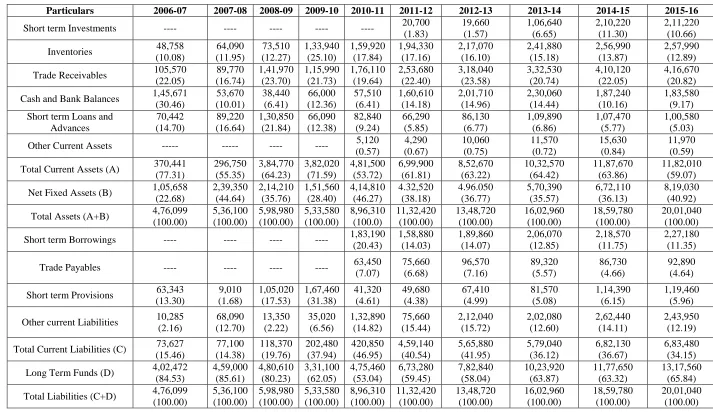
The data relating to the structure of working capital of Dr. Reddy‟s laboratories limited is presented in table 1.1. It is evident from the data analyses that the short term investment in current assets had increased from Rs. 20,700 lakhs in 2011-12 to Rs. 2,11,220 lakhs in 2015-16, whereas the net fixed assets increased from Rs 105,658 lakhs in 2006-07 to Rs 819,030 lakhs by the end of the study period. In the initial years of the study, the investment in net fixed assets was less than in the current assets but afterwards it has gone up. It is also evident from the fact that the size of the current assets had declined from 77.31 per cent in 2011-12 to 59.07 per cent of total current assets in 2015-16. Of the various current assets, short term investment formed 1.83 per cent of total assets in 2011-12 which thereafter had slided up to 10.66 per cent in 2015-16. However, current investment in absolute figures and improved sharply from Rs. 20,700 lakhs to Rs. 2,11,220 lakhs.
The inventory alone formed 10.08 per cent of total assets in 2011-12 whereas it has gone down to 12.89 per cent in 2015-16. The inventories moved from Rs 48,758 lakhs in 2006-07 and Rs 2,57,990 lakhs in 2015-16. The size of „other current assets‟ had altered slightly which is found to be next major item of inventory.
Trade debtors/receivables moved up from modest amount Rs. 105,570 lakhs in 2006-07 and to the highest level of Rs 4,16,670 lakhs in 2015-16. The size of cash and bank balances had fluctuated marginally from Rs 1,45,671 lakhs in 2006-07 and Rs 1,83,580 lakhs in 2015-16. Current liabilities were less than the long term funds during the ten years period of study. It can observe from absolute figures, as well as in terms of percentage. They ranged in between Rs 73,627 lakhs (15.46 per cent) in 2006-07 and Rs 6,83,480 lakhs (34.15 per cent in 2015-16. Short term borrowings are the prime item of current liabilities which varies 11.35
per cent of total current liabilities in 2015-16 to 14.07 per cent in 2010-11.
Table - 1.2 Structure of Working Capital in Divi’s Laboratories limited
(Rupees in Lakhs)
Particulars 2006-07 2007-08 2008-09 2009-10 2010-11 2011-12 2012-13 2013-14 2014-15 2015-16
Short term Investment ---- ---- ---- ---- 52,563.82
(23.10) 47,703.9 (17.30) 40,781.36 (12.99) 50,187.62 (13.53) 73,300.36 (16.62) 80,252.45 (16.15)
Inventories 21,350.89
(29.77) 28,141.48 (28.54) 42,128.15 (31.50) 49,850.44 (31.19) 57,170.55 (25.13) 67,896.26 (24.62) 83,569.42 (26.62) 93,241.76 (25.13) 1,16,264.02 (26.36) 1,20,782.77 (24.31) Trade Receivables 16,166 (22.54) 20,945 (21.24) 26,600.68 (19.89) 22,320.46 (13.96) 36,523.26 (16.05) 49,558.48 (17.97) 51,199.93 (16.31) 72,370.2 (19.50) 74,164.26 (16.81) 88,092.31 (17.73) Cash and Bank Balances 1,834
(2.55) 1,421 (1.44) 1,478.5 (1.10) 1,646.16 (1.03) 1,767.28 (0.77) 3,093.55 (1.12) 4,089.24 (1.30) 4,050.57 (1.09) 6,521.98 (1.48) 7,172.39 (1.44) Short term Loans and Advances 3,021
(4.21) 5,742 (5.82) 6,466.3 (4.83) 6,554.93 (4.10) 5,902.31 (2.59) 6,550.73 (2.37) 6,103.53 (1.94) 6,837.16 (1.84) 6,066.44 (1.38) 12,624.92 (2.54) Other Current Assets 21 (0.02) 52 (0.05) 34.37 (0.02) 27.08 (0.01) 143.81 (0.06) 291.91 (0.10) 667.67 (0.21) 611.19 (0.16) 922.73 (0.20) 540.11 (0.10) Total Current Assets (A) 42,392.73
(59.11) 56,301.25 (57.11) 76,708 (57.36) 80,399.07 (50.31) 1,54,071 (67.73) 1,75,094.83 (63.51) 1,86,411.15 (59.38) 2,27,298.5 (61.25) 2,77,240 (62.84) 3,09,465 (62.28) Net Fixed Assets (B) 29,315.27
(40.88) 42,271.75 (42.88) 57,016 (42.63) 79,406.93 (49.68) 73,406.57 (32.26) 27,489,979.17 (36.48) 1,27,465.31 (40.61) 1,43,750.67 (38.74) 1,63,898.07 (37.15) 1,87,378.62 (37.71)
Total Assets (A+B) 71,708
(100.00) 98,573 (100.00) 1,33,724 (100.00) 1,59,806 (100.00) 2,27,478 (100.00) 2,76,65,074 (100.00) 3,13,876 (100.00) 3,71,049.17 (100.00) 4,41,138 (100.00) 4,96,843.57 (100.00)
Short term Borrowings ---- ---- ---- ---- 1,36,243
(59.89) 5,020.37 (1.82) 3,051.45 (0.97) 1,632.37 (0.43) 2,507.12 (0.56) 4,142.09 (0.83) Trade
Payables ---- ---- ---- ----
12,300.41 (5.40) 15,953.97 (5.78) 16,044.4 (5.11) 15,170.48 (4.08) 22,686.57 (5.14) 23,269.05 (4.68)
Short term Provisions 201
(0.28) 3,656 (3.70) 4,894.39 (3.66) 9,644.5 (6.03) 16,792.49 (7.38) 13,582.61 (4.92) 13,007.89 (4.14) 14,779.98 (3.98) 20,344.94 (4.61) 24,057.88 (4.84) Other Current Liabilities 12,446
(17.35) 15,643 (15.86) 16,206.46 (12.11) 16,434.51 (10.28) 10,535.11 (4.63) 20,821.4 (7.55) 23341.64 (7.43) 31,157.76 (8.39) 3,2013.96 (7.25) 481.32 (0.09) Total Current Liabilities (C) 12,647
(17.63) 19,299 (19.57) 21,101 (15.77) 26,079 (16.31) 1,75,871 (77.31) 55,378.35 (20.08) 55,445.38 (17.66) 62,740.59 (16.90) 77,553 (17.58) 51,950 (10.45)
Long Term Funds (D) 59,061
(82.36) 79,274 (80.42) 112,623 (84.22) 133,727 (83.68) 51,607 (22.68) 2,76,09,695.65 (79.91) 2,58,431.08 (82.33) 3,08,308.58 (83.09) 3,63,585.27 (82.41) 4,44,893.23 (89.54) Total Liabilities (C+D) 71,708
Particulars 2006-07 2007-08 2008-09 2009-10 2010-11 2011-12 2012-13 2013-14 2014-15 2015-16
I. Indices of Current Assets
(2007=100) 100.00 132.80 180.94 189.65 363.43 413.03 439.72 536.17 653.98 729.99
II. Indices of Current Liabilities
(2007=100) 100.00 152.59 166.84 206.20 1390.61 437.87 438.40 496.09 613.21 410.76
III. Indices of Net Working
Capital (2007=100) 100.00 124.39 186.93 182.61 -73.28 402.46 440.28 553.21 671.30 865.71
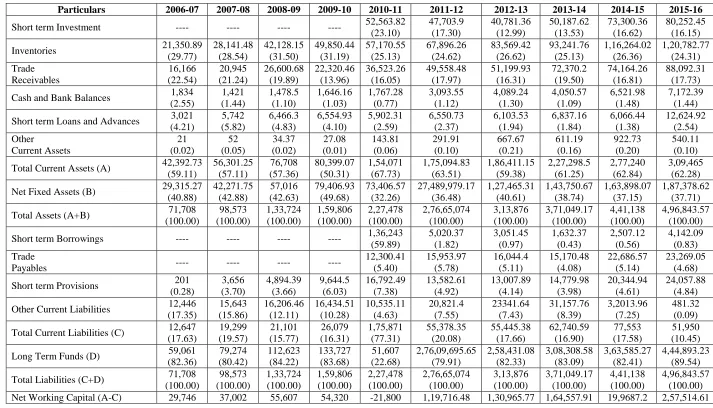
Table 1.2 portrays the structure of working capital of Divi‟s laboratories limited. The short term investments are Rs. 52,563.82 lakhs in 2010-11 to Rs. 80,252.45 lakhs in 2015-16, and it was ignored first four years from 2006-07 to 2009-10. The current assets as a percentage of total assets fluctuated from year to year up to 2015-16 but there after started to rise and reached the maximum of Rs. 3,09,465 lakhs in 2015-16. The investment in fixed assets, therefore, is less than the current assets from 2007 to 2016.
Among the current assets the inventories constituted a major portion varying from 29.77 per cent of total assets in 2006-07 to 24.31 per cent in 2015-16. Inventory of raw materials influences largely the size of inventory in the concern. The trade debtors varied from 17.73 per cent of total assets in 2015-16 to 22.54 per cent in 2006-07 and cash and bank balances 1.44 per cent in 2015-16 and 2.55 per cent in 2006-07. Short term loans and advances is 1.38 per cent in 2014-15 and 5.82 per cent in 2007-08.
The „other current assets‟ registered an upswing except in 2006-07, 2008-09 and 2009-10 during which years they contracted as compared to those of the respective preceding years. A current liability were represented by less than 50 per cent of total liabilities but was 77.31 per cent in 2010-11. Short borrowings were 59.89 per cent which is increased in 2010-11 and decreased by 0.83 per cent in 2015-16; it was surprising to note that short term borrowings are not found from 2006-07 to 2009-10 as all the dues were already repaid it. Trade payable is the leading item of current liabilities in the concern which sharply increased from Rs. 12,300.41 lakhs in 2010-11 to Rs. 23,269.05 lakhs in 2015-16 indicating liberal credit facility availed from the suppliers. Provisions and „other current liabilities‟ mildly altered from year to year during the period of the study.
Table - 1.3 Structure of Working Capital in Aurobindo Pharma limited
(Rupees in Lakhs)
Particulars 2006-07 2007-08 2008-09 2009-10 2010-11 2011-12 2012-13 2013-14 2014-15 2015-16
Short Term Investments 5
(0.00)
6
(0.00) --- ----
4 (0.00) 1,868 (0.29) 4 (0.00) 3 (0.00) 1,965 (0.15) 2 (0.00)
Inventories 65,440
(21.55) 79,503 (2.60) 87,763 (24.00) 1,10,245 (26.99) 1,45,527 (24.78) 1,54,556 (24.77) 1,92,359 (26.44) 2,36,754 (24.94) 3,61,130 (27.96) 4,08,810 (26.03)
Trade Receivables 62,611
(20.62) 66,501 (2.18) 88,976 (24.33) 95,601 (23.41) 1,23,098 (20.96) 1,23,996 (19.87) 1,59,698 (21.95) 2,63,657 (27.78) 3,53,917 (27.40) 4,17,192 (26.57) Cash and Bank balances 58,246
(19.18) 28,257 (0.92) 12,765 (3.49) 7,283 (1.78) 18,672 (3.17) 7,086 (1.13) 20,845 (2.86) 1,785 (0.18) 46,911 (3.63) 83,439 (5.31) Short term Loans and Advances 27,189
(8.95) 31,641 (1.03) 38,692 (10.58) 37,130 (9.09) 42,304 (7.20) 31,485 (5.04) 33,208 (4.56) 37,719 (3.97) 56,842 (4.40) 64,538 (4.10)
Other Current Assets ---- ---- 701
(0.19) 334 (0.08) 2,513 (0.42) 7,413 (1.18) 7,561 (1.03) 7,127 (0.75) 9,115 (0.70) 26,166 (1.66) Total Current Assets (A) 2,13,491
(70.32) 2,05,908 (6.75) 2,28,897 (62.60) 2,50,593 (61.36) 3,32,118 (56.55) 3,26,404 (52.32) 4,13,675 (56.87) 5,47,045 (57.64) 8,29,880 (64.25) 10,00,147 (63.70)
Net Fixed Assets (B) 90,097
(29.67) 28,41,850 (93.24) 1,36,745 (37.39) 1,57,739 (38.63) 2,55,110 (43.44) 2,97,359 (47.67) 3,13,610 (43.12) 4,01,937 (42.35) 4,61,568 (35.74) 5,69,788 (36.29)
Total Assets (A+B) 3,03,588
(100.00) 30,47,758 (100.00) 3,65,642 (100.00) 4,08,332 (100.00) 5,87,228 (100.00) 6,23,763 (100.00) 7,27,285 (100.00) 9,48,982 (100.00) 12,91,448 (100.00) 15,69,935 (100.00)
Short term Borrowings - - - - 1,23,473
(21.02) 1,60,821 (25.78) 2,23,612 (30.74) 2,35,456 (24.81) 2,50,208 (19.37) 3,22,902 (20.56)
Trade Payables - - - - 77,635
(13.22) 66,014 (10.58) 96,375 (13.25) 1,35,120 (14.23) 2,05,113 (15.88) 2,52,677 (16.09) Other Current Liabilities 44,424
(14.63) 55,460 (1.81) 54,346 (14.86) 67,280 (16.47) 69,909 (11.90) 58,034 (9.30) 15,087 (2.07) 38,768 (4.08) 1,36,495 (10.56) 1,53,737 (9.79)
Short term Provisions 2,638
(0.86) 3,230 (0.10) 2,659 (0.72) 3,519 (0.86) 5,832 (0.99) 6,636 (1.06) 8,009 (1.10) 12,660 (1.33) 21,824 (1.68) 18,272 (1.16) Total Current liabilities (C) 47,062
(15.50) 58,690 (1.92) 57,005 (15.59) 70,799 (17.33) 2,76,849 (47.14) 64,670 (46.73) 3,43,083 (47.17) 4,22,004 (44.46) 6,13,640 (47.51) 7,47,588 (47.61)
Long Term Funds (D) 2,56,526
(84.49) 29,89,068 (98.07) 3,08,637 (84.40) 3,37,533 (82.66) 3,10,379 (52.85) 3,32,258 (53.26) 3,84,202 (52.82) 5,26,978 (55.53) 6,77,808 (52.48) 8,22,347 (52.38) Total Liabilities (C+D) 3,03,588
Particulars 2006-07 2007-08 2008-09 2009-10 2010-11 2011-12 2012-13 2013-14 2014-15 2015-16
I. Indices of Current Assets
(2007=100) 100.00 96.44 107.21 117.37 155.56 152.88 193.76 256.23 388.71 468.47
II. Indices of Current Liabilities (2007=100) 100.00 124.70 121.12 150.43 588.26 137.41 729.00 896.69 1303.89 1588.51 III. Indices of Net Working Capital (2007=100) 100.00 88.45 103.28 108.03 33.20 157.26 42.41 75.13 129.92 151.75
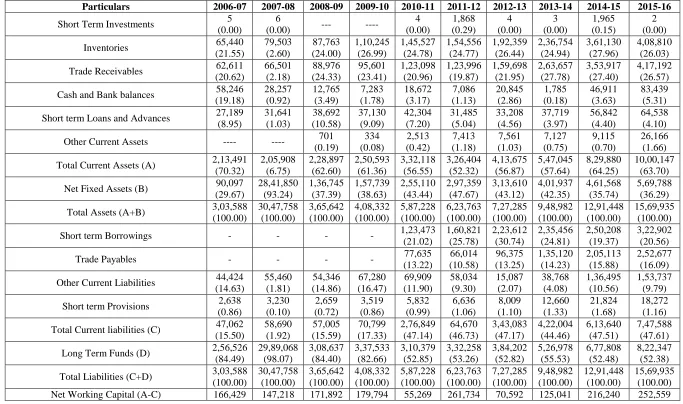
The data pertaining to the structure of working capital to Aurobindo Pharma Limited are furnished in the table 1.3 for the period of the study. Current assets shared major proportion with the range of variations in current assets shared major proportion of total assets in the Aurobindo Pharma limited as compared to all other select units under study. The range of variations in current assets and net fixed assets was from the lowest of 6.75 per cent and of total assets 29.67 per cent and the highest of 70.32 per cent and 93.24 per cent respectively for the period study. In spite of the current assets investment being higher than that of the fixed assets in all the years the former, however, has shown a downward trend, though not in terms of absolute figures but in percentage.
Inventory apportioned a lion‟s share of current assets as in the other sample units. It registered a rising trend except in 2006-07, 2007-08 and 202007-08-09 which moved up from Rs 1,10,245 lakhs in 2009-10 and Rs 4,08,810 lakhs in 2015-16. The short term investment is high in 2014-15 from 1,965 lakhs and it was low in 2015-16 with Rs. 2 lakhs. Trade receivables is the second leading item of current assets which had declined in terms in terms of percentage to total assets but significantly increased in absolute figures. Cash and bank balances were less with Rs.1,785 lakhs in 2014 and 83,439 lakhs in 2015-16 which plays a pivotal role in the management of cash and maintenance of bank balances. The short term loans and advances were Rs 27,189 lakhs in 2006-07 and 64,538 lakhs in the year 2015-16. Finally, the other current assets had altered moderately from year to year over the period of study.
Current liabilities and long term funds shared approximately 50 per cent of total current liabilities where the current liabilities Rs 47,062 in the year 2006-07 and Rs 7,47,588 lakhs in the year 2015-16. The short term borrowings were
Table - 1.4 Structure of Working Capital in Granules India limited
(Rupees in Lakhs)
Particulars 2006-07 2007-08 2008-09 2009-10 2010-11 2011-12 2012-13 2013-14 2014-15 2015-16
Short term Investments --- --- --- --- --- --- 945.92
(0.00) --- --- ----
Inventories 2,95,998.22
(9.56) 5,28,634.12 (16.07) 5,95,105.72 (16.05) 6,86,334.09 (18.91) 7,512.78 (17.24) 10,991.05 (19.23) 13,648.2 (20.00) 17,416.34 (17.55) 22,451.66 (18.66) 30,705.28 (21.13)
Trade Receivables 371,292
(11.99) 375,050 (11.40) 6,31,247.79 (17.03) 6,58,535.139 (18.15) 7,161.3 (16.43) 9,500.93 (16.62) 7,102.11 (10.40) 11,090.83 (11.18) 13,690.75 (11.38) 15,255.72 (10.50)
Cash and Bank balances 364,201
(11.76) 108,503 (3.29) 1,28,385.79 (3.46) 1,34,743.292 (3.71) 1,198.79 (2.75) 3,198.19 (5.59) 4,170.55 (6.11) 4,174.71 (4.20) 6,530.66 (5.42) 14,188.36 (9.76) Short term Loans and Advances 1,63,140
(5.27) 1,91,225 (5.81) 2,08,078.072 (5.61) 2,10,555.286 (5.80) 203.39 (0.46) 263.94 (0.46) 389.77 (0.57) 1,190.49 (1.20) 4,543.54 (3.77) 7,983.49 (5.49)
Other Current Assets 4,690
(0.15) 1,994 (0.06) 11,203.372 (0.30) 18,558.197 (0.51) 1,825.45 (4.18) 2,100.43 (3.67) 2,630.93 (3.85) 3,819.78 (3.85) 2,819.26 (2.34) 1,025.01 (0.70) Total Current Assets (A) 1,199,321
(38.74) 1,205,407 (36.65) 1,574,021 (42.47) 17,08,726.01 (47.10) 17,901.71 (41.08) 26,054.54 (45.60) 28,887.5 (42.33) 37,692.15 (37.99) 50,035.87 (41.60) 69,157.86 (47.60)
Net Fixed Assets (B) 18,95,742
(61.25) 20,82,719.63 (63.34) 21,31,692.14 (57.52) 19,18,940 (52.89) 25,674.82 (58.91) 31,076.96 (54.39) 39,344.8 (57.66) 61,509.19 (62.00) 70,235.13 (58.39) 76,129.14 (52.39)
Total Assets (A+B) 30,95,062
(100.00) 32,88,126.46 (100.00) 37,05,712.9 (100.00) 36,27,666 (100.00) 43,576.53 (100.00) 57,131.5 (100.00) 68,232.3 (100.00) 99,201.34 (100.00) 1,20,271 (100.00) 1,45,287 (100.00)
Short term Borrowings --- --- --- --- 8,315.27
(19.08) 11,360.22 (19.88) 8,545.98 (12.52) 10,090.9 (10.17) 12,496.99 (10.39) 15,769.05 (10.85)
Trade Payables --- --- --- --- 5,180.53
(11.88) 7,551.94 (13.21) 9,184.13 (13.46) 13,554.45 (13.66) 18,762.53 (15.60) 17,914.24 (12.33) Other Current Liabilities 1,75,462
(5.66) 3,94,159 (11.98) 3,08,462 (8.32) 4,62,681 (12.75) 1,865.21 (4.28) 1,984.18 (3.47) 2,377.26 (3.48) 4,777.99 (4.81) 8,898.35 (7.39) 13,338.03 (9.18)
Short term Provisions 31,653
(1.02) 37,910 (1.15) 33,508 (0.90) 29,335 (0.80) 349.66 (0.80) 466.32 (0.81) 470.93 (0.69) 830.48 (0.83) 1,344.93 (1.11) 686.67 (0.47) Total Current liabilities (C) 2,07,115
(6.69) 4,32,069 (13.14) 3,41,970 (9.22) 4,92,015 (13.56) 15,710.67 (36.05) 21,362.66 (37.39) 20,578.3 (30.15) 29,253.82 (29.48) 41,502.8 (34.50) 47,707.99 (32.83)
Long Term Funds (D) 28,87,947.7
(93.30) 28,56,057.18 (86.85) 33,63,742.82 (90.77) 31,35,650.77 (86.43) 27,865.86 (63.94) 35,768.84 (62.60) 4,7654 (69.84) 69,947.52 (70.51) 78,768.2 (65.49) 97,579.01 (67.16) Total Liabilities (C+D) 30,95,062
(100.00) 32,88,126.46 (100.00) 37,05,712.9 (100.00) 36,27,666 (100.00) 43,576.53 (100.00) 57,131.5 (100.00) 68,232.3 (100.00) 9,9201.34 (100.00) 1,20,271 (100.00) 1,45,287 (100.00)
Particulars 2006-07 2007-08 2008-09 2009-10 2010-11 2011-12 2012-13 2013-14 2014-15 2015-16
I. Indices of Current Assets
(2007=100) 100.00 100.50 131.24 142.47 1.49 2.17 2.40 3.14 4.17 5.76
II. Indices of Current Liabilities
(2007=100) 100.00 208.61 165.11 237.53 7.58 10.31 9.93 14.12 20.03 23.03
III. Indices of Net Working Capital
(2007=100) 100.00 77.94 124.17 122.62 0.22 0.47 0.83 0.85 0.86 2.16
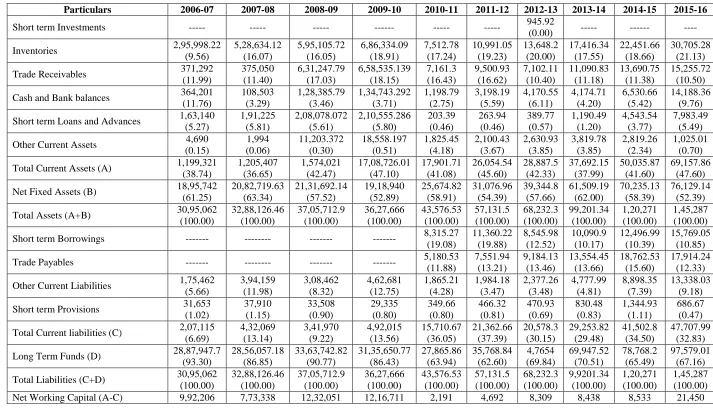
Table 1.4 manifests the details with regard to the structure of working capital in Granules India limited. Only in the year 2012-13 there is short term investment of Rs 945.92 lakhs and the current assets were increased from Rs 11,99,321 lakhs in 2006-07 and Rs. 69,157.86 lakhs during the study period 2015-16. The inventories constituted a major portion varying from 9.56 per cent in 2006-07 to 21.13 per cent in 2015-16.
The size of trade receivables had came down to 10.50 per cent in 2015-16 from 11.99 per cent in 2006-07 and cash and bank balances also come down to 9.76 per cent in 2015-16 from 11.76 per cent never remained constant. The short term loan and advances increases the companies‟ confidence level by providing loans and advances from 5.27 per cent in 2006-07 to 5.49 per cent in 2015-16. The „other current assets‟ ranged from Rs 0.15 per cent in 2006-07 to 0.70 per cent in 2015-16.
Current liabilities as a percentage of total liabilities represented the lowest proportion to all the units under the study which ranged from 6.69 per cent in 2010-11 to 32.83 per cent in 2015-16. The short term borrowings were Rs. 8,315.27 lakhs in 2006-07 and Rs. 15,569.05 lakhs in the year 2015-16.
Trade payable is the major item in this concern which was found varying from 5,180.53 lakhs in 2010-11 and Rs. 17,914.24 lakhs in 2015-16. The other current liabilities and short term provisions ranges from Rs. 175,462 lakhs and Rs 31,653 lakhs in 2006-07 and Rs 13,338.03 lakhs and Rs. 686.67 lakhs in 2015-16.
Net working capital had decreased from Rs 9,92,206 lakhs in 2006-07 to Rs 21450 lakhs in 2015-16. Similar trend can be observed from the indices of net working capital. It had positive working capital position during the decade from 2006-07 to 2015-16.
Table 1.5 Structure of Working capital in Suven Life Sciences Limited
(Rupees in Lakhs)
Particulars 2006-07 2007-08 2008-09 2009-10 2010-11 2011-12 2012-13 2013-14 2014-15 2015-16
Short term Investments --- --- --- --- 965
(4.31) 447.33 (1.56) 7.12 (0.02) 3.64 (0.00) 3.64 (0.00) 3.64 (0.00)
Inventories 2,28,998.35
(15.44) 2,44,010.95 (14.92) 2,720.43 (17.26) 3,049 (18.13) 3,336.56 (14.91) 4,650.17 (16.31) 5,381.43 (16.42) 7,862.87 (16.15) 8,180.55 (10.58) 8,346.44 (10.33)
Trade Receivables 1,61,421
(10.88) 3,55,859 (21.77) 21,39.75 (13.58) 3,260.99 (19.39) 3,137.38 (14.02) 2,523.93 (8.85) 2,377.76 (7.25) 6,547.03 (13.45) 4,016.92 (5.19) 5,356.49 (6.63)
Cash and Bank balances 97,751
(6.59) 30,369 (1.85) 123.27 (0.78) 223.09 (1.32) 294.63 (1.31) 316.86 (1.11) 2,183.3 (6.66) 6,939.96 (14.26) 27,968.9 (36.17) 24,063.79 (29.78) Short term Loans and Advances 1,86,589
(12.58) 1,97,075 (12.05) 1,389.42 (8.81) 1,059.97 (6.30) 1,703.67 (7.61) 2,528.88 (8.87) 3,716.77 (11.34) 6,809.17 (13.99) 7,459.79 (9.64) 8,865.8 (10.97)
Other Current Assets 1,239
(0.08) 585 (0.03) 8.96 (0.05) 7.95
(0.04) ---
12.68 (0.04) 19.68 (0.06) 35.75 (0.07) 68.08 (0.08) 32.24 (0.03)
Total Current Assets (A) 6,75,997.45
(45.58) 8,27,899.18 (50.65) 6,381.83 (40.50) 7,601 (45.21) 9,437.24 (42.19) 10,479.85 (36.77) 13,686.06 (41.77) 28,198.42 (57.94) 47,697.88 (61.69) 46,668.4 (57.76)
Net Fixed Assets (B) 8,06,946
(54.41) 8,06,612 (49.34) 9,373 (59.49) 9,211 (54.78) 12,926 (57.80) 18,018.88 (63.22) 19,075.3 (58.22) 20,464.3 (42.05) 29,615.53 (38.30) 34,123.19 (42.23)
Total Assets (A+B) 14,82,944
(100.00) 16,34,512 (100.00) 15,754.8 (100.00) 16,812.29 (100.00) 22,363.38 (100.00) 28,498.73 (100.00) 32,761.36 (100.00) 48,662.72 (100.00) 77,313.41 (100.00) 80,791.59 (100.00)
Short term Borrowings --- --- --- --- 2,368.41
(10.59) 2,285.4 (8.01) 2,782.59 (8.49) 2,855.36 (5.86) 2,823.51 (3.65) 2,416.36 (2.99)
Trade Payables --- --- --- --- 1,892.02
(8.46) 2,454.11 (8.61) 3,613.53 (11.02) 4,090.05 (8.40) 4,389.08 (5.67) 3,533.11 (4.37) Other Current Liabilities --- --- --- --- 1,233.02
(5.51) 4,077.77 (14.30) 3,611.53 (11.02) 4,751.84 (9.76) 4,244.59 (5.49) 4,198.25 (5.19) Current liabilities & Provisions 2,49,468.90
(16.82) 3,50,813.99 (21.46) 2,859.11 (18.14) 3,662.38 (21.78) 597.79 (2.67) 1,248.5 (4.38) 731.61 (2.23) 3,808.9 (7.82) 1,281.42 (1.65) 274.5 (90.33) Total Current liabilities (C) 2,49,468.90
(16.82) 35,0813.99 (21.46) 2,859.11 (18.14) 3,662.38 (21.78) 6,091.24 (27.23) 10,065.78 (35.32) 10,739.26 (32.78) 15,506.15 (31.86) 12,738.6 (16.47) 10,422.22 (12.90)
Long Term Funds (D) 12,33,475
(83.17) 12,83,698 (78.53) 12,896 (81.85) 13,150 (78.21) 16,272.14 (72.76 18,432.95 (64.67) 22,022.1 (67.21) 33,156.57 (68.13) 64,574.81 (83.52) 70,369.37 (87.09)
Total Liabilities (C+D) 14,82,944
Particulars 2006-07 2007-08 2008-09 2009-10 2010-11 2011-12 2012-13 2013-14 2014-15 2015-16 I. Indices of Current Assets
(2007=100) 100.00 122.47 0.94 1.12 1.39 1.55 2.02 4.17 7.05 6.90
II. Indices of Current Liabilities (2007=100) 100.00 140.62 1.14 1.46 2.44 4.03 4.30 6.21 5.10 4.17
III. Indices of Net Working Capital
(2000=100) 100.00 111.85 0.82 0.92 0.78 0.09 0.69 2.97 8.19 8.49
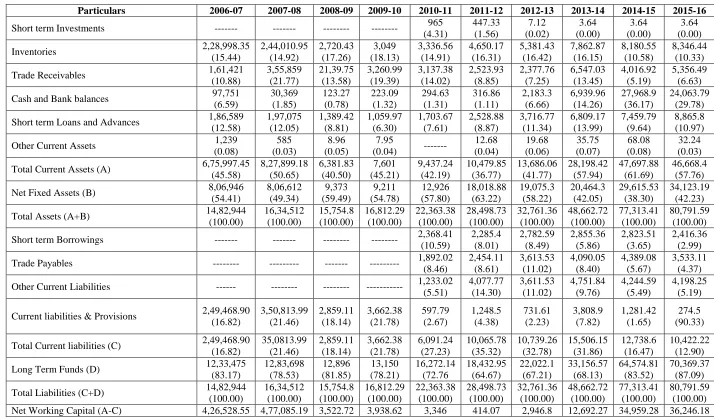
Table 1.5 manifests the details with regard to the structure of working capital of Suven life Sciences limited. The short term investments are Rs 965 lakhs in 2010-11 and Rs 3.64 lakhs in 2015-16 during five years. The Current assets percentage had increased from 45.58 per cent in 2006-07 to 57.76 per cent in 2015-16 while that of the fixed assets declined from 54.14 per cent in 2006-07 to 42.23 per cent during the same period. Both categories of assets, however, current assets were increased but the fixed assets were declined during the study period.
For the last six years the size of investments in trade debtors had outweighed that of the inventories. As such inventories were regulated to the second position, not found in any other sample units. But, the position of inventories in current assets was restored to the first place in 2011-12, 2012-13 and 2013-14 when compared with remaining years. The size of trade receivables shown high in the year 2007-08 with 21.77 per cent and from 2008-09 onwards, trade receivables downward trend in terms of percentage but not in absolute values. Cash and bank balances tended to declined from Rs 97,751 lakhs in 2006-07 to Rs 316.86 lakhs in 2011-12 and gradually increased from Rs 2,183.3 lakhs in 2012-13 and Rs 24,063.79 lakhs in 2015-16. Cash and bank balances tended to decline from 2006-07 to 2011-12 but the investment in 'other current assets' improved.
Current liabilities as a percentage of total liabilities represented the highest proportion of all the units under study which ranged from 35.32 per cent in 2011-12 to 12.90 per cent in 2015-16. The unit surprisingly had ignored short term borrowings, trade payables and other current liabilities until 2009-10. However, a beginning was made in 2010-11 with a short term borrowings of Rs 2,368.41 lakhs which appreciably thereafter improved to Rs.2,416.36 lakhs in 2015-16. Trade
payables are the leading item of current liabilities which varied from Rs. 1,892.02 lakhs in 2010-11 to Rs. 3,533.11 lakhs in 2015-16. While provisions formed a substantial proportion, ranged from Rs. 2,49,468.90 lakhs in 2006-07 to Rs. 10,422.22 lakhs in 2015-16.
Net Working Capital had increased from Rs. 3,25,183.46 lakhs in 2006-07 to Rs. 5,78,430.28 lakhs in 2007-08 which one again fell to Rs. 36,246.18 in 2015-16. Similar trend can be observed from the indices of net working capital. Though the rate of increase in current assets faster than of current liabilities. The unit, however, could enjoy a favourable working capital position and there was no deficit of working capital in all the years of the study period.
IV. REFERENCES
1) Bhunia, A., & Khan, I. U. (2011). Liquidity management efficiency of Indian Steel Companies. A Case Study. Far East Journal of Psychology and Business, 3(1), 3-13.
2) Singh D.P, (2011).” “Net Working Capital Level and Return on Capital Employed In Firms of Cement Industries in India”, VSRD-IJBMR, Vol. 1 (4), 269-280.
3) Sharma A K and Kumar Satish (2011), ‟Effect of Working Capital Management on Firm Profitability Empirical Evidence from India‟ Global Business Review, Vol. 12, Issue-1, pp-159 – 173.
4) Joshi, P. V. (1995), “Working Capital Management under Inflation”, 1st edition. New
Delhi. Anmol Publishers, pp. 20 – 93.
5) Scherr, F. C. (2007). Modern Working Capital Management, Prentice-Hall, International, Inc. pp. 1-3.
Academic Journal, Volume 3, Number 2, Fall 2007.
V. WEBSITES