Iran J Public Health, Vol. 47, No.10, Oct 2018, pp.1537-1545
Original Article
On the Frontline: Exploring the Perceptions of Lahore’s
Inner-city School Teachers Regarding Children Problems
*Nazish IMRAN
1, Atif RAHMAN
2, Nakhshab CHAUDHRY
3, Aftab ASIF
41. Dept. of Child & Family Psychiatry, King Edward Medical University/Mayo Hospital, Lahore, Pakistan 2. Institute of Psychology, Health & Society, University of Liverpool, Liverpool, United Kingdom
3. Dept. of Basic Sciences, King Edward Medical University, Lahore, Pakistan
4. Dept. of Psychiatry & Behavioral Sciences, King Edward Medical University/Mayo Hospital, Lahore, Pakistan
*Corresponding Author: Email: [email protected]
(Received 10 Aug 2017; accepted 18 Dec 2017)
Introduction
School experiences are important for children emotional, psychological and social development Over the past decade, a number of school-based mental health programs have been developed worldwide with aims to promote positive mental health, identify students with mental health diffi-culties and provide support within school settings wherever possible (1). Teachers' role in the school
mental health initiatives needs special emphasis. In low and middle-income countries (LMIC) like Pa-kistan, teachers are ideally positioned to serve as the frontline defense for identification and basic intervention for children with emotional & behavioral difficulties, if provided with proper training & resources (2).
Abstract
Background: We aimed to explore inner city school teachers’ perceptions of problems faced in schools, it causes and role of schools and teachers in promoting child social and emotional well-being, using qualitative approach.
Methods: Following ethical approval and informed consent, In-depth interviews were conducted in 2017 with twenty teachers belonging to four private schools in inner city area of Provincial capital, Lahore, Pakistan. Inclu-sion criteria were at least 12 years of formal education and minimum of 5 years’ experience in teaching profesInclu-sion. Framework Analysis was used to analyze data.
Results: Teachers identified learning problems, inattention, disobedience, aggression, lying & disrespect as the most commonly encountered problems of children, with very few teachers mentioning emotional difficulties. Teachers view the family, parenting practices and home environment alongside media (in particular social media) as being the main causes of child behavioral problems. With prompts, however, they did identify various school and teacher-related factors having negative impact on children. Fair conceptualization of good school and good teacher was observed. Need for teacher awareness and training for strategies promoting child emotional and social wellbeing was highlighted.
Conclusion: As perceived by teachers, children studying in inner city schools have several behaviour problems.
Study results and the gaps identified will help in ensuring that teachers receive training targeted towards their needs. Findings of the study also substantiate the need for targeting whole school-wide preventive approach as efforts begin to implement school mental health initiative in Pakistan.
Teachers training programs in Pakistan impart limited knowledge and skills in viewing children behavior from a developmental perspective or in classroom and behaviour management. Even with the on-job experience, many teachers lack the background to interact with students in manner to facilitate early intervention and prevention. Teach-ers own knowledge and beliefs regarding mental health influence the way they respond to student’s mental health crisis (3). Some teachers view child psychopathology to be the cause of problem behaviours (4.5), while others perceived environment as having greater role in behavior problem than genetic factors (6). Teachers tend to deliver low praise and most of their interactions with students exhibiting behavior problems are negative. Use of Punitive strategies is also com-mon (6-8).
Teacher training is a preventive approach to im-prove their knowledge, skills and competence to be able to promote positive mental health, identify, re-fer and support students with mental health issues and facilitate students learning. WHO, Eastern Mediterranean Region recently developed a concise and practical manual of school mental health for helping educators to better support the mental health needs of their students and to take practical steps that can be implemented at low costs in school (9). For school mental health program to be satisfactorily developed in the country, an in-depth understanding of teachers’ perceptions of child emotional and behavior problems & schools and teachers’ role in it, is essential. This area is under-researched in Pakistan.
The objectives of current study were to explore: 1) what are the inner-city school teachers’ percep-tions about children problems they face in schools and 2) their understanding of possible causes of these difficulties 3) their understanding of role of schools and teachers in promoting child social and emotional well-being.
Methods
This study was conducted in 2017 in the small pri-vate schools located in inner-city areas of Urban
Lahore, Pakistan having broadly same characteris-tics with respect of teacher-student ratio, medium of instruction, examination system (Board of Sec-ondary and Intermediate Education, Punjab) and fee structure between 2500-5000 PKR/month. It was embedded within the pilot phase of WHO School mental health training program.
After ethical approval from the University Review Board, Principal & teachers of four schools were invited to attend informal meeting by the principal investigator, who provided an overall view of the study.
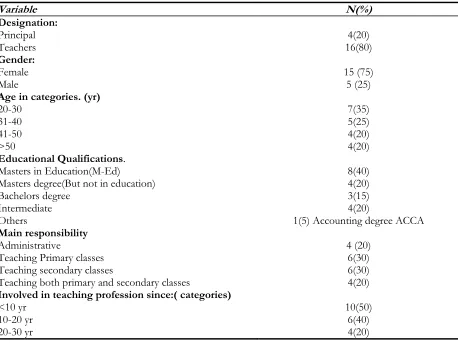
All four principals agreed to be interviewed and also facilitated in the identification of potential volunteer teachers to be interviewed based on re-searcher’s requirements to ensure varying experi-ence levels of teachers, both genders as well as rep-resentation from both junior and senior classes of the school system. For teachers, inclusion criteria were at least 12 yr of formal education (equivalent to A level) and minimum of 5 years’ experience in teaching profession. Based on established qualita-tive methods, we identified 20 as the target num-ber of participants in order to reach saturation in the data (10). Each school had an average of 30 teachers (Range 25-35) and 5 participants (includ-ing principal) were interviewed from each school. Participants background details & characteristics are summarized in Table 1. All 4 principals had started their career initially as teachers and later were given administrative responsibilities. Only 8 participants (including 4 principals) had degree in education before embarking in teaching career, thus majority were learning on job.
Data Collection
Table 1: Participants Characteristics (n=20)
Variable N(%)
Designation: Principal
Teachers 16(80) 4(20)
Gender: Female
Male 15 (75) 5 (25)
Age in categories. (yr) 20-30
31-40 41-50 >50
7(35) 5(25) 4(20) 4(20) Educational Qualifications.
Masters in Education(M-Ed)
Masters degree(But not in education) Bachelors degree
Intermediate Others
8(40) 4(20) 3(15) 4(20)
1(5) Accounting degree ACCA Main responsibility
Administrative
Teaching Primary classes Teaching secondary classes
Teaching both primary and secondary classes
4 (20) 6(30) 6(30) 4(20) Involved in teaching profession since:( categories)
<10 yr 10-20 yr 20-30 yr
10(50) 6(40) 4(20)
The interviews ranged from 50 min to 90 min and were conducted by the principal researcher (NI) on school premises, at times convenient for the participants. Interviews of all participants, who gave their consent, were recorded and were tran-scribed verbatim.
Data Analysis
The data collection and analysis were carried out simultaneously. We used framework Analysis ap-proach to analyses data. Data analysis employed all steps of Framework analysis approach (11). i.e. fa-miliarization with the data, themes and subthemes identification, charting & finally, data interpreta-tion by critically examining the summaries from all participants to understands links and associations. In order to ensure the rigor and trustworthiness of the study, member checking, transparency, & re-flexive journaling were utilized.
Results
A number of themes were identified and they have been grouped according to main aims of the study and the context of being a teacher in school. Over-all, remarkable consistency in themes was seen de-spite differences in individual participant charac-teristics and schools. Details of themes and sub-themes that emerged from the data within each of these categories are available from authors on re-quest. Summary of findings are as follows:
Problems faced by teachers in schools
Many children are extremely naughty and rude…They do not listen …. move away from seat often…. Throw wrappers on floors … Use of vulgar language by children, swearing, hitting is common.
Disrespect towards teachers was mentioned by many of the participants.
Problems are more with boys. Some younger teach-ers who were inexperienced, refused to take senior boys classes because of teasing/ whistling etc. We requested administration to have male teachers for senior boys’ classes.
In addition, bullying behaviours were also a cause of concern for teachers.
Children used to call names (bacteria) to a special child who had physical problems and was unable to walk straight.
Teachers also felt that problems in school children are increasing due to too much adverse exposures in inappropriate ages and less guidance. Surpris-ingly, only 2 teachers among all respondents men-tioned emotional difficulties faced by the school children and that also after prompts, highlighting that children with emotional difficulties perhaps remains unnoticed and unsupported within school settings due to silent nature of their difficulties.
Teachers’ Perceptions of Factors having ad-verse impact on children social and emotional well-being
Respondents believed that a number of factors, mostly outside of school have adverse impact on child social and emotional well-being.
Factors at home
Almost all teachers emphasized the role of home environment and parental influence as most im-portant factor in child well-being. Parents not spending time with children at home, having poor awareness of impact of their own behavior on kids (like swearing in front of child, watching inappro-priate content on TV, videos, not respecting other family members at home) were other key factors at home leading to difficulties in children. Poor parenting practices, parents being too busy to look after children due to various reasons was recurrent theme in most interviews.
Parents have stopped parenting their children, they often don’t know what is happening in their child lives.
Poor guidance by elders at home due to less inter-actions was also highlighted. Teachers also felt that parents own bad attitude towards teachers is responsible for disrespect shown by students to-wards them. Family breakdown and domestic vio-lence was also mentioned by some teachers as sig-nificant home stressors affecting children well-be-ing.
Factors in school
Teachers initially did not mention school or teacher factors as having possible causative role in student problems. When prompted however, teachers saw their own actions and behavior hav-ing the most significant influence on students fol-lowed by school atmosphere and peers. For exam-ple, negative behaviors and emotions may emerge if
“teachers use bad language, humiliate students / threaten them. Some teacher thinks their job is just to teach subject and that’s all…..”
But while they admitted to teachers’ bad attitude at times, they justified it by stating that, teachers themselves feel stressed out because of pressure from school administration and parents; Poor sal-aries and increasing workload contribute further to decrease their motivation. One teacher summed up the feelings of many teachers- the sense that teachers feel overburdened and not appreciated for their efforts.
Teaching is most deprived profession at Govern-ment level. Teachers have to meet their own sur-vival needs too, thus are frustrated. If a teacher is frustrated and aggressive and forgets that he is sup-posed to guide, support and teach problem solving to students, then obviously they are unable to fulfill their role/ responsibilities.”
school atmosphere. School atmosphere and peer interactions were also perceived by teachers as in-fluential in developing positive behaviors in school children.
“Government schools generally have a punitive at-mosphere with corporal punishments that lead to fear and resentment”
Teachers also expressed ambiguous views about various policies by Government to stop corporal punishment.
If one plants a tree and there is untidy growth, one needs to trim it. Similarly, sometimes one need to use hitting etc… for child benefit. Now a days teachers are fearful of fines/complaints.
It was noted with concern that while majority were against physical punishment, some teachers were unaware of the extreme emotional trauma a stu-dent may suffer because of humiliation.
Inconsistent policies, very frequent changes in exam system, knee jerk reactions to events also were mentioned by teachers as reasons for teach-ers and student dissatisfaction and having an over-all negative impact on school atmosphere.
Almost all participants agreed on the importance of games and extra-curricular activities in teaching so-cial skills and promoting child well-being, however mentioned various reasons for there being less em-phasis on it in schools. Generally, the impression was that school are focusing on Academics at the cost of other activities necessary for development of a well-balanced child personality. In some cases, schools are located in small buildings without ade-quate play grounds, facilities to promote games/ extra-curricular activities.
Factors in Society
Teachers expressed concerns about children being outside their homes without supervision, impact of gangs of youth on vulnerable kids in slum areas of city, overall law and order situation in country as having very negative influence on growing chil-dren.
Some children have bad company in neighborhood with older boys, they have inappropriate infor-mation at an early age which is dangerous. Another teacher mentioned
We as society have become more materialistic and less tolerant. Our parents used to earn less but we were happy. Now both families and kids are less contented.
Negative Role of Media/ internet
Teachers overwhelmingly expressed their reserva-tions on increasing media usage in society and by children in particular. Wastage of time, access to inappropriate content, lack of monitoring by gov-ernment organization on program content, lan-guage as well as no limit setting by parents were considered as lading to more adverse impact of technology. They specifically were concerned about sexual themes being observed in many chil-dren programs.
We are being destroyed more by media rather than terrorism. Even cartoons are full of sexual themes. If a prep class child (5 years old) is accusing a class fellow of wrongdoing with a boy in washroom, what am I supposed to think. What does he know about boys’ girls relationship… Isn’t it our society di-lemma….
Values being depicted in many western cartoons are not of our society.
Promotion of Students social and emotional well-being
All participants agreed that a good school has one of the strongest influences on grooming of young minds intellectually as well as morally. When asked about what constitutes some good school re-spondents stated
“Schools’ core values matter. Discipline, extra-curricular activities, good infrastructure, building, grounds, resources like labs, computers all contrib-ute to a good school.”
A good school focus on its students’ moral values in addition to education.
“A good school ensures that teachers and parents work together for children.”
due to their advantages in children well-being and promoting social skills. Teachers emphasized that good schools do have a much bigger role towards their students than to just impart education. These include teaching them life skills and empathy and caring attitude towards others.
School routines like assembly teaches children to be responsible, follow rules, make queues etc, all important lessons in life…..
Teachers saw themselves as one of the strongest in-fluences on students emotional and social well-be-ing. They considered themselves as role model and thus agreed that they need to focus on their own attitude, personality, punctuality and relationship with all stakeholders (parents, students and admin-istration) to have a positive impact on students. Be-ing able to enter teachBe-ing profession in Pakistan without any education related degree was consid-ered as a barrier to teachers’ competency
Teachers training is very important. At the mo-ment teacher learns on job. Schools are teachers’ nursery basically…
Regular liaison between school and parents, col-laborative work was identified as very important for student well-being.
Discussion
This study conducted in an inner-city school setting in Lahore investigated teacher’s perceptions related to students’ mental health. Respondents in our study talked about school-related problems in rela-tion to academic difficulties and antisocial behaviours while less emphasis was seen regarding the emotional issues. Academic problems included being irregular in school attendance, lack of interest in schoolwork, not completing homework, not memorizing lessons, always failing exams, & being more interested in playing rather than studying. This emphasis on learning issues is understandable in the local context of extreme focus on linking ac-ademic excellence with success in life and schools. Acceptance of there being intellectual disability or specific learning problems as cause of academic underachievement and need for individualized ed-ucation plan & curriculum modification for
stu-dents with these problems is generally not consid-ered by most teachers. Behaviour issues e.g. diso-beying, lying, wandering aimlessly, speaking rudely to others, threatening and being aggressive were also major concern to teachers but not recognized as possible mental health difficulties or having bio-logical reasons, rather they were mostly blamed on home environment and parents’ attitudes. Prob-lems identified in our study overlaps significantly with findings reported in terms of learning prob-lems and aggressive behavior among young people as being major areas of concern among stakehold-ers (12,13).
of school and teachers on influencing child behav-ior. Still, even with prompts, they did not appear to have concept of whole school approach rather were able to relate specifically to teachers negative behaviours like rudeness, humiliating attitudes and its impact on student learning and well-being. Lit-erature suggests that teachers recognized them-selves as one of the strongest influences on stu-dent’s behavior in addition to school climate and peers (16). There is also suggestion that teacher-student relationship shapes child behavior in school as well as home context (16). Schools con-text has been reported to have almost as much im-pact on students’ emotional health as the family context (17).
Teachers in our study reported having difficulties managing children’s behavioral problems. In addi-tion, behaviour management strategies used by teachers also appeared to be implemented in reac-tionary fashion following individual incidents. These findings support previous research that teachers do not consider behavior management in the whole school context despite there being well supported evidence for its positive influence (18,19). Some teachers despite alluding to the fact that students learn from their behavior admitted to relying on punitive approach to discipline kids in school. They also showed ignorance about the im-pact of using punitive strategies to manage behavior on child emotional well-being. We did not find any evidence form teachers of any of the schools that preventive strategies like positive atmosphere with clear rules and expectations, consistent enforce-ment of rules and regulations and avoiding triggers for negative behaviour were being employed. This finding that teachers are unaware of school climate influence and behaviour modification principles are important as they need to be included in any teacher training initiative.
Most of teachers had limited training in child de-velopment or behavior management principles, their perceptions may have been developed by learning on job as well as observing other teachers. Teachers are also susceptible to misperceptions because of their own background and beliefs (20). Respondents, when asked directly, were able to
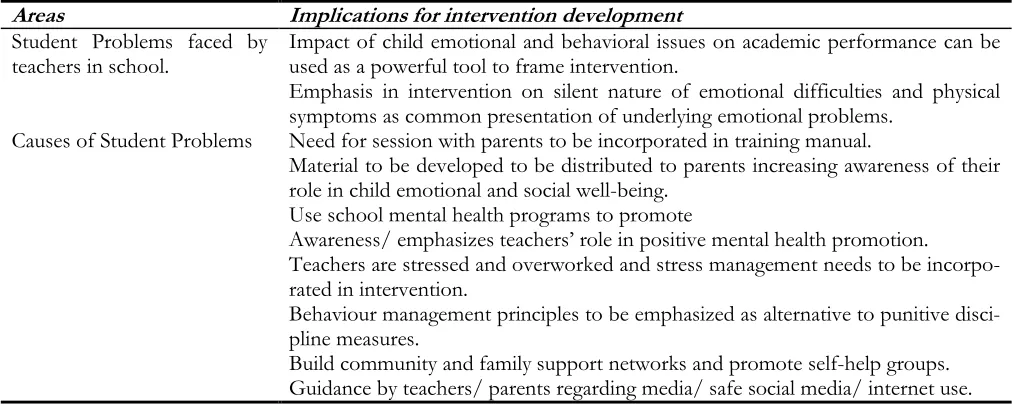
come up with examples of what they considered a good school and teacher but agreed that they see very few teachers around them who would fulfill their own idea of a good teacher. Except for one teacher, teaching profession was not the first ca-reer choice for any of the study respondents which are likely to affect their dedication, motivation, and effort towards their profession. In addition, poor salaries, overwork, hectic schedule and lack of incentives contribute towards teachers feeling less than satisfied with their role in schools and so-ciety. In order for any teacher training initiative to be successful, teachers not only need to be acknowledged for their important role in building society but their own stress/ concerns/ reserva-tions should also be addressed during the program (Table 2).
The findings of this research are potentially limited by several factors. This study was conducted in an inner-city area in Lahore and by selecting respond-ents purposively; therefore, the results may not be generalizable to rural areas. In addition, interview-ing parents and students, themselves would also have been helpful; however, time and resource limitations prevented this.
Conclusion
Table 2: Implications for intervention development on basis of themes emerging from the Interviews
Areas Implications for intervention development
Student Problems faced by
teachers in school. Impact of child emotional and behavioral issues on academic performance can be used as a powerful tool to frame intervention. Emphasis in intervention on silent nature of emotional difficulties and physical symptoms as common presentation of underlying emotional problems.
Causes of Student Problems Need for session with parents to be incorporated in training manual.
Material to be developed to be distributed to parents increasing awareness of their role in child emotional and social well-being.
Use school mental health programs to promote
Awareness/ emphasizes teachers’ role in positive mental health promotion. Teachers are stressed and overworked and stress management needs to be incorpo-rated in intervention.
Behaviour management principles to be emphasized as alternative to punitive disci-pline measures.
Build community and family support networks and promote self-help groups. Guidance by teachers/ parents regarding media/ safe social media/ internet use.
Further investigation into how these perceptions can be addressed in teacher training program is recommended.
Ethical considerations
Ethical issues (Including plagiarism, informed consent, misconduct, data fabrication and/or fal-sification, double publication and/or submission, redundancy, etc.) have been completely observed by the authors.
Acknowledgements
We would like to thank all schools and teachers, who participated in the study. The study had no funding.
Conflict of Interest
Authors report no conflict of interest.
References
1. Santor D, Short K, Ferguson B (2009). Taking mental health to school: A policy-oriented pa-per on school-based mental health for On-tario. http://www.excellenceforchil- dandyouth.ca/sites/default/files/posi-tion_sbmh.pdf
2. Severson HH, Walker HM, Hope-Doolittle J et al (2007). Proactive, early screening to detect be-haviorally at-risk students: Issues, approaches, emerging innovations, and professional prac-tices. J Sch Psychol, 45(2):193-223.
3. Graham A, Phelps R, Maddison C, Fitzgerald R(2011). Supporting children’s mental health in schools: Teacher views. Teachers and Teaching, 17(4):479-96.
4. Athanasiou MS, Geil M, Hazel CE, Copeland EP (2002). A look inside school-based consulta-tion: A qualitative study of the beliefs and prac-tices of school psychologists and teachers. Sch
Psychol Q, 7(3):258-298.
5. Crone DA, Horner RH (2000). Contextual, con-ceptual, and empirical foundations of func-tional behavioral assessment in schools.
Excep-tionality, 8(3):161-72.
6. Walker SO, Plomin R (2005). The nature–nurture question: Teachers’ perceptions of how genes and the environment influence educationally relevant behaviour. Educ Psychol, 25(5):509-16. 7. Nungesser NR, Watkins RV (2005). Preschool
teachers’ perceptions and reactions to chal-lenging classroom behavior: Implications for speech-language pathologists. Lang Speech Hear
Serv Sch, 36(2):139-51.
8. Gottfredson GD, Gottfredson DC (2001). What schools do to prevent problem behavior and promote safe environments. J Educ Psychol
9. Manual of school mental Health (2014) World Health Organization, Eastern Mediterranean Regional office.
10. Creswell JW (1998). Five qualitative traditions of inquiry. Qualitative inquiry and research de-sign: Choosing among five traditions. 65-6. Thousand Oaks, CA: Sage,
11. Gale NK, Heath G, Cameron E, Rashid S, Red-wood S (2013). Using the framework method for the analysis of qualitative data in multi-dis-ciplinary health research. BMC Med Res
Meth-odol, 13:117.
12. Adhikari RP, Upadhaya N, Gurung D et al (2015). Perceived behavioral problems of school aged children in rural Nepal: a qualitative study.
Child Adolesc Psychiatry Ment Health, 9: 25.
13. Alisauskas A, Simkiene G (2013). Teachers’ expe-riences in educating pupils having behavioural and / or emotional problems. Special
Educa-tion,1(28): 62–72.
14. Vijayalakshmi K, Kumar CV, Rajamanickm H, Cherian A (2007). Child rearing practices and psychological problems of children. Nursing
and Midwifery Research Journal, 3(2): 49-56.
15. Bharati S, Takao H (2010). Schooling: knowledge, perception and practices of parents. J Educ Res, 2:44–51.
16. Dutton Tillery A, Varjas K, Meyers J, Collins AS(2010). General education teachers’ percep-tions of behavior management and interven-tion strategies. J Posit Behav Interv, 12(2): 86-102. 17. Spence S, Burns J, Boucher S et al (2005). The
be-yond blue Schools Research Initiative: concep-tual framework and intervention. Australas
Psy-chiatry, 13(2): 159-64.
18. Nelson JR, Martella RM, Marchand-Martella N (2002). Maximizing student learning the effects of a comprehensive school-based program for preventing problem behaviors. J Emot Behav
Disord, 10(3): 136-48.
19. Sugai G, Horner R (2002). The evolution of disci-pline practices: School-wide positive behavior supports. Child & Family Behavior Therapy, 24(1-2): 23-50.
20. Mashburn AJ, Henry GT (2004). Assessing school readiness: Validity and bias in preschool and kindergarten teachers' ratings. Educational