Iran J Public Health, Vol. 47, Suppl. 1, 2018, pp.74-81
Original Article
Effects of 12 Weeks of Combined Exercise on Heart Rate
Variability and Dynamic Pulmonary Function in Obese and Elderly
Korean Women
Jisu KIM
1, Hun-Young PARK
1, *Kiwon LIM
1,21. Physical Activity and Performance Institute (PAPI), Konkuk University, Seoul, Republic of Korea 2. Dept. of Physical Education, Konkuk University, Seoul, Republic of Korea
*Corresponding Author: Email: [email protected]
(Received 10 Jan 2018; accepted 19 Mar 2018)
Introduction
Aging of the global population has become a public health concern with an important socio-economic dimension (1). This issue has been as-sociated with increased obesity rates due to chal-lenges as associated with decreased energy me-tabolism, sex hormones and muscle mass. Obesi-ty in the elderly population is a challenge not only
in the US but also in Europe and East Asian countries (2). Elderly individuals with obesity and overweight manifest an increased risk of prema-ture mortality, cardiovascular disease, cancer, type 2 diabetes, and several other diseases (3, 4). Therefore, anti-aging and anti-obesity studies are a critical component of public health.
Abstract
Background: We investigated whether a combination of aerobic and resistance exercise administered over a period of 12 weeks enhanced heart rate variability (HRV) and dynamic pulmonary function (DPF) in obese and elderly Korean women.
Methods: The study was conducted in 2016 in the Konkuk University (Seoul, Korea). The study partici-pants included 20 older obese women [aged 66.4±0.8years; >30 BMI and >30% in percent body fat]. The subjects were divided into a non-exercise group (n=10, control group; CON) and a combined exercise group (n=10, experimental group; EXP). Total power (TP), low frequency (LF), high frequency (HF), and LH/HF ratio were measured as frequency-domain methods. Salivary cortisol levels were analyzed by ELI-SA. The participants underwent dynamic pulmonary function (DPF) test.
Results: The EXP group showed a significantly decrease in body weight (P=0.002) and % body fat (P<0.001) following 12 weeks of combined exercise training. The CON group revealed a significant in-crease in LF (P=0.011), LF/HF ratio (P<0.001), salivary cortisol (P=0.015) and decrease in HF (P=0.003). However, the EXP presented a significant decrease in LF (P=0.006) and salivary cortisol (P=0.046), and a significantly increase in MVV (P<0.001).
Conclusion: Twelve wk of combined aerobic and resistance exercise improves heart rate variability, re-ducing mental stress in obese older women. In addition, the exercise program was found to be effective in reducing body fat and improving lung function in obese elderly women in East Asian countries with similar body composition and cultural patterns. Therefore, further collaborative research is needed to investigate obese older women in East Asian countries.
In South Korea, obesity rates have increased sharply over the past two to three decades, par-ticularly in older women, rapidly climbing from 22.2% in 1988 to 37.4% in 2015 (5). Even in East Asian countries containing populations with a body composition similar to that of Korea, the rate of elderly obesity is increasing sharply (6). The anti-obesity measures in East Asians need to be investigated because of their similar body composition including height, weight, fat ratio, and muscle mass (7, 8).
However, the majority of obese and aging studies were conducted in populations of European ances-try and United States whereas studies of obese old-er women in East Asian remain limited (6). Fur-thermore, most obesity-related studies have focused on abdominal or central obesity, hypertension, in-sulin resistance, high-triglyceride and low HDL-cholesterol levels, which are associated with meta-bolic syndrome (9, 10). However, the numerous changes in health-related indicators that occur dur-ing the process of obesity and agdur-ing need to be in-vestigated. In particular, heart rate variability (HRV) and dynamic lung function (DPF) reduction are indicators of age and obesity (11, 12).
HRV is the physiological variation in time interval between heartbeats. It is measured by the variation in the beat-to-beat interval that non-invasively as-sesses the activity of the autonomic nervous sys-tem (12). According to recent reports, 24-hour Holter monitoring of populations with individuals between 20 and 70 years, revealed an age-related decrease of all parameters, especially parasympa-thetic cardiac activity due to aging (13). The de-creased HRV indicated an abnormal functioning of the autonomic nervous system, and has been associated with mental stress (14). Chronic auto-nomic activation and/or disturbances may
influ-ence several physiological parameters, and increase the risk of cardiovascular disorders (15). Therefore, HRV is a clinically useful tool. In addition, aging results in decreased lung function. To prevent this decline, aerobic exercise is reportedly helpful in improving lung function. Recent reports suggest that prolonged aerobic exercise can improve lung function (16).
Nevertheless, whether prolonged aerobics com-bined with resistance exercise affects HRV and DPF in obese older women remains unclear. Therefore, the purpose of this study was to inves-tigate the effects of 12 wk of aerobic and re-sistance exercise on HRV and DPF in Korean obese older women.
Materials and Methods
Participants
The study was conducted in 2016 in the Konkuk University (Seoul, Korea). The study participants included 20 obese older women (66.4±0.8 age), who were not exposed to any medication and with a BMI (by Broca’s index) >30 and percent body fat >30%. These women were housewives with low levels of activity who had not per-formed any kind of exercise over the last 6 months.
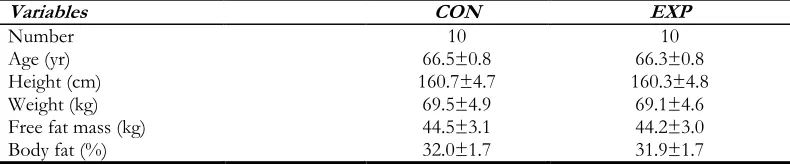
The participants provided written informed con-sent after sufficient explanation of the experiment and an understanding of the possible adverse ef-fects. They were assigned to a no-exercise group (n=10, control group; CON) and a combined exer-cise group (n=10, experimental group; EXP). There were no significant differences in physical charac-teristics among groups before exercise intervention (Table 1).
Table 1: Participant demographic characteristics
Variables CON EXP
Number 10 10
Age (yr) 66.5±0.8 66.3±0.8
Height (cm) 160.7±4.7 160.3±4.8
Weight (kg) 69.5±4.9 69.1±4.6
Free fat mass (kg) 44.5±3.1 44.2±3.0
Body fat (%) 32.0±1.7 31.9±1.7
This study was approved by the Institutional Re-view Board of KyungHee University (KHSIRB-16-016) in Korea.
Study Design
The study was designed as follows: 2 days of pre-test session (i.e., 2 pre-testing days and 1 day of rest between testing days), 12 wk of combined exer-cise session, and finally, 2 days of post-test ses-sion. The post-test started three days after the last training session. The training session began be-fore three days and the post-test began three days after the last training session.
On the first test day, all participants underwent fasting for more than 10 h and after stabilization, saliva was collected between 7:00 and 9:00 am and body composition measured. On the second test day, the participants underwent fasting for 4 h; heart rate variability (HRV) and dynamic pul-monary function (DPF) were measured in order in the morning.
The participants in EXP performed the following three kinds of combined exercise interventions for 90-120 min: aerobic exercise on a treadmill, aerobic exercise on a bicycle, and elastic re-sistance exercise. On the other hand, CON did not perform any exercise. All exercise interven-tions were performed at a constant temperature and humidity (22 ° C, 60%) for a total of 12 wk, three times a week. The maximal heart rate (HRmax) of the participants in EXP aerobic ex-ercise involving a treadmill and a bicycle was cal-culated using the Karbonen formula (206.9- [0.67 × age]). They performed 60 min of aerobic exer-cise corresponding to 60-70% of HRmax (tread-mill exercise 30 min and bicycle exercise 30 min, respectively). Further, older obese women in EXP performed elastic resistance training ses-sions involving front squat, incline chest press, seated row, push press, split squat, and pull apart. The participants in EXP performed 3 sets of 10-15 repetitions at an exercise intensity ranging from 6 to 7 on the OMNI-Resistance Exercise Scale of Perceived Exertion (OMNI-RES AM; from 0, extremely easy to 10, extremely hard), which corresponds to exercise intensity levels ranging from 60% to 70% of 1 RM, with rest for
90 s per set. Elastic resistance training sessions were conducted for approximately 30-40 min.
Measurement
Body composition (i.e., height, weight, fat-free mass, and percent body fat) was measured after fasting for more than 4 h using bioelectrical im-pedance analysis (BIA).
HRV was measured according to the following procedure. All subjects abstained from coffee, alcohol, and tobacco during the intervention pe-riod and HRV was measured after fasting for 4 h, in a room where noise was relatively blocked. Following approximately 10 min of rest, four pads were placed on both wrists and ankles using an HRV meter (LAXTHA, CANS-3000, Korea), and measured under sedentary and sleeping con-ditions. HRV was analyzed using time-domain methods based on beat-to-beat or normal-to-normal (NN) intervals, and frequency-domain methods assigned to bands of frequency followed by counting the number of NN intervals match-ing each band. The average of all RR intervals (mean RR), standard deviation of successive dif-ferences (SDDN), and root mean square of suc-cessive differences (RMSSN) were analyzed as time-domain methods. The total power (TP), low frequency (LF), high frequency (HF), and LH/HF ratio were measured as frequency-domain methods.
For salivary cortisol measurement, all participants underwent fasting for more than 10 h before the test, and abstained from brushing teeth. Further, the participants rinsed their mouth with cold wa-ter 10 min before collecting the saliva, and re-frained from eating or salivating. The collected frozen saliva was analyzed via ELISA using the ER HS SALIVARY CORTISOL kit (Salimetrics, Pennsylvania, USA).
maxi-mal voluntary ventilation (MVV) obtained by re-peated breathing and inspiration for 12 sec was used to evaluate DPF.
Statistical analysis
All statistical analyses were conducted using SPSS 23.0 (IBM Corp., Armonk, NY, USA) for Win-dows. Data are presented as mean ± standard deviation. The sample size was calculated to im-prove the statically power to more than 95% us-ing G-power. Normality of distribution of all outcome variables was verified using a Kolmogo-rov-Smirnov test. A two-way analysis (time × group) of variance with repeated measures of the “time” factor was used to analyze the effects of training programs on each dependent variable. If a significant interaction effect was found, a post-hoc Bonferroni test was used to identify within-group change over time. Additionally, a paired t -test was used to compare post-training compared with pre-training values of dependent variables in
each group separately. The a priorilevel of signif-icance was set at 0.05.
Results
Body Composition
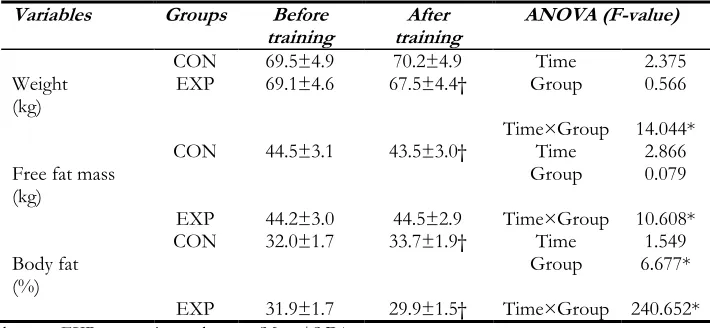
As shown in Table 2, there was a significant teraction in all body composition parameters in-cluding body weight (F=14.044, P=0.001), FFM (F=10.608, P=0.004), and %body fat (F=240.652,
P<0.001). Thepost-hoc analyses showed a signif-icant decrease in FFM (P=0.013) and increase in %body fat (P<0.001) in the CON group. However, the EXP presented a significant de-crease in body weight (P=0.002) and %body fat (P< 0.001) after 12 wk of combined exercise training.
Heart Rate Variability and Salivary Cortisol
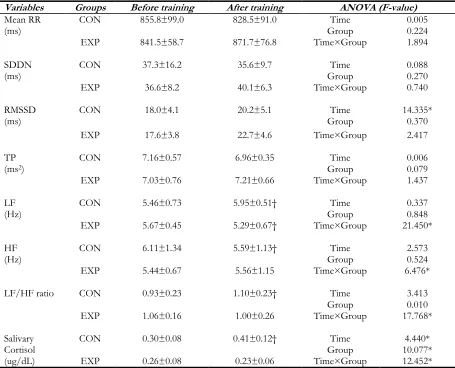
Table 3 displays data for stress-induced HRV be-fore and after 12 wk of combined exercise train-ing in both groups.
Table 2: Changes in body composition parameters by training in CON and EXP before and after training
Variables Groups Before
training training After ANOVA (F-value)
CON 69.5±4.9 70.2±4.9 Time 2.375
Weight
(kg) EXP 69.1±4.6 67.5±4.4† Group 0.566
Time×Group 14.044*
CON 44.5±3.1 43.5±3.0† Time 2.866
Free fat mass
(kg) Group 0.079
EXP 44.2±3.0 44.5±2.9 Time×Group 10.608*
CON 32.0±1.7 33.7±1.9† Time 1.549
Body fat
(%) Group 6.677*
EXP 31.9±1.7 29.9±1.5† Time×Group 240.652*
Note. CON = control group, EXP = experimental group (Mean±S.D.) * Significant (p<.05) interaction or main effect
† P<.05 vs. before training
No significant interaction was observed in mean RR, SDDN, and RMSSD related to time-domain methods. However, there was a significant inter-action between HF (F=21.450, P<0.001), LF (F=6.476, P=0.020), and LF/HF ratio (F=17.768,
P=0.001) using frequency-domain methods. In addition, salivary cortisol showed a significant
Table 3: Changes in HRV and salivary cortisol by training in CON and EXP before and after training
Variables Groups Before training After training ANOVA (F-value)
Mean RR
(ms) CON 855.8±99.0 828.5±91.0 Group Time 0.005 0.224
EXP 841.5±58.7 871.7±76.8 Time×Group 1.894
SDDN
(ms) CON 37.3±16.2 35.6±9.7 Group Time 0.088 0.270
EXP 36.6±8.2 40.1±6.3 Time×Group 0.740
RMSSD
(ms) CON 18.0±4.1 20.2±5.1 Group Time 14.335* 0.370
EXP 17.6±3.8 22.7±4.6 Time×Group 2.417
TP (ms2)
CON 7.16±0.57 6.96±0.35 Time 0.006
Group 0.079
EXP 7.03±0.76 7.21±0.66 Time×Group 1.437
LF
(Hz) CON 5.46±0.73 5.95±0.51† Group Time 0.337 0.848
EXP 5.67±0.45 5.29±0.67† Time×Group 21.450*
HF
(Hz) CON 6.11±1.34 5.59±1.13† Group Time 2.573 0.524
EXP 5.44±0.67 5.56±1.15 Time×Group 6.476*
LF/HF ratio CON 0.93±0.23 1.10±0.23† Time 3.413
Group 0.010
EXP 1.06±0.16 1.00±0.26 Time×Group 17.768*
Salivary Cortisol (ug/dL)
CON 0.30±0.08 0.41±0.12† Time 4.440*
Group 10.077*
EXP 0.26±0.08 0.23±0.06 Time×Group 12.452*
Note. HRV = heart rate variability, Mean RR = average of all RR interval, SDDN = standard deviation of the RR interval, RMSSD = the square roof of the mean squared difference of successive RR interval, TP = total power, LF = low frequency, HF = high frequency, CON = control group, EXP = experimental group. // * Significant (P<.05) interaction or main effect //†
P<.05 vs. before training
Dynamic Pulmonary Function
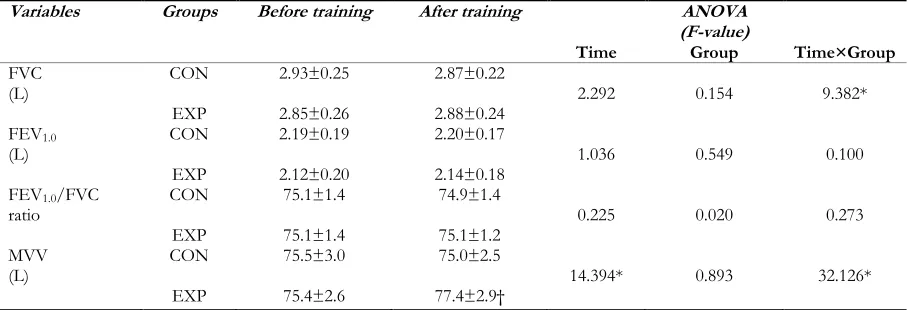
Data for DPF before and after the combined ex-ercise training in both groups are shown in Table 4. There was a significant interaction with FVC (F=9.382, P=0.007) and MVV (F=32.126,
P<0.001). Post-hoc analyses showed a significant decrease in FVC (P=0.011) of the CON group, and a significant increase in MVV of the EXP group (P<0.001).
Discussion
This study investigated HRV and DPF following long-term aerobic and resistance exercise in
the activity and balance of the autonomic nerv-ous system (12). HRV test is noninvasive, and the test method is relatively simple. The test results can be obtained promptly by computer analysis (20). Further, the activity of the autonomic nerv-ous system can be measured objectively and
easi-ly (14). Changes in the activity of the autonomic nervous system and balance due to stress enable the diagnosis of stress-related diseases. Therefore, the HRV test is considered as a useful tool to ob-jectively evaluate the psychological-emotional state of an individual (21).
Table 4: Changes in DFP by training in CON and EXP group before and after training
Variables Groups Before training After training ANOVA
(F-value)
Time Group Time×Group
FVC
(L) CON 2.93±0.25 2.87±0.22 2.292 0.154 9.382*
EXP 2.85±0.26 2.88±0.24
FEV1.0
(L)
CON 2.19±0.19 2.20±0.17
1.036 0.549 0.100
EXP 2.12±0.20 2.14±0.18
FEV1.0/FVC
ratio CON 75.1±1.4 74.9±1.4 0.225 0.020 0.273
EXP 75.1±1.4 75.1±1.2
MVV (L)
CON 75.5±3.0 75.0±2.5
14.394* 0.893 32.126*
EXP 75.4±2.6 77.4±2.9†
Note. DFP = dynamic pulmonary function, FVC = forced ventilator capacity, FEV1.0 = force expiratory volume in 1 second,
MVV = maximum voluntary ventilation, CON = control group, EXP = experimental group. * Significant (P<.05) interaction or main effect
† P<.05 vs. before training
The results of 12 wk of combined exercise in obese elderly women showed that the frequency domain analysis of HF was significantly higher than that of the control group. Recent reports suggest that depression, panic disorder, and anxi-ety affect the autonomic nervous system by mainly reducing the activity of the parasympa-thetic nervous system. HF has been reported to decrease in emotional states such as sustained stress, anxiety, and fear associated with decreased parasympathetic activity (22). LF showed a ten-dency to decrease compared with the control group. Previous studies have shown that LF is associated with mental stress, and that LF is re-duced in fatigue and has a significant positive correlation with depression and anger (23). LF is also known to be elevated in patients with mi-graine following hyperactivity of the sympathetic nervous system (20). LF/HF ratio reflects the overall balance of the autonomic nervous system. High LF/HF suggests a relative increase in the activity of sympathetic nervous system or
sup-pression of the parasympathetic activity (12). The LF/HF ratio increases when sympathetic activity is relatively dominant, such as anxiety, fear, ten-sion, distraction, and awakening (13). Conversely, LF/HF values are reported to be lower when parasympathetic activity is dominant, such as helplessness, nervous breakdown, depression, and low awakening. Our results are consistent with recent studies showing that continuous ex-ercise increases HRV and reduces stress. A pre-vious report suggested that eight weeks of mod-erate-intensity exercise (at 50% VO2max) of 44 min performed 3 to 4 times each week increases HRV in older women (24).
aero-bic and anaeroaero-bic exercise. Therefore, it was sug-gested that the cortisol reduction of through ex-ercise improves quality of life (25).
Lungs utilize oxygen for metabolism and release carbon dioxide from our bodies. Defective lung function causes various problems (26). Aging is an important variable that has a statistically sig-nificant correlation with pulmonary function (27). Following 12 wk of combined exercise, the im-proved FVC and MVV was related to the in-crease in oxygen uptake (28). Taken together, these results suggest that 12 wk of combined ex-ercise reduce body weight and fat content as well as improve HRV and lung function.
Conclusion
Twelve weeks of aerobic and resistance exercise improves HRV, and reduces mental stress in obese older women. In addition, the exercise program was found to be effective in reducing body fat and improving lung function in obese elderly women in East Asian countries with simi-lar body composition and lifestyle. Therefore, further collaborative research involving obese older women in East Asian countries is needed.
Ethical considerations
Ethical issues (Including plagiarism, informed consent, misconduct, data fabrication and/or fal-sification, double publication and/or submission, redundancy, etc.) have been completely observed by the authors.
Acknowledgements
This work was supported by the Ministry of Ed-ucation of the Republic of Korea and the Na-tional Research Foundation of Korea (NRF-2016S1A5B8914314). This paper was supported by the KU Research Professor Program of Konkuk University.
Conflict of interest
The authors declare no conflicts of interest.
References
1. Ma C, Avenell A, Bolland M, Hudson J et al (2017). Effects of weight loss interventions for adults who are obese on mortality, cardio-vascular disease, and cancer: systematic review and meta-analysis. BMJ, 359: j4849.
2. Wu YH, Moore S, Dube L (2018). Social capital and obesity among adults: Longitudinal find-ings from the Montreal neighborhood net-works and healthy aging panel. Prev Med, 111: 366-370.
3. Batsis JA, Zagaria AB (2018). Addressing Obesi-ty in Aging Patients. Med Clin North Am, 102(1): 65-85.
4. Liao C, Tsauo J, Wu Y et al (2017). Effects of protein supplementation combined with re-sistance exercise on body composition and physical function in older adults: a systematic review and meta-analysis. Am J Clin Nutr, 106(4): 1078-91.
5. Kim S, Yang JH, Park GH (2018). Eating fre-quency is inversely associated with BMI, waist circumference and the proportion of body fat in Korean adults when diet quality is high, but not when it is low: analysis of the Fourth Ko-rea National Health and Nutrition Examina-tion Survey (KNHANES IV). Br J Nutr, 119(8): 918-927.
6. Fu J, Li G, Li L et al (2017). The role of estab-lished East Asian obesity-related loci on pedi-atric leptin levels highlights a neuronal influ-ence on body weight regulation in Chinese children and adolescents: the BCAMS study.
Oncotarget, 8(55): 93593-607.
7. Chen Y, Copeland WK, Vedanthan R et al (2013). Association between body mass index and cardiovascular disease mortality in east Asians and south Asians: pooled analysis of prospective data from the Asia Cohort Con-sortium. BMJ, 347: f5446.
8. Wu YH, Hwang AC, Liu LK et al (2016). Sex differences of sarcopenia in Asian popula-tions: the implications in diagnosis and man-agement. J Clin Gerontol Geriatr, 7(2): 37-43. 9. Kirwan JP, Barkoukis H, Brooks LM et al
10. Penney TL, Jones NRV, Adams J et al (2017). Utilization of Away-From-Home Food Es-tablishments, Dietary Approaches to Stop Hypertension Dietary Pattern, and Obesity.
Am J Prev Med, 53(5): e155-e63.
11. Skloot GS (2017). The Effects of Aging on Lung Structure and Function. Clin Geriatr Med, 33(4): 447-57.
12. Xhyheri B, Manfrini O, Mazzolini M, Pizzi C, Bugiardini R (2012). Heart rate variability to-day. Prog Cardiovasc Dis, 55(3): 321-31.
13. Bonnemeier H, Wiegand UK, Brandes A et al (2003). Circadian profile of cardiac autonomic nervous modulation in healthy subjects: dif-fering effects of aging and gender on heart rate variability. J Cardiovasc Electrophysiol, 14(8): 791-9.
14. Myrtek M, Weber D, Brügner G, Müller W (1996). Occupational stress and strain of fe-male students: results of physiological, behav-ioral, and psychological monitoring. Biol Psy-chol, 42(3): 379-91.
15. Hjortskov N, Rissén D, Blangsted AK et al (2004). The effect of mental stress on heart rate variability and blood pressure during computer work. Eur J Appl Physiol, 92(1-2): 84-9.
16. Park J, Han D (2017). Effects of high intensity aerobic exercise on treadmill on maximum-expiratory lung capacity of elderly women. J Phys Ther Sci, 29(8): 1454-7.
17. Ho SS, Dhaliwal SS, Hills AP, Pal S (2012). The effect of 12 weeks of aerobic, resistance or combination exercise training on cardiovascu-lar risk factors in the overweight and obese in a randomized trial. BMC Public Health, 28(12): 704.
18. Ferrara CM, Goldberg AP, Ortmeyer HK, Ryan AS (2006). Effects of aerobic and resistive ex-ercise training on glucose disposal and skeletal muscle metabolism in older men. J Gerontol A Biol Sci Med Sci, 61(5): 480-7.
19. Urban RJ, Bodenburg YH, Gilkison C et al (1995). Testosterone administration to elderly men increases skeletal muscle strength and protein synthesis. Am J Physiol, 269(5 Pt 1): E820-6.
20. Acharya UR, Joseph KP, Kannathal N et al (2006). Heart rate variability: a review. Med Bi-ol Eng Comput, 44(12): 1031-51.
21. Dulleck U, Ristl A, Schaffner M (2011). Heart rate variability, the autonomic nervous system, and neuroeconomic experiments. J Neurosci Psychol Econ, 4(2): 117-124.
22. Kemp AH, Quintana DS, Felmingham KL, Mat-thews S, Jelinek HF (2012). Depression, comorbid anxiety disorders, and heart rate variability in physically healthy, unmedicated patients: implications for cardiovascular risk.
PLoS One, 7(2): e30777.
23. Francis JL, Weinstein AA, Krantz DS et al (2009). Association between symptoms of depression and anxiety with heart rate varia-bility in patients with implantable cardioverter defibrillators. Psychosom Med, 71(8): 821-7. 24. Madden KM, Levy WC, Stratton JK (2006).
Ex-ercise training and heart rate variability in old-er adult female subjects. Clin Invest Med, 29(1): 20-8.
25. Mura G, Cossu G, Migliaccio GM et al (2014). Quality of life, cortisol blood levels and exer-cise in older adults: results of a randomized controlled trial. Clin Pract Epidemiol Ment Health, 13(10): 67-72.
26. Fleg JL (2012). Aerobic exercise in the elderly: a key to successful aging. Discov Med, 13(70): 223-8.
27. Johnson BD, Badr MS, Dempsey JA (1994). Impact of the aging pulmonary system on the response to exercise. Clin Chest Med, 15(2): 229-46.