Global Journal of Advance Engineering Technologies and Sciences
EXPERIMENTAL STUDY OF THERMAL PERFORMANCE OF A SHELL
AND TUBE HEAT EXCHANGER WITH PHASE CHANGE MATERIAL
M.T.Jaffar Sathiq Ali
a, K.Ramsenthil Murugan
b, R.Stalinraj
c(a,b,cAssistantProfessor,Department of Mechanical Engineering, PET engineering college, Anna niversity)
ABSTRACT
The use of a latent heat storage system using phase change materials (PCMs) is an effective way of storing thermal energy.Among the different types of thermal energy storage, latent heat thermal energy storage has gained significant attention recently because of its high energy density per unit mass/volume at nearly constant temperature. PCMs have been widely used in latent heat thermal storage systems for heat pumps, solar engineering, and spacecraft thermal control applications. There are large numbers of PCMs that melt and solidify at a wide range of temperatures, making them attractive in a number of applications. The aim of this paper is to analyze the thermal behavior of PCM material in the shell and tube heat exchanger. The selected PCM is Lauric acid and melting point is 42OC.The effect of mass
flow rate and latent heat of PCM in the shell and tube heat exchanger is evaluated experimentally. The experimental work had been done the results indicate the when the flow rate is high the efficiency will be increased and higher latent heat ofLauric acid is 204 J/kg is having maximum thermal efficiency of 54.65% at 20 lit/hr.
Keywords—
Shell and Tube Heat Exchanger, Phase Change Material, latent heat.
INTRODUCTIONThe Continuous increase in the level of greenhouse gas emissions and the climb in fuels prices are the main driving forces behind efforts to more effectively utilize various sources of renewable energy. In many parts of the world, direct solar radiation is considered to be one of the most prospective sources of energy. The scientists all over the world are in search of new renewable energy sources. One of the options is to be developing the energy storage devices, which are as important as developing new sources of energy. It leads to saving of premium fuels and makes the system more cost effective by reducing the wastage of energy and capital cost. Heat exchangers with phase change material (PCM) are a solution to store energy (Amar M. Khudhair 2004). Thermal energy storage improves the efficiency and eliminates the mismatch between the energy supply and energy demand of solar thermal energy applications. Among the different types of thermal energy storage, a phase change material (PCM) thermal energy storage exhibits superior efficiency and dependability due to its high storage capacity and nearly constant thermal energy (Abduljalil A 2013). The transient forced convective heat transfer between heat transfer fluid (HTF) with moderate prandtl numbers and the tube wall, heat conduction through the wall and solid-liquid phase change of the phase change material, based on the enthalpy formulation (Al-AbidiSohif Mat K 2013). The heat transfer process during melting (charge) and solidification (discharge) of five small heat exchangers working as latent heat thermal storage systems. Commercial Paraffin RT35 is used as PCM filling one side of the heat transfer and water circulates through the other side as heat transfer fluid. Average thermal power values are evaluated for various operating conditions and compared among the heat exchangers studied. When the comparison is done for average power per unit area and per average temperature gradient, results show that the double pipe heat exchanger is the one with higher values in the range of 700-800 W/m2K (Atul Sharma 2009).( BinGao 2015) was presented the Experimental
suitable to supply the hot air for drying of food product during non-sunshinehours or when the intensity of solar energy is very low. Temperature gain of air in the range of 17°C to 5°C for approximately 10 hrs duration was achieved during discharging of LHS.(M. Rahim 2014) wasconsidered experimental investigation of phase change inside a finned- tube heat exchanger. The results indicate using the fins in the phase change process enhances melting and solidification procedures, the trend of this variation is different for the heat exchangers increasing the inlet temperature for the bare tube heat exchanger more effectively lowers melting time. ( SaeidSeddegh 2015) Thermal behaviour in a vertical and horizontal shell-and-tube energy storage system using phase change materials (PCMs) is investigated and compared using a combined conduction and convection heat transfer model. The results also showthat increasing the hot heat transfer fluid (HTF) inlet temperature substantially reduces the total charging time for both orientations. However, increasing the flow rate does not greatly affect the charging and discharging processes. In the present work, the experimentally investigated the Lauric acid as a phase change material (PCM) for a Shell and tube heat exchanger was proposed to increase the heat transfer coefficient when charging and discharging of the PCM.
EXPERIMENTAL SETUP &PROCEDURE
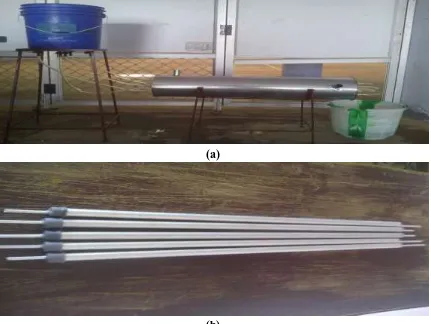
Thetest in Figure 1 (a) is a shell and tube heat exchanger with PCM consists of cold and hot water tanks, tubes, a flow control system, and a measurement system. The heat exchanger is made of the copper tubes and is filled with PCM in a way that the material is in the spaces between tubes and shell thicknessis 20 mm. Copper tubes outer diameter is 12.5 mm and PCM tube diameter is 25 mm respectively.
(a)
(b)
Figure 1 (b) shows the tube with phase change material. In which the HTF flows by forced convection through the HTF tubes during melting process. In this process, hot fluid heats the PCM which melts and stores the heat.Duringthe solidification process, the PCM solidifies and the stored heat is delivered to the cold fluid in the tubes. The mass flow rate of the water was fixed at 15-20 lit/hr.The hot water inlet temperature is 60-70ºC and cold water inlet temperature 25-30ºC.The inlet and outlet temperatures are measured by thermometer. The selected PCM is Lauric acid and the thermophysicalproperties of PCM shows the table 1.
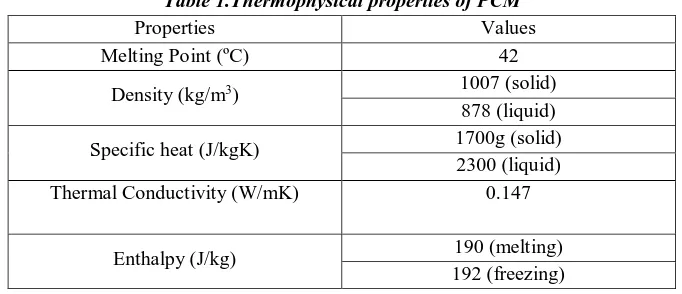
Table 1.Thermophysical properties of PCM
Properties Values
Melting Point (ºC) 42
Density (kg/m3) 1007 (solid)
878 (liquid)
Specific heat (J/kgK) 1700g (solid) 2300 (liquid)
Thermal Conductivity (W/mK) 0.147
Enthalpy (J/kg) 190 (melting)
192 (freezing)
The following relations are used to calculate the energy released by hot water and PCM during charging process and Energy gained by the cold water and PCM during discharging mode. The heat absorb capacity of PCM can be expressed as
Q= 𝑀. ℎ𝑓𝑔 (1)
Where M is the mass of PCM in kg, ℎ𝑓𝑔 enthalpy of PCM in J/kg, the heat absorbed by the PCM can be expressed as
Q= 𝑚𝐶𝑝∆T (2)
Where 𝑚 is the mass flow rate of the water in kg/S, 𝐶𝑝 is the specific heat of water in J/kgK, and ∆T is the temperature difference between PCM.
Heat Released by Water = Heat Absorbed by the PCM
The thermal power given to the PCM can be expressed as
Q =EPCMt [[MCpcm(Tpcm low−Tpcm initial)+MCHpcm+MCpcm(Tpcm end–Tpcm high)]
t ] (3)
Where EPCM is the heat capacity of PCM in J/S, t is the time in S, M is the mass of PCM in kg, Tpcm low is the lowest temperature of PCM in °C, Tpcm initial is the initial temperature of PCM, CHpcm is the enthalpy of PCM in J/kg, Tpcm end is the final temperature of the PCM in °C and Tpcm high is the highest temperature of the PCM in °C.
RESULTS AND DISCUSSIONS
Experiments were conducted in one day at two different mass flow rates. The temperature of inlet, outlet, PCM temperature were recorded at every 15 minutes interval.
Experimental recorded temperature at parallel flow condition
the heat from the hot water. At that time the temperature of PCM was measured at 62°C and discharged the heat in to cold water.
Table 2. Measured temperatures with respect to time in mass flow rate of water at 15 lit/hr Time
(min)
Hot water inlet temperature (°C)
Cold water inlet temperature(°C)
Hot water outlet temperature(°C)
Cold water outlet temperature(°C)
PCM
temperature(°C)
15 70 25 51 34 32
30 60 28 31 53 62
45 40 30 35 47 48
60 35 30 38 41 39
Table 3shows the experimental measured temperatures with respect to time in mass flow rate of water at 20 lit/hr. In 30 minutes PCM was melted and absorbed the heat from the hot water. At that time the temperature of PCM was measured at 65°C and discharged the heat in to cold water.
Table 3. Measured temperatures with respect to time in mass flow rate of water at 20 lit/hr Time
(min)
Hot water inlet temperature(°C)
Cold water inlet temperature(°C)
Hot water outlet temperature(°C)
Cold water outlet temperature(°C)
PCM
temperature(°C)
15 70 25 53 36 32
30 60 28 30 56 65
45 40 30 32 50 45
60 35 30 35 45 40
Variation of temperatures with respect to time.
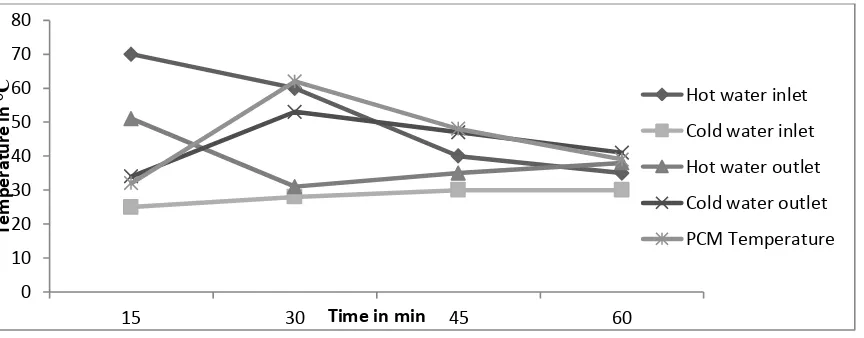
Figure 2 represents the variation of inlet, outlet water temperature and PCM temperature when it’s charging and discharging for mass flow rate is 15 lit/hr. Initially the hot water temperature measured at 70ºC circulated through the tubes. The PCM absorbs the heat from the hot water and stores them. Initially PCM temperature recorded at 32ºC after passed hot water the temperature of PCM increased. At that time hot water outlet temperature is decreased at 31ºC after 30 minutes the PCM temperature is increased at 62ºC and then cold water was circulated through inside the shell. Initially the cold temperature measured at 25ºC. Then the PCM stored heat is released. So the PCM temperature is reduced but cold water outlet temperature increased at 34ºC in 15 minutes and cold water outlet temperature maximum at after 15 minutes that is 53ºC. The temperatures of hot and cold water increased frequently depend upon the PCM melting temperature.
Figure 2. Variations of temperature with respect time for mass flow rate of 15 lit/hr.
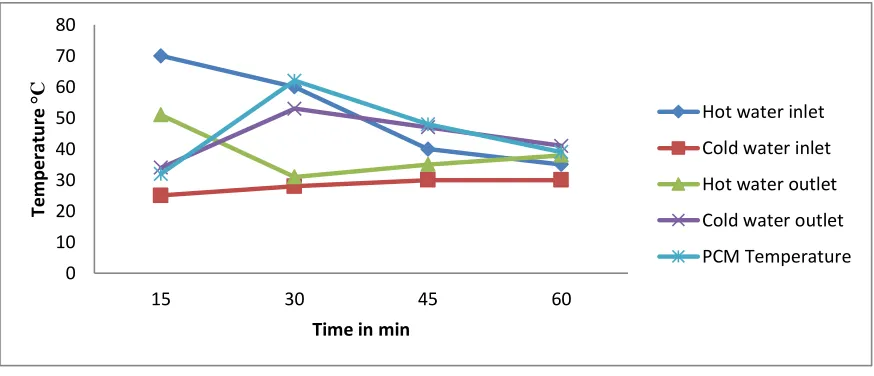
Figure 3 represents the variation of inlet, outlet water temperature and PCM temperature when it’s charging and discharging for mass flow rate is 20 lit/hr. Initially the hot water temperature measured at 70ºC circulated through the
0 10 20 30 40 50 60 70 80
15 30 45 60
Te m p e ra tu re in °C
Time in min
Hot water inlet
Cold water inlet
Hot water outlet
Cold water outlet
tubes. The PCM absorbs the heat from the hot water and stores them. Initially PCM temperature recorded at 32ºC after passed hot water the temperature of PCM increased. At that time hot water outlet temperature is decreased at 30ºC after 30 minutes the PCM temperature is increased at 65ºC and then cold water was circulated through inside the shell. Initially the cold temperature measured at 25ºC. Then the PCM stored heat is released. So the PCM temperature is reduced but cold water outlet temperature increased at 36ºC in 15 minutes and cold water outlet temperature maximum at after 15 minutes that is 56ºC.
Figure 3. Variations of temperature with respect time for mass flow rate of 20 lit/hr.
Table 4 shows the thermal performance of the heat exchanger with PCM. The energy released and gained when charging and discharging the phase change material. In mass flow rate 20 lit/hr had a maximum discharging the heat in to cold water and it have a better efficiency compare the mass flow rate 15 lit/hr.
Table 4 .Thermal performance of the heat exchanger with PCM
PCM Energy Released by the Hot Water during Charging Mode (J)
Energy Gained by the Cold Water during Discharging Mode (J)
Lauric Acid at 20
lit/hr 1645.34 597.75
Lauric Acid at 15
lit/hr 1978.26 584.71
CONCLUSION
An Experimental model was developed to predict the transient phase change heat transfer. Behavior of a shell-and-tube thermal heat storage unit with the PCM filling the shell-and-tubeside and HTF circulated inside the inner shell-and-tube. The results of experimental analysis show that the temperature cold water increased when PCM temperature is increased and hot water temperature decreased when PCM temperature decreased. Unsteady temperature distributions of heat transfer fluid, tube and phase change material have been obtained by experimentally and thermal behavior of latent heat storage unit during charging and discharging had been evaluated. When the flow rate is higher the efficiency of the setup increasing. It was also found that with flow rate 20lit/hr gives better efficiency than with 15lit/hr flow rate. When the latent heat of the PCM is higher the thermal efficiency of the PCM is increased. The PCM is Lauric acidit was found that having higher latent heat and having maximum thermal efficiency of 54.65% at 20 lit/hr.
The similar analysis may be considered by changing the parameters like influence of Various phase change materials,,nano-particle size, geometry, and change in flow as scope for future research.
0 10 20 30 40 50 60 70 80
15 30 45 60
Te
m
p
e
ra
tu
re
°C
Time in min
Hot water inlet
Cold water inlet
Hot water outlet
Cold water outlet
Nomenclatures M Mass (kg) ℎ Enthalpy (J/kg) m Mass flow rate (kg/S)
Cp Specific heat of water ( J/kgK)
K Thermal conductivity (W/mK) ρ Density (kg/m3)
REFERENCES
1. Amar M. Khudhair, Mohammed M. Farid, A review on energy conservation in building applications with thermal storage by latent heat using phase change materials, Energy Conversion and Management 45 (2004) 263–275.
2. Abduljalil A. Al-AbidiSohif Mat K. Sopian, M.Y. SulaimanAbdulrahman.Experimental study of melting and solidification of PCM in a triplex tube heat exchanger with fins, Energy and Buildings (2013).
3. Abduljalil A. Al-AbidiSohif Mat K. Sopian, M.Y. SulaimanAbdulrahman. Numerical study of PCM solidification in a triplex tube heat exchanger with internal and external fins, International Journal of Heat and Mass Transfer 61 (2013) 684–695.
4. Atul Sharma, V.V. Tyagi, C.R. Chen, D. Buddhi, Review on thermal energy storage with phase change materials and applications, Renewable and Sustainable Energy reviews 13 (2009) 318–345.
5. Bin Gao, Qincheng Bi, ZesenNie, Jiangbo Wu, Experimental study of effects of baffle helix angle on shell-side performance of shell-and-tube heat exchangers with discontinuous helical baffles, Experimental Thermal and Fluid Science 68 (2015) 48–57
6. M. Esapour, M.J. Hosseini, A.A. Ranjbar, Y. Pahamli, R. Bahrampoury, Phase change in multi-tube heat exchangers, Renewable Energy 85 (2016) 1017e1025
7. AshishAgarwal, R.M. SarviyaAn experimental investigation of shell and tube latent heat storage for solar dryer using paraffin wax as heat storage material Engineering Science and Technology, an International Journal 19 (2016) 619–631
8. M. Rahimi, A. A. Ranjbar,D. D. Ganji, K. Sedighi, Experimental Investigation of Phase Change inside aFinned-Tube Heat ExchangerJournal of EngineeringVolume 2014, Article ID 641954, 11 pages
9. SaeidSeddegh, XiaolinWang, Alan D. Henderson, A comparative study of thermal behaviour of a horizontal and verticalshell-and-tube energy storage using phase change materials, Applied Thermal Engineering 93 (2016) 348–358
10. Vindhya Vasiny, Prasad Dubey,RajRajatVerma,PiyushShankerVerma,A.K.Srivastava Performance Analysis of Shell & Tube Type Heat Exchanger under the Effect of Varied Operating Conditions, Journal of Mechanical and Civil Engineering (IOSR-JMCE)Volume 11, Issue 3 Ver. VI (May- Jun. 2014), PP 08-17.