Citation: IJSS: 6(1): 15-19, March 2017 DOI: 10.5958/2321-5771.2017.00002.3
©2017 New Delhi Publishers. All rights reserved
Creativity and Impulsivity among Deaf and Dumb
Children: A Correlational Study
Nabanita Maity
1and Bhim Chandra Mandal
2* 1Sponsored Teachers’ Training College, Purulia, West Bengal, India2Nikhil Banga Sikshan Mahavidyalaya, P.O. Bishnupur, Dist: Bankura, West Bengal, India
*Corresponding author: [email protected]
ABSTRACT
The present article tries to investigate the relationship between creativity and impulsivity among deaf and dumb students. Participants were deaf and dumb students of standard V to X of Bilaspur district, Chattishgarh. Random sampling were used to select 100 participants from two randomly selected special school. Impulsiveness scale (IS) developed and standardized by Dr. S.N. Rai and Divergent production abilities (DPA) scale developed and standardized by Dr. K.N. Sharama were used for present study. The survey method has been adopted for the present study. Random sampling technique has been used in the study. The result indicates negative relationship between creativity and impulsivity.
Keywords: Creativity, Impulsiveness, Deaf & Dumb children, t test
Impulsivity is defined as the inability to avoid behaviors and acts according to situations (Milich & Kramer, 1982) or incitation to act without any plan or thinking with the tendency of impulse (Eysenck & Eysenck, 1977; Schalling, 1978; Gordon, 1979; Martin et al., 1994; Hinslie & Shatzky, 1940). It is an attribution of personality that a person shows unpredictable behavior by the urgency of the moment. Accordingly, it refers to individuals who rush into quick decisions (Nederkoorn et al., 2006). It has also been shown to reveal many fundamental cognitive, emotional and neurological problems among children (Barratt, 1965; Evenden, 1999; Moeller, Barratt, Dougherty, Schmitz, & Swann, 2001; Rogers et al., 2010) that have led to behavioral problems and later problems in adulthood including substance abuse (Verdejo-Garcia, Lawerence, & Clark, 2008;), pathological gambling (Blanco, Potenza, Kim, Ibanez, Zaninelli, Saiz-Ruiz, & Grant, 2009) and violent behavior (Komarovskaya, Loper, & Warren, 2007; Amabile, 1996;
Johnson et al., 2013). According to Robinson, Smith, Miller, and Brownell (1999), those individuals who showed behavioral problems at an early age were more likely to suffer from low self control, hyperactivity, hostility, inattentiveness, disrespect toward authority, and impulsivity.
The common characteristic of creativity is to generate ideas, alternatives or possibilities to the problems to be solved and to develop new ideas and convert the new and imaginative concept into reality. Creativity skills usually have been thought to not be governed by any rules (Mumford et al., 1996).
the citizen of the country as an abled person. Sometimes disability in one part of body may stimulate the activity of other organs and senses. The constitution of India has assured equality of opportunity of all with special assistance to the weaker section. This dream can only be translated into reality if proper attention is paid to the neglected group like deaf and dumb children. They can overcome their disabilities, if proper education and environment is provided.
Hearing impaired children are one of the most diverse group of exceptional children. Due to impairment in the auditory mechanism they have hearing loss in one or both ears. Population census 2011 revealed that the number of people with hearing and speech disabilities estimated also about 50.71 lakhs and 19.98 lakhs with a total disability about 2.68 crores (Census Report, 2011). Although India is rapidly developing, there is still plenty of poverty, and a high rate of deafness and hence proper education for those people is essential as they may give contribution to human resource.
L
iteraturer
eviewAn interesting area of psychologists is the understanding of psychopathology of everyday life in relation to mental illness and creativity. There are so many anecdotes of the creative person and their relationship with mental illness. Claridge (1998) suggested that schizo element is most closely related to creativity, rather than the affective element. According to Eysenck (1993) neuroticism is positively related with creativity for arts students and negatively sciences students, may be due to the emotional involvement in art and the explicit rejection of emotion in science students.
Interestingly, Carlsson, Wendt and Risberg (2000) found that highly creative individuals scored higher in trait anxiety than a low creative group and that the high creative demonstrated a higher level of blood flow. They concluded that their results agreed with the view that creative people may generally be more anxious than non-creative and experience higher levels of arousal on physiological measures. Bala (1985)found that the deaf and orthopedically handicapped children differed from normal children in personality traits. Acar (2013) studied the relation between creativity and schizotypy and
found that relationship is not uniform and that positive symptoms represent the intersection of creativity and schizotypy. Haplin, haplin and Torrence (1974) found that blind children are more verbally fluent, flexible and original in compare to sighted children. Sharma I.P. (2002) found that creativity for physically impaired children did not dependent on residence. Stanzione (2013) compared the divergent thinking abilities between deaf and hearing adolescents.
From above literature review, it has observed that not much many studies are available on the impulsiveness and creativity on deaf and dumb children and the relation between these two variables. Now considering the importance of Impulsiveness and creativity of Deaf and dumb children, the present study will show the level of creativity and impulsiveness of deaf and dumb children.
Objectives of the study
The objectives of the study are as follows:
To study the extent of creativity and impulsiveness among deaf and dumb children.
To study the relationship between creativity and impulsiveness among deaf and dumb students Hypotheses of the study
In order to conduct the study smoothly, following hypotheses has been framed :
oH
1 : Deaf and dumb students have no creative abilities oH
2 : There is no significant relationship exist between creativity and impulsivity for deaf and dumb
students
oH
3: There is no significant difference in impulsivity between high and moderate creative deaf and dumb students
oH
4: There is no significant difference in impulsivity between high and low creative deaf and dumb
students
oH
Population and sample
All deaf and dumb students (V to X) of Bilaspur district, Chattishgarh are the population of this research. Random sampling technique has been used to select one Govt. school and one private school as samples from the population. The sample consists of 100 deaf and dumb students from two randomly selected schools of Bilaspur District (Table 1).
Table 1: Sample profile Sl.
No. Name of the school PrivateGovt./ Sample size
1 Govt. Deaf & Dumb Higher Secondary School, Tifra
(Bilaspur)
Government 77
2 Justice Tankha Rotary Memorial High School,Vinobhanagar
(Bilaspur)
Private
23
Tools used for the study
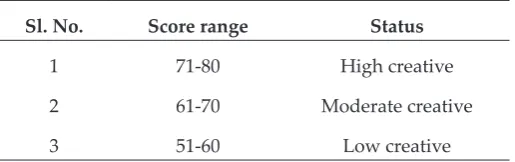
Suitable tools pave the way for successful accomplishment of the objectives of a study and the collection of pertinent data. For this study Impulsiveness scale (IS) developed and standardized by Dr. S.N. Rai, Department of psychology, Institute of Advanced Studies, Meerut University and Divergent production abilities (DPA) scale developed and standardized by Dr. K.N. Sharama, Department of psychology, University of Rajasthan, Jaipur has been used. The norm of the DPA scale is shown in Table 2.
Table 2: Norms of the Divergent production ability scale
Sl. No. Score range Status
1 71-80 High creative
2 61-70 Moderate creative
3 51-60 Low creative
The students are tested individually with the various parameters as mention in the above tools. After the responses, data has been scored, presented in tabular form and analyzed by appropriate statistical tests.
Analysis and interpretation of data
Testing of oH 1
It is observed from Table 3 that 64% of deaf and dumb students possesses high level of creativity whereas only 12% have low level of creativity. In view of the above oH
1 is rejected. Hence it may be concluded that deaf and dumb students possess high level of creativity. The result is consistent with the findings of Silver (1977) and (Kaltsounis, 1971).
Table 3: Percentage of students with level of creativity
Sl. No. Score range Status % of students
1 71-80 High Creative 64
2 61-70 Moderate creative 24
3 51-60 Low creative 12
Testing of oH
2
Pearson co-efficient correlation between creativity and impulsivity is found to be -0.41 which is negative and significant at 0.01 level. Thus, oH
2 is rejected. Hence we can say that creativity and impulsivity are inversely correlated. If creativity increases, impulsivity decreases and vice versa. The result corroborates the findings of Ward (1969) and Kipper et al. (2010) but not with the findings of Klein et al. (1976) who established no relationship between creativity and impulsiveness.
Testing of oH
3
The ‘t’ value for high and moderate creative deaf and dumb students is found to be 1.05 (df = 86) which is not significant neither in 0.01 level nor in 0.05 level. Hence, oH
3 is accepted. Thus, it may be concluded that high and moderate creative deaf and dumb students did not differ significantly in impulsive behavior.
Testing of oH
4
The ‘t’ value for high and low creative deaf and dumb students is found to be 5.40 (df = 74) which is significant at 0.01 level. Hence, oH
Testing of oH 5
The ‘t’ value for moderate and low creative deaf and dumb students is found to be 4.11 (df = 33) which is also significant at 0.01 level. Hence, oH
5 is rejected. Or in other words it can be concluded that moderate and low creative deaf and dumb students differs significantly in impulsive behavior.
r
esuLtsandd
iscussionThis study offers a contribution to the field of inclusive education by empirically investigating the interrelationship between creativity and impulsivity. Inferential statistical analysis clearly illustrated differences between various groups in various areas, confirming previous research. It is observed that 64% of deaf and dumb students possess creative behavior. Negative correlations were confirmed between creativity and impulsivity. Both high and moderate creative groups exhibited significantly lower level of impulsivity. Moreover, they also found that high creative-low creative and average creative-low creative pair has significant different in impulsive behavior. The results may be explained by the fact that impulsive actions are typically poorly conceived, prematurely expressed, unduly risky, or inappropriate to the situation that often result in undesirable consequences as a result of which creative thinking ability suppressed.
c
oncLusionThis study gives an insight about creativity and impulsiveness of deaf and dumb children. It is true that deaf and dumb children in India may not get fair opportunities to foster better growth in contrast to their normal counter-part. As a result the cognitive development of the disadvantages group particularly creativity may not reach to their best level. The findings established a basis for furthering Impulsivity and creativity research for deaf and dumb students. In particular examining whether impulsivity levels result in individuals’ creative involvement; or conversely, whether it is their extent of creative involvement that determines their levels of impulsivity. In conclusion, we can say that deaf and dumb students should encourage by peer, teacher , parents as well as by the other members
of the society because they may contribute to the society like normal citizen.
r
eferencesAcar, S. and Sen, S. 2013. A multilevel meta-analysis of the relationship between creativity and schizotypy. Psychology of Aesthetics, Creativity, and the Arts, 7(3): 214-228.
Amabile, T.M., Conti, R., Coon, H., Lazenby, J. and Herron, M. 1996. Assessing the work environment for creativity. Academy of Management Journal, 39(5): 1154-1184.
Bala, M. 1985. A comparative study of mental make-up and educational facilities for physically handicapped and normal children, Ph.D Dissertation in Education, KURU.
Barratt, E.S. 1965. Factor analysis of some psychometric measures of impulsivity and anxiety. Psychology Reports, 16:547-554. Blanco, C., Potenza, M.N., Kim, S.W., Ibanez, A., Zaninelli, R.,
Saiz-Ruiz, J. and Grant, J.E. 2009. A pilot study of impulsivity and compulsivity in pathological gambling. Psychiatry Research, 167:161-168.
Bruce, K.R., Steiger, H., Ng Ying Kin, N.M.K. and Israel, M. 2006. Reduced platelet [³H-] paroxetine binding in anorexia nervosa: relationship to eating symptoms and personality pathology. Psychiatry Research, 142:225–32.
Carlsson, I., Wendt, P.E. and Risberg, J. 2000. On the neurobiology of creativity: Differences infrontal activity between high and low creative subjects. Neuropsychologia, 38: 873–885.
Claridge, G.S. and Broks, P. 1984. Schizotypy and hemisphere function: I. Theoretical consideration and the measurement of schizotypy. Personality and Individual Differences, 5: 633–648. Evenden, J.L. 1999. Varieties of impulsivity. Psychopharmacology,
146:348-361.
Eysenck, S.B. and Eysenck, H.J. 1977. The place of impulsiveness in a dimensional system of personality description. British Journal of Social and Clinical Psychology, 16: 57-68.
Eysenck, H.J. 1993. Creativity and personality: Suggestions for a theory. Psychological Inquiry, 4: 147–178.
Gordon, M. 1979. The assessment of impulsivity and mediating behaviors in hyperactive and non-hyperactive boys. Journal of Abnormal Child Psychology, 7: 317-326.
Halpin G., Halpin, G. and Torrance, E.P. 1974. Relationships between creative thinking abilities and a measure of the creative personality. Educational Measurement. 34: 75-82. Hinslie, L. and Shatzky, J. 1940. Psychiatric Dictionary. Oxford
University Press, New York.
Kaltsounis, B. 1971. Differences in creative thinking of black and white deaf children: Perceptual and Motor Skills, 32: 243-248. Klein, G.A., Blockovich, R.N., Buchalter, P.S. and Huyghe, L. 1976.
Relationship between reflection-impulsivity and problem solving, Perceptual and Motor Skills, 42: 67-73.
Kipper, D.A., Green, D.J. and Prorak, A. 2010. The Relationship Among Spontaneity, Impulsivity, and Creativity, Journal of Creativity in Mental Health, 5(1): 39-53.
Komarovskaya, I., Loper, A.B. and Warren, J. 2007. The role of impulsivity in antisocial and violent behavior and personality disorders among incarcerated women. Criminal Justice and Behavior, 34:1499 – 1515.
Martin, C.S., Earlywine, M., Blackson, T.C., Vanyukov, M.M., Moss, H.B. and Tarter, R.E. 1994. Aggressivity, inattention, hyperactivity, and impulsivity in boys at high and low risk for substance abuse. Journal of Abnormal Child Psychology, 22(2): 177-203.
Milich, R. and Kramer, J. 1982. Socialization and peer relations in hyperactive children. In K. Gadow, and I. Bialer (Eds.), Advances in Learning and Behavioral Disabilities (pp. 283-339). Greenwich, CT: JAI Press.
Moeller, F.G., Barratt, E.S., Dougherty, D., Schmitz, J.M. and Swann, A.C. 2001. Psychiatric aspects of impulsivity. American Journal of Psychiatry, 158:1783-1793.
Mumford, M.D., Baughman, W.A., Threlfall, K.V., Supinski, E.P. and Costanza, D.P. 1996. Process-based measures of creative problem-solving skills: I. Problem construction. Creativity Research Journal, 9: 63-76.
Nederkoorn, C., Smulders, F.T., Havermans, R.C., Roefs, A. and Jansen, A. 2006. Impulsivity in obese women. Appetite, 47(2): 253-256.
Robinson, T.R. Smith, S.W., Miller, M.D. and Brownell, M.T. 1999. Cognitive behavior modification of hyperactivity/impulsivity and aggression: A meta-analysis of school based studies. Journal of Educational Psychology, 91:195-203.
Rogers, R.D., Moeller, F.G., Swann, A.C. and Clark, L. 2010. Recent research on impulsivity in individuals with drug use and mental health disorders: Implications for alcoholism. Alcoholism: Clinical and Experimental Research, 34(8): 1319-1333. Schalling, D. 1978. Psychopathy-related personality variables and
the psychophysiology of socialization. In R. D. Hare, and D. Schalling (Eds.), Psychopathic Behaviour: Approaches to Research (pp. 85-105). New York: Wiley.
Sharma, I.P. 2002. A comparative study of the personality traits interests and aspirations of high-creative and low-creative physically handicapped students of higher secondary schools. Ph.D., Education Rohilkhan University.
Silver, R.A. 1977. The question of imagination, originality, and abstract thinking by deaf children, American Annals of the Deaf, 2: 349–354
Stanzione, C.M., Perez, S.M. and Lederberg, A.R. 2013. Assessing Aspects of Creativity in Deaf and Hearing High School Students, J. Deaf Stud Deaf Educ., 18(2): 228-241.
Verdejo-Garcia, A., Lawrence, A. J. and Clark, L. 2008. Impulsivity as a vulnerability marker for substance-use disorders: Review of findings from high-risk research, problem gamblers and genetic association studies. Neuroscience Biobehavior Review, 32: 777-810.