JAST, Vol © Iranian A
Ex
Pr
Initial A Systems which ne Because electrical certainide paramete INS cons with an a 3 acceler The desig the intern present a determine HDP algo 1. Ph.D. C 2. Ph.D. C
l. 10, No. 1, pp. Aerospace Society
xtract
rocess
Sy
1, 2 and 3. D
In Inerti Jacob Dyna then extrac that, w of the intern Keyw
INTRO
Alignment in (INS) is a co eeds a multivof uncertain parts of IN entification m
rs [3-6]. As sists of a thre assembly of in
ometers) on i gn of a contro nal dynamics article, we use
e this interna orithm.
Candidate (Corr Candidate
39- 43 y, Winter-Spring
ting D
for a
ystem
Pr
A. A. Nikk
Department
n this paper, w ial Navigation bi-Bellman (HJ mic Programm a neural netw cted to simplify we do not need e HDP algorith nal dynamics m
words: optimal c gimbaled
ODUCTIO
gimbaled In mplicated exp variable cont nties in the NS, sometime methods to
shown in Fig ee-axial suspe nertial sensors
t, and some n ol system for t matrix of th e a new identi al dynamics m
responding Auth 2013
Dynam
a Gimb
Using
ogram
khah
1*, S. M
of Aerospac
*Postal Code
Ni
with the aim o System (as a JB) equation f ming algorithm ( work approxima
y the solutionof d to know the sy hm to the optim
atrix. control, Heuristi Inertial Navigati
N
12 nertial Navig perimental pro trol system [ e mechanical s we need todetermine sy gure 1, a gim
ension mecha s (3 gyroscope necessary actu this purpose, he platform. I ification meth matrix based hor)
mics M
baled
g Heu
mmin
M. Salehi A
e Engineerin e:1541849611
ikkhah@kntu
of estimatingint discrete linea for optimal c (HDP) for solvi ation for cost f HJB. Design p ystem matrix. Th mal control poli
ic Dynamic Pro on System, Initia
gation ocess, 1, 2]. l and o use ystem mbaled anism, es and uators. needs In the hod to
on a o
p th p an sy
Matrix
d Inert
ristic
g Met
Amiri
2, S. A
ng, K.N.Toos 1, Tehran, IRA
u.ac.ir
ternal dynamic r system), the control has be ing the equation function and process of the his important is icy makes possi
ogramming, neur al Alignment F System id r improving hysical system hree types arameter iden nd controlmo ystem identifi
x of A
tial N
Dyna
thod
A. Zahiripo
si University AN.cs matrix of a discrete-time een extracted.
n has been pres control input optimal contro ssue and the co ible the estima
ral network app
Figure 1. a gim
dentification is the mathema m using exp
of identifica ntification,stru odel identifica fication is to
Alignm
aviga
amic
ur
3y of Technolo
gimbaled Hamilton-Heuristic sented and has been oller shows onvergence tion of the
proximation,
mbaled INS [1]
model of a physical/dynamic system from the observed data. Six key steps are involved in system identification [7]; (1) Developing an approximate analytical model of structure, (2) Establishingthe levels of structural dynamic response which are likely to occur using the analytical model as well as thecharacteristics of anticipated excitation sources, (3) Determining the instrumentation requirements needed to sense the motion with prescribed accuracy and spatial resolution, (4) Performing experiments and recording the data, (5) Applying system identification techniques to identify the dynamic characteristics such as system matrixes, modal parameters, as well asexcitation and input/output noise characteristics, and (6)Refiningthe analytical model based on the identified results. The traditional identification techniques extracting modal parameters from input and output data have been well-developed and widely used in engineering. However, it is often a demandingtask to carry out excitation in the field testing of large engineering structures. To obviate such difficulties of the traditional techniques, methods of extracting modal parameters from structural response data have only been deeply investigated during the lastfew decades [8].Approximate dynamic programming (ADP) is a very effective method for the solution of Discrete-Time Nonlinear HJB [9]. There are many techniques of ADP to solve the cost function and hence the optimal control policy [10]. In [11], ADP techniques are classified into: heuristic dynamic programming (HDP), dual heuristic dynamic programming (DHP), action dependent heuristic dynamic programming (ADHDP), and action dependent dual heuristic dynamic programming (ADDHP).In [12], Liu and Li used optimal control for discrete-time HJB.
In the present studybased onthe idea of HDP, we extract a new internal dynamics matrix identification method. At first, we introduce the discrete time HJB, then, we useheuristic dynamic programming algorithm for solving HJB online, and finally introduce two neural network parametric structures to approximate the optimal cost function and policy. At last, using the main results obtained, we extract an estimator for the internal dynamics estimation of a discrete linear system.
DISCRETE-TIME HJB EQUATIONS
Consider an affine dynamic system of the form:= ( ) + ( ) ( ) (1)
where ∈
،
( ) ∈،
( ) ∈ ×and the
input ∈
.
It is desired to find the control input which minimizes the cost function given as (2):
( ) = ∑ + R (2)
where > 0 and > 0.
From Bellman's optimality theory and [13]:
∗( ) = ( ) ∗( ) (3)
and:
∗( ) = ∗ ( ) ( )
( ) ∗( )+ ∗( ) (4)
This equation reduces to the Ricatti equation in the linear quadratic regulator (LQR) instance, which can be solved with precision. In the general nonlinear case, the HJB cannotbe solved exactly.
From [9], the value iteration HDPalgorithm for solving it is proposed as:
( ) = arg + +
( )
= arg { + + ( ( ) + ( ) )}
= ( ) ( )
( ) = { + + ( )} =
+
(5)
( ) ( ) + ( ( ) + ( ) ( )) (6)
subsequently, for solving the equations (5), (6), neural network estimation has been proposed as follows:
( ) = ∑ ∅ ( ) = ∅( ) (7)
( ) = ∑ ( ) = ( ) (8)
where ∅( ) and ( ) are the activation functions and and are the network weights.
The updatedlawfor and is obtained from (9), (10) as:
= ( ) ( ) ×
( ) ( ( ), ) (9)
| = | − ( )(2 ( , | ) + ( ) ∅( )
( ) )
(10)
where Ω is the training set, is a positive step size, and m is the iteration number of the LMS algorithm.
Assuming the convergence of HDP algorithm for a linear system, the last relations show, ( ) and
( ) converge to the cost function of the optimal control problem and to the corresponding optimal control input,respectively.
Journal of Aerospace Science and Technology Vol. 10 / No. 1/ Winter - Spring 2013
/
41
Extracting Dynamics Matrix of Alignment Process for a Gimbaled …ESTIMATION of INNER DYNAMICS
MATRIX of DISCRETE-TIME LINEAR
SYSTEM
Consider the linear discrete system (for example with five states), described as:
( + 1) = ( ) + ( ) (11) From LQR method:
∗( ) = − (12)
where:
= ( + ) (13) And P is the symmetric positive definite of below Ricatti equation:
= + − ( + ) ×
:
(14)and
∗( ) = (15)
A reasonable selection of activation functions vector for cost and control input would be as:
∅( )
= [ 12 1 2 1 3 1 4 1 5 22 2 3]
( )
=[
1 2 3 4 5]
(16)
Then, converged weight vectors have the form of:
= [
]
=
w . w . w . w . w .
w . w . w . w . w .
w . w . w . w . w .
w . w . w . w . w .
w . w . w . w . w .
(17)
and:
∗( ) = ∅( )
∗( ) = ( )
(18)
As explained in section 3, HDP algorithm converges to the cost function of the optimal control problem and to the corresponding optimal control input, respectively. i.e.
∗( )
=
∗( )∗( )
=
∗( )(19)
Therefore:
∅( )
=
( ) = −
(20)
We define:
=
w 0.5w 0.5w 0.5w 0.5w
0.5w w 0.5w 0.5w 0.5w
0.5w 0.5w w 0.5w 0.5w
0.5w 0.5w 0.5w w 0.5w
0.5w 0.5w 0.5w 0.5w w
(21)
Then, (16-21) results:
=
= − (22)
Using (13), (22):
− = { + } B (23)
If the number of states is equal to control inputs, i.e. size(G)=size(B) and B is nonsingular, (constrains of proposed estimation algorithm), then, there is a unique solution for G from (23):
= { + }
(24)
That can be simplified to:
= { + } (25)
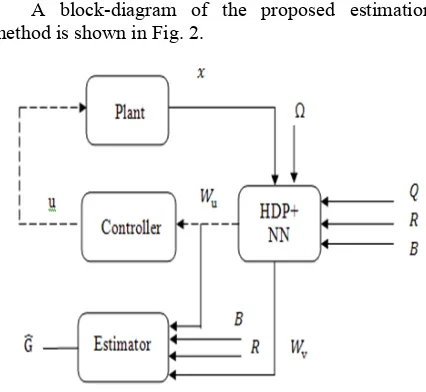
A block-diagram of the proposed estimation method is shown in Fig. 2.
Figure 2. Block-diagram of the proposed estimation method
ESTIMATION of INNER DYNAMICS
MATRIX of GIMBALED INERTIAL
NAVIGATION SYSTEM
Gyroscopes random error is defined as a stable stochastic process with autocorrelation function as follows [1]:
= { + } (26)
where is the standard deviation of random error of gyroscopes, which is known, and is the damping coefficient.
Differential equation of gyroscope error is as:
Dynamic equations of inertial navigation system considering gyroscopes disturbances are [14]:
( ) = ( ) + ( ) (28) where:
=
0 0 0 0
− 0 0 0
0 − 0 0 0
0 0 0 − 0
0 0 0 0 −
=
0 0
0 0
0 0
2 0
0 2
(29)
Inpractice two-channel control for horizontal axes is used. While in this paper, for extracting matrix A, because of constrains in the algorithm, a five-channel virtual control is utilized. Therefore:
( ) = ( ) + ( ) + ( ) (30) By assumption of matching condition ( ( ) = ( )), the equation (30) can be rewritten as:
( ) = ( ) + ( ) + ( )
= ( ) + ( ) + ( )
= ( ) + ( )
(31)
where:
( ) = ( ) + ( ) (32) For implementing the proposed method, we need thediscrete model of the system. For this aim, we use the approximation:
( ) ≅ ( ) ( ) (33)
Therefore:
( + 1) = ( ) + ( ) (34)
where:
= + Δ , = Δ (35) If we choosethe following parameters:
= ∗ sin( )
= cos( )
= 7.29 ∗ 10 ( )
= 35.5° , = 3 ∗ 10
= 10 , Δ = 0.01 ( )
With substituting in (29), (35):
=
1 4.23 − 7 0 0 0
−4.23 − 7 1 5.93 − 7 0 0
0 −5.93 − 7 1 0 0
0 0 0 0.999 0
0 0 0 0 0.999
(36)
With applying HDP+NN, and converge to:
−1.0000 0.0000 0.0002 0 0
−0.0002 −1.0003 0.0000 0 0
0.0002 −0.0000 −1.0002 0 0
0 0 0 −0.00001 0
0 0 0 0 −0.00003
= 15626406091563094323 273460 −646052 00 0 15628641410
0 0 16666 0 5
(37)
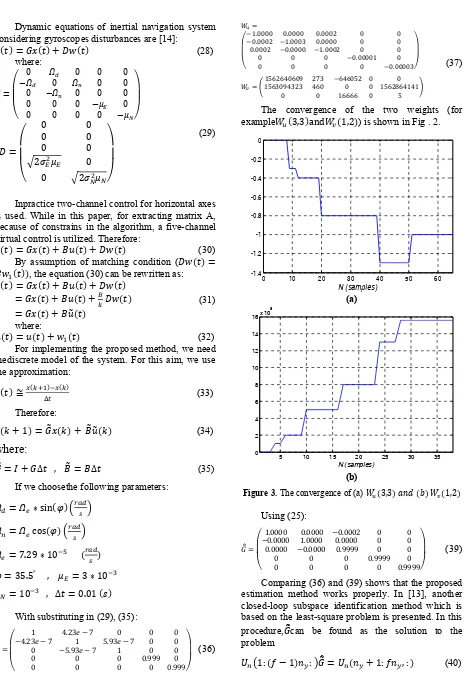
The convergence of the two weights (for example (3,3)and (1,2)) is shown in Fig . 2.
(a)
(b)
Figure 3. The convergence of (a) (3,3) ( ) (1,2)
Using (25):
=
1.0000 0.0000 −0.0002 0 0
−0.0000 1.0000 0.0000 0 0
0.0000 −0.0000 0.9999 0 0
0 0 0 0.9999 0
0 0 0 0 0.9999
(39)
Comparing (36) and (39) shows that the proposed estimation method works properly. In [13], another closed-loop subspace identification method which is based on the least-square problem is presented. In this procedure, can be found as the solution to the problem
1: ( − 1) : = ( + 1: , : ) (40)
For details see [13].
0 10 20 30 40 50 60
-1.4 -1.2 -1 -0.8 -0.6 -0.4 -0.2 0
N (samples)
5 10 15 20 25 30 35
0 2 4 6 8 10 12 14 16x 10
8
Journal of Aerospace Science and Technology Vol. 10 / No. 1/ Winter - Spring 2013
/
43
Extracting Dynamics Matrix of Alignment Process for a Gimbaled …From (40):
=
1.0000 1.22 − 7 −0.0002 0 0
−1.22 − 7 1.0000 0 0 0
0.0000 −0.0000 0.9999 0 0
0 0 0 0.98 0
0 0 0 0 0.98
(41)
comparing (39) and(41) shows that the proposed method in this paper enjoys ahigher accuracy especially in estimating the drift filter of gyroscopes that is related to the last two entries on the diagonal .
CONCLUSION
In this paper, a new method for extracting the inner dynamics matrix for a discrete time system was proposed. This idea is obtained from solving the HJB through thecomposition of Heuristic Dynamic Programming and Neural Network, in which the linear system critic network converges to the solution of ARE, the control network converges to the optimal policy and the internal dynamics did not require to implement HDP. This method was applied for estimatingtheinternal dynamics matrix of a gimbaledInertial Navigation System. furthermore, theestimation of gyroscopes random error filter was performed with precision.
REFERENCES
1. Meleshko, V.V, Initial Alignment in Inertial Navigation Systems, kornichook Publishing, Kiev, (1999) (In Russian).
2. Kuznetsov, N.T, Inertial Navigation and optimal filteration,MashinostroeniePublishing, Moscow, (1982) (In Russian).
3. Yong-Jin Shin, Jeong-Hwa Park, “Cheon-Joong Kim, Fast calibration technique for a gimbaled inertial navigation system”, ICAS2002 Congress, (2002).
4. Wangxinglon, “Fast alignment and calibration algorithms for inertial navigation system”, Agency for Defense, (2009).
5. Fu Z.,“Experimental Research on the
Identification of INS Platform Drift Error Parameters”, Harbin Institute of Technology, (1999).
6. Yang L.,“Rapid Auto calibration for the Errors of Inertial Platform”, Institute of Beijing Control Device Beijing China, (2000).
7. Satish Nagarajaiah, System Identification,
8. Zhang Y., Zhang Z., Xu X., Hua H., “Modal
parameter identification using response data only”,
Journal of Sound and Vibration, Volume 282, Issues 1–2, PP 367–380, (2005).
9. Al-Tamimi, A., Lewis, F.L., Abu-Khalaf, M., “Discrete-Time Nonlinear HJB Solution Using Approximate Dynamic Programming: Convergence Proof”, IEEE Transactions on Systems, Man, and Cybernetics, Part B: Cybernetics, Vol: 38, Issue: 4, (2008).
10.Sutton, R. S., Barto, A. G., Reinforcement Learning, MIT press, Cambridge, MA, (1998).
11.Wang Y., "Model-Free H-Infinity Load-Frequency Controller Design for Power Systems", IEEE 22nd
International Symposium on Intelligent Control, 10/(2007).
12.Liu, D., and H. Li. "Optimal control for discrete-timeaffine non-linear systems using general valueiteration", IET Control Theory and Applications, (2012).
13. Van Der Veen, G., van Wingerden, J.W.,
Bergamasco, M. , Lovera, M. and Verhaegen, M. , “Closed-loop subspace identification methods: an overview,” Control Theory & Applications, Vol.7, No. 10 , (2013).