Using The Theory
Of Planned Behavior To Explain
And Predict Behavior Intentions in Taiwan
Cheng-Lung Wu, National Penghu University of Science and Technology, TaiwanABSTRACT
This study aims to use the theory of planned behavior to verify undergraduates’ behavioral intentions regarding their participation in aquatic sports. Undergraduates in Taiwan serve as the research subjects and a survey method employs questionnaires. A total of 200 valid questionnaires were received out of 230, thus giving a valid response rate of 86.9%. The information was analyzed with AMOS 19.0. The research results show that: First, attitudes do not have a significant influence on the behavioral intentions; Second, subjective norms do not have a significant influence on the behavioral intentions; and Third, perceived behavior control has a significant influence on the behavioral intentions. It is expected that the results of this study can serve as reference for strategies and measures to promote aquatic sports in universities as well as agencies in the aquatic sports industry in Taiwan.
Keywords: Behavior Intentions; Theory Of Planned Behavior; Aquatic Sports; Behavioral Tendency
INTRODUCTION
ince the Sports Affairs Council (now the Sports Administration) put forward the Marine Sports Development Program in 2002, increased attention has been paid to aquatic sports on the part of schools and the public. Surrounded by seas and abounding with tourism resources on its offshore islands, Taiwan should be a country highly suitable for the promotion of aquatic sports. Nevertheless, as Lu (2006) points out, despite the government’s active efforts to promote related policies, the traditional fear of water or tragedies caused by the lack of safety measures in relevant sites have been holding the public back from participating more fully in aquatic activities. Therefore, in recently years, the Sports Administration has vigorously promoted a variety of sports programs. For example, in 2012, the Sports Administration set up the Implementation Directions to Subsidize the Promotion of Swimming and Aquatic Sports in Schools, in order to enhance students’ swimming ability, improve their safety awareness and self-rescuing ability, increase the opportunities for students to experience and learn about aquatic sports, encourage students to choose aquatic sports as a life-long habit, and select schools suitable for the promotion of swimming and aquatic sports.
and National Kaohsiung Marine University set up four departments, including the Department of Aquatic Sports Management.
All of these events add momentum to the development of aquatic education in Taiwan. It is observed from the literature on aquatic sports in Taiwan that most of the previous studies focus on the perception and benefits of aquatic sports (Kuo, 2008), motivations of participation (Lee, 2009; Chen & Lai, 2009), recreation conflicts (Wu, 2003), trends of development (Su & Chiu, 2005; Huang & Huang, 2006), marine sports tourism (Chang, 2009) and discussions based on the theory of planned behavior (Hsu & Pan, & Huang, 2011). However, there are relatively few studies on undergraduates’ attitudes toward choosing aquatic sports and factors affecting their attitudes. These issues are important because they can serve as reference for aquatic sports management, and enrich studies on aquatic sports. Therefore, this study uses undergraduates participating in aquatic sports as the research subjects, and adopts an empirical method to verify the model built based on the theory of planned behavior. Suggestions are also provided at the end of this study.
LITERATURE REVIEW
An overview of the related literature reveals that most of the discussions on behavioral intentions are developed based on Ajzen’s theory of planned behavior. Ajzen (1985) believes that the theory of planned behavior can effectively explain and predict intentions or behavior. He assumes that three variables: attitudes, subjective norms and perceived behavioral control, affect one another, while intentions are affected by different levels of attitudes, subjective norms, and perceived behavioral control. In other words, prior to acting, people need to have an intention to engage in the following behavior. The theory of planned behavior stresses that “attitudes” are an individual’s positive or negative feelings about a certain behavior. They result from an individual’s beliefs regarding the possible outcomes of engaging in that behavior, multiplied by his/her evaluation of the outcomes. In this study, if an undergraduate believes that participating in aquatic sports brings about positive feelings or benefits, s/he holds a positive attitude toward such participation. “Subjective norms” are the social pressure stemming from an individual’s perception of engaging in a certain behavior. It is the result of the normative belief of an individual’s important others who think the individual should or should not engage in that behavior, multiplied by the individual’s motivation to, or not to, comply with the opinions of important reference groups. In this study, if an undergraduate’s important reference groups, such as parents, teachers and seniors, support his/her participation in aquatic sports, and s/he follows the opinions of these important others, s/he is subject to stronger subjective norms. “Perceived behavioral control” emphasizes an individual’s subjectively perceived ease or difficulty in engaging in a certain behavior. It is the result of the individual’s control belief of the resources, or impediments to his/her engagement in that behavior, multiplied by the individual’s perceived ability to control the resources or impediments. In other words, if an undergraduate possesses basic skills or related knowledge of an aquatic sport, s/he has better behavioral control over, and higher interest in, that aquatic sport. The empirical research of Kwan, Bray and Martin (2009) suggests the validity of the theory of planned behavior in predicting behavioral intentions towards sports. Kouthouris and Spontis (2005) also prove the applicability of the theory of planned behavior to studies on outdoor sports. In other words, it is feasible to use the theory of planned theory to find the influence of undergraduates’ attitudes, subjective norms, and perceived behavioral control on the intentions to participate in aquatic sports.
theoretical model and observation information of “Behavioral Tendency Model of Water Sports in Kenting.” She further analyzes the causal relationship between the behavioral tendency of water sports tourists in Kenting and various factors. From the aforementioned literature, it is known that most of the previous studies focus on a single aquatic sport or area. However, there are sport, leisure and tourism-based aquatic activities. This study uses undergraduates in Taiwan as the research subjects and presents their behavioral intentions to participate in different types of aquatic sports.
RESEARCH METHOD
Research Framework
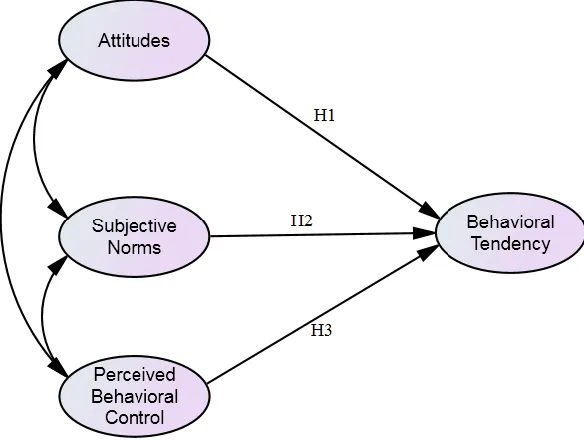
The research framework of the behavioral model of undergraduates participating in aquatic sports is constructed based on the research objectives and literature related to the theory of planned behavior. The research framework is shown in Figure 1.
Figure 1. The Diagram of the Research Framework:
Attitudes, Subjective Norms, Perceived Behavioral Control, Behavioral Tendency
Research Hypotheses
Hypothesis 1: Attitudes have a significant influence on behavioral intentions. Hypothesis 2: Subjective norms have a significant influence on behavioral tendency.
Hypothesis 3: Perceived behavioral control has a significant influence on behavioral tendency.
Research Subjects
Research Tools
Design of the Scale
The scale of this study is a modification of the scale of the behavioral tendency of aquatic sport tourists of Green Island, designed by Hsu, Pan and Huang (2011). The scale includes four dimensions: attitudes, subjective norms, perceived behavioral control, and behavioral tendency. It has a total of 18 items.
Scoring of the Scale
The scale of this study is scored based on the 7-point Likert scale. Ranging from seven to one point, the answers range from strongly agree, agree, mildly agree, neutral, mildly disagree, disagree to strongly disagree, respectively.
RESEARCH RESULTS
Characteristics of the Samples
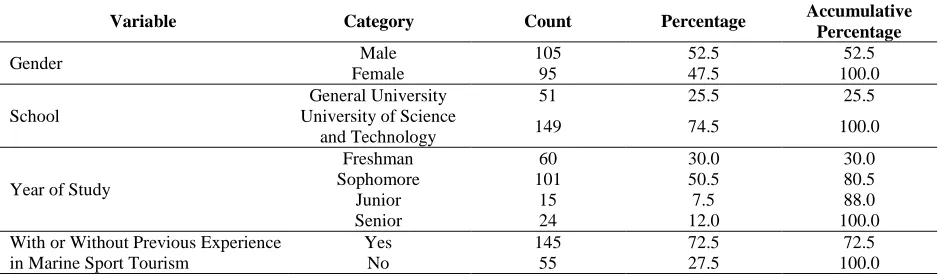
This study uses descriptive statistics to analyze the information distribution of the samples (see Table 1). In terms of gender, there were 105 males, accounting for 52.5% of the 200 valid samples, and 95 females, accounting for 47.5%. It shows that most of the undergraduates participating in aquatic sports are males. With regard to the types of schools they attend, most of them are from universities of science and technology, accounting for 74.5% of the valid samples. General universities follow it with 25.5% of the valid samples. As for the year of study, most of them are sophomores, accounting for 50.5% of the valid samples. It is followed by freshmen, accounting for 30.0%. The fewest are juniors, accounting for 7.5%. It shows that most of the undergraduates participating in aquatic sports are sophomores. In terms of “with or without previous experience in aquatic sports,” most of them have previous experience, accounting for 72.5% of the valid examples. Those without previous experience accounting for 27.5%, follow it. It shows that most of the undergraduates have experience in marine sport tourism.
Table 1. Characteristics of the Samples
Variable Category Count Percentage Accumulative Percentage
Gender Male 105 52.5 52.5
Female 95 47.5 100.0
School
General University 51 25.5 25.5
University of Science
and Technology 149 74.5 100.0
Year of Study
Freshman 60 30.0 30.0
Sophomore 101 50.5 80.5
Junior 15 7.5 88.0
Senior 24 12.0 100.0
With or Without Previous Experience in Marine Sport Tourism
Yes 145 72.5 72.5
No 55 27.5 100.0
Measurement and Analysis of the Structural Modeling
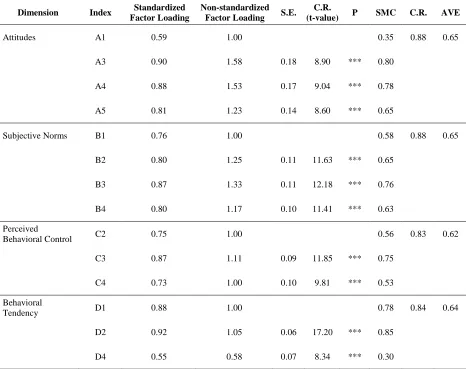
This study first analyzes the information via the structural equation modeling. It used standardized coefficient and MI value as the basis for deleting variable parameters. Items such as A2, A6, C1 and D3 were deleted, while the rest were kept (Chen, 2007).
Verifying the Convergent Validity
range between 0.62 and 0.65 (see Table 2). All the values meet the standards suggested by Hair, Anderson, Tatham and Black (1998), showing that this scale has convergent validity.
Table 2. Analysis of the Convergent Validity of the Theory of Planned Behavior
Dimension Index Standardized Factor Loading
Non-standardized Factor Loading S.E.
C.R.
(t-value) P SMC C.R. AVE
Attitudes A1 0.59 1.00 0.35 0.88 0.65
A3 0.90 1.58 0.18 8.90 *** 0.80
A4 0.88 1.53 0.17 9.04 *** 0.78
A5 0.81 1.23 0.14 8.60 *** 0.65
Subjective Norms B1 0.76 1.00 0.58 0.88 0.65
B2 0.80 1.25 0.11 11.63 *** 0.65
B3 0.87 1.33 0.11 12.18 *** 0.76
B4 0.80 1.17 0.10 11.41 *** 0.63
Perceived
Behavioral Control C2 0.75 1.00 0.56 0.83 0.62
C3 0.87 1.11 0.09 11.85 *** 0.75
C4 0.73 1.00 0.10 9.81 *** 0.53
Behavioral
Tendency D1 0.88 1.00 0.78 0.84 0.64
D2 0.92 1.05 0.06 17.20 *** 0.85
D4 0.55 0.58 0.07 8.34 *** 0.30
Verifying the Discriminant Validity
Table 3. Bootstrapped 95% Confidence Intervals of Correlation Coefficients of the Theory of Planned Behavior
Parameter Estimates
Bias-corrected Percentile method Lower
Bound
Upper Bound
Lower Bound
Upper Bound
Attitudes <--> Subjective Norms 0.50 0.31 0.68 0.29 0.66
Attitudes
<--> Perceived
Behavioral Control 0.48 0.30 0.61 0.30 0.61
Attitudes
<--> Behavioral
Intentions 0.48 0.31 0.64 0.31 0.65
Subjective Norms
<--> Perceived
Behavioral Control 0.75 0.65 0.84 0.64 0.84
Subjective Norms <--> Behavioral
Intentions 0.68 0.49 0.81 0.50 0.81
Perceived
Behavioral Control <-->
Behavioral
Intentions 077 0.61 0.87 0.62 0.87
Overall Analysis
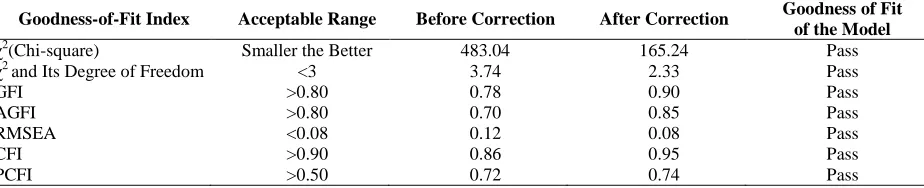
For the overall analysis, this study uses seven indices: χ2 test, χ2 and its degree of freedom ratio,
goodness-of-fit index (GFI), adjusted goodness-goodness-of-fit index (AGFI), root mean square error of approximation (RMSEA), comparative fit index (CFI) and parsimonious comparative fit index (PCFI), to verify the goodness of fit between the samples and the hypotheses. The χ2 and its degree of freedom ratio in this study is 2.33, which is smaller than 3. The GFI, AGFI, RMSEA, CFI and PCFI are 0.90, 0.85, 0.08, 0.95 and 0.74, respectively. After correction, all the values of the goodness of fit, as shown in Table 4, fall within the acceptable range (Wu, 2009), showing a considerable level of goodness of fit between the samples and hypotheses, and that the model of this study is acceptable.
Table 4. Analysis of Goodness of Fit of the Model
Goodness-of-Fit Index Acceptable Range Before Correction After Correction Goodness of Fit of the Model
χ2
(Chi-square) Smaller the Better 483.04 165.24 Pass
χ2
and Its Degree of Freedom <3 3.74 2.33 Pass
GFI >0.80 0.78 0.90 Pass
AGFI >0.80 0.70 0.85 Pass
RMSEA <0.08 0.12 0.08 Pass
CFI >0.90 0.86 0.95 Pass
Figure 2. Diagram of the Behavioral Model of Undergraduates’ Participation in Aquatic Sports
Table 5. Empirical Results of the Research Hypotheses
Hypothesis Path Relationship Path Value Does the Hypothesis Hold
1 Attitudes → Behavioral Tendency 0.12 No
2 Subjective Norms →Behavioral Tendency 0.19 No
3 Perceived Behavioral Control →Behavioral Tendency 0.58* Yes
It is known from Table 5 that Hypothesis 3 holds, meaning that perceived behavioral control has a significant influence on behavioral tendency. Both Hypotheses 1 and 2 do not hold, meaning that undergraduates’ behavior of engaging in aquatic sports is not subject to the influence of attitudes or subjective norms. The results of this study differ from those of Dai, Wang, Kao and Lee (2012). A possible explanation is that undergraduates have higher autonomy and are less likely to be influenced by their important others. On the other hand, when seeing their classmates enjoying their engagement in aquatic sports, undergraduates may participate as well, due to peer pressure, regardless of their own positive or negative opinions toward aquatic sports.
CONCLUSIONS AND SUGGESTIONS
Conclusions
This study adopted the theory of planned behavior and used undergraduates as its research subjects to construct behavioral intentions of their participation in aquatic sports. After an empirical analysis, three major conclusions are drawn from this study.
Third, of the three hypotheses in this study, both Hypotheses 1 and 2 do not achieve a level of significance, while Hypothesis 3 holds.
Suggestions
After the empirical analysis of the information, this study proposes several suggestions based on the research results to aquatic sports participants and managers.
For aquatic sports managers
It is known from this study that attitudes and subjective norms do not have a significant influence on undergraduates’ behavioral tendency regarding participation in aquatic sports. In other words, undergraduates may participate in aquatic sports due to invitations from peers or out of curiosity, and they may neglect the dangers of aquatic sports and their own skills in engaging in such sports. As a result, there is usually a frequent occurrence of drowning involving undergraduates and young people during summer vacation. Hence, it is suggested that aquatic sports managers take safety precautions concerning aquatic sports. For instance, there are often swells caused by typhoons along the coast of Kenting in the summertime. Despite the effort of the management of the Kenting National Park to put up red flags along the beach to warn tourists not to go into the sea, some still ignore or do not understand the warning. As a result, several accidents happen every year.
In this regard, the management of the Kenting National Park set up a new regulation, based on which red flags will be put up to prohibit tourists from going to the sea whenever waves reach one meter in height. Persons ignoring the warning will be immediately subject to a penalty of NTD 3,000. This measure is taken to solve the problem that many tourists ignore the warning of red flags due to the fact there used to be only exhortations without penalties. With the regulation and penalty clause, it is expected that accidents can be prevented. It is suggested that other aquatic sports managers can follow suit and set up related regulations to actively protect the safety of tourists.
Moreover, many large music festivals nowadays are held on beaches, and the festive atmosphere of these activities attracts many energetic undergraduates to participate. However, some of these activities take place in areas adjacent to dangerous waters. For instance, the estuary of the Daku River in Guanyin Township is categorized as one of the top ten dangerous waters in Taoyuan County. No aquatic activities are allowed here according to the Statute for the Development of Tourism, with fines ranging from NTD 5,000 to 25,000. Even so, the Taoyuan Coastal Rock n’ Roll Festival was still held here. Although the area used to be a lido, there are undercurrents and hidden whirlpools; victims are prone to be dragged to the open sea where they may drown. Therefore, it is suggested that the water management authority consider the approval of related activities based on the suitability of the water areas, in order to protect the safety of those involved.
For undergraduates participating in aquatic sports
Suggestions for future research
As mentioned above, most of the previous studies on aquatic sports focus on a single aquatic sport or area. This study uses a questionnaire to more extensively explore undergraduates’ behavioral intentions regarding their participation in aquatic sports. Given the fact that most participants in aquatic sports are young people, studies on undergraduates’ behavioral intentions regarding participation in aquatic sports can serve as reference for future research and contribute to related theories. Furthermore, while the rise in venues for aquatic sports in recent years provides people in Taiwan with a different kind of choice of leisure activities, accidents related to aquatic sports have increased as well. Therefore, this study makes practical contributions by providing suggestions to aquatic sports managers based on the research results.
Given that there are sport, leisure and tourism-based aquatic activities, it is suggested that further studies be conducted on tourism-based aquatic activities. The rich island culture of Taiwan is suitable for researching aquatic tourism. Involved areas such as ecology, landscaping, industry and humanities, are all noteworthy issues. Through the exploration of these issues, studies on aquatic sports will become even sounder, with solid results.
EPILOGUE
As an island located in the subtropical region, Taiwan is surrounded by seas and has numerous lakes, rivers and reservoirs, which make it rich in aquatic sports resources. It is a pity that due to the traditional perception of aquatic sports as dangerous activities, the promotion of such sports is not thriving as much as in other countries. In fact, Taiwan has all the conditions it needs to develop aquatic sports, and relevant governmental agencies in recent years have also been vigorously promoting aquatic sports. Through participation in aquatic sports, the public can enjoy the beauty of nature and immerse themselves in the relaxing atmosphere of aquatic environments. Therefore, these sports are particularly appealing to undergraduates and other young people. This study used undergraduates as the research subjects and adopted the theory of planned behavior to construct the research model. It also used the research results to provide suggestions to aquatic sports managers and undergraduates participating in aquatic sports, as well as to future researchers.
AUTHOR INFORMATION
Cheng-Lung Wu; Associate Professor of Marine Recreation; Ed.D. in Leisure Studies, Oklahoma State University (2004); Head of the Department of Marine Sports & Recreation (2004-2006; 2014-now), National Penghu University of Science & Technology, Taiwan. R. O. C.; Member of the Taiwan Society for Sport Management; Dr. Wu’s research interests include marine recreation, sports tourism, and leisure behavior. He can be reached at: [email protected]
REFERENCES
Ajzen, I. (1985). Action-control: From cognition to behavior. In J. Kuhl & J. Beckman (Eds.), From intentions to actions: A theory of planned behavior (pp. 11-39), Heidelberg: Springer.
Chang, H. (2009). A study of tourist cognized on costal sport tourism attractions, travel experiences, perceived values, and behavioral intension. Leisure and Recreation Industry Management, 2(3), 31-51. Chang, J. (2008). A study of college students’ behavior intention in windsurfing (Unpublished master’s thesis).
National Chung Cheng University, Chiayi County, Taiwan.
Chen, S. (2007). Structural equation modeling -Amos operation. Taipei, Taiwan: Psychological Publishing Co., Ltd. Chen, Y., & Lai, Y. (2009). A study of the motivation of canal waters sports participants in New Taipei city. Journal
of Chiayi Physical Education, Health, and Leisure, 8(1), 47-62.
Dai, Y., Wang, C., Kao, S., & Lee, M. (2012). Behavior study of water recreational activities by theory of planned behavior-A Case in Penghu. Journal of Management Practices and Principles, 90, 33-58.
Hair, J. F., Jr., Anderson, R. E., Tatham, R. L., & Black, W. C. (1998). Multivariate data analysis with readings (5th ed.). Englewood Cliffs, NJ: Prentice Hall.
85-107.
Haung, K. (2008). The investigation of creating the characteristics of the aquatic sports. Sports Research Review, 90, 82-89.
Huang, K., & Huang X. (2006). A study of the development and current trend of water sports. Sports Research Review, 83, 165-172.
Kouthouris, C., & Spontis, A. (2005) Outdoor recreation participation: an application of the theory of planned behavior. The Sport Journal, 8(3). Retrieved from at: thesportjournal.org/article/outdoor-recreation-participation-an-application-of-the-theory-of-planned-behavior.
Kuo, F. (2008). A study of the cognition and benefit of water activities for the participants in Taipei region. Journal of Taiwan Aquatic Sport, 1, 35-50.
Kwan, M. Y. W., Bray, S. R., & Martin Ginis, K. A. (2009). Predicting physical activity of first-year university students: An application of the theory of planned behavior. Journal of American College Health, 58, 45-52. Lee, H. (2009). A study of the participants’ motivation and recreational conflicts in Kengting water sports
(Unpublished master’s thesis). National Pingtung Education College, Pingtung, Taiwan.
Lu, X. (2006). A study of the current development of adult water activities in Kaohsiung (Unpublished master’s thesis). National Kaohsiung Normal University, Kaohsiung, Taiwan.
Sport Administration, Ministry of Education (MOE) (2012, July 4th). Sport Administration grant to promote the implementation of the school swimming and water sports, retrieved from
http://edu.law.moe.gov.tw/LawContentDetails.aspx?id=FL046158&KeyWordHL=&StyleType=1 Su, W., & Chiu, Z. (2005). A study of the development of recreational water sports activities in Taiwan. Journal of
College Physical Education, 79, 104-110.
Wu, C. (2003). An Investigation of Recreational Conflicts among Participants in Coastal Recreational Activities. Sports & Exercise Research, 5(2), 51-63.
Wu, L. (2010). A study of tourist behaviors in Kengting water sports (Unpublished master’s thesis). Ta Jen University of Science and Technology, Pingtung, Taiwan.
Wu, M. (2009). Structural equation modeling – The operation and application of AMOS. Taipei, Taiwan, Wunan Publishing Company.